
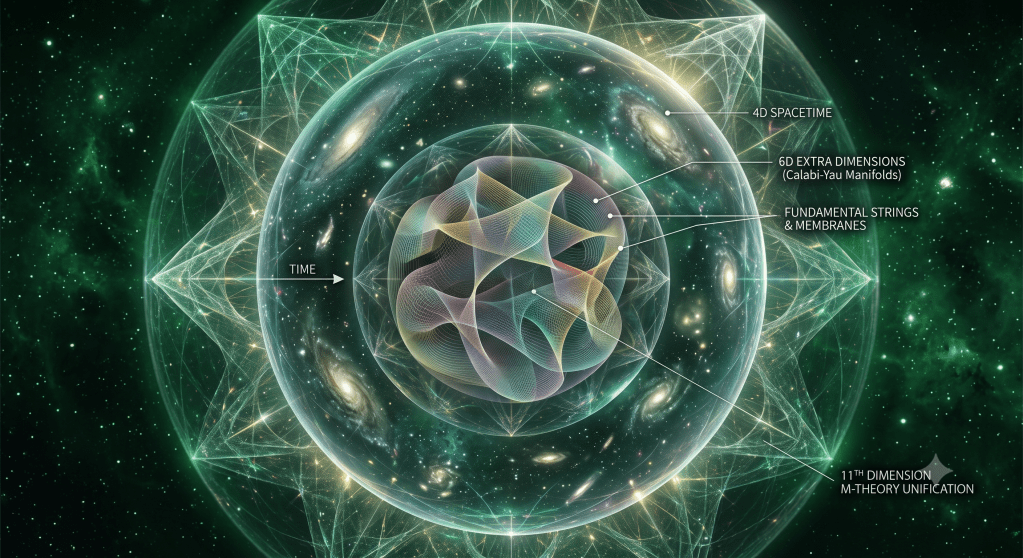
Presented by Gemini
Audio teaser: Does God Collapse the Quantum Wave function
Abstract
This report presents a rigorous theological, metaphysical, and cosmological analysis of the absolute divine attributes of Omniscience (Al-ʿIlm) and Omnipotence (Al-Qadir) in Islamic scholastic theology (Kalām), reframed through the paradigm of modern quantum mechanics. Historically, the advent of Newtonian physics fostered a rigid, deterministic, and mechanistic worldview that relegated divine agency to a passive, deistic origin, presenting a severe challenge to classical monotheistic theology. This analysis argues that incorporating quantum mechanics into the conceptualization of these divine attributes is not merely an optional intellectual exercise but a theological and philosophical necessity dictated by the empirical realities of modern physics and cosmology. By conducting a systematic exegetical analysis of Surah Saba (34:1-3), Surah Al-An’am (6:59), and Surah Al-Hadid (57:1-6), alongside parallel scriptural evidences, this report demonstrates that the Quranic depiction of reality—characterized by absolute information conservation, the discretization of physical states, non-local correlations, and the continuous renewal of creation (tajdīd al-khalq)—directly supports and finds its logical culmination in quantum field theory and occasionalist metaphysics. This synthesis bridges classical Ash’arite theology, famously championed by Abū Ḥāmid al-Ghazālī, with modern physics, presenting a unified ontological model wherein natural laws are understood as the persistent, mathematical “habits” of the Divine Will (sunnat Allāh), and the collapse of the quantum wavefunction represents the immediate, volitional exercise of divine sovereignty.
Ontological Mapping of Al-ʿIlm and Al-Qudrah in Islamic Theology
In Islamic metaphysics, the absolute unity of God (Tawḥīd) is inextricably bound to the perfection and operational immediacy of His essential attributes, foremost among which are Omniscience (Al-ʿIlm) and Omnipotence (Al-Qudrah). Classical theologians of the Ash’arite and Maturidite schools defined these attributes not as passive, static qualities of the divine essence, but as active, eternal, and non-contingent realities through which the cosmos is brought into being, ordered, and sustained frame-by-frame. Al-ʿIlm denotes the absolute, exhaustive, and immediate knowledge of God, encompassing all necessary, possible, and impossible states of affairs, spanning from the macro-cosmological structures of the universe down to the micro-physical transitions of subatomic states. Al-Qudrah represents the infinite divine capacity to actualize or annihilate any contingent state of affairs, completely unconstrained by secondary efficient causes, intrinsic material properties, or physical limitations.
To understand the operational scope of these attributes, Islamic theology makes a fundamental distinction between the realm of sensory experience (ʿālam al-shahādah) and the unseen realm (ʿālam al-ghayb). As outlined by classical exegetes, the unseen is categorized into two distinct dimensions:
- Relative Unseen (Al-Ghayb al-Nisbī): This dimension comprises phenomena that are hidden from certain observers due to spatial, temporal, or situational limitations, but are accessible to others through physical proximity or scientific instruments. A standard classical illustration is a lecturer speaking in a closed room, whose words are known to the students inside but remain unseen and unheard by those outside. In modern terms, the interior of a black hole, the genetic sequence of an unfertilized egg, or the molecular structure of a distant star represent relative unseen phenomena that human technology can progressively uncover.
- Absolute Unseen (Al-Ghayb al-Mutlaq): This dimension encompasses ultimate metaphysical realities, absolute future events, and the fundamental parameters of existence that remain entirely inaccessible to unassisted human intellect or empirical measurement. This absolute category is governed by the five keys of the unseen (mafātīḥ al-ghayb), which include the exact timing of the Last Hour, the precise patterns of rain, the comprehensive physical and spiritual destiny of the fetus in the womb, the specific worldly earnings of a soul tomorrow, and the exact coordinate of an individual’s death. These keys are known to none but Allah, representing a sovereign epistemic domain that cannot be penetrated by human genius or technology.
The preservation and execution of Al-ʿIlm and Al-Qudrah are cosmologically registered in the Lauḥ al-Maḥfūẓ (the Preserved Tablet), which classical theology defines as the indestructible, transcendent, and complete informational blueprint of the entire cosmos. Every physical transition, from the creation of the universe to the final eschatological events, is inscribed within this perfect record.
To clarify the operational mechanics of this divine administration, the Quran draws an essential distinction between Khalq (Creation) and Amr (Command), stating in Surah Al-A’raf: “Unquestionably, His is the creation and the command” (Quran 7:54). In a modern conceptual framework, Khalq represents the physical substrate, the material particles, and the hardware of the cosmos, whereas Amr denotes the governing codes, the mathematical laws, and the non-material algorithms that dictate how Khalq behaves and interacts. Through Amr, the divine command continuously descends through the layers of the cosmos, ensuring that every micro-physical event conforms to the pre-ordained knowledge of the Creator, as declared in Surah At-Talaq: “It is Allah who has created seven heavens… His command descends among them so that you may know that Allah is over all things competent and that Allah has encompassed all things in knowledge” (Quran 65:12).
Exegetical Analysis of the Quranic Anchors
To establish a solid theological-scientific synthesis, we must analyze the foundational Quranic passages that detail the scale, mechanism, and precision of divine knowledge and power.
                    ┌──────────────────────────────────────┐
                    │        THE OMNISCIENT ENGINE         │
                    │   (Information Preservation & Scale)  │
                    └──────────────────┬───────────────────┘
                                       │
            ┌──────────────────────────┼──────────────────────────┐
            ▼                          ▼                          ▼
┌───────────────────────┐  ┌───────────────────────┐  ┌───────────────────────┐
│  SURAH AL-AN'AM 6:59  │  │   SURAH SABA 34:1-3   │  │  SURAH AL-HADID 57:1-6│
├───────────────────────┤  ├───────────────────────┤  ├───────────────────────┤
│ • Mafātīḥ al-Ghayb    │  │ • Mithqālu Dharratin  │  │ • Ontological Quadrad │
│ • falling leaf vector │  │ • Smaller / Greater   │  │ • Wave-Particle Dual  │
│ • "Moist or Dry" code │  │ • Subatomic precision │  │ • Spatial Co-Presence │
└───────────────────────┘  └───────────────────────┘  └───────────────────────┘
Surah Al-An’am 6:59: The Epistemic Keys and the Information-Theoretic Register
Surah Al-An’am states:
“And with Him are the keys of the unseen; none knows them except Him. And He knows what is on the land and in the sea. Not a leaf falls but that He knows it. And no grain is there within the darknesses of the earth and no moist or dry thing but that it is written in a clear record.”
Classical exegetes, including Al-Tabari and Ibn Kathir, emphasize that this passage provides the most comprehensive declaration of divine omniscience in the scriptural corpus, asserting that God’s knowledge is both macroscopic and minutely detailed. The “keys of the unseen” (mafātīḥ al-ghayb) represent the hidden causal mechanisms of the universe.
The verse shifts from abstract metaphysical categories to specific physical examples: a falling leaf, a grain hidden in the deep darkness of the earth, and the categorization of “moist or dry”. The choice of a falling leaf is highly significant. A falling leaf is a classic example of a complex, chaotic thermodynamic system. Its trajectory is influenced by countless turbulent air currents, temperature fluctuations, and molecular collisions, making it practically unpredictable to human observers. Yet, the text asserts that this event is fully known, registered, and ordered by the Divine Mind.
From an information-theoretic perspective, the phrase “no moist or dry thing but that it is written in a clear record” (Kitābin-Mubīn) represents a fundamental physical accounting. “Moist” and “dry” function as basic physical polarities—analogous to binary states (0 and 1) in computational physics. The verse asserts that every physical state, transition, and configuration of matter and energy is preserved in an indestructible informational medium. Divine knowledge is not merely a passive awareness; it is an active, structural register that underlies the physical existence of every state in the cosmos.
Surah Saba 34:1-3: Subatomic Precision and the Cosmological Scale
In Surah Saba, the text addresses the skeptics who deny the possibility of physical resurrection and the arrival of the Last Hour:
“But those who disbelieve say, ‘The Hour will not come to us.’ Say, ‘Yes, by my Lord, it will surely come to you. [Allah is] the Knower of the unseen.’ Not absent from Him is an atom’s weight (mithqālu dharratin) within the heavens or within the earth or [what is] smaller than that or greater, except that it is in a clear register.”
The historical context of this revelation centers on the pagan Meccans’ rejection of the bodily resurrection, arguing that once human bodies disintegrate into dust and scatter across the earth, their reassembly is physically impossible. The Quranic response is a direct appeal to the absolute precision of divine omniscience: because God knows the exact position, identity, and state of every particle, resurrection presents no physical or logical difficulty for Him.
The key linguistic term in this verse is dharratin (often translated in modern times as “atom’s weight”). In classical Arabic, dharrah referred to a tiny ant or a speck of dust—the smallest conceivable unit of matter visible to the pre-modern human eye. However, the text adds a crucial modifier: “or [what is] smaller than that (aṣgharu min dhālik) or greater”. This phrase indicates that physical matter is not infinitely continuous, nor does it terminate at the scale of the dharrah. Instead, it explicitly posits the existence of subatomic structures.
Modern physics has confirmed that the atom is not indivisible; it is composed of subatomic particles (protons, neutrons, and electrons), which are further comprised of quarks and leptons, governed by quantum field interactions. The Quranic assertion that nothing “smaller than that” escapes His knowledge establishes that divine omniscience penetrates the fundamental quantum scale. This is reinforced by a highly parallel passage in Surah Yunus: “And not absent from your Lord is any part of an atom’s weight within the earth or within the heaven or anything smaller than that or greater but that it is in a clear register” (Quran 10:61). It implies that the probabilistic behavior of subatomic particles, which appears random to human observers, is fully registered and ordered within the Divine Register.
Surah Al-Hadid 57:1-6: Transcendence, Immanence, and the Spatiotemporal Coordinate
Surah Al-Hadid, a Medinan chapter belonging to the Musabbiḥāt (chapters beginning with the glorification of Allah), provides an ontological map of divine sovereignty:
“Whatever is in the heavens and earth exalts Allah, and He is the Exalted in Might, the Wise. His is the dominion of the heavens and earth. He gives life and causes death, and He is over all things competent. He is the First and the Last, the Outward and the Inward, and He is, of all things, Knowing. It is He who created the heavens and earth in six days and then established Himself above the Throne. He knows what penetrates into the earth and what emerges from it and what descends from the heaven and what ascends therein; and He is with you wherever you are. And Allah is Seeing of what you do. His is the dominion of the heavens and the earth. And to Allah are returned [all] matters. He causes the night to enter the day and causes the day to enter the night, and He is Knowing of that within the breasts.”
This passage balances divine transcendence and immanence. Verse 3 contains four of the divine names:
- Al-Awwal (The First): Prior to any temporal coordinate (t=0), existing uncaused.
- Al-Ākhir (The Last): Persisting beyond the cessation of the physical spacetime continuum.
- Az-Ẓāhir (The Outward/Manifest): Evident through His handiwork and the macroscopic physical structures of the observable universe.
- Al-Bāṭin (The Inward/Hidden): Completely transcendent, inaccessible to sensory perception, representing the underlying quantum vacuum and metaphysical substrate of reality.
These four names form an ontological quadrangle that frames all created existence, indicating that God is the origin, end, external boundary, and internal essence of all things.
Verse 4 maps the physical vectors of divine omniscience, stating that He knows “what penetrates into the earth and what emerges from it and what descends from the heaven and what ascends therein”. This describes a continuous, dynamic exchange of matter, radiation, and information across the boundaries of the cosmos.
Most importantly, the verse declares: “and He is with you wherever you are” (wa huwa ma’akum ayna mā kuntum). This spatial and ontological presence is not a physical containment within spacetime, but an active, sustaining immanence. It asserts that the Creator is immediately present at every spatial coordinate (x,y,z) and temporal instant (t), observing and sustaining the existence of every physical system.
Quantum Mechanics as a Theological and Cosmological Necessity
A major challenge for classical monotheistic theology emerged from classical Newtonian physics, which depicted the cosmos as a deterministic “clockwork” machine. In a Newtonian universe, physical systems are governed by strict classical determinism; if the initial position and momentum of every particle are known, every future event is rigidly predetermined by mechanical laws. Under this framework, the universe operates as a closed, self-sustaining causal loop, leaving no logical room for divine intervention, miracles, or genuine human free will. This deterministic model eventually led to deism, portraying God as a passive creator who set the universe in motion and then withdrew from its daily administration.
To counter this deterministic challenge, incorporating quantum mechanics is not merely an optional academic exercise, but a cosmological necessity for a coherent contemporary defense of divine action. Quantum mechanics introduces a fundamental, irreducible indeterminacy at the micro-physical level, dismantling the clockwork model and providing a modern scientific vocabulary that aligns with classical Islamic occasionalism.
The Indeterminacy Principle and Wavefunction Collapse
In the subatomic realm, physical systems do not possess definite, classical properties prior to measurement. Instead, they exist in a state of coherent superposition, mathematically described by a wavefunction (Ψ) that encompasses all potential outcomes. According to Heisenberg’s uncertainty principle:
Δx⋅Δp≥2ℏ
where Δx represents the uncertainty in position, Δp represents the uncertainty in momentum, and ℏ is the reduced Planck constant. This relation shows that nature is fundamentally open and non-deterministic at its core.
The transition from a probabilistic superposition to a single, concrete classical reality occurs during wavefunction collapse. The standard Copenhagen interpretation of quantum mechanics cannot identify a physical, secondary causal mechanism that forces the wavefunction to collapse into a specific state; it can only calculate the statistical probability of the outcome.
This indeterminacy at the core of physics represents what contemporary theologians call the “causal joint” or the physical “looseness at the joints” where divine agency operates. Because physical laws only dictate statistical probabilities, the actualization of a specific event does not violate any empirical law of physics. Thus, quantum indeterminacy provides an elegant framework for Ghazalian occasionalism: the collapse of the wavefunction is the physical manifestation of the Divine Will (Al-Qudrah) choosing a specific state of reality at every micro-instant.
Non-Locality, Quantum Entanglement, and the Demise of Secondary Causality
Further empirical evidence against classical secondary causality is found in the quantum phenomena of entanglement and tunneling.
Quantum Entanglement and Non-Locality
In classical physics, all physical influences are constrained by “locality”—meaning they must propagate through space at a speed limited by the velocity of light (c). However, quantum entanglement occurs when two or more particles become correlated in such a way that the measurement of one instantly determines the state of the other, regardless of the distance separating them. This correlation operates instantaneously across space without any physical signal traveling between the particles, violating classical locality.
This non-locality demonstrates that physical connections are not inherent in material objects themselves. Instead, they must be mediated and coordinated externally by a transcendent, non-local substrate that encompasses all spatial coordinates simultaneously—conforming directly to the omnipresence and omnipotence of Allah.
┌────────────────────────────────────────────────────────────────────────┐│ MODELS OF PHYSICAL CAUSALITY │├────────────────────────────────────────────────────────────────────────┤│ ││ 1. CLASSICAL MECHANICS (Newtonian Determinism) ││ [State A] ──────────► (Inherent Physical Law) ──────────► [State B]││ ││ 2. GHAZALIAN OCCASIONALISM (Direct Divine Volition) ││ [State A] ──────────► (Immediate Divine Action) ────────► [State B]││ ││ 3. QUANTUM FIELD THEORY (Probabilistic Superposition) ││ [Superposition] ────► (Wavefunction Collapse) ──────────► [State B]││ (Locus of Al-Qudrah) │└────────────────────────────────────────────────────────────────────────┘
Quantum Tunneling
In classical mechanics, a particle cannot cross a potential energy barrier if its kinetic energy is less than the potential energy of the barrier. In quantum mechanics, however, a particle can “tunnel” through this barrier and appear on the other side. This process is non-deterministic and non-sequential; the particle does not physically travel through the barrier in a continuous trajectory; it simply ceases to exist on one side and is recreated on the other.
Quantum tunneling demonstrates that classical, deterministic cause-and-effect chains break down at a fundamental level, illustrating that the transition of physical states is not governed by rigid material necessity, but by a flexible, probabilistic order maintained by the Divine Will.
The Metaphysics of Continuous Recreation (Tajdīd al-Khalq)
The Ash’arite school of Kalām proposed that the cosmos is not a static, self-sustaining machine that persists continuously through time. Instead, they formulated the doctrine of tajdīd al-khalq (continuous recreation), which posits that the universe consists of indivisible atoms (jawāhir) and their temporary qualities (a’rāḍ). Crucially, they asserted that these qualities cannot endure for two successive moments of time. Consequently, at every single instant, the entire universe is destroyed and immediately recreated by a fresh command of God. If God were to cease this continuous recreation for even a single moment, the entire cosmos would instantly cease to exist.
Ash’arite Atomism and the Quantum “Refresh Rate”
This theological framework finds a modern scientific parallel in quantum gravity theories and the digital physics paradigm. In modern cosmology, time and space are not infinitely continuous fluids. According to the Planck scale, there is a fundamental limit to the divisibility of spacetime:
- Planck Length (ℓP):
ℓP=c3ℏG≈1.6×10⁻³⁵ m
- Planck Time (tP):
tP=c5ℏG≈5.4×10−44 s
At this fundamental scale, spacetime is quantized and discrete. This discretization suggests that physical motion is not a smooth, continuous slide, but rather a sequence of discrete transitions from one Planck frame to the next.
This digital metaphor provides a clear illustration of the classical occasionalist doctrine and the Quranic mechanism of divine maintenance. This mechanism is directly alluded to in Surah Fatir:
“Indeed, Allah holds the heavens and the earth, lest they cease (tazūlā). And if they should should begin to fail, no one could hold them after Him.” (Quran 35:41)
The “holding” (imsāk) is the continuous projection of the “next frame” of existence at every Planck time interval (tP), demonstrating the absolute dependency of the cosmos on the primary, active causation of Allah.
The Primordial “Water” as the Canvas of Time
The cosmological origin of this continuous recreation is rooted in the primordial state described in the Quran:
“And He it is Who created the heavens and the earth in six periods—and His Throne was upon the water (wa kāna ‘arshuhu ‘ala al-mā’)…” (Quran 11:7)
As detailed in classical exegesis and modern metaphysical reflections, this primordial “water” is not wet, physical H₂O, but rather an expression of absolute, unmanifested potentiality and temporal flow prior to the formation of physical matter and ordered spacetime. It represents “Time” itself in its raw, ungoverned state—a chaotic, luminous medium over which the Divine Throne (ʿArsh), the symbol of absolute sovereignty and governance, was established.
Through the divine command, the “Unseen Pen” sketched the initial trajectory upon this temporal deep, initiating the cosmic expansion and bringing forth order from chaos. The establishment of the Throne over this primordial potentiality demonstrates that time, space, and physical matter are entirely dependent on the continuous, structuring volition of the Creator, who regulates the cosmic flow from its silent origin to its infinite deltas as a single, present reality.
Addressing Modern Secular and Bioethical Challenges
To demonstrate the comprehensiveness of these Quranic attributes, this analysis must address contemporary secular challenges that attempt to pit empirical progress against scriptural authority.
The “Knowledge of the Womb” Paradox and Genetic Determinism
A prominent modern challenge arises from contemporary biotechnology, where genetic testing, in vitro fertilization (IVF), and pre-implantation genetic testing (PGT) allow clinical practitioners to identify structural abnormalities and determine embryonic sex prior to implantation. Critics have asserted that such empirical capability refutes the exclusivity of the divine keys of the unseen, specifically the exclusive knowledge of “what is in the wombs” as stated in Surah Luqman (31:34).
However, contemporary Islamic scholars and bioethicists resolve this apparent paradox by distinguishing between basic, limited physical markers and exhaustive metaphysical knowledge. When an ultrasound or genetic test reveals a physical attribute, it represents a minute, highly contingent vector of physical observation mediated by secondary causes that God has established. In contrast, the complete divine knowledge of the womb is absolute and unconstrained, encompassing the child’s ultimate destiny in Paradise or Hellfire, its lifespan, its precise moral trajectory, its psychological configuration, and its continuous sustenance throughout its earthly journey.
The Epistemology of Scientific Inquiry under Occasionalism
A historical critique, sometimes leveled against Ghazalian occasionalism, suggests that denying secondary causality undermines scientific inquiry. The argument asserts that if there are no necessary physical connections between causes and effects, then the universe is arbitrary, making scientific exploration futile.
However, this critique misunderstands the epistemological basis of occasionalism. Far from killing scientific curiosity, occasionalism reframes the “laws of nature” as the stable and reliable habits of the Divine Will (sunnat Allāh or ʿādah). These habits are not chaotic or arbitrary; they are characterized by mathematical precision, order, and consistency, precisely because they reflect the perfect wisdom of the Creator.
By studying these mathematical regularities under the framework of sunnat Allāh, scientists are not merely mapping cold, mechanical chains. Instead, they are engaged in a spiritual and empirical quest to understand the elegant habits of the Divine Mind. Occasionalism provides a solid metaphysical foundation for science, recognizing that natural laws are contingent, yet highly predictable, and thus fully studyable.
To synthesize these complex concepts, the following table maps classical Islamic theological concepts to their modern scientific equivalents, establishing the conceptual links between exegesis and physics:
| Classical Theological Concept (Kalām) | Quranic Exegetical Reference | Quantum Mechanical / Cosmological Correlate | Metaphysical Implication for Divine Attributes |
|---|---|---|---|
| Tajdīd al-Khalq (Continuous Recreation) | “Indeed, Allah holds the heavens and the earth, lest they cease.” (35:41) | Planck-Scale Discretization & Simulation Hypothesis (Frame-by-frame rendering at tP≈5.4×10−44 s) | Demonstrates absolute, moment-by-moment dependency of the cosmos on Al-Qayyūm (The Self-Subsisting Sustainer). |
| Al-ʿIlm al-Muḥīṭ (Exhaustive Omniscience) | “Not a leaf falls but that He knows it… nor anything moist or dry but is in a clear record.” (6:59) | Quantum Unitarity & Information Conservation (∑Pi=1) | Confirms that no physical state or cognitive transition is ever lost; all are preserved in the Kitāb Mubīn. |
| Ibṭāl al-Asbāb (Denial of Secondary Causality) | “Your Lord creates and chooses what He wills; not for them was the choice.” (28:68) | Quantum Indeterminacy & Wavefunction Collapse (Transition from superposition to eigenstate) | Identifies the quantum transition as the physical locus of Al-Qudrah (Divine Volition) acting without physical disruption. |
| Az-Ẓāhir wa Al-Bāṭin (The Manifest and the Hidden) | “He is the First and the Last, the Outward and the Inward…” (57:3) | Wave-Particle Duality & Quantum Fields (Observable classical matter vs. unobservable quantum vacuum) | Shows that physical reality is dual-layered, where the unobservable quantum engine drives the visible universe. |
| Nafī al-Jiha (Divine Non-Locality / Transcendence of Space) | “And He is with you wherever you are.” (57:4) | Quantum Non-Locality & Entanglement (Instantaneous correlation across arbitrary distances) | Proves that the coordinating laws of the universe operate beyond classical spatial and temporal constraints. |
| Daqīq al-Kalām (Subatomic Theology) | “Not absent from Him is an atom’s weight… or what is smaller than that or greater…” (34:3) | Subatomic Physics (Quarks, leptons, and quantum fluctuations at the Planck scale) | Affirms that divine omniscience is highly detailed, tracking and ordering the micro-physical foundations of reality. |
Thematic Epilogue
The conceptual journey from classical Islamic theology to the frontiers of quantum mechanics reveals a profound convergence of ancient exegesis and contemporary empirical science. For centuries, the rise of mechanistic, classical determinism threatened the metaphysical foundations of theistic faith, presenting a cold, clockwork universe that left little logical space for an active, living God. This deterministic worldview sought to bind the Creator to His own creation, reducing the divine attributes to passive historical events or a distant prime movement.
The twentieth-century quantum revolution swept away this rigid paradigm. By revealing that the fundamental building blocks of reality are not hard, self-determining billiard balls, but rather complex, probabilistic waves of potentiality, modern physics has restored a sense of dynamic contingency to the natural order. This transition has shown that the universe is not a closed, mechanical loop, but a highly open, flexible structure that is continuously updated and sustained.
As explored in this analysis, the Quranic verses of Surah Saba (34:1-3), Surah Al-An’am (6:59), and Surah Al-Hadid (57:1-6) do not merely provide metaphors of divine authority; they describe a highly detailed, information-theoretic register of reality. The text presents a cosmos where no subatomic fluctuation escapes the divine register, where the continuous refresh of physical states mirrors the continuous recreation of tajdīd al-khalq, and where the absolute preservation of information is maintained in a perfect record.
When a believer contemplates the universe through this theological-scientific synthesis, the natural world transforms from a cold, automated mechanism into a living canvas of Divine Volition. The falling leaf, the radioactive decay of an isotope, the non-local correlation of entangled photons, and the dynamic transitions of subatomic fields are no longer viewed as random, isolated accidents. Instead, they are recognized as the direct, continuous manifestation of the divine command Kun fa-yakūn (“Be, and it is”).
In this unified framework, the laws of physics are understood not as self-existent entities that govern the universe independently of God, but as the stable, reliable, and beautiful habits of the Divine Will (sunnat Allāh), willed with perfect wisdom. This understanding allows the contemporary mind to engage with empirical science not as a source of skepticism, but as a path to deeper theological cognizance—where every equation of quantum field theory and every measurement of cosmological structure becomes a testament to the absolute Omniscience, Omnipotence, and Majesty of Allah.





Leave a comment