
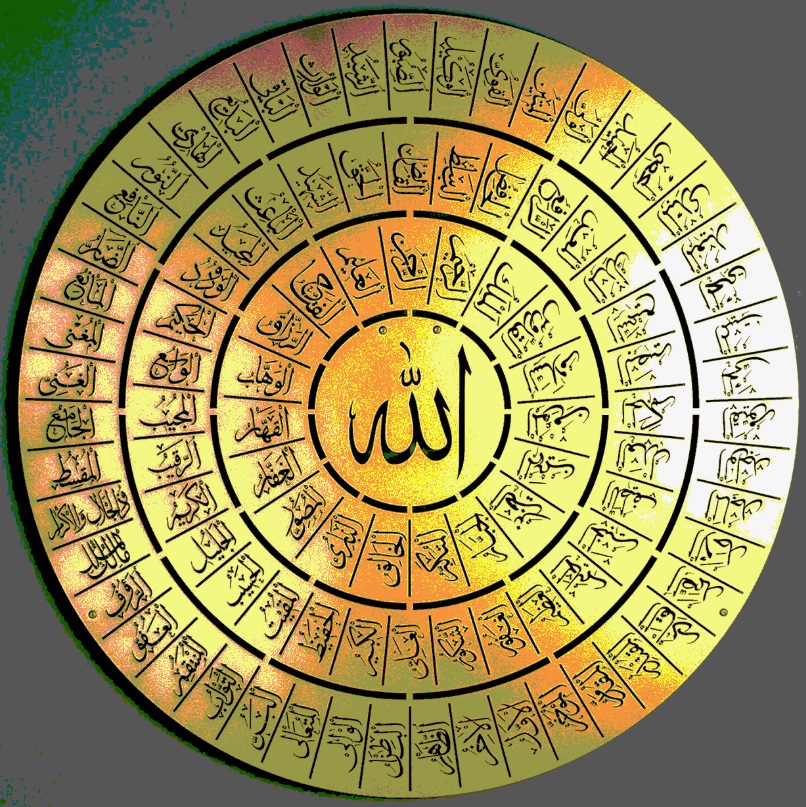
Epigraph
هُوَ اللَّهُ الَّذِي لَا إِلَٰهَ إِلَّا هُوَ الْمَلِكُ الْقُدُّوسُ السَّلَامُ الْمُؤْمِنُ الْمُهَيْمِنُ الْعَزِيزُ الْجَبَّارُ الْمُتَكَبِّرُ ۚ سُبْحَانَ اللَّهِ عَمَّا يُشْرِكُونَ
هُوَ اللَّهُ الْخَالِقُ الْبَارِئُ الْمُصَوِّرُ ۖ لَهُ الْأَسْمَاءُ الْحُسْنَىٰ ۚ يُسَبِّحُ لَهُ مَا فِي السَّمَاوَاتِ وَالْأَرْضِ ۖ وَهُوَ الْعَزِيزُ الْحَكِيمُ
Al Quran 59:23-24
Presented by ChatGPT for Zia H Shah MD
Abstract
The Qur’an presents itself not as a collection of isolated pronouncements but as a kitāb mutashābih mathānī: a Book whose parts resemble, reinforce, balance, and repeatedly illuminate one another. Qur’an 39:23 describes this internal resonance, while 4:82 invites sustained reflection upon the absence of fundamental contradiction within revelation. This principle underlies tafsīr al-Qurʾān bi’l-Qurʾān—interpreting the Qur’an through the Qur’an itself.
The same hermeneutical principle applies to the Most Beautiful Names of Allah. The divine attributes are distinct in meaning but indivisible in their divine Referent. Omnipotence is never blind because Allah is All-Knowing; sovereignty is never tyrannical because He is the Holy, the Just, and the Merciful; mercy is not moral indifference because He is Master of the Day of Judgment; judgment is not cruelty because His mercy encompasses all things. The Names consequently function as mutual safeguards against distorted conceptions of God.
Sūrat al-Fātiḥah provides the foundational grammar of this integrated theology through four primary descriptions: Rabb al-ʿālamīn, al-Raḥmān, al-Raḥīm, and Mālik Yawm al-Dīn. Āyat al-Kursī, Qur’an 2:255, expands that grammar into a majestic synthesis of divine life, self-subsistence, knowledge, sovereignty, permission, preservation, transcendence, and greatness. Qur’an 59:22–24 then offers perhaps the most concentrated procession of the Divine Names, moving from omniscience and mercy to holiness, peace, sovereignty, creative power, and wisdom.
Drawing especially upon Zia H Shah MD’s essays on divine omnipotence and the “Inshallah universe” and compassionate living in the Qur’an, this essay argues that sound theology must culminate in moral transformation. To know al-Raḥmān is to become merciful within human limits; to worship al-ʿAdl is to practice justice; to trust al-Qadīr is to strive without worshipping one’s own means; and to believe in Mālik Yawm al-Dīn is to live responsibly before the final judgment.
1. The Qur’an’s testimony to its own coherence
Qur’an 39:23
ٱللَّهُ نَزَّلَ أَحْسَنَ ٱلْحَدِيثِ كِتَـٰبًا مُّتَشَـٰبِهًا مَّثَانِىَ تَقْشَعِرُّ مِنْهُ جُلُودُ ٱلَّذِينَ يَخْشَوْنَ رَبَّهُمْ ثُمَّ تَلِينُ جُلُودُهُمْ وَقُلُوبُهُمْ إِلَىٰ ذِكْرِ ٱللَّهِ ۚ ذَٰلِكَ هُدَى ٱللَّهِ يَهْدِى بِهِۦ مَن يَشَآءُ ۚ وَمَن يُضْلِلِ ٱللَّهُ فَمَا لَهُۥ مِنْ هَادٍ
A close rendering:
Allah has sent down the most beautiful discourse: a Book whose parts resemble and confirm one another, repeating and pairing its teachings. The skins of those who stand in awe of their Lord shiver at it; then their skins and hearts soften to the remembrance of Allah. That is Allah’s guidance, by which He guides whom He wills. Whoever Allah allows to stray will have no guide.
The crucial expression is كِتَابًا مُّتَشَابِهًا مَّثَانِيَ. Here mutashābih is positive: mutually resembling, consonant, harmonious, and self-confirming. Mathānī suggests repetition, reiteration, and pairing. Classical exegetical explanations include the repetition of fundamental truths and the pairing of promise with warning, mercy with judgment, this life with the Hereafter, and historical narrative with moral application. One passage recalls, qualifies, or completes another. Maʿārif al-Qur’an explicitly explains the verse as meaning that one verse confirms or explains another.
Because several modern translations remain copyrighted, the table quotes their exact rendering of the central coherence phrase; the linked verse provides their complete versions.
| Translation | Rendering of mutashābihan mathānī |
|---|---|
| Saheeh International | “a consistent Book wherein is reiteration” |
| M. A. S. Abdel Haleem | “a Scripture that is consistent and draws comparisons” |
| Abdullah Yusuf Ali | “a Book, consistent with itself, yet repeating its teaching in various aspects” |
| Marmaduke Pickthall | “a Scripture consistent” and internally pairing promise with warning |
| Mufti Taqi Usmani | “a book containing subjects resembling each other, mentioned again and again” |
| Abul Aʿla Maududi | “a self-consistent Book which repeats its contents in manifold forms” |
The verse also describes coherence as an existential experience. Revelation first makes the skin shiver and then softens skin and heart. Fear is not the final religious state. Awe opens the soul; remembrance brings tenderness. Warning and mercy do not cancel each other—they cooperate in spiritual healing.
Qur’an 4:82
أَفَلَا يَتَدَبَّرُونَ ٱلْقُرْءَانَ ۚ وَلَوْ كَانَ مِنْ عِندِ غَيْرِ ٱللَّهِ لَوَجَدُوا۟ فِيهِ ٱخْتِلَـٰفًا كَثِيرًا
Six popular translations render it as follows:
- Saheeh International: “Then do they not reflect upon the Qur’an? If it had been from other than Allah, they would have found within it much contradiction.”
- M. A. S. Abdel Haleem: “Will they not think about this Quran? If it had been from anyone other than God, they would have found much inconsistency in it.”
- Abdullah Yusuf Ali: “Do they not consider the Qur’an with care? Had it been from other than Allah, they would surely have found therein much discrepancy.”
- Marmaduke Pickthall: “Will they not then ponder on the Qur’an? If it had been from other than Allah they would have found therein much incongruity.”
- Mufti Taqi Usmani: “Do they not, then, ponder about the Qur’an? Had it been from someone other than Allah, they would have found much discrepancy.”
- Abul Aʿla Maududi: “Do they not ponder about the Qur’an? Had it been from any other than Allah, they would surely have found much inconsistency.”
The governing verb is يَتَدَبَّرُونَ, from a root suggesting looking toward the end or consequence of something. Tadabbur is more than cursory reading. It means tracing an argument, comparing passages, following themes across contexts, and asking where the discourse leads. The verse therefore does not encourage passive repetition; it issues an invitation to intellectual examination. Qur’an 4:82 and its commentaries connect reflection with the recognition of a discourse free from fundamental conflict.
2. What Qur’anic coherence means
The Qur’an’s coherence operates at several levels.
Lexical and thematic coherence
Repeated words act as semantic bridges. Raḥmah, ḥikmah, ʿilm, qudrah, ʿadl, hudā, and taqwā accumulate meaning across the Book. No single occurrence exhausts a Qur’anic concept.
For example, “Lord of the worlds” in al-Fātiḥah is unfolded through passages describing Allah as the One who creates, proportions, provides, sustains, guides, heals, gives death, and resurrects. Similarly, “Master of the Day of Judgment” is clarified by 82:17–19, where no soul will possess power to rescue another and all command will belong to Allah.
Coherence through complementary perspectives
An apparent tension frequently dissolves when two passages are seen as addressing different levels:
- Human beings choose, yet their capacity to choose exists within divine willing.
- Allah guides, yet people are accountable for refusing guidance.
- Natural means are effective within creation, yet none is metaphysically independent of the Creator.
- Allah forgives, yet persistent injustice remains answerable before Him.
- He is transcendent beyond comparison, yet nearer to the human being than the jugular vein.
These are not necessarily contradictions. They are layered affirmations about divine and creaturely agency.
Structural coherence
Modern scholarship on naẓm—the ordered relationship of verses and sūrahs—has emphasized that Qur’anic units possess thematic architecture rather than being atomized sayings. Mustansir Mir’s study of the Farāhī–Iṣlāḥī tradition is a major modern treatment of this approach. His work surveys thematic and structural coherence in Qur’anic interpretation.
External coherence
The Qur’an also asks readers to compare revelation with three external theaters of signs:
- The horizons: cosmic order, nature, life, and history.
- The human self: consciousness, moral awareness, vulnerability, and longing.
- Moral experience: the consequences of justice, arrogance, compassion, corruption, gratitude, and selfishness.
Qur’an 41:53 promises signs “in the horizons and within themselves.” This does not turn scripture into a modern science textbook. It means that authentic revelation, rightly understood, should not require us to deny rationality, the moral constitution of humanity, or the intelligibility of creation.
3. The ninety-nine Names: plurality without fragmentation
The Qur’an declares that Allah possesses al-asmāʾ al-ḥusnā, the Most Beautiful Names, and commands believers to call upon Him through them (7:180; 17:110; 20:8). The well-known hadith states that Allah has ninety-nine Names and promises Paradise to the person who aḥṣāhā—a word that can encompass enumerating, preserving, understanding, and living by them. Sahih al-Bukhari records this teaching.
Yet the Names must not be imagined as ninety-nine components within God or ninety-nine independent forces. Allah is not assembled from mercy, power, knowledge, and sovereignty. Rather:
The Names are distinct in meaning but one in their divine Referent.
Human thought distinguishes the attributes because finite minds approach the Infinite from different conceptual directions. We experience one effect as provision, another as forgiveness, another as justice, and another as guidance. But the One acting is always Allah.
Islamic theological schools developed different accounts of the relationship between the divine Essence and attributes. Nevertheless, the governing Qur’anic conviction is uncompromising unity: divine knowledge, will, power, wisdom, justice, and mercy do not compete as rival personalities.
This yields a central interpretive rule:
No divine attribute may be interpreted in a manner that negates another divine perfection.
Thus:
- Power cannot be interpreted as ignorant force, because Allah is al-ʿAlīm.
- Will cannot become irrational caprice, because He is al-Ḥakīm.
- Sovereignty cannot become injustice, because He wrongs no one.
- Judgment cannot become cruelty, because He is al-Raḥmān al-Raḥīm.
- Mercy cannot become approval of oppression, because He is Just and Master of Judgment.
- Transcendence cannot mean absence, because He is al-Qayyūm, continuously sustaining creation.
- Nearness cannot imply physical embodiment, because He is al-ʿAliyy, the Most High.
The Names are therefore a system of mutual theological correction.
4. The four foundational attributes of Sūrat al-Fātiḥah
Sūrat al-Fātiḥah is the Qur’an in seed form. It moves from God as He is, to humanity as it should respond, and finally to the path along which the relationship unfolds.
Its four primary descriptions are:
| Expression | Theological horizon | Names it anticipates | Human response |
|---|---|---|---|
| Rabb al-ʿālamīn | Creation, nurture, sustenance, providence and development | Creator, Provider, Sustainer, Guide | Gratitude and stewardship |
| Al-Raḥmān | All-encompassing and initiating mercy | Generous, Loving, Forbearing | Universal compassion |
| Al-Raḥīm | Continuing, intimate and restorative mercy | Forgiving, Pardoning, Accepter of repentance | Hope, repentance and forgiveness |
| Mālik Yawm al-Dīn | Sovereignty, moral consequence and final judgment | King, Just, Reckoner, Witness | Accountability and moral courage |
Rabb al-ʿālamīn: Lord of all worlds
Rabb signifies far more than an owner. It conveys creation, nurturing, sustaining, educating, bringing something progressively toward fulfillment, and governing it with providential care.
The addition of al-ʿālamīn, “all worlds,” universalizes divine Lordship. Allah is not the tribal deity of one people, race, civilization, planet, or historical period. Every level of existence belongs within His providence.
Lordship is consequently dynamic. The God who originates creation does not abandon it after its beginning. This anticipates Āyat al-Kursī’s al-Qayyūm, the One by whom everything subsists, and Qur’an 59’s al-Khāliq, al-Bāriʾ, and al-Muṣawwir.
It also corrects a crude picture of omnipotence. Divine power is not merely the capacity to destroy or overwhelm. The power of the Rabb educates, nourishes, heals, guides, and brings latent possibilities to maturity.
Al-Raḥmān: mercy preceding merit
Al-Raḥmān signifies mercy of an immeasurable and overflowing kind. It includes the gifts that precede human choice: existence, embodiment, consciousness, relationships, natural resources, moral awareness, and access to guidance.
This mercy cannot be reduced to reward for prior virtue. Before a human being can earn anything, he or she has already received life, faculties, time, and a world in which moral action is possible.
Its appearance immediately after Rabb al-ʿālamīn tells us how divine Lordship should be understood. The universe is not ruled by naked domination. Providence is enveloped in mercy.
Al-Raḥīm: mercy accompanying and restoring
The distinction between al-Raḥmān and al-Raḥīm has been expressed in several ways by Muslim exegetes. A useful, though not exclusive, distinction is that al-Raḥmān evokes mercy in its boundless fullness, while al-Raḥīm emphasizes mercy repeatedly reaching, accompanying, forgiving, and restoring its recipients.
Placed together, the Names reject two spiritual illnesses:
- Despair: because divine mercy remains open.
- Presumption: because mercy calls for repentance, gratitude, and transformation.
Mercy is not divine indifference toward cruelty. Genuine mercy must protect victims, restore moral order, and prevent aggressors from possessing the final word.
Mālik Yawm al-Dīn: mercy within moral sovereignty
The sequence of al-Fātiḥah is decisive. The Qur’an does not say only that Allah is Merciful; it says that the Merciful is also Mālik Yawm al-Dīn—Master or Sovereign of the Day of Recompense.
Without mercy, judgment could be imagined as terrifying severity. Without judgment, mercy could be misread as moral permissiveness. Their conjunction produces moral hope:
- No sincere repentance is lost.
- No hidden kindness is forgotten.
- No victim is ultimately abandoned.
- No tyrant possesses permanent impunity.
- No human judgment is final.
The first four attributes thus form a theological arc:
Providence creates and nurtures; mercy surrounds and restores; judgment brings creation to its morally meaningful end.
This is why the next verse naturally declares, “You alone we worship, and You alone we ask for help.” Worship belongs to the One in whom all these perfections are united.
5. Āyat al-Kursī: the crown synthesis of the attributes
The Prophet asked Ubayy ibn Kaʿb which verse was the greatest in Allah’s Book. When Ubayy identified Āyat al-Kursī, the Prophet affirmed his answer. The report appears in Sahih Muslim 810. The description “crown verse” is therefore an apt devotional honorific, while “greatest verse” rests upon the Prophetic report.
A close rendering of Qur’an 2:255 reads:
Allah—there is no deity except Him, the Ever-Living, the Self-Subsisting Sustainer. Neither drowsiness nor sleep overtakes Him. To Him belongs whatever is in the heavens and the earth. Who can intercede with Him except by His permission? He knows what lies before them and behind them, while they encompass nothing of His knowledge except what He wills. His Kursī encompasses the heavens and earth, and preserving them does not burden Him. He is the Most High, the Magnificent. Qur’an 2:255
1. Unity: “There is no deity except Him”
All subsequent attributes belong to one God. The verse does not present life, knowledge, power, and sovereignty as separate metaphysical principles. Tawḥīd is the grammar holding the entire verse together.
2. Al-Ḥayy: the Ever-Living
Created life is received, dependent, changing, and vulnerable. Divine life is neither acquired nor threatened. Allah is not one living being among others; all creaturely life is dependent upon Him.
Divine life also grounds the other attributes. Knowledge belongs perfectly to the One whose life never diminishes; sustaining power belongs to the One who never dies.
3. Al-Qayyūm: the Self-Subsisting Sustainer
Al-Qayyūm conveys both independence and sustaining activity:
- Allah depends upon nothing.
- Everything depends upon Allah.
This explains Rabb al-ʿālamīn. Lordship is continuous ontological support, not merely a creative event in the remote past. Qur’an 35:41 similarly depicts Allah as holding the heavens and earth from passing away.
4. “Neither drowsiness nor sleep overtakes Him”
The verse immediately removes creaturely limitations from the analogy of life. Human attention alternates between vigilance and unconsciousness. Divine knowledge and preservation never lapse.
This negation interprets the positive Names: Allah is living, but not with biological life; sustaining, but not through effort; knowing, but not through sensory acquisition.
5. Universal ownership
“To Him belongs whatever is in the heavens and earth” expands Mālik Yawm al-Dīn into Mālik al-wujūd—the Sovereign of existence itself. His authority on Judgment Day is not newly acquired. The Day of Judgment merely unveils a sovereignty that has always been real.
6. Intercession only by permission
Intercession does not create a rival center of power. Prophets, angels, and righteous servants possess no autonomous claim against Allah. Whatever intercession occurs is itself contained within divine mercy, justice, knowledge, and permission.
7. All-encompassing knowledge
“He knows what lies before them and behind them” removes every temporal and epistemic boundary. Allah knows the manifest and hidden, cause and consequence, public deed and private intention.
This knowledge interprets judgment: the Judge cannot be deceived. It also interprets mercy: Allah knows the wounds, constraints, ignorance, struggle, and sincerity invisible to other human beings.
8. The limits of creaturely knowledge
“They encompass nothing of His knowledge except what He wills” provides a charter for both intellectual humility and scientific inquiry. Human beings genuinely know—but derivatively, partially, and provisionally.
The statement neither glorifies ignorance nor grants omniscience to science. Discovery is possible because creation is intelligible; epistemic humility is necessary because finite observers never stand outside the reality they investigate.
9. The encompassing Kursī
The Kursī has received various interpretations, including the divine footstool, dominion, authority, or an emblem of encompassing knowledge. Whatever interpretation is adopted, the theological point is not that Allah is spatially contained in a cosmic chair. The verse declares that the whole created order is encompassed by His rule, while its concluding Names—al-ʿAliyy al-ʿAẓīm—place Him beyond creaturely limitation.
10. Preservation without weariness
The preservation of the cosmos does not burden Him. Here omnipotence, Lordship, and self-subsistence converge. Divine sustaining is not labor expended against resistant matter.
11. Al-ʿAliyy and al-ʿAẓīm
The verse ends with transcendence and majesty. Allah is near through knowledge, mercy, and sustaining presence, yet remains al-ʿAliyy, beyond spatial confinement, and al-ʿAẓīm, possessing greatness without limit.
Āyat al-Kursī is therefore “crown-like” because nearly every major theological theme radiates from it: unity, life, providence, ownership, knowledge, permission, power, preservation, transcendence, and greatness.
6. Qur’an 59:22–24: a procession of mutually interpreting Names
The closing verses of Sūrat al-Ḥashr provide one of the Qur’an’s richest concentrated descriptions of Allah. The sequence itself is a theology.
The movement of the passage
Verse 22 begins with divine identity, unity, knowledge, and mercy:
He is Allah, other than whom there is no deity: Knower of the unseen and the witnessed. He is al-Raḥmān, al-Raḥīm.
Verse 23 moves into sovereignty, holiness, peace, security, guardianship, might, irresistible authority, and supreme greatness:
He is Allah, other than whom there is no deity: the Sovereign, the Holy, the Source of Peace, the Giver of Security, the Guardian, the Mighty, the Compeller-Restorer, the Possessor of true greatness.
Verse 24 turns toward creative activity:
He is Allah: the Creator, the Originator, the Fashioner. To Him belong the Most Beautiful Names. Everything in the heavens and earth glorifies Him. He is the Mighty, the Wise. Qur’an 59:22–24
Knowledge precedes mercy
The sequence first names Allah as ʿĀlim al-ghayb wa’l-shahādah, Knower of the unseen and visible, and then as al-Raḥmān al-Raḥīm.
His mercy is therefore never uninformed sentiment. He knows completely before He forgives, guides, restrains, or judges. Divine mercy takes account of realities hidden from every human tribunal.
Al-Malik is interpreted by al-Quddūs
Human kingship is corrupted by ignorance, insecurity, greed, and self-interest. The Qur’an immediately purifies divine kingship by naming Allah al-Quddūs, the Absolutely Holy and Pure.
He is King without the defects of kings. His sovereignty is not magnified human monarchy; it is sovereignty purified of need, vanity, partiality, and injustice.
Al-Quddūs is followed by al-Salām
Divine holiness does not signify sterile remoteness. Allah is al-Salām: the Source of peace, wholeness, security, and freedom from defect.
The Sovereign’s ultimate order is directed toward salām, not chaos. Paradise is the Abode of Peace, and the Qur’anic path seeks reconciliation without surrendering justice.
Al-Muʾmin and al-Muhaymin
Al-Muʾmin can signify the Giver of security, the Confirmer of truth, and the One faithful to His promises. Al-Muhaymin signifies the Guardian, Overseer, Witness, and Preserver.
A remarkable Qur’anic correspondence appears in 5:48, where the Qur’an itself is called muhayminan over previous scripture—a guardian, witness, and criterion. The attribute of the Revealer becomes, at a created level, a function of the revelation.
Al-ʿAzīz, al-Jabbār, al-Mutakabbir
These Names express majesty and irresistible authority:
- Al-ʿAzīz: the invincibly Mighty and Honorable.
- Al-Jabbār: the One whose determination cannot be frustrated, and, in another shade of the root, the One who restores what is broken.
- Al-Mutakabbir: the rightful Possessor of all greatness.
Read alone, such terms might be misunderstood as force. But they do not stand alone. The Mighty is already identified as the Merciful, Holy, Source of Peace, and Giver of Security. Power is surrounded by moral and metaphysical perfection.
Al-Khāliq, al-Bāriʾ, al-Muṣawwir
The creative Names suggest three distinguishable aspects:
- Al-Khāliq: the Creator who determines and brings into existence.
- Al-Bāriʾ: the Originator who produces creatures in ordered differentiation.
- Al-Muṣawwir: the Fashioner who grants forms, structures, proportions, and individuality.
Unity does not produce monotony. One Creator generates astonishing plurality: galaxies and cells, snowflakes and faces, species and minds. Diversity becomes an expression of one inexhaustible creative source.
The conclusion: al-ʿAzīz al-Ḥakīm
The passage ends by pairing might with wisdom. This is one of the Qur’an’s most important theological safeguards:
Allah is not merely able to do all genuinely possible things; He knows and wisely wills what He does.
Qur’an 59 thus recapitulates al-Fātiḥah. Al-Malik recalls Mālik Yawm al-Dīn; al-Raḥmān al-Raḥīm repeat its double mercy; the creative Names unfold Rabb al-ʿālamīn; and al-Ḥakīm assures us that the whole divine economy is meaningful.
7. The recurring pairs of Names as theological guardrails
The Qur’an frequently closes verses with paired Names. These conclusions are not ornamental rhymes; they tell the reader how to interpret the preceding statement.
| Qur’anic pairing | Mutual interpretation |
|---|---|
| Al-ʿAzīz al-Ḥakīm | Might acts through wisdom, not caprice |
| Al-Ghafūr al-Raḥīm | Forgiveness is an expression of restorative mercy |
| Al-Samīʿ al-ʿAlīm | Hearing is joined to complete knowledge |
| Al-Laṭīf al-Khabīr | Subtle kindness rests upon intimate awareness |
| Al-ʿAfūw al-Qadīr | The One able to punish also possesses the power to pardon |
| Al-Tawwāb al-Raḥīm | Acceptance of repentance flows from mercy |
| Al-Wāsiʿ al-ʿAlīm | Divine abundance is governed by perfect knowledge |
Qur’an 4:149 is especially striking: Allah is ʿAfūw Qadīr, Pardoning and Powerful. Pardon is most morally significant when it comes from one who has the power to impose judgment. Conversely, power receives moral beauty when it can restrain itself and forgive.
8. Omnipotence within the harmony of the Names
Zia H Shah MD’s essay distinguishes three related expressions derived from the root q-d-r, which carries meanings of ability, determination, proportion, measure, and decree:
- Al-Qādir: the One fully able.
- Al-Qadīr: the One whose power is perfect and inexhaustible.
- Al-Muqtadir: the Sovereign whose determination unfailingly takes effect.
This root relationship is important. Divine power is not sheer magnitude. It is power that measures, proportions, orders, sustains, and brings about.
Shah’s central insight is that omnipotence must be interpreted through the full constellation of Names. Allah’s power is:
- informed by knowledge;
- ordered by wisdom;
- morally perfect in justice;
- gracious in mercy;
- purposive in providence;
- and sovereign without dependence.
Logical contradictions are not “difficult objects” that omnipotence fails to produce. A square circle or something simultaneously created and uncreated in the same respect is not a possible thing. Divine power relates to every genuine possibility, while divine perfection excludes ignorance, defeat, injustice, and non-being.
The “Inshallah universe”
Shah describes a cosmos that is lawful but not metaphysically self-sufficient:
- Natural regularities are real and scientifically investigable.
- Created causes are genuine means but not independent sovereigns.
- The universe continues only through divine preservation.
- Human planning remains necessary, but outcomes belong to Allah.
- “If Allah wills” is an ontological confession, not an excuse for laziness.
This resonates with al-Ghazālī’s critique of necessary causation. Al-Ghazālī did not deny that fire is regularly followed by burning or medicine by healing. He denied that the created cause, by itself, metaphysically compels its effect independently of God. Contemporary scholarship describes occasionalism as assigning ultimate causal efficacy to God, while Islamic philosophers generally defended dependent secondary causation. The philosophical debate is surveyed here.
Quantum physics does not prove occasionalism, divine intervention, or the “Inshallah universe.” Interpretations of quantum mechanics remain philosophically diverse. Nevertheless, quantum indeterminacy and nonclassical correlations make the old picture of a completely transparent, locally deterministic clockwork cosmos less intellectually compulsory. Theology may see providence operating through the created order without treating God as an additional physical force.
The critical balance is:
Use the means, study the laws, seek treatment, plan carefully, and work diligently—but do not deify the means.
9. Mercy as the moral interpretation of omnipotence
The companion essay, “Two Hundred Verses about Compassionate Living in the Quran”, insists that belief in Allah’s attributes must transform conduct.
Its fundamental thesis is that belief becomes spiritually meaningful when it produces compassion, honesty, justice, generosity, and service. Qur’an 2:177 itself refuses to reduce righteousness to ritual orientation. It joins faith in God, revelation, and the Last Day with care for relatives, orphans, the poor, travelers, petitioners, and those in bondage.
The moral implications of the Names include:
- Because Allah is al-Raḥmān, believers must cultivate mercy.
- Because He is al-ʿAdl, they must act justly even toward opponents.
- Because He is al-Ghafūr, they should forgive without enabling abuse.
- Because He is al-Karīm, they should give without humiliating recipients.
- Because He is al-Sattār in the devotional tradition, they should not delight in exposing human faults.
- Because He is al-Salām, they should become sources of safety.
- Because He is al-Muhaymin, those entrusted with authority must protect rather than exploit.
Qur’an 16:90 joins justice, iḥsān, and generosity toward relatives. Qur’an 41:34 commands believers to answer evil with what is better, potentially transforming enmity into friendship. Qur’an 5:8 forbids hatred from becoming an excuse for injustice. Qur’an 21:107 describes the Prophet as a mercy to all worlds.
This is not imitation of Allah in His absoluteness. Human beings cannot possess divine omniscience, sovereignty, or self-subsistence. They can, however, reflect creaturely and morally appropriate traces of mercy, patience, generosity, justice, wisdom, and protection.
A religious life that loudly celebrates al-Raḥmān while humiliating the weak has misunderstood the Name. A ruler who invokes al-Malik while practicing injustice has confused divine sovereignty with human arrogance. A believer who trusts al-Qadīr but refuses effort has confused dependence upon God with fatalism.
10. Majesty and beauty: jalāl and jamāl
Muslim spirituality often groups the Names under two broad aspects:
- Names of majesty: sovereignty, might, judgment, transcendence, and irresistible authority.
- Names of beauty: mercy, forgiveness, gentleness, generosity, and love.
These are not opposing halves of God. Majesty protects beauty from sentimentality; beauty protects majesty from being misconceived as terror.
Mercy without moral seriousness may abandon victims. Judgment without mercy may ignore weakness, repentance, and transformation. The perfect divine act is neither a compromise nor a negotiation between competing attributes. It is the act of the one God whose mercy is just, whose justice is wise, and whose wisdom is merciful.
The believer’s spiritual life correspondingly moves between:
- awe and intimacy;
- fear and hope;
- repentance and confidence;
- striving and reliance;
- moral accountability and trust in forgiveness.
This is precisely the movement of 39:23: the skin shivers, then the skin and heart soften. Jalāl awakens; jamāl draws near.
11. The Names as a unified map of existence
When al-Fātiḥah, Āyat al-Kursī, and the closing verses of al-Ḥashr are read together, they offer a remarkably integrated theology.
Ontology
Allah is al-Ḥayy, al-Qayyūm, al-Khāliq, and al-Bāriʾ: the source and sustainer of existence.
Cosmology
He is Rabb al-ʿālamīn and al-Muṣawwir: the Lord who orders, develops, diversifies, and gives form to the worlds.
Epistemology
He is Knower of the unseen and seen. Human knowledge is real but bounded by what He enables creatures to discover.
Providence
He neither sleeps nor tires. Every created means operates within His sustaining dominion.
Moral theology
He is Merciful, Holy, Wise, and Just. Reality possesses moral direction and does not terminate in brute fact.
Eschatology
He is Mālik Yawm al-Dīn. History moves toward disclosure, recompense, reconciliation, and judgment.
Spiritual psychology
He is the One worshipped and the One whose help is sought. Knowledge of the Names should produce gratitude, humility, hope, moral courage, compassion, and serenity.
Social ethics
The worshipper must become a source of safety, justice, forgiveness, and service. Theology is tested in the treatment of parents, spouses, children, neighbors, strangers, enemies, the poor, the orphan, and the powerless.
Thematic epilogue: One Light through many Names
The Qur’an is coherent because its ultimate subject is One. Its narratives, commandments, parables, prayers, warnings, and promises return repeatedly to the same divine Reality. This repetition is not redundancy but refraction: one light disclosed through different situations and received by different dimensions of the human soul.
Al-Fātiḥah gives the first luminous outline. Allah is the Lord who brings every world toward fulfillment, the Compassionate whose gifts precede merit, the Merciful who accompanies and restores, and the Sovereign before whom every life acquires final moral meaning.
Āyat al-Kursī enlarges the vision. The Lord of the worlds is the Ever-Living and Self-Subsisting One. His attention never lapses, His knowledge has no horizon, His authority has no rival, His preservation requires no effort, and no creature knows except through the knowledge He grants. He is nearer than every sustaining cause yet higher than every created dimension.
The closing verses of al-Ḥashr transform this theology into a procession of praise. The Knower is Merciful; the King is Holy; the Holy One is the Source of Peace; the Mighty One gives security; the Compeller restores the broken; the Creator delights in form and diversity; and limitless power returns, at the passage’s conclusion, to limitless wisdom.
Here the “Inshallah universe” finds its proper meaning. It is not a universe without law, responsibility, or human endeavor. It is a universe whose laws are dependable gifts rather than independent gods; whose causes are means rather than sovereigns; whose future is open to providence; and whose every moment remains dependent upon the Ever-Living Sustainer.
Likewise, compassionate living becomes the earthly fruit of divine knowledge. If the Names remain only a memorized list, their spiritual purpose has not been fulfilled. To know al-Raḥmān is to show mercy. To know al-Salām is to make others safe. To know al-ʿAdl is to refuse injustice. To know al-Ghafūr is to leave room for repentance. To know al-Qadīr is to hope when circumstances appear impossible. To know Mālik Yawm al-Dīn is to remember that neither hidden goodness nor hidden oppression will be lost.
Thus, the Qur’an interprets the Qur’an, the Divine Names interpret one another, and together they interpret human existence. Revelation, creation, conscience, and final judgment become chapters of one Book of meaning. Beneath their astonishing diversity, all point toward one confession:
The universe is sustained by one Lord, embraced by one Mercy, governed by one Wisdom, accountable to one Sovereign, and invited toward one peace.




Leave a comment