

Presented by Claude
ABSTRACT
This essay advances a twofold thesis offered in the irenic, rationalist spirit of the Lahore Ahmadiyya Movement. First, it argues that Baba Guru Nanak (1469–1539), the founder of the Sikh Panth, can be recognized by Muslims as a wali — a saint drinking from the fountain of pure monotheism — whose message resonates profoundly with the tawhid of the Qur’an. Second, and more broadly, it proposes that Sikhism as a historical movement functioned as a providential bridge between the two great religious civilizations of the Indian subcontinent, Islam and Hinduism, mediating the Sant tradition, bhakti devotion, and Sufi Islam. The case for Nanak as a Muslim saint is built from Ahmadiyya sources — Hazrat Mirza Ghulam Ahmad’s Sat Bachan (1895), which predates the 1914 split and is thus shared heritage; the Lahore Ahmadiyya treatment by Mrs. Ulfat Aziz-us-Samad in The Light; and the Woking Muslim Mission milieu founded by Khwaja Kamal-ud-Din — read alongside mainstream scholarship (W. H. McLeod, Khushwant Singh, T. P. Hughes) on Sufi influence on Nanak. Traditional evidences are surveyed: the chola inscribed with Qur’anic verses at Dera Baba Nanak; traditions of pilgrimage to Mecca and Baghdad; the lifelong companionship of the Muslim bard Bhai Mardana; the janamsakhi accounts; the declaration “There is no Hindu, there is no Musalman”; and the burial-cremation dispute at Kartarpur. The essay then maps the deep commonalities between Islam and Sikhism, honestly noting the differences. It sketches the history of the ten Gurus, handling the Mughal–Sikh conflict as political as much as religious and highlighting warm Muslim–Sikh bonds (Mian Mir, Pir Buddhu Shah). It situates Nanak within the Qur’anic doctrine that God raised a warner in every nation (35:24), and within the Ahmadiyya conviction that figures such as Krishna, Buddha, Zoroaster, and Confucius may have been prophets. Finally, it reads Nanak as one brushstroke on a vast providential canvas — the Divine pedagogy that guides humanity incrementally across millennia, just as guided evolution unfolds life across aeons. Throughout, these are offered as resonances and providential possibilities, not dogmatic proofs, and the Lahore Ahmadiyya position (Nanak as saint / mujaddid-like figure, not a claim to appropriate or convert) is distinguished from the Qadiani framing.
I. GURU NANAK AS A MUSLIM SAINT — WITH LAHORE AHMADIYYA SOURCES
Guru Nanak was born in April 1469 in the village of Talwandi (present-day Nankana Sahib, near Lahore in Pakistan) into a Hindu Khatri family, and died in 1539 at Kartarpur. From within the Muslim world, and specifically within the intellectual family descending from Hazrat Mirza Ghulam Ahmad of Qadian, there arose a striking claim: that this beloved teacher, revered by millions, was at heart a Muslim saint who had drunk from the same fountain of monotheism as the followers of the Prophet Muhammad.
The foundational Ahmadiyya treatment is Hazrat Mirza Ghulam Ahmad’s Urdu treatise Sat Bachan (“The True Word”), written and published in 1895. It is essential to note — and this is central to the Lahore Ahmadiyya claim upon this heritage — that Sat Bachan was written in 1895, nineteen years before the movement split in 1914 into the Qadiani branch (which came to hold Ghulam Ahmad a prophet) and the Lahore branch (the Ahmadiyya Anjuman Ishaat-i-Islam, which held him to be a mujaddid, a reformer, and firmly maintained the finality of prophethood in Muhammad). Sat Bachan thus belongs to the shared patrimony of both branches. In it, Ghulam Ahmad wrote that he had been given knowledge of Baba Nanak’s circumstances some thirty years earlier, and he related that he had twice seen Nanak in visions in which Nanak “confessed that he had obtained illumination from the same light [of Islam].” Ghulam Ahmad wrote: “I hold Bava Nanak in honour for I know that he drank from the same fountain from which we drink.” Islamsikhism + 2
Ghulam Ahmad’s argument had two prongs. Negatively, it defended Nanak against the attacks of Swami Dayananda Saraswati, founder of the Arya Samaj, who in his Satyarth Prakash had disparaged Nanak as an unlettered pretender. Positively, it marshalled evidence that Nanak had embraced the pure monotheism of Islam and had separated himself from the Hindu Vedas. Ghulam Ahmad cited the Christian missionary T. P. Hughes’ Dictionary of Islam (1885), whose article on “Sikhism” stated that Sikhism “was intended as a means of bridging the gulf which separated the Hindus from the believers in the Prophet,” and that “the religion of Nānak was really intended as a compromise between Hindūism and Muhammadanism, if it may not even be spoken of as the religion of a Muhammadan sect.” alislam + 3
The genuinely Lahore Ahmadiyya voice on this subject is found in an article titled simply “Guru Nanak” by Mrs. Ulfat Aziz-us-Samad, published in The Light (Lahore), the organ of the Ahmadiyya Anjuman Ishaat-i-Islam Lahore, in its issue of 8/16 November 1976. She wrote: “It is often claimed that the aim of Guru Nanak was to bring about a reconciliation between Islam and Hinduism by combining elements taken from these two faiths into his own religion… This is, however, not quite correct. There is almost nothing that is common between the teachings of Guru Nanak and Hinduism.” And further: “Guru Nanak… preached a faith which was very different from Hinduism. His religious views were almost identical with those of Islam. He was a Sufi.” Most tellingly, she observed: “In all that he accepted, as well as in all that he rejected, he showed himself to be a follower of Islam. Guru Nanak differed with the Hindus over the fundamentals of their faith; but he differed with the Muslims, not over Islam, but rather over the neglect of the true spirit of Islam by the Muslims.” Ahmadiyya
The broader institutional home of the Lahore Ahmadiyya in the West was the Woking Muslim Mission, founded in 1913 by Khwaja Kamal-ud-Din (1870–1932) at the Shah Jahan Mosque in Woking, and managed from 1914 by the Lahore Ahmadiyya Movement. Kamal-ud-Din — himself a Punjabi, whose grandfather had served as a chief Muslim judge of Lahore during the Sikh period — founded The Islamic Review, the pre-eminent Islamic publication in the English-speaking world for over five decades. The Woking mission cultivated exactly the non-sectarian, rational, universalist presentation of Islam that makes an appreciative reading of Nanak natural; while I was not able to locate a stand-alone Islamic Review article devoted to Nanak, the mission’s ethos and Kamal-ud-Din’s Punjabi rootedness form the cultural matrix from which this appreciation flows. Wikipedia
The traditional evidences
Several traditional evidences are cited in this literature:
The chola (cloak) at Dera Baba Nanak. A robe (chola sahib), preserved at Dera Baba Nanak in Gurdaspur district, is traditionally believed to have belonged to Guru Nanak, and is embroidered with Qur’anic verses and Arabic numerals arranged as charms. According to tradition it was presented to Nanak by a Muslim devotee at Baghdad, and it was brought to Dera Baba Nanak on 1 March 1828 by Baba Kabli Mal, a descendant of the Guru. On 30 September 1895, Ghulam Ahmad and his companions arranged with the custodians to examine it, and reported that Qur’anic verses were inscribed upon it. Sikh scholarship contests both the dating and the interpretation of the relic, and honesty requires noting that dispute. Wikipedia + 2
Pilgrimage to Mecca and Baghdad. The janamsakhi traditions and the early testimony of Bhai Gurdas (born about twelve years after Nanak) record that Nanak journeyed westward to Mecca, Medina, and Baghdad, accompanied by the Muslim bard Mardana. The famous Mecca story — in which Nanak, rebuked for sleeping with his feet toward the Ka’bah, replies, “Then turn my feet in a direction where God is not” — is among the most beloved in the tradition. At Baghdad, a shrine long stood commemorating his discourse with the Sufi Bahlol Dana; an inscription there (variously read as dated 917 or 927 AH, i.e., c. 1511–1520 CE) memorialized “Baba Nanak.” Modern scholarship regards the surviving inscription as of uncertain and probably later date, so it should be presented as tradition rather than documentary proof.
Bhai Mardana and Muslim companionship. Nanak’s lifelong companion was Bhai Mardana, a Muslim rebab-player of the Mirasi caste, who accompanied him on his journeys and whose verses were later included in the Guru Granth Sahib — one of very few figures besides the Gurus so honored. Scroll.in
“There is no Hindu, there is no Musalman.” After his transformative experience of God at the river (traditionally, a three-day disappearance), Nanak’s first recorded words were: “There is no Hindu, there is no Musalman.” The janamsakhi accounts elaborate that when questioned by the qazi, Nanak explained what it truly means to be a Musalman — a searching redefinition of authentic faith rather than a rejection of Islam.
The Mool Mantar and Qur’anic tawhid. The opening of the Guru Granth Sahib, the Mool Mantar, begins “Ik Onkar” — “There is One God” — and describes God as Sat Nam (True Name), Karta Purakh (Creator), Nirbhau (without fear), Nirvair (without hatred), Akal Murat (timeless), Ajuni (unborn), Saibhang (self-existent). The parallels to the Islamic shahada and to Surah al-Ikhlas (“He is Allah, the One… He begets not, nor is He begotten, and there is none like unto Him,” Qur’an 112:1–4) are unmistakable. “Nirankar” — the Formless — echoes the Qur’anic “nothing is like unto Him” (42:11). That Nanak’s God is “Ajuni” (unborn) aligns precisely with “He begets not, nor is He begotten.”
The burial–cremation dispute at Kartarpur. Tradition holds that at Nanak’s death both Muslims and Hindus claimed him — Muslims wishing to bury him, Hindus to cremate him — and that when the shroud was lifted, only flowers remained. The very dispute testifies that his Muslim contemporaries regarded him as one of their own saints.
Mainstream scholarship and a fair counterpoint
Mainstream scholarship independently acknowledges deep Sufi and Islamic influence on Nanak. The compositions of the Sufi Baba Farid (Sheikh Farid) — four shabads and 112 saloks — are included in the Guru Granth Sahib, as are the verses of Kabir and other figures of the Sant and bhakti traditions. W. H. McLeod situated Nanak within the Sant tradition of northern India, itself a confluence of bhakti devotion and Sufi mysticism. Khushwant Singh, in his History of the Sikhs, memorably described Sikhism as “born out of wedlock between Hinduism and Islam after they had known each other for a period of nearly nine hundred years” — a formulation Mrs. Aziz-us-Samad quoted precisely in order to contest its Hindu half.
Intellectual honesty and respect demand a clear counterpoint. Mainstream Sikh scholarship regards Guru Nanak as the founder of an independent, divinely revealed faith — not as a Muslim, a Hindu, or a syncretist. Sikhs understand the Mool Mantar as original revelation, not borrowing; they hold that Nanak transcended both categories precisely because his was a new and complete dispensation. The Lahore Ahmadiyya reading offered here is emphatically not a claim to annex Nanak or to convert Sikhs. It is, rather, an invitation to mutual recognition: to notice how much the light that shone through Nanak resembles the light Muslims cherish, and to honor him as a saint in the widest and warmest sense.
II. WHAT IS COMMON BETWEEN ISLAM AND SIKHISM
The convergences are numerous and substantial:
- Strict monotheism. Ik Onkar and tawhid both affirm one indivisible God, directly paralleling the affirmation of Qur’an 112.
- Rejection of idolatry. Both faiths reject the worship of images.
- A formless God. The Sikh Nirankar (Formless) and the nirguna conception parallel the Qur’anic “nothing is like unto Him” (42:11).
- Rejection of caste; human equality. The Sikh institutions of langar (the communal free kitchen) and sangat (the congregation) embody a radical equality that parallels Islamic egalitarianism and the ummah. Notably, Guru Amar Das appointed 22 preachers to 22 dioceses (manjis), of whom 8 were women — a remarkable demonstration of gender equality for that milieu.
- Congregational worship in the gurdwara and the mosque.
- Remembrance of God. Nam Simran (remembrance of the Name) closely parallels Islamic dhikr (Zikr-e-Ilahi).
- Honest labor and charity. Kirat karo (earn honestly) and vand chhako (share with others) parallel the Islamic insistence on halal earnings and zakat.
- Householder life over asceticism. Both faiths reject monasticism; Nanak taught salvation within family life, echoing the Qur’anic observation that monasticism was “a thing which they invented” (57:27).
- Scripture at the center. The Guru Granth Sahib and the Qur’an each occupy the living heart of their communities.
- Inclusion of Muslim saints’ verses. The Guru Granth Sahib incorporates the verses of the Sufi Baba Farid and of Kabir, and the compositions of the Muslim bard Bhai Mardana — an extraordinary act of interfaith reverence.
- Divine will. The Sikh hukam (divine order/command) parallels the Islamic concepts of qadar and the ethos of inshallah.
- Daily discipline of prayer. The Sikh nitnem (daily prayers, morning, evening, and night) parallels the five daily salat of Islam.
Honesty also requires naming the differences. Sikhism adopted the Indic framework of karma and reincarnation, whereas Islam teaches bodily resurrection and a Day of Judgment. Sikhism has a lineage of ten Gurus culminating in the Guru Granth Sahib as eternal Guru, whereas Islam holds to the finality of prophethood in Muhammad (khatam an-nabiyyin). Sikhism has no fixed prophetology and grants wide freedom of conscience, teaching that many paths may lead to the one Waheguru; Islam presents itself as the completed and final dispensation. These are real distinctions, not to be glossed over.
III. A SHORT HISTORY OF EARLY SIKHISM UNTIL THE LAST GURU
Sikhism unfolded through ten Gurus across roughly two centuries:
- Guru Nanak (1469–1539) founded the Panth and the community at Kartarpur.
- Guru Angad developed and standardized the Gurmukhi script.
- Guru Amar Das institutionalized the langar and organized the manji system of dioceses.
- Guru Ram Das founded the city of Amritsar.
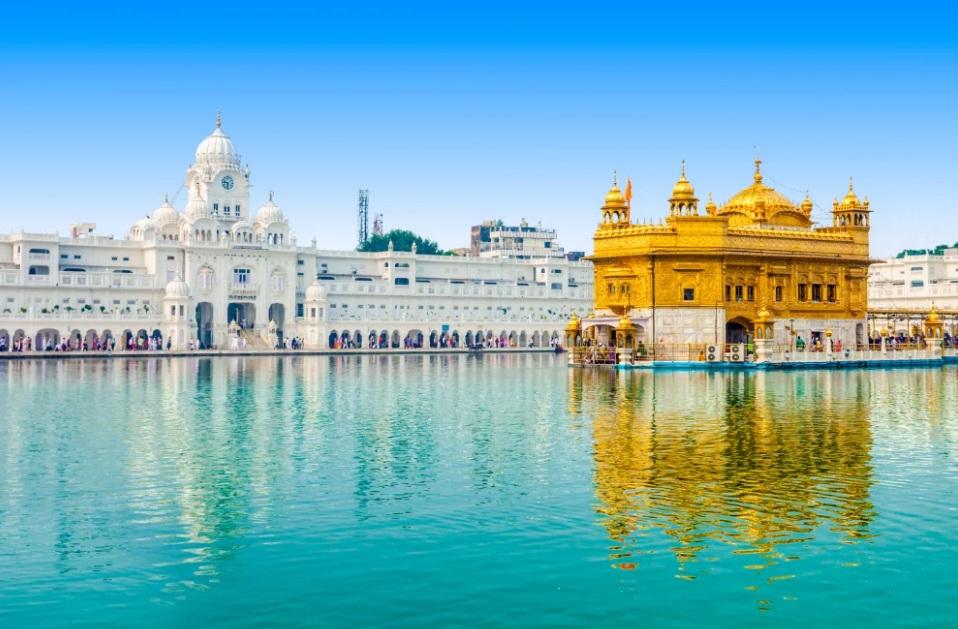
- Guru Arjan compiled the Adi Granth, completing it on 29 August 1604 and installing it in the Harmandir Sahib (the Golden Temple) on 1 September 1604. A cherished tradition — first attested in later chronicles such as the Tawarikh-i-Punjab (1848) — holds that the Muslim Sufi saint Mian Mir of Lahore, a close friend of Guru Arjan, laid the foundation stone of the Harmandir Sahib. It should be candidly noted that the earliest Sikh sources state Guru Arjan himself laid the foundation, and some Sikh historians regard the Mian Mir tradition as a later accretion; nonetheless the tradition itself, and the documented warm friendship between the two men, testify to the interfaith goodwill of the age. Guru Arjan was martyred under the Mughal emperor Jahangir in 1606. Wikipedia
- Guru Hargobind introduced the doctrine of miri-piri — the union of temporal (miri) and spiritual (piri) authority — donning two swords.
- Guru Tegh Bahadur was executed in Delhi in 1675 on the orders of the emperor Aurangzeb; Sikh tradition holds that he gave his life defending the religious freedom of Kashmiri Pandits (Hindus) facing forced conversion, earning him the title “Hind di Chadar” (Shield of India). He is remembered as a Sikh who died for the religious liberty of Hindus — a supreme act of principled pluralism. (Some historians, such as Satish Chandra, note the paucity of contemporary corroboration for the specific Kashmiri-Pandit narrative and situate the execution in the broader political tensions of Aurangzeb’s reign; the martyrdom itself is undisputed historical fact.)
- Guru Gobind Singh (d. 1708) founded the Khalsa on Vaisakhi in 1699, initiating the Panj Pyare (Five Beloved Ones) and instituting the Five Ks. Before his death he declared that the Guru Granth Sahib would be the eternal Guru — “Guru maneyo Granth” — ending the line of human Gurus. (This is, of course, the Sikh understanding of the Guru Granth as the last and living Guru “according to them.”)
The Mughal–Sikh conflict of the seventeenth and eighteenth centuries was real and bloody, but it was political as much as religious — a contest over sovereignty, succession, and regional power, not a simple war of faiths. This is vividly shown by the warm Muslim–Sikh relationships that persisted throughout. Mian Mir mourned Guru Arjan’s martyrdom and never again accepted the gifts of Jahangir. Pir Buddhu Shah, a Muslim Sufi of Sadhaura, fought alongside Guru Gobind Singh at the Battle of Bhangani (c. 1688), losing two of his sons and many followers in the Guru’s cause — and was later himself martyred by the Mughal authorities for having aided the Guru. And from the very beginning, Nanak’s closest companion had been the Muslim Mardana. Until Partition in 1947, by long convention, only Muslim Mirasis (rababis) served as the hereditary musicians singing the sacred verses in Sikh gurdwaras.
IV. SIKHISM AS A BRIDGE BETWEEN HINDUISM AND ISLAM IN A PLURALISTIC PARADIGM
Arising precisely at the interface of the Hindu and Islamic civilizations of India, Sikhism drew together the Sant tradition, bhakti devotion, and Sufi Islam into a distinctive synthesis. Whatever one concludes about Nanak’s own religious identity, the historical function of the movement he founded was mediatory: it spoke both Indic and Islamic religious vocabularies, honored a Muslim Sufi (Baba Farid) and a Hindu weaver-mystic (Kabir) in the same scripture, and preached a formless, casteless, one God to a society divided by both.
The Qur’an itself supplies the theological framework within which a Muslim can honor such a phenomenon. The Qur’an teaches that salvation is open to all who believe in God and the Last Day and do good: “Surely those who believe, and those who are Jews, and the Christians, and the Sabians — whoever believes in Allah and the Last Day and does good, they have their reward with their Lord, and there is no fear for them, nor shall they grieve” (2:62; cf. 5:69, in Maulana Muhammad Ali’s Lahore Ahmadiyya rendering). It affirms a divinely willed diversity of religious paths: “For everyone of you We appointed a law and a way. And if Allah had pleased He would have made you a single people, but that He might try you in what He gave you. So vie with one another in good works” (5:48). It declares that God appointed devotional ways for every nation (22:67, 22:34) and — most importantly for our argument — that God raised a warner among every people: “And there is not a people but a warner has gone among them” (35:24); “And for every nation there is a messenger” (10:47). It reminds the Prophet that not all messengers were named to him: “And (We sent) messengers We have mentioned to thee before and messengers We have not mentioned to thee” (4:164). And it names the fundamental unity of the prophetic message across dispensations (42:13). alahmadiyya + 3
Maulana Muhammad Ali, the towering intellectual of the Lahore Ahmadiyya Movement, drew out exactly this universalism. On 5:48 he commented that “the appointment of a law and a way for everyone refers to the giving of different laws to different nations in accordance with their requirements before the revelation of the Quran,” recognizing “the principle to which it refers frequently, that prophets were raised among every people, for which see particularly 10:47, 13:7 and 35:24.” (The 2010 edition of his commentary adds an editor’s note glossing 5:48 to mean that “all religions, though they are different, set before their adherents the same goal of doing good works, and therefore the followers of each religion should try to excel followers of other religions… in the doing of good works” — a gloss consonant with, though later than, Muhammad Ali’s own note.) In Islam — The Religion of Humanity he wrote: “The great characteristic of Islam is that it requires its followers to believe that all the great religions of the world that prevailed before it were revealed by God; and thus Islam lays down the basis of peace and harmony among the religions of the world.” Ahmadiyya
Within this framework, the Ahmadiyya movement (in both its branches, tracing to Ghulam Ahmad) has held that great figures outside the Abrahamic line — Krishna, Rama, Buddha, Zoroaster, Confucius — may well have been prophets or messengers of God raised among their peoples. To place Baba Nanak within this chain — as a saint, a mujaddid-like reformer of pure monotheism raised in fifteenth-century Punjab, distilling tawhid into an Indic idiom for a Hindu-majority society at the very moment it most needed the message — is exactly what Qur’anic universalism would lead one to expect. A saint arising in Punjab, preaching one formless God, rejecting caste and idolatry, is not an anomaly to be explained away but a datum the Qur’an predicts. Wikipedia
V. GOD’S CREATIVE, INCREMENTAL, CENTURIES-SPANNING PLAN TO GUIDE HUMANITY
Divine guidance, like divine creation, unfolds gradually, creatively, and cumulatively. God is Al-Haqq, The Truth, and Al-Hadi, The Guide; and He guides humanity to Himself not in a single flash but incrementally — through prophets raised to every nation (35:24), through renewal and reform, through saints and sages, through the slow ripening of moral insight that we can trace in the abolition of slavery, the elevation of the rights of women, and the growth of religious freedom.
There is a deep unity between the Book of Nature and the Book of Revelation here. Just as the physical cosmos took some 13.8 billion years to unfold, and life on earth developed across billions of years of what may be called guided evolution, so too the moral and spiritual education of humankind has been stretched across millennia, dispensation after dispensation. This is a signature theme of my writing: that God works through history as through nature — not as an absentee clockmaker but as the continuous Sustainer. This is the vision of al-Ghazali’s occasionalism, which I have elsewhere called the “Inshallah universe”: the doctrine that no created thing possesses independent causal efficacy, that at every moment reality is upheld by the will of God, who “holds the heavens and the earth, lest they cease” (35:41), and of whom “not a leaf falls but He knows it” (6:59). If the cosmos is sustained moment by moment, then history too is a continuous divine act. The Muslim Times + 2
Within the framework of the Four Books of God — Revelation, Nature, the Self, and Deeds — religious history itself is a page of the Book of Deeds, a record of how God has actually dealt with humankind across time. And it accords with the Bil-Haqq cosmological principle: that God created the heavens and the earth “with truth” (bil-haqq), not in vain (44:38–39; 15:85). A creation made in truth, sustained in truth, and guided toward truth would naturally include the raising of guides in every land and age.
Read in this light, Guru Nanak arising in fifteenth-century Punjab — precisely at the meeting point of Hinduism and Islam, distilling the purest monotheism into an Indic idiom his people could receive — is one brushstroke on a vast providential canvas. The patience of the Divine pedagogy is the point. Apparent religious plurality is not a sign of Divine failure but of Divine creativity and Divine forbearance, allowing human freedom its scope so that the better qualities of humankind may be manifested. As the Qur’an itself frames it: “And if Allah had pleased He would have made you a single people, but that He might try you in what He gave you. So vie with one another in good works” (5:48). alahmadiyya
VI. DEMOGRAPHICS AND DIASPORA
Sikhism is the world’s fifth-largest religion, with an estimated 25 to 30 million adherents (a 2020 estimate by Charles Preston gives 29,254,000). Per Pew Research Center, over nine-in-ten Sikhs live in India, chiefly in the Sikh-majority state of Punjab (where Sikhs were 58 percent of the population in the 2011 census). But the Sikh diaspora is now a global phenomenon spanning every inhabited continent. According to national census figures, Canada is home to about 771,790 Sikhs (2.12 percent of the population as of the 2021 census — the largest national Sikh proportion in the world); England and Wales to 524,140 Sikhs per the UK Office for National Statistics 2021 Census (520,092 in England and 4,048 in Wales, about 0.88 percent of the population); Australia to about 210,400; and Italy to roughly 150,000–220,000, with substantial communities in Malaysia, East Africa, and the Gulf. The United States figure is contested: only 70,697 Americans declared Sikh as their ethnicity in the 2020 census, and a census-ratio method yields roughly 280,000, yet the Sikh Coalition and Harvard’s Pluralism Project cite “an estimated 500,000 Sikhs living in America.” Sikhs have risen to remarkable prominence in Western public life — in Canadian and British politics especially — a visibility out of all proportion to their numbers. Wikipedia
For comparative scale: per the Pew Research Center’s 2025 report (Conrad Hackett et al.), Islam counted 2.0 billion adherents, 25.6 percent of the world population, in 2020; “the number of Muslims increased by 347 million [from 2010 to 2020] — more than all other religions combined,” making Islam the fastest-growing major group of the decade, with the majority in the Asia-Pacific region. Hinduism counted about 1.2 billion adherents, “representing 14.9% of the world’s population… the fourth largest group,” with “the majority of Hindus [living] in India (95%),” and communities in Nepal, Bali, and a growing global diaspora.
The Sikh community occupies a singular position between these two great religious populations. Fluent in both Indic and Islamic religious vocabularies, geographically and culturally straddling the India–Pakistan divide (Punjab was itself partitioned in 1947), the Sikh diaspora is well suited to serve as interlocutor and peacemaker. A concrete and moving symbol of this bridging role is the Kartarpur Corridor, completed for Guru Nanak’s 550th birth anniversary and opened on 9 November 2019 (its foundation stones laid by Narendra Modi on the Indian side on 26 November 2018 and by Imran Khan on the Pakistani side on 28 November 2018), which allows Indian Sikh pilgrims visa-free access across the border to Gurdwara Darbar Sahib Kartarpur in Pakistan — the site where Nanak spent his last years and died. On the day of the inauguration, Modi drew the resonance explicitly: “Today is November 9, the day when the Berlin Wall was brought down. Today the Kartarpur corridor was also inaugurated… this date gives us the message to stay united and move forward.” In October 2024, India and Pakistan renewed the corridor agreement for a further five years (to 2029). The corridor has weathered periods of strain — including a suspension amid the crisis following the 2025 Pahalgam attack — but it remains one of the very few standing bridges of goodwill between the two nuclear-armed neighbors. That this bridge is built upon the memory of Guru Nanak is itself an eloquent parable of the argument of this essay.
VII. THEMATIC EPILOGUE — WITH LAHORE AHMADIYYA CAVEATS
Let me close by naming, clearly, the spirit and the limits of what I have offered.
These are resonances and providential possibilities, not dogmatic proofs. That is a distinction the Lahore Ahmadiyya tradition, following the rational and irenic exegesis of Maulana Muhammad Ali, has always insisted upon. To say that the light which shone through Baba Nanak resembles the light Muslims cherish, that the Mool Mantar sings in the same key as Surah al-Ikhlas, that a saint of pure monotheism arising in Punjab is exactly what Qur’anic universalism predicts — this is to offer recognition, not annexation. It is emphatically not a claim to convert Sikhs, nor to appropriate their Guru, nor to diminish the integrity of the Panth that reveres the Guru Granth Sahib as its eternal, living Guru. Mainstream Sikhs understand Nanak as the bearer of an independent revelation, and that self-understanding is to be honored, not overwritten.
Two further caveats of attribution are owed to the reader in the interest of scholarly honesty. First, the case for Nanak as a Muslim saint originates with Hazrat Mirza Ghulam Ahmad’s Sat Bachan (1895), a work predating the 1914 split and therefore common heritage; the Lahore Ahmadiyya branch, which holds Ghulam Ahmad to be a mujaddid and firmly upholds the finality of prophethood in Muhammad, receives Nanak accordingly — as a saint and reformer, not through any claim of new law-bearing prophethood. This must be distinguished from the Qadiani framing, in which the argument became entangled with claims about Ghulam Ahmad’s own prophetic station and his being the “second coming” of various figures. Some of the most-circulated modern articles on this theme (for instance “Birth of Sikhism,” published in the Qadiani Review of Religions in March 1993) belong to the Qadiani branch, not the Lahore branch; the authentically Lahore Ahmadiyya voice on Nanak is that of Mrs. Ulfat Aziz-us-Samad in The Light. Second, several traditional evidences — the Baghdad inscription, the precise dating and reading of the chola — are contested by modern scholarship and should be received as living tradition rather than as documentary proof.
With those caveats made plain, the invitation stands, and it is a warm one. It is a call for Muslim–Sikh–Hindu dialogue built on mutual recognition rather than mutual suspicion; for remembering, in an age when the Mughal–Sikh wars are weaponized to divide, the older and truer memory of Mardana’s rabab, of Mian Mir’s grief, of Pir Buddhu Shah’s sacrifice, of Guru Tegh Bahadur dying for the freedom of Hindus, of the corridor at Kartarpur. The God of the Qur’an raised a warner in every nation and appointed for each a law and a way, willing our very diversity as a test in goodness. It is my hope and prayer that the ummah of Muhammad, the panth of Nanak, and the dharma traditions of India may compete with one another in one thing only — as the Qur’an commands — and that is in good works: fastabiqu al-khayrat.
References and Further Reading
- Mirza Ghulam Ahmad, Sat Bachan (1895), in Ruhani Khaza’in, vol. 10.
- Maulana Muhammad Ali, English Translation and Commentary of the Holy Quran (Ahmadiyya Anjuman Ishaat-i-Islam Lahore); Islam — The Religion of Humanity; The Religion of Islam.
- Mrs. Ulfat Aziz-us-Samad, “Guru Nanak,” The Light (Lahore), 8/16 November 1976.
- “Baba Guru Nanak — A Muslim Saint” (Ansar Raza) and “Birth of Sikhism” (attrib. Prof. Abdul Jaleel, Review of Religions, March 1993) — Ahmadiyya Muslim Community (Qadiani); to be read with the attributional caveats above.
- Khwaja Kamal-ud-Din and The Islamic Review (Woking Muslim Mission), 1913–1971.
- T. P. Hughes, A Dictionary of Islam (1885), art. “Sikhism.”
- W. H. McLeod, Gurū Nānak and the Sikh Religion; Khushwant Singh, A History of the Sikhs.
- The janamsakhi traditions; Bhai Gurdas, Varan.
- Pew Research Center, “How the Global Religious Landscape Changed from 2010 to 2020” (2025).
- Statistics Canada (2021 Census); UK Office for National Statistics (2021 Census).
- Zia H. Shah, essays on al-Ghazali’s occasionalism, the “Inshallah universe,” the Four Books of God, and guided evolution (The Muslim Times / thequran.love).




Leave a comment