
Presented by Claude for Zia H Shah MD
Abstract
This essay offers an interdisciplinary commentary on Qur’an 26:7 — “Do they not look at the earth, how many of every noble kind (zawj karīm) We have caused to grow therein?” — situated within the opening movement of Sūrat al-Shuʿarāʾ (26:1–9). It proceeds in the manner I have adopted across my commentaries: the Arabic text and its transliteration, six named English renderings, and the readings of five classical exegetes (al-Ṭabarī, al-Zamakhsharī, al-Rāzī, al-Qurṭubī, and Ibn Kathīr), whose philology of zawj (“kind, species”) and karīm (“noble, generous, praiseworthy in its kind”) is shown to anticipate — without concordism — a modern botanical vision. The heart of the essay is a long survey of the flora of the earth organized by biogeographic realm: Madagascar, Hawaii, the Cape, Australia, the Neotropics, Socotra, New Caledonia, Malesia, the Mediterranean, the Andes, the Sino-Himalaya, the Arctic-alpine zone, and the Arabian milieu of revelation itself. Into this I weave the phenomena the verse’s kam (“how many”) now names for us — adaptive radiation, endemism, island biogeography, the coevolution of flowers and pollinators, Darwin’s “abominable mystery,” double fertilization, and the Fibonacci geometry of the growing shoot. A further section walks the reader through the world’s great botanical gardens as places where the diversity and beauty of zawj karīm is gathered and read. Throughout, science and Qur’an are held together as resonance and anticipation, never as “scientific miracle.” Natural law is treated as sunnat Allāh; growth (anbatnā, “We caused to grow”) is read as first-person divine agency within an occasionalist “Inshallah universe”; and evolution by natural selection is embraced as God’s method rather than His rival. The essay closes with a thematic epilogue on beauty as a sign (āyah) — the aesthetic argument for God, and the honest puzzle of why a blind and indifferent cosmos should be so extravagantly beautiful to us.
I. The Verse
أَوَلَمْ يَرَوْا۟ إِلَى ٱلْأَرْضِ كَمْ أَنۢبَتْنَا فِيهَا مِن كُلِّ زَوْجٍۢ كَرِيمٍ
Transliteration: A-wa-lam yaraw ilā l-arḍi kam anbatnā fīhā min kulli zawjin karīm.
A working translation: “Do they not look toward the earth — how many of every noble kind have We caused to grow therein?”
The verse turns on four load-bearing words. Yaraw ilā (“look toward”) is not the passive verb of mere seeing; the preposition ilā directs the gaze, converting sight into contemplation. Kam (“how many”) is an open interrogative of magnitude that does not name a number. Anbatnā (“We caused to grow”) is a first-person divine act. And zawj karīm — “noble/generous kind” — is the phrase whose semantic depth the classical commentators mined and modern botany has, unwittingly, illustrated on a scale its first hearers could not have conceived.
II. Six Translations
The verse has been rendered into English many times. Six representative versions:
- Sahih International: “Did they not look at the earth — how much We have produced therein from every noble kind?”
- Yusuf Ali: “Do they not look at the earth — how many noble things of all kinds We have produced therein?”
- Pickthall: “Have they not seen the earth, how much of every fruitful kind We make to grow therein?”
- Muhammad Asad: “Have they, then, never considered the earth — how much of every noble kind [of life] We have caused to grow thereon?”
- The Clear Qur’an (Mustafa Khattab): “Have they not looked at the earth, ˹to see˺ how many types of fine plants We have grown in it?”
- Maulana Muhammad Ali (rendered by a scholar-translator whose annotated English translation, first published in 1917, was among the earliest by a Muslim and remains distinctive for its rationalist, note-rich apparatus): “See they not the earth, how many of every noble kind We cause to grow in it?”
The near-unanimous rendering of zawj as “kind” rather than “pair,” and of karīm as “noble,” “fruitful,” or “fine,” already telegraphs the exegetical consensus we shall examine. Asad’s interpolation “[of life]” and Pickthall’s “fruitful” are the two most interpretively daring choices; both are defensible on classical grounds.
III. The Context: Sūrat al-Shuʿarāʾ 26:1–9
The verse does not stand alone. It is the empirical hinge of a tightly argued opening. In M. A. S. Abdel Haleem’s translation:
26:1 Ṭā Sīn Mīm. 26:2 These are the verses of the Scripture that makes things clear. 26:3 [Prophet], are you going to worry yourself to death because they will not believe? 26:4 If We had wished, We could have sent them down a sign from heaven, at which their necks would stay bowed in utter humility. 26:5 Whenever they are brought a new revelation from the Lord of Mercy, they turn away: 26:6 they deny it, but the truth of what they scorned will soon hit them. 26:7 Do they not see the earth, and what noble kinds of thing We grow in it? 26:8 There truly is a sign in this, though most of them do not believe. 26:9 Your Lord alone is the Almighty, the Merciful.
The architecture is deliberate. Verse 4 raises and then sets aside the possibility of coercive proof — a sign that would force submission — in favour of the ordinary, deniable, freely-interpretable signs of the created world. Verse 7 then “turns the camera” from the sky to the soil: the sign is not a thunderbolt but the quiet, ubiquitous, staggering fact of vegetation. And verse 9 closes by binding two divine names that a superficial reading might hold in tension — al-ʿAzīz (the Almighty) and al-Raḥīm (the Merciful) — so that the earth’s fertility is disclosed as at once an index of power and a medium of mercy. This is, in miniature, the Qur’an’s characteristic epistemology of nature: look, recognize the sign, name the Lord.
IV. What the Classical Mufassirūn Understood by Zawj Karīm
The Arabic zawj (زوج) carries at least three senses — pair or mate, kind or type, and counterpart. The word karīm (كريم) is cognate with the divine name al-Karīm, the Generous, and ranges across “noble,” “generous,” “excellent,” and “beautiful.” What is striking, when one reads the five great commentators on this specific verse, is their near-unanimous reading of zawj as kind/species rather than male-female pair, and their convergent reading of karīm as denoting both beauty of appearance and generosity of benefit.
Al-Ṭabarī (d. 310/923), in Jāmiʿ al-bayān, glosses the phrase with admirable economy: “yaʿnī bi’l-karīm: al-ḥasan” — “by karīm is meant the beautiful/good.” He supplies the Arabic idiom: a date-palm of fine yield is called karīma, and a she-camel or ewe abundant in milk is likewise karīma. He cites Qatāda, who glosses karīm simply as ḥasan (beautiful), and Mujāhid, who reads the phrase as “of the plants of the earth, of what people and cattle eat.” Ṭabarī’s distinctive emphasis is temporal: the earth grew these kinds “after it was dead, with no vegetation in it” (baʿda an kānat mayyita lā nabāta fīhā) — tying the verse directly to the resurrection (baʿth) that the deniers mocked. Growth from barren ground is itself a rehearsal of the raising of the dead. Quran + 2
Al-Zamakhsharī (d. 538/1144), the Muʿtazilite master of al-Kashshāf, supplies the verse’s most influential philological gloss. He describes zawj explicitly as “al-ṣinf min al-nabāt” — “the kind of plant” — and then defines karīm as “ṣifa li-kull mā yurḍā wa-yuḥmad fī bābihi“: “a description of everything that is approved and praiseworthy (yuḥmad) in its own category.” He generalizes with a triad: a karīm face is one approved in its beauty; a karīm book is one approved in its meanings and benefits; and the karīm plant is that which is “approved in the benefits associated with it.” Al-Zamakhsharī also poses, in his characteristic question-and-answer style, the grammatical puzzle of why the verse joins kam (“how many”) with kull (“every”): kull, he answers, denotes the comprehensive enumeration of all plant-kinds “in detail,” while kam denotes that this totality is “exceedingly, excessively abundant” (mutakāthir mufriṭ al-kathra) — and the pairing together alerts us to “the perfection of His power” (kamāl qudratih). Surah Quran + 2
Fakhr al-Dīn al-Rāzī (d. 606/1210), in Mafātīḥ al-Ghayb, follows and deepens this reading. Zawj, he says, means ṣinf (kind). Karīm is “a description of everything that is pleasing and praiseworthy in its kind” — the same yurḍā wa-yuḥmad formula — and “the karīm plant is that which is pleasing in its benefits, of what people and cattle eat.” His philosophically distinctive move is to dwell on the rhetorical force of kam and kull together: the two words, he argues, demonstrate simultaneously the exhaustive variety and the overwhelming abundance of what God grows, “arranged upon the perfection of His power.” He even notes that the singular āyah (“sign”) in verse 8 may point either to the single act of causing-to-grow (anbatnā) or to each individual kind among the countless azwāj — so that every single species is, on its own, a sign. QuranpediaIslamWeb
Al-Qurṭubī (d. 671/1273), in al-Jāmiʿ li-aḥkām al-Qurʾān, reads karīm as “ḥasan sharīf” (beautiful and noble) and roots it etymologically: “the origin of karam in the language is nobility and excellence” (al-sharaf wa’l-faḍl). A karīma palm is “excellent, abundant in fruit”; a karīm man is noble, excellent, and forgiving. Citing the grammarian al-Farrāʾ, he glosses zawj as al-lawn — the “sort” or “variety.” And he reads the opening verb devotionally: had the deniers “looked with their hearts and their insight” (bi-qulūbihim… bi-baṣāʾirihim), they would have known that God alone deserves worship, for He is “the One who brings forth and causes to grow” (al-mukhrij wa’l-munbit). Quran + 2
Ibn Kathīr (d. 774/1373), in his Tafsīr, is the briefest, reading the verse as a notice of God’s greatness, power, and dominion (ʿaẓama, qudra, sulṭān) against those who dared oppose His Messenger. He glosses zawj karīm broadly as “crops, fruits, and animals” — extending the “noble kinds” beyond the botanical — and cites al-Shaʿbī’s arresting dictum that “people, too, are from the plants of the earth: whoever enters Paradise is karīm (noble), and whoever enters the Fire is laʾīm (base).” QuranQuran
Two conclusions follow. First, the classical consensus reads zawj as kind/species — a taxonomic rather than a sexual sense — even though the same commentators knew well that zawj can mean male-female pair and that date-palms in particular have distinct male and female trees requiring pollination. Second, they converge on a reading of karīm that fuses aesthetic and utilitarian value: the noble kind is at once beautiful to behold (ḥasan), excellent in its nature (sharīf, faḍl), praiseworthy in its category (maḥmūd fī bābihi), and generous in the benefits it yields to humans and animals. This is precisely the collapse of beauty and generosity into a single word that makes the verse so fertile for the reflection that follows — and it is a reading that anticipates, without ever claiming to predict, the modern discovery that the plant kingdom is at once the most beautiful and the most life-sustaining of the earth’s domains. I stress anticipates and not proves: the mufassirūn were doing philology and theology, not botany, and the resonance we now feel is a gift of reading them in our own age, not a hidden miracle smuggled into the text.
V. Reading the Second Book: Anbatnā, Sunnat Allāh, and the Inshallah Universe
Before we turn to the flora itself, a word on method, because it governs everything that follows.
I have long argued that God has authored more than one book. There is the Book of Revelation — the Qur’an. There is the Book of Nature — the cosmos, which the Qur’an itself repeatedly commands us to read. There is the Book of the Self and Destiny, and the Book of Deeds. Qur’an 26:7 is one of the clearest imperial commands in all of scripture to open the second book: “Do they not look toward the earth…?” The verb is one of directed attention, and the object is the living surface of the planet. To do botany, ecology, and evolutionary biology carefully is, on this reading, an act of Qur’anic obedience.
The natural laws that the biologist describes — natural selection, genetic drift, the physics of diffusion that governs a leaf’s gas exchange, the chemistry of chlorophyll — I understand as sunnat Allāh, the settled custom of God, the regular way in which the divine will ordinarily acts. There is no rivalry here between “God did it” and “natural selection did it,” any more than there is rivalry between “the author wrote the sentence” and “the pen deposited the ink.” Following al-Ghazālī’s occasionalism — which I have elsewhere recast as the “Inshallah universe,” a cosmos in which every event is a fresh divine act rather than the autonomous output of self-sufficient secondary causes — I read the verb anbatnā, “We caused to grow,” in its plain first-person force. It is not a metaphor for God having set up a plant-growing machine and walked away. It is the claim that the growth of every seedling, now, is a direct act of the Sustainer. The Qur’an makes this explicit elsewhere: “Have you considered the seed you sow? Is it you who make it grow, or are We the Grower?” (56:63–64). The farmer plants; God grows. The evolutionary lineage diversifies; God diversifies it. Adaptive radiation is not an alternative to divine creativity but one of its most spectacular signatures — the very brushwork of the sunnat Allāh.
This is why I part company, respectfully but firmly, with the concordist tradition of Maurice Bucaille, Zakir Naik, and others who read modern science back into the Qur’an as a series of encoded “scientific miracles.” That method mistakes the genre of the text and hostages faith to the next revision of the textbook. The Qur’an is not a botany manual with the answers printed in invisible ink. It is a summons to look — and what makes the summons so moving is that its power scales with our knowledge. The seventh-century hearer who knew a few hundred plants obeyed 26:7 by noticing the palms and tamarisks of the Hijaz. We obey it by standing before the roughly 350,000 known species of the vascular plant kingdom. The verse has not changed; the magnitude of its kam has expanded by three orders of magnitude. That is resonance, not concordism — and it is, to my mind, far more wonderful.
VI. The Plant Kingdom by the Numbers
How many is “how many”? Modern taxonomy gives the kam of 26:7 a staggering answer. Kew’s World Checklist of Vascular Plants (WCVP), whose eighth version was released in March 2022, contained 1,233,172 names, of which 418,737 were accepted — and the tropics alone are home to most of the roughly 350,000 known vascular plant species (Ortiz et al., Botanical Sciences, 2023). A landmark 2019 study led by Brian Enquist of the University of Arizona — the work of 35 researchers over a decade, published in Science Advances (5:eaaz0414) — assembled a final dataset of 34,902,348 observation records of 434,934 land-plant species. Its most arresting finding: about 36.5% of Earth’s roughly 435,000 plant species are “exceedingly rare,” recorded fewer than five times in the entire history of botanical science, clustering in hotspots such as the Northern Andes, Costa Rica, South Africa, Madagascar, and Southeast Asia.
The kingdom is overwhelmingly dominated by the flowering plants: angiosperms account for roughly nine in ten of all species. The five largest flowering-plant families alone — the daisies (Asteraceae, ~33,000 species), the orchids (Orchidaceae, ~28,000), the legumes (Fabaceae, ~20,000), the coffee family (Rubiaceae), and the grasses (Poaceae) — together contain over a hundred thousand species. Roughly two thousand new plant species are described every year. And the noble kinds are vanishing even as we discover them: Kew’s State of the World’s Plants and Fungi 2023 report — the work of some 200 scientists — estimated that 45% of all known flowering-plant species are threatened with extinction, and that as many as 77% of the vascular plants not yet formally described are likely already at risk. thequranthequran
Every one of these numbers is a commentary on a single word: kam. The verse asked “how many?” and left the answer open, so that each generation’s answer would be its own act of worship. Ours is the first generation able to answer in hundreds of thousands — and the first obligated, by that very knowledge, to grieve the losses.
VII. The Noble Kinds by Biogeographic Realm
What follows is the long heart of this commentary: a walk across the biogeographic realms of the earth, reading in each the zawj karīm that the verse invites us to number. I organize it geographically, because geography is where the deepest lesson of modern botany lives — the lesson of endemism, that the noble kinds are not scattered evenly but are lavished, region by region, in forms found nowhere else, as if the Grower delighted in painting each island and each mountain in a palette reserved for it alone.
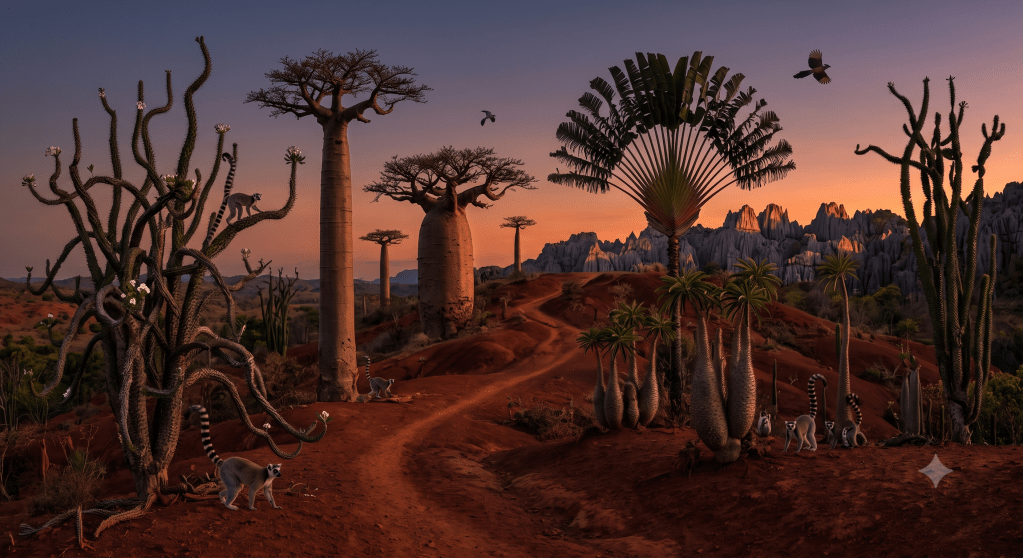
Madagascar: the Great Red Island
No landmass illustrates the profligacy of zawj karīm better than Madagascar, isolated in the Indian Ocean since it parted from the African and Indian plates roughly 88–160 million years ago. It hosts more than 10,000 native plant species, of which around 80–90% are endemic — found nowhere else on the planet. Six of the world’s eight or nine baobab species (genus Adansonia) are endemic to the island, including the colossal Grandidier’s baobab, Adansonia grandidieri, called reniala, “mother of the forest,” in Malagasy — a water-storing giant that can live for centuries. The traveller’s palm, Ravenala madagascariensis, spreads its leaves in a great flat fan. The Madagascar periwinkle, Catharanthus roseus, yields the alkaloids vincristine and vinblastine that transformed the treatment of childhood leukaemia and Hodgkin’s lymphoma — karīm in the most literal Qur’anic sense of “generous in benefit.” Riake Resort & Villa
And here grows the most theologically suggestive flower of all. In 1862 Charles Darwin received a specimen of the Malagasy orchid Angraecum sesquipedale, whose nectar is held at the bottom of a spur up to about 30 cm long. Darwin reasoned that some unknown moth must exist with a proboscis long enough to reach it, and he predicted the pollinator’s existence from the flower’s form alone. He was ridiculed. Decades after his death, in 1903, the moth was found: a hawkmoth named, in tribute to the prophecy, Xanthopan morganii praedicta. Here is coevolution made visible — flower and pollinator shaped to one another across deep time, each the counterpart (zawj, in its other sense) of the other. It is a parable, for me, of the sunnat Allāh: a lawful, gradual, reciprocal fitting-together that a believer reads as artistry and a naturalist reads as selection, and which need not be two readings at all.
Hawaii: an island laboratory of noble kinds
The Hawaiian archipelago is the most isolated on Earth, some 3,900 km from the nearest continent. Colonization was so improbable that, on average, a single plant species established naturally only once every roughly 100,000 years. Yet from those vanishingly rare founders, evolution built a native flora of around 1,400 taxa, of which some 89–90% are endemic. The mechanism is adaptive radiation: a few ancestors diversifying to fill empty niches across habitats spanning rainforest to alpine desert. The silversword alliance — around 30 species in three genera, all descended from a single Californian tarweed ancestor whose seed likely arrived on a bird’s feathers some five million years ago — produced trees, shrubs, mat-plants, cushion-plants, and vines. The great botanist Peter Raven called it the finest example of plant adaptive radiation known. The Haleakalā silversword, Argyroxiphium sandwicense, called ʻāhinahina (“very grey”), grows on volcanic cinder above 2,100 m, lives for decades, sends up a single flowering stalk bearing hundreds of maroon flower-heads, and dies. It cannot self-pollinate; it depends on endemic Hawaiian bees. And it is imperilled: Hawaii is the “endangered species capital” of the United States, with over a hundred plant taxa already extinct. The lobeliads and the ʻōhiʻa lehua (Metrosideros polymorpha), whose crimson pom-pom flowers dominate native forests, tell the same double story of dazzling radiation and acute fragility. thequran
The Cape Floristic Region: the smallest and richest floral kingdom
At the southern tip of Africa lies a botanical miracle: the Cape Floristic Region, the smallest of the world’s six floral kingdoms and the only one contained within a single country. In an area of roughly 90,000 km² — less than 0.5% of Africa’s land — grow around 9,000 vascular plant species, of which more than 6,200, or 69%, are found nowhere else on Earth; it is the only one of the planet’s biodiversity hotspots that encompasses an entire floral kingdom. This is the highest concentration of plant diversity of any temperate region on Earth. Its dominant vegetation is fynbos (“fine bush”), built from four great families: the proteas (Proteaceae), the heaths (Ericaceae), the reed-like restios (Restionaceae), and the bulbs. The king protea, Protea cynaroides, South Africa’s national flower, bears flower-heads up to 30 cm across. The fynbos is fire-adapted — many species germinate only after fire — and its lineages are ancient, the proteas tracing back tens of millions of years. That so much beauty should be crammed into so small a compass is, for the believer, a concentrated dose of the kam of 26:7.
Australia: a raft of Gondwanan antiquity
Australia’s long isolation, after it broke from Gondwana some 50 million years ago, produced a flora both ancient and strange. The eucalypts (~700 species) and the wattles (Acacia, hundreds of species) radiated to dominate a continent of nutrient-poor soils. The banksias and grevilleas (Proteaceae) evolved brush-like inflorescences pollinated by birds and even by the nectar-feeding honey possum. The kangaroo paws (Anigozanthos), endemic to the Mediterranean-climate southwest, bear velvety tubular flowers. And in 1994, in a remote canyon of the Blue Mountains, botanists found living specimens of a tree known only from fossils tens of millions of years old: the Wollemi pine, Wollemia nobilis — a “living fossil,” fewer than a hundred mature trees in the wild, now the object of an international conservation and ex situ propagation effort. Southwest Australia alone, a recognized biodiversity hotspot, holds over 5,500 vascular plant species, more than half of them endemic.
The Amazon and the Neotropics
The Neotropical rainforests hold the richest tree flora on Earth. In a landmark 2013 study in Science, led by Hans ter Steege of the Naturalis Biodiversity Center, an international team estimated that Amazonia contains roughly 16,000 tree species distributed among some 390 billion individual trees — yet fully half of all those trees belong to just 227 “hyperdominant” species, a mere 1.4% of the total. On the still waters grow the giant water-lilies, Victoria amazonica, whose leaves span nearly three metres and whose night-blooming flowers trap and release their beetle pollinators. The heliconias flame in red and yellow; the bromeliads perch as epiphytes, each a tiny aerial pond; the orchid family reaches its greatest diversity here. From this realm came cacao (Theobroma cacao) and the rubber tree (Hevea brasiliensis). And the Brazil nut, Bertholletia excelsa, is a parable of ecological interdependence: its flowers can be pollinated only by large-bodied bees (orchid bees and others) strong enough to pry open the flower’s hood; those male bees, in turn, need the scent of particular orchids to mate; and the nut’s woody fruit is opened and its seeds dispersed chiefly by the agouti, a large rodent. Remove any thread — orchid, bee, or agouti — and the noble kind fails. No plant, the Brazil nut teaches, is an island; each is woven into a web of counterparts.
Socotra: the Galápagos of the Indian Ocean
Off the Horn of Africa, in Yemeni waters, the archipelago of Socotra has been isolated for at least six million years. Of its roughly 825 plant species, about 37% are endemic. Its emblem is the dragon’s blood tree, Dracaena cinnabari, whose branches splay into a dense mushroom-shaped crown — an adaptation for harvesting mist and shading its own seedlings — and whose red resin, dam al-akhawayn (“the blood of the two brothers”), has been traded since antiquity as medicine, dye, and incense. The desert rose, Adenium obesum subsp. socotranum, swells into a grey bottle-trunk crowned with pink blossoms; the cucumber tree, Dendrosicyos socotranus, is the only member of the cucumber family to grow as a tree. Socotra is a living argument that the Grower’s palette is inexhaustible: given an isolated crucible and enough time, forms arise here that arise nowhere else.
New Caledonia: the root of the flowering tree
In the southwest Pacific lies an island whose flora is a window into the deepest past of the angiosperms. New Caledonia, a fragment of the drowned continent Zealandia, hosts several thousand native species with roughly 80% endemism, and five endemic plant families. Its unusual ultramafic soils — rich in nickel and other metals toxic to most plants — have driven the evolution of a highly specialized, heavily endemic flora, alongside an extraordinary richness of ancient Araucaria conifers. But its supreme treasure is a modest understory shrub, Amborella trichopoda, the sole species of its family and order. Molecular phylogenetics consistently places Amborella as the sister lineage to all other living flowering plants — the earliest surviving branch of the angiosperm tree, its lineage reaching back perhaps 140–160 million years. As one conservationist put it, to lose Amborella would be to lose a genus, a family, an order, and “the only witness to at least 140 million years of evolutionary history.” When 26:7 bids us look at the noble kinds We caused to grow, the humble Amborella is, in an evolutionary sense, close to the base of them all.
Malesia and Southeast Asia: the largest flowers on Earth
The rainforests of Sumatra and Borneo hold the botanical world’s most extravagant blooms. Rafflesia arnoldii — a rootless, leafless, stemless parasite living inside the tissue of a jungle vine — produces the largest single flower of any plant: a fleshy, mottled, five-lobed disc that can exceed 1 m across (a specimen found in West Sumatra in January 2020 measured 111 cm) and weigh as much as 11 kg, reeking of carrion to summon its fly pollinators. Its rival for gigantism, the titan arum Amorphophallus titanum, produces the largest unbranched inflorescence (a cluster of many flowers), a spire that can exceed three metres and likewise stinks of decay. The pitcher plants (Nepenthes) turn leaves into carnivorous traps. And the durian — pungent, revered, custard-fleshed — is pollinated by bats. Here the “noble” kind ranges from the sublime to the deliberately repulsive: even the corpse-flower, hideous to the human nose, is a masterwork of adaptation and thus, in its way, karīm in the sense the mufassirūn intended — praiseworthy in its own category.
The Mediterranean, the Andes, the Sino-Himalaya, and the Arctic-alpine
Four further realms deserve mention. The Mediterranean basin is one of the planet’s great hotspots, a fire-shaped mosaic of some 25,000 plant species, roughly half endemic — the world of the olive, the wild tulip, the cistus, and the aromatic labiates. The Andes, especially the tropical Northern Andes, are a global epicentre of orchid and plant richness and one of the densest concentrations of “exceedingly rare” species. The Sino-Himalayan region — the mountains of southwest China, the eastern Himalaya, and northern Burma — is the world center of rhododendron diversity (over a thousand species in the region), home to the sky-blue Himalayan poppies (Meconopsis, a genus of some 54 species that arose roughly 20 million years ago), and to more than a thousand orchid taxa in the Indian Himalaya alone. And the Arctic and alpine floras show the opposite face of zawj karīm: not exuberance but tenacity — cushion plants, saxifrages, and the woolly-leaved denizens of the high scree, hoarding warmth and moisture at the very limit of where flowering life can persist.
The Arabian milieu: the flora of revelation
Finally, we return to the earth beneath the verse’s first hearers. The Arabian Peninsula hosts a respectable regional flora of several thousand species, concentrated in the monsoon-touched mountains of Yemen and Dhofar. There grows the frankincense tree, Boswellia sacra, whose fragrant resin was, for millennia, Arabia’s most precious export. And the Qur’an itself names a modest botanical catalogue — perhaps two to three dozen plants — that anchors its imagery in the lived landscape: the date palm (nakhl), the olive (zaytūn), the fig (tīn), the pomegranate (rummān), the grapevine (aʿnāb), ginger (zanjabīl), the ṭalḥ (variously identified as the banana or a flowering acacia), and the lote tree, sidr (Ziziphus spina-christi). The Qur’anic Botanic Garden in Qatar and Shahina Ghazanfar’s Plants of the Qurʾān (Kew Publishing, 2023) have gathered and identified this flora. The point is not that the Hijaz was botanically rich — it was not, by global standards — but that the verse addressed to a people who knew a few hundred plants was built to keep expanding as human knowledge did. The Bedouin looked at the acacia and saw a sign; we look at 350,000 species and see the same sign, magnified beyond measure.
VIII. The Deep Patterns: Radiation, Pollination, and the “Abominable Mystery”
Behind this global tour lie a handful of deep scientific patterns, each of which enriches the reading of 26:7.
Adaptive radiation and island biogeography. The silverswords of Hawaii, the lobeliads, the fynbos proteas, the Malagasy baobabs — again and again, a few founders on an isolated stage diversify into a riot of forms. Islands, as the theory of island biogeography formalized by MacArthur and Wilson explains, are engines of endemism precisely because isolation plus opportunity equals divergence. The believer sees in this not a machine running without a maker, but the maker’s characteristic method: creation through lawful process, extended across deep time.
The coevolution of flowers and pollinators. Darwin’s orchid and its predicted moth are the emblem, but the principle is universal. Flowers are, overwhelmingly, advertisements and rewards evolved in dialogue with animal senses. Bees see into the ultraviolet — with photoreceptors tuned to UV, blue, and green rather than our red, green, and blue — and countless flowers bear UV “nectar guides,” bull’s-eye patterns of UV-absorbing centres and UV-reflecting margins, invisible to us, that direct the bee to the reward. Red, tubular, scentless flowers are tuned to birds; pale, night-scented flowers to moths and bats; carrion-mimics to flies. Flower colour, symmetry, scent, and nectar are, in the main, a coevolved sensory language between plant and pollinator.
Darwin’s “abominable mystery.” In a letter of 22 July 1879 to his friend Joseph Hooker, then Director of Kew, Darwin called “the rapid development, as far as we can judge, of all the higher plants within recent geological times” an “abominable mystery.” The flowering plants seemed to appear and diversify with a suddenness that troubled his gradualism. Modern work — molecular phylogenies, the Amborella and water-lily genomes, revised fossil dating, and the recognition of insect coevolution — has softened the mystery without wholly dissolving it: the origin and explosive Cretaceous radiation of the angiosperms remain among biology’s great open questions. For the believer, an unsolved scientific problem is not a gap to stuff God into; it is simply a frontier of the second book still being read. I make no “God of the gaps” argument here. I note only that the sheer, still-not-fully-explained creative burst that gave us the flowering plants is exactly the sort of thing 26:7 asks us to stand before in wonder.
The signature of the golden angle. Look closely at how a plant places its leaves, its florets, its seeds. New organs emerge at the growing tip separated by an angle close to 137.5° — the “golden angle,” derived from the golden ratio φ ≈ 1.618. Because this angle is the “most irrational” division of the circle, successive leaves never stack, and seeds pack with maximal efficiency; the visible result is the interlocking Fibonacci spirals of the sunflower head (often 34 one way and 55 the other), the pinecone, and the pineapple. Whether one explains the golden angle by the physics of auxin diffusion at the meristem or by the geometry of optimal packing, the outcome is a mathematical elegance written into the humblest weed.
Double fertilization. And there is a process unique to the flowering plants that deserves to be better known: double fertilization. When a pollen grain germinates, it delivers two sperm cells — one fertilizes the egg to form the embryo, the other fuses with two nuclei to form the endosperm, the nutritive tissue that feeds the developing seed (and, as wheat, rice, and maize, feeds most of humanity). The plant, in a single reproductive act, makes both the child and the child’s food. It is difficult to read this and not hear the Qur’anic register of rizq, of provision built into the very structure of life.
IX. Plant Sexuality and the Azwāj Verses: A Resonance, Handled with Care
The word zawj opens onto one of the Qur’an’s recurrent themes: azwāj, pairs. “Glory be to Him who created all the pairs — of what the earth grows, of themselves, and of things they do not know” (36:36). “And of everything We created pairs” (51:49). “And it is He who spread the earth… and of all fruits He made therein two kinds/pairs” (13:3). The Qur’an repeatedly asserts that createdness comes in pairs, and repeatedly includes plants in the claim. Elsewhere the same botanical constellation recurs with the sister phrase zawj bahīj, “every joyous/beautiful kind” (22:5; 50:7), and with the command to “watch their fruits as they grow and ripen” (6:99), the reasoning that neighbouring plots watered by one water yield differing fruits “for people who reason” (13:4), and the summons to gardens “of beauty and delight,” ḥadāʾiq dhāt bahjah (27:60).
Now, the sexuality of plants — the fact that flowers bear male organs (stamens) and female organs (pistils), and that pollen is the fertilizing agent — was not experimentally established in Europe until Rudolf Jakob Camerarius’s De sexu plantarum epistola of 1694, in which he isolated male from female plants and showed that both were needed to set viable seed; Linnaeus built his whole classificatory “sexual system” upon it in his Systema Naturae of 1735. It is tempting, and some have yielded to the temptation, to present the azwāj verses as a miraculous scientific pre-announcement of plant sexuality a millennium before Camerarius.
I decline that move, and I want to be explicit about why. First, the classical commentators on 26:7, as we saw, overwhelmingly read zawj here as kind/species, not male-female pair — so the “miracle” reading is not even the dominant classical understanding of this verse. Second, the Arabs demonstrably knew that date palms had male and female trees and hand-pollinated them; plant sexuality in that gross sense was ancient practical knowledge, not a secret. Third, and most importantly, the “scientific miracle” method is theologically and intellectually hazardous: it makes the truth of revelation hostage to the shifting consensus of science, and it flattens the Qur’an’s summons to wonder into a cheap game of proof-texting. What I affirm instead is resonance: the Qur’an’s insistent language of pairing and kinds — of a creation ordered into complementary, reproducing types — sits in deep and satisfying harmony with what botany has since disclosed about the sexual, paired, prodigiously diversified nature of plant life. That harmony is real and worth savouring. It is not a proof; it is a consonance between the two books of the one Author.
X. The World’s Great Botanical Gardens: Where the Noble Kinds Are Gathered and Read
If 26:7 commands us to look at the earth’s noble kinds, the botanical garden is the institution humanity built to make that looking possible in one place. These gardens are, at once, arks of conservation, laboratories of science, and — not least — cathedrals of aesthetic pedagogy, where an ordinary visitor may in an afternoon encounter more of the plant kingdom’s beauty than a medieval scholar met in a lifetime.
The Royal Botanic Gardens, Kew, near London, is the world’s most influential. A UNESCO World Heritage Site since 2003, it holds a living collection of more than 27,000 taxa, a herbarium of over 8 million specimens, the great glasshouses of the Palm House and the restored Temperate House, and — at its Wakehurst site — the Millennium Seed Bank, the largest wild-plant seed bank on Earth. As of 1 March 2023 it had banked more than 2.4 billion individual seeds representing 40,020 species of wild plants from 190 countries — roughly 16% of the world’s seed-plant species. It is difficult to imagine a more concrete answer to kam: a vault, built against extinction, in which the noble kinds are literally banked for the future.
Kirstenbosch, on the eastern slopes of Table Mountain in Cape Town, is devoted to the flora of its own extraordinary kingdom — the fynbos, the proteas, the cycad amphitheatre — and is widely counted among the most beautiful gardens on Earth. Singapore Botanic Gardens, also a UNESCO site, crowns its collection with the National Orchid Garden, the world’s greatest display of cultivated orchids, thousands of species and hybrids in perpetual bloom. Bogor Botanical Gardens in Indonesia anchors the study of the Malesian flora. The New York Botanical Garden and the Missouri Botanical Garden (whose Flora projects and TROPICOS database underpin much of world plant taxonomy) are the great engines of Neotropical botany; Bogotá’s botanical garden and Colombia’s unrivalled orchid diversity stand behind them.
Europe holds the tradition’s roots. The Orto Botanico di Padova, founded in 1545, is the oldest university botanical garden still in its original location, a UNESCO World Heritage Site whose circular plan symbolizes the world encircled by water — a Renaissance emblem of exactly the totality 26:7 evokes. The Jardin des Plantes in Paris and the Royal Botanic Garden Edinburgh carry the tradition forward.
And then there are the gardens built frankly for delight and instruction: Keukenhof in the Netherlands, where some seven million tulip and spring bulbs are planted each year; the Dubai Miracle Garden; Butchart Gardens in Canada; Longwood Gardens and the Huntington and the Desert Botanical Garden in the United States; the Eden Project in Cornwall, with its great biome domes; and Singapore’s Gardens by the Bay, with its cooled conservatories and towering artificial “Supertrees.” These gardens teach by beauty; they are, in the Qur’anic idiom, machines for the manufacture of tafakkur, contemplation. And the impulse is old: the Qur’anic summons to observe nature helped power a classical Muslim botany, from al-Dīnawarī’s ninth-century Kitāb al-Nabāt (Book of Plants) onward.
It would be an omission to close this section without the Islamic garden itself. The Qur’anic paradise, jannah, is literally a “garden” — the word occurs scores of times — described as gardens beneath which rivers flow, with fruits and shade without end (55:46–78; 47:15). From this vision grew the chahār bāgh, the fourfold Persian-Islamic garden divided by four water-channels evoking the four rivers of paradise (water, milk, wine, and honey), realized in the Generalife of Granada, the Shalimar Bagh of Lahore and Kashmir, and the garden-tomb of the Taj Mahal. As Emma Clark has observed, every Islamic garden on earth is meant as both a foretaste and a mirror of the garden of paradise. The English word “paradise” itself descends, through Greek, from the Old Iranian pairidaeza, “a walled enclosure.” When we walk in Kirstenbosch or Kew, or in the Generalife, we are — whether we know it or not — rehearsing the reading of 26:7: looking at the noble kinds, and being drawn through their beauty toward their Grower.
XI. Thematic Epilogue: Beauty as a Sign, and the Puzzle of the Tasteless Universe
I want to close where the verse itself closes — with the sign (āyah, 26:8) — and with the question that the flora of the earth presses most sharply upon the reflective mind: why is it beautiful?
That the plant kingdom is useful the mufassirūn already saw; karīm, they said, means generous in benefit, the food of people and cattle. That it is beautiful they saw too; karīm, they said, means ḥasan, lovely to behold. But here is the puzzle that modern biology hands to theology. Much of a flower’s beauty is explicable by natural selection: the colours, the symmetry, the scent, the UV nectar-guides evolved to seduce pollinators, and the bee’s preferences and the flower’s advertisements shaped one another. So far, so lawful. But the pollinators are bees and moths and birds — and the beauty overflows its function. The orchid is beautiful to us, who neither pollinate it nor are its intended audience. The fynbos hillside in bloom, the blue Himalayan poppy on its scree, the sunflower’s Fibonacci spiral — these arrest the human heart, which selection did not design to be their consumer. This is what I have called the aesthetic surplus: beauty in excess of biological need, beauty gratuitously legible to a spectator the flower never evolved to please.
The honest atheist has a reply, and I want to state it fairly. Perhaps our aesthetic response is itself an evolutionary by-product — a spandrel of sensory systems tuned for other tasks (finding fruit, reading landscapes, choosing mates), so that flowers merely happen to trip circuitry built for survival. Perhaps, as sexual-selection theorists argue, beauty needs no cosmic explanation at all, being simply what happens when preference and display chase each other. These are serious answers and I do not wave them away.
But I do not find them sufficient, and here is the argument from beauty as I hold it. Thinkers from F. R. Tennant to Richard Swinburne have pressed the point: if the universe were the product of blind, indifferent process and nothing more, there is no particular reason to expect it to be beautiful, still less to expect it to be beautiful in ways a conscious observer can savour and be moved by. As Swinburne puts it, “if God creates a universe, as a good workman he will create a beautiful universe. On the other hand, if the universe came into existence without being created by God, there is no reason to suppose that it would be a beautiful universe.” Richard Dawkins famously described nature as “no design, no purpose… nothing but pitiless indifference” — and a pitilessly indifferent process, I submit, should produce a tasteless world, a world of function without radiance. Instead we find a world drenched in gratuitous splendour, from the peacock’s train to the periwinkle’s bloom, and we find ourselves — alone among the animals, so far as we can tell — able to weep at it. Elaine Scarry, in On Beauty and Being Just, has argued that the encounter with beauty is bound up with a summons to justice and truth; Hans Urs von Balthasar built an entire theology on glory as the self-evidence of the divine. In the Islamic tradition the same intuition is native and ancient: God is al-Jamīl, the Beautiful; al-Badīʿ, the Originator of wonders; al-Bāriʾ and al-Muṣawwir, the Maker and the Fashioner. The Prophet ﷺ said, “God is beautiful, and He loves beauty” (Muslim). Ibn ʿArabī read the whole cosmos as the self-disclosure of the divine beauty; Rūmī read the rose and the garden as the beloved’s face; Iqbal, in his Reconstruction, built his aesthetics on beauty as a creative, God-ward force. And the Qur’an itself grounds all of this: “He made beautiful everything He created” (32:7); “You will see no flaw in the creation of the Most Merciful — look again: do you see any rifts?” (67:3).
I do not offer this as a proof that compels. I offer it, in Swinburne’s own terms, as a C-inductive consideration — one that raises the probability of theism without pretending to settle the matter — and, more personally, as the thing that moves me most. The flowers of the earth are, on the naturalist’s own account, the product of a lawful evolutionary process; that process, on my account, is sunnat Allāh, the very handwriting of God. The two readings are not rivals. But the naturalist’s account, complete on its own terms, still leaves standing the surplus — the sheer, unnecessary, heartbreaking loveliness of the noble kinds, and our strange capacity to be pierced by it. That surplus is what 26:7 calls a sign. “Do they not look toward the earth — how many of every noble kind have We caused to grow therein? Truly in that is a sign — yet most of them do not believe. And your Lord — He is indeed the Almighty, the Merciful.”
To look, then, is the whole command; to number the noble kinds is the whole method; and to be led, through their generosity and their beauty, from the second book to its Author — that is the whole point. And it is a summons offered, in the pluralist spirit of the Qur’an itself (2:62; 5:48; 22:40), to every human being who has ever stood before a flowering hillside and felt the stir of something more.




Leave a Reply