
Presented by Gemini
Audio teaser: Quranic Invisible Pillars and Modern Astrophysics
Abstract
This paper presents an interdisciplinary investigation into the cosmological implications of the Quranic expression bighayri ʿamadin tarawnahā (بِغَيْرِ عَمَدٍ تَرَوْنَهَا)—”without pillars that you see”—as recorded in Surah Ar-Ra’d and Surah Luqman. It contrasts the classical exegetical division between the absolute absence of physical columns and the existence of invisible structural forces with the models of modern gravitational physics. By tracing the evolution of gravity from Newtonian mechanics to Einstein’s curved spacetime, dark matter, and dark energy, this study demonstrates how modern science provides a physical vocabulary for the classical concept of invisible supports.
The paper further analyzes the vulnerability of the scientific vanguard to philosophical biases, detailing how Sir Arthur Eddington and Albert Einstein rejected the extreme implications of gravitational collapse, such as the Chandrasekhar limit and the physical reality of black holes. This human error is contrasted with the error-free semantic durability of the Quranic text. Finally, utilizing the “Two Books” epistemological framework of Dr. Zia H. Shah, the study integrates cosmic fine-tuning, guided evolution, and the fundamental laws of nature into a unified theological and scientific narrative.
Scriptural Foundations and Linguistic Divergence
The structural integrity and suspension of the cosmos are presented in the Glorious Quran as primary signs (āyāt) of divine sovereignty, design, and creative precision. The linguistic focal point of this cosmological discourse resides in the specific Arabic phrasing chosen to describe the containment of the celestial vault. In Surah Ar-Ra’d (13:2) and Surah Luqman (31:10), the text employs a highly calculated grammatical construction:
بِغَيْرِ عَمَدٍ تَرَوْنَهَا
This phrase, transliterated as bighayri ʿamadin tarawnahā, contains a semantic versatility that has occupied classical lexicographers and modern theologians alike. The noun ʿamad is the plural of ʿamūd, denoting physical columns, pillars, or structural supports. The verb tarawnahā is a derivative of ra’ā, meaning to perceive, view, or visually detect. Syntactically, classical Arabic grammar permits two distinct readings of this construction, yielding divergent cosmological paradigms:
- The Negation of Pillars (Absolute Structural Absence): Under this grammatical parsing, the phrase tarawnahā (“you see them”) acts as an explanatory or state clause (ḥāl) confirming the immediate observation of the reader. The translation reads: “He created/raised the heavens without pillars, as you can plainly see”. This perspective asserts that the sky stands entirely devoid of any supporting structures, physical or otherwise, representing a direct, continuous suspension by divine volition.
- The Negation of Visibility (Invisible Structural Forces): Alternatively, the phrase tarawnahā serves as an adjectival qualifier (na’t) for the pillars (ʿamad). The translation thus becomes: “He raised the heavens without pillars [that] you can see”—meaning that structural supports do exist, but they are completely imperceptible to human vision.
These grammatical pathways divided classical Islamic scholarship into two major intellectual schools, preserved systematically in the compendiums of Al-Tabari, Al-Baghawi, and Ibn Kathir.
| Classical Commentator | Exegetical Position on ʿAmad | Grammatical Mechanism | Cosmological Rationale |
|---|---|---|---|
| Ibn Abbas & Mujahid | Invisible Pillars Exist | Tarawnahā acts as an adjectival modifier (na’t) qualifying ʿamad. | The heavens are supported by dynamic, invisible structures or boundary forces established by the Creator, keeping the cosmic bodies in their proper places. |
| Ikrimah | Invisible Pillars Exist | Subordinated clause of description. | The cosmos contains hidden pillars of support that remain entirely outside the limits of human sight. |
| Al-Hasan al-Basri | No Pillars Exist | Tarawnahā acts as a circumstantial state clause (ḥāl). | The universe stands without any pillars, visible or invisible; its suspension is a direct, unmediated manifestation of divine power. |
| Qatadah | No Pillars Exist | Direct negation of the noun ʿamad. | Emphasized that the sky is prevented from falling onto the earth purely by divine decree, utilizing no intermediate mechanical structures. |
While classical commentators debated these positions within the observational limits of their eras, the Farahi school of Quranic exegesis—developed by Hamiduddin Farahi, Amin Ahsan Islahi, and refined by Javed Ahmad Ghamidi—emphasizes that the Quran possesses structural coherence (Nazm) and a context-driven linguistic precision that resolves such apparent dichotomies.
Under this rigorous textual analysis, the Quranic discourse uses natural phenomena as signs to remind humanity of the ultimate reality of the Hereafter.
Modern scientific discoveries do not alter the text of the Quran, but they expand human comprehension of its signs. The “invisible pillars” are thus understood as the unobservable, non-material forces described by modern physics, such as gravitational fields, dark matter, and the curvature of spacetime.
Modern Physics and the Unseen Scaffolding of the Universe
To understand how gravity acts as the physical equivalent of these “invisible pillars,” one must trace the transition of gravitational theory from a mechanical force to a geometric property. When Sir Isaac Newton published his Philosophiae Naturalis Principia Mathematica in 1687, he formulated the law of universal gravitation, describing how every massive body attracts every other body through empty space:
F=Gr2m1m2
Yet, Newton himself was deeply unsettled by the metaphysical implications of his theory, specifically the concept of “action at a distance”. He admitted that it was inconceivable for inanimate, brute matter to operate upon and affect other matter across vast vacuums without some non-material mediator. Newton’s mathematical description defined the effects of the invisible pillar but left its physical nature unexplained.
This conceptual void was filled in 1915 by Albert Einstein’s General Theory of Relativity. Einstein replaced the Newtonian concept of an attractive force with the geometry of the four-dimensional spacetime manifold. In this framework, mass and energy dictate the curvature of spacetime, and spacetime dictates the motion of mass and energy.
The universe is held in place not by mechanical ropes or columns, but by this invisible geometric warping. Spacetime itself acts as the dynamic, unseen structural support—the literal “pillar that cannot be seen”.
This invisible scaffolding becomes highly apparent when analyzing the large-scale structure of the cosmos. Observational astrophysics in the late twentieth century revealed that the visible (baryonic) mass of galaxies is completely insufficient to provide the gravitational attraction necessary to hold them together.
Without an unseen stabilizing mass, galaxies would fly apart due to their rotational velocities. This led to the discovery of dark matter, which constitutes approximately 26.8% of the mass-energy density of the universe, whereas ordinary baryonic matter accounts for a mere 4.9%.
| Cosmic Matter Component | Percentage of Mass-Energy Density | Observational Method | Cosmological Role |
|---|---|---|---|
| Baryonic (Ordinary) Matter | ~4.9% | Direct electromagnetic detection (light, heat, radiation). | Forms stars, planets, nebulae, and all visible structures. |
| Dark Matter | ~26.8% | Gravitational lensing, galactic rotation curves. | Serves as the invisible gravitational scaffolding holding galaxies and clusters together. |
| Dark Energy | ~68.3% | Accelerated expansion of the cosmos, cosmic microwave background. | Drives the accelerated expansion of space, acting as a “gravitational repulsion”. |
The total matter content of the universe (baryonic and dark matter) sums to approximately 31.7%. This is a striking parallel to the numerical designation of Surah Luqman (31:10), which describes the creation of the heavens without pillars that can be seen.
Dark matter does not interact with electromagnetic radiation—making it completely invisible to all telescope wavelengths—yet it exerts immense gravitational pull. It forms massive, invisible filaments and halos around which galaxies coalesce. Thus, the modern astronomical view matches the classical language of Surah Luqman (31:10), where the mention of invisible pillars is juxtaposed with the placement of “firmly set mountains” (rawāshī) to stabilize the Earth, mirroring how dark matter stabilizes the broader cosmos.
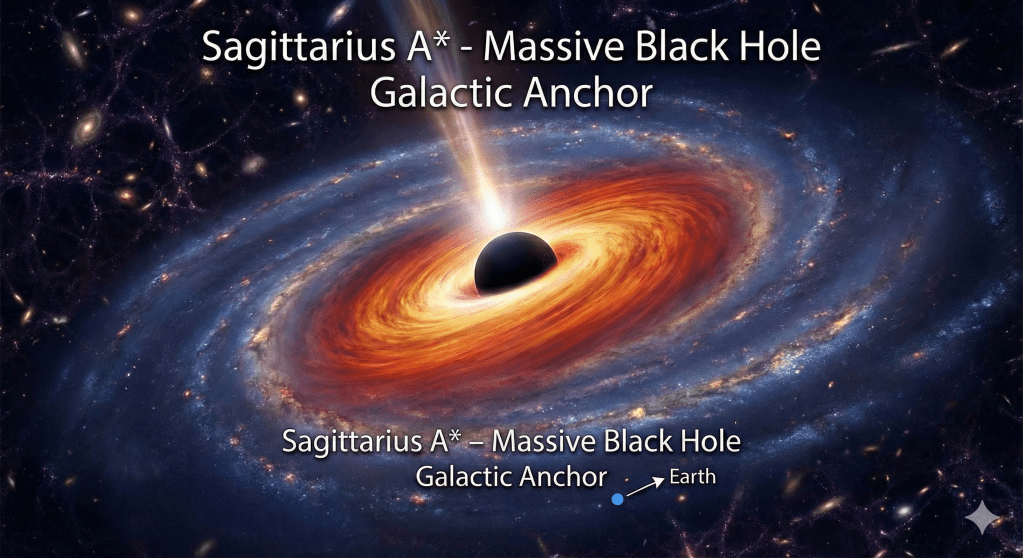
At the center of these galactic structures are supermassive black holes, such as Sagittarius A* at the core of the Milky Way, which act as localized gravitational anchors. These dense regions of warped spacetime exert a powerful gravitational grip that influences the stellar orbits of entire galaxies.
The cosmic web itself, described in Surah Adh-Dhariyat (51:7) as a heaven of “crochet” or woven pathways (al-ḥubuk), is held together by these unseen gravitational fibers. This structure matches the “invisible pillars” of the Ibn Abbas school, demonstrating that cosmic bodies are anchored by non-material fields.
The Fallibility of the Scientific Vanguard: Eddington, Einstein, and the Rejection of Stellar Collapse
While the Quranic text accommodates these unseen gravitational dynamics without structural or physical error, the history of science shows that the human pioneers of physics repeatedly struggled to accept the extreme implications of gravity. This intellectual resistance is best demonstrated by the historical events surrounding the discovery of the Chandrasekhar limit and the theoretical existence of black holes.
The Voyage of Chandrasekhar and the Relativistic White Dwarf
In the summer of 1930, a twenty-year-old Indian student named Subrahmanyan Chandrasekhar sailed from Madras (now Chennai) to England to begin his doctoral studies at Cambridge University. To occupy himself during the long voyage, he calculated the physical parameters governing white dwarf stars.
Astronomers of the day had only a sketchy understanding of what makes stars tick, knowing them to be balls of hot gas engaging in a mammoth balancing act where internal thermal gas pressure tries to expand into the vacuum of space while gravity pulls it back.
In stars like our Sun, an equilibrium is achieved as long as the star consumes its nuclear fuel. But when that fuel runs out, gravity inevitably prevails, causing the star to contract; the smaller the radius, the fiercer the gravitational grip becomes.
Astronomers were familiar with white dwarfs—tiny, burned-out stars containing a mass comparable to the Sun squashed into a volume the size of a planet, compressing their atoms cheek by jowl. It was once thought that the laws of quantum physics—specifically electron degeneracy pressure arising from the Pauli Exclusion Principle—would prevent any further compression, allowing the star to remain stable indefinitely.
However, from his shipboard calculations, Chandrasekhar integrated Einstein’s special relativity with quantum degeneracy physics and reached a different conclusion.
His equations suggested that if a star has a large enough mass, the crushing effect of its immense gravity would cause the atomic electrons to move so fast that their velocities would approach the speed of light (c). Far from the degenerate matter getting more rigid, the relativistic effects would make it even more compressible, presaging a cataclysmic implosion.
In the absence of any other support, the star would collapse into a point of infinite density and infinite geometrical curvature—a singularity representing a boundary of space and time.
Chandrasekhar calculated the critical mass above which this instability occurs, arriving at a limit of approximately 1.44 solar masses (1.44M⊙), now known as the Chandrasekhar Limit:
MCh≈2ω303π(Gℏc)3/2(μemH1)2
The Eddington Rejection and Academic Dogma
Upon arriving in England, Chandrasekhar announced his result, only to find himself dismissed as a young upstart peddling frivolous nonsense. In the 1930s, the complete gravitational collapse of a star was considered too outlandish to take seriously.
The most distinguished astrophysicist of the day, Sir Arthur Eddington—who had famously confirmed Einstein’s general relativity by measuring the gravitational deflection of light during the 1919 solar eclipse—publicly ridiculed Chandrasekhar during an infamous encounter at the Royal Astronomical Society. Eddington declared:
“The star has to go on radiating and radiating and contracting and contracting until, I suppose, it gets down to a few km radius, when gravity becomes strong enough to hold in the radiation, and the star can at last find peace… I think there should be a law of Nature to prevent a star from behaving in this absurd way!”
[cite: 4, 5]
This public rejection by an established scientific authority devastated the young Chandrasekhar, who eventually decided to leave Britain and settle in the United States, where he pursued a distinguished career at the University of Chicago.
Eddington was wrong. If a dying star’s core exceeds the Chandrasekhar limit, it does indeed undergo a spectacular convulsion, collapsing and exploding at the same time: the core implodes in a fraction of a second, while the outer layers are blasted into space in a supernova explosion, such as the one witnessed by Chinese astronomers in 1054 CE.
The core collapses further to form either a neutron star—where atoms are crushed by gravity into a ball of neutrons the size of a city—or, for even more massive stars, collapses completely into a black hole.
| Stellar Mass Range (Core Mass) | Final Evolutionary State | Supporting Pressure / Mechanism | Observational Discovery / Evidence |
|---|---|---|---|
| M<1.44M⊙ | White Dwarf[cite: 4, 5] | Electron Degeneracy Pressure | Famously observed in Sirius B and other nearby stellar remnants. |
| 1.44M⊙<M≈3M⊙ | Neutron Star[cite: 5] | Neutron Degeneracy Pressure | Discovered as pulsars in the late 1960s; observed in the Crab Nebula (1054 CE supernova remnant). |
| M>3M⊙ | Black Hole[cite: 4, 5] | None (Complete Gravitational Collapse) | First discovered in Cygnus X-1 in 1972; imaged directly by the Event Horizon Telescope. |
Einstein’s Denial of Black Holes
Albert Einstein also rejected the extreme implications of his own theory. Although the basic concept of a black hole was implicit in the exact solution to the field equations published by Karl Schwarzschild in 1916, it was dismissed for decades as a mathematical artifact with no physical meaning.
Even Einstein would have none of it. In 1939, Einstein published a paper in The Annals of Mathematics titled “On a Stationary System With Spherical Symmetry Consisting of Many Gravitating Masses,” arguing that physical processes would always prevent gravitational collapse from forming a Schwarzschild singularity.
Einstein modeled a swarm of masses in circular orbits, attempting to show that as the system contracts, the orbital speeds necessary to prevent collapse would have to approach the speed of light before the event horizon could form. Since material bodies cannot exceed c, Einstein concluded that singularities could not exist in physical reality.
Einstein’s model, however, was fundamentally flawed. He assumed a static, stationary system of stable orbits, ignoring the dynamic, non-equilibrium physics of a real imploding stellar core. That same year, J. Robert Oppenheimer and Hartland Snyder published a realistic dynamical analysis of gravitational collapse, demonstrating that when a massive star runs out of thermonuclear fuel, it does collapse directly through its Schwarzschild radius, completely cut off from the outside universe.
Yet, Einstein remained indifferent, never accepting the physical reality of black holes.
It took decades for the concept to be fully understood, culminating in the 1972 discovery of the first physical black hole, Cygnus X-1. We now have to take seriously what Eddington and Einstein refused to confront: that some stars can undergo total gravitational collapse, with violent effects on time and space.
This history reveals a profound philosophical lesson: human geniuses like Einstein and Eddington, despite formulating the very laws of gravity, rejected their logical physical outcomes due to their own intellectual biases. In contrast, the text of the Quran contains no such errors, physical misconceptions, or historically limited assertions.
It describes the cosmos using highly precise, open terminology that remains entirely consistent with these extreme relativistic discoveries.
Thematic Epilogue: Epistemological Integration of Nature and Revelation
The intellectual harmony between modern physics and Quranic cosmology is best understood through the epistemological framework developed by Dr. Zia H. Shah. Shah revives the classical “Two Books” doctrine, asserting that the Creator has revealed Himself through two distinct media:
- The Book of Scripture (The Written Revelation / The Quran): The verbal communication of divine will and metaphysical truth.
- The Book of Nature (The Physical Cosmos): The structural creation, governed by the elegant, mathematical laws of physics.
Shah maintains that because both books originate from the same divine source, they cannot contradict one another. Any apparent conflict is simply a reflection of human error in interpreting either the scriptural text or the scientific data.
This ontological parity is supported by the Quran’s deliberate use of the word āyah (plural āyāt) to refer to both a scriptural verse and a natural phenomenon, such as the rotation of planets or the invisible suspension of the heavens. For the scientific believer, exploring physical reality through a microscope or telescope is itself a form of active exegesis.
To overcome what Shah terms the “anesthesia of familiarity”—the cognitive bias where humanity takes daily phenomena like gravity completely for granted—one must examine the profound cosmic fine-tuning that governs the physical constants.
- The Gravitational Constant (G): Gravity is the weakest of the four fundamental forces, yet it dictates the large-scale structure of the cosmos. If gravity were slightly stronger, stars would burn through their fuel far too rapidly, preventing the stable development of planetary systems. If it were slightly weaker, cosmic temperatures would remain too cold for stellar ignition, leaving a dark, lifeless universe devoid of heavy elements.
- The Strong Nuclear Force: This force binds protons and neutrons within the atomic nucleus. If the strong nuclear force were only slightly stronger, almost all hydrogen in the early universe would have fused into helium, preventing the formation of stars like our Sun and eliminating the hydrogen required to make water. If it were slightly weaker, atomic nuclei would disintegrate, leaving a universe composed solely of hydrogen, unable to form carbon, oxygen, or any organic chemistry.
- The Initial Expansion Rate of the Universe: One second after the Big Bang, the balance between the expansion rate and the mass density of the universe had to be adjusted with extreme accuracy. If the expansion had been faster by mere fractions of a percent—specifically 1 part in 1015—matter would have dispersed too rapidly for stars and galaxies to coalesce. If the expansion had been slower by that same microscopic margin, gravity would have overwhelmed the expansion, causing a premature collapse of the entire universe back into a singular point.
- The Cosmological Constant (Λ): This value, which drives the accelerated expansion of space, represents one of the most extreme cases of fine-tuning in physical science. It must be set to zero or a tiny non-zero value, requiring a balance of roughly 1 part in 10120 to prevent the universe from either ripping itself apart or collapsing instantly.
Under Shah’s paradigm, this fine-tuning is the mathematical signature of the Creator. Shah extends this creative process to biology, advocating for a model of guided evolution. Rather than viewing creation as a static, instantaneous event, Shah integrates the Quranic description of creation occurring in sequential stages (atwār) with the biological reality of evolutionary descent. This ongoing creative mechanism is described in the Quran through four distinct attributes of the Creator:
- Al-Khāliq (The Creator): The initial originator who brings energy, matter, space, and time into existence from nothingness.
- Al-Bāriʾ (The Maker/Developer): The master coordinator who shapes and develops raw matter into organized, stable physical systems.
- Al-Muṣawwir (The Fashioner): The designer who gives form, beauty, and diversity to biological structures and physical systems.
- Al-Fāṭir (The Originator of Laws): The lawgiver who establishes the physical constraints and mathematical constants that allow the universe to function.
Through these attributes, cosmology, physics, chemistry, and evolutionary biology are unified into a single, continuous divine act. The same “invisible pillars” of gravity that hold galaxies together also govern the thermonuclear furnaces of stars, creating the heavy elements necessary for biological life to evolve stage by stage under divine guidance.
The “invisible pillars” of Surah Ar-Ra’d and Surah Luqman are not merely ancient metaphors; they represent the mathematical laws that sustain physical reality. Whether interpreted as absolute structural absence or as invisible physical support, the scriptural text remains aligned with modern cosmology.
To the classical mind, the sky stood as a visible miracle sustained without material columns; to the modern mind, the universe is held in a delicate balance by gravitational fields, spacetime geometry, and dark matter scaffolding.
The cosmos stands secure, held together by invisible pillars of natural law, inviting humanity to look to the horizons, overcome the anesthesia of familiarity, and recognize the divine symmetry that unites nature and revelation.




Leave a Reply