

Audio teaser: The Universe Never Deletes Your Deeds
Abstract
This study presents a rigorous multidisciplinary commentary on Quranic verses 45:27-32, framing classical Islamic eschatology within the modern “Four Books Thesis” developed by Dr. Zia H. Shah, MD. By integrating quantum information theory, the holographic principle, and Al-Ghazali’s occasionalism, this analysis demonstrates how the scriptural depiction of an absolute, self-recording cosmos is highly congruent with 21st-century digital physics. Specifically, this work explores the linguistic and structural significance of the “Book of Deeds” being invoked twice in consecutive verses (45:28 and 45:29). Through an examination of the Arabic root n-s-kh (transcription/duplication) and the mechanics of quantum decoherence, the “recording” of human volition is shown to be a fundamental, irreversible physical process. The analysis concludes that the Quranic vision of cosmic accountability represents a sophisticated informational framework where the physical universe is an objective, losslessly preserved medium.
The Scriptural Grounding: Arabic Text and Comparative Translations
The structural, philosophical, and scientific arguments developed in this study rest upon the text of Surah Al-Jathiyah (45:27-32). Below is the original Arabic text followed by a comparative, verse-by-verse matrix of six prominent English translations.
وَلِلَّهِ مُلْكُ السَّمَاوَاتِ وَالْأَرْضِ ۚ وَيَوْمَ تَقُومُ السَّاعَةُ يَوْمَئِذٍ يَخْسَرُ الْمُبْطِلُونَ ٢٧ وَتَرَىٰ كُلَّ أُمَّةٍ جَاثِيَةً ۚ كُلُّ أُمَّةٍ تُدْعَىٰ إِلَىٰ كِتَابِهَا الْيَوْمَ تُجْزَوْنَ مَا كُنْتُمْ تَعْمَلُونَ ٢٨ هَٰذَا كِتَابُنَا يَنْطِقُ عَلَيْكُمْ بِالْحَقِّ ۚ إِنَّا كُنَّا نَسْتَنْسِخُ مَا كُنْتُمْ تَعْمَلُونَ ٢٩ فَأَمَّا الَّذِينَ آمَنُوا وَعَمِلُوا الصَّالِحَاتِ فَيُدْخِلُهُمْ رَبُّهُمْ فِي رَحْمَتِهِ ۚ ذَٰلِكَ هُوَ الْفَوْزُ الْمُبِينُ ٣٠ وَأَمَّا الَّذِينَ كَفَرُوا أَفَلَمْ تَكُنْ آيَاتِي تُتْلَىٰ عَلَيْكُمْ فَاسْتَكْبَرْتُمْ وَكُنْتُمْ قَوْمًا مُجْرِمِينَ ٣١ وَإِذَا قِيلَ إِنَّ وَعْدَ اللَّهِ حقٌّ وَالسَّاعَةُ لَا رَيْبَ فِيهَا قُلْتُمْ مَا نَدْرِي مَا السَّاعَةُ إِنْ نَّظُنُّ إِلَّا ظَنًّا وَمَا نَحْنُ بِمُسْتَيْقِنِينَ ٣٢
| Verse | Translation Source | Translated Text |
|---|---|---|
| 45:27 | Sahih International | And to Allah belongs the dominion of the heavens and the earth. And the Day the Hour appears – that Day the falsifiers will lose. |
| Abdullah Yusuf Ali | To Allah belongs the dominion of the heavens and the earth, and the Day that the Hour of Judgment is established,- that Day will the dealers in Falsehood perish! | |
| Marmaduke Pickthall | And unto Allah belongeth the Sovereignty of the heavens and the earth; and on the day when the Hour riseth, on that day those who follow falsehood will be lost. | |
| Muhammad Asad | For, God’s is the dominion over the heavens and the earth; and on the Day when the Last Hour dawns – on that Day will be lost all who [in their lifetime] tried to reduce to nothing [whatever they could not understand]. | |
| M.A.S. Abdel Haleem | Control of everything in the heavens and the earth belongs to God. When the Hour comes, those who follow falsehood will be the losers on that Day. | |
| Shakir | And Allah’s is the kingdom of the heavens and the earth; and on the day when the hour shall come to pass, on that day shall they perish who say false things. | |
| 45:28 | Sahih International | And you will see every nation kneeling [from fear]. Every nation will be called to its record [and told], “Today you will be recompensed for what you used to do.” |
| Abdullah Yusuf Ali | And thou wilt see every sect bowing the knee: Every sect will be called to its Record: “This Day shall ye be recompensed for all that ye did!” | |
| Marmaduke Pickthall | And thou wilt see each nation crouching, each nation summoned to its record. (And it will be said unto them): This day ye are requited what ye used to do. | |
| Muhammad Asad | And thou wilt see all people kneeling down [in humility]: all people will be called upon to [face] their record: “Today you shall be requited for all that you ever did!” | |
| M.A.S. Abdel Haleem | You will see every community kneeling. Every community will be summoned to its record: ‘Today you will be repaid for what you did.’ | |
| Shakir | And you shall see every nation kneeling down; every nation shall be called to its book: today you shall be rewarded for what you did. | |
| 45:29 | Sahih International | This, Our record, speaks about you in truth. Indeed, We were having transcribed whatever you used to do. |
| Abdullah Yusuf Ali | “This Our Record speaks about you with truth: For We were wont to put on Record all that ye did.” | |
| Marmaduke Pickthall | This Our Book pronounceth against you with truth. Lo! We have caused (all) that ye did to be recorded. | |
| Muhammad Asad | This Our record speaks of you in all truth: for, verily, We have caused to be recorded all that you ever did! | |
| M.A.S. Abdel Haleem | Here is Our record that tells the truth about you: We have been recording everything you do. | |
| Shakir | This is Our book that speaks against you with justice; surely We wrote what you did. | |
| 45:30 | Sahih International | So as for those who believed and did righteous deeds, their Lord will admit them into His mercy. That is what is the clear attainment. |
| Abdullah Yusuf Ali | Then, as to those who believed and did righteous deeds, their Lord will admit them to His Mercy that will be the achievement for all to see. | |
| Marmaduke Pickthall | Then, as for those who believed and did good works, their Lord will bring them in unto His mercy. That is the evident triumph. | |
| Muhammad Asad | Now as for those who have attained to faith and done righteous deeds, their Sustainer will admit them to His grace: that will be [their] manifest triumph! | |
| M.A.S. Abdel Haleem | Those who believed and did good deeds will be admitted by their Lord into His mercy- that is the clearest triumph. | |
| Shakir | Then as to those who believed and did good, their Lord will make them enter into His mercy; that is the manifest achievement. | |
| 45:31 | Sahih International | But as for those who disbelieved, [it will be said], “Were not Our verses recited to you, but you were arrogant and became a people of criminals?” |
| Abdullah Yusuf Ali | But as to those who rejected God, (to them will be said): “Were not Our Signs rehearsed to you? But ye were arrogant, and were a people given to sin.” | |
| Marmaduke Pickthall | And as for those who disbelieved (it will be said unto them): Were not Our revelations recited unto you? But ye were scornful and became a guilty folk. | |
| Muhammad Asad | But as for those who were bent on denying the truth, [they will be told:] “Were not My messages conveyed to you? And withal, you gloried in your arrogance, and so you became people lost in sin.” | |
| M.A.S. Abdel Haleem | But those who disbelieved [will be asked]: ‘When My revelations were recited to you, were you not arrogant and persistent in wicked deeds?’ | |
| Shakir | But as for those who have disbelieved: ‘Were not My signs recited to you, and you waxed proud, and were a sinful people.’ | |
| 45:32 | Sahih International | And when it was said, ‘Indeed, the promise of Allah is truth and the Hour [is coming] – no doubt about it,’ you said, ‘We know not what is the Hour. We assume only assumption, and we are not convinced.’ |
| Abdullah Yusuf Ali | “And when it was said that the promise of Allah was true, and that the Hour- there was no doubt about its (coming), ye used to say, ‘We know not what is the hour: we only think it is an idea, and we have no firm assurance.’” | |
| Marmaduke Pickthall | And when it was said: Lo! Allah’s promise is the truth, and there is no doubt of the Hour’s coming, ye said: We know not what the Hour is. We deem it naught but a conjecture, and we are by no means convinced. | |
| Muhammad Asad | And when it was said, “God’s promise is true, and the Hour, there is no doubt of it,” you said; “We know not what the Hour may be; we have only a surmise, and are by no means certain.” | |
| M.A.S. Abdel Haleem | When it was said to you, “God’s promise is true: there is no doubt about the Hour,” did you not reply, “We know nothing of the Hour. This is only conjecture in our opinion. We are not convinced”? | |
| Shakir | And when it was said, Surely the promise of Allah is true and as for the hour, there is no doubt about it, you said: We do not know what the hour is; we do not think (that it will come to pass) save a passing thought, and we are not at all sure. |
Theological and Historical Context of Surat Al-Jathiyah
To appreciate the conceptual depth of Quran 45:27-32, it must be situated within the historical and philosophical landscape of Late Meccan society. Surat Al-Jathiyah (“The Crouching” or “The Kneeling”) serves as a systematic critique of arrogance, materialism, and the denial of human accountability. The Meccan oligarchy maintained a worldview dominated by Dahriyah (materialist fatalism), which claimed that the universe was governed exclusively by the passage of time (al-dahr). Their foundational creed, as highlighted in verse 45:24, asserted that biological decay and death were merely the mechanical results of entropy: “There is nothing but our worldly life; we die and live, and nothing destroys us except time”.
This materialist fatalism denied any objective purpose to human action, treating life as a temporary thermodynamic fluctuation that would eventually be erased without a trace. The Quranic response in verses 27-32 directly attacks this physicalist assumption. It constructs a counter-narrative where time is not a passive agent of destruction, but an active dimension of information storage. By asserting that “to Allah belongs the dominion of the heavens and the earth” (45:27), the text establishes that the physical universe is an engineered system designed to preserve, evaluate, and eventually reconstruct human history.
The Dual Invocations of the Book of Deeds
A critical feature of Quran 45:27-32 is the consecutive, dual reference to the “Book of Deeds” in verses 28 and 29. Far from being a redundant stylistic choice, these two references employ distinct theological, linguistic, and structural frameworks to outline a comprehensive system of cosmic accountability.
The Communal Ledger: Kitābihā (45:28)
In verse 45:28, the text states: “And you will see every nation kneeling [from fear]. Every nation will be called to its record/book” (kullu ummatin tud’ā ilā kitābihā). The use of the third-person feminine singular possessive suffix (hā – “its”) binds the record directly to the specific nation (ummah).
This first invocation represents the communal or horizontal ledger of moral history. In classical exegesis, such as the commentaries of Al-Tabari and Ibn Kathir, this refers to the shared destiny and collective responsibility of human societies. Human beings do not act in isolation; their choices are shaped by, and in turn shape, the cultural, legal, and systemic structures of their civilizations. The “book of the nation” evaluates human volition as an emergent property of complex social systems, capturing how collective institutions facilitated righteousness or perpetuated systemic injustice.
The Divine-Objective Database: Kitābunā (45:29)
In verse 45:29, the perspective transitions from the localized communal record to an absolute, divine standard: “This, Our record, speaks about you in truth. Indeed, We were having transcribed whatever you used to do” (hādhā kitābunā yanṭiqu ‘alaykum bil-ḥaqqi innā kunnā nastansikhu mā kuntum taʿmalūn). The possessive suffix shifts to the first-person plural (nā – “Our”), declaring direct divine ownership and sovereign authority over the dataset.
The critical verb here is nastansikhu, a Form X derivation of the root n-s-kh. In classical Arabic lexicography, naskh refers to transcription, copying, duplicating, or cloning an original archetype into another medium. Unlike the communal ledger, which reflects the contextualized societal consequences of action, the divine database represents the objective, lossless replication of the actions themselves.
The choice of nastansikhu implies that human choices are not merely noted down post-facto; rather, they are actively cloned and translated in real-time from their physical execution into an indestructible, high-fidelity cosmic registry.
| Dimension | Communal Record: Kitābihā (Quran 45:28) | Divine Record: Kitābunā (Quran 45:29) |
|---|---|---|
| Linguistic Formulation | Third-person feminine singular possessive suffix (hā – “its book”) binding the record to the collective entity (ummah). | First-person plural possessive suffix (nā – “Our book”) declaring direct divine ownership and authority. |
| Theological Horizon | Subjective, localized, and contextualized within historical, cultural, and societal systems. | Objective, absolute, and cosmic; completely independent of human bias or localized constraints. |
| Operational Mechanism | Summoning of nations to face their historical and moral trajectories as a collective organism. | Continuous active transcription and replication (naskh) of all physical transactions. |
| Linguistic Verb Action | Tud’ā (summoned/called) – passive calling to witness a contextualized ledger. | Yanṭiqu (speaks/witnesses) and nastansikhu (cloning/transcribing) – active physical projection of actions. |
Integration with the Four Books Paradigm of Zia H. Shah MD
To build an intellectually robust bridge between these scriptural concepts and 21st-century cosmology, this commentary integrates the “Four Books Thesis” developed by Dr. Zia H. Shah, MD. Dr. Shah—a sleep medicine and pulmonary physician practicing in Upstate New York, who received his medical education at King Edward Medical University before undergoing advanced fellowships in the United States—serves as a primary architect for this modern reconciliation of scripture and science. As the Chief Editor of the Muslim Times and the Chair of Religion and Science for the Muslim Sunrise, Dr. Shah’s corpus rejects the simplistic “conflict model” of science and religion, moving beyond basic concordism to propose a unified, informational cosmology.
His core argument, presented in the seminal article The Four Books of God: A Quranic Cosmology in the Age of Quantum Physics (https://thequran.love/2026/04/20/the-four-books-of-god-a-quranic-cosmology-in-the-age-of-quantum-physics/), expands the classical Islamic “Two Books” metaphor (Scripture and Nature) into a four-fold framework of divine records. These records are not parallel, isolated domains of truth; they are mutually constitutive, forming a single, coherent system of divine volition and cosmic organization.
  ┌────────────────────────────────────────────────────────┐
  │                   THE MOTHER BOOK                      │
  │                   (Umm al-Kitāb)                       │
  └──────────────────────────┬─────────────────────────────┘
                             │
       ┌─────────────────────┼─────────────────────┐
       ▼                     ▼                     ▼
┌──────────────┐      ┌──────────────┐      ┌──────────────┐
│   BOOK OF    │      │   BOOK OF    │      │   BOOK OF    │
│  REVELATION  │◄────►│    NATURE    │◄────►│   DESTINY    │
│  (Scripture) │      │  (Creation)  │      │ (Al-Lawh...) │
└──────┬───────┘      └──────┬───────┘      └──────┬───────┘
       │                     │                     │
       └─────────────────────┼─────────────────────┘
                             │
                             ▼
                      ┌──────────────┐
                      │   BOOK OF    │
                      │    DEEDS     │
                      │ (Kitāb al..) │
                      └──────────────┘
Within this cosmological architecture, the four books function in an integrated loop:
- The Book of Revelation (The Qur’an): The spoken and written Word of God. It provides the supreme spiritual, ethical, and moral coordinate system (Haqq al-Yaqeen) needed to interpret physical reality.
- The Book of Nature (The Cosmos): The physical universe, viewed as a readable text of divine action (Qur’an-e takwini). It is comprised of observable physical signs (Ayat) that reveal design, cosmic fine-tuning, and the underlying intelligence of the Creator.
- The Book of Destiny (Al-Lawh al-Mahfūẓ): The Preserved Tablet, which serves as the pre-programmed informational grid of physical laws, boundary conditions, and universal constants. This book acts as the cosmological source code that ensures physical processes run deterministically and consistently.
- The Book of Deeds (Kitāb al-Aʿmāl): The permanent record of all conscious human volition, moral choices, and physical actions. This book compiles the specific inputs generated by human free will as it operates within the computational boundaries defined by the Book of Destiny.
In this framework, the physical laws of the universe are not autonomous, self-sustaining properties. Drawing on Al-Ghazali’s occasionalism, Dr. Shah describes these laws as the “Divine Habit” (ʿādah)—the continuous, frame-by-frame recreation of reality by the Creator. Human choices are actively mirrored, copied, and transcribed (nastansikhu) into this cosmic canvas, ensuring that the physical universe behaves as a massive recording device.
Quantum Unitarity, Decoherence, and the Holographic Eschaton
When verse 45:29 asserts, “This, Our record, speaks about you in truth. Indeed, We were having transcribed whatever you used to do,” it describes a universe designed for absolute, lossless information preservation. This theological claim aligns closely with several core concepts in quantum information theory, digital physics, and cosmology.
Quantum Unitarity and Information Conservation
In modern quantum mechanics, the evolution of a physical system is described by the Schrödinger equation, which governs the state vector of a closed system. This time evolution is fundamentally unitary, which means the quantum state changes in a way that preserves probability. A critical mathematical consequence of unitarity is that quantum information can never be destroyed, nor can it be created from nothing.
If a book is burned to ash, the classical information written on its pages is lost to human observers. However, from the standpoint of quantum mechanics, the informational state of every carbon atom, electron, and radiated photon remains perfectly preserved within the total wave function of the universe. This principle is mathematically formalized by the no-hiding theorem (proven by Sam Braunstein and Arun Pati), which proves that when information is lost from a local quantum system through dissipation or thermalization, it is never destroyed; instead, it migrates entirely into the quantum correlations (entanglement) of the larger environment.
The universe, therefore, acts as an un-erasable thermodynamic ledger. This absolute physical persistence provides a concrete, mathematical parallel to the Quranic assertion that “not an atom’s weight” can escape the divine record.
This absolute retention of information is also grounded in the thermodynamics of computation, specifically Landauer’s Principle. Landauer’s Principle states that erasing a single bit of information always dissipates a minimum thermodynamic cost of heat energy, expressed as:
ΔQ≥kBTln2
where kB is the Boltzmann constant and T is the absolute temperature of the thermodynamic environment. Because erasing information carries an absolute physical penalty, a universe designed for absolute physical retention is the most natural state of the cosmos, aligning perfectly with the Quranic promise of absolute, loss-free justice.
Quantum Decoherence as a Record
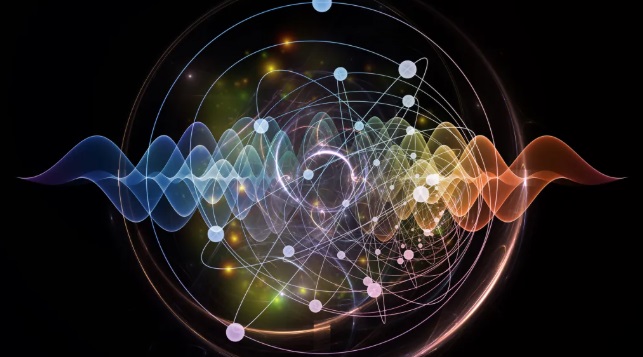
Traditional theology describes recording angels (Kiraman Katibin) actively writing down every human word and deed. Dr. Shah proposes a physical model for this process: the recording mechanism is the natural phenomenon of quantum decoherence.
When a conscious agent exercises free will—vocalizing a word, moving a limb, or even firing a sequence of synapses in the brain—the system is not isolated. The macroscopic elements of the body constantly interact with environmental particles, such as air molecules, thermal radiation, and ambient photons.
This interaction causes the quantum states of the agent to entangle with the environment. This process of quantum decoherence “collapses” the superposition of potential actions into a single, concrete, classical reality, permanently writing the historical path of that action into the physical fabric of spacetime.
From this perspective, the recording angels are understood as the physical and thermodynamic entanglement fields that continuously “transcribe” and lock our subjective choices into the irreversible timeline of the objective universe.
  ┌────────────────────────────────────────────────────────┐
  │                CONSCIOUS AGENT (Subject)               │
  │  Superposition of potential choices: |ψ⟩ = α|0⟩ + β|1⟩  │
  └──────────────────────────┬─────────────────────────────┘
                             │
                             │ (Exercise of Moral Volition)
                             ▼
  ┌────────────────────────────────────────────────────────┐
  │              ENVIRONMENTAL INTERACTION                 │
  │     Photons, air molecules, and thermal radiation      │
  │          entangle with the agent's physical system     │
  └──────────────────────────┬─────────────────────────────┘
                             │
                             │ (Quantum Decoherence / Collapse)
                             ▼
  ┌────────────────────────────────────────────────────────┐
  │                 THE RECORDED STATE                     │
  │    Irreversible classical reality written into history  │
  │          "We were having transcribed..." (45:29)       │
  └────────────────────────────────────────────────────────┘
The Holographic Principle and the Cosmic Archive
Where is this astronomical volume of historical data stored? Dr. Shah addresses this by leveraging the Holographic Principle from string theory and black hole thermodynamics, pioneered by Gerard ‘t Hooft and Leonard Susskind.
The holographic principle posits that the entire informational content of a three-dimensional volume of space can be mathematically mapped and fully described by the physical states encoded on its two-dimensional boundary.
In black hole physics, information that falls into the event horizon is not lost but is preserved losslessly on the two-dimensional boundary surface. Applying this to cosmology, Dr. Shah proposes that the entire universe can be viewed as an information structure projected from a higher-dimensional cosmological boundary.
This boundary serves as the ultimate “cosmic memory surface” or Al-Lawh al-Mahfuz. In this context, every human thought, volition, and action is projected and permanently inscribed on the holographic boundary of the universe.
This leads directly to the concept of the Holographic Eschaton, where the Resurrection (Al-Qiyamah) is modeled not as a magical creation ex nihilo, but as a systematic process of data retrieval and rendering. On the Day of Judgment, the preserved quantum information is retrieved from the cosmic boundary, reconstructing the biological organisms and rendering their entire historical timeline into readable, objective output.
Philosophical Implications: Occasionalism, Volition, and Divine Sovereignty
The theological architecture of Surah Al-Jathiyah confronts the deterministic, materialist worldview of the pre-Islamic Arabs (the Dahriyya), who claimed: “There is nothing but our worldly life; we die and live, and nothing destroys us except time” (45:24). The Quran rejects this worldview as mere conjecture (zann), replacing a universe governed by blind entropy with a cosmos designed around absolute information preservation.
Resolving the Free Will Paradox
Critics of cosmic predestination often point to an apparent contradiction between the absolute foreknowledge of God (the Book of Destiny) and the moral responsibility of the human soul (the Book of Deeds).
Under Dr. Shah’s framework, this paradox is resolved through the concept of computational constraints. The Book of Destiny does not force human choices; rather, it defines the pre-programmed mathematical codes, physical constants, and boundary conditions of the cosmos.
Just as a computer simulation requires an underlying operating system to run, human moral agency requires a stable, law-governed physical environment to execute meaningful choices. The physical laws of the universe are the necessary “hardware” that allows the “software” of human volition to generate real, lasting consequences.
Revitalizing Ghazalian Occasionalism
This digital cosmological framework also breathes new life into classical Ash’arite and Ghazalian occasionalism. Al-Ghazali famously argued that natural laws are not autonomous, self-existent causal powers, but rather represent the habitual, frame-by-frame recreation of reality by the divine will (ʿādah).
In the language of quantum mechanics, this can be understood as a continuous, discrete rendering of the cosmos. The transition of a quantum wave packet from a range of probabilities to a single collapsed classical state is not a blind, accidental occurrence; instead, it represents the continuous, divine observation and recreation of physical reality.
This means that while the Book of Destiny dictates the mathematical rules of the rendering engine, the human agent is given a genuine window of free will to select their moral trajectories. The moment a choice is made, it is collapsed into classical reality and cloned (nastansikhu) into the cosmic database.
| Philosophical Parameter | Traditional Materialist / Dahriyya View | Shah’s “Four Books” View |
|---|---|---|
| Primary Metric of Success | Material accumulation, geopolitical hegemony, and physical dominance | The spiritual quality, integrity, and depth of individual moral effort (sa’ee) |
| Cosmic Record Keeper | Non-existent; physical history is lost to entropy, decay, and time | An objective digital database losslessly encoded via quantum unitarity and the holographic principle |
| Scientific Inquiry | A secular endeavor that threatens traditional religious dogma | Reclaimed as a supreme act of worship (Tafakkur) and a systematic reading of the Book of Nature |
| The Nature of Time and Destiny | A linear, blind, and destructive physical mechanism (al-dahr) | A pre-programmed informational grid providing the computational arena for moral volition |
The psychological profiles of the disbelievers outlined in verses 45:31-32 highlight the intellectual cost of denying this informational cosmology. The text describes those who reject the resurrection as falling into arrogance (fastakbartum) and intellectual complacency, dismissing the eschaton as mere conjecture (zann) and passing thought.
Without the paradigm of a losslessly preserved Book of Deeds, human behavior inevitably degenerates into moral opportunism, as there is no perceived long-term conservation of moral value in the universe. Belief in the Book of Deeds, therefore, provides a necessary rational anchor for objective morality, assuring the conscious observer that every effort is permanently recorded and structurally preserved in the fabric of reality.
Thematic Epilogue
Quran 45:27-32 presents a profound vision of a universe that is fundamentally readable, recordable, and meaningful. Far from being a chaotic assembly of matter and energy destined to be erased by the march of time, the cosmos is revealed to be a carefully constructed informational ledger.
By reading these verses through Dr. Zia H. Shah’s Four Books Thesis, theology and physics are brought into a fruitful, unified dialogue. The dual invocation of the Book of Deeds in verses 28 and 29 is not a simple rhetorical repetition, but a structural revelation. It links the subjective, communal narrative of human history to the objective, fundamental quantum-informational database of the cosmos.
This framework reassures the conscious observer that moral effort is never lost. The physical laws defined in the Book of Destiny operate as the rendering engine for the physical world, creating a canvas where the human soul can paint its choices.
As these choices are executed, they are instantly recorded through quantum decoherence and losslessly cloned onto the holographic boundary of the universe. The Book of Nature and the Book of Revelation serve as twin guides in this life, pointing toward this ultimate reality.
When the Last Hour dawns, the physical universe will not simply collapse into oblivion; rather, it will undergo a process of data recovery. The holographic cosmic boundary will render the preserved data of our choices, reconstructing our physical forms and presenting the Book of Deeds with absolute, mathematical, and divine truth.



Leave a Reply