
Audio teaser: The Physics of Divine Omnipresence
The Dimensional Architecture of Divine Omnipresence: A Scientific, Philosophical, and Theological Commentary on Quran 58:7
Presented by Gemini for Zia H Shah MD
Abstract
This research report provides a multi-disciplinary commentary on Quran 58:7 and its correlative verses (2:186, 57:4, 56:85, 50:16, 8:24, and 11:61), establishing a conceptual nexus between classical Islamic metaphysics and contemporary theoretical physics. Historically, Islamic scholars struggled to reconcile the absolute transcendence (Tanzīh) of the Divine essence with His intimate immanence (Tashbīh) within the created order. By utilizing the higher-dimensional models of modern string theory and 11-dimensional M-theory—particularly as synthesized in the pioneering theological-scientific treatises of Zia H. Shah, MD—this analysis demonstrates how multi-dimensional cosmology mathematically models a Divine presence that is simultaneously transcendent and immanently close to every coordinate of reality without occupying physical space or displacing matter.
Furthermore, this report examines the physical implications of “nearness” through the lens of quantum nonlocality, the ER=EPR conjecture (which equates quantum entanglement with microscopic, non-traversable wormholes), and the “Hard Problem of Consciousness”. Through these frameworks, the classical philosophical distinction between objective physical reality and subjective internal experience is bridged, revealing a unified metaphysical architecture wherein Divine “Knowledge by Presence” (al-ʿIlm al-Ḥuḍūrī) permeates both the microscopic quantum vacuum and the deepest recesses of human subjectivity.
Theological and Exegetical Analysis of Quran 58:7
The foundational text under investigation is Quran 58:7, which proclaims the absolute, unmediated omniscience of the Divine:
أَلَمْ تَرَ أَنَّ اللَّهَ يَعْلَمُ مَا فِي السَّمَاوَاتِ وَمَا فِي الْأَرْضِ ۖ مَا يَكُونُ مِن نَّجْوَىٰ ثَلَاثَةٍ إِلَّا هُوَ رَابِعُهُمْ وَلَا خَمْسَةٍ إِلَّا هُوَ سَادِسُهُمْ
وَلَا أَدْنَىٰ مِن ذَٰلِكَ وَلَا أَكْثَرَ إِلَّا هُوَ مَعَهُمْ أَيْنَ مَا كَانُوا ۖ ثُمَّ يُنَبِّئُهُم بِمَا عَمِلُوا يَوْمَ الْقِيَامَةِ ۚ إِنَّ اللَّهَ بِكُلِّ شَيْءٍ عَلِيمٌ
“Have you not considered that Allāh knows what is in the heavens and what is on the earth? There is in no private conversation three but that He is the fourth of them, nor are there five but that He is the sixth of them – and no less than that and no more except that He is with them wherever they are. Then He will inform them of what they did on the Day of Resurrection. Indeed Allāh is, of all things, Knowing.”
[cite: 5, 6]
Linguistic and Structural Composition
The verse employs highly precise structural rhetoric. In his classical commentary, Imam Ahmad ibn Hanbal noted that the passage is deliberately bounded by the concept of Divine knowledge: it begins by declaring that Allāh knows all that exists in the heavens and the earth, and culminates with the affirmation that He is All-Knowing of everything. This rhetorical framing serves to steer the reader away from anthropomorphic interpretations of “presence” (Ma’iyyah). The divine “withness” described is not spatial containment or material cohabitation, but rather an epistemic and existential encompassing.
The classical Arabic term Najwa (نجوى) denotes a private, intimate, or secret consultation conducted in whispers, hidden from the ears of external observers. By using numerical progressions—three people with the Divine as the fourth, five with the Divine as the sixth, and explicitly asserting “no less than that and no more”—the text establishes that the Divine is not merely a passive, distant observer of human affairs. Rather, He is an active, constituent participant in the ontological reality of every interaction.
Classical Hermeneutical Interpretations
In Tafsir Ibn Kathir, the discourse surrounding Ma’iyyah (withness) is bifurcated into two dimensions:
- General Withness (al-Ma’iyyah al-ʿĀmmah): God’s encompassing knowledge, sight, and hearing over all creation, as referenced in the opening of the verse.
- Specific Withness (al-Ma’iyyah al-Khāṣṣah): His divine aid, protection, and immediate presence with His prophets and righteous servants, which is highlighted in other passages but contrasted here with the inescapable universal presence that monitors conspirators and whisperers alike.
Scholars such as Al-Qurtubi and the authors of Ma’arif al-Quran emphasize that the physical impossibility of a literal “spatial” descent or placement of the Divine within a human gathering necessitates a metaphysical understanding. If God were physically confined to a location to be “the fourth” or “the sixth,” it would imply He is subject to the limitations of space, division, and physical boundaries—attributes fundamentally denied by the core Islamic tenet of Tawḥīd (Divine Oneness and Transcendence). Thus, classical theology posited that God is present everywhere by His knowledge, power, and sight while His essence (Dhāt) remains distinct from and transcendent over the created cosmos.
However, this classical formulation left open an ontological question: how does an absolute, non-spatial being interact with, perceive, and intimately “co-occupy” the specific spatial coordinates of a material universe? To address this, one must turn to the wider Quranic corpus that describes Divine proximity.
A Correlative Exposition of Divine Proximity in the Quranic Corpus
To build a comprehensive theological framework, Quran 58:7 must be read in tandem with other verses that elucidate the nature of Divine immanence, nearness, and unmediated access to creation.
1. Quran 2:186: The Proximity of Direct Responsiveness
وَإِذَا سَأَلَكَ عِبَادِي عَنِّي فَإِنِّي قَرِيبٌ ۖ أُجِيبُ دَعْوَةَ الدَّاعِ إِذَا دَعَانِ ۖ فَلْيَسْتَجِيبُوا لِي وَلْيُؤْمِنُوا بِي لَعَلَّهُمْ يَرْشُدُونَ
“And when My servants ask you, [O Muhammad], concerning Me – indeed I am near. I respond to the invocation of the supplicant when he calls upon Me. So let them respond to Me [by obedience] and believe in Me that they may be [rightly] guided.”
[cite: 17, 18]
In this verse, a profound structural shift occurs. Throughout the Quran, when the Prophet Muhammad is asked about various matters (such as the crescent moons, orphans, or the soul), the text invariably commands: “Say (Qul)…”. However, when the question concerns the proximity of the Creator, the word “Say” is bypassed entirely. The response is delivered in the first person: “indeed I am near”. This linguistic immediacy underscores an unmediated, direct relationship between the Creator and the human consciousness. The nearness (Qurb) described here is both ontological and functional; it guarantees that the human voice, even in the silent chambers of the heart, requires no physical medium or spatial transit to reach the Divine.
2. Quran 57:4: The Co-Presence of the Encompasser
هُوَ الَّذِي خَلَقَ السَّمَاوَاتِ وَالْأَرْضَ فِي سِتَّةِ أَيَّامٍ ثُمَّ اسْتَوَىٰ عَلَى الْعَرْشِ ۚ يَعْلَمُ مَا يَلِجُ فِي الْأَرْضِ وَمَا يَخْرُجُ مِنْهَا
وَمَا يَنزِلُ مِنَ السَّمَاءِ وَمَا يَعْرُجُ فِيهَا ۖ وَهُوَ مَعَكُمْ أَيْنَ مَا كُنْتُمْ ۚ وَاللَّهُ بِمَا تَعْمَلُونَ بَصِيرٌ
“He is the One Who created the heavens and the earth in six periods, then established Himself upon the Throne. He knows what penetrates into the earth and what emerges from it, and what descends from the heaven and what ascends into it; and He is with you wherever you are. And Allāh is Seeing of what you do.”
[cite: 22]
This verse juxtaposes the ultimate cosmic scale of creation and the absolute transcendence of the Throne (al-ʿArsh) with the immediate, intimate immanence of Ma’iyyah (“He is with you wherever you are”). The theological term Al-Muḥīṭ (The Encompasser) is derived from this conceptual framework. God does not look down upon the universe from a distance; rather, the entire spatial-temporal matrix is enveloped within His divine reality. He is present at every node of cosmic activity, monitoring the microscopic penetration of particles into the earth and the macroscopic ascent of energy into the heavens.
3. Quran 56:85: Proximity at the Ontological Threshold of Death
وَنَحْنُ أَقْرَبُ إِلَيْهِ مِنكُمْ وَلَٰكِن لَّا تُبْصِرُونَ
“And We are nearer to him than you, but you do not see.”
[cite: 25]
Set against the dramatic backdrop of human mortality, this verse addresses the moment of transition when the soul (Rūḥ) reaches the throat. The surrounding family members, medical practitioners, and physical observers look on, physically closer to the dying individual than any other entity. Yet, the text asserts an unseen, higher-order proximity: “We are nearer to him than you, but you do not see”. This reveals that physical, spatial proximity (which is visible and measurable in three dimensions) is secondary to an underlying, non-spatial Divine proximity that governs the departure of consciousness.
4. Quran 50:16: Proximity Beyond the Physical Conduit of Life
وَلَقَدْ خَلَقْنَا الْإِنسَانَ وَنَعْلَمُ مَا تُوَسْوِسُ بِهِ نَفْسُهُ ۖ وَنَحْنُ أَقْرَبُ إِلَيْهِ مِنْ حَبْلِ الْوَرِيدِ
“And We have already created man and know what his soul whispers to him, and We are closer to him than [his] jugular vein.”
[cite: 28, 29]
The jugular vein (Ḥabl al-Warīd) is the vital biological conduit carrying oxygenated blood directly to the human brain; its severing results in instantaneous physical death. By declaring a proximity closer than this primary physical vessel, the Quran shifts the locus of Divine presence from external space into the very center of human biology and subjective consciousness. The verse links this proximity to the Divine knowledge of Waswasah—the silent, pre-vocalized whispers of the human ego. This implies that God’s access to human thoughts is more direct than the human mind’s access to its own cognitive processes.
5. Quran 8:24: Interposition at the Core of Human Subjectivity
يَا أَيُّهَا الَّذِينَ آمَنُوا اسْتَجِيبُوا لِلَّهِ وَلِلرَّسُولِ إِذَا دَعَاكُمْ لِمَا يُحْيِيكُمْ ۖ وَاعْلَمُوا أَنَّ اللَّهَ يَحُولُ بَيْنَ الْمَرْءِ وَقَلْبِهِ وَأَنَّهُ إِلَيْهِ تُحْشَرُونَ
“O you who have believed, respond to Allāh and to the Messenger when he calls you to that which gives you life. And know that Allāh intervenes between a man and his heart and that to Him you will be gathered.”
[cite: 30, 31]
The Arabic verb Yaḥūl (يحول) indicates an absolute barrier, an intervention, or an interposition that stands between two things. This verse states that God interposes Himself between a man and his own heart. In Islamic psychology, the “heart” (Qalb) is the seat of intellect, volition, and spiritual perception. This divine interposition means that the ultimate foundation of human free will, subjective experience, and self-awareness is constantly sustained by an immediate Divine presence. It is a radical assertion of immanence: the human subject cannot access their own inner self except through the underlying medium of the Divine.
6. Quran 11:61: Prophetic Affirmation of Nearness and Responsiveness
وَإِلَىٰ ثَمُودَ أَخَاهُمْ صَالِحًا ۚ قَالَ يَا قَوْمِ اعْبُدُوا اللَّهَ مَا لَكُم مِّنْ إِلَٰهٍ غَيْرُهُ ۖ هُوَ أَنشَأَكُم مِّنَ الْأَرْضِ وَاسْتَعْمَرَكُمْ فِيهَا ۖ
فَاسْتَغْفِرُوهُ ثُمَّ تُوبُوا إِلَيْهِ ۚ إِنَّ رَبِّي قَرِيبٌ مُّجِيبٌ
“And to Thamūd [We sent] their brother Ṣāliḥ. He said, ‘O my people, worship Allāh; you have no deity other than Him. He has produced you from the earth and settled you in it, so ask forgiveness of Him and then repent to Him. Indeed, my Lord is near and responsive.’”
[cite: 32, 33]
Here, the Prophet Salih connects the physical, terrestrial origin of humanity—being produced “from the earth” and “settled in it”—with the metaphysical reality of a Lord Who is Qarīb (Near) and Mujīb (Responsive). This establishes that although human beings are physically bound to a material, three-dimensional planet, their spiritual and ontological origin remains directly tethered to a non-local, responsive Divine source.
Scientific Implications of Divine Proximity: Extra Dimensions, Entanglement, and Holographic Wormholes
When these theological concepts are analyzed alongside modern physics, the literal concept of “being near” takes on a revolutionary meaning. Rather than relying on classical spatial-mechanical metaphors, contemporary theoretical physics offers elegant mathematical frameworks—such as extra dimensions, quantum entanglement, and wormholes—that provide rigorous models for understanding divine omnipresence and immanence.
Multi-Dimensional Cosmology: The Theses of Zia H. Shah, MD
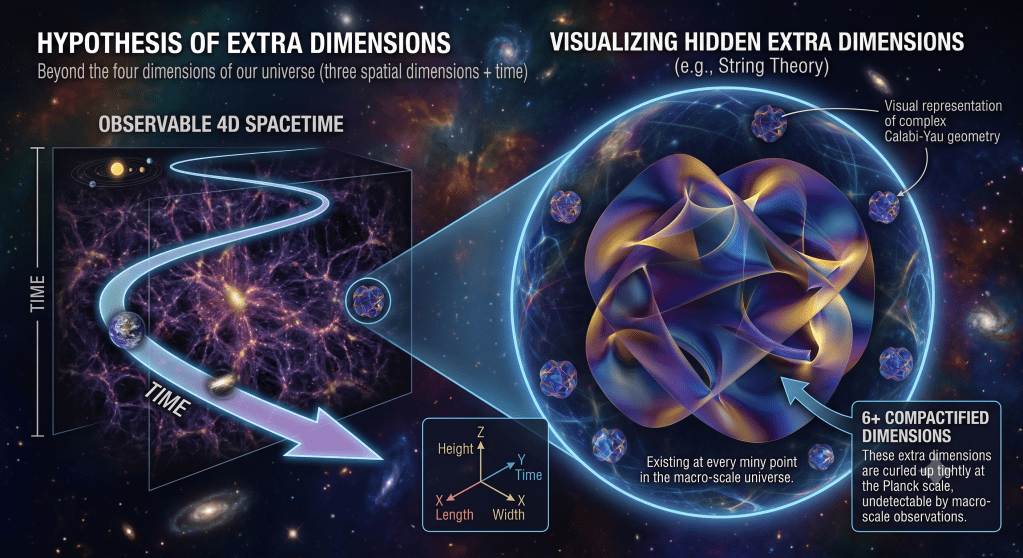
In a series of ground-breaking papers exploring the intersections of theoretical physics and Islamic theology, Zia H. Shah, MD, posits that God’s absolute omniscience mathematically demands the existence of extra spatial dimensions. Shah argues that if God is to possess instantaneous, complete knowledge of the state of every single subatomic particle, quark, atom, and conscious thought in the universe, He must have a direct, unmediated presence at every coordinate of reality. If this presence were restricted to our familiar three-dimensional spatial matrix (3D space + 1D time), it would violate the laws of physical displacement, or render God a material entity subject to spatial confinement.
To resolve this, Shah utilizes the mathematics of higher-dimensional string theory and 11-dimensional M-theory. In these models, our entire four-dimensional space-time continuum is conceptualized as a localized sheet, or “brane,” embedded within a much larger, higher-dimensional bulk space. Shah introduces the elegant Tapestry Analogy to make this intuitive:
Imagine a flat, two-dimensional piece of paper (2D space) inhabited by two-dimensional beings. A three-dimensional observer standing outside the paper can look down and touch every single point on that 2D sheet simultaneously without traveling across the surface of the paper itself. To the 2D inhabitants, the 3D hand appears “everywhere” at once, contacting their reality without displacing any 2D objects.
Applying this analogy to higher dimensions, our entire 3D physical universe is a tapestry enveloped by a higher-dimensional Divine reality. A being operating from a higher dimension can be in direct, physical contact with the interior of every solid object, the center of every star, and the neural pathways of every brain simultaneously. This higher-dimensional access does not displace physical matter, just as a 3D line can pass through a 2D square without disrupting its perimeter in the 2D plane. Thus, the Quranic name Al-Muḥīṭ (The Encompasser) and the assertion “He is with you wherever you are” are shown to be conceptually consistent with a universe structured around hidden spatial dimensions.
M3,1⊂M10,1
where M3,1 represents our standard four-dimensional space-time, embedded within the eleven-dimensional manifold M10,1 of M-theory. This mathematical relationship allows for transcendent separation from the brane while maintaining absolute immanent contact at every coordinate of space-time.
Furthermore, in higher dimensions, a being can see all of time laid out at once, mirroring the theological belief that the past, present, and future are all present to God in a single, eternal “now”. Shah also contextualizes the role of the “recording angels” (Kirāman Kātibīn) and unseen witnesses through this framework. Rather than adopting a sensationalized approach, Shah notes that the language of extra dimensions and quantum physics can serve as a disciplined, cautious philosophical model for understanding how an absolute record of human actions is kept without requiring physical books or local scribes.
Quantum Entanglement and Cosmic Interconnectedness
While extra dimensions provide a model for global omnipresence, quantum mechanics provides a compelling paradigm for the localized, instantaneous “nearness” and unmediated responsiveness described in Quran 2:186 and 58:7.
Quantum entanglement is the phenomenon where two or more particles become linked such that the physical state of one instantaneously correlates with the state of the other, regardless of the spatial distance separating them. Albert Einstein famously resisted this concept, labeling it “spooky action at a distance” because it seemed to violate the absolute speed limit of light (c) mandated by his Special Theory of Relativity.
However, modern quantum experiments have verified that this instantaneous connection is a fundamental feature of reality. Landmark studies have confirmed this nonlocality across vast distances:
- In 2017, the Chinese satellite Micius (launched under the Quantum Experiments at Space Scale, or QUESS, program) successfully demonstrated quantum entanglement over a record distance of 1,200 km.
- To bypass the severe photon loss associated with ground-based optical fibers over long distances, the QUESS project transmitted entangled photon pairs through the vacuum of space via highly focused laser beams.
- The chief commander of the project, Wang Jianyu, described the precision required for this alignment as equivalent to “tossing a coin from a plane at 100,000 meters above sea level exactly into the slot of a rotating piggy bank”. This space-based method achieved a distribution efficiency a trillion times greater than ground-based telecommunication fibers.
- Additionally, an experiment conducted by Juan Yin and colleagues analyzed entangled photons separated by 15 km and concluded that if a physical signal were traveling between them to coordinate their states, it would have to propagate at a lower bound of at least 10,000 times the speed of light.
Δt→0⟹vcorrelation≥104c
Mainstream quantum physics interprets this as being intrinsically nonlocal, meaning entangled particles behave as a single unified system rather than separate elements. This nonlocality is interpreted differently across various physical frameworks:
- Copenhagen Interpretation: The wavefunction collapses instantly across any distance when a measurement is made. This collapse is not viewed as a physical force or signal, but rather as an instantaneous update in our knowledge of the system.
- Many-Worlds Interpretation: Avoids wavefunction collapse entirely. When entangled particles are measured, the universe splits into branches corresponding to each outcome; the correlation remains because the observer and the observed particles evolve together as part of a single, branching quantum state.
- Pilot-Wave Theory (De Broglie-Bohm): Entangled particles share a single, connected wavefunction that extends across space. A measurement on one particle instantly guides the behavior of the other because the pilot wave links them nonlocally.
- Superdeterminism: Posits that the universe has “conspired” from its inception such that the detector settings and the particle states are not independent, removing the need for instantaneous signaling at the price of absolute free will and independent variables.
Regardless of the interpretation, these quantum correlations reveal that at a fundamental level, the universe is woven together by non-local connections, providing a robust scientific analogy for how the Creator can remain in immediate contact with all parts of the cosmos simultaneously.
Holographic Geometry and Quantum Wormholes (ER=EPR)
To demystify how entangled particles coordinate their outcomes across vast distances without violating relativity, theoretical physicists have explored speculative, alternative models. One of the most prominent modern concepts is the ER=EPR conjecture, proposed by Juan Maldacena and Leonard Susskind.
This conjecture suggests that every entangled pair of particles (representing the “EPR” paradox) is physically connected by a tiny Einstein-Rosen bridge (representing “ER”, or a quantum wormhole). Instead of traveling across normal three-dimensional physical space, the connection is established via a shortcut through a higher dimension. This explains why the correlation appears instantaneous to us.
Crucially, standard gravitational physics maintains that these wormholes are non-traversable due to topological censorship. Under normal conditions, Einstein’s field equations prevent anything from passing through the wormhole because the throat pinches off or collapses too quickly. In systems of entangled fermions, the rapid formation of black holes over both ends of the wormhole ensures non-traversability, which elegantly preserves causality and prevents superluminal signaling.
However, a highly relevant breakthrough in this domain was published by physicist Peter K.F. Kuhfittig in 2024, titled Wormholes supported by small extra dimensions. Traditionally, keeping a Morris-Thorne wormhole open requires a violation of the null energy condition, demanding the existence of highly unphysical “exotic matter”. Kuhfittig demonstrated that the existence of small, microscopic extra dimensions—consistent with the compactified dimensions of string theory—can resolve this issue. The extra dimensions themselves can be responsible for the unavoidable energy violation, allowing the throat of the wormhole to be lined with ordinary matter.
This scientific development has profound implications for our theological model:
Extra Dimensions⟹Wormhole Stabilization⟹Instantaneous Spatial Connectivity
It shows that hidden, microscopic extra dimensions provide the exact physical mechanism needed to support and stabilize spatial shortcuts. This mathematically aligns with Zia H. Shah’s thesis that extra dimensions are the key to understanding how the universe is structurally designed to allow immediate, unmediated connection and access.
This relationship between quantum information and physical geometry was empirically simulated in 2022, when physicists Natalie Wolchover and Maria Spiropulu’s team utilized Google’s Sycamore quantum processor to create a “holographic wormhole”. By manipulating entangled qubits in a quantum chip, the researchers simulated the dynamics of a traversable wormhole in a holographic dual space, demonstrating that the fabric of space-time itself may emerge directly from quantum information.
Comparative Matrix of Quranic Proximity and Theoretical Physics
The following table synthesizes the seven Quranic verses with their key Arabic terminology, theological focus, and modern scientific counterparts.
| Quranic Verse | Key Arabic Term | Theological Theme | Physics / Metaphysical Counterpart |
|---|---|---|---|
| Quran 58:7[cite: 5] | Najwa (Secret whispers) | Universal, unmediated omniscience and co-presence | Multi-dimensional coordinate access (D>4) |
| Quran 2:186[cite: 18] | Qarīb (Near) | Direct, unmediated responsiveness to prayer | Quantum nonlocality and zero-latency correlation |
| Quran 57:4[cite: 22] | Ma’akum (With you) | Spatial-temporal encompassment (Al-Muḥīṭ) | Embedding of the 3D space-time brane in bulk |
| Quran 56:85[cite: 25] | Aqrabu (Nearer) | Unseen ontological proximity at the death threshold | Hidden dimensions of reality |
| Quran 50:16[cite: 28] | Ḥabl al-Warīd (Jugular vein) | Interpenetration of physical biology and thought | ER=EPR spatial shortcuts |
| Quran 8:24[cite: 31] | Yaḥūlu (Interposes) | Divine foundation of subjective self-awareness | Quantum wave-function coupling and consciousness |
| Quran 11:61[cite: 33] | Mujīb (Responsive) | Intimate interaction with material creation | Information-theoretic emergence of space-time |
The Metaphysics of Subjective Consciousness: The Hard Problem and Knowledge by Presence
The ultimate challenge in both modern science and philosophy is not the mapping of outer space, but the exploration of inner space: the nature of subjective, first-person experience.
The Hard Problem of Consciousness
In the philosophy of mind, David Chalmers coined the term “the Hard Problem of Consciousness” to distinguish between the “easy problems” (such as mapping the neural correlates of sensory inputs or identifying brain wave patterns) and the truly difficult problem of explaining why and how physical brain processes give rise to subjective experience (qualia).
Reductionist materialism posits that the mind is merely an emergent property of biochemical reactions and electrical signals within the brain. Yet, this perspective cannot explain the subjective “feel” of seeing the color red, experiencing pain, or harboring a private thought. This “explanatory gap” highlights the limitation of modern physicalism: the human mind remains a private, highly secure sanctuary, inaccessible to external physical measurement. An external observer can map a person’s neurological activity using functional Magnetic Resonance Imaging (fMRI), but they can never directly access or experience that person’s subjective thoughts.
Divine Transparency and Knowledge by Presence (al-ʿIlm al-Ḥuḍūrī)
While the human mind remains a private, closed sanctuary to other human beings and scientific instruments, the Quran asserts that this domain is completely open and transparent to the Creator:
“…وَنَعْلَمُ مَا تُوَسْوِسُ بِهِ نَفْسُهُ…” (ق 50:16)
“and We know what his soul whispers to him…”
[cite: 28]
“…وَاعْلَمُوا أَنَّ اللَّهَ يَحُولُ بَيْنَ الْمَرْءِ وَقَلْبِهِ…” (الأنفال 8:24)
“And know that Allāh intervenes between a man and his heart…”
[cite: 31]
Islamic philosophers, such as Shihab al-Din al-Suhrawardi and Mulla Sadra, developed the concept of Knowledge by Presence (al-ʿIlm al-Ḥuḍūrī) to explain this divine transparency. Unlike human knowledge, which is “acquired knowledge” (al-ʿIlm al-Ḥuṣūlī) obtained through sensory perception, mental concepts, and external representations, God’s knowledge of His creation is unmediated. Because He is the ultimate sustainer of existence, He does not observe the human mind from the outside. Rather, He is present to the mind, encompassing the conscious subject and their thoughts.
Zia H. Shah, MD, connects this philosophical concept directly with the hard problem of consciousness and multi-dimensional physics. Shah proposes that the explanatory gap of consciousness is bridged through the divine presence at a higher-dimensional level. If physical reality is a three-dimensional brane embedded in an eleven-dimensional bulk, then the human consciousness—which experiences thoughts that have no measurable physical weight or dimensions in 3D space—may have its roots extending into these higher dimensions.
The Creator, existing in the highest-dimensional reality, has direct, unmediated contact with the subjective seat of consciousness. This multi-dimensional connection allows the Divine to know the innermost secrets of the heart (Sudūr) and the quietest whispers of the soul (Waswasah) without needing to observe them through physical, biological media. The physical laws of the universe, the higher-dimensional geometry of space, and the subjective mysteries of human consciousness are thus woven into a single, cohesive, multi-dimensional tapestry.
Thematic Epilogue
When the theological, philosophical, and scientific strands of this research are woven together, a unified picture of reality emerges. Quran 58:7 is not merely a moral warning about secret conversations; it is an elegant description of the fundamental architecture of the cosmos.
By declaring that God is “the fourth of three” and “the sixth of five” “wherever they may be,” the text reveals a universe where physical distance, spatial boundaries, and material isolation are ultimately illusions. In our physical world, objects appear separate, minds seem isolated, and the Divine can feel distant. Yet, when analyzed through the lens of modern theoretical physics, the universe is shown to be nonlocal, higher-dimensional, and fundamentally interconnected.
The extra-dimensional cosmology of string theory demonstrates how a transcendent Creator can remain immanently close to every coordinate of space-time, touching every particle and conscious thought simultaneously without displacing physical matter. The quantum entanglement of the ER=EPR conjecture reveals that the microscopic vacuum is connected by spatial shortcuts, showing that the physical distances of our three-dimensional world are bypassed at the quantum scale.
This is further supported by the work of Peter K.F. Kuhfittig, which demonstrates that hidden, microscopic extra dimensions can stabilize and support these cosmic shortcuts, removing the need for unphysical exotic matter and showing a direct physical mechanism for higher-dimensional connectivity. Finally, the philosophy of al-ʿIlm al-Ḥuḍūrī bridges the explanatory gap of the hard problem of consciousness, demonstrating that the silent whispers of the soul are directly open to the Creator, Who interposes between a man and his heart.
Ultimately, this synthesis shows that the universe is not a collection of isolated material objects drifting in cold, empty space. It is a highly integrated, multi-dimensional masterpiece. The same Creator Who established the eleven-dimensional geometry of bulk space is the One Who sustains the quantum entanglement of subatomic particles, and is the very Knower of the silent whispers of the human heart. Human beings are never alone, not because of a physical spatial presence of the Divine, but because our very existence, consciousness, and physical reality are permanently embedded within the absolute, omnipresent, and loving embrace of Al-Muḥīṭ—the Encompasser of all things.





Leave a Reply