
Presented by Claude for Zia H Shah MD
Abstract
This commentary examines the recurring Qurʾānic declaration that God “raised the heavens without pillars that you [can] see” (bi-ghayri ʿamadin tarawnahā), which appears verbatim in Sūrat al-Raʿd (Q 13:2) and Sūrat Luqmān (Q 31:10). It reproduces both verses in Arabic with transliteration and six parallel English translations, then reconstructs the classical exegetical debate over the celebrated grammatical fork in the phrase — whether tarawnahā affirms that the heavens have no pillars at all, or that they rest upon pillars invisible to human sight — as handled by al-Ṭabarī, al-Zamakhsharī, Fakhr al-Dīn al-Rāzī, al-Qurṭubī, and Ibn Kathīr. It then presents the modern understanding of gravity from Newton’s universal gravitation through Einstein’s general relativity and its contemporary extensions, and surveys the history of reading these verses in relation to gravitational force, distinguishing resonance and anticipation from the concordism of the “scientific miracle” school. Framed within the intellectual commitments of thequran.love — al-Ghazālī’s occasionalism recast as the “Inshallah universe,” the “Four Books of God,” natural theology via fine-tuning, the aesthetic argument, and engagement with the theism of Newton, Polkinghorne, and Davies — the essay argues that the verse does not encode physics but invites reflection: it teaches us to look for the unseen support of the cosmos, and gravity, far from dissolving that lesson, deepens it, for gravity is itself a contingent regularity — a sunnat Allāh — whose mathematical elegance requires a ground it cannot supply for itself.
I. The Two Verses: Arabic Text and Transliteration
Sūrat al-Raʿd (The Thunder) 13:2
ٱللَّهُ ٱلَّذِي رَفَعَ ٱلسَّمَٰوَٰتِ بِغَيْرِ عَمَدٍ تَرَوْنَهَا ۖ ثُمَّ ٱسْتَوَىٰ عَلَى ٱلْعَرْشِ ۖ وَسَخَّرَ ٱلشَّمْسَ وَٱلْقَمَرَ ۖ كُلٌّ يَجْرِي لِأَجَلٍ مُّسَمًّى ۚ يُدَبِّرُ ٱلْأَمْرَ يُفَصِّلُ ٱلْآيَاتِ لَعَلَّكُم بِلِقَآءِ رَبِّكُمْ تُوقِنُونَ
Allāhu lladhī rafaʿa l-samāwāti bi-ghayri ʿamadin tarawnahā, thumma stawā ʿalā l-ʿarsh, wa-sakhkhara l-shamsa wa-l-qamar, kullun yajrī li-ajalin musamman, yudabbiru l-amra yufaṣṣilu l-āyāti laʿallakum bi-liqāʾi rabbikum tūqinūn.
Sūrat Luqmān 31:10
خَلَقَ ٱلسَّمَٰوَٰتِ بِغَيْرِ عَمَدٍ تَرَوْنَهَا ۖ وَأَلْقَىٰ فِي ٱلْأَرْضِ رَوَاسِيَ أَن تَمِيدَ بِكُمْ وَبَثَّ فِيهَا مِن كُلِّ دَآبَّةٍ ۚ وَأَنزَلْنَا مِنَ ٱلسَّمَآءِ مَآءً فَأَنبَتْنَا فِيهَا مِن كُلِّ زَوْجٍ كَرِيمٍ
Khalaqa l-samāwāti bi-ghayri ʿamadin tarawnahā, wa-alqā fī l-arḍi rawāsiya an tamīda bikum wa-baththa fīhā min kulli dābbah, wa-anzalnā mina l-samāʾi māʾan fa-anbatnā fīhā min kulli zawjin karīm.
The shared clause — bi-ghayri ʿamadin tarawnahā — is the axis of this commentary. In 13:2 the verb is rafaʿa (“He raised”); in 31:10 it is khalaqa (“He created”). The noun ʿamad is the plural of ʿimād, a column or supporting post (an ustuwāna).
II. Six Parallel Translations
Quran 13:2
- Sahih International: “It is Allah who erected the heavens without pillars that you [can] see; then He established Himself above the Throne and made subject the sun and the moon, each running [its course] for a specified term. He arranges [each] matter; He details the signs that you may, of the meeting with your Lord, be certain.”
- Yusuf Ali: “Allah is He Who raised the heavens without any pillars that ye can see; is firmly established on the throne (of authority); He has subjected the sun and the moon (to his Law)! Each one runs (its course) for a term appointed. He doth regulate all affairs, explaining the signs in detail, that ye may believe with certainty in the meeting with your Lord.” quran
- Pickthall: “Allah it is Who raised up the heavens without visible supports, then mounted the Throne, and compelled the sun and the moon to be of service, each runneth unto an appointed term; He ordereth the course; He detaileth the revelations, that haply ye may be certain of the meeting with your Lord.” quran
- Muhammad Asad: “It is God who has raised the heavens without any supports that you could see, and is established on the throne of His almightiness; and He [it is who] has made the sun and the moon subservient [to His laws], each running its course for a term set [by Him]. He governs all that exists. He makes plain these messages, so that you might be certain in your hearts that you are destined to meet your Sustainer.”
- Dr. Mustafa Khattab (The Clear Quran): “It is Allah Who has raised the heavens without pillars—as you can see—then established Himself on the Throne. He has subjected the sun and the moon, each orbiting for an appointed term. He conducts the whole affair. He makes the signs clear so that you may be certain of the meeting with your Lord.”
- Maulana Muhammad Ali (Lahore Ahmadiyya movement): “Allah is He Who raised the heavens without any pillars that you can see, then He established Himself on the Throne (of power); and He made the sun and the moon subservient (to you). Each one runs (its course) to an appointed term. He regulates the affair, making clear the messages that you may be certain of the meeting with your Lord.”
Quran 31:10
- Sahih International: “He created the heavens without pillars that you see and has cast into the earth firmly set mountains, lest it should shift with you, and dispersed therein from every creature. And We sent down rain from the sky and made grow therein [plants] of every noble kind.” Quran
- Yusuf Ali: “He created the heavens without any pillars that ye can see; He set on the earth mountains standing firm, lest it should shake with you; and He scattered through it beasts of all kinds. We send down rain from the sky, and produce on the earth every kind of noble creature, in pairs.” Islam Awakened
- Pickthall: “He hath created the heavens without supports that ye can see, and hath cast into the earth firm hills, so that it quake not with you; and He hath dispersed therein all kinds of beasts. And We send down water from the sky and We cause (plants) of every goodly kind to grow therein.” My Islam
- Muhammad Asad: “He [it is who] has created the skies without any supports that you could see, and has placed firm mountains upon the earth, lest it sway with you, and has caused all manner of living creatures to multiply thereon. And We send down water from the skies, and thus We cause every noble kind [of life] to grow on earth.”
- Dr. Mustafa Khattab (The Clear Quran): “He created the heavens without pillars—as you can see—and placed firm mountains upon the earth so it does not shake with you, and scattered throughout it all types of creatures. And We send down rain from the sky, causing every fine kind of plant to grow on earth.” Quran.com
- Maulana Muhammad Ali (Lahore Ahmadiyya movement): “He created the heavens without pillars that you can see, and He cast mountains on the earth lest it be convulsed with you, and He spread on it animals of every kind. And We send down water from the clouds, then cause to grow therein of every noble kind.”
Two divergences in rendering already encode the classical debate. Pickthall’s “without visible supports” and Khattab’s “without pillars—as you can see” incline toward the reading that there are simply no pillars, a fact open to everyone’s sight. Yusuf Ali’s “without any pillars that ye can see” leaves grammatical room for the possibility that supports exist but escape human vision. Yusuf Ali himself flagged the ambiguity in his note, observing that “that ye can see” may modify either “pillars” or “the heavens,” adding: “The heavens are supported on no pillars that we can see. What we see is the blue vault of heaven, but there are invisible forces or conditions created by Allah, which should impress us with His power and glory.” AlimAlim
III. The Classical Exegetical Fork: Do the Heavens Have Invisible Pillars?
The phrase bi-ghayri ʿamadin tarawnahā generated one of the most discussed micro-debates in classical tafsīr, turning on a single question of Arabic syntax: to what does the verb tarawnahā (“[that] you see them”) attach?
There are two principal construals:
- The independent-clause reading (no pillars at all). Here tarawnahā is a new, syntactically independent (mustaʾnaf) sentence: “He raised the heavens without pillars — [and this is something] you [yourselves] see.” The observable fact that no columns hold up the sky is itself the evidence of divine power. On this reading ʿamad is simply negated.
- The adjectival reading (invisible pillars). Here tarawnahā is a relative/adjectival clause modifying ʿamad: “without pillars that you [could] see” — implying that pillars exist but are of a kind imperceptible to the eye. This reading is famously attributed to Ibn ʿAbbās and Mujāhid. Surah Quran
Both readings are grammatically admissible, and both are ancient. The early textual attestations, transmitted with full chains by al-Ṭabarī, distribute as follows. For the “invisible pillars” reading, al-Ṭabarī records Mujāhid (“ʿamad lā tarawnahā” — pillars you do not see), and Ibn ʿAbbās in the famous reply transmitted through ʿIkrima: when told that someone claimed the sky rests on pillars, Ibn ʿAbbās said, in effect, “What do you know? Perhaps it has pillars you do not see” (mā yudrīka? laʿallahā bi-ʿamadin lā tarawnahā). For the “no pillars at all” reading, al-Ṭabarī cites Iyās ibn Muʿāwiya (“the sky is domed over the earth like a dome,” i.e., without pillars) and Qatāda (“He raised them without pillars”). Al-Ṭabarī himself preferred the plain sense: the heavens are raised without pillars that we see, and there is no binding report to the contrary. IslamWeb + 3
al-Ṭabarī (d. 310/923), Jāmiʿ al-Bayān
Al-Ṭabarī, the father of transmission-based exegesis, lays out both views with their chains and adjudicates in favor of the apparent meaning. His verdict — “the soundest of the statements is to say as God said… they are raised without pillars that we see… and there is no report or binding proof to the contrary” — models the restraint that later critics of scientific exegesis would invoke: the mufassir stays with what the language and the reports secure and does not overreach. Quran Islam
al-Zamakhsharī (d. 538/1144), al-Kashshāf
The great Muʿtazilite grammarian-rhetorician treats the phrase primarily as an istishhād — an appeal to eyewitness testimony. His preferred parsing makes tarawnahā an independent clause: “He raised the heavens without pillars — a fact to which your very seeing bears witness.” He reports the adjectival (“invisible pillars”) construal only secondarily, as a qīla (“it is said”), noting that it is supported by the variant reading tarawnahu (with a masculine pronoun referring back to ʿamad) attributed to Ubayy ibn Kaʿb. Significantly, when al-Zamakhsharī does entertain the invisible-pillars option (especially at 31:10), he immediately dematerializes it: the “unseen pillars” are glossed as God’s holding the heavens up by His power (imsākuhā bi-qudratih) — not physical columns but the sustaining divine act itself. This is a decisively theological, not cosmological, reading. Islamic BookIslamic Book
Fakhr al-Dīn al-Rāzī (d. 606/1210), Mafātīḥ al-Ghayb (al-Tafsīr al-Kabīr)
Al-Rāzī, the philosopher-theologian, gives the fullest treatment. He opens by quoting al-Kashshāf by name, then lists three views on tarawnahā: (1) the independent-clause reading; (2) al-Ḥasan al-Baṣrī’s proposed inversion of word order (taqdīm/taʾkhīr), which al-Rāzī rejects on the principle that “if the plain sense is possible, resort to inversion is not permissible”; and (3) the adjectival “invisible pillars” reading, including the folkloric version that the heavens rest on invisible supports upon Mount Qāf, “a mountain of chrysolite encircling the world.” Al-Rāzī dismisses the Mount Qāf version as “utterly baseless” (fī ghāyat al-suqūṭ) on a piercingly logical ground: the verse is adduced as proof of the powerful Creator, but if the heavens merely rested on a mountain, that would prove nothing about God’s existence. islamwebislamweb
Al-Rāzī then offers his own preferred reading, which he judges “better than all of them”: ʿimād means “that upon which one relies,” and since these immense bodies remain suspended in the high void by the power of God, their true “pillar” is nothing other than God’s power, preservation, governance, and sustaining (qudrat Allāh wa-ḥifẓuh wa-tadbīruh). He constructs a genuine cosmological-theological proof from this: the heavenly bodies rest in the void, yet nothing in their bodily nature privileges one location over another (bodies are equal in their essential quiddity, and the loci of the void are equivalent); therefore their occupying a determinate place requires a determining agent (murajjiḥ). Crucially, al-Rāzī rejects an infinite regress of supports: the heavens are not held by “a chain above or pillars below,” for then the same question would recur for that support, entailing an impossible infinite regress. Hence they stand only because “the Governor of the world set them there” — a “compelling proof” (burhān qāhir) of the Creator, and evidence that God is neither a body nor confined to a place or direction. This is, in the medieval idiom, precisely a reflection on unseen support and the impossibility of a self-supporting cosmos. islamweb + 2
al-Qurṭubī (d. 671/1273), al-Jāmiʿ li-Aḥkām al-Qurʾān
The Andalusian Mālikī al-Qurṭubī canvasses the same two readings and preserves the cosmological lore of the earlier tradition (the reports about mountains anchoring the earth, connected in the narrative traditions to the encompassing Mount Qāf, and the “dome” imagery of Iyās ibn Muʿāwiya). His treatment is characteristically comprehensive, gathering grammatical, lexical, and narrative materials; like the majority, he preserves both the “no pillars” and “invisible pillars” opinions as live options within the tradition rather than forcing a single resolution.
Ibn Kathīr (d. 774/1373), Tafsīr al-Qurʾān al-ʿAẓīm
Ibn Kathīr states the transmitted positions cleanly. On 13:2 he reports that “there are pillars, but you cannot see them” is the view of Ibn ʿAbbās, Mujāhid, al-Ḥasan, and Qatāda, while Iyās ibn Muʿāwiya held that “the heaven is like a dome over the earth,” i.e., without pillars. Ibn Kathīr then declares the no-pillars reading “better for this part of the Ayah” (al-lāʾiq bi-l-siyāq), corroborating it with Q 22:65, “He withholds the heaven from falling on the earth except by His permission.” On this reading, tarawnahā is an emphatic confirmation of the negation — “raised without pillars, just as you see” — which he calls “the more perfect [demonstration] of God’s power and ability.” On 31:10 he sharpens the split: al-Ḥasan and Qatāda held there are no pillars, visible or invisible, while Ibn ʿAbbās, ʿIkrima, and Mujāhid held there are pillars you do not see. My Islam + 3
A source-critical note: Qatāda and al-Ḥasan al-Baṣrī appear on both sides across the transmissions, a discrepancy that al-Ṭabarī and Ibn Kathīr both register. This is itself instructive: the earliest community did not read the verse as a settled cosmological doctrine but as a spur to contemplate divine power, and the grammar genuinely underdetermines the choice.
The upshot. The dominant classical judgment (al-Ṭabarī, Ibn Kathīr, and al-Zamakhsharī’s primary reading) is that the heavens have no visible pillars, full stop — the very absence of support being the sign. Yet a venerable minority tradition rooted in Ibn ʿAbbās held that there are pillars, only invisible ones. And al-Rāzī’s synthesis — that the “pillar,” if we must speak of one, is God’s own sustaining power holding the heavens in the void without any material prop and without regress — is the reading that most naturally converses with the modern picture of an unseen, non-material principle structuring the cosmos.
IV. The Modern Understanding of Gravity
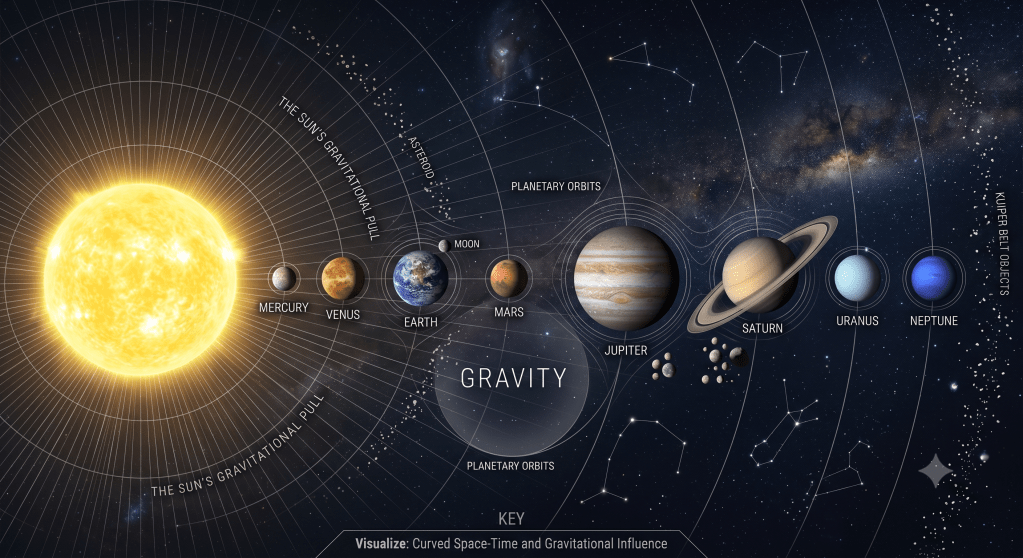
If the classical exegetes debated whether the heavens rest on visible or invisible pillars, the history of physics can be read as the slow discovery that the cosmos is indeed held together by something invisible — not a column, but a principle.
From Aristotle to Newton
As the Encyclopædia Britannica narrative “Gravity: From Apples to the Universe” recounts, the ancient Greek philosopher Aristotle held that objects fall because each of the four elements (earth, air, fire, water) has a “natural place” toward which it tends: earthy things return to the Earth, while fire rises toward the heavens. This view “reigned until the scientific revolution that began in the Renaissance.” Then, “standing on the shoulders of giants” like Kepler and Galileo, Isaac Newton “realized that the apple falling to the ground and the Moon orbiting Earth were subject to the same gravitational force.” That force, Newton showed, “was proportional to the mass of the two bodies attracting each other and inversely proportional to the square of the distance between them” — so that doubling the distance quarters the attraction. This single law “operated between everything in the universe and explained the motions of the Moon and the planets very well.” britannica + 3
The unification was profound: the terrestrial and the celestial, long held to obey different laws, were governed by one principle. There are no ropes, rods, or columns between the Sun and the Earth; the planets are held in their orbits by an invisible attraction acting across the void. Newtonian gravity had spectacular triumphs — as Britannica notes, “it was used to predict the location of the then unknown planet Neptune.” britannica
The Anomaly of Mercury and Einstein’s Revolution
“Well, almost.” Britannica records that for Mercury, the closest planet to the Sun, Newton’s law was “not quite as accurate in predicting the location of the planet’s perihelion.” The anomaly was precise and famous: of Mercury’s observed perihelion advance of roughly 5,600 arcseconds per century, planetary perturbations calculated on Newtonian principles account for about 5,557, leaving an unexplained residual of approximately 43 arcseconds per century — a discrepancy first isolated by the French astronomer Urbain Le Verrier in 1859. This residual “vexed astronomers until Einstein introduced his theory of general relativity in 1915, in which gravity is not a force reaching out across the universe but is a bending of space-time around a massive object. The orbits of the planets and the apples falling to the ground follow the shape of space-time.” Einstein wrote four papers on general relativity in November 1915; in the third, he calculated the movement of Mercury’s perihelion at 42.98 arcseconds per century — a near-exact match to the observed anomaly. britannicabritannica
This is a decisive conceptual shift: gravity ceases to be a “force” in the Newtonian sense and becomes geometry. Mass and energy curve the four-dimensional fabric of spacetime, and bodies moving freely simply follow the straightest available paths (geodesics) through that curved geometry. The equivalence principle — that the effects of gravity and of acceleration are locally indistinguishable — lies at the theory’s heart. The invisible “support” is now the very shape of space and time.
Confirmations and Extensions
General relativity, Britannica notes, “quickly pointed the way to new science.” It was confirmed at the total solar eclipse of 29 May 1919, when British expeditions — Arthur Eddington’s team on the island of Príncipe off West Africa, and Andrew Crommelin and Charles Davidson at Sobral, Brazil, organized under the Astronomer Royal Frank Dyson — measured the deflection of starlight passing near the Sun. The Sobral result of 1.98 ± 0.12 arcseconds and the Príncipe result of 1.61 ± 0.30 arcseconds matched Einstein’s predicted deflection of about 1.75 arcseconds, roughly twice the value Newtonian physics would allow. Its reach continues to widen: “Descriptions of black holes and the big bang both have their basis in general relativity,” and the theory “has even led to a new kind of astronomy using gravitational waves.” These were first detected directly at 09:50:45 UTC on 14 September 2015 — the event designated GW150914, the merger of two black holes of about 36 and 29 solar masses — and announced by the LIGO–Virgo collaborations in Physical Review Letters on 11 February 2016. To these one may add the twentieth- and twenty-first-century recognition that most of the universe’s gravitating substance is invisible: dark matter, inferred purely from its gravitational effects, provides an unseen scaffolding for the formation of galaxies, while dark energy drives the accelerating expansion of the cosmos.
The cumulative picture is striking. The Sun, Moon, planets, stars, and galaxies are suspended and structured without any visible pillar. What holds them is an unseen principle — expressible as Newton’s law, deepened as the curvature of spacetime, and manifest most dramatically where matter itself becomes invisible (black holes, dark matter). The heavens are, quite literally, raised “without pillars that you see.”
V. The History of Interpreting These Verses Through Gravity
Did anyone connect “pillars you cannot see” with gravitational force? The answer is that the connection is old in impulse and widespread in the modern period — and that it must be handled with care.
The Ibn ʿAbbās reading as a proto-anticipation
Because a strand of the earliest exegesis (Ibn ʿAbbās, Mujāhid) held that the heavens rest on invisible pillars, modern authors have seized on this as an uncanny anticipation of gravity. In Shīʿī literature, a report attributed to Imam ʿAlī al-Riḍā is frequently cited: asked whether God had not said the skies are established “without any pillar that can be seen,” and receiving assent, the Imam is said to have replied, “Therefore, there exists a pillar which is invisible, which you are not able to see” — a saying that contemporary Shīʿī commentators (e.g., the widely circulated life-lessons literature associated with Nāṣir Makārim Shīrāzī’s circle) present as an early pointer to the law of gravity.
Modern and contemporary commentators
- Maulana Muhammad Ali (Lahore Ahmadiyya), whose translation is used above, embodies the modernist reading in which the cosmic order runs by “fixed laws” that are nonetheless continuously God’s governance. His commentary on this sūrah’s natural-order verses stresses that no created thing “came into being by itself or carries out its functions by itself” — even where laws are fixed, “the government and regulation behind it is still that of Allah.” Alim
- Sayyid Abul Aʿlā Mawdūdī made the gravitational reading explicit. On 31:10 he wrote that the phrase admits two meanings — “you can see for yourself that they stand without pillar,” and “they stand on the pillars which you cannot see” — noting that Ibn ʿAbbās and Mujāhid favored the second. He then added: “If the meaning is expressed in terms of the natural sciences of the present day, it can be said that the countless stars and planets in the heaven have been established in their positions and orbits without any visible support and prop… It is the law of gravitation which is supporting the system.”
- Muhammad Asad rendered the phrase “without any supports that you could see” and, in his notes, expanded the semantic range of samāʾ to include “the cosmic space in which the stars, the solar systems… and the galaxies pursue their course” — a deliberately modern, non-literal cosmology, though Asad characteristically avoided crude concordist proof-texting.
- Tantawi Jawharī (d. 1940), author of the vast twenty-five-volume al-Jawāhir fī Tafsīr al-Qurʾān al-Karīm, is the paradigmatic exponent of tafsīr ʿilmī (scientific exegesis), placing scientific remarks alongside Qurʾānic verses to demonstrate the compatibility of Islam and modern science; his method has been both influential and heavily criticized as reducing exegesis to the display of scientific information.
- Zaghlūl El-Naggar, a leading contemporary proponent of the “scientific miracle” (iʿjāz ʿilmī) genre, explicitly reads the “invisible pillars” as gravity and treats the survival of the Ibn ʿAbbās reading as evidence that identifying the unseen supports with physical forces does not contradict the earliest understanding of the text.
- Maurice Bucaille, whose The Bible, the Qurʾan and Science launched the modern popular concordist wave, argued that the verse refutes the ancient belief in solid supports for the sky, positing instead an effectively “invisible” support system.
The scholarly critique of concordism — and the correct register
This is precisely the point at which discipline is required. The academic study of tafsīr ʿilmī has produced a sustained critique. The classical Andalusian jurist Abū Isḥāq al-Shāṭibī (d. 790/1388), in al-Muwāfaqāt, objected on principle to reading later sciences into the Qurʾān, insisting the Book be understood as its first Arabic audience understood it and not made a repository of every subsequent science. In the modern academy, the physicist Nidhal Guessoum (in Islam’s Quantum Question) argues that the “scientific miracle” theory rests on a misunderstanding of both the nature of science — which is provisional and self-revising — and of the Qurʾān, retrojecting present knowledge into a pre-scientific text. Critics (Taner Edis, Pervez Hoodbhoy) note that Bucailleism reduces science to a “stamp collection,” downplays the historical occasion of revelation, and stakes the Qurʾān’s authority on scientific claims that may later be overturned.
The register adopted here — and consistently on thequran.love — is therefore not concordist. These convergences are resonances and anticipations, not proofs; the verse invites reflection, it does not encode physics. This is explicitly distinguished from the “scientific miracle” apologetics of Maurice Bucaille and the popular style of Zakir Naik. The verse’s claim is theological: the heavens have no visible support, and the believer is summoned to recognize the unseen sustaining of the Lord. That modern physics has found an unseen principle structuring the cosmos does not “prove” the Qurʾān; it furnishes a magnificent contemporary occasion for the very reflection (tafakkur) the verse commands.
VI. The Rest of the Two Verses: The Cosmos Under Divine Governance
The pillarless heavens are the opening term of a larger argument in each verse, and the surrounding clauses supply the context of taskhīr (subjection) and tadbīr (governance).
Q 13:2 in full
After the raising of the heavens, the verse proceeds: thumma stawā ʿalā l-ʿarsh — “then He established Himself upon the Throne.” The classical tradition (as Ibn Kathīr notes, cross-referencing Q 7:54) received the divine “establishment upon the Throne” (istiwāʾ) without anthropomorphic elaboration — affirmed as befits His majesty, its modality unknown. Theologically it signals sovereign dominion over the whole of creation.
Then: wa-sakhkhara l-shamsa wa-l-qamar, kullun yajrī li-ajalin musamman — “and He subjected the sun and the moon, each running for an appointed term.” The verb sakhkhara (to subject, to press into service) and the image of each celestial body “running” (yajrī) along a course to a fixed term reads with striking naturalness alongside orbital mechanics: the heavenly bodies are not free agents but constrained to lawful, periodic paths. The “appointed term” (ajal musamman) simultaneously names the regular period of their motion and their eventual end. The verse closes with yudabbiru l-amra yufaṣṣilu l-āyāt — “He directs the affair; He details the signs” — the theme of divine tadbīr, the continuous governance of the cosmos, “that you may be certain of the meeting with your Lord.” The cosmological sign is enlisted for an eschatological purpose: the One who ordered this vast system can and will raise the dead.
Q 31:10 in full
Here the pillarless heavens are paired with the earth’s stabilization: wa-alqā fī l-arḍi rawāsiya an tamīda bikum — “and He cast into the earth firm mountains, lest it sway with you.” The classical exegetes uniformly read the rawāsī (firm mountains) as stabilizers, “pegs” (awtād) anchoring the earth. The verse continues with the spreading of “every kind of creature” (min kulli dābbah) and the sending down of rain that causes “every noble kind” (zawj karīm) to grow. The rhetorical structure moves from the largest scale (the heavens) to the terrestrial (mountains), the biological (creatures), and the botanical (vegetation in pairs), culminating in 31:11 with the challenge: “This is the creation of Allah; so show Me what those besides Him have created.” The whole is a tawḥīd argument from the integrated order of nature.
The connective thread across both verses is tadbīr: a single Governor upholds the heavens without pillars, subjects sun and moon to their courses, anchors the earth, and brings forth life. The unseen support of the sky and the firm anchoring of the ground are two faces of one sustaining wisdom.
VII. Philosophical and Theological Depth: Does Gravity Explain Away the Divine Support?
The natural modern worry is that gravity replaces the divine support the verse points to: once we can write down an inverse-square law or the Einstein field equations, is God not surplus to requirements? The answer developed here is that the objection confuses two different questions — and that the verse, read carefully, was never making the claim the objection assumes.
Describing a regularity versus grounding it
Newton described how bodies attract; he pointedly refused to say why. In the Principia‘s General Scholium he wrote that he had “not yet been able to discover the cause of these properties of gravity from phenomena, and I feign no hypotheses” (hypotheses non fingo). Gravity, for Newton, was a mathematically exact regularity whose ultimate ground he declined to invent. And in the very same General Scholium he drew the theological conclusion that the order itself demands an Orderer: “This most beautiful system of the sun, planets, and comets, could only proceed from the counsel and dominion of an intelligent and powerful Being… This Being governs all things, not as the soul of the world, but as Lord over all.” For Newton, good physics was good theology: describing the regularity did not dissolve the need for its Author but sharpened it.
Einstein’s geometrization deepens rather than dissolves the mystery. To say that planets follow geodesics in curved spacetime answers Newton’s “how” more elegantly, but it raises a further “why”: why does spacetime obey these field equations rather than others? Why is the universe intelligible in mathematical terms at all? The equations describe the regularity; they do not explain why there is a lawful, elegant regularity rather than chaos or nothing.
al-Ghazālī’s occasionalism and the “Inshallah universe”
This is where the intellectual framework of thequran.love does its work. Following al-Ghazālī and the Ashʿarī tradition, one may hold that what we call “laws of nature” are not autonomous powers resident in matter but descriptions of the habitual action of God — sunnat Allāh, the custom or wont of God, which He sustains by choice and could suspend at will. Al-Ghazālī did not deny that fire and burning regularly co-occur; he denied that observation ever proves a necessary connection between them. On this view gravity does not compete with divine action; gravity is one of the regularities of divine action — the reliable custom by which God holds the heavens and moves the spheres. The phrase “Inshallah” (“if God wills”) becomes a metaphysical thesis in miniature: the order of nature persists because God wills its persistence, moment by moment. Zia Shah’s commentary on these matters has argued that modern physics, especially the indeterminacy at the quantum level, sits comfortably with this occasionalist metaphysics, since it suggests that “causality is not an inherent, necessary force in matter” at the fundamental level.
Read this way, the Qurʾānic phrase “without pillars that you see” is not falsified by gravity and not merely “explained” by it. It is an invitation to look for the unseen support — and the deepest reading, anticipated by al-Rāzī, is that even gravity’s mathematical law is itself contingent. A law is not self-explaining; that the cosmos should obey one elegant, life-permitting regularity rather than another, or none, is exactly the sort of fact that points beyond the physics to its ground. The “pillar” that upholds the heavens is neither a visible column nor, in the end, the equation itself, but the sustaining will the equation makes visible.
The Four Books, fine-tuning, and the aesthetic argument
Three further frameworks characteristic of thequran.love illuminate the verses.
First, the “Four Books of God”: Revelation (the Qurʾān), Nature (the created cosmos), Destiny (the al-Lawḥ al-Maḥfūẓ, the Preserved Tablet), and Deeds. The pillarless-heavens verse sits precisely at the interface of the Book of Revelation and the Book of Nature: it commands the reader to read the cosmos, and modern gravitational physics is a chapter in that second Book. The two Books, rightly read, do not contradict; they mutually illuminate.
Second, fine-tuning as natural theology. The strength of gravity is among the most cited fine-tuned parameters. In the Astronomer Royal Martin Rees’s formulation in Just Six Numbers (1999), the parameter N — the ratio of the strength of electromagnetism to gravity between two protons — is approximately 10³⁶; Rees observes that “were it a few zeros shorter, only a short-lived miniature universe could exist and there would be no time for biological evolution.” Conversely, if N were significantly smaller (gravity relatively stronger), “stars would be much smaller and would burn much quicker… There would not be sufficient time for life to evolve.” If gravity were slightly weaker (relative to electromagnetism), main-sequence stars such as the Sun would be significantly colder and would not explode in the supernovae that forge and scatter the heavy elements on which life depends, and matter might never clump into galaxies at all. That the gravitational coupling lies in the narrow window permitting long-lived stars and complex chemistry is, for the natural theologian, a further “sign.” The very force that raises the heavens without pillars is calibrated with a precision that itself invites reflection on a Calibrator.
Third, the aesthetic argument. Newton’s own words — “this most beautiful system” — register that the cosmic order is not merely functional but beautiful, and beauty, on this reading, is a mode of divine self-disclosure. The elegance of the inverse-square law, the geometric grandeur of general relativity, and the sheer scale of a universe suspended without pillars are objects of wonder that draw the reflective mind toward its Source. Modern philosopher-scientists — John Polkinghorne, who argued from the deep mathematical intelligibility of the world to a divine Mind; Paul Davies, who pressed the question of why the universe is comprehensible and law-governed; and Roger Penrose, awed by the mathematical order underlying physical law — extend, in a contemporary key, exactly Newton’s move from the beauty and lawfulness of nature to the question of its ground.
VIII. Thematic Epilogue: Reading the Book of Nature Beside the Book of Revelation
The Qurʾān twice declares that God raised the heavens “without pillars that you see,” and twice sets that declaration within a panorama of divine governance: the Throne established, the sun and moon subjected to their courses, the mountains anchoring the earth, the rain quickening every noble kind. The classical exegetes divided over the grammar — no pillars at all, or pillars unseen — and the most philosophically searching of them, al-Rāzī, resolved the tension by locating the true “pillar” in God’s own sustaining power, holding the heavens in the void without material support and without regress.
Fourteen centuries later, physics discovered that the cosmos is in fact held together by something invisible: not a column but a principle — Newton’s universal attraction, Einstein’s curvature of spacetime, and, at the largest scales, the unseen mass of dark matter and the unseen pressure of dark energy. The moon, the planets, the stars, and the galaxies hang suspended and ordered by an unseen sustaining influence, exactly as the verse says: without pillars that we see.
The proper conclusion is neither the deflationary claim that gravity has abolished the need for God, nor the concordist claim that the verse secretly “contained” Newton and Einstein all along. It is, rather, that the two Books converge in their testimony. The Book of Nature has taught us that the heavens rest on no visible pillar and that the invisible principle which sustains them is itself contingent, elegant, and finely balanced — a regularity that describes but cannot ground itself. The Book of Revelation had already summoned us to precisely this recognition: to look past the visible for the unseen support, and past the law for its Lawgiver. Gravity, on this reading, is not the rival of the divine tadbīr but its most beautiful signature — the sunnat Allāh by which, at every instant and by His leave, the heavens are kept from falling. The verse does not encode the physics; it opens the eye. And the eye, having seen that the sky stands on nothing it can see, is returned — as the verse intends — to certainty concerning the meeting with its Lord.
Wa-Allāhu aʿlam.





Leave a Reply