
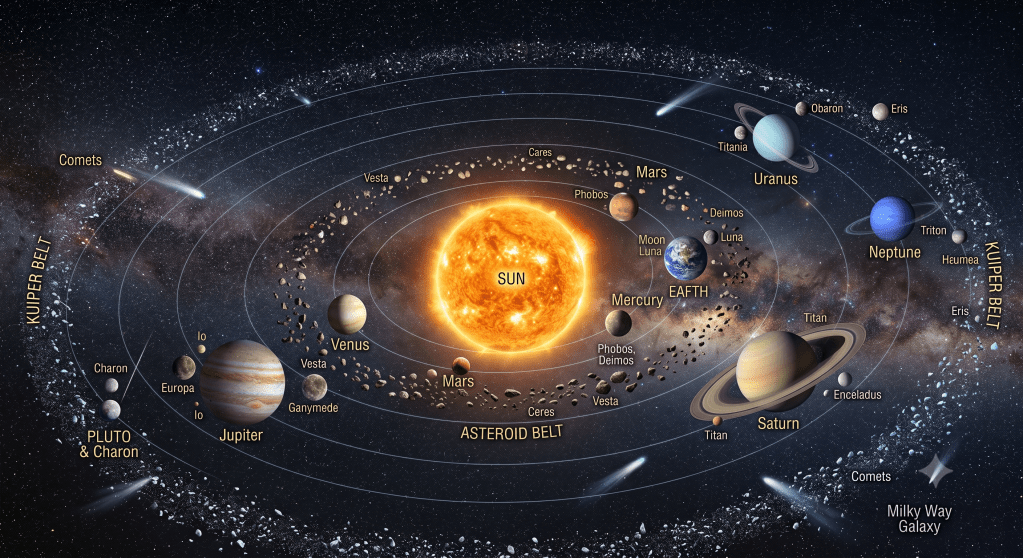
The Invisible Architecture of the Heavens
A Scientific, Philosophical, and Theological Commentary on Qur’an 13:2 and 31:10
Presented by ChatGPT for Zia H Shah MD
Abstract
Qur’an 13:2 and 31:10 describe Allah as raising or creating the heavens bi-ghayri ʿamadin tarawnahā—“without pillars that you can see.” The Arabic permits two closely related readings: the heavens stand without pillars at all, as human beings can plainly observe; or they are sustained by “pillars” that are not visible. Classical commentators discussed both possibilities centuries before modern physics, although they did not—and historically could not—identify those supports with Newtonian gravity or Einsteinian spacetime. Some, particularly Fakhr al-Dīn al-Rāzī, nevertheless spoke of an invisible sustaining reality: Allah’s power, preservation, and governance.
Modern physics gives the imagery a remarkable new resonance. Newton unified terrestrial falling and celestial motion through universal gravitation; Einstein reconceived gravity as the curvature of spacetime; contemporary cosmology shows gravity organizing planets, stars, galaxies, dark matter, gravitational lenses, black holes, and the large-scale structure of the universe. Gravity is not literally a material column, nor does the Qur’an present a scientific equation. Yet it functions analogically like an invisible architecture: it orders trajectories, binds systems and makes a structured cosmos possible without visible scaffolding.
In their contexts, however, these verses intend more than cosmology. Qur’an 13:2 moves from cosmic government to certainty in resurrection, while 31:10 proceeds from celestial, geological, biological and botanical signs to a challenge against idolatry. Following the broader Qur’an-and-science perspective developed by Zia H Shah MD, nature should be read as a book of divine signs: science investigates the mechanisms of creation, philosophy asks why those mechanisms are intelligible, and theology identifies their ultimate ground in the sustaining wisdom and power of Allah.
The two verses
Qur’an 13:2
اللَّهُ الَّذِي رَفَعَ السَّمَاوَاتِ بِغَيْرِ عَمَدٍ تَرَوْنَهَا ثُمَّ اسْتَوَىٰ عَلَى الْعَرْشِ وَسَخَّرَ الشَّمْسَ وَالْقَمَرَ ۖ كُلٌّ يَجْرِي لِأَجَلٍ مُّسَمًّى ۚ يُدَبِّرُ الْأَمْرَ يُفَصِّلُ الْآيَاتِ لَعَلَّكُم بِلِقَاءِ رَبِّكُمْ تُوقِنُونَ
Allah is the One who raised the heavens without pillars that you can see; then He established His sovereignty over the Throne and subjected the sun and moon, each running for an appointed term. He governs every affair and explains the signs, so that you may attain certainty concerning the meeting with your Lord.
Qur’an 31:10
خَلَقَ السَّمَاوَاتِ بِغَيْرِ عَمَدٍ تَرَوْنَهَا وَأَلْقَىٰ فِي الْأَرْضِ رَوَاسِيَ أَن تَمِيدَ بِكُمْ وَبَثَّ فِيهَا مِن كُلِّ دَابَّةٍ ۚ وَأَنزَلْنَا مِنَ السَّمَاءِ مَاءً فَأَنبَتْنَا فِيهَا مِن كُلِّ زَوْجٍ كَرِيمٍ
He created the heavens without pillars that you can see, placed firm mountains upon the earth lest it sway with you, dispersed through it every kind of living creature, and sent water down from the sky, thereby causing every noble kind to grow upon it.
The two formulations are complementary. In 13:2 Allah raised—rafaʿa—the heavens; in 31:10 He created—khalaqa—them. Creation speaks of origination; raising speaks of structure, distinction, elevation and maintenance. Together they attribute both the existence and the continuing order of the cosmos to Allah.
“Without pillars that you can see”: the grammatical depth
The key phrase is:
بِغَيْرِ عَمَدٍ تَرَوْنَهَا
bi-ghayri ʿamadin tarawnahā
The word ʿamad is the plural of ʿimād: a pillar, column, support or something relied upon. Because classical Arabic manuscripts contained no modern punctuation, tarawnahā—“you see them”—can be connected in two ways.
| Reading | Approximate translation | Implication |
|---|---|---|
| Tarawnahā refers to the heavens | “He raised the heavens without pillars—as you see them.” | No pillars exist; their unsupported elevation is itself the sign. |
| Tarawnahā qualifies the pillars | “He raised the heavens without pillars that you can see.” | The supports, if called pillars analogically, are invisible. |
The second reading does not mean that the Qur’an teaches literal transparent columns. It permits the more general idea that the cosmic order depends upon realities that are not visible to unaided human sight. The first reading is equally compatible with modern astronomy: celestial bodies are not resting upon rigid props or suspended from cables.
The lasting power of the wording lies precisely in its refusal to tie cosmic order to the mythology of a material dome propped up by mountains, gods or giants. The verse points to what is observed—the absence of visible supports—while leaving the mechanism open to investigation.
The history of interpretation
Al-Ṭabarī: two early opinions
Al-Ṭabarī (d. 923) preserves reports representing both readings. Ibn ʿAbbās and Mujāhid were reported as allowing the sense that there are supports which people do not see. Other authorities understood the heavens to have no pillars whatsoever. Al-Ṭabarī preferred the cautious conclusion that the heavens stand without any pillars perceptible to us, declining to assert more than the language and transmitted evidence warranted. His discussion shows that the grammatical ambiguity is ancient, not a modern invention designed to accommodate gravity. Al-Ṭabarī on 13:2
Al-Qurṭubī: an explicit grammatical analysis
Al-Qurṭubī (d. 1273) states the alternatives with unusual precision. If tarawnahā functions as an adjective describing ʿamad, the meaning permits pillars that cannot be seen. If it functions as a circumstantial clause describing the heavens, there are no pillars at all. Al-Qurṭubī on 31:10
This is important methodologically. Modern readers are not entitled to suppress one grammatical possibility merely because another seems more scientifically attractive. Both belong to the interpretive tradition.
Fakhr al-Dīn al-Rāzī: the invisible support of divine preservation
Al-Rāzī (d. 1209) offers the most philosophically suggestive classical interpretation. A pillar, he observes, is that upon which something depends. Celestial bodies remain aloft through Allah’s power, preservation and governance; therefore, in a deeper theological sense, their “pillar” is the divine act that sustains them, although human beings neither see that governance nor comprehend the manner of the sustaining.
Al-Rāzī was not proposing Newtonian attraction. His “pillar” was metaphysical and theological, not a measurable force. Nevertheless, his interpretation anticipates an essential distinction: visible material supports are absent, while an invisible order of preservation is real. He also uses the verse to argue that Allah is not a body occupying a location within the created heavens, because everything spatial is itself dependent upon divine preservation. Al-Rāzī on 13:2
Ibn Kathīr: both readings, with a preference
Ibn Kathīr (d. 1373) records the invisible-pillars interpretation from Ibn ʿAbbās, Mujāhid, al-Ḥasan and Qatādah. He also reports the image of the heaven as a dome without pillars and ultimately prefers the view that the heavens are elevated without pillars at all, “as you see.” For him, this better manifests Allah’s power. Ibn Kathīr on 13:2
Did classical commentators invoke gravity?
No classical commentator invoked gravity in the specifically Newtonian or Einsteinian senses. To say otherwise would be anachronistic. They did not possess:
- Newton’s universal inverse-square law;
- the modern concepts of inertia, mass and orbital free fall;
- the gravitational constant;
- Einstein’s equivalence principle;
- four-dimensional spacetime or its curvature.
Classical exegetes did, however, preserve the linguistic possibility of unseen support, and al-Rāzī explicitly described an invisible sustaining order. These ideas can enter into dialogue with gravity, but they should not be confused with a scientific discovery of gravity.
Modern commentators and gravity
Modern exegesis makes the connection explicit. Abul Aʿlā Maududi explains that stars and planets are not tied by cables or stopped by visible barriers; the law of gravitation maintains the celestial system. He retains both grammatical readings and presents gravity as a modern scientific expression of the verse’s imagery. Maududi on 31:10
Zia H Shah likewise identifies gravity as the most natural contemporary analogue of “pillars that cannot be seen.” His particular contribution is to recover a sense of wonder from what he calls the “anesthesia of familiarity”: gravity is so universal that we cease to experience it as astonishing. He reads the verses as treating law-governed natural phenomena themselves as āyāt—signs of Allah—not merely as ordinary processes contrasted with miracles. “The Mystery of Gravity and the Quranic Verses about It”
The historically responsible conclusion is therefore:
The classical tradition supplied the grammatical and theological categories of invisible support; modern commentators, after Newton and Einstein, applied gravity as a scientific analogue.
From apples to the universe: the scientific history of gravity
The historical arc presented in Britannica’s essay, “Gravity: From Apples to the Universe”, illustrates how slowly humanity came to understand the invisible ordering of the heavens.
Aristotle: terrestrial and celestial realms
Aristotle treated falling as the movement of heavy matter toward its “natural place,” the center of the world. The heavens were governed by a different kind of motion. Terrestrial falling and celestial orbiting were not yet recognized as manifestations of one universal interaction.
This division is precisely what Newton would eventually overcome.
Galileo: the mathematics of falling
Galileo’s experiments and analyses showed that freely falling bodies undergo regular acceleration and that, apart from air resistance, differences in weight do not produce the simple differences in falling speed assumed in Aristotelian physics. He turned falling from a qualitative tendency into a mathematically describable motion.
Kepler: the geometry of planetary motion
Using Tycho Brahe’s observations, Johannes Kepler established that planets move in ellipses, sweep out equal areas in equal times and have orbital periods mathematically related to their distances from the sun. Kepler described how planets move but did not yet possess Newton’s unified gravitational explanation for why.
Newton: the apple and the moon
The famous apple story is best understood as an image of conceptual unification, not as the claim that no one had noticed falling objects before Newton. Newton’s great question was whether the power drawing an apple toward Earth might extend as far as the moon.
His answer united earth and heaven:F=Gr2m1m2
Every mass attracts every other mass in proportion to their masses and inversely as the square of the distance between them. The same law explains:
- an apple’s fall;
- the moon’s orbit around Earth;
- Earth’s orbit around the sun;
- tides;
- comets;
- binary stars;
- much of the dynamics of galaxies and clusters.
A planet in orbit is not statically “held up.” It is perpetually falling toward the sun while its tangential motion continually carries it forward. An orbit is therefore a dynamic equilibrium between inertia and gravitational acceleration. The “pillar” analogy must be understood dynamically: gravity does not prop a planet up like a marble upon a pedestal; it provides the invisible relational structure within which orbital motion occurs.
Cavendish: weighing the Earth
In 1797–98 Henry Cavendish used a torsion balance to detect the exceedingly weak attraction between laboratory masses. His stated purpose was to determine Earth’s mean density; later formulations express the experiment as a measurement of the gravitational constant G. Gravity, though invisible, became quantitatively detectable through its effects.
This illustrates a profound epistemological point: invisible does not mean unreal or inaccessible. Science frequently knows entities and fields not by seeing them directly but by measuring what they do.
Einstein: from force to geometry
Newton described gravity with extraordinary accuracy but did not provide a physical mechanism for instantaneous attraction across empty space. Einstein’s general theory of relativity transformed the concept. Matter and energy shape spacetime, and freely moving bodies follow its natural paths, called geodesics. In this description, Earth is not pulled around the sun by an invisible cord; it follows a path through curved spacetime.
Einstein Online summarizes the contrast succinctly: Newtonian gravity deflects objects from straight paths through a force, whereas in general relativity bodies follow the straightest possible paths within a curved geometry. Einstein Online’s introduction to general relativity
Newtonian gravity remains an excellent approximation for ordinary planetary calculations. General relativity becomes indispensable for extreme precision, very strong gravitational fields, black holes, gravitational lensing and cosmology. The relativistic corrections required by satellite clocks are also necessary for accurate GPS navigation. NASA on general relativity
Gravitational waves: the architecture can ripple
Einstein’s theory predicts that accelerating compact masses can produce ripples in spacetime. LIGO directly detected such waves in September 2015 from merging black holes, opening an entirely new form of astronomy. LIGO Scientific Collaboration
The “invisible architecture” is therefore not inert. It can bend light, slow clocks, guide planets, collapse stars and propagate waves across the cosmos.
Gravity on different cosmic scales
Planets and solar systems
The sun’s gravity governs the principal architecture of the solar system. Planets, asteroids and comets follow trajectories determined by their velocities and the curved spacetime associated predominantly with the sun’s mass. Moons similarly orbit planets.
Thus the Qur’anic statement that Allah “subjected the sun and the moon, each running for an appointed term” joins two ideas that modern physics also joins:
- celestial motion is ordered rather than arbitrary;
- the order is temporally finite rather than divine or self-existent.
The Qur’an does not confuse motion with self-sovereignty. The sun and moon move, but they are musakhkhar—subjected to an order not of their own making.
Stars
Gravity compresses clouds of gas until stars form. Within a stable star, inward gravity is balanced by pressure associated with heat and nuclear reactions. When fuel is exhausted, gravity can help produce white dwarfs, neutron stars or black holes.
Here “support” is not a single force. Cosmic stability often consists of opposing tendencies in a delicately structured balance.
Galaxies and dark matter
Galaxies are systems of stars, gas, dust, compact objects and dark matter bound together gravitationally. NASA describes galaxies as gravity-bound systems. Their observed motions indicate much more gravitating matter than is visible. Dark matter does not emit or absorb light in ordinary ways, but its presence is inferred from galaxy rotation, gravitational lensing and structure formation. NASA notes that its gravitational effects help ordinary matter assemble into stars, galaxies and clusters. NASA on dark matter
Dark matter intensifies the resonance of “pillars that you cannot see”: not only is gravity invisible, but much of the matter producing cosmic gravitational fields is itself electromagnetically invisible.
Nevertheless, it would be scientifically excessive to identify dark matter—or a supermassive black hole such as Sagittarius A*—as the one intended Qur’anic pillar. The Milky Way is not held together solely by its central black hole; the distributed mass of stars, gas and especially dark matter is crucial. The safest correspondence is with the whole invisible gravitational architecture rather than one particular object.
Cosmic expansion and dark energy
On the largest scales gravity competes with cosmic expansion. Observations indicate that expansion is accelerating, conventionally attributed to dark energy or a cosmological constant. Dark energy is not simply a pillar opposing gravity; its nature remains uncertain, and alternative gravitational explanations continue to be investigated. NASA on dark energy
This cautions against mapping every scientific unknown onto one scriptural word. The verse is semantically capacious; it should not be imprisoned inside a provisional cosmological model.
The unfinished quantum problem
General relativity describes gravity extremely well on large scales, while quantum theory governs the microscopic world. A complete experimentally confirmed quantum theory of gravity has not yet been achieved. NASA accordingly describes general relativity as highly successful but probably incomplete because it lacks a quantum foundation. NASA Physics of the Cosmos
The Qur’anic formulation remains open where science remains open. It directs attention to the phenomenon without prematurely dictating a mechanism.
Philosophical commentary
1. Seeing effects without seeing causes
Humans do not see gravity as they see a column of stone. They see falling bodies, orbital motion, tides, lensing and changes in clock rates. From effects, scientists infer a gravitational field or curved spacetime.
This is an instance of scientific realism: rational belief need not be restricted to what unaided eyes directly perceive. We accept electrons, fields, genes, black-hole horizons and dark matter distributions because they provide explanatory coherence and make successful predictions.
The verse’s phrase “that you see” thus opens an epistemological contrast:
- the visible heavens;
- the absent visible scaffolding;
- the hidden order disclosed through disciplined reasoning.
The Qur’an repeatedly summons human beings to look, but it does not reduce knowledge to looking. Observation must mature into reflection.
2. From material pillars to mathematical relations
A literal pillar is local, solid and static. Gravity is relational, universal and dynamic. Einsteinian gravity is more radical still: the “support” is not an object within space but the geometry of spacetime.
The history of gravity therefore represents a philosophical ascent:visible props→unseen force→geometrical structure
This does not prove that the Qur’an predicted general relativity. It shows that its nonmechanistic wording survives conceptual revolutions better than a primitive cosmological description would have.
3. Laws describe regularity; do they explain its ultimate existence?
Newton’s equation tells us how masses behave. Einstein’s equations relate matter-energy to spacetime geometry. Neither equation, simply as physics, explains:
- why a universe exists;
- why it possesses mathematically intelligible laws;
- why those laws are stable;
- why there is matter-energy for them to describe;
- why the constants have their actual values;
- why rational minds can uncover the order.
To answer “gravity” when asked why the heavens maintain ordered relations is scientifically illuminating. To answer “the equations exist as a brute fact” is a further philosophical position, not an empirical discovery.
The theological reading does not compete with physics at the same explanatory level. “Gravity” identifies a created regularity; “Allah sustains the heavens” identifies its ultimate ontological ground. One may therefore affirm both without contradiction:
Allah sustains the celestial order through the regularities that physics describes as gravitation.
4. The danger of a “God of the gaps”
God should not be inserted only where science has not yet found an explanation. If theology depends upon ignorance, each scientific advance appears to shrink God’s domain.
The Qur’anic approach is different. The understood phenomenon remains a sign. Gravity was a sign when mysterious; Newton’s law made it a mathematically richer sign; general relativity deepened it; quantum gravity may deepen it again. The divine sign is not merely the gap but the intelligibility, existence and ordered fruitfulness of the entire system.
5. Natural theology without coercion
Qur’an 13:2 says that the signs are detailed so that people may become certain of meeting their Lord. Qur’an 31:11 asks idolaters to show what their supposed gods have created. These are forms of natural theology: reasoning from the existence and order of the world toward its Creator and Sustainer.
This is not a laboratory proof that compels metaphysical assent. The same physical data can be placed inside theism, deism, naturalism or other worldviews. But the Qur’an argues that purposive monotheism offers the most comprehensive account of a coherent, law-governed and intelligible cosmos. Contemporary philosophy continues to debate whether cosmic contingency and order point to a necessary or sustaining cause. Stanford Encyclopedia of Philosophy on the cosmological argument
Theological commentary on Qur’an 13:2
“Allah is the One”
The verse begins with the divine name and a relative clause: Allah is the One who… Cosmic order is not presented as anonymous. The mechanisms are personal acts of creation, subjection and governance.
“Raised the heavens”
“Raised” need not be reduced to vertical displacement in an earthly coordinate system. It evokes differentiation, elevation, vastness and the establishment of cosmic order. The heavens are neither God nor independent deities; they are created realities.
“Then established Himself over the Throne”
The Throne signifies supreme sovereignty and governance. It should not be imagined as a physical chair located somewhere inside the universe with Allah occupying a spatial coordinate. Al-Rāzī used the verse itself to argue for divine transcendence beyond bodily location.
The movement of the passage is from physical creation to metaphysical sovereignty: the One who raises the heavens rules all that they contain.
“Subjected the sun and moon”
Sakhkhara means to subject, harness or make serviceable. The regularity of celestial motion is not interpreted as independence from God but as obedience to a created order. Natural law is thus a form of cosmic submission.
“Each runs for an appointed term”
Celestial bodies are dynamic and finite. Modern astronomy likewise understands stars, planetary systems and galaxies as possessing histories. Stars form and die; orbits evolve; cosmic structures are not eternal.
The phrase also establishes an eschatological horizon. The universe is not merely a repetitive machine; it moves toward an appointed consummation.
“He governs the affair”
Yudabbiru al-amr integrates creation and providence. Allah does not create and abandon. His creative act includes ordering, sustaining and directing.
In theological language, gravity is not a rival agent standing between God and creation. It is part of the manner in which divine governance appears as stable natural order.
“So that you may be certain of meeting your Lord”
The verse moves deliberately from cosmology to resurrection. The reasoning is an argument from the greater to the apparently lesser: the One capable of originating and sustaining a universe is capable of restoring human life.
Physics by itself does not derive an afterlife. Rather, cosmic creation establishes the theological premise of divine power, while revelation supplies the promise of resurrection and judgment.
Theological commentary on Qur’an 31:10–11
Qur’an 31:10 gathers several domains of nature into one panorama:
- cosmic architecture: the heavens;
- terrestrial stability: mountains;
- zoological abundance: living creatures;
- the hydrological cycle: rain;
- botanical fecundity: noble kinds of plants.
The movement is downward from the remote heavens to the soil beneath one’s feet. The Creator of cosmic order is also the giver of rain, vegetation and animal life.
The statement about mountains should not be turned into the scientifically false claim that mountains prevent all earthquakes. Mountains arise largely through tectonic processes, some of which also produce earthquakes. The Arabic an tamīda bikum evokes swaying, instability and the habitability of the earth at the human scale. Mountains contribute to crustal structure, watersheds, climate and ecological diversity, but the verse is theological phenomenology rather than a complete theory of plate tectonics.
Similarly, zawj karīm can mean every noble, excellent or flourishing kind; it need not always denote a male-female botanical pair.
Verse 31:11 then declares:
“This is Allah’s creation. Show Me what those besides Him have created.”
The challenge is ontological, not merely technological. Humans rearrange existing materials; they do not originate the universe, its laws, matter, spacetime or life’s entire possibility from nothing. Nor can an idol explain the unity of cosmic, geological, biological and hydrological order.
Zia H Shah’s broader Qur’an-and-science perspective
Several recurring principles in Zia H Shah’s writings illuminate these verses.
Nature as a book of signs
Shah develops the classical “Two Books” idea—the Book of Revelation and the Book of Nature—into a wider “Four Books” framework: revelation, nature, destiny or the Preserved Tablet, and the record of deeds. For the present verses, the first two are central.
The Qur’an verbally says that the heavens are upheld without visible pillars. The Book of Nature discloses the physical grammar of that upholding through Newtonian attraction, relativistic geometry and cosmic structure. Because both ultimately come from Allah, apparent conflict should stimulate renewed investigation of either our scientific model or our human interpretation of scripture. Shah’s Four Books framework
Observation joined to reason
Shah emphasizes that the Qur’an repeatedly calls for empirical observation and rational analysis. The repeated Qur’anic command to look at creation is not an invitation to passive admiration alone. It encourages the movement from perception to measurement, comparison, inference and explanation. “Allah Suggests Empirical Observation and Rational Analysis”
Miracles within the laws of nature
In Shah’s approach, a divine sign need not violate regularity. The very existence of a universal, mathematically elegant and life-permitting order is miraculous in the broader Qur’anic sense of āyah. Gravity is not less divine because its effects can be calculated.
This perspective helps overcome the anesthesia of familiarity. Falling rain, germinating seeds, orbital motion and the human ability to formulate field equations are all extraordinary, although repetition tempts us to call them ordinary.
Divine habit rather than autonomous nature
Shah’s engagement with Ghazalian occasionalism treats laws of nature as stable expressions of the divine habit—ʿādat Allāh—rather than self-existent powers independent of Allah. On this view:
- physics describes dependable patterns;
- theology attributes the continuing existence of those patterns to Allah;
- divine sovereignty does not require capricious violations of empirical regularity.
The Qur’anic phrase yudabbiru al-amr—“He governs the affair”—is especially congenial to this position. The cosmos is dependable because its Lord is faithful and wise, not because creation has escaped divine governance.
A necessary hermeneutical caution
The Qur’an is not identical with any one scientific commentary upon it. Gravity offers a compelling contemporary interpretation of the invisible-pillars image, but Newtonian gravity was revised by Einstein and general relativity will likely be incorporated into a deeper quantum theory.
Accordingly, the strongest formulation is not:
“The Arabic word ʿamad scientifically means Einsteinian gravity.”
It is:
“The Qur’anic image of heavens ordered without visible supports is strikingly compatible with the invisible gravitational architecture disclosed by modern science.”
That distinction preserves both intellectual confidence and interpretive humility.
Thematic epilogue: from the falling apple to the meeting with our Lord
An apple falls. The moon does not crash into the earth. Earth does not flee from the sun. Stars gather into galaxies; light bends around unseen mass; clocks change their pace in gravitational fields; colliding black holes send ripples through spacetime across billions of light-years. Nothing is held by the stone columns imagined by ancient myth, yet nothing is without measure, relation or order.
Newton saw a universal force where earlier thought had divided earth from heaven. Einstein saw geometry where Newton had seen force. Contemporary cosmology sees an immense gravitational web, much of whose matter remains invisible. Each intellectual revolution has replaced a more tangible picture with a subtler, more relational and more mathematically profound one.
Against that history, bi-ghayri ʿamadin tarawnahā acquires extraordinary contemplative depth. The verse does not give Newton’s equation or Einstein’s tensor. Its purpose is greater than inserting a modern formula into a seventh-century text. It awakens the question behind every formula: why is there a coherent heaven to describe, why is it sustained without visible scaffolding, why is it intelligible to the human mind, and what does its ordered dependence reveal about its ultimate ground?
Qur’an 31:10 answers by gathering heaven, earth, animal, rain and plant beneath one declaration: “This is Allah’s creation.” Qur’an 13:2 carries the reflection toward its existential destination: “so that you may become certain of meeting your Lord.”
Science reveals the architecture. Philosophy asks what that architecture means. Theology names its Creator and Sustainer. Gravity may be invisible, but its consequences are everywhere. So too, the Qur’an teaches, divine governance is not one object among other objects in the cosmos. It is the sustaining reality upon which the entire cosmos—every mass, orbit, law, life and conscious observer—continually depends.





Leave a Reply