
Presented by Claude
Abstract
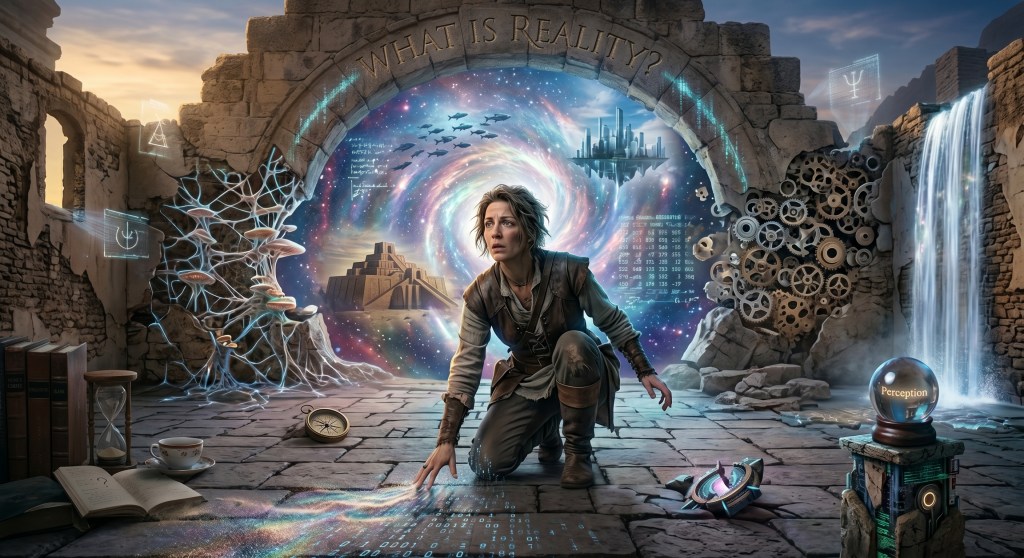
What is reality? To answer this question, we must look beyond the immediate testimony of our senses. This essay explores the nature of reality by examining how it is processed, constructed, and understood across different observers: from a human with normal trichromatic vision to individuals experiencing color blindness or total blindness; from the distinct sensory ecosystems (Umwelts) of bats and butterflies to a hypothetical advanced extraterrestrial intellect; and ultimately, to the absolute, unmediated perspective of the Creator. Integrating contemporary neuroscience, the philosophy of mind (qualia), and the theological insights of Zia H Shah MD regarding the neurological construction of color, we argue that physical reality in its raw state is an unrendered canvas of mathematical values and electromagnetic frequencies. Subjective experience is not a passive mirror of this world, but an active, conscious translation. By studying the diversity of these sensory translations, we discover that the multi-hued universe is a profound divine sign (āyah) designed to evoke a trembling awe (khashyah) within those who possess deep knowledge.
Introduction: The Multilayered Quarry of Reality
For centuries, human beings operated under the intuitive assumption of naive realism—the belief that the world is exactly as we see it. We look at a ripe pomegranate and assume its vivid redness is a physical property inherent to the skin of the fruit itself. However, modern science has cracked open this illusion, revealing a far more fascinating truth: the external universe is a silent, colorless landscape of fluctuating electromagnetic fields, acoustic pressure waves, and atomic configurations.
Reality, then, is not a singular, fixed stage. It is a relationship between an objective environment and the sensory-cognitive apparatus of the observer. This realization transforms our inquiry from a simple definition of matter into a profound investigation across three intersecting axes: the biological mechanics of how brains construct perception, the philosophical puzzle of subjective experience, and the theological recognition of nature as a deliberately calibrated book of signs.
The Neurological Construction of Reality: The Human Spectrum
To understand how reality is shaped, we must trace the path of raw data as it enters human consciousness. As articulated by Zia H Shah MD in his commentaries on the neuroscience of vision, what we call “vision” is an elaborate, multi-staged computational pipeline that transforms invisible energetic inputs into an internal mental theater.
The physical world presents us with photons. These photons are refracted by the cornea and crystalline lens of the eye, passing through the vitreous humor to strike the retina—a sophisticated outpost of the central nervous system lining the back of the globe. Within the human retina, an average of 92 million rod cells specialize in capturing low-light, monochromatic motion, while 4.6 million cone cells manage high-acuity daylight and color vision.
The conversion of light into thought begins through a biochemical miracle. Human color vision depends on three distinct classes of cone cells, each defined by a specific opsin protein paired with a light-sensitive chromophore (11-cis-retinal):
- S-Cones (Short-wavelength): Peak sensitivity near 420–440 nm (traditionally associated with blue).
- M-Cones (Medium-wavelength): Peak sensitivity near 534–545 nm (associated with green).
- L-Cones (Long-wavelength): Peak sensitivity near 564–580 nm (associated with red).
When a photon hits 11-cis-retinal, it triggers photoisomerization into all-trans-retinal. This microscopic structural twist sets off a massive G-protein signaling cascade: the activation of transducin, the stimulation of cGMP phosphodiesterase, the closure of cyclic nucleotide-gated channels, and the subsequent hyperpolarization of the cell membrane. This change alters the release of the neurotransmitter glutamate at the synapse.
The raw trichromatic signals are then compressed into antagonistic channels by retinal ganglion cells—calculating differences such as Red-Green ($L – M$) and Blue-Yellow ($S – (L + M)$)—before traveling along the optic nerve, through the Lateral Geniculate Nucleus (LGN) of the thalamus, and into the Primary Visual Cortex (V1) within the occipital lobe.
The ultimate generation of our visual reality occurs deeper in the cortex. Within V1, color data enters specialized cylinders known as cytochrome oxidase blobs. It then flows along the ventral visual pathway into Area V4, the brain’s master color engine. Area V4 does not merely read incoming wavelengths; it performs global environmental calculations to maintain color constancy. This ensures that a green leaf looks green whether it is illuminated by the blue tint of dawn or the amber glow of twilight.
Divergent Human Realities: Color Blindness and Blindness
What happens when this biological architecture shifts? In individuals with congenital achromatopsia (complete color blindness) or rod monochromacy—often caused by genetic mutations in the cone channels (such as CNGA3 or CNGB3)—the world is experienced purely in shades of silver, gray, and jet-black. For an achromatope, the vibrant palette of a garden does not exist.
For a person who is totally blind from birth, reality is completely detached from spatial luminescence. Their world is mapped through tactile geometry, acoustic localization, and thermal boundaries.
This raises a vital philosophical question: Is the world of the trichromat “more real” than the world of the color-blind or the blind person?
From a scientific standpoint, no. Both the trichromat and the achromatope are receiving genuine physical data; they are simply running that data through different neurological compilers. Wavelengths of 700 nm are not inherently red; redness is a qualia—a subjective, qualitative property of conscious experience created inside the mind. The external world contains the mathematical frequency, but the mind creates the color.
The Comparative Ecology of Consciousness: Animals and Aliens
If human variations demonstrate that reality is mind-dependent, looking at other species confirms it. Every organism occupies what the biologist Jakob von Uexküll called an Umwelt—a self-contained sensory bubble defined by the specific inputs an animal’s survival requires.
The Bat: Reality as Spatial Echoes
As the philosopher Thomas Nagel famously explored in his essay What Is It Like to Be a Bat?, a bat’s experience of reality is fundamentally alien to ours. Navigating via echolocation, a bat emits high-frequency sonic pulses and analyzes the returning echoes to map its surroundings.
Where humans see a room in terms of lighting, color, and shadow, a bat perceives it as a shifting grid of acoustic textures, density variations, and micro-doppler shifts caused by insect wings. The bat’s brain translates auditory delays into a vivid spatial map. To a bat, reality is an auditory-spatial architecture that a human cannot experience, even though both occupy the exact same physical room.
The Butterfly: An Expanded Palette
While humans are trichromats, many species of butterflies possess four, five, or even up to fifteen distinct photoreceptor types. They are tetrachromats or pentachromats, capable of seeing deep into the ultraviolet spectrum.
To a butterfly, a simple yellow flower reveals intricate ultraviolet “nectar guides”—concentric landing strips invisible to the human eye. Its compound eyes slice reality into a high-speed mosaic of movement and polarization patterns. The butterfly’s reality is saturated with hues and data streams that our brains simply lack the wiring to imagine.
+-----------------------------------------------------------------------+| THE SPECTRUM OF OBSERVERS |+-----------------------------------------------------------------------+| OBSERVER | SENSORY ARCHITECTURE | OPERATIONAL REALITY |+------------------+--------------------------+-------------------------+| Totally Blind | Tactile / Acoustic | Spatial boundaries maps|| Achromatope | Rods only | Shades of gray/lumens || Normal Human | Trichromatic (S,M,L) | Constrained color/form || Butterfly | Penta/Tetrachromatic | UV nectar guides || Bat | Echolocation / Sonar | Acoustic-spatial grid || Advanced Alien | Multi-spectrum / Quantum| Hyper-dimensional |+-----------------------------------------------------------------------+
The Advanced Alien: Higher-Dimensional Comprehension
Imagine an advanced extraterrestrial intellect possessing sensory faculties far beyond our own. This being might detect the entire electromagnetic spectrum—gazing directly at radio waves, sensing the magnetic field lines of the earth, or observing quantum entanglement states in real-time.
Where humans infer dark matter or gravitational waves through mathematics and instruments, this alien might see them as a tangible landscape. Such a being would view human perception the way we view a blind person’s world—as a highly restricted, heavily filtered slice of a much larger, more complex reality.
Interactive Sensory Reality Explorer
To truly appreciate how changing sensory thresholds dynamically alter the universe we inhabit, experiment with the interactive exploration model below. By shifting the observer perspective, you can see how the same ambient physical parameters are translated into entirely distinct visual realities.
Theological and Philosophical Consolidation: God as Ultimate Reality (Al-Haqq)
If reality changes depending on who is looking, what is the true nature of the universe? Philosophy offers several paths. Materialism insists that the fundamental reality is the cold, mindless collision of subatomic particles. Idealism counters that because reality is entirely constructed by the mind, the mind itself is the primary substance of existence.
However, when we merge modern neuroscience with theology, a deeper insight emerges—one that Zia H Shah MD anchors firmly within Quranic discourse. The mind-dependent nature of our universe does not mean reality is an empty illusion. Instead, it points to a deliberate, conscious design. The universe is a beautifully calibrated system where physical laws are converted into conscious experiences by a Creator who is Himself the source of all consciousness.
In Islamic theology, one of the primary names of God is Al-Haqq—The Ultimate Reality, The Absolute Truth. Unlike created beings, whose understanding of the universe is partial, indirect, and constrained by biological hardware, God’s knowledge is absolute, comprehensive, and unmediated.
God does not need an eye, a retina, or a visual cortex to process wavelengths. God does not look at a filtered slice of the universe; He sustains the entire matrix of existence. God sees the photon, the electron, the consciousness that perceives them, and the qualia produced within that consciousness, all simultaneously.
This perspective gives a profound new depth to the verses of the Glorious Quran that focus on the diversity of nature. In his writings at thequran.love, Dr. Zia H Shah highlights two critical passages where the variation of colors is presented as a divine sign:
1. Surah Ar-Rum (30:22)
وَمِنْ آيَاتِهِ خَلْقُ السَّمَاوَاتِ وَالْأَرْضِ وَاخْتِلَافُ أَلْسِنَتِكُمْ وَأَلْوَانِكُمْ ۚ إِنَّ فِي ذَٰلِكَ لَآيَاتٍ لِّلْعَالِمِينَ
“And of His signs is the creation of the heavens and the earth and the diversity of your languages and your colors. Indeed in that are signs for those of knowledge.”
2. Surah Fatir (35:27–28)
أَلَمْ تَرَ أَنَّ اللَّهَ أَنزَلَ مِنَ السَّمَاءِ مَاءً فَأَخْرَجْنَا بِهِ ثَمَرَاتٍ مُّخْتَلِفًا أَلْوَانُهَا ۚ وَمِنَ الْجِبَالِ جُدَدٌ بِيضٌ وَحُمُرٌ مُّخْتَلِفٌ أَلْوَانُهَا وَغَرَابِيبُ سُودٌ وَمِنَ النَّاسِ وَالدَّوَابِّ وَالْأَنْعَامِ مُخْتَلِفٌ أَلْوَانُهُ كَذَٰلِكَ ۗ إِنَّمَا يَخْشَى اللَّهَ مِنْ عِبَادِهِ الْعُلَمَاءُ ۗ
“Do you not see that Allah sends down rain from the sky, and We produce thereby fruits of varying colors? And in the mountains are tracts, white and red of varying shades and [some] extremely black. And among people and moving creatures and grazing livestock are various colors similarly. Only those fear Allah, from among His servants, who have knowledge…”
In the seventh century, these references to the variations of colors (alwān) were understood as descriptions of the visible world—the diverse skin tones of humanity, the brilliant hues of vegetation, and the striking strata of mountains.
However, read through twenty-first-century neuroscience, these verses reveal a stunning layer of depth. The Quran explicitly links the diversity of colors to those who possess knowledge (al-ʿulamāʾ). Why does color vision require scientific knowledge to be fully appreciated as a divine sign?
Because it is only through deep study that we discover color is not a passive feature of matter. It is a brilliant systemic marvel. God did not just create a colorful world; He designed a precise, microscopic dance of opsin proteins, retinal configurations, G-protein signaling networks, and cortical engines to build that colorful experience inside our minds. The diversity of colors is actually a diversity of conscious experiences, elegantly calibrated to help us navigate, appreciate, and find meaning in our environment.
Thematic Epilogue
When we ask what is reality, we find that it is a grand, unfolding text—a multi-layered book of signs written by a single Author. The realization that our sensory world is an internal neural construction does not diminish its wonder; it deepens it into a source of spiritual awe.
The color-blind person, the normal human, the bat, the butterfly, and the advanced alien are all reading different lines of the same cosmic poem. Each observer is real, and each perspective is true within its assigned sphere, acting as a customized window into the vast creative power of the Divine. Our biological limits prevent us from seeing the whole picture at once, reminding us of our shared humility across different cultures, languages, and species.
By recognizing that our personal view of reality is just a fraction of the whole, we can build a profound sense of interfaith tolerance and intellectual humility. We see that different minds perceive different hues of the absolute truth. Science does not replace the divine layout; it maps the beautiful mechanics of how it works. As we study the brilliant biological systems that turn a colorless universe into a vivid, meaningful home, our scientific understanding deepens into spiritual wonder. We join the ranks of those who truly understand, standing in profound awe of the Master Artist who shapes every spectrum of consciousness.



Leave a Reply