
Presented by Gemini
Audio teaser: God in the Eleventh Dimension
Abstract
This report presents a multidisciplinary exegesis of divine proximity (qurb) as articulated in the Quran, specifically analyzing verses 2:186, 50:16, 8:24, and 56:83-85. It explores the proposition that the divine nearness described in these passages is not merely a metaphorical or philosophical abstraction, but a literal reality that can be conceptualized through modern theoretical physics, including quantum mechanics, multi-dimensional space-time models, and wormhole geometries. Incorporating the theological and scientific inquiries of Zia H. Shah MD, the analysis demonstrates how divine omniscience and omnipresence find structural parallels in string theory, M-theory, and quantum nonlocality.
To bridge this intellectual framework with experiential reality, the report examines the psycho-spiritual methodology of meditation and Zikr-e-Ilahi (remembrance of God). This systematic focus of consciousness allows the human soul to transcend the lower ego and achieve the state of Nafs al-Mutma’innah (the tranquil soul) as celebrated in Surah Al-Fajr. Ultimately, this synthesis proposes that the “Word of God” in scripture and the “Work of God” in the physical universe are complementary books of a singular, coherent reality.
Scientific and Theological Frameworks of Divine Omnipresence
The intellectual bridge between sacred scripture and natural science is historically rooted in the methodology of Bucaillism, which asserts that genuine scientific truths and the Quran must ultimately harmonize because the Author of scripture is also the Architect of the universe. Roughly 750 verses of the Quran—approximately one-eighth of the text—exhort human beings to study nature, utilize analytical reason, and reflect upon the physical universe. In this framework, the same Arabic term, ayat, is used to describe both the verses of the written scripture and the phenomena of the natural world, suggesting that revelation and creation are twin sources of truth that must be read side-by-side.
A primary challenge in classical theology has been the formulation of divine omnipresence without collapsing into pantheism or anthropomorphism. Classical Christian theologians wrestled with this balance; Saint Augustine cautioned against naive physical imagery, such as imagining God spread through space like a gas, proposing instead that God is wholly present in all places at once in an indivisible, spiritual manner. Thomas Aquinas defined divine omnipresence through three modes: power (all things are subject to His rule), presence (all things are bare and open to His eyes), and essence (He acts as the active cause sustaining all things in existence).
In the Islamic tradition, the Sunni schools of Ash’arite and Maturidi theology similarly established that God exists transcendent of physical space, directions, and temporal flows. This doctrine of tanzih (transcendence) declares God free of physical attributes, asserting that His “being with” creation is defined by His all-encompassing knowledge, power, and active governance rather than a physical localized presence.
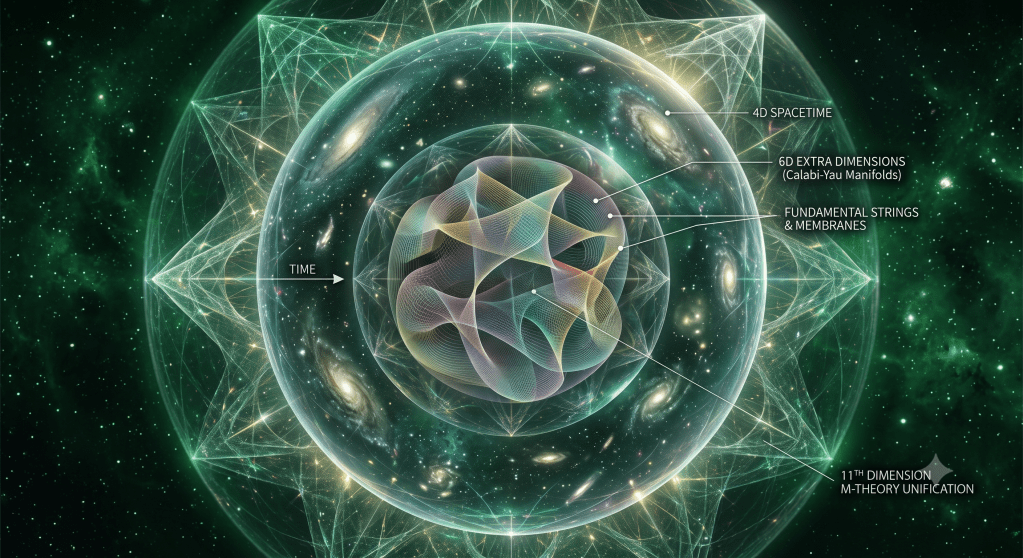
Modern theoretical physics offers a sophisticated conceptual vocabulary that aligns with these classical doctrines. Zia H. Shah MD argues that if God possesses absolute omniscience (‘Alim al-ghayb wa al-shahadah) over every subatomic particle, quark, and galaxy, He must possess a corresponding form of omnipresence. This absolute access implies that the underlying structure of physical reality must accommodate an interface between the Creator and every spatial coordinate.
Consequently, Shah proposes that physics must include extra dimensions to explain this omnipresent access, predicting that empirical research will eventually validate the existence of large extra dimensions. Rather than violating physical laws, divine actions and miracles can be re-conceptualized as higher-dimensional events interacting naturally with our limited three-dimensional slice of reality, providing a rational framework for the Unseen (al-Ghayb).
Comprehensive Exegesis and Textual Analysis of the Proximity Verses
To establish a rigorous textual foundation, the four core verses detailing divine proximity are presented below, pairing the original Arabic text with five distinct English translations.
Exegesis of Quranic Verse 2:186
وَإِذَا سَأَلَكَ عِبَادِي عَنِّي فَإِنِّي قَرِيبٌ ۖ أُجِيبُ دَعْوَةَ الدَّاعِ إِذَا دَعَانِ ۖ فَلْيَسْتَجِيبُوا لِي وَلْيُؤْمِنُوا بِي لَعَلَّهُمْ يَرْشُدُونَ
| Translator | English Translation |
|---|---|
| Sahih International | And when My servants ask you, [O Muhammad], concerning Me – indeed I am near. I respond to the invocation of the supplicant when he calls upon Me. So let them respond to Me [by obedience] and believe in Me that they may be [rightly] guided. |
| Abdel Haleem | If My servants ask you about Me, I am near. I respond to those who call Me, so let them respond to Me, and believe in Me, so that they may be guided. |
| Yusuf Ali | When My servants ask thee concerning Me, I am indeed close (to them): I listen to the prayer of every suppliant when he calleth on Me: Let them also, with a will, Listen to My call, and believe in Me: That they may walk in the right way. |
| Pickthall | And when My servants question thee concerning Me, then behold, I am nigh. I answer the prayer of the suppliant when he crieth unto Me. So let them hear My call and let them trust in Me, in order that they may be led aright. |
| Mustafa Khattab | When My servants ask you ˹O Prophet˺ about Me, I am truly near. I respond to one’s prayer when they call upon Me. So let them respond ˹with obedience˺ to Me and believe in Me, perhaps they will be ˹rightly˺ guided. |
The grammatical structure of verse 2:186 highlights an unmediated, direct relationship between the Creator and the human soul. In other Quranic passages where the Prophet is asked about legal or social matters, the response is prefaced with the command qul (“Say”). Here, that command is bypassed; the response is issued directly by the Divine: “indeed I am near”.
This unmediated, instantaneous response can be conceptualized through quantum nonlocality. In classical mechanics, any signal transmission is bounded by the speed of light (c≈3×10⁸ m/s), implying a physical and temporal separation between a supplication and its reception.
However, quantum entanglement confirms that physical systems can exhibit instantaneous, nonlocal correlations across arbitrary distances. While standard quantum mechanics respects the no-signaling principle—meaning random measurement outcomes cannot be used to transmit classical data faster than light—nonlocality demonstrates that the universe is fundamentally interconnected at a level that transcends classical spatial separation. The divine reception of prayer operates on this foundational, nonlocal informational layer of reality.
Exegesis of Quranic Verse 50:16
وَلَقَدْ خَلَقْنَا الْإِنسَانَ وَنَعْلَمُ مَا تُوَسْوِسُ بِهِ نَفْسُهُ ۖ وَنَحْنُ أَقْرَبُ إِلَيْهِ مِنْ حَبْلِ الْوَرِيدِ
| Translator | English Translation |
|---|---|
| Sahih International | And We have already created man and know what his soul whispers to him, and We are closer to him than [his] jugular vein. |
| Abdel Haleem | We created man – We know what his soul whispers to him: We are closer to him than his jugular vein. |
| Yusuf Ali | It was We Who created man, and We know what dark suggestions his soul makes to him: for We are nearer to him than (his) jugular vein. |
| Pickthall | We verily created man and We know what his soul whispereth to him, and We are nearer to him than his jugular vein. |
| Mustafa Khattab | Indeed, ˹it is˺ We ˹Who˺ created humans and ˹fully˺ know what their souls whisper to them, and We are closer to them than ˹their˺ jugular vein. |
In verse 50:16, the biological metaphor of the jugular vein (habl al-warid) represents the critical channel of life and physical consciousness. To assert that the Creator is closer to a human being than their own internal vasculature requires a dimensional, rather than a physical, model of proximity.
This is clarified by the “Flatland” analogy. A two-dimensional creature living on a flat sheet of paper is restricted to a plane. If a boundary is drawn around this 2D creature, it cannot escape or see beyond it within its two dimensions. However, a three-dimensional observer looking down from the perpendicular z-axis can view the entire internal structure of the 2D creature simultaneously, accessing its center without crossing the 2D boundary. To the 2D creature, the 3D observer is closer to its core than any point on its own flat surface.
By mathematical extension, an entity operating in a higher spatial dimension—such as the six compactified dimensions of Calabi-Yau manifolds in string theory or the eleven dimensions of M-theory—would possess direct, perpendicular access to every internal coordinate of our three-dimensional space.
[4D/Higher-Dimensional Space: Omnipresent Divine Realm] | | (Perpendicular Spatial Dimension) v+-------------------------------------------------------+| [3D Physical Space of Human Body] || Internal Organs <--- [Direct Access] ---> Brain || * Divine proximity: "Closer than the jugular vein" |+-------------------------------------------------------+
This model explains how the Divine can be intimately present at every subatomic scale of a human being, accessing the subtle cognitive states and whispers of the soul without displacing any physical matter.
Exegesis of Quranic Verse 8:24
يَا أَيُّهَا الَّذِينَ آمَنُوا اسْتَجِيبُوا لِلَّهِ وَلِلرَّسُولِ إِذَا دَعَاكُمْ لِمَا يُحْيِيكُمْ ۖ وَاعْلَمُوا أَنَّ اللَّهَ يَحُولُ بَيْنَ الْمَرْءِ وَقَلْبِهِ وَأَنَّهُ إِلَيْهِ تُحْشَرُونَ
| Translator | English Translation |
|---|---|
| Sahih International | O you who have believed, respond to Allah and to the Messenger when he calls you to that which gives you life. And know that Allah intervenes between a man and his heart and that to Him you will be gathered. |
| Abdel Haleem | Believers, respond to God and His Messenger when he calls you to that which gives you life. Know that God stands between a man and his heart, and that you will be gathered to Him. |
| Yusuf Ali | O ye who believe! give your response to Allah and His Messenger, when He calleth you to that which will give you life; and know that Allah cometh in between a man and his heart, and that it is He to Whom ye shall all be gathered. |
| Pickthall | O ye who believe! Obey Allah, and the Messenger when He calleth you to that which quickeneth you, and know that Allah cometh in between the man and his own heart, and that He it is unto Whom ye will be gathered. |
| Mustafa Khattab | O believers! Respond to Allah and His Messenger when he calls you to that which gives you life. And know that Allah stands between a person and their heart, and that to Him you will be gathered. |
The divine intervention “between a person and their heart” (yahulu bayna al-mar’i wa qalbihi) addresses the fundamental mechanism of human consciousness. In classical Islamic terminology, the heart (qalb) is the locus of spiritual perception, volition, and self-awareness.
This intervention can be analyzed through the lens of quantum wave-function collapse and the occasionalist metaphysics of Abu Hamid al-Ghazali. In Ghazali’s occasionalism, physical causes possess no inherent power; instead, every event in the universe is directly created and sustained by God at every discrete frame of time.
In quantum mechanics, a system remains in a superposition of multiple potential states described by its wave function (ψ) until an interaction forces a collapse into a single, concrete reality. Under an occasionalist framework, this moment of collapse is not a product of blind randomness, but the continuous, frame-by-frame rendering of the “Divine Habit” (‘adah).
By sustaining the transition from quantum probability to conscious neurological activity, the divine presence acts as the ultimate underlying observer. God is interposed between the physical brain and the conscious experience of the heart, serving as the continuous sustainer of human self-awareness.
Exegesis of Quranic Verses 56:83-85
فَلَوْلَا إِذَا بَلَغَتِ الْحُلْقُومَ (83) وَأَنتُمْ حِينَئِذٍ تَنظُرُونَ (84) وَنَحْنُ أَقْرَبُ إِلَيْهِ مِنكُمْ وَلَـٰكِن لَّا تُبْصِرُونَ (85)
| Translator | English Translation |
|---|---|
| Sahih International | Then why, when the soul at death reaches the throat, And you are at that moment looking on – And Our angels are nearer to him than you, but you do not see – |
| Abdel Haleem | When the soul of a dying person reaches the throat, and you are at that moment looking on, We are closer to him than you are, though you do not see Us. |
| Yusuf Ali | Then why do ye not (intervene) when (the soul of the dying) reaches the throat,- And ye the while (sit) looking on,- But We are nearer to him than ye, and yet ye see not,- |
| Pickthall | Why, then, when it (the breath) cometh up to the throat, And ye are at that moment looking on, – And We are nearer unto him than ye are, but ye see not! – |
| Mustafa Khattab | Then why ˹do you not intervene˺ when the soul ˹of the dying˺ reaches ˹their˺ throat, while you are looking on, and We are closer to them than you, but you cannot see? |
These verses describe the biological transition of death, where physical onlookers are inches away from the dying person, yet remain blind to the proximity of the Divine and the angelic forces. This scenario illustrates the operational boundary between the observable physical world (alam al-shahadah) and the unobservable, extra-dimensional reality (alam al-ghayb).
While human biological senses are structurally confined to three spatial dimensions, the moment of death represents the untethering of human consciousness from the physical brain. As the soul transitions, it enters a multi-dimensional state where physical distance is no longer the defining metric of proximity.
This transition can be modeled using the ER=EPR hypothesis in physics, which proposes that entangled quantum states (EPR) are connected through microscopic wormholes or Einstein-Rosen bridges (ER) in the deep geometry of space-time.
If the universe’s fabric is structurally connected through higher-dimensional shortcuts, then the transit of the soul from the physical body to the divine presence does not require traversing vast, three-dimensional distances. Rather, it occurs via an immediate, higher-dimensional pathway that remains completely unobservable to physical onlookers bound by the three-dimensional plane.
Quantum Metaphysics and Information Conservation
To understand how divine omniscience and accountability operate at a subatomic scale, Zia H. Shah MD points to the exegesis of Surah Saba (34:1-5). These verses proclaim that not even the weight of a “speck of dust”—or a subatomic particle—in the heavens or the earth escapes divine knowledge, asserting that all things are meticulously recorded in a “clear Record”. This theological principle of universal record-keeping mirrors the fundamental physical law of information conservation.
In modern quantum mechanics, the principle of unitarity dictates that physical information cannot be destroyed; the wave function evolves deterministically, preserving the history of all physical states. Proponents of the holographic principle and quantum computation suggest that reality, at its core, is a grand information processing system—an idea summarized by John Archibald Wheeler’s phrase “it from bit”.
Shah draws a parallel between this physical conservation of information and the spiritual record of human deeds (Kitab or Lawh Mahfuz). In this framework, physical and moral events are integrated parts of a single tapestry, meaning that every human action, thought, and intention leaves a permanent, ineffaceable imprint on the multi-dimensional fabric of the cosmos.
To explain the mechanics of this recording and the reality of the afterlife, Shah also references the Many-Worlds Interpretation (MWI) of quantum mechanics. First proposed by Hugh Everett III in 1957, MWI eliminates the concept of wave function collapse, positing instead that the universal wave function continuously splits into branching, parallel histories.
By utilizing MWI as an analytical tool, Shah suggests that the human soul and the afterlife can be grounded in a larger, multi-dimensional reality where consciousness is not merely an emergent, transient byproduct of a decaying three-dimensional brain, but an entity existing in a much richer, unseen framework.
Alternatively, the de Broglie-Bohm pilot-wave theory (1952) provides a deterministic, realist, and explicitly nonlocal model of quantum mechanics. In this interpretation, physical particles are guided along precise trajectories by a nonlocal pilot wave that permeates the entire universe. A measurement performed on a single particle instantly alters the guiding force acting on its entangled partners across the cosmos.
This pilot-wave framework offers another physical metaphor for Ghazali’s occasionalism: the entire universe behaves as an undivided whole, held in perfect, immediate coordination by an underlying, non-physical wave of influence.
To substantiate this nonlocality, experimental physicists conducted several landmark tests of Bell’s inequalities:
| Physicist | Historical Era | Key Experimental Contribution | Role in Nonlocality Validation |
|---|---|---|---|
| John F. Clauser | Early 1970s | Measured polarization correlations of entangled photons. | Provided the first strong empirical evidence violating Bell’s inequalities, though local “loopholes” remained. |
| Alain Aspect | 1980s | Rapidly changed analyzer settings during the flight of entangled photons. | Closed the locality loophole by ensuring settings were chosen too quickly for any subluminal signal to pass between polarizers. |
| Anton Zeilinger | Late 1990s–Present | Demonstrated multi-photon entanglement and long-distance quantum teleportation. | Closed remaining freedom-of-choice loopholes and laid the groundwork for secure quantum information systems. |
This collective physical evidence conclusively demonstrates that local realism is untenable, proving that our physical universe is constructed upon a foundation of instantaneous, nonlocal coordination.
The Spiritual Ascent to Nafs al-Mutma’innah
While theoretical physics provides the intellectual framework to conceptualize divine proximity, the realization of this nearness must be experiential, cultivated through systematic spiritual practice. The Quranic model for this transformation is detailed in Surah Al-Fajr (the 89th chapter of the Quran), a Meccan surah containing 30 verses located in the final section, Juz 30.
The Oaths of Dawn and the Warnings of History
Surah Al-Fajr opens with majestic oaths drawing attention to the signs of the universe: the break of dawn, the ten nights (interpreted as the first ten nights of Zul-Hajj or Muharram), the even and the odd, and the departing night. Dawn represents a quiet transition where darkness gradually yields to light, symbolizing the soul’s reception of divine mercy and its awakening from ignorance.
To contrast the peaceful, receptive state of the spiritual soul, the surah highlights the historical downfalls of powerful past civilizations—such as the people of ‘Ad (inhabitants of the city of Iram with its lofty structures), the tribe of Thamud (who carved dwellings out of valley rocks), and the powerful Pharaoh. Despite their advanced architecture, material wealth, and geopolitical power, these nations were destroyed because of their arrogance, corruption, and systemic oppression.
The surah exposes a common human error: when tested with wealth and honor, individuals boast that God has honored them; when tested with limited means, they complain that God has humiliated them. The Quran corrects this, stating that true success is not measured by material wealth, but by moral responsibility—specifically caring for orphans, feeding the poor, and avoiding greed.
The Path of Zikr and Reliance on Al-Kafi
The transition from worldly anxiety to spiritual peace is accelerated by understanding and practicing the attributes of God. A central attribute in this journey is Al-Kafi (The Sufficient), derived from verses such as:
“Is not Allah sufficient for His servant?…” (Quran 39:36)
and
“And whoever relies upon Allah – then He is sufficient for him.” (Quran 65:3)
By engaging in Zikr-e-Ilahi (the systematic remembrance of God) and meditation, the practitioner shifts focus from worldly anxieties, racism, and chaos to the beautiful names of God. This practice reduces cognitive noise, leading to emotional balance and a conscience that prevails over the ego. The contented soul (an-nafs al-mutmainnah) is achieved by pondering over God’s signs in the universe, deriving spiritual nourishment from historical lessons, and accepting truth over self-interest.
Through this discipline, the soul transitions through three distinct psychological states:
- Nafs al-Ammarah (The Commanding Self): Driven by primal desires, greed, and the illusion of physical separation.
- Nafs al-Lawwamah (The Self-Accusing Self): Characterized by moral awareness, experiencing inner conflict and remorse when actions deviate from divine guidance.
- Nafs al-Mutma’innah (The Tranquil Soul): A state of absolute calm and inner peace, completely satisfied with the decree of its Lord.
The surah concludes with a comforting invitation to this serene soul:
“O reassured soul, return to your Lord, well-pleased and well-pleasing [to Him], so enter among My [righteous] servants, and enter My Paradise.” (Quran 89:27-30)
This tranquil soul responds to life’s trials with patience and to its blessings with gratitude, having dissolved the illusion of physical separation to reside in continuous, conscious proximity to the Divine Creator.
Epilogue: The Unified Tapestry of Being
The synthesis of Quranic metaphysics, classical theology, and modern physics reveals a coherent, unified worldview where science and scripture speak in unison. The classical materialist view of a deterministic universe composed of isolated physical objects has been replaced by a model of reality that is interconnected, multi-dimensional, and fundamentally informational.
By reading the “Book of Nature” alongside the “Book of Scripture,” divine proximity ceases to be a abstract metaphor and becomes an elegant feature of cosmic geometry. String theory’s extra dimensions provide a model for how the Divine can be transcendent yet immanently present at every subatomic coordinate. Quantum nonlocality and the ER=EPR hypothesis demonstrate that physical space is deeply interconnected, allowing instantaneous divine response and immediate cognitive access to the human heart.
This convergence of science and faith has practical, transformative implications for human life. It reassures the modern seeker that their thoughts, actions, and moral struggles are recorded within the structure of the cosmos.
Through meditation and the practice of Zikr-e-Ilahi, human beings can look past the noise of the physical world, align their consciousness with divine attributes, and transform their inner state from anxiety to the serenity of Nafs al-Mutma’innah. In this state of realized proximity, the boundaries between physics and metaphysics dissolve, and the soul returns to its Creator—content, peaceful, and balanced within the infinite dimensions of His creation.




Leave a Reply