
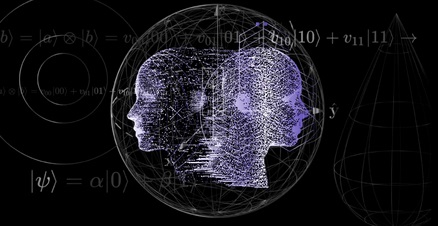
Epigraph
كَيْفَ تَكْفُرُونَ بِاللَّهِ وَكُنتُمْ أَمْوَاتًا فَأَحْيَاكُمْ ۖ ثُمَّ يُمِيتُكُمْ ثُمَّ يُحْيِيكُمْ ثُمَّ إِلَيْهِ تُرْجَعُونَ
How can you ignore God when you were lifeless and He gave you life, when He will cause you to die, then resurrect you to be returned to Him. (Al Quran 2:28)
وَيَسْأَلُونَكَ عَنِ الرُّوحِ ۖ قُلِ الرُّوحُ مِنْ أَمْرِ رَبِّي وَمَا أُوتِيتُم مِّنَ الْعِلْمِ إِلَّا قَلِيلًا
And they ask you concerning the soul. Say, ‘The soul is by the command of my Lord; and of the knowledge thereof you have been given but a little.’ (Al Quran 17:85)
Presented by Gemini
Audio teaser: Is your brain a radio receiver
The investigation into the fundamental nature of consciousness represents the most significant intellectual challenge in contemporary science and philosophy. This research report provides a comprehensive analysis of the “Closer to Truth” inquiry featuring Robert Lawrence Kuhn, David Chalmers, John Searle, Marilyn Schlitz, V.V. Raman, and Andrei Linde. Following a detailed identification of these participants and a reconstruction of their dialogue, the report transitions into a thematic epilogue focused on the intellectual corpus of Dr. Zia H. Shah, MD. By synthesizing clinical medicine, quantum cosmology, and Quranic exegesis, this analysis demonstrates how consciousness serves as an irreproachable sign leading toward a Transcendent Creator rather than an inert or “dead” universe.
Identification and Profiles of the Discourse Participants
The dialogue presented in the video “Is Consciousness Fundamental?” is facilitated by a panel of scholars whose expertise spans the domains of neurobiology, analytic philosophy, social anthropology, and theoretical physics.
Robert Lawrence Kuhn: The Host and Catalyst
Robert Lawrence Kuhn is the creator, executive producer, and host of “Closer to Truth.” A neuroscientist by training, Kuhn’s academic background provides the empirical rigor necessary to navigate the intersection of cosmology, consciousness, and philosophy. His career is defined by a commitment to exploring “humanity’s deepest questions” through on-camera conversations with the world’s leading thinkers. In the context of this specific investigation, Kuhn acts as a “metaphysical detective,” framing the central tension between a purely materialist worldview and one that acknowledges consciousness as a primary feature of reality.
David Chalmers: The Architect of the Hard Problem
David John Chalmers, an Australian philosopher and cognitive scientist, is arguably the most influential figure in modern consciousness studies. Born in Sydney in 1966, Chalmers demonstrated early exceptionalism in mathematics, winning a bronze medal at the International Mathematical Olympiad before turning his attention to philosophy. He earned his PhD at Indiana University Bloomington under Douglas Hofstadter, producing a thesis titled “Toward a Theory of Consciousness”.
Chalmers rose to global prominence in 1995 with his formulation of the “Hard Problem of Consciousness,” which distinguishes between the functional mechanisms of the brain (the “easy problems”) and the subjective “feeling” of experience. His position, often described as “naturalistic dualism,” posits that mental states are ontologically distinct from and not reducible to physical systems. Chalmers’ childhood experience with synesthesia—where music was perceived as colors—likely informed his lifelong focus on the irreducible nature of qualitative experience, or qualia.
John Searle: The Defender of Biological Naturalism
John Rogers Searle (1932–2025) was a seminal American philosopher whose work at the University of California, Berkeley, redefined the philosophy of language and mind. Searle is perhaps best known for his “Chinese Room” thought experiment, which argued that a computer program, no matter how sophisticated, can never possess genuine understanding or intentionality because it merely manipulates symbols according to rules.
In the debate over whether consciousness is fundamental, Searle represents the position of “biological naturalism”. He views consciousness as a higher-level biological feature of the brain, analogous to digestion in the stomach. For Searle, consciousness is ontologically subjective—it only exists as experienced by a subject—but it is caused by the objective physical processes of neurons. He rejects the “fundamentalist” view as a category error that confuses epistemology with ontology.
Marilyn Schlitz: The Anthropologist of Noetic Experience
Marilyn Schlitz, PhD, is a social anthropologist and researcher who has focused on the powers of the mind and the nature of healing. As President Emeritus and Senior Fellow at the Institute of Noetic Sciences, Schlitz has pioneered research into “distant interactions between living systems” (DMILS) and the social dimensions of consciousness. Her work is characterized by a “nested” view of awareness, where individual consciousness is inextricably linked to cultural, environmental, and spiritual relationships. Schlitz’s perspective is informed by her clinical studies on the power of compassionate intention and her multidisciplinary exploration of death and the continuity of consciousness.
V.V. Raman: The Bridge Between Science and Indic Wisdom
Varadaraja V. Raman is an emeritus professor of physics and humanities at the Rochester Institute of Technology. A physicist by training, Raman has dedicated much of his career to fostering a “multilogue” between the empirical sciences and the philosophical traditions of India. He views consciousness as the “auditorium” that gives meaning to the “stage” of the universe; without it, the cosmos would be an empty performance. Raman emphasizes the Hindu concept of Tat Tvam Asi (“Thou art that”), suggesting that the individual soul is a reflection of a grander, cosmic reality.
Andrei Linde: The Cosmologist and the Quantum Observer
Andrei Linde is a Russian-American theoretical physicist and a professor at Stanford University. He is a primary architect of the “inflationary universe” theory, for which he has received numerous prestigious awards. Linde’s contribution to the consciousness debate arises from his work in quantum cosmology, particularly the Wheeler-DeWitt equation. He posits that the act of observation may be necessary for the universe to transition from a probabilistic wave function into a definitive, “real” state of existence. Linde has famously suggested that consciousness might be as essential to the structure of the cosmos as the laws of physics.
Dialogue Protocol: Reconstructing “Is Consciousness Fundamental?”
The following protocol reconstructs the central dialogue from the “Closer to Truth” investigation. While the program is edited for broadcast, the following represents the detailed progression of arguments as presented in the video.
The Framing of the Investigation
Robert Lawrence Kuhn [00:28]: Kuhn begins by posing the existential question that serves as the episode’s foundation. He asks whether our mental life—our thoughts, feelings, and sense of self—is merely a random biological accident, a byproduct of a physical brain, or if conscious awareness reveals a “hidden reality” that is fundamental to the very structure of the universe. This frames the debate between “Materialism” (the brain produces the mind) and “Fundamentalism” (consciousness is a basic building block).
The Philosopher’s Dilemma: David Chalmers
David Chalmers [01:45]: Chalmers introduces the “explanatory gap.” He explains that while we can map the brain’s “wiring” and understand how it processes sensory data, there is no theory in current physics that explains “what it feels like” to have that experience. He notes that no matter how much we study the objective facts of neurons, the subjective “what-it-is-likeness” remains unexplained.
David Chalmers [03:10]: He outlines three radical views for those who believe the materialist account is insufficient :
- Radical Emergence: Consciousness is distinct from matter but “pops out” when matter is organized in specific, complex ways. This would require new “psychophysical laws” to link physical states to conscious states.
- Panpsychism: The view that consciousness is ubiquitous, existing even in fundamental particles like electrons. If consciousness is a basic property, then all matter possesses at least a “proto-consciousness”.
- The Ground of Being: This is the most radical stance, suggesting that consciousness is the primary reality, and the physical world (mass, space, time) is merely a derivative manifestation of how consciousness is structured internally.
The Biological Counter-Argument: John Searle
John Searle [06:43]: Searle immediately challenges the fundamentalist premise. He argues that the history of the universe contradicts the idea that consciousness is a building block.
John Searle [07:27]: Searle notes that for approximately 13.7 billion years, the universe existed as a purely physical system of stars, galaxies, and gas. Consciousness only arrived very late in the evolutionary process, specifically on Earth (and perhaps elsewhere) through the development of complex nervous systems. Therefore, consciousness cannot be a “fundamental” part of the universe’s origin; it is a biological product, much like the secretion of bile by the liver.
John Searle [07:53]: He accuses philosophers like Chalmers of making a “category error.” He distinguishes between Epistemology (how we know the world, which requires consciousness) and Ontology (how the world exists, which does not require our consciousness). He dismisses the idea of a “conscious universe” as an archaic anthropomorphism that science has outgrown.
The Relational and Teleological View: Marilyn Schlitz
Marilyn Schlitz [11:12]: Schlitz offers a different perspective, viewing consciousness not as a “thing” in the brain but as a “nested set of relationships”.
Marilyn Schlitz [11:41]: She describes a range of awareness moving from the physiological self to the cultural dimension where humans are “entangled” through language and shared meaning.
Marilyn Schlitz [13:07]: She suggests that consciousness reveals the “teleological nature” of life—an inherent drive toward greater complexity and expression. She concludes by suggesting that at its highest level, consciousness connects to a metaphysical “totality” or “divine” interconnection that exists outside of linear space and time.
The Meaning of the Cosmos: V.V. Raman
V.V. Raman [14:48]: Raman addresses the tension between the “dead” universe of science and the “living” universe of faith.
V.V. Raman [15:19]: He argues that while science can describe the “hardware” of the cosmos, it is consciousness that provides the “meaning”. Using the analogy of a poem, he notes that science can analyze the chemical composition of the ink and paper, but it will never find the “poem” itself in the physical atoms.
V.V. Raman [17:50]: From a Hindu perspective, Raman suggests that individual consciousness is like a drop of water reflecting the entire ocean. He calls consciousness “cosmic dust,” implying that it is the element that turns a silent, mechanical universe into a meaningful reality.
The Observer and the Wave Function: Andrei Linde
Andrei Linde [19:58]: Linde approaches the question from the vantage point of theoretical physics and quantum cosmology.
Andrei Linde [20:34]: He explains that when we try to describe the entire universe using the Wheeler-DeWitt equation, we find that the wave function of the universe is static; it does not change with time.
Andrei Linde [21:23]: He argues that for the universe to “come alive” and have a real existence, it must be observed. He suggests that the “observer” and the “observed” are linked in a fundamental way. If there is no one to witness the universe, it remains a mere abstraction of probabilities. While many of his colleagues are reluctant to include consciousness in their equations, Linde maintains that it may be a necessary component of reality.
Summary of Philosophical Frameworks
| Position | Primary Proponent | Core Argument | Ontological Status |
|---|---|---|---|
| Biological Naturalism | John Searle | Consciousness is a high-level biological process produced by the brain. | Derivative |
| Naturalistic Dualism | David Chalmers | Consciousness is a fundamental property that cannot be reduced to physics. | Fundamental |
| Quantum Observationalism | Andrei Linde | The universe requires an observer to exist in a definitive state. | Fundamental/Causal |
| Relational Holism | Marilyn Schlitz | Consciousness is a nested set of interconnections, leading to the divine. | Transcendent |
| Indic Synthesis | V.V. Raman | Consciousness provides the “meaning” to the physical “hardware.” | Teleological |
Zia H. Shah, MD: The Physician-Philosopher Persona
To analyze the “thematic epilogue” of this investigation, it is necessary to introduce the background and methodology of Dr. Zia H. Shah, MD. Dr. Shah is a dual-expert whose career is split between clinical medicine and theological scholarship.
Medical and Professional Background
Dr. Zia Shah is a physician specializing in Pulmonary Medicine and Sleep Disorders in Upstate New York. He has over 40 years of experience in the medical field, having graduated from medical school in 1985. His expertise in Sleep Medicine is particularly relevant to the study of consciousness, as he routinely treats patients who transition between states of deep unconsciousness (sleep apnea, insomnia) and active awareness. Dr. Shah is also the Chief Editor of The Muslim Times, where he manages a significant intellectual platform, and serves as the Chair of Religion and Science for the Muslim Sunrise.
The “Four Books” Thesis
Shah’s intellectual framework is built upon the “Four Books Thesis,” which argues that God reveals Himself through four distinct records that form a coherent whole:
- The Book of Nature: The observed truths of science and physics.
- The Book of Scripture: The revealed word of the Quran.
- The Book of History: The patterns of human civilization and divine justice.
- The Book of the Self: The internal witness of human consciousness.
Shah argues that because God is the author of all four books, there can be no genuine contradiction between them. If a conflict appears, it is the result of “Wrong Theology” or a failure in scientific interpretation. His work on consciousness specifically seeks to show how the “Book of the Self” (subjective experience) serves as an internal witness to the “Book of Nature” (objective reality).
Thematic Epilogue: Consciousness as the Prime Signifier of Divine Creation
Drawing from the dialogue in “Is Consciousness Fundamental?” and the extensive writings of Dr. Zia H. Shah, MD, a unified argument emerges: the existence of subjective experience is the ultimate “signpost” leading the rational mind away from a dead, inert universe and toward the recognition of a Prior Mind—God.
The Ontology of the “Dead and Inert” Universe
Dr. Zia Shah begins his argument by critiquing the materialist or “physicalist” framework, which he characterizes as the “Ontology of the Dead Cosmos”. In this worldview, the universe originated approximately 13.8 billion years ago as a collection of mindless particles—fermions and bosons—governed by immutable mathematical laws.
Shah points out a profound ontological deficit in this view: none of the fundamental constituents of this universe possess awareness. An electron does not “feel” its mass; a photon does not “experience” light; a proton has no hopes or dreams. In this reductionist view, the universe is a colossal, blind machine grinding away in silence.
Shah argues that if the universe were truly “dead” at its foundation, it could never, through any amount of random arrangement, give rise to a “living” subjective experience. He labels the transition from inert atoms to first-person perspective an “impossible miracle” within the naturalist paradigm. For Shah, the existence of a single “I” in a universe of “Its” requires a Prior Mind to act as the source of awareness.
The Radio Analogy: Brain as Receiver, Not Generator
To bridge the medical reality of the brain with the theological reality of the soul (Ruh), Dr. Shah employs the Radio Analogy.
- The Scenario: Imagine a radio playing a complex symphony. If an observer smashes the radio’s speakers, the sound becomes distorted. If they destroy the radio entirely, the music stops.
- The Materialist Error: A materialist observer, seeing this, concludes that the physical radio produced the music. This is the error of neuroscientists who believe that because brain damage affects consciousness, the brain must be the source of consciousness.
- The Reality: The truth is that the radio was merely a receiver and transceiver for a signal broadcast from a distant station. The signal exists independently of the hardware.
- Theological Synthesis: Shah identifies the “signal” as the soul (Ruh), which exists in the “World of Command” (Alam al-Amr). The brain is the biological transceiver evolved to filter this signal into a linear, temporal experience suitable for survival on Earth.
This analogy elegantly explains why medical science can observe the correlates of consciousness (brain activity) without ever finding consciousness itself in the physical atoms. It also accounts for the “Hard Problem” highlighted by David Chalmers: we are mapping the radio’s wiring, but we are ignoring the existence of the broadcast signal.
Refuting the “Consciousness as Illusion” Stance
Shah deals extensively with “illusionism”—the claim by figures like Daniel Dennett that subjective awareness is a “trick” of the brain. Shah argues that this stance is philosophically and scientifically incoherent.
- The Paradox of the Perceiveless Illusion: An illusion is, by definition, an experiential event—a false appearance to a consciousness. If consciousness itself is the illusion, who is being fooled? As John Searle argued, the “illusion” of consciousness would still require consciousness to perceive it.
- Appearance as Reality: In the realm of phenomenology, appearance is reality. If I feel pain, the “feeling” is the real fact, even if the cause is an illusion.
- The Burden of Proof: Shah argues that the burden of proof is on those who deny the reality of the most immediate fact of our existence—our own awareness.
Shah frames the denial of consciousness as the “last stand” of a failing materialist paradigm. He calls this the “Eclipse of Matter,” where the tools of materialism have mapped the stars and split the atom but have “crashed against the shoals of the human mind”.
The “Magical Jacket” and the Incoherence of Atheism
Dr. Shah utilizes a metaphor known as the Magical Jacket to expose the logical flaws of the materialist position. He posits that if someone found a jacket that produced a sandwich, then a watch, and finally a living, conscious human being, it would be irrational to claim the jacket is a “brute fact” with no further explanation.
The atheist worldview argues that the “dead” universe has produced consciousness—a phenomenon qualitatively superior to the matter that supposedly generated it. Shah highlights the incoherence of this transition :
- Inert Atoms: Carbon, hydrogen, and oxygen atoms have no internal “feel”.
- Collection of Atoms: A stone is a collection of these atoms but remains non-conscious.
- The Human Brain: A “wet” collection of the same atoms which suddenly possesses a “first-person perspective”.
Shah concludes that it is far more coherent to posit a single, Supreme Consciousness (God) as the origin of all awareness than to believe in the “miraculous” emergence of consciousness from billions of non-conscious electrons.
Quantum Indeterminacy and Divine Volition
Shah connects the cosmological views of Andrei Linde regarding the “observer” with the theological concept of Occasionalism—the belief that the universe is renewed by the will of God in every moment.
Shah proposes that Quantum Indeterminacy is the physical interface for Divine Volition. At the quantum level, events like the decay of an atom are probabilistic. Physics can predict the likelihood but never the specific outcome of a single event. Shah suggests that what science calls “randomness,” theology identifies as the sovereign choice of God. This allows God to “guide” reality and sustain the universe without “breaking” the observable laws of physics at the macroscopic level.
This synthesis supports the view of Guided Evolution. Shah accepts common ancestry and natural selection as the instruments of Divine Will but firmly rejects the notion that these processes are “blind” or unsupervised. Consciousness, in this framework, is the intended result of a universe designed to produce observers who can recognize their Creator.
The Quranic Synthesis: Four Signs of Consciousness
In his comprehensive research, Dr. Shah identifies four specific Quranic verses that establish consciousness as a primary sign of the Divine.
| Quranic Verse | Subject | Shah’s Commentary |
|---|---|---|
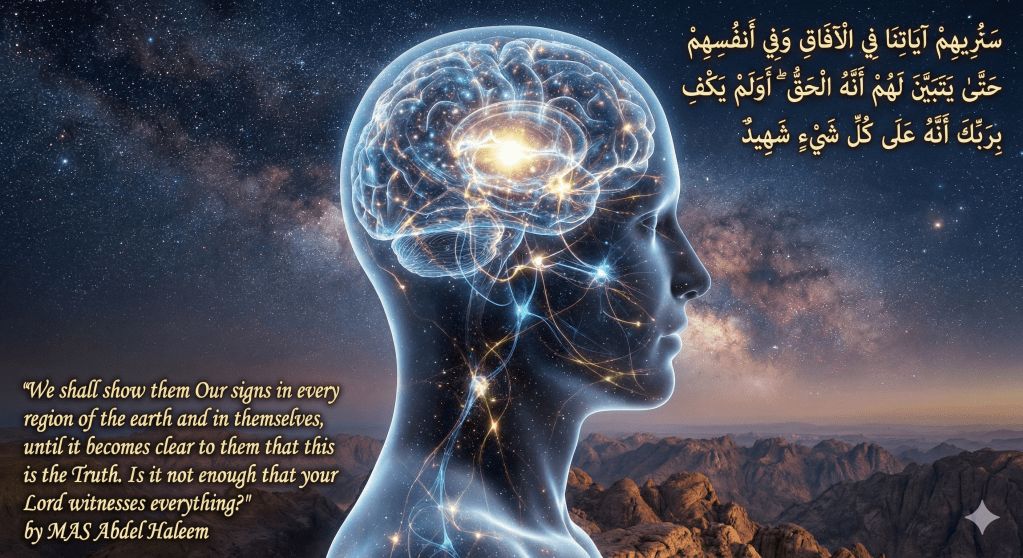
| 41:53 | “Signs… in themselves” | This verse establishes consciousness as an “internal laboratory” for discovering God. |
| 17:85 | The Soul (Ruh) | Defines consciousness as a lasting mystery from the “Command of the Lord.” |
| 39:42 | Sleep as “Little Death” | Uses Shah’s expertise in sleep medicine to show the soul’s independence from the brain. |
| 8:24 | Divine Intervention | “Allah comes between a person and his heart,” symbolizing proximity to the self. |
In his analysis of Quran 39:42, Shah highlights the mystery of the “continuity of the self”. He notes that even though active consciousness ceases during sleep, an individual wakes up as the same “I” with the same memories. He argues that this serves as daily empirical evidence that the “self” is recorded and sustained by a higher authority rather than being a flickering product of brain activity.
In commentary on Quran 41:53, Shah emphasizes the “Two Eyes” of Truth: the Eye of Reason (Science) to study the “Book of Nature,” and the Eye of Revelation (Scripture) to study the “Book of God”. He argues that when humanity opens both eyes, they see that the external signs in the cosmos (fine-tuning, entropy) are perfectly mirrored by the internal signs in the human self (consciousness, morality).
Conclusion: From Inertia to Awareness
The investigation into the fundamental nature of consciousness, as explored through the “Closer to Truth” dialogue and the work of Dr. Zia H. Shah, MD, culminates in a profound realization: the universe is not a closed, mechanical system of “dead” matter.
As the participants in the video demonstrate, even within the halls of secular philosophy and physics, there is a growing acknowledgment that consciousness cannot be easily dismissed as a biological accident. David Chalmers’ “Hard Problem,” John Searle’s “Ontological Subjectivity,” Marilyn Schlitz’s “Nested Relationships,” and Andrei Linde’s “Quantum Observer” all point to the irreducible nature of awareness.
Dr. Zia H. Shah, MD, provides the final synthesis. By identifying the “Hard Problem” as a “Theological Signpost,” Shah demonstrates that the emergence of consciousness from an originally inert universe is the ultimate proof of a Prior Mind. The brain acts as the “biological transceiver” for a soul that originates in the “World of Command,” and the act of subjective experience is the “Prime Signifier” of a universe that is alive with meaning and purpose. Ultimately, the study of consciousness reveals that we do not live in a “dead” cosmos, but in a creation where every heartbeat of awareness is a witness to the Transcendent.


 The Glorious Quran and Science
Leave a reply to Zia H Shah Cancel reply