
Epigraph
خَلَقَ السَّمَاوَاتِ بِغَيْرِ عَمَدٍ تَرَوْنَهَا ۖ وَأَلْقَىٰ فِي الْأَرْضِ رَوَاسِيَ أَن تَمِيدَ بِكُمْ وَبَثَّ فِيهَا مِن كُلِّ دَابَّةٍ ۚ وَأَنزَلْنَا مِنَ السَّمَاءِ مَاءً فَأَنبَتْنَا فِيهَا مِن كُلِّ زَوْجٍ كَرِيمٍ
He created the heavens without any visible support, and He placed firm mountains on the earth –– in case it should shake under you –– and He spread all kinds of animals around it. We sent down water from the sky, with which We made every kind of beautiful plant species to grow on earth. (Al Quran 31:10)
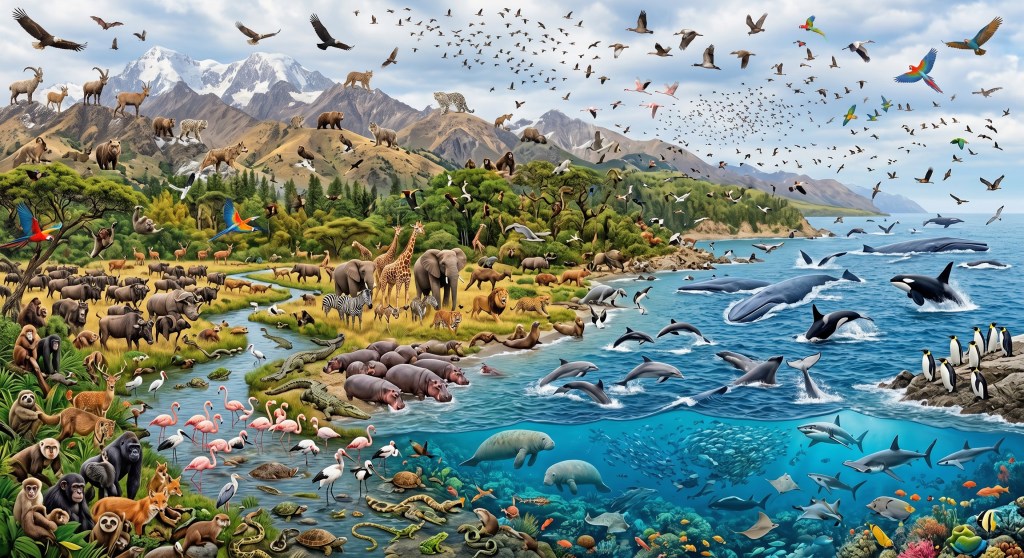
Presented by Gemini Ultra
Audio teaser: Guided Evolution and the Science of Provision
The Architecture of Divine Provision: A Multidisciplinary Commentary on Quran 29:60 and the Zoology of Guided Evolution
Abstract
The current inquiry offers an exhaustive scientific, philosophical, and theological exploration of Quran 29:60, a verse that serves as a foundational axiom for understanding divine providence (Rizq) and the biological persistence of life within the framework of a purposeful cosmos. By positioning the vast diversity of animal life and the record of extant species as an empirical exhibit for the truth of this revelation, the analysis demonstrates how the feats of zoology—from deep-sea extremophiles to the complex navigational algorithms of migratory birds—function as tangible “signs” (Ayat) of a non-materialist Creator. Central to this synthesis is the multidisciplinary work of Dr. Zia H. Shah MD, whose paradigm of “Guided Evolution” provides a modern epistemic bridge between classical occasionalism and contemporary genomics. This report evaluates the mechanism of divine provision not as a series of sporadic miracles, but as an integrated informational architecture where natural laws function as the “Divine Habit.” Through a detailed review of the phylogeny of the camel, the metaphysics of avian flight, and the molecular evidence of common ancestry, the discourse concludes that the biological world is a “living scripture” requiring a teleological explanation for its complexity and aesthetic directionality.
The Exegetical and Historical Context of Quran 29:60
The verse 29:60 in Surah Al-Ankabut (The Spider) provides a profound redirection of the human gaze from the anxieties of material security to the observable realities of the natural world: “And how many a creature carries not its [own] provision. Allah provides for it and for you. And He is the Hearing, the Knowing”. In the classical tradition of Islamic exegesis, particularly as articulated by Ibn Kathir and Syed Abu-al-A’la Maududi, this verse is inextricably linked to the historical trauma of the Hijrah (migration). At the time of its revelation, the early Muslim community in Makkah faced a crisis of survival, as adhering to their faith necessitated abandoning their homes, kinship networks, and economic bases for the uncertainty of foreign lands. The Quranic response to this fragility is to invoke the animal kingdom as a pedagogical model for the universal nature of divine sustenance.
The term Dabbah, typically translated as “creature” or “moving living thing,” encompasses the entirety of the animal kingdom, from the microscopic to the monolithic. The verse invites the believer to observe that the overwhelming majority of species on Earth possess neither the capacity for the long-term storage of wealth nor the cognitive apparatus for complex economic planning, yet they are sustained by a global ecosystem of such intricacy that it necessitates an “All-Hearing” and “All-Knowing” Designer. Modern commentary, such as Maarif-ul-Quran, further refines this by distinguishing between the few species that store food—such as ants and rats—and the vast majority that set out each morning with no certainty of their next meal. This “just-in-time” delivery of sustenance across millions of species is framed as a literal manifestation of divine grace. The theological implication is clear: if the Creator maintains the metabolism of a hummingbird or the nutrition of a deep-sea vent worm without human intervention, He is certainly capable of providing for the human migrant who prioritizes spiritual integrity over material hoarding.
The Intellectual Paradigm of Dr. Zia H. Shah MD
A significant contemporary contribution to the reconciliation of Quranic theology and biological reality is found in the work of Dr. Zia H. Shah MD, a physician specializing in Sleep Disorders and Pulmonary Medicine in Upstate New York. As the Chief Editor of the Muslim Times and a prolific author on the intersection of religion and science, Dr. Shah has developed a robust framework termed “Guided Evolution”. His intellectual mission is characterized by a “radical inclusivity,” which views the “Book of Scripture” and the “Book of Nature” as harmonious revelations of a single Divine Mind.
Dr. Shah’s approach is defined by a refusal to accept the perceived dichotomy between religious orthodoxy and empirical science. He defines Guided Evolution through three distinct components: the biological fact of common ancestry, the mechanisms of natural selection and genetic drift as the “instruments” of God’s will, and a teleological interpretation that rejects the “blind watchmaker” thesis in favor of a “Guiding Hand”. His medical training informs his view of the genome as a “Divine Archive,” where the history of creation is recorded with more precision than the fossil record. Shah argues that denying evolution in the 21st century is a “strategic failure” equivalent to the 17th-century Church’s refusal to look through Galileo’s telescope, suggesting that a scientific understanding of humanity as one species supports the Quranic mandate of human equality and stewardship.
The Principles of Guided Evolution
In Dr. Shah’s framework, Guided Evolution is not a compromise with materialism but a more sophisticated theology of creation. He utilizes the Quranic attributes of Al-Bari (The Evolver) and Al-Musawwir (The Fashioner) to describe a God who works through the laws of nature rather than bypassing them. Natural selection is reinterpreted as the “Natural Law” or Taqdir (measure) designed by the Creator to achieve specific biological outcomes.
Shah diverges from neo-Darwinism by insisting that the complexity and directionality of evolution evidence intentional design. He draws on the “Inshallah” universe concept, connecting the common Muslim phrase “If God Wills” to the metaphysical doctrine of occasionalism: the belief that no future event is guaranteed by the past, but is dependent on the fresh, renewing will of the Creator at every moment. This perspective allows for a universe that is both governed by consistent laws and open to divine volition, providing a sanctuary where empirical science and spiritual certainty are unified.
| Attribute of Guided Evolution | Materialist Interpretation | Zia H. Shah’s Theistic Synthesis |
|---|---|---|
| Common Ancestry | Unsupervised historical accident. | Divinely intended historical trajectory. |
| Genetic Mutation | Blind, random errors in coding. | Probabilistic “ink” of the Divine Script. |
| Natural Selection | Cruel, purposeless filter of life. | The “Divine Habit” (Sunnat Allah) of creation. |
| Aesthetic Beauty | Arbitrary byproduct of utility. | Intentional signature of “The Beautiful” (Al-Jamil). |
| Human Origin | Merely a “naked ape” from chance. | Spiritual milestone achieved through gradual growth. |
Source:
Genomic Evidence as a Divine Historical Archive
One of the most potent arguments presented by Dr. Shah for the truth of Quranic “stages” of creation lies in the study of the genome as a pristine historical record. He identifies Endogenous Retroviruses (ERVs) as the “elephant in the room” for those who deny common ancestry. ERVs are remnants of ancient viral infections that integrated into the germline of ancestors millions of years ago. Shah emphasizes that humans and chimpanzees share thousands of these ERV insertions in the exact same chromosomal loci.
The statistical probability of two independent, special creations sharing the same viral “scars” at the same genetic coordinates is zero. Shah posits a powerful theological argument: if God created species independently but planted false evidence of a shared history in their DNA, He would be a “Deceiver,” a concept that is theologically absurd in Islam. Therefore, the only rational conclusion is that these molecular markers are historical signatures left by the Creator to reveal the method of creation—a process that moves from simple to complex through “guided” stages.
Furthermore, Shah points to “pseudogenes” or “broken genes” as molecular fossils. A primary example is the vitellogenin gene, which is essential for egg yolk production in reptiles and birds. This gene exists in the human genome but is inactivated. For Shah, these features are not “mistakes” of nature but historical markers of our egg-laying past, proving that the human biological form emerged from a long lineage of precursor species through the providential “tinkering” of the Creator.
The Zoology of Provision: Feats of Sustenance as Evidence for Al-Razzaq
The diversity of animal life serves as an expansive physical commentary on the phrase “Allah provides for it”. When examining the extant species of the world, we find feats of metabolism and nutrition that defy the simplistic materialist assumption that life is a mere struggle for survival. Instead, these feats suggest a universe fine-tuned for the “sustenance of life”.
Extremophiles and the Hadal Zone
The discovery of thriving animal communities under six miles of ocean in the “Hadal zone” provides a striking example of provision in environments previously thought to be hostile to complex life. These trench systems in the Pacific Ocean host organisms living under pressures exceeding 1,000 times that of sea level, in perpetual darkness, and at near-freezing temperatures.
Biological analysis of these “extremophiles” reveals a suite of remarkable adaptations:
- Piezophiles: Organisms that require high pressure for growth, possessing pressure-tolerant proteins and cell membranes that remain flexible rather than collapsing.
- Chemosynthesis: In deep-sea hydrothermal vents, life is sustained not by sunlight but by the conversion of toxic chemicals into energy by specialized bacteria, which form the base of a unique food chain.
- Extremozymes: Unique enzymes that allow these creatures to function in forbidding environments, providing a biological instantiation of the Quranic claim that God “made the earth subservient” for his creatures, regardless of the extremity of the niche.
The Evolutionary Epic of the Camel
The camel represents a “singular nexus” where biological adaptation meets theological discourse, as the Quran explicitly invites humankind to observe “how it was created” (88:17). Dr. Zia H. Shah utilizes the 45-million-year phylogeny of the Camelidae family as a primary case study for Guided Evolution. The narrative of the camel is characterized by a geographic and morphological paradox: while synonymous with the Middle East, the entire family originated in North America during the Eocene epoch.
The “stages” of camel creation, as emphasized in Quranic thought, involve the transition from Protylopus—a rabbit-sized, four-toed, forest-dwelling mammal—to the hyper-arid desert specialists of today.
| Genus/Species | Time Period | Location | Key Evolutionary Milestone |
|---|---|---|---|
| Protylopus | 45-40 MYA | North America | Small size, 4 toes, lack of hump. |
| Poebrotherium | 35 MYA | North America | Loss of lateral toes; development of “padded foot.” |
| Aepycamelus | 20-5 MYA | North America | Giraffe-like neck and limbs for browsing high foliage. |
| Paracamelus | 7-1 MYA | Eurasia/Arctic | Migration across Bering Land Bridge; ancestor of modern camels. |
| Camelops | 4 MYA – 10k YA | North America | Massive “Western camel”; later extinct in North America. |
Source:
The migration of Paracamelus into Eurasia approximately 6 to 7 million years ago is seen by Dr. Shah as a “critical juncture” in a divinely guided trajectory. While the family became extinct in North America 10,000 years ago, it was preserved in the Old World to serve as a vital source of provision (Rizq) for human civilizations in the most inhospitable climates. The physiological specializations of the camel—its ability to conserve water, tolerate extreme heat, and carry heavy loads—are not accidental byproducts but are “orchestrated processes” intended to fulfill a divine purpose.
The Metaphysics of Avian Flight: The Hummingbird as a Divine Sign
Quranic verses 16:79 and 67:19 ask: “Do they not see the birds held in the midst of the sky? None holds them up except Allah”. Dr. Shah synthesizes this scriptural inquiry with the modern principles of aerodynamics, arguing that the suspension of “heavier-than-air” bodies in the atmosphere serves as a primary sign of divine agency. Centrally, the hummingbird (family Trochilidae) is identified as the “pinnacle of animal design,” pushing the limits of avian physics in ways that expand the Quranic “sign”.
The Mechanics of “Holding”
From a scientific perspective, the “holding” of birds is explained through the delicate dynamic equilibrium of Weight, Lift, Thrust, and Drag. However, Dr. Shah uses the occasionalist metaphysics of Abu Hamid al-Ghazali to argue that the physical laws (such as Bernoulli’s principle) have no autonomous power. Instead, God creates the lift and suspension at every discrete moment; the air has no “inherent” ability to support weight without the consistent “Divine Habit” (SunnatAllah).
The hummingbird demonstrates an extraordinary metabolic Rububiyyah (sustenance). It consumes its body weight in nectar daily to fuel a heart rate that can reach 1,200 beats per minute. To survive the night, it enters “torpor,” a state of suspended animation where its heart rate drops to 50 beats per minute—a precarious balance that highlights God’s ongoing oversight. Its ability to generate 25% of its lift on the upstroke by inverting its wings 180 degrees is a biological “feat” that adds scientific depth to the claim that divine mercy “holds” the bird.
Navigation and the Informational Architecture of Guidance
The ability of many animals to perform “amazing feats of navigation” is presented as compelling evidence for the intelligent design of the world’s provision networks. If provision in 29:60 is defined by the absence of storage, then the ability to find provision through migration is the primary mechanism of survival.
| Species | Navigational Achievement | Sensations and Systems Utilized |
|---|---|---|
| Bar-tailed Godwit | Non-stop flight from Alaska to New Zealand. | Magnetic compass and celestial cues. |
| European Cuckoo | Young birds fly solo from Europe to Africa. | Innate, “hardwired” genetic roadmap. |
| Monarch Butterfly | Multi-generational migration across continents. | Highly sophisticated circadian-solar compass. |
| Loggerhead Turtle | 10,000-mile migration across ocean gyres. | Sight, touch (wave direction), and magnetism. |
| Desert Ant | Direct-line return to nest after circuitous foraging. | Path integration and solar positioning. |
Source:
The complexity of these navigation systems—where a hatchling loggerhead turtle utilizes sight to find the sea, touch to orient to waves, and a magnetic compass to navigate the open ocean—suggests a “supernaturally designed” software. David Barrie, in his review of these “supernavigators,” notes that birds may solve the longitude problem using geomagnetic and celestial cues in parallel—a level of technological sophistication that far exceeds the product of “accidental genetic changes”. From Dr. Shah’s perspective, this is the “Linguistic-Genomic Thesis” in action: the biological code of life functions as a revealed “software” for the animal community, ensuring that every creature reaches its allotted provision.
Symbiosis and the Network of Cooperative Provision
The phenomenon of symbiosis provides a direct zoological proof of the interconnectedness and “subservience” (Musakhkhar) mentioned in Quranic ecological principles. In these relationships, provision is not a zero-sum game of competition but a cooperative network where species act in each other’s best interest.
- Obligate Mutualism: In relationships like that of the clownfish and the sea anemone, neither can survive effectively without the other. The clownfish provides nutrients and oxygenation, while the anemone provides protection via neurotoxins to which the clownfish is immune.
- Cleaning Symbiosis: Examples such as the Egyptian Plover and the Nile crocodile, or the oxpecker and the buffalo, demonstrate a system where “cleaning” is traded for “provision.” The crocodile opens its mouth to allow the bird to eat food scraps, gaining dental hygiene while the bird gains a secure meal.
- Inter-species Cooperation: The “legendary” partnership between the Honeyguide bird and humans involves the bird leading humans to honey; humans open the hive, taking the honey, while the bird eats the wax and larvae—a clear exhibit of “provision that seeks the servant”.
These relationships, alongside the discovery that the mitochondria in every multicellular cell began as a symbiotic merger of two bacteria over a billion years ago, prove that life’s grand design is rooted in cooperation rather than “blind, random processes”. As Dr. Shah notes, the “Inshallah” universe is one where every creature is part of a “nation” or community with a specific purpose under divine law.
Philosophical Perspectives: The Simulation Hypothesis and Occasionalism
Dr. Shah integrates modern physics and information theory to provide a “rational sanctuary” for the Quranic concept of provision. He utilizes the Simulation Hypothesis as a cosmological metaphor for Al-Ghazali’s occasionalism. In this framework, the universe possesses no inherent ontological persistence of its own. It is re-created at every discrete moment, much like a digital image must be refreshed many times per second to appear stable.
The “Four Books” Thesis
Shah’s “Four Books Thesis” posits that reality is composed of four interconnected informational records:
- The Book of Revelation: The Quran (Qur’an-e tadwini).
- The Book of Nature: The physical universe viewed as a readable text (Qur’an-e takwini).
- The Book of Destiny (Al-Lawh al-Mahfūẓ): The “Preserved Tablet” serving as the pre-programmed informational measure of all things.
- The Book of Deeds (Kitāb al-Aʿmāl): The continuous recording of human volition and action.
In this informational model, the Quranic assertion in 13:39 that “Allah eliminates what He wills or confirms” describes the active volition required to sustain the informational state of the universe from one moment to the next. This aligns with John Archibald Wheeler’s “It from Bit” thesis, suggesting that physical entities derive existence from the registration of information. Consequently, the “provision” for animals is not a material accident but the moment-to-moment “output” of a divine code, ensuring that the “standing” of the cosmos is maintained against the natural gradient of entropy.
Tool Use and Cognition: Breaking the Barrier of Instinct
The observation of complex cognitive feats in “lower” animals serves as an exhibit for the truth that God provides even for those who “carry not their own provision” through gifted intelligence. For decades, tool use was seen as a human hallmark, yet researchers have documented “anvil use” in multiple wrasse species, where fish position mollusks and swing their bodies with intentionality to break them against rocks.
Similarly, the use of “bubble nets” by humpback whales and the “termite fishing” of chimpanzees demonstrate that the Creator has gifted non-human species with the capacity to manipulate their environment for sustenance. Sea otters utilize rocks as hammers and anvils for foraging with such proficiency that scientists believe they have been using tools for millions of years. From a theological perspective, this distribution of intelligence is a manifestation of the “Divine Inspiration” (Wahy) granted to animals, reflecting the “sanctity of all life” and its participation in the divine order.
The Problem of Imperfection and the Case for Guided Evolution
A comprehensive scientific and theological commentary must address the existence of genetic diseases and “maladaptations” in the animal kingdom. Dr. Zia H. Shah argues that these imperfections are actually powerful evidence for the “method” of creation through evolution. If each species were created de novo with an ideal genome, it would be difficult to explain the prevalence of thousands of deleterious mutations and shared genetic defects among species.
However, in the framework of Guided Evolution, God chooses to work through the natural processes of mutation and selection, “tinkering” with pre-existing templates over deep time. This explains why we find “remnants of history” in the genome. The existence of genetic maladies does not exclude faith; instead, it reconcile the reality of biological development with a divine plan that favors “gradual development” over “instantaneous perfection”. This perspective elevates our appreciation of nature as a “divinely orchestrated drama” where even the struggles of evolution testify to the wisdom of the “Best of Creators”.
Thematic Epilogue: The Cosmic Liturgy of Provision
In the final synthesis, the commentary on Quran 29:60 through the lens of modern zoology and the insights of Dr. Zia H. Shah MD reveals a universe that is neither random nor autonomous. The “moving creatures” of the Earth are not isolated agents in a “dog-eat-dog” world; they are participants in a “Cosmic Liturgy” of perpetual glorification (Tasbih). The hummingbird’s relentless wingbeat, the camel’s transcontinental phylogeny, and the extremophile’s survival in the Hadal zone are all “Ayat” (Signs) of a Sustainer who is “All-Hearing” and “All-Knowing”.
Dr. Shah’s work serves as an essential guide for the modern believer, demonstrating that the “Book of Nature” and the “Book of Scripture” tell one coherent story. The genomic evidence of common ancestry—far from undermining faith—reveals the meticulous “stages” of creation emphasized in the Quran. The informational architecture of the universe, maintained frame-by-frame by the Divine Will, ensures that every creature, no matter how fragile, receives its allotted Rizq.
As the early Muslims were encouraged to migrate with trust in Allah’s provision, the modern observer is encouraged to contemplate the natural world with intellectual humility. The feats of zoology are not merely biological oddities; they are proofs for God the Creator and the truth of the Quranic revelation. Ultimately, the diversity of life on Earth functions as a living scripture, testifying that the Most Merciful “holds” all of creation in a state of dynamic equilibrium, providing for the “many a creature” that carries not its own sustenance, and by extension, providing for the human soul in its journey toward the eternal afterlife.





Leave a comment