
Presented by Claude

Abstract
The closing pentad of Sūrat al-Sajdah (Q 32:26–30) constitutes one of the Qurʾān’s most rhetorically condensed arguments for monotheism, prophethood, and the resurrection. In five short verses, the Meccan revelation moves from the silent ruins of vanished civilizations, to the daily miracle of rain quickening dead soil, to the mocking demand of the disbelievers for an immediate Day of Judgment, and finally to a pastoral instruction to the Prophet Muḥammad to “turn away and wait.” The passage operates simultaneously as historical argument (an appeal to the visible record of divine justice in time), as natural-theological argument (an appeal to the cycle of water and life as a sign of resurrection), as philosophical and epistemological argument (the contrast between hearing, seeing, and willful spiritual blindness), and as theological proclamation (the certainty of judgment, the futility of last-minute belief, and the pedagogy of patience). This commentary integrates the classical exegesis of al-Ṭabarī, al-Zamakhsharī, al-Rāzī, al-Qurṭubī, and Ibn Kathīr; modern scholarly readings from Sayyid Abū al-Aʿlā Mawdūdī, Muḥammad ʿAbdel Haleem, Muhammad Ali, and the Seyyed Hossein Nasr-led Study Quran; archaeological context concerning the destroyed peoples of Arabia (Thamūd, ʿĀd, the Nabataeans of al-Ḥijr/Madāʾin Ṣāliḥ); contemporary scientific reflection on the hydrological cycle and historical sociology; philosophical analysis of the Qurʾānic concept of hudā (guidance) as moral receptivity; theological reflection on Yawm al-Fatḥ (the Day of Decision); and the distinct synthesis offered by Zia H. Shah, MD, on his Qurʾān blog, thequran.love, where the surah’s closing argument is read as a paradigm of how the “first creation” functions as evidentiary scaffolding for belief in “the second creation,” the Hereafter.
1. The Qurʾānic Text (Arabic with English Translation)
The verses are set within a Meccan surah of thirty āyāt that opens with the disjointed letters Alif-Lām-Mīm, affirms the Qurʾān as revelation from “the Lord of the Worlds,” and culminates in this argumentative crescendo to the disbelievers of Quraysh.
Verse 26
أَوَلَمْ يَهْدِ لَهُمْ كَمْ أَهْلَكْنَا مِن قَبْلِهِم مِّنَ ٱلْقُرُونِ يَمْشُونَ فِى مَسَـٰكِنِهِمْ ۚ إِنَّ فِى ذَٰلِكَ لَءَايَـٰتٍ ۖ أَفَلَا يَسْمَعُونَ
Awalam yahdi lahum kam ahlaknā min qablihim min al-qurūn yamshūna fī masākinihim; inna fī dhālika la-āyāt, afalā yasmaʿūn.
“Does it not guide them [to see] how many generations We destroyed before them, in whose dwellings they now walk? Surely in that are signs—will they not then hear?” My IslamIslamic Studies
Verse 27
أَوَلَمْ يَرَوْا۟ أَنَّا نَسُوقُ ٱلْمَآءَ إِلَى ٱلْأَرْضِ ٱلْجُرُزِ فَنُخْرِجُ بِهِۦ زَرْعًا تَأْكُلُ مِنْهُ أَنْعَـٰمُهُمْ وَأَنفُسُهُمْ ۖ أَفَلَا يُبْصِرُونَ
Awalam yaraw annā nasūqu al-māʾa ilā al-arḍi al-juruzi fa-nukhriju bihi zarʿan taʾkulu minhu anʿāmuhum wa-anfusuhum; afalā yubṣirūn.
“Have they not seen that We drive the water to the parched land, and bring forth thereby crops from which their cattle and they themselves eat? Do they not then see?” Islamic Studies
Verse 28
وَيَقُولُونَ مَتَىٰ هَـٰذَا ٱلْفَتْحُ إِن كُنتُمْ صَـٰدِقِينَ
Wa-yaqūlūna matā hādhā al-fatḥu in kuntum ṣādiqīn.
“And they say, ‘When will this Decision (al-fatḥ) come, if you are truthful?’” Clear Quran
Verse 29
قُلْ يَوْمَ ٱلْفَتْحِ لَا يَنفَعُ ٱلَّذِينَ كَفَرُوٓا۟ إِيمَـٰنُهُمْ وَلَا هُمْ يُنظَرُونَ
Qul yawma al-fatḥi lā yanfaʿu alladhīna kafarū īmānuhum wa-lā hum yunẓarūn.
“Say: ‘On the Day of Decision the faith of those who disbelieved will not avail them, nor will they be granted respite.’” NobleQuran
Verse 30
فَأَعْرِضْ عَنْهُمْ وَٱنتَظِرْ إِنَّهُم مُّنتَظِرُونَ
Fa-aʿriḍ ʿanhum wa-ntaẓir innahum muntaẓirūn.
“So turn away from them and wait; they too are waiting.” Clear Quran
2. Historical Commentary: The Meccan Audience and the Witness of Ruins
2.1 The Place of the Passage in the Surah
Sūrat al-Sajdah is, by classical Egyptian chronology, the seventy-fifth chapter to be revealed; Theodor Nöldeke independently placed it as the seventieth in the order of revelation. It is universally classified as Meccan, addressed to the Quraysh of Mecca during a period of intense rejection of the Prophet’s message, in which the central themes of the surah—divine unity (tawḥīd), the truthfulness of revelation (risāla), and the Hereafter (ākhira)—were being publicly contested. The first half of the chapter establishes God as Creator and arranges the great theological themes; verses 23–25 invoke the precedent of Moses and the Children of Israel as the prior recipients of a divinely revealed Book; and at verse 26 the surah turns its rhetorical lens directly upon the contemporary deniers, confronting them with the silent testimony of the past and the recurring testimony of the seasons. Wikipedia + 3
2.2 Ibn Kathīr (d. 774/1373)
In his Tafsīr al-Qurʾān al-ʿAẓīm, Ibn Kathīr glosses verse 26 as an argument a posteriori from the disappearance of nations: “Will these people who deny the Messengers not learn from the nations who came before them, whom Allah destroyed for their rejection of His Messengers and their opposition to what the Messengers brought them of the straight path? No trace is left of them whatsoever.” He links the verse to the parallel formula of Q 19:98 (“Can you find a single one of them, or hear even a whisper of them?”) and Q 22:45–46, which speaks of townships reduced to ruins and asks whether the disbelievers “have not traveled through the land,” concluding that “it is the hearts in the breasts that grow blind.” The “signs” (āyāt) of which the verse speaks are, for Ibn Kathīr, “proofs and important lessons” drawn precisely from the contrast between the destruction of those who denied and the salvation of those who believed. Alim + 3
On verse 27, Ibn Kathīr aligns it with Q 80:24–25 (“Then let man look at his food: We pour forth water in abundance”) and treats the revival of dead earth not only as proof of God’s creative agency in the present but as the principal Qurʾānic analogon for resurrection.
For the demand of al-fatḥ in verse 28 and its answer in verse 29, Ibn Kathīr is emphatic that fatḥ here does not refer to the Conquest of Mecca (a position which, he observes, would entail “a grievous mistake,” since on that day the Prophet ﷺ accepted into Islam the freed Meccan prisoners-of-war—nearly two thousand persons whose belated faith was clearly accepted). Rather, fatḥ signifies the Day of Decision—Judgment Day—when belated belief is unavailing, in line with Q 26:118 (Noah’s prayer “judge between me and them”), Q 34:26 (“Our Lord will assemble us all together, then He will judge between us with truth”), and Q 14:15 and 8:19 (which use istaftaḥa in the sense of seeking divine adjudication). My IslamMy Islam
Verse 30, in Ibn Kathīr’s reading, foretells “the consequences of [the Prophet’s] patience and the fulfillment of God’s promise of victory,” while for the disbelievers, who awaited some calamity to befall the Prophet (cf. Q 52:30, “a poet—we await for him some calamity by time”), the same word—intiẓār, “waiting”—becomes a tragic irony: they wait, but for their own destruction. Quran.com
2.3 Al-Ṭabarī (d. 310/923)
Al-Ṭabarī, in Jāmiʿ al-Bayān, the foundational tafsīr of the tradition, treats verse 26 as a remonstrance: “Does the destruction of those before them by their persistence in disbelief and disobedience not become a guidance and an admonition?” He gathers reports from early authorities (Qatāda, Mujāhid) which identify the “generations” (qurūn) with named peoples whose ruins lay along the Arabian caravan routes—above all the peoples of Nūḥ, ʿĀd, Thamūd, the people of Madyan, and the cities of Lot. The Meccan caravans that traveled north to Syria and south to Yemen literally walked among these ruins; the verb yamshūna fī masākinihim (“they walk in their dwellings”) is therefore not metaphorical but topographical. Al-Ṭabarī’s reading anchors the rhetorical question in concrete geography.
2.4 Al-Zamakhsharī (d. 538/1144)
The Muʿtazilī rhetorician al-Zamakhsharī, in al-Kashshāf, draws attention to the linguistic force of awalam yahdi (“did it not guide”) where the more usual structure would be awalam yatabayyan (“did it not become clear”). He notes that hudā—guidance—is here predicated of an event (the destruction of nations) rather than of a teacher; the past itself becomes a hādī. He further observes the pairing of afalā yasmaʿūn (“will they not hear?”) at v. 26 with afalā yubṣirūn (“will they not see?”) at v. 27: the historical argument is auditory, transmitted by speech and report (cf. samāʿ), while the agricultural argument is visual, available to direct observation. Faith is thus called by both ear and eye. Al-Zamakhsharī treats v. 30’s parallel “waiting” as a precision of inverted irony (ṭibāq): the believer’s expectation is consummated; the disbeliever’s expectation devours him.
2.5 Fakhr al-Dīn al-Rāzī (d. 606/1210)
In his Mafātīḥ al-Ghayb, al-Rāzī arranges the closing argument of the surah into a structured proof. The disbelievers, he says, have three possible objections to the Hereafter: (a) that they have no evidence of God’s power to destroy nations (refuted by v. 26); (b) that they have no evidence of God’s power to revive what is dead (refuted by v. 27); and (c) that the absence of an immediate, datable judgment must mean no judgment is coming (refuted by vv. 28–29). For al-Rāzī, the surah closes by demonstrating that the proof of resurrection is not merely the revival of vegetation (a quantitative analogy) but the very pattern of God’s pedagogy in history—God customarily warns, then judges, and the present silence is itself a moment of mercy and probation. The waiting of v. 30 is for al-Rāzī a divinely commanded contemplative posture; the Prophet is not to argue further but to allow time itself to vindicate truth.
2.6 Al-Qurṭubī (d. 671/1273)
Al-Qurṭubī’s al-Jāmiʿ li-Aḥkām al-Qurʾān is encyclopedic in style and gives particular attention to variant readings (qirāʾāt), occasions of revelation (asbāb al-nuzūl), philological detail, and juridical implication. On v. 26 he discusses the philological force of al-qurūn, which can mean a span of years (sometimes said to be a hundred or 120 years) or a generation. He records the position that the “generations” (qurūn) include explicitly the peoples of ʿĀd at al-Aḥqāf in Yemen, Thamūd at al-Ḥijr, the people of Lot at the Dead Sea, and the people of Madyan, all of whose ruins were known to the Arabs of Mecca. He cites the reading reported from Ibn ʿAbbās that yamshūna fī masākinihim refers not only to occasional travel but to habitual transit on the trade routes. Wikipedia
On v. 27, al-Qurṭubī discusses al-arḍ al-juruz—the “shorn,” barren land that has been stripped of vegetation—and links it with the Yemenī agricultural lands and the parched basins of the Ḥijāz, where the rains, sometimes channelled from distant uplands, give life to land that had appeared sterile. He, like al-Ṭabarī, treats this as a sign legible to peasant and bedouin alike.
On v. 29, al-Qurṭubī decisively rejects the view that yawm al-fatḥ refers to the Conquest of Mecca, the Battle of Badr, or the Day the Prophet prayed against the Quraysh during the famine; the correct interpretation is the Day of Resurrection, on which delayed belief is no longer accepted, paralleling Pharaoh’s belief upon drowning (Q 10:90–91).
2.7 The Destroyed Civilizations: ʿĀd, Thamūd, and the Ruins of al-Ḥijr
The Qurʾānic refrain of vanished peoples whose ruins remain (cf. Q 15:80–84; 27:52; 29:38; 7:73–79; 11:61–69) circles around two paradigmatic Arab nations:
- ʿĀd, the people of the Prophet Hūd, traditionally located in al-Aḥqāf (the “curving sand-hills”) of Hadramawt in southern Arabia. They were destroyed, the Qurʾān says, by a furious wind for their arrogant denial. SeekersGuidance
- Thamūd, the people of the Prophet Ṣāliḥ, traditionally located in northwestern Arabia, who carved dwellings into the mountains and were destroyed by an earthquake and a thunderbolt-like blast for hamstringing the she-camel that was their God-given sign. The Qurʾān explicitly mentions Thamūd twenty-six times, making them, after Pharaoh and his people, the most cited example of a destroyed nation. Wikipedia
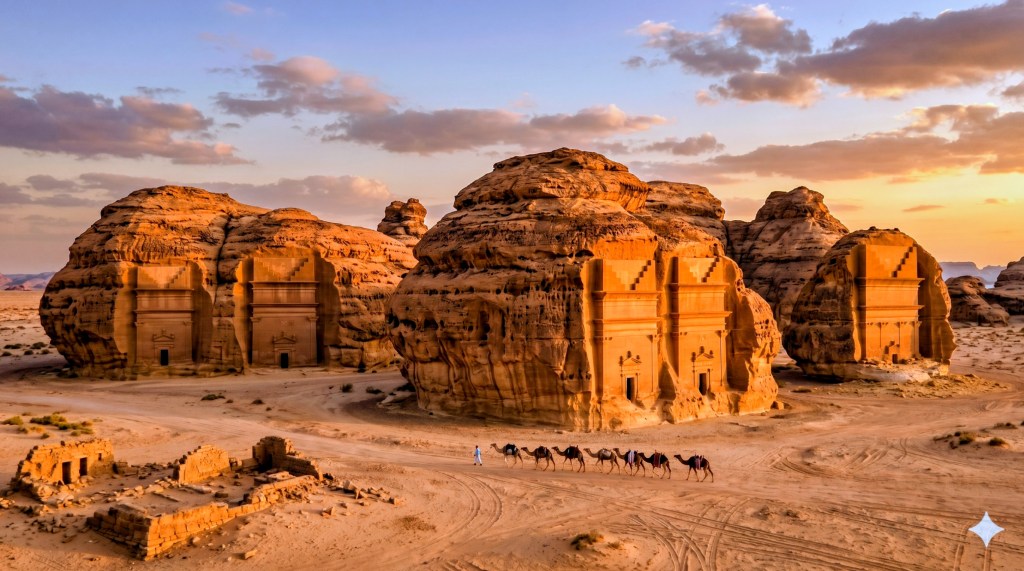
The site most associated with this Qurʾānic memory in the popular Muslim imagination is al-Ḥijr / Madāʾin Ṣāliḥ (Hegra), in the Al-ʿUlā region of present-day Saudi Arabia. UNESCO inscribed Hegra as a World Heritage Site in 2008—the first Saudi site to receive that designation—precisely because of its monumental rock-cut tombs and inscriptions. Modern scholarship and traditional commentary jointly clarify, however, that the visible Nabataean tombs at Hegra date to the Nabataean kingdom (1st century BCE–1st century CE), centuries after the original Thamūd of Ṣāliḥ. As the contemporary scholar Samer Dajani notes, “the Thamūd were not the only civilization that built houses in rocky mountains,” and Robert G. Hoyland has suggested that the name “Thamūd” attached to multiple successive populations of the same region. The narration of Ibn ʿUmar, transmitted in al-Bukhārī, that the Prophet ﷺ on the Tabūk expedition warned his companions not to enter the punished places without weeping (“Do not pass through the dwelling place of those who wronged themselves without crying”), preserves the verse’s pastoral force regardless of whether any specific surviving ruin is the literal site of Ṣāliḥ’s people. The Qurʾān itself names the location of the punished people only as al-Ḥijr (Q 15:80), not “Madāʾin Ṣāliḥ,” a designation that emerged in later Ottoman times. SeekersGuidance + 4
The historical commentary thus converges: the Qurʾān is not making a claim about the precise dating of one ruined city; it is appealing to the cumulative testimony of the long Arabian memory of vanished peoples whose dwellings, in literal fact, the Quraysh caravans walked through twice a year on the riḥlat al-shitāʾ wa-l-ṣayf (the “winter and summer journey,” Q 106:2).
3. Scientific Commentary: The Earth, the Hydrological Cycle, and the Sociology of Civilizations
3.1 The Hydrological Argument of Verse 27
Verse 27 condenses, in a single sentence, what hydrologists today call the global water cycle: clouds carry water from oceans inland, rain reaches even the most parched lands, and germinating seeds initiate the food chain that sustains animal husbandry and human nutrition. The verse names three nodes of this system—al-māʾ (water), al-arḍ al-juruz (the shorn or sterile land), and zarʿ (vegetation/crops)—and ties human and animal flourishing (taʾkulu minhu anʿāmuhum wa-anfusuhum) to a process whose every step now has rigorous physical description: evaporation, condensation, advection, precipitation, infiltration, and primary production through photosynthesis. The Qurʾān’s rhetorical framing—“Do they not see?”—presupposes that observation is possible to anyone willing to attend, but its scientific resonance has only deepened with time. Modern Muslim commentators such as Muhammad Ali (in his English translation and commentary) emphasize that the verse appeals to a regularity of nature whose authorship is precisely what Quraysh’s polytheism obscured: rain was attributed to the stars (al-anwāʾ) in pre-Islamic Arabia, while the Qurʾān insists upon a single Lawgiver behind the law.
3.2 The Earth (al-arḍ) and the Sociology of Civilizations
Verse 26’s appeal to the destruction of generations is not merely a moral threat; it constitutes one of the earliest sustained articulations in world religious literature of a sociological and philosophical-historical argument: civilizations rise and fall, not at random but according to discernible patterns, and these patterns are evidentiary. Sayyid Abū al-Aʿlā Mawdūdī, in his Tafhīm al-Qurʾān, observes that the verse asks “the disbelievers of Arabia” to read history not as accident but as consequence; the same logic that animated the famous Muqaddima of Ibn Khaldūn (d. 1406)—who argued that civilizations follow a moral and material cycle in which luxury, division, and injustice precede collapse—is anticipated here in a single rhetorical question. Modern historians from Arnold Toynbee to Jared Diamond have offered secular variants of the same argument; the Qurʾān’s contribution is to insist that the moral and the material are not separable in the longue durée of empires. Islamic Studies
3.3 Earth-Revival as Evidentiary Bridge
The juxtaposition of v. 26 (death of nations) with v. 27 (life of vegetation) is theologically and scientifically suggestive. The dead earth of v. 27 is, structurally, the analogue of the dead nations of v. 26: both are subjects of divine quickening and divine judgment respectively, and both attest to a single Sovereign of life and death. Seyyed Hossein Nasr and the editors of The Study Quran note that the rebirth of the dead land is the Qurʾān’s most frequent metaphor for resurrection, occurring in nearly identical terms across the surahs (cf. Q 7:57; 22:5; 35:9; 41:39; 50:9–11; 57:17). The contemporary physician-essayist Zia H. Shah, MD (whose synthesis is examined more fully in §6), observes that the Qurʾān deliberately uses the “first creation” as a probabilistic argument for the “second creation,” deploying as evidence those phenomena that even the most skeptical observer must concede. Thequran
3.4 The Relativity of Time and Verse 5
Although vv. 26–30 are the focus of the present commentary, the surah’s earlier statement that “a Day with your Lord is as a thousand years of your reckoning” (32:5) belongs to the same theological argument: it loosens the disbeliever’s demand of v. 28 (“When?”) from any naïve human chronology. As Zia Shah notes on his blog, “before Albert Einstein humanity did not have any conception that time can be relative,” and a hermeneutic that takes the relativity of time seriously dissolves the apparent opposition between divine patience (long delay) and divine certainty (definite verdict). thequran + 2
4. Philosophical Commentary: Hearing, Seeing, and the Epistemology of Faith
4.1 The Phenomenology of Two Senses
The passage’s most striking philosophical structure is the deliberate alternation between two cognitive modalities. Verse 26 ends with afalā yasmaʿūn—“will they not hear?”—and verse 27 ends with afalā yubṣirūn—“will they not see?” The classical commentators, especially al-Zamakhsharī and al-Rāzī, recognize that this is not an aesthetic doublet but an epistemic claim. Knowledge of vanished civilizations is transmitted: it comes by report, by khabar, by hearing the testimony of those who passed through their cities and the prophets who interpreted their meaning. Knowledge of the present cycle of rain and growth is direct: it comes by sight, by the immediate experience of any farmer in the Ḥijāz. The Qurʾān thereby implies that the testimony of revelation is not opposed to the testimony of nature; both are āyāt (signs), and both demand a faculty of attention that the disbeliever has refused.
4.2 Hudā (Guidance) as Receptivity, Not Compulsion
The verb of v. 26 (awalam yahdi) makes the destruction of past civilizations the grammatical subject of guidance: the past “guides” the present. In Islamic philosophical theology, hudā is not the imposition of belief but the offering of sufficient signs; the resistance of the heart is what determines whether those signs are seen as such. This is consistent with al-Rāzī’s and al-Qurṭubī’s standard distinction between hudā al-dalāla (guidance as the production of evidence, which God offers to all) and hudā al-tawfīq (guidance as the actualization of belief in the heart, which God grants according to receptivity). The verses thereby furnish a major data point in the long Islamic philosophical debate, from the Muʿtazila through the Ashʿariyya, on the relation between human freedom and divine grace.
4.3 The Argument from History as a Form of Inductive Reasoning
Verse 26 is, in philosophical idiom, a piece of inductive reasoning from collective experience. Past nations who rejected the moral order met destruction; present nations have no logical immunity to the same pattern; therefore, attention to the moral order is rationally recommended. This is the structure of the Qurʾān’s repeated appeal to “travel through the earth” (sīrū fī al-arḍ; cf. 3:137; 6:11; 16:36; 27:69; 30:9, 42)—a kind of induction by historical fieldwork. In the language of philosophy of religion, this is a historical-cumulative argument analogous to those advanced in the modern era by scholars such as Richard Swinburne for theism on the basis of multiple converging considerations.
4.4 Moral Accountability and the Time of Belief
Verse 29 raises a sophisticated philosophical problem: why should belated belief not be accepted? The classical answer, given clearly by al-Rāzī, is that belief acquires moral worth only when it is held under conditions of evidentiary risk—that is, when one believes without coercion, while the unseen is still unseen. Belief produced by the direct sensory experience of the punishment is not a morally meaningful act of faith; it is a forced acknowledgment, like Pharaoh’s in Q 10:90–91. The verse is therefore not arbitrary but a consequence of a deeper philosophical principle: that the moral significance of belief depends upon its conditions of formation. Søren Kierkegaard, writing in a different idiom many centuries later, would call this the “leap” of faith taken under objective uncertainty; the Qurʾān, with terser economy, calls it simply al-īmān bi-l-ghayb—belief in the unseen.
4.5 The Pedagogy of Intiẓār (Waiting)
Verse 30’s instruction to “turn away and wait” transforms patience itself into an epistemic discipline. Iʿrāḍ here is not contempt but a refusal to be drawn into a mode of debate that the disbelievers control through mockery; intiẓār is the cultivation of a long temporal horizon. Modern philosophers of time have noted that moral judgment requires the ability to hold open a future in which present claims will be tested. The Qurʾān models exactly this disposition.
5. Theological Commentary: Judgment, Prophethood, and Divine Mercy
5.1 Prophethood and the Prior Revelation
Read in continuity with vv. 23–25, the closing pentad rests upon the Qurʾān’s claim of continuity with prior prophecy: Moses received a Book that was “a guidance for the Children of Israel,” and Muḥammad ﷺ receives a Book whose function for the Quraysh is structurally similar. The verses of vv. 26–30 thus stand within a covenantal logic in which God’s pattern of warning and judgment is universal. The destroyed peoples of v. 26 are precisely those whom prior prophets had warned in vain. Islamic Studies
5.2 Yawm al-Fatḥ: The Day of Decision
The technical theological term al-fatḥ (lit. “opening”) is used in the Qurʾān in three connected senses: an opening of judgment (cf. 7:89; 26:118), an opening of victory (cf. 48:1), and an opening of the heart by guidance. In v. 28, the disbelievers use it sarcastically; in v. 29, the Qurʾān recovers it for its eschatological gravity. The mainstream classical position, championed by al-Ṭabarī, al-Qurṭubī, and Ibn Kathīr, identifies yawm al-fatḥ with the Day of Resurrection. A minority view, mentioned and refuted by Ibn Kathīr, identified it with the Conquest of Mecca; Ibn Kathīr decisively rejects this since on that day belated faith was in fact accepted from approximately two thousand Meccans, contradicting the verse’s own statement. My Islam
5.3 The Theology of Warning as Mercy
The conjoined images of past destruction and present rain articulate a single theology in which warning and provision are both expressions of raḥma (mercy). The peoples destroyed had received their prophet; the present generation has Muḥammad ﷺ; and the rain that the present generation drinks daily is itself a memorandum of the same Provider. The Qurʾānic God is thus not arbitrary in judgment; rather, judgment is the long withholding of mercy after mercy has been refused. This is consistent with verse 21 of the same surah: “We shall certainly afflict them with the lesser punishment before the greater, that they may return.”
5.4 The Nature of the Qurʾān as Guidance and Mercy
Although v. 30 closes the surah with an instruction to the Prophet, the surah’s self-understanding is articulated in v. 3 (“the truth from your Lord, that you may warn a people”) and v. 23 (the Book as hudā, “guidance”). The closing verses thus dramatize the function of the Qurʾān: a Book that opens by claiming to be a guidance closes by demonstrating, through the unhearing of its addressees, both the necessity and the difficulty of that guidance. Modern theologians—from Sayyid Quṭb in Fī Ẓilāl al-Qurʾān to ʿAbdel Haleem in his prefatory remarks to this surah—have noted that the Qurʾān’s self-presentation here is performative: it is itself the āya of which it speaks. My IslamThequran
5.5 Patience as a Theological Virtue
The Prophet’s instruction in v. 30 (“turn away and wait”) connects with the Qurʾānic ethic of ṣabr (patient endurance). Theologically, patience is not passivity; it is active alignment with divine time. As al-Rāzī notes, the disbeliever’s “waiting” and the believer’s “waiting” have different metaphysical orientations: one waits for the world to confirm them; the other waits for them to be confirmed by the world to come. This division of waitings is, in miniature, the entire eschatology of the Qurʾān.
6. Commentary from Zia H. Shah, MD (thequran.love)
Zia H. Shah, a physician based in Upstate New York and Chief Editor of The Muslim Times, has authored a verse-by-verse commentary on Sūrat al-Sajdah on his blog The Glorious Quran and Science (thequran.love), titled “Surah Sajdah: Prostration: Defining Paradise and Hell” (December 22, 2017), and a more recent commentary, “The Prostration: A Verse-by-Verse Commentary on Surah As-Sajdah” (April 21, 2026). The following synthesis of his perspective on vv. 26–30 draws principally from the 2017 piece, supplemented by his broader hermeneutical principles articulated across his blog.
6.1 The First Creation as Argument for the Second
Shah’s most distinctive thesis, applied with particular force to this surah, is that the Qurʾān “often uses the first creation as a proof for the second creation, namely our accountability in the hereafter.” The dead-earth-revived-by-rain image of v. 27, in his reading, is not merely meteorology; it is the Qurʾān’s preferred argumentative analogy for resurrection. In his article “Stephen Hawking: ‘There is no heaven; it’s a fairy story!’” (linked in his commentary), Shah collects every Qurʾānic verse in which divine quickening of the earth is invoked as a sign of the Hereafter, arguing that the cumulative weight of this analogy is one of the strongest internal-Qurʾānic arguments against materialist denials of the afterlife. Thequran
6.2 Archaeology and the Verses of Destroyed Generations
Shah anchors v. 26 archaeologically by linking it to two UNESCO World Heritage sites: Madāʾin Ṣāliḥ (al-Ḥijr) in northwestern Saudi Arabia and Petra (the Nabataean capital) in Jordan. He explicitly notes (citing UNESCO and other sources) that the visible monuments at these sites are largely Nabataean, and he engages the broader contemporary discussion about the relation between the Qurʾānic Thamūd and the historically attested Nabataeans. His interest is less in identifying any single ruin with the people of Ṣāliḥ than in showing that the Arab world is studded with the literal evidence that civilizations have risen and fallen—precisely the point of v. 26. thequran
6.3 The Two Pillars of Abrahamic Monotheism
In his commentary on v. 30 and elsewhere, Shah repeatedly returns to a thesis that he describes as the “two fundamental beliefs of Islam, which it shares with Judaism and Christianity”—belief in a Transcendent God and accountability in the life after death (cf. Q 87:16–19). The closing verses of Sūrat al-Sajdah, in his reading, function as a compact statement of both: the destroyed nations attest the Transcendent Lawgiver, and the demand for al-fatḥ in v. 28 forces the issue of accountability. He treats the entire surah as “an attempt to teach humans Monotheism, attributes of the Transcendent God of Abrahamic faiths and accountability from different angles and perspectives.” thequran
6.4 The Withholding of a Date for the Day
On the disbelievers’ mocking demand of v. 28 (“When?”), Shah’s commentary offers an unusually clear epistemological reading: “God is not going to give humanity a date for the Day of Judgment as it takes away from the basic paradigm that He has set for our faith, on reasonable and not mathematical or conclusive evidence and of future accountability, the timing of which is not precisely laid out to maintain an element of surprise and suspense about the final destruction of our abode, our earth.” Faith, for Shah, is constitutively probabilistic: a system of reasonable belief in an unseen reality, and its epistemic structure would collapse under the weight of mathematical certainty.
6.5 The Continuing Disclosure of Signs
Shah cites Q 41:53 as a programmatic verse for his entire blog: “We will show them Our Signs in the universe and also in their own psyche and consciousness until it becomes manifest to them that the Quran is the Truth.” This implies, in his hermeneutics, that the āyāt of vv. 26–27—the testimony of vanished cities and the testimony of quickened earth—are not exhausted by their seventh-century presentation. Modern archaeology, modern hydrology, modern climatology, and modern sociology all expand the field of these signs; “any good commentary of the Quran can never be written in stone,” he writes, and verses about “sociology” and natural phenomena “have to be understood and read in contemporary terms,” while “the main themes of theology—Monotheism and our accountability in the hereafter—are written in stone.” Thequran + 2
6.6 A Distinctive Synthesis
What is distinctive in Shah’s reading of vv. 26–30, when compared with both the classical tafsīr tradition and modern Sunni commentaries such as Mawdūdī’s, is the explicit incorporation of (a) modern archaeological identification of the relevant sites; (b) an Einsteinian relativity-of-time hermeneutic for the surah’s broader theology of the Day; (c) an evidentialist epistemology in which faith and reason are not opposed but coordinated; and (d) a strict insistence (drawn from his reading of v. 17) that all eschatological imagery—including the “destruction” language of v. 26 and the “punishment” language of v. 29—is to be read with metaphorical seriousness rather than crude literalism, since “no soul knows what is kept hidden in store for them” (32:17). The destruction of past civilizations is real; the precise modality of post-mortem accountability transcends our present cognition. thequran
7. Thematic Epilogue
Sūrat al-Sajdah closes by braiding three strands into a single argumentative cord. The first strand is historical: the dwellings of vanished peoples—ʿĀd at the curving sand-hills, Thamūd at al-Ḥijr, Lot’s cities by the Dead Sea, Madyan along the trade routes—stand as silent jurisprudents of moral cause and effect. To walk among them, as the Quraysh literally did, was to walk inside an argument. The second strand is natural-theological: the daily miracle of water reaching parched earth and producing the bread of cattle and of human beings demonstrates that the same hand that judges also feeds; that destruction and provision are two faces of the same sovereignty. The third strand is eschatological: against the mocking demand for an immediate Day of Decision, the Qurʾān answers that al-fatḥ is coming on its own terms, that belief produced by the sight of judgment is not the kind of belief that judgment seeks, and that the appropriate posture for the prophet and his community is the long, disciplined patience of waiting.
The classical commentators—al-Ṭabarī’s philological fidelity, al-Zamakhsharī’s rhetorical precision, al-Rāzī’s structural argumentation, al-Qurṭubī’s encyclopedic breadth, Ibn Kathīr’s hadith-rich exposition—each illuminate one face of this cord. Modern readers, including Mawdūdī, Muhammad Ali, ʿAbdel Haleem, the Study Quran circle, and Zia H. Shah, extend the same threads into the spheres of historical sociology, hydrology, archaeology, philosophy of religion, and the relation of science to scripture. The deepest theological substrate of the passage, however, is older than all commentary: it is the conviction that history, nature, and the human heart are not three separate orders but a single order; that the same God speaks in the wind that buried ʿĀd, in the cloud that drives water to the juruz land, and in the verse that asks, with infinite patience, “Will they not then hear? Will they not then see?”
The Qurʾān’s last word in the surah is muntaẓirūn—“they too are waiting.” The disbelievers wait for time to vindicate them; the believers wait for time to be vindicated by something beyond it. The five verses are a tutorial in the difference between these two waitings. To read them carefully is to be invited into the second.






Leave a Reply