
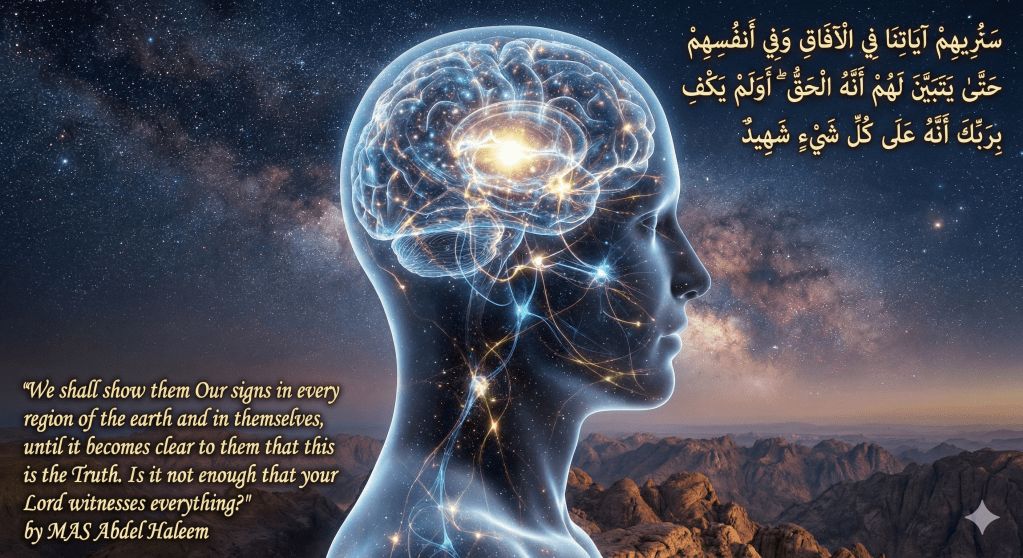
Presented by Gemini Ultra
The quest to comprehend the nature of human consciousness represents the ultimate convergence of the physical sciences, philosophical inquiry, and theological revelation. For centuries, the reductionist paradigm has attempted to categorize the mind as a purely biological byproduct—a localized epiphenomenon of neurochemical interactions. However, as the scientific enterprise enters its sixth century, the “inner light” of subjective experience remains an irreducible enigma, frequently referred to as the final frontier of human knowledge. This report constructs a comprehensive and rigorous case for the existence of a Divine Creator, predicated on the metaphysical necessity of consciousness as delineated in the Glorious Quran and further illuminated by contemporary expert discourse from the “Closer to Truth” series. By integrating the clinical insights of Dr. Zia H. Shah, MD—whose work in pulmonary and sleep medicine provides a unique empirical vantage point on the continuity of the self—with the philosophical and cosmological arguments of leading thinkers, this analysis demonstrates that consciousness is a transcendent “Ayah” (Sign) rather than a mere biological accident.
The Epistemological Convergence and the Unity of Truth
A central pillar of contemporary thought in this field is the rejection of the “blind watchmaker” thesis in favor of a framework that recognizes the inherent teleology of the cosmos. Dr. Zia H. Shah identifies this as a methodology rooted in the classical Islamic principle that truth is unitary; if God is both the Creator of the Universe (the Work of God) and the Revealer of the Quran (the Word of God), there can be no ultimate contradiction between empirical discovery and revealed scripture. This perspective reinterprets the Quranic term Ayah to include both the linguistic verses of the text and the physical phenomena of the natural world, suggesting that the study of a neuron under a microscope is an act of exegesis parallel to the study of a scriptural root word.
This synthesis is perhaps most comprehensively represented by the “Four Books” thesis, which proposes that the Creator reveals His attributes through four distinct yet interlinked domains: Nature, Scripture, History, and the Self. Within this framework, consciousness is positioned as the ultimate internal witness to the Divine, serving as the “meeting point” between the finite human mind and the Infinite Divine reality.
The Landscape of Contemporary Consciousness Theories
To understand the current impasse, one must survey the radical diversity of competing explanations for the mind. After five centuries of investigation, over 225 theories currently jostle for explanatory authority, yet none commands a consensus. This diversity is itself telling, suggesting that the core of consciousness may lie “beyond the rim of human intellectual competence”.
| Theoretical Category | Representative Thinkers | Core Ontological Proposition | Relationship to Physicalism |
|---|---|---|---|
| Metaphysical Naturalism | Sue Blackmore, Daniel Dennett | Consciousness is a byproduct of neural complexity or a “user illusion.” | Reductive |
| Dualist Interactionism | Sir John Eccles, Zia H. Shah | The mind/soul is a non-material substance interacting with the brain. | Non-Reductive |
| Panpsychism | Keith Ward, V.V. Raman | Awareness is a fundamental property of all matter in the universe. | Fundamentalist |
| Divine Mind Pantheism | John Leslie | The physical world consists of the structured thoughts of a Divine Mind. | Idealist |
| Natural Teleology | Thomas Nagel | Nature possesses an inherent, non-intentional bias toward the emergence of mind. | Teleological |
| Objective Realism | David Chalmers | Consciousness is a fundamental fact over and above the physical facts. | Dualist |
The lack of consensus in these models reflects the “Hard Problem” of consciousness—the question of why physical processing should give rise to a rich inner life at all. As David Chalmers observes, “Why should physical processing give rise to a rich inner life at all? It seems objectively unreasonable that it should, and yet it does”.
The Hard Problem and the Incoherence of Materialist Reductionism
The transition from objective neural firing to the subjective “felt” quality of experience represents an ontological chasm that physics cannot bridge. This is frequently illustrated through the concept of “qualia”—the private, introspectively accessible properties of experience, such as the redness of a sunset or the specific sensation of middle C. Materialism struggles to explain how “inert atoms” like carbon, hydrogen, and oxygen, which have no internal “feel,” can combine to produce a “first-person perspective”.
Dr. Shah dismisses the materialist explanation of “Brute Emergence” as “magic” disguised as science, arguing that one cannot get “subjectivity” from “objectivity” any more than one can get the number four from the color blue. This argument is supported by the “Zombie Argument,” which posits that we can imagine a universe physically identical to our own in which humans behave exactly as they do here but “the lights are out”—meaning they lack any internal subjective experience. If such a world is conceivable, it implies that the existence of consciousness in our world is not a logical necessity of the physical facts alone, but an “extra” feature of reality.
The Limits of Science and the Quranic Spirit (Al-Rūḥ)
The enduring mystery of consciousness is directly addressed in Quran 17:85: “They ask you concerning the soul (al-rūḥ). Say: The soul is of the command of my Lord, and you have not been given of knowledge except a little”. This verse places a divine limit on human knowledge, foreshadowing the modern struggle to demystify the mind. In the Quranic worldview, the rūḥ or spirit is not a material substance but an interface between the human and the transcendent.
Dr. Shah interprets this “command” (amr) as indicating the non-material origin of the self. While science can study the brain’s “whir of information processing,” the “subjective aspect”—the thing that it is “like to be” a conscious organism—belongs to a higher plane of reality. This sets the stage for a humbling realization: despite centuries of study, the “inner light” remains an enigmatic phenomenon that defines our existence yet defies full understanding.
Clinical Perspectives: Sleep and the Continuity of the Self
As a physician specializing in Sleep Medicine, Dr. Zia H. Shah utilizes the daily experience of sleep to argue for the soul’s independence from the biological substrate. The Quran describes sleep as a “little death” in Surah Az-Zumar: “Allah takes the souls at the time of their death, and those that do not die He takes during their sleep” (39:42).
The clinical significance of this observation lies in the continuity of the self. An individual wakes up as the “same person” despite a total cessation of active consciousness during deep sleep. Dr. Shah argues that this persistence of identity, across the gap of unconsciousness, serves as daily empirical evidence for the soul’s existence and the possibility of a final resurrection. The self is not merely a transient byproduct of active neural firing; if it were, the interruption of those firings during sleep or anesthesia would lead to a “new” consciousness upon waking. Instead, the “I” remains constant, suggesting a more fundamental anchor for identity.
The Receiver Model of the Brain
To reconcile neurological function with the existence of the soul, Dr. Shah favors the “receiver” or “filter” model of the brain. Just as a radio receives a signal but does not create it, the brain processes consciousness that originates from a non-material source. This model explains why brain damage affects the expression of consciousness—damaging the radio affects the sound—without proving that the brain generates the mind. In this view, the brain is an interface capable of receiving messages from the “Transcendent God of Abrahamic faiths”.
The “Magical Jacket” and the Incoherence of Atheism
To expose the logical deficits of metaphysical naturalism, Dr. Shah employs the metaphor of the “Magical Jacket”. Imagine walking into a store and finding a jacket that fits your measurements exactly, containing your passport, your private diary, and your house keys. If the shopkeeper claims no tailor measured you, but that there are simply “infinite jackets” in the back room and you happened to find the one that fits, no rational person would accept the explanation.
The specificity of the universe—its fine-tuning for life and consciousness—implies a Designer. The atheist is forced to abandon the principle of causation when addressed with the existence of the cosmos, settling for the “brute fact” that the universe exists “just because”. This leads to a devastating inconsistency: while science demands causes for cell division or bridge collapses, atheism abandons this demand for the universe itself.
Table of Universal Constants and Fine-Tuning
The following data illustrates the extreme sensitivity of the cosmic parameters required for a conscious observer to emerge, a phenomenon Zia H. Shah aligns with the “Habit of God” (‘Adah).
| Constant | Role in Cosmic Architecture | Sensitivity/Fine-Tuning Magnitude | Result of Deviation |
|---|---|---|---|
| Expansion Rate of the Big Bang | Governs the speed at which the early universe grew. | 1 part in 1060 | Immediate collapse or failure of galaxy formation. |
| Aqueous Design (Water Properties) | Specific polarity and expansion upon freezing. | Precisely calibrated for life | Terrestrial life becomes impossible. |
| Invisible Pillars (Gravity/EM) | Forces holding celestial bodies in courses. | Balanced for planetary stability | Cosmic chaos or structural collapse. |
| Cosmic Microwave Background | Initial “smoke” phase of hot plasma. | Uniformity required for structure | No stars or heavy elements could form. |
Dr. Shah argues that the “invisible pillars” mentioned in Quran 13:2 and 31:10 are the invisible forces of gravity and electromagnetism that ensure cosmic regularity. By claiming ownership over “the heavens, the earth, and whatever is between them,” the Quran ensures that no “middle zone” of celestial mechanics is seen as an autonomous domain independent of the Creator.
The “Closer to Truth” Insights: Expert Discourse on Consciousness
The mystery of human consciousness serves as a primary exhibit in the debate over ultimate reality. Robert Lawrence Kuhn, the host of “Closer to Truth,” notes the dilemma: is consciousness a purely physical accident, or does it point to a fundamental force or a conscious God?.
Keith Ward: Consciousness as a Fundamental Element
Theologian and philosopher Keith Ward argues that consciousness is not a byproduct of matter but a fundamental element of reality itself. He suggests that the entire universe likely depends on a “wider cosmic form of consciousness”.
“Consciousness might be cosmic, not just human. God’s intentions influence the universe’s development, allowing for causal input into how the universe develops.” — Keith Ward [03:12,05:32].
Ward’s position aligns with the Quranic view that consciousness is primary and that God’s intentions are manifest in the evolutionary process. He views religions as being committed to the belief that there is a “reality of compassion and goodness,” even if they construe this in different ways. For Ward, God is the “ultimate essence of all reality,” a view that complements both theistic and certain non-theistic spiritual traditions.
Paul Davies: The Universe as a Self-Understanding System
Cosmologist Paul Davies takes consciousness seriously as having “cosmic significance,” though he does not subscribe to traditional monotheism. He argues that life, mind, and culture are fundamental to the grand story of the cosmos because they allow the universe to generate its own self-understanding.
“The universe has engineered its own comprehension through living beings. Using quantum physics, observers help sharpen the laws of physics through a feedback loop, creating a self-consistent universe that explains itself.” — Paul Davies [16:32,18:13].
Davies suggests that “we might be of immense cosmic significance—though we cannot, at this point, tell whether this is the case”. His work highlights that the stunning success of quantum mechanics is based on principles so astonishing that their full implications are often not appreciated, even by professional scientists. This suggests a “cosmocultural” perspective where the coevolution of cosmos and culture gives rise to cosmic value.
John Leslie: Reality as the Thinking of a Divine Mind
Philosopher John Leslie presents a Platonist and pantheist view, suggesting that the entire cosmos exists due to an “ethical requirement”. He argues that only a mind can hold a “complicated pattern” together as a single thing.
“All the things of our universe could exist just in the intricately structured thinking of a single mind, perhaps well worth calling ‘divine’. Without our knowing it, the patterns of our lives would be mere ingredients of its thought-patterns.” — John Leslie.
Leslie’s view posits that reality might consist of “nothing else” but infinite divine awareness of everything worth thinking about. This “Divine Mind” would be unified in a fashion familiar to quantum physicists, where parts are not real in isolation from the others. For Leslie, the world of scientific experience and divine causal intervention are the same world, and the existence of patterns in the universe requires a being who can recognize them.
V.V. Raman: The Artistic Signature of Brahman
Hindu physicist V.V. Raman presents a perspective of “cosmic awareness” (Brahman) undergirding the universe. He posits that there is consciousness in every atom and that individual awareness is a “little bit of a reminder of who did this grand painting” [12:15]. Unlike Western monotheism, this view sees “pure consciousness” as the highest plane of existence and the ultimate reality itself. This emphasizes a unity and continuity of life from the smallest to the largest entities in the Hindu tradition.
Sue Blackmore: The Materialist Skepticism
Psychologist Sue Blackmore represents the materialist viewpoint, rejecting the idea that consciousness points to anything supernatural. She dismisses invoking God as “mystery mongering” and expects that science will eventually provide a biological explanation for how brains relate to experience.
“Invoking God is mystery mongering… it doesn’t help in the least and replaces one mystery with another.” — Sue Blackmore [08:52,09:05].
Blackmore’s critique serves as a representative of the “Age of Rationalism,” where religious experience is often rationalized away or derided as superstition. However, as Dr. Shah notes, the “Hard Problem” remains because physicalism is incomplete as a theory of the physical world, given that the physical world includes conscious organisms among its occupants.
Teleology and the Evolutionary Argument Against Naturalism (EAAN)
Dr. Shah employs the “Evolutionary Argument Against Naturalism,” associated with philosopher Alvin Plantinga, to challenge the reliability of human reason under a materialist worldview. If our brains are merely survival engines evolved for hunting and gathering, there is no reason to trust them to understand quantum mechanics or metaphysical truth. Natural selection rewards utility (survival), not necessarily truth; therefore, the materialist who claims his brain is a “meat-machine” undermines the reliability of his own atheistic conclusion.
Belief in truth requires a belief that the mind is more than matter. If thoughts are just chemical reactions and random neuron firings, the very tools used to seek truth—logic and reason—are rendered philosophically incoherent. This sentiment is echoed by Thomas Nagel, who writes, “I want atheism to be true and am made uneasy by the fact that some of the most intelligent… people I know are religious believers”. Nagel’s skepticism of the materialist Neo-Darwinian conception is based on the available scientific evidence which, in his view, does not require us to subordinate the incredulity of common sense.
The Simulation Hypothesis and Divine Volition
In recent years, the Simulation Hypothesis has gained traction as a cosmological model, suggesting that our reality may be a computational construct. Dr. Shah explores whether this hypothesis provides “slam-dung proof” for Guided Evolution. If the universe is code, it requires a Coder. Surah Al-Jathiyah and Surah As-Sajdah are interpreted as providing a theological and linguistic analysis of “Divine Sovereignty” and “Cosmic Order” in an informational age.
The concept of “Occasionalism,” famously defended by Al-Ghazali, suggests that God is the continuous sustainer of the universe, directly involved in every physical event. Dr. Shah connects this to quantum indeterminacy—the behavior of individual photons being reflected or refracted. Science cannot predict the behavior of a single photon; it is only a statistical distribution. Dr. Shah posits that these individual rays are governed from an “additional dimension” that we cannot currently observe, a modern scientific echo of Ghazali’s Occasionalism.
The Prostration of the Universe (Surah 22:18)
Dr. Shah aligns the scientific concept of “universal motion” and “orbits” with the Quranic idea that “all that is in the heavens and the earth glorifies Him”. The “Bio-Hydraulic Majesty” of organisms like the Sequoia sempervirens is analyzed as a theological exhibit of the Quranic verse “We made from water every living thing” (21:30). Every ray of light, from quantum uncertainty to divine witness, serves as an “Ayah” for the seeker.
Synthesis: The Coherence of the Theistic Framework
The “Table of Coherence” contrasts the atheistic and theistic explanations for fundamental human and cosmic phenomena, demonstrating that theism offers a more parsimonious and logically robust framework.
| Phenomenon | Atheistic Explanation | Theistic Explanation | Coherence Verdict |
|---|---|---|---|
| Origin of the Universe | Brute Fact / Quantum Vacuum | Necessary Being | Theism avoids infinite regress. |
| Fine-Tuning | Multiverse (Unseen/Statistical) | Design (Teleology) | Theism is more parsimonious (One God vs. Infinite Universes). |
| Consciousness | Illusion / Reductive Emergence | Imago Dei / Divine Spirit (Rūḥ) | Theism explains the subject; Atheism denies it. |
| Reason/Mathematics | Evolutionary Accident (Utility-based) | Mind of God (Truth-based) | Theism validates the reliability of reason. |
| Objective Morality | Herd Instinct / Social Construct | Divine Law / Transcendent Good | Theism grounds objective values. |
The theistic explanation acknowledges the “manifest image” of the world as it seems to us—full of colors, shapes, and meanings—while also accounting for the “scientific image” of atoms and quantum wave functions. As David Chalmers notes, even if we were in a simulation, the reality of our experience would still be “Reality 2.0″—a new version of reality that is still real.
The Primordial Covenant and the Heart’s Meeting Point
The Quranic notion that God “comes between a person and their heart” (8:24) suggests that consciousness is the nexus of two orders of reality—the created physical order and the divine transcendent order. Our finite minds touch and intersect with the infinite reality of God, meaning consciousness carries a “spark of the transcendent” within it.
This is linked to the “Primordial Covenant” (Alast), a symbolic description of the process by which human beings realize Divine Oneness. As individuals grow in intellect and contemplate the “signs in the horizons and in themselves,” the existence of a single God becomes manifest. Dr. Shah emphasizes that “nothing is hidden” from Divine omniscience, which extends to “whatever you conceal in your hearts and whatever you reveal” (Quran 27:74).
Conclusion: The Inevitable Witness of the Self
The exhaustive investigation into the nature of consciousness—bridging clinical sleep medicine, contemporary neurophilosophy, and Quranic exegesis—reveals that the human self is the final and most profound witness to the Creator. While materialist science attempts to reduce the mind to “meat-machine” dynamics, the “Hard Problem” and the “Magical Jacket” of cosmic fine-tuning testify to a higher purpose.
Dr. Zia H. Shah’s methodology encourages a world where humanity opens “both eyes”: the Eye of Reason to study Nature and the Eye of Revelation to study Scripture. By answering the Divine call, a person realizes that true life springs from spiritual and moral vitality. Consciousness is not a failure of human inquiry but a profound sign of sacred origin—a living miracle that invites humility and wonder. As modern science reaches the limits of the material world, it finds “Nothingness” (the empty state) but is challenged to acknowledge “Nothing” (the Transcendent) which lies beyond the rim of rational reach. Ultimately, as the Quran promises, the signs within our own selves lead to the Truth, vindicating the insight that the secret of our consciousness is in the hands of the Infinite.




Leave a comment