
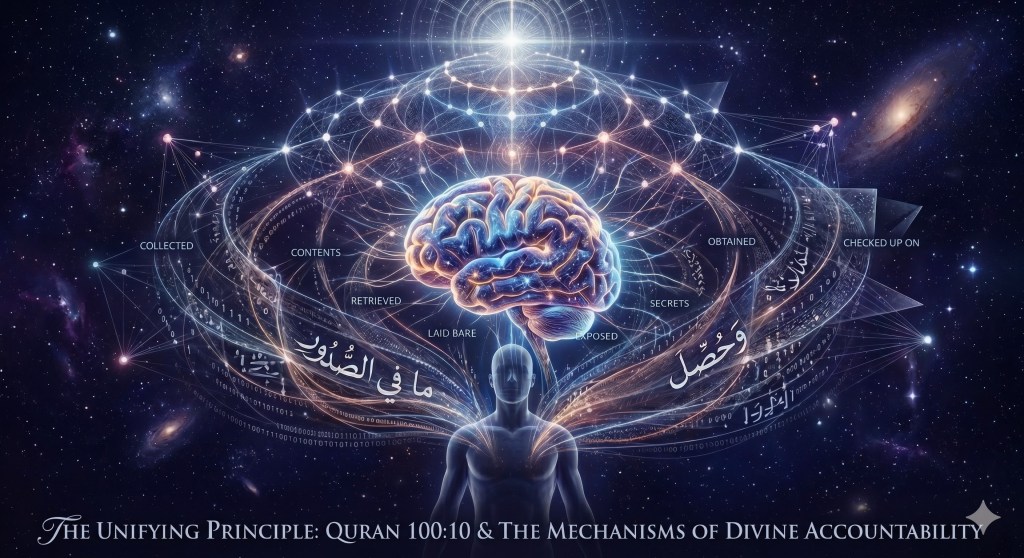
Presented by Zia H Shah MD with the help of Claude
Prologue: The verse that turns the self inside out
وَحُصِّلَ مَا فِي الصُّدُورِ Wa ḥuṣṣila mā fī al-ṣudūr
Eight syllables. A single Arabic verb in the passive voice. An object that is simultaneously an organ, a container, and a hidden ontological region. And from these few words emerges one of the Qur’an’s most breathtaking eschatological claims: that at the end of cosmic history, the contents of every human interior will be extracted, sifted, distinguished, and made manifest.
The verse stands as the tenth āyah of Sūrat al-ʿĀdiyāt (Chapter 100), a short, hammering, percussive Meccan sūrah whose opening verses swear an oath by galloping warhorses — ḍabḥan, qadḥan, ṣubḥan, naqʿan, jamʿan — a rhyme scheme that gallops as fast as its subject. The Last Dialogue The sūrah diagnoses the human condition as kanūd QuransheikhAlim (a barren, ungrateful soil that yields nothing to the one who waters it) and then pivots, in its final three verses, to the cosmic reckoning: when graves are violently overturned (buʿthira mā fī al-qubūr), when what lies inside chests is sifted out (ḥuṣṣila mā fī al-ṣudūr), and when the Lord is revealed as khabīr Alim — intimately Acquainted with the innermost.
Muhammad Asad renders the verse: “and all that is [hidden] in men’s hearts is bare.” Pickthall: “And the secrets of the breasts are made known.” Yusuf Ali: “And that which is (locked up) in (human) breasts is made manifest.” Mustafa Khattab: “and the secrets of the hearts will be laid bare.” Quran.com Safi Kaskas, in his recent 2025 translation, chooses a striking contemporary idiom: “and the hearts’ contents are retrieved.” Wahiduddin Khan: “And the hearts’ contents shall be brought into the open.” Shakir: “And what is in the breasts is made apparent.” Laleh Bakhtiar, in her gender-attentive rendering, gives: “and will be shown forth what is in the breasts?” T. B. Irving translates with a fascinatingly mundane computational tone: “and whatever is on [people’s] minds is checked up on.” Abdul Hye: “and that which is in the hearts (of people) will be made known.” Saeed Malik: “and what is [held] in the bosoms is retrieved?” The Study Quran: “and what lies within breasts is made known.” Talal Itani’s 2025 AI-assisted rendition: “And what is in the hearts is exposed.” His earlier 2012 version: “And the contents of the hearts are obtained.” Kamal Omar expands with unusual exactness: “and stood fully received whatever (was stored hidden within the hearts) in the chests.” Farook Malik: “and that what is in their breasts will be made known.” Ghali: “And whatever is in the breasts is sought out.” Sarwar: “and all that is in the hearts is made public.” Taqi Usmani: “and all that is contained in the hearts will be exposed.” Quran O Shabbir Ahmed: “And the secrets of the hearts will be laid bare.” Munir Munshey: “And all the secrets buried in the hearts are divulged.” Syed Vickar Ahamed: “And whatever (locked up) in (human) breasts is made (clearly) evident—” Sahih International (Umm Muhammad): “And that within the breasts is obtained.” Quran.com The Monotheist Group (2017): “And what is inside the chests will be collected.” Abdel Haleem: “when the secrets of hearts are uncovered, on that Day.” My Islam Abdul Majid Daryabadi: “And there shall be brought to light that which is in the breasts.” Ahmed Ali: “And the secrets of the hearts exposed.” Aisha Bewley: “and the heart’s contents are brought into the open.” Ali Ünal: “And all that is in the breasts is laid open and made out.” Ali Quli Qaraʾi: “and what is in the breasts is divulged.” Hamid S. Aziz: “And what is in the breasts is brought to light.” Bakhtiari Nejad: “and what is in the chests/minds is exposed.” Bilal Muhammad: “And that which is in the chest is made manifest.” Musharraf Hussain: “and the secrets of hearts will be revealed?” Maududi: “and the secrets of the hearts are laid bare (and examined).” Surah Quran And Mohammad Shafi, in a telling choice of verb: “And that which was in (human) minds recovered.”
Read together, these three dozen translations perform, in English, what the Arabic does in one word. The verb ḥuṣṣila refuses to resolve into a single English equivalent — it is extracted and sifted and retrieved and exposed and obtained and collected and examined and recovered all at once. This multiplicity is not a translator’s indecision. It is the verse itself. Quranic Arabic has chosen a word whose semantic field encompasses winnowing grain, smelting ore, acquiring knowledge, realizing what was potential, and producing a final yield. The Day of Judgment, this verse tells us, is the day when the hidden informational content of every conscious being is decompressed, audited, and rendered legible.
The thesis of this commentary is simple and its implications are vast: if Allah has declared that the contents of our breasts will be retrieved, then — because Allah runs the cosmos through lawful, systematic mechanisms — He must have built the mechanism for this retrieval into the very architecture of creation. Our intentions are not ghostly immaterial emissions that God merely remembers; they are, we shall argue, physically real informational events, inscribed in structures we are only now beginning to glimpse: in the quantum substrate of neural microtubules, in the entangled correlations that knit spacetime together, in the holographic boundary that encodes every region of our universe, in the compactified dimensions of string theory, in a Preserved Tablet (al-Lawḥ al-Maḥfūẓ) whose modern analogue may be the conservation of quantum information itself.
What follows is an attempt to read Qur’an 100:10 at the intersection of classical tafsīr, philosophy of mind, quantum mechanics, information theory, and Islamic eschatology. The claim is not that modern physics “proves” the Qur’an, nor that the Qur’an “anticipated” modern physics. The claim is stronger and stranger: that the Qur’anic description of eschatological retrieval and the scientific discovery of information conservation are converging on the same ontological truth from opposite directions — that in a universe built on information, no thought is ever truly private, and no intention is ever truly lost.
I. The Arabic verb that unweaves the heart
The verb حُصِّلَ (ḥuṣṣila) is not a casual choice. It is a Form II passive (faʿʿala pattern, majhūl) derived from the root ح-ص-ل (ḥ-ṣ-l), whose agricultural and metallurgical roots in classical Arabic lexicography cluster around a single image: the kernel that remains after the chaff is blown away; the metal that emerges after the ore is heated. In Lisān al-ʿArab and Lane’s lexicon, ḥāṣil is the yield, the residue, the final result of a process of separation.
This image matters. Qur’an 100:10 does not say the breasts will be opened (futiḥat), or exposed (uẓhirat), or brought out (ukhrijat). It uses the intensive Form II, which in philosophical Arabic — especially the Arabic of Ibn Sīnā and Fakhr al-Dīn al-Rāzī — became a technical term for the process by which the potential becomes actual, or by which something indeterminate is rendered determinate. Taḥṣīl al-ʿilm, “the acquisition of knowledge,” was the classical term for the scholar’s lifelong work of sifting the authentic from the spurious among reported traditions. The verse thus carries an epistemic charge as much as a mechanical one: it is not merely that contents emerge from the breasts, but that they are evaluated, sorted, distinguished.
Al-Rāzī, in his Mafātīḥ al-Ghayb, argued precisely this distinction. Where verse 9 of the same sūrah describes the graves as buʿthira — violently scattered, overturned, with a sense of tumultuous eruption — verse 10 describes the breasts as ḥuṣṣila, a cognitive-evaluative operation that refines. The chiastic parallel is deliberate. The outward body is ejected; the inward content is distilled. The physical universe convulses; the informational universe clarifies. As Al-Zamakhsharī notes in al-Kashshāf, the Form II conveys “bringing out something in the open, and sorting out different things from one another” Surah Quran — a reading Maududi preserves verbatim. And as Al-Ṭabarī reports on the authority of Ibn ʿAbbās, Mujāhid, Qatādah, and Sufyān al-Thawrī, the verb here means muyyiza wa-buyyina — “was distinguished and made clear.” Surah Quran
The passive voice is equally deliberate. Arabic grammarians call this construction al-mabnī li-l-majhūl — “built for the unknown.” But in Quranic rhetoric, the suppression of the agent functions not to hide Him but to magnify Him: the Agent is so exalted that His name need not be spoken, and the action is so categorical that no contingency can interrupt it. This is why verse 11 immediately follows with the divine name khabīr — the one Acquainted with hidden particulars — a name that Al-Rāzī carefully distinguishes from the more general ʿalīm: ʿalīm describes knowledge simpliciter, but khabīr is knowledge of the interior, the fine-grained, the secret.
Then there is the object: الصُّدُور (al-ṣudūr). The Qur’an does not say “what is in the hearts” using qulūb, the most common Arabic word for heart. It does not use fuʾād (the inflamed, impassioned heart, mentioned in 17:36 as juridically accountable). Blogger It does not use lubb (the innermost kernel, used for the intellect of the purified). It uses ṣudūr — plural of ṣadr, literally “chest” or “breast,” from the root ṣ-d-r meaning that from which things issue forth.
Classical Islamic psychology, drawing on al-Ḥakīm al-Tirmidhī’s treatise Bayān al-farq bayn al-ṣadr wa-l-qalb wa-l-fuʾād wa-l-lubb, Living Islam organized these four terms in a concentric hierarchy. The ṣadr is the outermost chamber, the vestibule in which things are stored — secrets, motives, whispers (it is “into the ṣudūr” that Shayṭān whispers in 114:5), MuslimMatters hidden intentions, dormant plans, half-formed thoughts. Al-Islam Deeper lies the qalb, the site of belief; deeper still the fuʾād, the site of passion; and at the center, the lubb, the pith where pure tawḥīd rests. Mymuslimin +2 The Qur’an’s choice of ṣudūr in 100:10 is therefore exquisitely precise: the verse is about the storage chamber of consciousness, the layer where the raw data of mental life accumulates before it is either confessed or concealed. MuslimMatters It is, in informational terms, the buffer.
This is why Safi Kaskas’s 2025 translation — “and the hearts’ contents are retrieved” — and T. B. Irving’s “whatever is on [people’s] minds is checked up on” — both translations reaching for a computational vocabulary — are not anachronisms. They are latent in the original. The Arabic already speaks of the ṣudūr as a repository whose contents are retrievable.
II. The sūrah’s cosmic-cavalry theology
To understand why 100:10 matters, one must feel the gallop of the nine verses that precede it. Sūrat al-ʿĀdiyāt opens with an oath — and oaths in the Qur’an are never decorative. They swear by created things in order to draw the reader’s attention to a sign (āyah) they have failed to see. Here the oath is sworn by the ʿādiyāt, the chargers, and the imagery is martial: horses panting in the dawn raid, striking sparks from their hooves on desert stone, kicking up dust as they plunge into the enemy’s center. AlimWikipedia
The jawāb al-qasam — the answer to the oath — arrives in verse 6: “Indeed, mankind, to his Lord, is ungrateful.” Wikipedia Then verse 7: “And indeed, he is to that a witness.” Quran.com Then verse 8: “And indeed, in love of wealth, he is intense.” Alim
The contrast is devastating. The animal, dumb and voiceless, spends itself utterly for its master. Islamicstudies.info The human, gifted with intellect, language, revelation, and countless favors, is kanūd — a word whose root denotes ground so barren that no matter how much rain falls on it, nothing grows; a soul so ungrateful that it counts only its afflictions and forgets its blessings. And worse: the human knows this about himself. The ingrate is a witness against himself — ʿalā dhālika la-shahīd — anticipating 75:14, bal al-insānu ʿalā nafsihi baṣīrah: “Rather, man, against his own self, is evidence.”
It is precisely here that verse 9 demands, with an almost accusatory incredulity: “Does he not know, when the contents of the graves are scattered (إِذَا بُعْثِرَ مَا فِي الْقُبُورِ), and what is in the breasts is sifted (وَحُصِّلَ مَا فِي الصُّدُورِ), that their Lord, that Day, is khabīr — intimately Acquainted with them?” Worldofislam
This is a two-axis resurrection. The grave gives up the body; the breast gives up the mind. The physical is exhumed; the informational is retrieved. And in between these two disinterments — one of matter, one of meaning — stands the verb ḥuṣṣila, which in the Arabic of Al-Qurṭubī’s tafsīr is glossed as the separation of the good from the evil, the sincere from the hypocritical, the believed from the merely professed. As Abdul Majid Daryabadi renders it: “there shall be brought to light that which is in the breasts.” Surah Quran As The Monotheist Group puts it more literally: “what is inside the chests will be collected.”
This is where the theological claim becomes physical. For the breast’s contents to be collected — to be retrieved — they must have been, in some sense, stored. And if stored, then stored somewhere. And if somewhere, then in some structure. The verse does not merely declare that God knows; it declares that what God knows will be extracted from the place in which it is kept. The Quran, in other words, is committing itself to an ontology: consciousness leaves a trace, and the trace is real, and the trace can be recovered.
III. The juristic correlate: no judgment without retrieval
Islamic jurisprudence rests on a single hadith that Al-Shāfiʿī called “one-third of all religious knowledge” WordPress and which Al-Bukhārī placed as the opening hadith of his Ṣaḥīḥ, as if to declare that the entire edifice of Islamic law is founded on this one principle: Islaah
إِنَّمَا الْأَعْمَالُ بِالنِّيَّاتِ Innamā al-aʿmālu bi-l-niyyāt. “Actions are only by intentions.”
The Arabic particle innamā is a particle of exclusive restriction (ḥaṣr): Islaah not “actions are accompanied by intentions,” but “actions are nothing but their intentions.” Every act of worship — wudūʾ, ṣalāh, ṣawm, ḥajj, zakāh — derives its validity not from its external form but from the qaṣd (resolve) that animates it. As Al-Ghazālī writes in Kitāb al-Niyya wa-l-Ikhlāṣ wa-l-Ṣidq, the 37th book of the Iḥyāʾ ʿUlūm al-Dīn: WikipediaGhazali “Intention is the soul of the act; without it, the body of the act is lifeless.” The worship of the heedless is mere habit; the habits of the gnostic are worship. Quran Gallery App Everything turns on what is in the ṣadr.
But now consider the juridical crisis this creates. If judgment is by intention, and intention is hidden in the ṣudūr, then no judgment is possible unless the ṣudūr can be read. Any legal system that punishes or rewards based on invisible mental states requires a mechanism for making those states visible to the judge. In earthly courts, we resort to testimony, confession, and circumstantial inference — all of them imperfect. But the divine court cannot be imperfect; it would not be ʿadl (justice) if it were. Surah Quran Therefore, the doctrine of niyyah entails a doctrine of retrieval. Ḥuṣṣila mā fī al-ṣudūr is the epistemic precondition of qiṣāṣ al-ākhirah — the retribution of the Hereafter. Without retrieval, no justice. Without the verb in 100:10, the whole moral architecture of Islam collapses into unverifiable claims.
The Qur’an confirms this linkage explicitly. “Whether you disclose what is within yourselves or conceal it, Allah will bring you to account for it” (2:284). “Say: whether you conceal what is in your breasts or reveal it, Allah knows it” (3:29). “And Allah is Knower of that which is in the breasts” — ʿalīm bi-dhāt al-ṣudūr — a formula that occurs in 3:154, 5:7, 8:43, 11:5, 31:23, 35:38, 39:7, 42:24, 57:6, 64:4, and 67:13. “The hearing, the sight, and the heart (fuʾād) — about all these, one will be questioned” (17:36). “Whoever does an atom’s weight of good will see it; and whoever does an atom’s weight of evil will see it” (99:7–8). And most strikingly parallel to 100:10: “The Day when secrets will be put on trial” (86:9) — yawma tublā al-sarāʾir — where the verb bulā is the verb for testing metal in fire.
In the classical Islamic imagination, the mechanism of recording is embodied in the Kirāman Kātibīn — the Noble Recording Angels of 82:10–12: “And indeed, over you are keepers — noble recorders (kirāman kātibīn) — who know whatever you do.” Quran Gallery App Sūrat Qāf 50:17–18 describes them more starkly: “Man does not utter any word except that with him is a watcher prepared.” Quran Gallery App And Sūrat al-Zukhruf 43:80: “Our envoys are with them, writing it down.” Smfforfree These angels are not a quaint mythological accessory. They are, in the classical schema, the agents of a continuous act of recording — one on the right for good deeds, one on the left for bad, Grokipedia inscribing every word and (per numerous hadith) every resolved intention into a personal register that becomes, at death, the Book of Deeds (kitāb al-aʿmāl) that the soul will read on the Day of Judgment (17:13–14; 18:49; 69:19–26). The registers of the righteous are gathered into ʿIlliyyīn (83:18–21); the registers of the wicked into Sijjīn (83:7–9).
Above these individualized registers stands al-Lawḥ al-Maḥfūẓ — the Preserved Tablet, named explicitly in 85:22, Quran Gallery App identified in classical tafsīr with the Umm al-Kitāb (Mother of the Book) Sloughislamictrust of 13:39 and 43:4, with the kitāb maknūn (well-guarded Book) of 56:77–78, with the kitāb mubīn (clear record) of 6:59, with the imām mubīn (clear register) of 36:12, and with the kitāb ḥafīẓ of 50:4. Nothing — “not a wet thing nor a dry thing” Fethullah Gülen (6:59) — is absent from this record. A hadith in Tirmidhī reports that the first thing Allah created was the Qalam (Pen), commanded to write the decree of all things until the Hour. Ummat al Wusta A hadith in Muslim states that Allah wrote the decrees of creation fifty thousand years before He created the heavens and the earth. Ummat al Wusta
Here, then, is the classical Islamic cosmology of information. There is an absolute cosmic archive (the Lawḥ al-Maḥfūẓ), containing every event and every state of affairs, written before creation. There are continuous local recorders (the Kirāman Kātibīn), transcribing in real time the actions and relevant intentions of each conscious agent. There is the individual register (the kitāb al-aʿmāl), which each soul carries. And there is the eschatological retrieval event — ḥuṣṣila mā fī al-ṣudūr — when the private is rendered public, the potential made actual, the stored contents decompressed and distributed to their owners.
The question this commentary now turns to is: what could the physical substrate of such a system be?
IV. Intentionality, qualia, and the hard problem
Before we can ask how consciousness is recorded, we must ask what consciousness is. Modern philosophy of mind, from Franz Brentano’s 1874 Psychology from an Empirical Standpoint Stanford Encyclopedia of Philosophy onward, has centered on a single claim: intentionality is the mark of the mental. Stanford Encyclopedia of Philosophy Mental states, uniquely, are about something. Stanford Encyclopedia of PhilosophyStanford Encyclopedia of Philosophy A thought is a thought of something. A belief is a belief that something. A desire is a desire for something. Stanford Encyclopedia of Philosophy This “aboutness” or directedness — the Latin intendere, “to stretch toward” — has no obvious physical analogue; rocks are not about anything. Wikipedia Edmund Husserl Stanford Encyclopedia of Philosophy built an entire phenomenological tradition on this feature, Stanford Encyclopedia of Philosophy arguing that the structure of consciousness is irreducibly intentional — consciousness is always consciousness-of. ResearchGate
It is no accident that classical Arabic philosophy settled on niyya — from the root n-w-y, “to aim, to intend, to direct oneself toward” — as the central moral category. The hadith innamā al-aʿmālu bi-l-niyyāt is not merely a legal principle; it is a phenomenological claim that the moral substance of an act lies in its intentional structure. Brentano and the Prophet agree on this point: what distinguishes a human act from a mere event is the intentional vector that animates it.
But intentionality is only half the mystery. The other half is qualia: the subjective qualitative character of experience. Thomas Nagel, in his 1974 essay “What Is It Like to Be a Bat?”, argued that no amount of third-person information about bat neurology would Open Encyclopedia of Cognitive Scienceever tell us what bat echolocation feels like from the inside. David Chalmers, in 1995, formalized this as the hard problem of consciousness: the “easy” problems — discrimination, attention, report, behavioral integration — are tractable by standard neuroscience, but the hard problem is why any of this is accompanied by subjective experience at all. Why is there “something it is like” to be me? Why does neural firing generate an inner movie rather than proceeding silently in the dark?
Chalmers’s famous zombie argument claims that a molecule-for-molecule duplicate of a human, lacking all phenomenal consciousness, is at least conceivable — and if conceivable, then physicalism is incomplete. Joseph Levine called this the explanatory gap: even a complete physical story of the brain seems to leave out the experiential.
From an Islamic perspective, the hard problem is not a problem but a sign. Consciousness, the Qur’an implies, is not a derivative epiphenomenon of matter but something breathed into matter by divine decree — “and [He] breathed into him of His Rūḥ” (32:9; 15:29; 38:72). The Rūḥ itself is cordoned off from full human comprehension: “They ask you about the Rūḥ. Say: the Rūḥ is of the affair of my Lord, and you have not been given of knowledge except a little” (17:85). Classical Islamic psychology distinguishes rūḥ (the spirit, the divine breath) from nafs (the self or soul in its embodied, psychological aspect), and identifies three stations of the nafs in its moral trajectory: nafs ammāra (the soul commanding evil, 12:53), nafs lawwāma (the self-reproaching soul, 75:2), and nafs muṭmaʾinna (the soul at peace, 89:27). Consciousness, in this schema, is neither mere neural computation nor a ghost in the machine; it is a created interface between the physical body and a non-physical principle, and it is precisely this interface that leaves traces — in the ṣudūr — that can be retrieved.
Ibn Sīnā’s celebrated “Flying Man” thought experiment (in the Kitāb al-Shifāʾ) asks us to imagine a person created fully formed but suspended in empty space, with no sensory input, no bodily awareness, no memory. Ibn Sīnā claims that even this person would affirm his own existence — a pure self-awareness independent of any empirical content. For Ibn Sīnā, this establishes the soul’s immateriality: the self is known to itself not by any bodily process but by a kind of direct presence. Suhrawardī would later formalize this as al-ʿilm al-ḥuḍūrī — knowledge by presence — a non-representational, non-propositional knowing in which the knower and the known coincide. This is precisely the kind of knowing that God has of our ṣudūr: not inferred from external signs but immediately present.
Mullā Ṣadrā (d. 1640) synthesized these traditions into a startling metaphysical vision. His doctrine of al-ḥarakah al-jawhariyya (substantial motion) holds that reality itself is in continuous becoming — not just accidents changing but substances themselves evolving along a trajectory of intensification. The soul, for Ṣadrā, is jismāniyyat al-ḥudūth, rūḥāniyyat al-baqāʾ — “corporeal in origination, spiritual in subsistence.” It begins as a material potentiality of the body and, through the continuous exercise of thought and intention, transubstantiates itself into an increasingly immaterial and luminous mode of being. Every intention you form is not merely recorded; it is you, intensifying toward some ultimate form of yourself. The retrieval described in 100:10 is, on Ṣadrā’s reading, not the reading of an external file but the public disclosure of the being that the person has, by the accumulation of intentions, become.
V. It from bit: information as the fabric of reality
In 1989, the American physicist John Archibald Wheeler — student of Einstein and teacher of Feynman — delivered a lecture at a quantum foundations conference in Tokyo that he titled with three words: “It from Bit.” His thesis: “every ‘it’ — every particle, every field of force, even the spacetime continuum itself — derives its function, its meaning, its very existence entirely… from the apparatus-elicited answers to yes-or-no questions, binary choices, bits.”
This was not mysticism. It was the culmination of a forty-year intellectual arc. Claude Shannon, in his 1948 papers, had shown that information could be quantified — that the bit was as real a physical quantity as the erg or the meter. Rolf Landauer, at IBM in 1961, had proved that information is physical: erasing a single bit necessarily dissipates a minimum of kB T ln 2 joules of heat, a quantity now experimentally confirmed (Bérut et al., Nature, 2012). Jaynes had rewritten statistical mechanics in 1957 as a theory of information. And Bekenstein and Hawking had shown in the 1970s that black holes — the most extreme gravitational objects in the universe — have an entropy proportional not to their volume but to their surface area, measured in bits at the Planck scale.
From this arc Wheeler drew his radical inference: matter is not the substrate of information; information is the substrate of matter. When physicists probe an electron, they do not find a little billiard ball; they find a structured set of answers to yes/no questions — spin up or down, this location or that, this energy level or the next. At the bottom of physics there are not things — there are distinctions, and distinctions are bits.
If this is right, then the universe is, in its deepest stratum, an information-processing system. And if the universe is an information-processing system, then the Qur’anic claim that our intentions are recorded is not a supernatural addition to physics but a natural consequence of the universe being the kind of universe it is. In an information-theoretic cosmos, recording is the default, not the exception. Forgetting is what requires an explanation.
This is reinforced by a sequence of remarkable results collectively known as the no-go theorems of quantum information:
- The no-cloning theorem (Wootters & Zurek; Dieks, 1982): an unknown quantum state cannot be perfectly copied.
- The no-deleting theorem (Pati & Braunstein, Nature, 2000): given two copies of an unknown state, you cannot reduce them to one.
- The no-hiding theorem (Braunstein & Pati, Physical Review Letters, 2007, experimentally verified via NMR in 2011 and via IBM’s quantum computer in 2019): if information appears to disappear from a system via decoherence, it has not vanished — it must be recoverable from the environment. Information cannot be destroyed; it can only be relocated.
The most famous test case is the black hole information paradox. Hawking’s 1976 calculation suggested that black holes destroy information: a pure quantum state swallowed by a black hole returns as thermal (random) Hawking radiation. This appeared to violate unitarity, the deepest principle of quantum mechanics. For forty-three years the paradox was unresolved. Then, in 2019, two simultaneous papers — Geoffrey Penington’s “Entanglement Wedge Reconstruction and the Information Paradox” (arXiv:1905.08255) and Almheiri, Engelhardt, Marolf, and Maxfield’s “The entropy of bulk quantum fields” (arXiv:1905.08762) — introduced the concept of “entanglement islands” inside the black hole, and by following the Page curve of entanglement entropy, demonstrated that the calculated entropy is consistent with unitarity. Quanta Magazine‘s October 2020 headline was unambiguous: “The Most Famous Paradox in Physics Nears Its End. Information, they now say with confidence, does escape a black hole.”
Pause on the implication. The most destructive object in the known universe cannot destroy information. Not a single bit. A human life, with its roughly 10²⁷ atoms and its lifetime integral of neural firing, produces a quantity of information vastly smaller than what a black hole accretes and re-emits. If a black hole cannot erase a bit, then neither can death. The contents of the breast — in the strict, technical, quantitative sense of the word — cannot be destroyed by the decomposition of the body. They must be somewhere. Which is precisely what the Qur’an, fourteen centuries ago, asserted in its passive verb: ḥuṣṣila — retrieved, collected, sifted out. The verb presupposes storage; the physics supplies it.
VI. Quantum entanglement, non-locality, and the fourth in every conversation
In 1935, Einstein, Podolsky, and Rosen pointed out that quantum mechanics predicts the existence of correlations between spatially separated particles that appear to act instantaneously, violating — they thought — the locality of special relativity. Einstein famously derided it as “spukhafte Fernwirkung” — “spooky action at a distance.” In 1964, John Bell derived an inequality that any local hidden-variable theory must obey. In 1982, Alain Aspect performed the decisive experiment: Bell’s inequality is violated. Local realism is false. In 2022, the Nobel Prize in Physics was awarded to Aspect, Clauser, and Zeilinger for experimentally demonstrating that nature is non-locally correlated.
What does this mean? It means that the universe is not a collection of independent local things, interacting only through signals that propagate at the speed of light. It means that particles once in contact remain correlated — entangled — in ways that transcend spatial separation. It means, as Anton Zeilinger’s experiments with 600-year-old starlight have demonstrated, that the correlations hold across cosmological distances. Entanglement is not a curiosity of the laboratory; it is the fundamental texture of reality. Recent work in holography (Van Raamsdonk, Maldacena) even suggests that spacetime itself is woven from entanglement — that the smooth geometry we inhabit is an emergent phenomenon of a more fundamental entangled substrate.
Now read Sūrat al-Mujādila 58:7 with these results in mind:
“There is no private conversation of three but that He is the fourth of them, nor of five but that He is the sixth of them — and no less than that and no more except that He is with them wherever they are.”
The Qur’an here is making a claim about the non-locality of divine presence. No conversation is local; no whisper is truly private; the circuit of every thought includes a term we do not see. What physics has discovered in Bell’s theorem is a pale but structurally analogous truth about nature itself: the universe is inherently non-local. Every entangled pair, once created, remains correlated forever, regardless of distance. If consciousness at its base involves quantum processes — and we shall consider below the evidence that it does — then every conscious act potentially establishes entanglements with a cosmic substrate, entanglements that cannot, by the no-hiding theorem, be destroyed.
This is, of course, not a literal physical mechanism for the recording angels. But it is a structural demonstration that a universe such as ours is already non-local, already informationally integrated, already of the kind in which Qur’anic claims about omniscient divine awareness are consistent with the deepest discoveries of natural science. وَحُصِّلَ مَا فِي الصُّدُورِ is not a violation of physics; it is a corollary of it.
VII. The holographic principle and the boundary of the self
The most radical development in theoretical physics since Einstein is the holographic principle, proposed by Gerard ‘t Hooft in 1993 and elaborated by Leonard Susskind in his 1995 paper “The World as a Hologram.” Susskind wrote:
“The three-dimensional world of ordinary experience — the universe filled with galaxies, stars, planets, houses, boulders, and people — is a hologram, an image of reality coded on a distant two-dimensional surface.”
In 1997, Juan Maldacena’s AdS/CFT correspondence provided a mathematically rigorous realization of this idea: a full quantum theory of gravity in a bulk (d+1)-dimensional anti-de Sitter spacetime is equivalent to a conformal field theory living on its d-dimensional boundary. This is now the most-cited result in theoretical physics, and its implication is staggering: every region of space is fully described by information encoded on its boundary. The bulk is the hologram; the boundary is the film.
If this principle is universal — and there are strong reasons to believe it is — then the contents of every region of spacetime, including every human skull, are encoded holographically on some surface that bounds that region. Nothing inside is “lost” in the sense of being informationally inaccessible from outside; rather, everything inside is already represented on the boundary. In Islamic theological terms, there is a remarkable resonance with the doctrine of the Lawḥ al-Maḥfūẓ: a cosmic surface on which all that happens in the bulk is already inscribed. The Preserved Tablet, understood through the lens of modern holography, is not a supernatural bulletin board; it is the boundary description of the universe, the two-dimensional film on which every three-dimensional event is registered at the Planck scale. The Qur’an called it kitāb maknūn — “a hidden Book” (56:78). Holography calls it the boundary Hilbert space.
Bekenstein’s formula — S = A / (4 ℓ²ₚ), entropy equals area divided by four Planck areas — tells us that a region one square meter in area can hold roughly 10⁶⁹ bits. The surface of the Earth could encode the quantum state of every particle in the solar system with astronomical bits to spare. When the Qur’an tells us that “every thing, We have enumerated it in a clear register” (36:12, imām mubīn), and that “not a wet thing nor a dry thing, but it is in a clear record” (6:59), and that “no calamity strikes upon the earth or within yourselves except that it is in a register before We bring it into being” (57:22) — the classical reader experienced this as a majestic hyperbole. The modern reader, armed with holography, realizes it may be a statement of informational fact.
VIII. Orchestrated objective reduction and the quantum brain
The question remains: how does private mental content get out of the skull and onto the cosmic record? Here we enter the most contested and most exciting frontier: the physics of consciousness itself.
In 1989 and 1994, the mathematical physicist Roger Penrose published The Emperor’s New Mind and Shadows of the Mind, arguing from Gödel’s incompleteness theorem that human mathematical insight cannot be algorithmic and must therefore involve non-computable physical processes. He identified these with a hypothesized form of gravity-induced objective reduction (the Diósi–Penrose mechanism): when a quantum superposition involves enough mass-energy displacement, it collapses spontaneously on a timescale τ ≈ ℏ/E_G, where E_G is the gravitational self-energy of the mass separation. Each collapse event, Penrose proposed, is a “moment of consciousness” — a connection of the brain to the fundamental fabric of spacetime.
Collaborating with the anaesthesiologist Stuart Hameroff, Penrose located these collapse events in the microtubules — cylindrical protein polymers of tubulin in the neuronal cytoskeleton — and named the theory Orchestrated Objective Reduction (Orch OR).
Orch OR has always been controversial. Max Tegmark in 2000 calculated that microtubule coherence should decohere in ~10⁻¹³ seconds, far too quickly for cognitive timescales. But Hagan, Hameroff, and Tuszyński’s 2002 rebuttal in Physical Review E corrected Tegmark’s model of the relevant superposition and obtained times consistent with conscious cognition, further extended by Debye-layer screening and actin-gel ordering. More importantly, recent experimental evidence (2022–2024) has dramatically strengthened the case:
- Babcock et al. (2024) theoretically demonstrated collective quantum superradiant states in microtubules at room temperature.
- The Wiest laboratory at Wellesley College (August 2024) showed that rats pretreated with epothilone B, a microtubule-binding drug, took over a minute longer to lose consciousness under general anaesthesia — consistent with microtubules being a direct target of anaesthetic action.
- Celardo and colleagues (2019–2024) have reported long-lived room-temperature delayed luminescence and tryptophan superradiance in microtubular structures.
- A 2025 review in Neuroscience of Consciousness (Oxford) by Wiest concluded that “a quantum microtubule substrate of consciousness is experimentally supported and solves the binding and epiphenomenalism problems.”
This is not yet mainstream consensus. But the evidence has crossed from fringe speculation into serious contention. And the theological resonance is striking. If consciousness is a sequence of objective-reduction events coupling neural quantum states to the Planck-scale geometry of spacetime, then every conscious thought is, literally, a perturbation of spacetime itself. Every intention imprints on the informational substrate. Every niyya is a ripple in geometry.
To Orch OR one can add Henry Stapp’s quantum mind theory, which takes the von Neumann / Wigner formulation of quantum mechanics seriously and treats conscious acts of attention as genuine quantum measurements — “Process 1” events — that select which questions nature answers. Stapp invokes the quantum Zeno effect (Misra & Sudarshan, 1977, experimentally demonstrated by Itano, Heinzen, Bollinger, and Wineland in 1990 at NIST) as a mechanism by which sustained attention can hold neural quantum states in place, giving conscious intention real causal efficacy. And David Bohm’s implicate order posits that mind and matter are both unfolded from a deeper informational substrate — a view that resonates closely with both Mullā Ṣadrā’s graded ontology and Ibn ʿArabī’s doctrine of the ʿālam al-mithāl, the imaginal realm that is ontologically real but non-physical.
Consider now the convergence. On one side, Islamic metaphysics offers: a soul that intensifies through every intention (Ṣadrā); a cosmic archive (Lawḥ al-Maḥfūẓ); recording agents who inscribe every uttered word (Kirāman Kātibīn); a non-local divine presence that is always “the fourth of three” (58:7); and an eschatological event in which the contents of the breasts are sifted. On the other side, modern physics offers: a universe whose fundamental currency is information (Wheeler); an absolute conservation of quantum information (no-hiding theorem); a holographic encoding of every region on its boundary (Maldacena); non-local correlations that knit the cosmos together (Bell, Aspect); and a growing body of evidence that consciousness itself operates at a quantum level in neural microtubules (Penrose–Hameroff, Wiest).
وَحُصِّلَ مَا فِي الصُّدُورِ — “and what is in the breasts is sifted” — is the point at which these two traditions rhyme.
IX. Extra dimensions, the Barzakh, and the geography of the unseen
The Qur’an repeatedly speaks of al-ghayb — the unseen — as a real domain, inhabited by real entities, accessed by none but Allah and those to whom He grants access (72:26–27). Islamic eschatology posits a Barzakh — an intermediate realm between death and resurrection (23:100) — in which souls persist and experience something of their ultimate destiny. Ibn ʿArabī and Mullā Ṣadrā elaborated this into the ʿālam al-mithāl, an “imaginal world” that is neither purely material nor purely abstract but a genuine third ontological region in which forms have subtle, image-like reality.
Classical thinkers had no vocabulary for describing this domain except analogically. Modern physics has such a vocabulary: extra dimensions. String theory requires 10 spacetime dimensions for consistency; M-theory (Witten, 1995) unifies this into 11. Six or seven of these dimensions are compactified — curled up at scales near the Planck length (10⁻³⁵ m) — typically on Calabi–Yau manifolds whose precise geometry determines the low-energy particle physics we observe. Braneworld scenarios (Randall–Sundrum, 1999; Arkani-Hamed–Dimopoulos–Dvali, 1998) propose that our entire observable universe is a 3-brane embedded in a higher-dimensional bulk, with gravity — and perhaps other fields — accessing the extra dimensions.
To be precise: mainstream physics does not claim that extra dimensions are repositories of souls or memories. That would be speculation beyond what the equations say. But the equations do establish something remarkable: dimensions beyond the three we perceive are a serious possibility, consistent with all known experimental data, required by our best candidate theories of quantum gravity, and capable in principle of storing vast amounts of information at the Planck scale.
The theological inference is modest but significant. When the Qur’an speaks of ʿālam al-ghayb and when classical commentators locate the Lawḥ al-Maḥfūẓ “among the higher group” (as Ibn Kathīr writes on 85:22), the modern reader is not obliged to picture a literal shelf above the clouds. The ghayb may be, quite literally, the dimensions we cannot perceive — and the informational structure of our universe may overflow the three dimensions available to our senses in ways that modern geometry is only beginning to formalize. The ḥuṣṣila of 100:10 may be, among other things, a dimensional unfolding: the contents stored in a compactified region of spacetime being decompressed into the macroscopic dimensions of the resurrected cosmos.
One must distinguish this from pseudoscientific appropriations. Ervin Laszlo’s proposal of an “Akashic Field” (Science and the Akashic Field, 2004), which identifies the quantum vacuum with a cosmic memory of all events, is not accepted in mainstream physics and conflates the technical zero-point field with a metaphysical repository. A responsible scholarly commentary must say this plainly. But the underlying intuition — that the physical universe contains informational depth beyond what classical intuition supplies — is not a New Age embellishment; it is a mainstream inference from holography, entanglement, and the no-hiding theorem. The Qur’anic reader does not need Laszlo. They have Maldacena.
X. Divine omniscience, free will, and the question Al-Ghazālī asked Ibn Sīnā
A theological worry now surfaces. If every intention is pre-recorded in the Lawḥ al-Maḥfūẓ, and every neural event is a quantum measurement whose outcome is in some sense fixed, how is human freedom preserved? The Qur’an insists on both divine omniscience (“Allah has encompassed all things in knowledge,” 65:12) and human moral responsibility (“We showed him the way: either grateful or ungrateful,” 76:3). How can both be true?
This question convulsed classical Islamic thought. Al-Ghazālī’s Tahāfut al-Falāsifa (The Incoherence of the Philosophers, c. 1095) charged Ibn Sīnā with heresy on three points, one of which was Ibn Sīnā’s doctrine that God knows particulars only “in a universal way” — a doctrine Ibn Sīnā adopted to preserve divine immutability (if God knew that Zayd is in the market now, and Zayd later leaves, God’s knowledge would seem to change). Al-Ghazālī retorted that this denies the Qur’anic doctrine that “not a leaf falls but He knows it” (6:59) and therefore undermines the entire moral architecture of accountability.
The theologians (the Ashʿarites especially) responded with the doctrine of kasb (acquisition): God creates the act, but the human “acquires” it — becomes the responsible agent of it — in a manner that preserves both divine sovereignty and human accountability. The Māturīdīs softened this into a more robust human agency; the Muʿtazila pushed further toward libertarian free will. But all agreed on the basic point: divine foreknowledge does not destroy human responsibility, because God’s knowledge of an act is knowledge of the act-as-freely-chosen, not a cause that coerces it.
Modern physics contributes an unexpected resource to this debate. Quantum mechanics, in most interpretations, is irreducibly probabilistic — the outcome of a measurement is not determined in advance by the prior state. If consciousness involves genuine quantum processes (as Orch OR and Stapp propose), then human decisions are not the deterministic output of classical brain dynamics but involve a real indeterminacy that is nevertheless oriented by the intentional structure of the agent. This opens a metaphysical space in which divine omniscience (knowledge of what will actually happen, perhaps known holographically from the boundary rather than causally from the past) is compatible with human freedom (genuine indeterminism oriented by intentional states that the agent forms).
In this framework, the Lawḥ al-Maḥfūẓ is not a deterministic script that coerces events; it is the total informational state of a universe in which agents genuinely choose, and their choices — because they are real informational events — are real entries in the record. The verb ḥuṣṣila is then not the arbitrary exposure of a pre-ordained destiny but the retrieval of a biography that the agent authored in collaboration with the laws of nature God established.
XI. Resurrection as reconstitution: the information-theoretic Qiyāmah
Ibn Sīnā famously held that bodily resurrection could not be demonstrated by philosophical reason, though he accepted it on the basis of revelation. Al-Ghazālī regarded the philosophical denial of bodily resurrection as grounds for takfīr — declaring someone outside the fold of Islam. Mullā Ṣadrā, characteristically, offered a synthesis: the resurrection is real and bodily, but the resurrected body is a body of the ʿālam al-mithāl — a real, perceptible, embodied existence in the imaginal realm, reconstituted from the form the soul has acquired through its lifetime of substantial motion.
Modern information theory offers a striking parallel. The classical Islamic doctrine holds that at the Resurrection, God will reconstitute each human from the scattered atoms of their corpse — a doctrine the early Meccans mocked (“Who will give life to these bones when they are decayed?” 36:78) and the Qur’an answered: “He will give them life who produced them the first time” (36:79). The physical worry — how can a body be reconstituted from scattered dust? — finds a natural modern resolution: a body is not its particular atoms but its informational pattern. Since particles of the same type are quantum-mechanically indistinguishable, what makes you you is not which specific electrons are in your neurons but the configuration — the pattern — the information.
The no-hiding theorem guarantees that the information specifying any quantum system is never destroyed. The holographic principle guarantees that it is encoded on the boundary of any region that contains it. And the substance of Mullā Ṣadrā’s vision — that the soul is the trajectory it has traced through the space of possible forms — coincides precisely with an information-theoretic account of personal identity in which you are your biographical information, and the Resurrection is the reconstitution of that information in a new physical vehicle.
This is not a reduction of Islamic eschatology to computationalism. It is the observation that the Qur’anic picture of resurrection and the physical picture of information conservation are mutually consistent in a way that would have astonished both medieval mutakallimūn and nineteenth-century materialists. The Day of Resurrection is, among other things, a cosmic decompression event: the information that was stored in the boundary of spacetime, in the non-local correlations of the quantum vacuum, in the microtubular records of individual brains, in the noble registers of the Kirāman Kātibīn, and in the absolute archive of the Lawḥ al-Maḥfūẓ — all of it flows back into manifestation. The bodies come out of the graves (buʿthira mā fī al-qubūr); the minds come out of the breasts (ḥuṣṣila mā fī al-ṣudūr); and the khabīr Lord, by the ontological definition of His name, knows every detail.
XII. Why intentions matter: the mercy hidden in retrieval
A reader unacquainted with the Islamic framework might hear in 100:10 only terror: every hidden thought made public, every secret exposed. But the verse is also, astonishingly, a statement of mercy. If intentions are recorded, then good intentions unacted upon are also recorded — as indeed a famous ḥadīth qudsī preserved in Bukhārī and Muslim declares: “If My servant intends a good deed and does not do it, record for him one good deed; if he does it, record ten to seven hundred-fold. If he intends an evil deed and does not do it, record for him one good deed [for refraining]; if he does it, record only one bad deed.” The recording asymmetry tilts the cosmic ledger toward mercy. The sincere intention of a helpless man to feed the poor, though he never had the means, is an entry in the boundary record as real as any act.
Moreover, the doctrine of tawba (repentance) — which the Qur’an declares can erase sins entirely (25:70: “Allah will replace their evil deeds with good ones”) — is not magic. It is precisely what the Islamic tradition of the Lawḥ al-Maḥw wa-l-Ithbāt (the Tablet of Erasure and Confirmation, derived from 13:39, “Allah erases what He wills and establishes”) already anticipated: the informational record is not static but dynamic. Sincere repentance is itself an intentional act, which generates a new informational state, which reconfigures the prior entries. The retrieval on the Day of Judgment is a retrieval of the final state of the record, not a retrieval of every intermediate state. This is why Muhammad Taqi Usmani’s translation — “and all that is contained in the hearts will be exposed” — and Ali Ünal’s — “And all that is in the breasts is laid open and made out” — are theologically precise: it is the content, the final sifted residue, that is exposed, not the chaos of every passing thought.
This is the mercy of the verb ḥuṣṣila. It is a sifting, not a dumping. It separates — as Al-Qurṭubī insisted — the good from the evil. It yields the kernel. And the kernel of a sincere believer, even one whose outward deeds were imperfect, may be more luminous than the exhaustive catalogue of a hypocrite’s externally impressive acts. The Day of ḥuṣṣila is the day on which sincerity is finally legible. As Al-Ghazālī wrote in the Iḥyāʾ: niyyat al-muʾmin khayrun min ʿamalihi — “the believer’s intention is better than his action” — because intentions are beyond the reach of ostentation, known only to God, and retrievable only by Him.
XIII. The arrow of time, entropy, and why forgetting is the anomaly
A final scientific thread must be drawn in. The second law of thermodynamics tells us that entropy — statistical disorder — always increases in closed systems. This is the source of the arrow of time: the past is what has low entropy, the future what has high entropy. Memory, life, and consciousness are all local islands of low entropy, sustained by the continuous dissipation of energy obtained from the Sun’s low-entropy photons.
Why is this relevant? Because the second law is the deepest reason we experience forgetting. In a universe of increasing entropy, the specific arrangements that carry information (a letter, a memory, a neural pattern) are thermodynamically unfavored and tend to dissipate into noise. This is why books decay, brains fade, and civilizations fall.
But the second law is statistical, not fundamental. The microscopic laws of physics — including quantum mechanics with its unitary evolution — are time-symmetric and information-preserving. At the deepest level, no bit is ever lost. Forgetting is a coarse-grained phenomenon that occurs because we cannot track all the microstates; the information we think we have “forgotten” is still encoded in the environment, just distributed so widely that no local observer can reconstitute it.
But the no-hiding theorem tells us that this distributed information is, in principle, recoverable by operations on the full environmental Hilbert space.
Who has access to the full Hilbert space? In physics, no finite observer does. In Islamic theology, one Being does: the Being whose name is al-Muḥīṭ, the All-Encompassing (2:19, 3:120, 4:108, 4:126, 41:54). Allah encompasses all things in knowledge — aḥāṭa bi-kulli shayʾin ʿilmā (65:12) — and the Arabic verb aḥāṭa carries precisely the geometric-topological sense of surrounding a region from its boundary. This is the Lawḥ al-Maḥfūẓ in its boundary-holographic aspect. This is why “not a leaf falls but He knows it” (6:59). This is why “He is Knower of that which is in the breasts” — ʿalīm bi-dhāt al-ṣudūr — in all eleven Qur’anic occurrences.
The verb ḥuṣṣila, in this light, is not a miracle that violates physics. It is the lifting of the thermodynamic coarse-graining that ordinarily hides information from finite observers. On the Day of Judgment, the information that was always there — encoded in the quantum substrate, preserved by unitarity, registered on the cosmic boundary, inscribed in the Preserved Tablet — is rendered legible. What the angels wrote, what the microtubules collapsed, what the boundary encoded, what the Lord knew: all of it is sifted, retrieved, made manifest. وَحُصِّلَ مَا فِي الصُّدُورِ.
Epilogue: A parliament of translations and the convergence of two sciences
Return to the thirty-five translations with which we began. Read them now not as redundancies but as a single polyphonic chord sounding the multiple frequencies of حُصِّلَ.
Some translators heard the forensic register: Pickthall’s “secrets of the breasts are made known”; Munir Munshey’s “secrets buried in the hearts are divulged”; Ahmed Ali’s “secrets of the hearts exposed”; Shabbir Ahmed and Mustafa Khattab’s “the secrets of the hearts will be laid bare”; Abdel Haleem’s “when the secrets of hearts are uncovered, on that Day.” These translations emphasize the moral-judicial dimension: a court has convened, and the defendant’s inner life is testimony.
Some translators heard the revelatory register: Yusuf Ali’s “made manifest”; Shakir’s “made apparent”; Sarwar’s “made public”; Hamid Aziz’s “brought to light”; Syed Vickar Ahamed’s “made (clearly) evident”; Bilal Muhammad’s “made manifest”; Wahiduddin Khan’s “brought into the open”; Aisha Bewley’s “brought into the open”; Bakhtiar’s “will be shown forth”; Daryabadi’s “brought to light”; Maududi’s “laid bare (and examined)”. Here the emphasis is on disclosure: the veil lifted, the hidden made seen.
Some translators heard the retrieval register — and it is striking how many of them are recent, perhaps reflecting our contemporary information-technological moment: Safi Kaskas’s “retrieved”; Saeed Malik’s “retrieved”; Sahih International’s “obtained”; Talal Itani (2012) “obtained”; Itani (2025 AI) “exposed”; Mohammad Shafi’s remarkable “recovered”; Kamal Omar’s “stood fully received”; The Monotheist Group’s “collected”; Ghali’s “sought out”; Qaraʾi’s “divulged.” These renderings grasp the Form II verb’s semantic core: not merely exposure but active acquisition, a retrieval operation performed on a storage medium.
Some translators heard the computational or inspectional register: T. B. Irving’s unforgettably modern “whatever is on [people’s] minds is checked up on”; Ali Bakhtiari Nejad’s “chests/minds is exposed”. These translations, perhaps unintentionally, align the verse with the audit, the log file, the query against a database.
And the great majority heard the epistemic register — the making known — in which concealment ends and divine knowledge is vindicated: Abdul Hye, Farook Malik, The Study Quran, Taqi Usmani.
What is extraordinary is that all of these registers are in the original. The Arabic does not force a choice between forensic, revelatory, retrieval, computational, and epistemic meanings, because the Form II of ḥ-ṣ-l encompasses them all. The verse is, as it were, a hyperlink — pointing simultaneously to a courtroom, a veil-lifting, a data retrieval, an inspection, and a knowing. In a universe in which information is the most fundamental substrate, a single Arabic word can reference the juridical, the phenomenal, the informational, the computational, and the ontological at once, because at the deepest level these are facets of the same reality.
We have argued throughout this commentary that the Qur’anic eschatology of 100:10 is consistent with — indeed, illuminated by — five convergent scientific discoveries: (1) the fundamentality of information (Wheeler, Shannon, Landauer); (2) the conservation of quantum information (no-hiding theorem, black hole islands); (3) the holographic encoding of bulk on boundary (Bekenstein, ‘t Hooft, Susskind, Maldacena); (4) non-locality and entanglement as the fabric of spacetime (Bell, Aspect, Zeilinger, 2022 Nobel); and (5) the growing evidence for quantum processes in conscious neural activity (Penrose–Hameroff, Wiest, Babcock). And we have paired these with five Islamic doctrines: (1) the centrality of niyya as the ontological substrate of moral action; (2) the Kirāman Kātibīn as real agents of continuous informational recording; (3) the Lawḥ al-Maḥfūẓ as a cosmic information archive; (4) the non-local divine presence of 58:7; and (5) the substantial-motion account of the soul in Mullā Ṣadrā as the trajectory an intentional being traces through the space of possible forms.
The thesis proposed by the framing of this commentary now stands clarified: because Allah governs the cosmos through lawful, systematic mechanisms, whatever He declares about the reality of accountability must be grounded in mechanisms He has built into the structure of creation. The retrieval of the breasts is not a suspension of natural law but its completion. The recording angels are not a metaphor for a data center; they are agents operating in a universe whose physical substrate — as we are now discovering — is already a continuous recording medium, from the boundary of spacetime to the microtubules of neurons, from the entangled correlations of the vacuum to the compactified dimensions of string theory. The Qur’an does not describe a supernatural addition to nature; it describes the full extent of the nature Allah has created.
The single verb ḥuṣṣila gathers all of this into itself. Winnowing — because the Day of Judgment separates the kernel of sincerity from the chaff of hypocrisy. Smelting — because the Day applies the heat of divine examination to the mixed ore of the self. Acquiring knowledge — because the cosmos itself is a knowing, and the Day is the moment in which its knowing becomes public. Realizing the potential — because every intention a human ever formed was a vector oriented toward some form, and the Day is when those vectors terminate in their actual destinations. Producing the yield — because a human life is, in the final accounting, its informational net result.
Let the final word come from the Arabic itself, the eight syllables with which we began:
وَحُصِّلَ مَا فِي الصُّدُورِ Wa ḥuṣṣila mā fī al-ṣudūr.
No single English translation captures it. All thirty-five, read as a chord, begin to. And behind all of them — older than Shannon’s bit, older than Bekenstein’s area law, older than Bell’s inequality, as old as the Qur’an and as young as tomorrow — stands the quiet, terrifying, and finally merciful ontological assertion that nothing you have ever thought is lost, nothing you have ever intended is unrecorded, nothing you have ever concealed is beyond retrieval — and that on a Day which physics now assures us is not a violation of natural law but a consummation of it, the sifting will come.
The believer reads this verse and trembles. The physicist reads this verse and, perhaps for the first time, recognizes the structure of his own equations. And in that recognition — the moment when ḥuṣṣila and no-hiding become translations of one another, when dhāt al-ṣudūr and boundary Hilbert space point to the same reality, when the Kirāman Kātibīn and the holographic principle describe the same recording — Islamic theology and modern science achieve not concordance (which is too weak) nor identity (which is too strong) but convergence: two paths up the same mountain, meeting at the summit where what is in the breasts is, at last, retrieved.




Leave a Reply