
Presented by Zia H Shah MD
Audio teaser: The universe physically records your thoughts
Prologue
The metaphysical framework of the Quranic worldview is built upon the premise that the universe is a structured, law-governed, and meaningful reality. Within this cosmic order, human existence is not a transient accident but a purposeful trial, characterized by the absolute precision of divine justice. At the center of this eschatological landscape lies the profound declaration of Surah Al-Adiyat, verse 10:
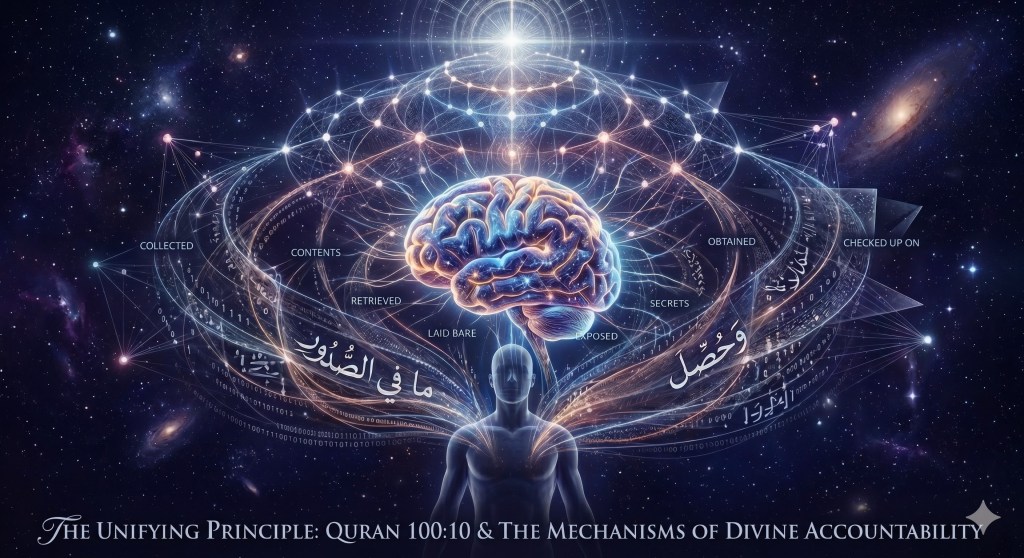
وَحُصِّلَ مَا فِي الصُّدُورِ
Wa hussila ma fis-sudur
This verse represents a pivotal transition in the narrative of human accountability. The Surah begins with an evocative oath, swearing by the “galloping, panting horses” (100:1) and the “striking sparks of fire” (100:2) that raid at dawn. This imagery of intense energy, movement, and external friction serves to contrast the manifest, physical world with the internal, hidden reality of the human persona described in verse 10. While the horses raise “dust in clouds” (100:4) and penetrate the “midst of the enemy” (100:5), the true battleground of the soul is the “breast” (al-sadr), where intentions and thoughts are formulated in secrecy.
The underlying premise of this inquiry is that Allah creates and unfolds everything in our universe through systematic laws of nature. If the physical world is governed by the laws of thermodynamics, relativity, and quantum mechanics, it is entirely rational to assume that the mechanisms for our accountability and the Afterlife are likewise rooted in the fundamental fabric of reality. The Quranic promise that “all that is [hidden] in men’s hearts is bare” (Muhammad Asad) suggests an informational transparency that challenges our classical notions of privacy.
In the contemporary scientific paradigm, information is increasingly viewed not merely as a description of matter, but as the ontological substrate of the universe itself—a concept summarized by John Archibald Wheeler’s “it from bit”. This report investigates how the “quantum reality” in quantum mechanics, the non-locality of quantum entanglement, and the principles of information theory provide the mechanisms for the record-keeping of our very consciousness, thoughts, and intentions. We posit that the “secrets of the hearts” are archived in known dimensions or extra-dimensions of our universe, awaiting the “Day of Retrieval” (Safi Kaskas) when the hidden becomes manifest.
Linguistic and Exegetical Foundations of Verse 100:10
To understand the mechanism described in وَحُصِّلَ مَا فِي الصُّدُورِ (Wa hussila ma fis-sudur), one must conduct a rigorous linguistic audit of the terms employed. The verse utilizes a vocabulary that implies an active, forensic process of data extraction and sorting.
The Semantic Depth of Hussila
The triliteral root ḥā-ṣād-lām (ح ص ل) appears only once in the entire Quran, specifically in this verse, in the Form II passive verb ḥuṣṣila. In classical Arabic lexicons, tahsil (the verbal noun) refers to the process of obtaining or producing something by extracting it from its surroundings. Historically, it was used to describe the extraction of a kernel from its husk or the separation of gold from dross in a crucible.
The use of the passive voice hussila indicates that on the Day of Resurrection, an external, divine force will act upon the contents of the heart. This process is twofold: it involves the “retrieval” of information that was stored and the “scrutiny” or “sorting” of that information to distinguish good from evil. As Abul Ala Maududi notes, tahsil contains the meanings of both exposing secrets and sorting different things from one another. This aligns with the Quranic theme in Surah At-Tariq, where it is stated: “The Day the hidden secrets are held to scrutiny” (86:9).
The Topology of Al-Sudur
The term al-sudur (plural of sadr) is conventionally translated as “breasts” or “chests,” but in Quranic psychology, it represents the seat of consciousness, the interface between the internal soul and the external world. The root ṣād-dāl-rā (ص د ر) appears 46 times in the Quran, often in contexts emphasizing the concealment of thought versus the manifestation of speech.
The sadr is the container of the qalb (heart). While the qalb is the essence of the person, the sadr is the staging ground where thoughts are formulated and intentions are “locked up.” The verse 100:10 declares that the content of this storage medium will be “obtained” (Talal Itani, 2012) and “brought into the open” (Wahiduddin Khan). The choice of sudur instead of qulub suggests that the retrieval focuses on the formulated intentions—the “motives” behind the acts—which are often hidden even from the self.
Comparative Translation Analysis of 100:10
The following table synthesizes the nuances of over 35 translations of verse 100:10, illustrating the multifaceted nature of the retrieval mechanism:
| Translator | Translation of 100:10 | Mechanical Focus |
|---|---|---|
| Muhammad Asad | and all that is [hidden] in men’s hearts is bare | Transparency/Visibility |
| Muhammad Marmaduke Pickthall | And the secrets of the breasts are made known | Informational Transfer |
| Yusuf Ali (Saudi Rev. 1985) | And that which is (locked up) in (human) breasts is made manifest | Unlocking/Disclosure |
| Mustafa Khattab 2018 | and the secrets of the hearts will be laid bare— | Anatomical Revelation |
| Safi Kaskas 2025 | and the hearts’ contents are retrieved, | Data Recovery |
| Wahiduddin Khan | And the hearts contents shall be brought into the open | Spatial Displacement |
| Shakir | And what is in the breasts is made apparent | Materialization |
| Dr. Laleh Bakhtiar | and will be shown forth what is in the breasts? | Demonstration |
| T.B. Irving | and whatever is on [people´s] minds is checked up on, | Audit/Supervision |
| Abdul Hye | and that which is in the hearts (of people) will be made known, | Communication |
| Saeed Malik | and what is [held] in the bosoms is retrieved? | Acquisition |
| The Study Quran | and what lies within breasts is made known | Discovery |
| Talal Itani & AI (2025) | And what is in the hearts is exposed. | Stripping of Privacy |
| Talal Itani (2012) | And the contents of the hearts are obtained | Extraction |
| Dr. Kamal Omar | and stood fully received whatever (was stored hidden within the hearts) in the chests | Archival Receipt |
| M. Farook Malik | and that what is in their breasts will be made known | Externalization |
| Muhammad Mahmoud Ghali | And whatever is in the breasts is sought out | Active Search |
| Muhammad Sarwar | and all that is in the hearts is made public | Social Manifestation |
| Muhammad Taqi Usmani | and all that is contained in the hearts will be exposed | Comprehensive Reveal |
| Shabbir Ahmed | And the secrets of the hearts will be laid bare | Uncovering |
| Dr. Munir Munshey | And all the secrets buried in the hearts are divulged | Confession/Release |
| Syed Vickar Ahamed | And whatever (locked up) in (human) breasts is made (clearly) evident— | Evidence/Clarity |
| Umm Muhammad (Sahih International) | And that within the breasts is obtained | Direct Access |
| (2017) | And what is inside the chests will be collected. | Aggregation |
| Abdel Haleem | when the secrets of hearts are uncovered, on that Day | Temporal Unveiling |
| Abdul Majid Daryabadi | And there shall be brought to light that which is in the breasts | Illumination |
| Ahmed Ali | And the secrets of the hearts exposed | Transparency |
| Aisha Bewley | and the heart´s contents are brought into the open, | Accessibility |
| Ali Ünal | And all that is in the breasts is laid open and made out | Deciphering |
| Ali Quli Qara’i | and what is in the breasts is divulged | Disclosure |
| Hamid S. Aziz | And what is in the breasts is brought to light | Revelation |
| Ali Bakhtiari Nejad | and what is in the chests/minds is exposed, | Psychological Visibility |
| Bilal Muhammad 2018 | And that which is in the chest is made manifest | Realization |
| Musharraf Hussain | and the secrets of hearts will be revealed? | Prophetic Revelation |
| Maududi | and the secrets of the hearts are laid bare (and examined) | Judicial Scrutiny |
| Mohammad Shafi | And that which was in (human) minds recovered | Forensic Recovery |
The semantic breadth of these translations—ranging from “retrieved” (Kaskas) to “collected” (Monotheist Group) and “recovered” (Shafi)—points toward a systematic, law-based operation. This is not a metaphorical “knowing,” but a literal, mechanical “retrieval” of data that was previously “locked up” (Yusuf Ali) or “buried” (Munshey).
Information Theory and the Conservation of Intent
To understand how our “very thoughts and intentions are being recorded,” we must look at the universe through the lens of Information Theory. In this paradigm, information is the fundamental building block of reality, a concept that aligns perfectly with the Quranic description of the “Preserved Tablet” (Al-Lawh al-Mahfuz).
Quantum Unitarity and the Indestructibility of Information
One of the most foundational principles of quantum mechanics is unitarity, which dictates that the evolution of a quantum system is reversible. This implies that information can never be destroyed. Even if a book is burned to ashes, the information it contained is theoretically still present in the velocities, positions, and quantum states of the resulting particles and photons.
In the context of 100:10, this principle suggests that the “secrets of the breasts” are physical states that leave an indelible mark on the universe. If the universe is a closed quantum system, every thought—as an energetic event in the brain—is preserved through the unitary evolution of the system’s wave function. The “Day of Recovery” (Shafi) is simply the point in the universe’s evolution where these states are re-localized for observation.
The No-Hiding Theorem
The “no-hiding theorem” in quantum information theory provides a rigorous mathematical basis for the Quranic claim that “what is in the breasts is made apparent” (Shakir). The theorem states that if information is lost from one part of a system—for example, when we “forget” a thought or it “disappears” from our conscious mind—it must have migrated to the correlations (entanglement) between that system and its environment. Information cannot vanish into nothingness; it must reside somewhere in the universe’s Hilbert space.
This provides a literal mechanism for the “Recording Angels” (Kiraman Katibin). From a scientific perspective, these “angels” can be understood as the environmental degrees of freedom that constantly “measure” our internal states and “write” them into the background fabric of spacetime through decoherence. As Dr. Zia H. Shah MD argues, the “Record” is not a metaphor for human memory but a literal description of the informational fidelity of the cosmos.
Landauer’s Principle and the Weight of Deeds
The theological concept of the “weight of deeds” finds a scientific analogue in Landauer’s Principle, which states that erasing a single bit of information requires a minimum amount of energy and dissipates a specific amount of heat. Specifically, the energy E required to erase one bit is given by:
E=kBTln2
Where kB is the Boltzmann constant and T is the temperature of the system. This principle implies that information is physically “heavy” in terms of its energetic cost. Consequently, every intention formulated in the “breast” is an informational event with physical consequences. A “good” intention creates coherence (negentropy), while a “bad” intention (characterized by kanud or ingratitude) can be seen as an entropic disturbance. The “retrieval” in 100:10 serves as an audit of these informational/energetic signatures.
Quantum Consciousness and the Mechanism of the Breast
The query posits that “The quantum reality in quantum mechanics… should provide engagement with our very consciousness.” This is supported by modern theories that locate the origin of consciousness at the Planck scale of spacetime geometry.
The Penrose-Hameroff Orch-OR Theory
The Orchestrated Objective Reduction (Orch-OR) theory, proposed by Roger Penrose and Stuart Hameroff, suggests that consciousness originates from quantum computations in microtubules within brain neurons. Unlike classical theories that see the brain as a complex electrical computer, Orch-OR posits that our brains are quantum computers.
In this model, “tubulin” protein dimers within microtubules act as qubits (quantum bits). These qubits exist in states of superposition—multiple possibilities simultaneously—until they reach a threshold for “Objective Reduction” (OR). This OR event is a “collapse” of the wave function that results in a moment of conscious awareness or choice. Crucially, Penrose suggests that these collapses are not random but are “orchestrated” by the fundamental geometry of spacetime, which may encode Platonic values of ethics and aesthetics.
This provides a plausible biological mechanism for the “breast” mentioned in 100:10. The sadr can be viewed as the microtubule-dense regions of the brain where quantum superpositions of “intentions” occur. When an intention is finalized, the wave function collapses, “recording” that specific state into the structure of spacetime.
Microtubules as Information Antennas
Research has shown that microtubules exhibit collective quantum dipole oscillations in the terahertz (THz), gigahertz (GHz), and megahertz (MHz) frequency ranges. These vibrations are “orchestrated” and can resonate across scales. This resonance allows the internal “thought” to be broadcasted into the environment.
The “secrets of the hearts” are thus not sealed in a vacuum. They are vibrational states that, through superradiance and delayed luminescence, interact with the surrounding field. This supports the idea that our “very thoughts and intentions” leave a discernible neural and quantum trace that is “recovered” (Mohammad Shafi) on the Day of Resurrection.
| Biological Component | Quantum Function | Theological Parallel |
|---|---|---|
| Microtubules | Quantum Processor / Qubits | The Breast (Al-Sadr) |
| Objective Reduction (OR) | Moment of Choice / Wave Collapse | Formulation of Intention (Niyyah) |
| Tubulin Vibrations | Resonant Signal | “What is in the breasts” |
| Decoherence | Recording to Environment | Writing of the Angels (Katibin) |
Extra-Dimensions and the “Fate on the Neck”
The Quran describes the “record” of a person’s life as being “fastened to his neck” (17:13) and declares that these records will be “spread open” on the Day of Resurrection. In the framework of String Theory, this “record” may be stored in the hidden extra-dimensions of the universe.
Calabi-Yau Manifolds as Storage Substrates
Superstring theory and M-theory require the existence of 10 or 11 dimensions (9 or 10 spatial and 1 temporal) to unify the fundamental forces of nature. While we only perceive three spatial dimensions (length, width, height), the remaining six are “compactified”—curled up at the Planck scale (10−35 meters) into complex shapes called Calabi-Yau manifolds.
These extra dimensions are not “somewhere else”; they exist at every point in our 3D space. A thought or intention, as a quantum-vibrational event, could alter the local “fluxes” or “shape moduli” of the Calabi-Yau manifold associated with an individual’s world-line. This would mean that the “Record” is literally carried with the individual, encoded in the hidden geometry of their own localized spacetime—the “fate on the neck”.
Decompactification and the Day of Judgment
The Quranic term for “spread open” regarding the record is manshura, which implies an unfolding. In physics, “decompactification” is a process where curled-up dimensions expand to become macroscopic.
If the “secrets of the hearts” are currently “locked up” in 6-dimensional Calabi-Yau “throats” (Klebanov-Strassler throats), they are invisible to our 3D sensory apparatus. However, if these dimensions were to “decompactify” on the Day of Judgment, the information stored within their geometry would instantly become readable in the macroscopic world. The “hidden” would become “manifest” (Bilal Muhammad) because the space itself has unfolded to reveal its full dimensionality.
The Landscape and Divine Omniscience
The String Theory “Landscape” estimates there are 10500 possible vacuum states (geometric configurations of extra dimensions). This astronomical number provides a virtually infinite capacity for recording the granular details of human history. Each “atom’s weight” of intent acts as a phase transition that shifts the local vacuum from one state to another, creating a unique “text” or “scroll” for each soul.
This provides a physical mechanism for divine omniscience. For a Being to know every quark and every thought, He must operate from a higher-dimensional perspective. From a higher dimension (the “Bulk”), an observer can see the entirety of a lower-dimensional plane (the “Brane”) without being visible to its inhabitants. The “Unseen” (Al-Ghaib) is thus simply that which exists in orthogonal dimensions.
The Holographic Principle: The Universe as an Inscribed Record
The “Holographic Principle” suggests that the description of a volume of space can be thought of as encoded on a lower-dimensional boundary. This concept offers a stunning parallel to the “Preserved Tablet” (Al-Lawh al-Mahfuz).
Bekenstein Bound and Information Density
The principle was inspired by black hole thermodynamics. Jacob Bekenstein and Stephen Hawking discovered that the maximum information (entropy) of a black hole is proportional to the area of its event horizon, not its volume. This relationship is defined by:
S=4GℏkBc3A
Where A is the area of the horizon and G is the gravitational constant. Leonard Susskind and Gerard ‘t Hooft extrapolated this to the entire universe, proposing that our 3D reality is a “hologram” projected from a 2D informational screen at the cosmic horizon.
In this framework, the “contents of the hearts” are not just stored in the brain; they are “inscribed” (isomorphic) on the informational boundary of the universe. The “secrets” are stored on a distant two-dimensional surface, making them robust against standard disruptions in the 3D world. On the Day of Resurrection, this boundary information is “retrieved” (Safi Kaskas), re-manifesting the 3D reality of our thoughts and deeds.
The “Minus-First Law” of Physics
Leonard Susskind proposed what he calls the “minus-first law”: Information is never lost. This law is considered more fundamental than the conservation of energy. It implies that every human action, being a physical event, leaves an indelible mark in the universal ledger.
The “Book” mentioned in the Quran (18:49) in which “nothing, small or great, is left unlisted” corresponds to this strictly conserved quantum information. Divine judgment, therefore, is not a memory-based testimony but a data-recovery process where the universe itself “testifies” by revealing its conserved state.
Philosophical Integration: Mulla Sadra and Substantial Motion
The scientific mechanisms of storage and retrieval find a profound philosophical counterpart in the work of Mulla Sadra (1571–1640), particularly his concept of “Substantial Motion” (al-harakah al-jawhariyyah).
The Soul as a Self-Recording Entity
Mulla Sadra revolutionized Islamic philosophy by arguing that existence is dynamic and that substances themselves are in constant motion. He proposed that the human soul is not a static essence but a reality that evolves through its actions and perceptions.
According to Sadra, the soul originates with the body (jismaniyyat al-huduth) but ascends toward immaterial perfection (ruhaniyyat al-baqa’). Every “thought and intention” in the “breast” is a moment of substantial motion. The soul does not merely “think”; it becomes its thoughts. Consequently, the “contents of the hearts” are not external notes in a diary but the very ontological states of the soul.
The retrieval in 100:10 is thus the soul manifesting its own achieved form. A person who cultivates greed and ingratitude (kanud) literally transforms their soul into a “tightened” and “darkened” state. On the Day of Judgment, when the body is shed, the soul appears in its “imaginal body” (jism mithali), which reflects the true nature of its earthly intentions.
Alam al-Mithal: The Mechanism of Retrieval
Sadra’s cosmology includes the Alam al-Mithal (the Imaginal World or the World of Images), which acts as an intermediate realm between the physical and the purely intellectual. This realm is where the “secrets of the hearts” are objectively preserved as forms.
During earthly life, the “imaginary faculty” (quwat-al-mutakhayala) produces forms that are “hidden” within the mind. However, in the intermediate world (Barzakh) and the Afterlife, these forms become objective realities. The “retrieval” described in Quran 100:10 is the transition of these internal imaginal forms into the external reality of the soul’s environment. If the intention was pure, the retrieved form is “felicity”; if it was corrupt, it is “pain and punishment”.
The Unity of the Knower and the Known
Mulla Sadra also taught the “Unity of the Intellect, the Intelligent, and the Intelligible” (ittihad al-aqil wa’l-ma’qul). This implies that to know a thing is to be united with its existence. Divine omniscience—knowing the “secrets of the hearts”—is possible because the Creator is the sustainer of the soul’s existence at every moment of its substantial motion. There is no “privacy” from God because He is closer to the soul than its own jugular vein (50:16), being the very source of the information-processing that constitutes consciousness.
Entanglement and the Universal Interconnectedness
The query suggests that “quantum entanglement… should provide engagement with our very consciousness.” This non-local correlation provides a mechanism for the “witnessing” of thoughts across the universe.
Non-Locality and Divine Presence
Quantum entanglement demonstrates that particles can remain correlated so that the state of one instantaneously affects the other, regardless of distance. This challenges the classical notion of “separability”.
If the human consciousness is entangled with the fundamental field of the universe, then our “secret” thoughts are non-locally present throughout the cosmos. Verse 57:4 (“He is with you wherever you are”) and 2:115 (“Wherever you turn, there is the face of Allah”) can be viewed as theological expressions of this universal interconnectedness. The “retrieval” in 100:10 is the act of focused measurement that brings these non-local correlations into local, manifest evidence.
The Mirror Model of Suhrawardi
Suhrawardi’s “Philosophy of Illumination” (Ishraq) uses the “light-image-mirror” model to describe existence. In this framework, the “contents of the breasts” are like images in a mirror. The image is not “in” the mirror in a material sense, but it is “reflected” through the interaction of light.
Modern quantum analogies liken this to the “collapse of the wave function”. The potentiality of a thought (superposition) becomes an actuality (manifestation) through the “gaze” of the Observer. On the Day of Resurrection, the “Divine Light” (24:35) will act as the ultimate observer, causing all the “potential” secrets of the heart to “collapse” into the “actual” record of reality.
Thematic Epilogue: The Symphony of Resurrection
The journey through the linguistic, scientific, and philosophical landscape of Quran 100:10 reveals a universe of absolute retention and systematic accountability. The verse وَحُصِّلَ مَا فِي الصُّدُورِ (Wa hussila ma fis-sudur) is not merely a statement of divine knowledge; it is an architectural blueprint for the Afterlife.
We have identified several robust mechanisms that facilitate this “record keeping”:
- Information Theory ensures that the “intentions and motives” are indestructible bits of data, strictly conserved through the laws of quantum unitarity and the “no-hiding” theorem.
- Quantum Consciousness (Orch-OR) provides the biological antenna—microtubules—that translate subjective intent into physical, spacetime “blisters” at the Planck scale.
- Extra-Dimensional Physics (String Theory) offers the near-infinite storage capacity of Calabi-Yau manifolds, where our “fate” is fastened to our local geometry as hidden flux states, waiting to be “spread open” through decompactification.
- The Holographic Principle suggests that our very “I-ness” is inscribed on the 2D horizon of the universe, a permanent ledger that remains “made manifest” (Yusuf Ali) even as the 3D world passes away.
- Substantial Motion (Mulla Sadra) teaches that we are our records; our souls are dynamic informational entities that evolve toward their final, “retrieved” form.
The implications of these mechanisms are profound. They suggest that “privacy” is a classical illusion born of our 3D sensory limitations. In reality, our brains are “broadcasting” our thoughts in the language of neural and quantum activity, and the universe has no “delete” key.
As Safi Kaskas translates, “the hearts’ contents are retrieved,” and as Mohammad Shafi renders, they are “recovered”. This recovery is the “sorting” (tahsil) of the grain from the dusk, the “negentropy” of sincere faith from the “entropy” of ungratefulness (kanud). Resurrection is thus the ultimate “de-noising” of human history, where the “signal” of our true intentions is amplified and the “dust” of our superficial actions is cleared away.
Ultimately, the verse reminds us that the “Day when the secret thoughts of the hearts will be exposed” (Asad) is a day of perfect, law-governed justice. Because Allah creates through systematic laws, our accountability is not a matter of divine caprice but a consequence of our own informational legacy. We are “writing” our own “Preserved Tablet” with every beat of our hearts and every vibration of our thoughts. When the “contents of the graves are scattered” (100:9) and the “secrets of the hearts are laid bare” (100:10), we will encounter nothing but ourselves, revealed in the full, multi-dimensional light of truth.





Leave a Reply