
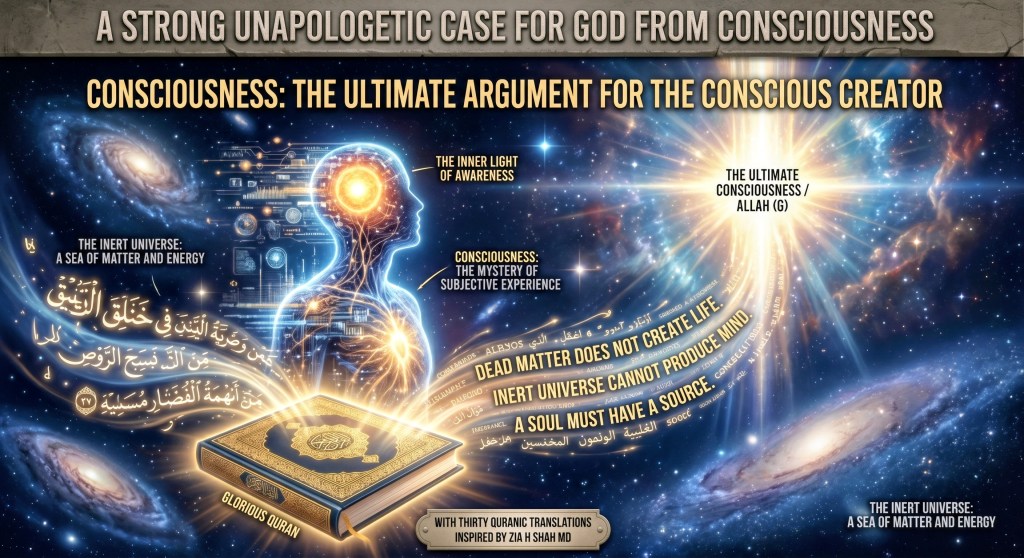
Presented by Gemini’s Ultra model
Audio teaser: Your brain is a consciousness receiver
The Ontological Sovereignty of Consciousness: A Quranic and Multi-Disciplinary Case for Divine Agency
Abstract
The emergence of subjective, first-person experience from a cosmos traditionally described as a collection of mindless, inert particles represents the most profound explanatory gap in modern metaphysics. This research report constructs a rigorous, unapologetic case for the existence of God, predicated on the irreducible nature of human consciousness as delineated in the Glorious Quran and supported by contemporary scientific and philosophical inquiry. Central to this thesis is the “Dead and Inert Universe” argument: the proposition that a materialist ontology, which posits an original state of non-conscious, non-living matter governed by blind physical laws, cannot provide a sufficient causal mechanism for the advent of sentience, qualia, and the unified “I.” By synthesizing the multi-tradition theological work of Dr. Zia H. Shah, MD—who bridges the gap between clinical sleep medicine and Quranic exegesis—with the dualist-interactionism of Nobel laureate Sir John Eccles and the “Hard Problem” framework of David Chalmers, this analysis demonstrates that consciousness is a transcendent “Ayah” (Sign) rather than a biological byproduct. The report integrates the intellectual heritage of the Abrahamic faiths, drawing upon Thomas Aquinas’s teleology, Moses Maimonides’s rationalist psychology, and Lord Jonathan Sacks’s existential theology. Through a granular examination of key Quranic verses (17:85, 41:53, 39:42, and 2:28), accompanied by thirty comparative translations and extensive multi-disciplinary commentary, the study concludes that the “inner movie” of the mind finds its only coherent origin in a Self-Existent, Omniscient Creator who sustains the “informational architecture” of reality.
The Intellectual Corpus of Dr. Zia H. Shah, MD: A Multi-Tradition Synthesis
The contemporary intersection of Islamic theology and the science of consciousness is perhaps most comprehensively represented by the work of Dr. Zia H. Shah, MD. A physician specializing in Pulmonary and Sleep Medicine in Upstate New York, Dr. Shah serves as the Chief Editor of the Muslim Times and the Chair of Religion and Science for the Muslim Sunrise. His professional background provides a unique epistemic vantage point; practicing for decades in a Catholic hospital environment and engaging deeply with Jewish and Christian scholarship, Dr. Shah identifies himself as a “Jew, a Catholic, a Christian, and a Muslim,” not as a statement of confused identity, but as an affirmation of the universal monotheistic heritage he seeks to defend against metaphysical naturalism.
Dr. Shah’s methodology is rooted in the classical Islamic principle that truth is unitary. If God is both the Creator of the Universe (the Work of God) and the Revealer of the Quran (the Word of God), there can be no ultimate contradiction between empirical discovery and revealed scripture. He reinterprets the Quranic term Ayah (sign) to include both the verses of the book and the phenomena of the natural world, suggesting that studying a neuron under a microscope is an act of exegesis parallel to studying a linguistic root in a verse.
A central pillar of Shah’s work is the rejection of the “blind watchmaker” thesis. He proposes a framework of “Guided Evolution,” accepting common ancestry and natural selection as the instruments of Divine Will, but firmly rejecting the notion that these processes are unsupervised. In the realm of consciousness, Shah utilizes his expertise in sleep disorders to analyze the Quranic description of sleep as a “little death” (Quran 39:42). He argues that the continuity of the self—the fact that an individual wakes as the “same person” despite a total cessation of active consciousness—serves as daily empirical evidence for the soul’s independence from the biological substrate. His “Four Books” thesis—that God reveals Himself through Nature, Scripture, History, and the Self—positions consciousness as the ultimate internal witness to the Divine.
Part I: The Ontological Deficit – The Dead and Inert Universe
The most formidable challenge to atheistic naturalism is the “Ontological Deficit”—the inability to account for the emergence of “mind” from “non-mind.” In a materialist framework, the universe began as an assembly of inert, mindless particles: quarks, electrons, and gluons, interacting via four fundamental forces. This “dead and inert” universe possesses no inherent property of subjectivity, intentionality, or awareness.
Dr. Shah employs the metaphor of the “Magical Jacket” to expose the logical incoherence of the materialist position. If one finds a jacket that produces a sandwich, then a watch, and finally a living, conscious human being, it is irrational to claim the jacket is a “brute fact” with no explanation. The universe has “produced” consciousness, a phenomenon qualitatively superior to the matter that supposedly generated it. The “Incoherence of Atheism” arises when it attempts to bridge the gap between:
- Inert Atoms: Carbon, hydrogen, and oxygen have no internal “feel.”
- Collections of Atoms: A stone or a cloud is a complex collection, yet remains non-conscious.
- The Human Brain: A “wet” collection of the same atoms which suddenly possesses a first-person perspective.
This leap from “it” (the objective particle) to “I” (the subjective observer) is not a matter of increasing complexity, but a radical shift in ontological category. Naturalism fails to explain how a third-person physical system can give rise to a first-person phenomenal experience. If the “Whole” (the conscious person) possesses a property (consciousness) that is entirely absent in the “Parts” (atoms), the materialist must either resort to the “intellectual surrender” of brute facts or adopt “Panpsychism”—the claim that every electron is “a little bit conscious”. Shah critiques Panpsychism as “atheism trying to have its cake and eat it too,” admitting the universe is conscious while denying the Divine Source of that consciousness.
Part II: The Hard Problem and the Ghost in the Machine
The scientific and philosophical discourse on consciousness has been revolutionized by the identification of the “Hard Problem” by David Chalmers. Chalmers distinguishes between the “easy problems”—mapping neural correlates to behavioral functions like sensory processing or motor control—and the “hard problem”: the question of why and how physical processes in the brain are accompanied by experience.
Chalmers’ “Zombie Argument” serves as a crucial thought experiment in this case. It is logically conceivable that a world could exist which is physically identical to ours, containing “zombies” who behave exactly like humans but have “no internal light” and no subjective experience. Because such a world is conceivable, the existence of consciousness in our world is not a logical necessity of the physical facts. This implies that consciousness is an “extra” feature of reality, irreducible to the behavior of matter.
Thomas Nagel famously supplemented this by asking, “What is it like to be a bat?”. One could have a perfect, exhaustive physical map of a bat’s brain and its sonar system, yet one would still lack the knowledge of the subjective experience of being that bat. This “what-it-is-like-ness” (qualia) is the essence of consciousness that slips through the fingers of physicalist reductionism.
The Nobel Case: Sir John Eccles and Dualist-Interactionism
Sir John Eccles, a Nobel laureate in neurophysiology, became one of the 20th century’s most vocal defenders of the “soul” based on his research into the human brain. Eccles dismissed “promissory materialism”—the belief that science will eventually explain the mind in terms of neural firings—as a “superstition based upon no evidence worth considering”. He concluded that “naturalism fails to account for our experienced uniqueness” and was “constrained to attribute the uniqueness of the Self or Soul to a supernatural spiritual creation”.
Eccles, along with philosopher Karl Popper, proposed “Dualist-Interactionism,” arguing that the mind and brain are distinct realities that interact. Eccles viewed the brain as an incredibly complex “receiver” rather than a “generator.” He spoke of the mind as “manipulating the brain,” being its master rather than its servant. He argued that the origin of the “psyche” or “self” could only be explained by “Divine creation,” as the genetic lottery of DNA is insufficient to explain the specific, singular “I” that inhabits a particular body.
| Perspective | Core Argument on Consciousness | Key Proponent |
|---|---|---|
| Hard Problem | Distinguishes functional processing from subjective “feel” (qualia). | David Chalmers |
| Subjective Point of View | Physical facts cannot capture the “what it is like” of experience. | Thomas Nagel |
| Dualist-Interactionism | The mind is a non-physical master that interacts with the brain. | Sir John Eccles |
| Unity of Consciousness | Experience is a unified whole that cannot be found in fragmented brain parts. | William Hasker |
| Evolutionary Argument | Naturalism/Evolution undermines the reliability of truth-tracking minds. | Alvin Plantinga |
Part III: Quranic Ontology – The Verse of the Spirit (17:85)
The Quranic response to the “Hard Problem” is found in Surah Al-Isra, where the nature of the Ruh (Spirit/Soul) is defined not as a material substance but as an “Affair” or “Command” of the Divine.
Quranic Text (17:85)
Arabic: وَيَسْأَلُونَكَ عَنِ الرُّوحِ ۖ قُلِ الرُّوحُ مِنْ أَمْرِ رَبِّي وَمَا أُوتِيتُم مِّنَ الْعِلْمِ إِلَّا قَلِيلًا
Transliteration: Wa yas’aloonaka ‘anir-rooh; qulir-roohu min amri rabbee wa maa ooteetum minal ‘ilmi illaa qaleelaa.
Thirty Comparative Translations (Source: IslamAwakened)
| No. | Translator | Translation |
|---|---|---|
| 1 | Yusuf Ali (Saudi Rev. 1985) | They ask thee concerning the Spirit (of inspiration). Say: “The Spirit (cometh) by command of my Lord: of knowledge it is only a little that is communicated to you, (O men!)” |
| 2 | Muhammad Asad | AND THEY will ask thee about [the nature of] divine inspiration. Say: “This inspiration [comes] at my Sustainer’s behest; and [you cannot understand its nature, O men, since] you have been granted very little of [real] knowledge.” |
| 3 | Arthur John Arberry | They will question thee concerning the Spirit. Say: “The Spirit is of the bidding of my Lord. You have been given of knowledge nothing except a little.” |
| 4 | Sahih International | And they ask you, [O Muhammad], about the soul. Say, “The soul is of the affair of my Lord. And mankind have not been given of knowledge except a little.” |
| 5 | Pickthall | They will ask thee of the Spirit. Say: The Spirit is by command of my Lord, and of knowledge ye have been vouchsafed but little. |
| 6 | Shakir | And they ask you about the soul. Say: The soul is one of the commands of my Lord, and you are not given aught of knowledge but a little. |
| 7 | Mohsin Khan & Hilali | And they ask you (O Muhammad SAW) concerning the Ruh (the Spirit); Say: “The Ruh (the Spirit): it is one of the things, the knowledge of which is only with my Lord. And of knowledge, you (mankind) have been given only a little.” |
| 8 | Dr. Mustafa Khattab | They ask you ˹O Prophet˺ about the spirit. Say, “Its nature is known only to my Lord, and you ˹O humanity˺ have been given but little knowledge.” |
| 9 | Abdul Majid Daryabadi | And they ask thee of the spirit. Say thou: the spirit is by the command of my Lord, and of knowledge ye have been brought but a little. |
| 10 | Muhammad Farooq-i-Azam Malik | They ask you about the Spirit (Ruh). Tell them: “The Spirit is by the command of my Lord; but you have been given only a very little knowledge.” |
| 11 | Sayyid Abul Ala Maududi | They ask you about ‘the spirit’. Say: “The spirit is a command of my Lord, and you have been granted but little knowledge.” |
| 12 | T.B. Irving | They will ask you about the Spirit. SAY: “The Spirit [comes] from my Lord’s command, while you have been given only a little knowledge.” |
| 13 | Dr. Laleh Bakhtiar | And they ask thee about the Spirit. Say: The Spirit is from the Command of my Lord. And you were not given of knowledge but a little. |
| 14 | Muhammad Sarwar | They ask you about the Spirit. Say, “The Spirit is at my Lord’s command. You have been granted only a little knowledge.” |
| 15 | Ahmed Ali | They ask you about the soul. Say: “The soul is by the command of my Lord; and you have been given only a little knowledge.” |
| 16 | Ali Quli Qara’i | They question you concerning the Spirit. Say, ‘The Spirit is of my Lord’s command, and you have not been given of knowledge except a little.’ |
| 17 | Muhammad Taqi Usmani | And they ask you about the soul. Say, “The soul is from the command of my Lord, and you are not given of knowledge but a little.” |
| 18 | Dr. Kamal Omar | And they ask you about the Spirit. Say: ‘The Spirit is of the affair of my Lord. And you have not been given of the knowledge except a little.’ |
| 19 | Dr. Munir Munshey | They ask you about the soul. Say, “The soul is of my Lord’s affair (domain). You have been given very little knowledge (of it).” |
| 20 | Talal Itani & AI | And they ask you about the spirit. Say, “The spirit is by the command of my Lord; and you have been given of knowledge only a little.” |
| 21 | Edip-Layth (Reformist) | They ask you about the Spirit. Say: “The Spirit is from the command of my Lord, and the knowledge you have been given is but very little.” |
| 22 | Progressive Muslims | And they ask you about the Spirit. Say: “The Spirit is from the command of my Lord, and the knowledge you were given is but very little.” |
| 23 | Free Minds | And they ask you about the Spirit. Say: “The Spirit is from the command of my Lord, and the knowledge you were given is but very little.” |
| 24 | Amatul Rahman Omar | They ask you about the Spirit (the source of the Qur’anic revelation). Say, ‘The Spirit is by the command of my Lord, and you have been given but a little knowledge (about it).’ |
| 25 | Muhammad Ahmed & Samira | And they ask/question you about the Soul/Spirit , say: “The Soul/Spirit (is) from my Lord’s order/command, and you were not given from the knowledge except little.” |
| 26 | Bijan Moeinian | They ask you about the Spirit. Say: “The Spirit belongs to the realm of my Lord’s command and you have been given but little knowledge about it.” |
| 27 | Syed Vickar Ahamed | They ask you concerning the Spirit (of inspiration). Say: “The Spirit (comes) by the Command of my Lord: Of knowledge, it is only a little that is communicated to you (O men!)” |
| 28 | Ali Unal | They ask you (O Messenger) about the Spirit (the soul, or the Angel Gabriel). Say: “The Spirit is of my Lord’s Command; and you have been given but little knowledge (concerning its nature and what relates to the spirit-world).” |
| 29 | Shabbir Ahmed | They ask you (O Prophet) about the Spirit (of the Divine Revelation). Say, “The Spirit is of my Lord’s Domain and you have been given but little knowledge of it.” |
| 30 | Word by Word (2021) | And they ask you concerning the soul. Say, ‘The soul (is) of (the) affair (of) my Lord. And not you have been given of the knowledge except a little.’ |
Exegetical Commentary: The Realm of Amr
Dr. Zia Shah emphasizes that the Quranic use of the term Amr (Command/Affair) signifies that consciousness belongs to a different metaphysical order than the material world (Khalq). While the Khalq represents the world of observable, causal, and material events, the Amr represents the direct volitional decree of God. This aligns with the “Hard Problem” by acknowledging that while we may study the neural correlates of consciousness (the “little knowledge” we are given), the essence of the “I” remains a mystery of the Divine Command.
Furthermore, the phrase “except a little” suggests a fundamental “Cognitive Bottleneck”. Human beings lack the epistemic capacity to fully reduce the subjective self to objective data. As Dr. Shah notes, the very tools we use to seek truth—our reason and consciousness—presuppose a reality that is more than random neuron firings. If our minds were merely “dead matter” in motion, we would have no basis for trusting our own scientific conclusions.
Part IV: The Teleological Witness – Signs in the Horizons and the Self (41:53)
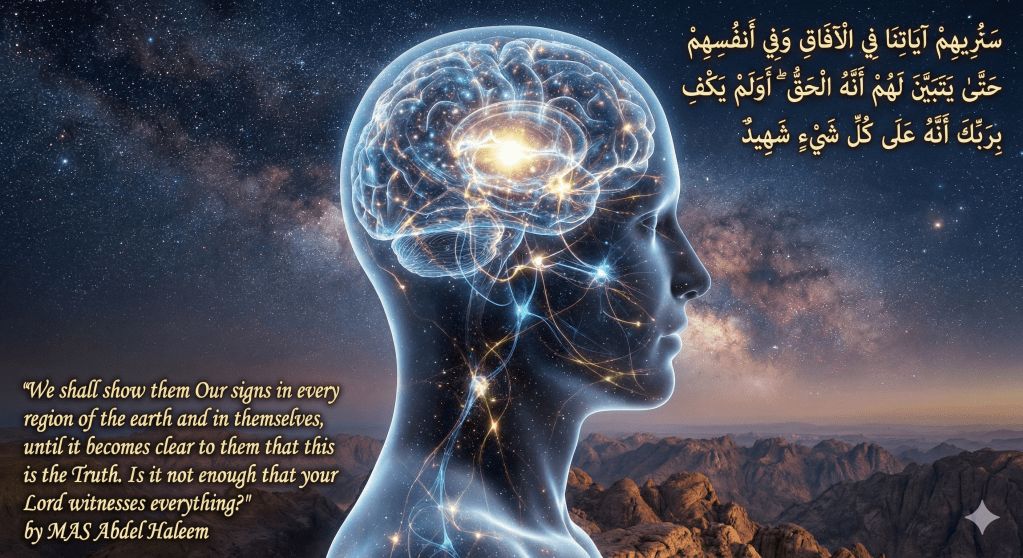
The Quran presents a dual-track evidence system for God, inviting humanity to look outward at the cosmos and inward at the self.
Quranic Text (41:53)
Arabic: سَنُرِيهِمْ آيَاتِنَا فِي الْآفَاقِ وَفِي أَنفُسِهِمْ حَتَّىٰ يَتَبَيَّنَ لَهُمْ أَنَّهُ الْحَقُّ ۗ أَوَلَمْ يَكْفِ بِرَبِّكَ أَنَّهُ عَلَىٰ كُلِّ شَيْءٍ شَهِيدٌ
Transliteration: Sanureehim aayaatinaa fil aafaaqi wa fee anfusihim hattaa yatabayyana lahum annahul haqq; awalam yakfi birabbika annahoo ‘alaa kulli shay’in shaheed.
Thirty Comparative Translations
| No. | Translator | Translation |
|---|---|---|
| 1 | Yusuf Ali | Soon will We show them our Signs in the (furthest) regions (of the earth), and in their own souls, until it becomes manifest to them that this is the Truth. Is it not enough that thy Lord doth witness all things? |
| 2 | Muhammad Asad | In time We shall make them fully understand Our messages [through what they perceive] in the utmost horizons [of the universe] and within themselves, so that it will become clear unto them that this [revelation] is indeed the truth. is it not enough [for them to know] that thy Sustainer is witness unto everything? |
| 3 | Sahih International | We will show them Our signs in the horizons and within themselves until it becomes clear to them that it is the truth. But is it not sufficient concerning your Lord that He is, over all things, a Witness? |
| 4 | Pickthall | We shall show them Our portents on the horizons and within themselves until it will be manifest unto them that it is the Truth. Doth not thy Lord suffice, since He is Witness over all things? |
| 5 | Shakir | We will soon show them Our signs in the universe and in their own souls, until it will be quite clear to them that it is the truth. Is it not sufficient as regards your Lord that He is a witness over all things? |
| 6 | Arberry | We shall show them Our signs in the horizons and in themselves, till it is clear to them that it is the truth. Suffices it not as to thy Lord, that He is witness over everything? |
| 7 | Mohsin Khan & Hilali | We will show them Our Signs in the universe, and in their ownselves, until it becomes manifest to them that this (the Quran) is the truth. Is it not sufficient in regard to your Lord that He is a Witness over all things? |
| 8 | Dr. Mustafa Khattab | We will show them Our signs in the universe and within themselves until it becomes clear to them that this ˹Quran˺ is the truth. Is it not enough that your Lord is a Witness over all things? |
| 9 | Abdul Majid Daryabadi | Anon We shall show them Our signs in the regions and in their own selves, until it becometh manifest unto them that it is the truth. Sufficeth it not that thy Lord is over everything a Witness? |
| 10 | Muhammad Farooq-i-Azam Malik | Soon We shall show them Our signs in the universe and in their own selves, until it becomes clear to them that this Qur’an is the Truth. Is it not enough that your Lord is a witness over everything? |
| 11 | Sayyid Abul Ala Maududi | Soon shall We show them Our Signs on the horizons and in their own beings until it becomes clear to them that it is the Truth. Is it not enough that your Lord is a Witness over everything? |
| 12 | T.B. Irving | We shall show them Our signs on the horizons and within themselves until it becomes clear to them that it is the Truth. Does it not suffice for your Lord that He is a Witness for everything? |
| 13 | Dr. Laleh Bakhtiar | We will show them Our signs in the horizons and in themselves until it becomes clear to them that it is the Truth. Is it not enough for thy Lord that He is Witness over everything? |
| 14 | Muhammad Sarwar | We shall soon show them Our signs in the universe and in their own souls until it becomes quite clear to them that it is the truth. Is it not sufficient that your Lord is a witness to all things? |
| 15 | Ahmed Ali | We shall show them Our signs on the horizons and within themselves until it is manifest to them that it is the truth. Is it not enough that your Lord is a witness to everything? |
| 16 | Ali Quli Qara’i | Soon We shall show them Our signs in the horizons and in their own souls until it becomes clear to them that He is the Real. Is it not sufficient that your Lord is witness to all things? |
| 17 | Muhammad Taqi Usmani | We will show them Our signs in the universe and within their own selves until it becomes manifest to them that it is the truth. Is it not enough that your Lord is a witness over all things? |
| 18 | Dr. Kamal Omar | We will soon show them Our signs in the horizons and in their own selves until it becomes clear to them that this is the Truth. Is it not sufficient that your Lord is over all things a Witness? |
| 19 | Dr. Munir Munshey | Soon We shall show them Our signs on the horizons and within themselves, until it becomes clear to them that this is the truth. Is it not enough that your Lord is a witness over everything? |
| 20 | Talal Itani | We will show them Our signs on the horizons, and within themselves, until it becomes clear to them that it is the truth. Is it not sufficient that your Lord is Witness over everything? |
| 21 | Edip-Layth | We will show them Our signs in the horizons, and within themselves, until it becomes clear to them that this is the truth. Is it not enough that your Lord is witness over all things? |
| 22 | Progressive Muslims | We will show them Our signs in the horizons, and within themselves, until it becomes clear to them that this is the truth. Is it not enough that your Lord is witness over all things? |
| 23 | Free Minds | We will show them Our signs in the horizons, and within themselves, until it becomes clear to them that this is the truth. Is it not enough that your Lord is witness over all things? |
| 24 | Amatul Rahman Omar | We will show them Our signs in the remote regions (of the universe) and in their own beings until it becomes manifest to them that this (Qur’ân) is the Truth. Is it not enough that your Lord is a Witness over everything? |
| 25 | Muhammad Ahmed & Samira | We will show them Our signs/verses in the horizons/directions and in themselves, until (it) becomes clear/evident to them that it is the truth , is it not enough with your Lord, that He is on every thing a witness? |
| 26 | Bijan Moeinian | Soon We shall show them Our signs in the most remote parts of the universe and in their own beings so that they understand that this [Qur’an] is the truth. Is it not enough for you that your Lord is a Witness to all things? |
| 27 | Syed Vickar Ahamed | Soon We will show them Our Signs in the (furthest) regions (of the earth), and in their own souls (and bodies), until it becomes manifest (and clear) to them that this is the Truth. Is it not enough that your Lord is Witness over all things? |
| 28 | Ali Unal | We will show them Our signs on the outer horizons (of the universe and the earth) and within their own selves, until it becomes quite clear to them that it (the Qur’an) is the truth. Is it not sufficient as regards your Lord that He is witness over all things? |
| 29 | Shabbir Ahmed | We will soon show them Our Signs in the furthest regions of the universe and within their own “Self”, until it becomes manifest to them that this is the Truth. Is it not enough that your Lord is a Witness over all things? |
| 30 | Dr. Shehnaz Shaikh | We will show them Our signs in the horizons and in themselves until it becomes clear to them that it (is) the truth. Is it not enough concerning your Lord that He (is) on every thing a Witness? |
Scientific Synthesis: Open Both Eyes
Dr. Shah interprets this verse as a mandate to “open both eyes”—the eye of reason to study nature and the eye of revelation to study scripture. The “Horizons” (Aafaaq) encompass the Big Bang, the fine-tuning of the cosmological constants, and the “unreasonable effectiveness of mathematics,” all of which point to an external Designer. The “Themselves” (Anfusihim) refers to the internal architecture of consciousness and accountability.
The fact that the universe is comprehensible to a conscious mind is a mystery that science cannot explain. As Dr. Shah highlights, if the origin of the universe is the first stumbling block for atheism, consciousness is the second, perhaps more insurmountable barrier. If the universe were a random, dead accident, there would be no reason for it to be structured in a way that allows for internal witness. The “unity of each given possibility” in the conscious subject is required to bridge the gap between being and knowing.
Part V: The Biological Leap – Life from Lifelessness (2:28)
The Quranic case for God from consciousness is intrinsically linked to the miracle of life itself. The “Dead and Inert Universe” crux is explicitly stated in Surah Al-Baqarah.
Quranic Text (2:28)
Arabic: كَيْفَ تَكْفُرُونَ بِاللَّهِ وَكُنتُمْ أَمْوَاتًا فَأَحْيَاكُمْ ۖ ثُمَّ يُمِيتُكُمْ ثُمَّ يُحْيِيكُمْ ثُمَّ إِلَيْهِ تُرْجَعُونَ
Transliteration: Kayfa takfuroona billaahi wa kuntum amwaatan fa-ahyaakum thumma yumeetukum thumma yuhyeekum thumma ilayhi turja’oon.
Thirty Comparative Translations
| No. | Translator | Translation |
|---|---|---|
| 1 | Yusuf Ali | How can ye reject the faith in Allah?- seeing that ye were without life, and He gave you life; then will He cause you to die, and will again bring you to life; and again to Him will ye be returned. |
| 2 | Muhammad Asad | How can you refuse to acknowledge God, seeing that you were lifeless and He gave you life, and then He will cause you to die and then will bring you again to life, and then unto Him you will be returned? |
| 3 | Sahih International | How can you disbelieve in Allah when you were lifeless and He brought you to life; then He will cause you to die, then He will bring you back to life, and then to Him you will be returned. |
| 4 | Pickthall | How can ye disbelieve in Allah when ye were dead and He gave you life, then He will give you death, then life again, and then unto Him ye will be return? |
| 5 | Shakir | How do you deny Allah and you were dead and He gave you life? Next He will cause you to die, then He will bring you to life, then to Him you will be returned. |
| 6 | Arberry | How do you disbelieve in God, seeing you were dead and He gave you life, then He shall make you dead, then He shall give you life, then unto Him you shall be returned? |
| 7 | Mohsin Khan & Hilali | How can you disbelieve in Allah? Seeing that you were dead and He gave you life. Then He will give you death, then again will bring you to life (on the Day of Resurrection) and then unto Him you will return. |
| 8 | Dr. Mustafa Khattab | How can you disbelieve in Allah when you were lifeless and He brought you to life? Then He will cause you to die, then He will bring you back to life, and then to Him you will be returned. |
| 9 | Abdul Majid Daryabadi | How can ye disbelieve in Allah, whereas ye were dead and He gave you life? Then He will cause you to die, and then He will bring you to life, and then unto Him ye will be returned. |
| 10 | Muhammad Farooq-i-Azam Malik | How can you disbelieve in Allah? He gave you life when you were dead, He will cause you to die and then bring you to life again, and then you will be returned to Him. |
| 11 | Sayyid Abul Ala Maududi | How can you be ungrateful to Allah Who bestowed life upon you when you were lifeless, Who will cause you to die and will again bring you back to life, and to Whom you will finally return? |
| 12 | T.B. Irving | How can you disbelieve in God? You were dead and He gave you life. Then He will let you die, then He will bring you to life again; then to Him will you be returned. |
| 13 | Dr. Laleh Bakhtiar | How disbelieve ye in God, while ye were dead and He gave life to you? Then, He causes you to die; then, He gives life to you; then, to Him you are returned. |
| 14 | Muhammad Sarwar | How can you disbelieve in God who gave you life when you were dead? He will cause you to die and again bring you to life and to Him you will all return. |
| 15 | Ahmed Ali | How can you deny God? You were dead and He gave you life; and He will cause you to die and then bring you back to life, and then to Him you will return. |
| 16 | Ali Quli Qara’i | How can you deny Allah? You were lifeless and He gave you life, then He will make you die and then He will make you live [again], and then you will be brought back to Him. |
| 17 | Muhammad Taqi Usmani | How is it that you deny Allah, while you were lifeless and He gave you life; then He will make you die, then He will make you live again, and then to Him you will be returned? |
| 18 | Dr. Kamal Omar | How can you disbelieve in Allah? And you were dead and He gave you life, then He causes you to die, then He brings you back to life, then unto Him you will be returned. |
| 19 | Dr. Munir Munshey | How can you disbelieve in Allah? You were dead, and He gave you life. He will cause you to die, then He will bring you to life (again), and then to Him you will return. |
| 20 | Talal Itani | How can you believe not in Allah, when you were dead and He gave you life? Then He will cause you to die, then He will bring you to life, and then to Him you will be returned. |
| 21 | Edip-Layth | How can you reject God when you were dead and He brought you to life? Then He makes you die, then He brings you to life, then to Him you return. |
| 22 | Progressive Muslims | How can you reject God when you were dead and He brought you to life? Then He makes you die, then He brings you to life, then to Him you return. |
| 23 | Free Minds | How can you reject God when you were dead and He brought you to life? Then He makes you die, then He brings you to life, then to Him you return. |
| 24 | Amatul Rahman Omar | How can you disbelieve in Allah, when you were dead and He gave you life? Then He will cause you to die, then He will bring you back to life (again), and then to Him you will be returned. |
| 25 | Muhammad Ahmed & Samira | How do you disbelieve with (in) God, and you were deads (lifeless) so He gave you life, then He makes you die, then He gives you life, then to Him you are being returned. |
| 26 | Bijan Moeinian | How can you deny God? You were dead and He gave you life; then He causes you to die, then He gives you life (on the day of resurrection) and then you will be returned to Him. |
| 27 | Syed Vickar Ahamed | How can you reject (the) faith in Allah? — Seeing that you were without life, and He gave you life; then He will cause you to die, and will again bring you to life; and again to Him you will be returned. |
| 28 | Ali Unal | How can you disbelieve in Allah, seeing that you were dead and He gave you life, then He will cause you to die, and then He will bring you to life (again), and then you are being returned to Him? |
| 29 | Shabbir Ahmed | How can you deny Allah? You were lifeless and He gave you life, then He will cause you to die, then He will bring you to life again, and then to Him you will be returned. |
| 30 | Dr. Shehnaz Shaikh | How (can) you disbelieve in Allah, and you were dead and He gave you life; then He will cause you to die, then He will give you life, then to Him you will be returned? |
Philosophical Insight: The Cycle of Life as Divine Presence
Dr. Shah interprets this verse as the “Epigraph” of the consciousness lead to God. He argues that the move from “dead” matter to biological life and conscious awareness is an intentional phase in a divinely orchestrated cycle. In a universe that was once 100% inanimate matter, the appearance of a single conscious observer is an “impossible miracle”.
The “Inshallah Universe” concept highlights that no future event is guaranteed by the past, but is dependent on the fresh, renewing will of the Creator. This is often reflected in “Occasionalism”—the belief that God is the only true efficient cause, and what we call “laws of nature” are simply the habits of God’s creative action. Consciousness is the ultimate witness to this continuous sustenance.
Part VI: The Informational Soul – Sleep, Death, and Accountability (39:42)
One of the most profound Quranic insights into consciousness is the parallel drawn between sleep and death. Dr. Shah’s clinical expertise in sleep medicine allows for a deeper reading of Surah Az-Zumar.
Quranic Text (39:42)
Arabic: اللَّهُ يَتَوَفَّى الْأَنفُسَ حِينَ مَوْتِهَا وَالَّتِي لَمْ تَمُتْ فِي مَنَامِهَا ۖ فَيُمْسِكُ الَّتِي قَضَىٰ عَلَيْهَا الْمَوْتَ وَيُرْسِلُ الْأُخْرَىٰ إِلَىٰ أَجَلٍ مُّسَمًّى ۚ إِنَّ فِي ذَٰلِكَ لَآيَاتٍ لِّقَوْمٍ يَتَفَكَّرُونَ
Transliteration: Allaahu yatawaffal anfusa heena mawtihaa wallatee lam tamut fee manaamihaa fayumsikul latee qadaa ‘alayhal mawta wa yursilul ukhraa ilaa ajalim musammaa; inna fee dhaalika la-aayaatil liqawmin yatafakkaroone.
Thirty Comparative Translations
| No. | Translator | Translation |
|---|---|---|
| 1 | Yusuf Ali | It is Allah that takes the souls (of men) at death; and those that die not (He takes) during their sleep: those on whom He has passed the decree of death, He keeps back (from returning to life), but the rest He sends (to their bodies) for a term appointed verily in this are Signs for those who reflect. |
| 2 | Muhammad Asad | It is God [alone] who causes all human beings to die at the time of their [bodily] death, and [causes to be as dead], during their sleep, those that have not yet died: thus, He keeps [in a state of death] those upon whom He has passed the decree of death, and lets the others go free until a term set [by Him] is fulfilled. Behold, in [all] this there are messages indeed for people who think! |
| 3 | Sahih International | Allah takes the souls at the time of their death, and those that do not die [He takes] during their sleep. Then He keeps those for which He has decreed death and releases the others for a specified term. Indeed in that are signs for a people who give thought. |
| 4 | Pickthall | Allah receiveth (men’s) souls at the time of their death, and that (soul) which dieth not (yet) in its sleep. He keepeth that (soul) for which He hath ordained death and dismisseth the rest till an appointed term. Lo! herein verily are portents for people who take thought. |
| 5 | Shakir | Allah takes the souls at the time of their death, and…source appointed term; most surely there are signs in this for a people who reflect. |
| 6 | Arberry | God takes the souls at the time of their death, and that which has not died, in its sleep; He withholds that against which He has decreed death, but releases the other till a stated term. Surely in that are signs for a people who self-reflect. |
| 7 | Mohsin Khan & Hilali | It is Allah Who takes away the souls at the time of their death, and those that die not during their sleep. He keeps those (souls) for which He has ordained death and sends the rest for a term appointed. Verily, in this are signs for a people who think deeply. |
| 8 | Dr. Mustafa Khattab | ˹It is˺ Allah ˹Who˺ takes the souls of the dead at the time of their death, and those who have not died, during their sleep. He keeps those for whom He has ordained death, and releases the others until an appointed term. Surely in this is a sign for people who reflect. |
| 9 | Abdul Majid Daryabadi | Allah taketh away the souls at the time of their death and those that have not died, in their sleep; then He withholdeth those on whom He hath passed the decree of death, and sendeth others back for a term appointed. Verily in that are signs for a people who ponder. |
| 10 | Muhammad Farooq-i-Azam Malik | It is Allah Who takes the souls at the time of death, and of those who do not die, during their sleep. He withholds those on whom He has passed the decree of death and sends the others back till an appointed term. In this, there are signs for those who reflect. |
| 11 | Sayyid Abul Ala Maududi | It is Allah (alone) Who takes away the souls of people at the hour of their death, and takes away at the time of sleep the souls of those who have not yet died. Then He retains the souls of those against whom He had decreed death and returns the souls of others until an appointed time. Surely there are Signs in this for a people who reflect. |
| 12 | T.B. Irving | God takes up their souls at the time of their death, and those who have not died, during their sleep. He keeps those on whom He has decreed death, and sends the others back for a set term. In that are signs for people who will reflect. |
| 13 | Dr. Laleh Bakhtiar | God takes away the souls at the time of their death and that which died not in its sleep. Then, He withholds that for which He decreed death and sends the other for a term, that which is determined. Truly, in that are signs for a folk who reflect. |
| 14 | Muhammad Sarwar | God takes away the souls of the people on their death. (He also takes away) the souls of those who are asleep. He keeps the souls of those who are destined to die and returns the others (to their bodies) for an appointed time. In this there are signs for the people who reflect. |
| 15 | Ahmed Ali | God takes the souls of men at the time of their death, and of those who are not yet dead, during their sleep. He keeps those whose death has been decreed, and sends back the others till a time appointed. In this are signs for those who reflect. |
| 16 | Ali Quli Qara’i | Allah takes the souls at the time of their death, and those who have not died, in their sleep. Then He retains those for whom He has ordained death and releases the others until a specified term. There are indeed signs in that for a people who reflect. |
| 17 | Muhammad Taqi Usmani | Allah takes the souls at the time of their death, and those who do not die, in their sleep. Then He withholds those on whom He has passed the decree of death and sends the others back till an appointed term. Surely in this there are signs for a people who reflect. |
| 18 | Dr. Kamal Omar | Allah takes the souls at the time of their death, and that which did not die — during its sleep. Then He retains that for which He has decreed death and He releases the others for a term appointed. Verily, in this are indeed signs for a people who think. |
| 19 | Dr. Munir Munshey | Allah takes away the souls at the time of their death; and also the souls of those who have not (yet) died, during their sleep. Then He keeps the souls for which He has decreed death and sends back the others for a fixed term. Indeed, in that are signs for the people who think! |
| 20 | Talal Itani | Allah takes the souls at the time of their death, and those that have not died, during their sleep. He retains those for whom He has decreed death, and He sets free the others until a predetermined time. In that are signs for people who think. |
| 21 | Edip-Layth | God takes the souls at the time of their death; and for those who have not died, during their sleep. He then keeps those that have been overtaken by death, and He sends the others back until a predetermined time. In that are signs for a people who think. |
| 22 | Progressive Muslims | God takes the souls at the time of their death; and for those who have not died, during their sleep. He then keeps those that have been overtaken by death, and He sends the others back until a predetermined time. In that are signs for a people who think. |
| 23 | Free Minds | God takes the souls at the time of their death; and for those who have not died, during their sleep. He then keeps those that have been overtaken by death, and He sends the others back until a predetermined time. In that are signs for a people who think. |
| 24 | Amatul Rahman Omar | Allah takes away the souls of the people at the time of their death and of those also who have not died, (He takes away their souls) during their sleep. Then He withhold (the souls of) those for whom He has ordained death and sends back (the souls of) others for an appointed term. In that there are signs for a people who reflect. |
| 25 | Muhammad Ahmed & Samira | God takes/receives the souls (at) time/near (of) its death, and which did not die in its sleep/dream, so He holds/grasps which He passed/judged the death on it, and He sends the other to a named/identified term/time, that in that (are) signs (E) for a nation thinking. |
| 26 | Bijan Moeinian | God takes people’s souls at the time of death and during the sleep for those who are not yet to die. He then holds the souls of those whose death is arrived and releases the souls of others for a specified time. There are indeed signs in this for those who reflect. |
| 27 | Syed Vickar Ahamed | It is Allah that takes the souls (of men) at death; and those that do not die (He takes) during their sleep: Those on whom He has passed the decree of death, He keeps back (from returning to life), but the rest He sends (to their bodies) for an appointed term. Verily, in this are Signs for those who reflect. |
| 28 | Ali Unal | Allah takes the souls at the time of their death, and the souls of those who have not died, in their sleep. Then He withholds those on whom He has passed the decree of death, and sends the others back for an appointed term. Surely in that are signs for a people who reflect. |
| 29 | Shabbir Ahmed | Allah takes the souls of people at the time of death, and during their sleep He takes the souls of those who have not died. He keeps the souls of those on whom He has passed the decree of death and sends back the others till an appointed term. Surely, in this are Signs for a people who reflect. |
| 30 | Dr. Shehnaz Shaikh | Allah takes the souls (at) the time (of) their death, and the one which (did) not die in its sleep. Then He withholds the one which He decreed death on it and He sends the other for a term fixed. Indeed, in that (are) signs for a people (who) reflect. |
Clinical and Theological Synthesis: The Daily Resurrection
Dr. Shah utilizes the phenomenon of sleep to illustrate the soul’s independence from the brain’s metabolic state. When an individual is in deep sleep or under general anesthesia, the subjective consciousness disappears, yet the “person” remains intact and returns upon waking. Shah argues that this continuity across the “gap” of unconsciousness serves as a daily empirical proof of the soul’s ontological stability. The brain serves as the “modulator” or “receiver,” but the information that constitutes the “Self” is held by the Divine.
This leads to the “Informational Architecture of Accountability” (Quran 100:10). If the self is not purely material, then its history and intentions can be “sifted” and preserved beyond the biological death of the body. In a “Simulation” or computational model of reality, as discussed by Shah, every quantum event must be resolved and updated, implying a “Self-Subsistent Sustainer” (Al-Qayyūm) who computes every frame of our existence.
Part VII: The Abrahamic United Front – Multi-Faith Perspectives
The case for God from consciousness represents a powerful convergence across the monotheistic spectrum, which Dr. Shah actively promotes to resist metaphysical naturalism.
Thomas Aquinas: The Intellect and the First Mover
St. Thomas Aquinas, in his Summa Theologica, provided an a posteriori case for God through the Five Ways. His “Fourth Way” (Gradation) argues that we find degrees of goodness and truth in the world, which implies a maximum standard—God. More relevant to consciousness is his “Fifth Way,” which notes that non-intelligent things (like the brain’s chemistry) act toward ends, requiring an intelligent Director. Aquinas viewed the soul as the “form” of the body. He argued that the human intellect has operations (like understanding universals) that do not depend on the physical body, proving it is a “subsistent substance” that can exist independently.
Moses Maimonides: The Rational Soul and the Perplexed
Moses Maimonides, the “greatest Jewish scholar of the middle ages,” sought to harmonize Aristotelian reason with faith in The Guide for the Perplexed. He identified five aspects of the soul, culminating in the Ha-Maskil (the rational part), which allows man to engage with metaphysical ideas. For Maimonides, “we relate to God through the universe,” and the human intellect is the primary instrument of that relation. He argued that the intellect can comprehend the true order of the world, and by perfecting our intellect, we “emulate and connect with God”.
Lord Jonathan Sacks: The Search for Meaning
The late Lord Jonathan Sacks provided a modern existential defense of the soul. He argued that “science is about explanation; religion is about interpretation”. Sacks emphasized that human beings are “meaning-seeking animals” and that the “poetry of everyday life” is etched with the “charisma of holiness and grace”. He warned that when we lose respect for God, we eventually lose respect for humanity, as we begin to see ourselves as mere “machines” or “digital information”. Sacks defended the “neshama” (soul), arguing that even in the deepest suffering, the soul “cannot be taken captive”.
Alvin Plantinga: The Modal Argument for Dualism
Contemporary philosopher Alvin Plantinga provides a sophisticated logical defense of substance dualism. His “Modal Argument” posits that it is conceivable for a person to exist without their physical body (as in dreams or religious visions of the afterlife). Because it is conceivable that “I exist but nothing physical exists,” it is logically possible. And if it is logically possible, then the “I” cannot be identical to the body. Plantinga also famously argued that evolution/naturalism would select for survival, not for “truth-tracking,” thus creating a “defeater” for the naturalist’s own beliefs.
Thematic Epilogue: The Homecoming of the Spirit
The journey through the “dead and inert universe” terminates not in the cold silence of material entropy, but in the vibrant interiority of the conscious self. The Quranic evidence, as synthesized by Dr. Zia H. Shah and bolstered by the giants of science and theology, suggests that consciousness is the ultimate “lead to God.” It is the meeting point between the finite biology of the brain and the infinite command of the Divine.
When we consider the “Hard Problem” of Chalmers, the “dualist-interactionism” of Eccles, and the “Inshallah” universe of Shah, we find a coherent, unapologetic case for the Creator. Consciousness is not a ghost in the machine; it is the master of the machine. It is the “I” that observes the “it.” The fact that a collection of atoms—born of the stars—can suddenly wake up and ask “Why?” is the most profound sign of a Purpose that transcends the stars themselves.
The Quran invites us to reflect: “How can you disbelieve in Allah and you were dead and He gave you life?” (2:28). This transition from lifeless matter to self-aware spirit is the signature of the Hand that knew where it was going. We are not merely “bytes of digital information,” but “divine creations” with an “immortal soul”. The search for consciousness is, ultimately, the soul’s search for its Origin. And as the signs in the horizons and the signs within ourselves converge, the truth becomes manifest: He is the Real.




Leave a Reply