
Epigraph
خَلَقَ اللَّهُ السَّمَاوَاتِ وَالْأَرْضَ بِالْحَقِّ ۚ إِنَّ فِي ذَٰلِكَ لَآيَةً لِّلْمُؤْمِنِينَ
God has created the heavens and earth for a true purpose (with mathematical accuracy). There truly is a sign in this for those who believe. (Al Quran 29:44)
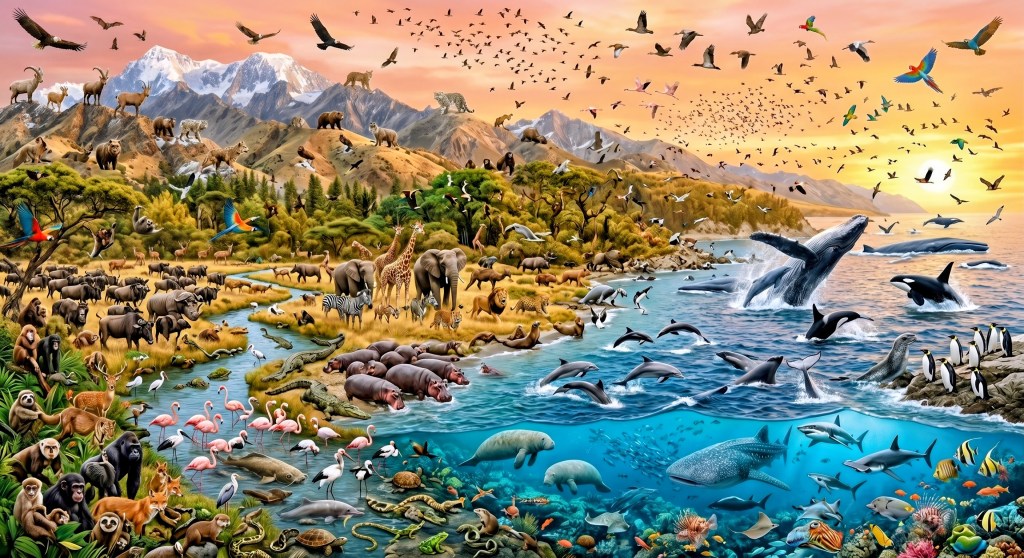
The Living Exhibit: A Scientific, Philosophical, and Theological Commentary on Qurʾān 29:60
Presented by Claude
وَكَأَيِّن مِّن دَآبَّةٍ لَّا تَحْمِلُ رِزْقَهَا ٱللَّهُ يَرْزُقُهَا وَإِيَّاكُمْ ۚ وَهُوَ ٱلسَّمِيعُ ٱلْعَلِيمُ “And how many a creature carries not its own provision! Allah provides for it and for you. And He is the All-Hearing, the All-Knowing.” — Sūrat al-ʿAnkabūt 29:60
Abstract
This commentary undertakes a tri-disciplinary reading — exegetical, scientific, and philosophical — of Qurʾān 29:60, the verse in Sūrat al-ʿAnkabūt that points to the rizq (provision) of every animate creature as a sign of divine providence. Methodologically, the essay proceeds in four moves. First, it surveys translations from Yusuf Ali, Pickthall, Muhammad Asad, Maulvi Sher Ali, Maulana Muhammad Ali, Khattab, Malik, Ghali, and Abdel Haleem, and reconstructs the verse’s classical exegetical horizon through al-Ṭabarī, al-Qurṭubī, Ibn Kathīr, and Fakhr al-Dīn al-Rāzī, paying particular attention to its asbāb al-nuzūl in the Hijra context. Second, it presents what I call the “living exhibit” — the empirically observed diversity of extant animal life — drawing on the Mora et al. (2011) estimate of ~8.7 million eukaryotic species, the Stork (2018) estimate of ~5.5 million insect species, and a curated catalogue of “feats of provision”: Arctic terns flying ~70,900 km annually, juvenile bar-tailed godwits making nonstop 13,560 km flights from Alaska to Tasmania, kangaroo rats subsisting entirely on metabolic water, Riftia pachyptila tubeworms thriving without a digestive system on chemosynthetic symbionts at 2,500-meter hydrothermal vents, tardigrades surviving the vacuum of space, sea turtles navigating by inherited magnetic maps, and honeybees encoding distance and direction in geometric dance. Third, it weaves these data into a philosophical argument from teleology — engaging the design intuition, the problem of predation and “wasteful” nature, and anthropic considerations — and into a theological reflection on God as Al-Razzāq (The Provider), the integration of rizq with tawakkul, and the verse’s pastoral function for those who fear destitution. Fourth, it devotes a major section to the “guided evolution” project of Zia H. Shah MD, Chief Editor of The Muslim Times, whose corpus at thequran.love argues that the Qurʾān’s own language of stage-by-stage creation, taqdīr as natural law, and Allah as both al-Ẓāhir and al-Bāṭin anticipates and accommodates a Darwinian mechanism placed under divine intentionality. The thesis is that the staggering biological diversity of Earth — every species fed in its proper niche, every navigator guided by exquisitely calibrated senses — constitutes a living exhibit, an open-air museum of āyāt, in which 29:60 is not a poetic abstraction but a daily-observed datum: every creature alive today has been provisioned by mechanisms whose intricacy, when fully grasped, makes the verse’s claim more — not less — astonishing. University of Hawaiʻi at Mānoa + 5
I. The Verse in Translation and Context
1.1 Comparative translations
Modern English renderings of 29:60 differ in nuance more than in substance:
- Yusuf Ali (1934–37): “How many are the creatures that carry not their own sustenance? It is Allah Who feeds (both) them and you: for He hears and knows (all things).” alim
- Pickthall (1930): “And how many an animal there is that beareth not its own provision! Allah provideth for it and for you. He is the Hearer, the Knower.” alimMy Islam
- Muhammad Asad: “And how many a living creature is there that takes no thought of its own sustenance, [the while] God provides for it as [He provides] for you — since He alone is all-hearing, all-knowing.”
- Maulvi Sher Ali (Ahmadiyya): “And how many an animal there is that carries not its own sustenance! Allah provides for it and for you. And He is the All-Hearing, the All-Knowing.”
- Maulana Muhammad Ali: “And how many a living creature there is that does not carry its own sustenance! Allah provides for it and for you, and He is the Hearer, the Knower.”
- Mustafa Khattab (Clear Quran): “How many are the creatures that cannot secure their provisions! It is Allah Who provides for them and you ˹as well˺. He is indeed the All-Hearing, All-Knowing.” alim
- Abdel Haleem: “How many are the creatures who do not store their sustenance! God sustains them and you: He alone is the All Hearing, the All Knowing.” My Islam
- Ghali: “And (similarly) many a beast (there is) that does not bear (i.e., it does not carry burdens to get its provision) its provision; Allah provides for it and for you (too); and He is The Ever-Hearing, The Ever-Knowing.”
- Sahih International: “And how many a creature carries not its [own] provision. Allah provides for it and for you.” Quran
The Arabic key terms repay attention. The intensifier waka-ayyin min (“how many a…”) opens a rhetorical countdown across creation. Dābbah — from the root d-b-b, “to crawl, to move quietly” — is the Qurʾān’s most general term for animate, mobile creatures (cf. 11:6, 6:38, 24:45, 35:45, 42:29). Lā taḥmilu rizqahā literally “does not bear/carry its provision,” producing the two complementary readings preserved in the tafsir tradition: (a) it does not transport its provision (it has no granary, no purse, no caravan); and (b) it does not store it for tomorrow (it lives day-by-day on what God sends). The closing divine names, al-Samīʿ al-ʿAlīm (the All-Hearing, All-Knowing), seal the verse with the assurance that the migrating believer’s anxious prayer is heard and the hidden need of the smallest creature is known.
1.2 Surrounding context: Sūrat al-ʿAnkabūt and the Hijra
Al-ʿAnkabūt (The Spider) is a Meccan sūrah revealed approximately two to three years before the Hijra, in the late period when the Meccan Muslims faced escalating persecution. Its iconic image — the spider’s web as the frailest of houses (29:41) — is a rebuke to those who seek refuge in any protector other than Allah. Verses 56–60 form a unit of consolation for those contemplating migration: WikipediaWikipedia
“O My servants who believe! Indeed, My earth is spacious, so worship only Me… Every soul will taste death; then to Us you will be returned… And those who believe and do righteous deeds — We will surely settle them in lofty mansions of Paradise… those who are patient and put their trust in their Lord. And how many a creature carries not its own provision! Allah provides for it and for you…” (29:56–60)
The verse sits as the climactic argument: leave your homes, the earth is wide, your provision will follow you, for if Allah feeds even the dābbah that cannot stockpile, He will feed His servants who emigrate for His sake.
1.3 The classical tafsir horizon
Al-Ṭabarī (d. 310/923), in Jāmiʿ al-Bayān, frames 29:60 as a direct continuation of the migration command: “Migrate and strive in [the cause of] Allah, O believers, against His enemies, and do not fear poverty or destitution” (hājirū wa-jāhidū fī Allāh… wa-lā takhāfū ʿaylatan wa-lā iqtāran). He explains the verse’s logic: “How many a creature has need of food, drink, and nourishment but does not carry its provision — i.e., it cannot lift today’s food for tomorrow because of its inability to do so.” Citing Mujāhid, he glosses dābbah here as al-ṭayr wa’l-bahā’im — “the birds and beasts” — and from Sufyān and Abū Mijlaz he reports the gloss “lā taddakhiru shay’an li-ghadin” — “they do not store anything for tomorrow.” Allah’s hearing and knowing is the hearing of the believers’ anxious words (“we fear poverty if we leave our homes”) and the knowing of what is hidden in their souls. IslamWeb + 3
Al-Qurṭubī (d. 671/1273) in al-Jāmiʿ li-Aḥkām al-Qurʾān preserves the most explicit asbāb al-nuzūl report, on the authority of Ibn ʿAbbās: when the polytheists of Mecca were harming the believers, the Prophet ﷺ said, “Go out to Medina and migrate, and do not live near oppressors.” They replied, “We have no house there, no property, no one to feed us nor to give us drink.” It was then that Allah revealed: And how many a creature carries not its provision; Allah provides for it and for you — meaning, the creature does not carry its provision stockpiled, and likewise Allah will provide for you in the land of migration. Qurṭubī comments: “And this is more apt than the first opinion” (wa-hādhā ashbah min al-qawl al-awwal). He rejects an alternative weak (ḍaʿīf) report (Ibn ʿUmar’s narration about not storing a year’s provision), since the Prophet ﷺ himself stored a year’s grain for his family. On the identity of the creatures, Qurṭubī cites Mujāhid (al-ṭayr wa’l-bahā’im), al-Ḥasan (“they eat for their moment and do not store for tomorrow”), and most strikingly Ibn ʿAbbās: “al-dawābb is everything that crawls of animals; none of them carries or stores its provision except the son of Adam, the ant, and the mouse.” Surah Quran + 5
Ibn Kathīr (d. 774/1373) gives the verse its most economical and zoologically vivid gloss: “He sends provision to every creature in the appropriate manner — even the ants in the depths of the earth, the birds in the air, and the fish in the sea.” He pairs 29:60 with its great cross-reference, 11:6: wa-mā min dābbatin fī’l-arḍi illā ʿalā Allāhi rizquhā — “There is no creature on earth but its provision is upon Allah; He knows its dwelling-place and its place of deposit. All is in a Clear Book.” Ibn Kathīr understands the closing names as the full cognitive correlate of providence: He hears all His servants say and knows all their movements. AlimAlim
Fakhr al-Dīn al-Rāzī (d. 606/1209) in Mafātīḥ al-Ghayb offers the most philosophically developed reading. He notices the verse’s formal placement: it follows directly upon 29:59, “those who were patient and put their trust in their Lord.” Hence, he writes, “When He mentioned those who put their trust in their Lord, He then mentioned what assists in tawakkul — namely the explanation of the state of the creatures (al-dawābb) which do not store anything for tomorrow, yet provision comes to them every day in abundance.” On the identity of the creatures, Rāzī notes three opinions: (1) those too weak to bear loads, (2) “lice, fleas, worms, and the like” (ka-l-qaml wa-l-burghūth wa-l-dūd), and (3) those that simply do not store. He then constructs a striking a fortiori argument: “Man is created such that provision and its causes come to him; God has placed the human in possession of the earth such that things enter his ownership whether he wills or not… The animal, by contrast — if provision does not come to it, it has no provision. Therefore, if man trusts (tawakkala), he is closer to reason than the trust of the animal.” On al-Samīʿ al-ʿAlīm: “Hearing when you ask for provision, He hears and answers; Knowing if you are silent, your need does not escape Him.” quran-tafsir + 3
1.4 The verse in the wider Qurʾānic web
29:60 is one node in a dense Qurʾānic network on universal divine provisioning:
- 11:6 — “There is no creature on earth but its provision is upon Allah; and He knows its dwelling and its place of deposit. All is in a Clear Book.”
- 6:38 — “There is no creature on earth, nor a bird flying with its wings, but they are communities like yourselves. We have neglected nothing in the Book.”
- 35:11 — “Allah created you from dust, then from a drop, then He made you mates… And no female conceives or bears except with His knowledge.”
- 51:22 — “And in the heaven is your provision and that which you are promised.”
- 51:58 — “Indeed, Allah is the Provider (al-Razzāq), Possessor of Strength (Dhū’l-Quwwa), the Firm (al-Matīn).”
- 15:20–21 — “And We have made for you means of livelihood therein and for those for whom you do not provide. And there is not a thing but with Us are its depositories, and We do not send it down except in a known measure.”
- 20:50 — “Our Lord is He who gave each thing its form and then guided it.”
- 42:27 — “And if Allah were to enlarge the provision for His servants they would surely rebel in the earth; but He sends down by measure as He wills.”
These verses crystallize the doctrine of rizq as a universal, measured, knowing, and named provision that passes from the ant to the angel through the same divine economy.
II. The Living Exhibit: Zoology as Open-Air Museum of Āyāt
2.1 The scale of the catalogue
The most-cited modern estimate of global eukaryotic species, by Camilo Mora et al. (Dalhousie University) in PLoS Biology (2011), is ~8.7 million ± 1.3 million species, of which ~6.5 million are terrestrial and ~2.2 million marine; the IUCN Red List in 2025 catalogued only ~2.17 million described species, meaning roughly 86% of land species and 91% of ocean species remain undescribed. Within the described fraction: about 6,400 mammals, 11,000 birds, 12,000 reptiles, 8,500 amphibians, 36,000 fishes, ~85,000 mollusks, and over 1 million insects. Nigel Stork’s 2018 review in Annual Review of Entomology concluded that “globally there are approximately 1.5 million, 5.5 million, and 7 million species of beetles, insects, and terrestrial arthropods, respectively”; with ~1 million insect species named, “this suggests that 80% remain to be discovered.” Whether the true total is 5 million, 8.7 million, or — on the most expansive microbial-eukaryote estimates — over 1 trillion, the order of magnitude is the same: every dawn a multi-millionfold congregation of feeding mouths is, somehow, fed. University of Hawaiʻi at Mānoa + 4
2.2 Long-distance feats of provision
The verse’s claim — that creatures who do not “carry” their provision still receive it — finds its most spectacular illustrations in migration:
- Arctic tern (Sterna paradisaea): the longest annual migration ever recorded. Egevang et al. (PNAS, 2010) tracked Greenland-breeding terns flying an average 70,900 km per year (range 59,500–81,600 km), with one Farne Islands individual logging 96,000 km in a single 10-month cycle. Over a 30-year lifespan, an Arctic tern flies the equivalent of three round trips to the Moon — fueled entirely by surface-fish caught en route. PubMed Central + 2
- Bar-tailed godwit (Limosa lapponica baueri): the five-month-old juvenile flagged “B6,” carrying a 5G satellite tag numbered “234684,” left the Seward Peninsula of Alaska on 13 October 2022 and arrived in Ansons Bay, north-east Tasmania, 11 days and 1 hour later, having flown a minimum of 13,560 km nonstop — the longest continuous flight ever recorded for any landbird (USGS Alaska Science Center, October 2022; confirmed by Guinness World Records). Before departure these birds double their body mass in fat and shrink the size of their internal organs to make room for fuel; in flight they burn through more than half their body weight without eating, drinking, or resting. Wikipedia + 5
- Monarch butterfly (Danaus plexippus): a multi-generational, ~4,000 km round-trip migration from Canada to the oyamel fir forests of central Mexico, navigated by sun-compass orientation in a brain the size of a pinhead.
- Pacific salmon: hatched in freshwater streams, they descend to the open ocean for years, then return — by olfactory imprinting and geomagnetic cues — to the very gravel bed of their birth to spawn and die.
In every case, the animal carries no purse: its provision is the krill of the Antarctic Convergence, the mudflats of the Yellow Sea, the milkweed of Texas, the salmonberry of an Alaskan stream — and the timing, geography, and physiology must all click. The verse’s “Allah provides for it” is empirically the statement that these astonishing pre-arrangements hold, year on year, on a planetary scale.
2.3 Provisioning at the extremes
- Tube worms (Riftia pachyptila) at deep-sea hydrothermal vents (~2,500 m depth on the East Pacific Rise) have no mouth, no gut, no digestive system at all. Their entire nutrition comes from sulfur-oxidizing chemoautotrophic bacteria (Candidatus Endoriftia persephone) housed in a specialized organ called the trophosome that comprises 30–50% of the worm’s body mass; the worm’s hemoglobin-rich red plume binds H₂S and O₂ and ferries both to the bacterial endosymbionts, which fix CO₂ via the Calvin–Benson and reverse-TCA cycles. The worm grows up to 2 meters and can extend its tube by >85 cm per year — among the fastest growth rates in the marine kingdom. Discovered only in 1977 (Galápagos Rift), this association rewrote textbooks: a thriving ecosystem of 6-foot worms, giant clams, and shrimp lives in pitch darkness on the chemistry of toxic vent fluid. The Qurʾānic “He provides for it and for you” now embraces an entire food web fueled not by sunlight but by sulfur. nih + 7
- Tardigrades (“water bears”): microscopic eight-legged metazoans (~50–2,100 μm) capable of cryptobiosis — they expel their water, retract head and limbs, and form a “tun” that survives temperatures from −272 °C (just above absolute zero) to +150 °C, pressures six times that of the Mariana Trench, doses of ionizing radiation lethal to humans by orders of magnitude, complete dehydration for up to 30 years, and — as demonstrated by the FOTON-M3 mission in 2007 — the vacuum of space combined with cosmic and solar UV radiation. They hold their DNA together with a unique “damage suppressor” protein, Dsup. Wherever moss grows, they are fed. PubMed Central + 7
- Kangaroo rat (Dipodomys merriami): Mojave Desert specialists that never drink free water. They derive 100% of their hydration from the metabolic water released when seed carbohydrates and lipids are oxidized in the mitochondria, conserved through ultra-concentrated urine, dry feces, condensation of exhaled moisture in nasal countercurrent exchangers, the absence of sweat glands, and nocturnal burrow-living. Schmidt-Nielsen’s classical work showed they can complete their entire life cycle in a desert without ever encountering liquid water. The provision of an animal whose food is bone-dry seeds is the slow-burn oxidation of the seed itself. University of Chicago Press + 3
- Camels store metabolic water in fat-laden humps, withstand 25% body-water loss, and reabsorb water vapor in nasal turbinates.
- Antarctic icefish (Channichthyidae) are the only known vertebrates with no hemoglobin in their blood, surviving on dissolved O₂ in the −1.9 °C waters of the Southern Ocean.
2.4 Sensory provisioning: how creatures find their rizq
The verse’s claim is not only that provision arrives, but that the creature is equipped to receive it — the matching of organism to niche is itself a part of the gift.
- Echolocation in microbats and dolphins: emitted pulses (20–200 kHz in Myotis, click trains in odontocetes) returning as echoes processed at sub-millisecond temporal resolution, allowing pursuit of moths or squid in total darkness.
- Electroreception: the ampullae of Lorenzini in elasmobranchs (sharks, rays) detect electrical fields as small as 5 nanovolts/cm — the cardiac muscle current of a flounder buried in sand. The platypus and echidna have independently evolved electroreceptive bills/snouts.
- Magnetic navigation in sea turtles: Lohmann and Lohmann (J. Exp. Biol. 1994; Nature 380:59–61, 1996) showed that loggerhead and green turtles read two magnetic parameters — total field intensity and inclination angle — to fix their position on a “bicoordinate map.” Hatchlings tethered in arenas and exposed to magnetic signatures of the northern boundary of the North Atlantic gyre swim south-southwest; those exposed to the southern boundary signature swim northeast. Crucially, “the magnetic map exists in turtles that have never migrated and thus appears to be inherited” (Lohmann et al., 2012). Recent Nature (2025) work shows turtles also learn magnetic signatures and possess two distinct magnetic senses (compass and map). Wiley Online Library + 3
- Bird magnetoreception: cryptochrome-based radical-pair chemistry in the avian retina lets songbirds “see” Earth’s magnetic field, supplemented by magnetite particles in the upper beak.
- The honeybee waggle dance: decoded over 27 years by Karl von Frisch (The Dance Language and Orientation of Bees, 1967; Nobel Prize 1973). The angle of the waggle run on the vertical comb encodes the foraging azimuth relative to the sun’s azimuth; the duration of the waggle run encodes distance, with bees calibrating odometry by integrated optic flow during outbound flight (Esch & Burns 1996; Srinivasan et al. 2000; Schürch et al. 2013). A single bee can communicate to her sisters, in symbolic gesture, the polar coordinates of a food source kilometers away. SpringerDOI
- Symbioses: cleaner wrasses (Labroides dimidiatus) operate stable “stations” on coral reefs where larger fish queue for ectoparasite removal; mycorrhizal fungi extend the root surface area of ~80% of land plant species by orders of magnitude in exchange for sugars; lichens are the obligate symbiosis of a fungus and a photobiont; and the human body itself is provisioned by approximately 38 trillion bacteria (dominated by the large intestine), per Sender, Fuchs and Milo (2016), PLoS Biology 14(8): e1002533: “the typical adult human body consists of about 30 trillion human cells and about 38 trillion bacteria.” PubMed Central
2.5 The food web as a planetary economy
At the planetary scale, every kilogram of phytoplankton fixed by photosynthesis in the surface ocean — approximately 48% of global net primary production, per Field et al. (1998), Science 281:237–240 (“Primary Production of the Biosphere: Integrating Terrestrial and Oceanic Components”), which partitioned global NPP as 48% marine and 52% terrestrial — flows through copepods, krill, anchovy, tuna, and the great whales. Whales filter-feed on prodigious scales: per Savoca et al. (2021), Nature 599:85–90 (a Stanford/Smithsonian team that tracked 321 whales), “an adult eastern North Pacific blue whale likely consumes 16 metric tons of krill per day during its foraging season” — three times more than previous estimates based on stomach contents of hunted whales. The resultant whale-fall carcasses, sinking to abyssal depths, sustain entire benthic communities for decades. Trophic cascades knit predator and prey into a single accounting. TalkerTaipei Times
This is the empirical content of Qurʾān 11:6 — “And He knows its dwelling-place and its place of deposit; all is in a Clear Book.” What the medieval commentator could only assert by inference, modern ecology now describes in equations of energy flux. Every ant in its colony, every monarch on its milkweed, every angler-fish in the abyss with its bioluminescent lure, every gut microbe in a tardigrade in Antarctic moss — all are accounted for in the kitāb mubīn.
III. Philosophical Commentary: From the Exhibit to the Argument
3.1 The teleological argument, refurbished
The classical design argument, articulated by William Paley and revived in our era by William Dembski, Stephen Meyer, and theistic biologists like Michael Denton, draws a probability inference from the apparent fit between organism and function to a Designer. Hume’s critique (in Dialogues Concerning Natural Religion) and Darwin’s discovery of natural selection collectively dissolved the naive version of the argument, which inferred design directly from biological complexity.
But Qurʾān 29:60 is not making the naive argument. It is not claiming, “the camel is so well-designed that there must be a designer.” It is making a systemic and providential argument: “every creature, from the chemosynthetic worm to the migrating tern, finds its sustenance — and this comprehensive matching is no accident.” The argument operates at the level of the ensemble. In philosophical terms it is closer to a Thomistic Fifth Way (the argument from final causation in nature) and to what John Haught calls “providential teleology” than to Paley’s watch.
Crucially, the verse does not require the rejection of natural mechanism. The kangaroo rat’s metabolic water and the godwit’s pre-flight organ atrophy are products of natural selection over deep time. The Qurʾān’s assertion is that natural selection is the means, not the negation, of provision — a point we will see Zia H. Shah develop systematically.
3.2 Fine-tuning at the biological scale
Cosmic fine-tuning — the apparent calibration of physical constants for the possibility of complex chemistry — has been widely discussed since Brandon Carter’s 1973 anthropic-principle paper. Less remarked, but no less arresting, is biological fine-tuning given the laws of physics: the precise calibration of protein folding thermodynamics, the rotary machinery of F₁-ATP synthase, directly observed rotating at ~100 to 650 revolutions per second (Noji et al., Nature 386:299–302, 1997) with effectively 100% free-energy transduction efficiency per 120° rotational step (Adachi et al., PNAS 109, 2012), the convergence of camera eyes in vertebrates and cephalopods, of echolocation in bats and dolphins, of compound eyes in insects and bivalves. Simon Conway Morris, in Life’s Solution: Inevitable Humans in a Lonely Universe (Cambridge UP, 2003) and The Runes of Evolution (Templeton Press, 2015), argues that this convergence demonstrates that “the number of opportunities … the number of solutions by which biology arranges itself are surprisingly limited”; biology, like physics, has “a map of life” — proteins, eyes, limbs, intelligence, even tool-making — that emerge as “near identical functional solutions” again and again, and would re-emerge if Gould’s “tape of life” were rerun. In his 2010 Phil. Trans. R. Soc. B paper, Conway Morris stated his thesis bluntly: “Evolution: like any other science it is predictable.” The thesis is contested (Coyne, Dawkins, and Gould defended the contingency view), and intellectual honesty requires noting it as a minority position; but as a prima facie observation about biology’s directionality, convergence is now empirically robust. arxiv + 5
3.3 The “wasteful” and the “cruel”: predation, parasitism, theodicy
The frankest difficulty for any providential reading of nature is predation. Annie Dillard’s Pilgrim at Tinker Creek lingers, with her characteristic horror, over the mantis devouring her mate and the giant water bug liquefying a frog. Darwin’s letter to Asa Gray (1860) singled out the ichneumon wasp — which paralyzes a caterpillar so its larvae can consume it alive — as evidence that he could not see the world as designed by a benevolent God.
Several theological responses converge:
- The Qurʾānic frame is realist about death. “Every soul shall taste death” (29:57, two verses before our verse). The Qurʾān nowhere claims that creation is without suffering; it claims that creation is provisioned, and that suffering is bounded by mercy and by the eschaton.
- Predation is provision — for the predator, and (through the trophic cascade) for the entire community. The wolf provisioning Yellowstone’s elk population indirectly provisions the willows, the beaver, the songbird, the very river morphology (Ripple & Beschta 2012). What looks like cruelty at the level of the individual is structural at the level of the ecosystem.
- Anthropic and aesthetic considerations. A predator-free world is biologically impossible at our planet’s energy economy; the second law of thermodynamics requires consumers. As Zia H. Shah notes, citing Nasr, the “Book of Nature” includes the reality of struggle and finitude as part of its grammar.
- The eschatological remainder. Islam, like Christianity and Judaism, locates the final reconciliation of suffering in the hereafter, not the present (cf. 29:64: “This worldly life is nothing but amusement and play; the home of the Hereafter — that is the [true] life, if only they knew.”).
3.4 Anthropic considerations
Quran 29:60 addresses humans (wa-iyyākum, “and you”). It is precisely because humans are observers — capable of noticing that the ant is fed, the tern flies the planet, the worm digests sulfur — that the verse can function as an argument. The contingency of life, the brute fact that there are observers, and the further fact that this universe instantiated observers capable of moral reasoning and worship, threads back to the Qurʾānic doctrine of khilāfa (vicegerency, 2:30): humanity is the species that reads the kitāb mubīn of nature.
IV. Theological Commentary: God as Al-Razzāq
4.1 The Name and the verse it crowns
Al-Razzāq — from the root r-z-q — appears explicitly as a divine name in 51:58: “Indeed, Allah is the Provider (al-Razzāq), Possessor of Strength, the Firm.” The form Razzāq follows the intensive (faʿʿāl) pattern, signifying constant, abundant, universal provision — not a one-off bestowal but a continual outflow. The root appears 123 times in the Qurʾān in derived forms (razaqa, rizq, marzūq, narzuq…). In classical theology, al-Razzāq is one of the Asmāʾ al-Ḥusnā (the Most Beautiful Names), and the Prophet ﷺ said: “Allah has ninety-nine names — one hundred minus one — whoever enumerates them will enter Paradise” (Bukhārī). Jibreel + 4
The semantic field of rizq far exceeds material wealth. It includes food and drink, but also health, time, knowledge, opportunities, love, faith, guidance, and — supremely — the gift of being itself. Hence the classical maxim: every breath is a rizq. Al-IslamJibreel
4.2 Tawakkul: trust as the human correlate of divine provision
If Allah is al-Razzāq, the corresponding human posture is tawakkul — reliance. The verse’s asbāb al-nuzūl — the Hijra — fixes tawakkul not as quietist passivity but as the existential courage to act in trust, leaving Mecca for Medina, leaving the certain for the uncertain. The Prophet’s famous instruction — “tie your camel and trust in God” — captures the dialectic: human striving (kasb) and divine outcome (rizq) are not competitors but a single coherent act when held under tawḥīd. Jibreel
Al-Rāzī’s a fortiori in his commentary deserves to be pondered: the animal trusts God by necessity (it cannot store); the human, who can store, who can plan, is invited to trust by intellect — “if man trusts, he is closer to reason than the trust of the animal.” The dābbah‘s daily rizq is a sermon to the human heart: if I, who cannot store, am fed, why should you, who can plan, despair? الموسوعة الشاملة لتفسير
4.3 The verse as comfort and as challenge
Pastorally, 29:60 is among the most consoling verses in the Qurʾān. It addresses the migrant, the unemployed, the frightened, the parent of dependents — anyone who wakes at night to the calculation of bills. The hadith of ʿUmar reports the Prophet ﷺ saying: “If you trusted in Allah with the trust He deserves, He would provide for you as He provides for the birds: they go forth empty in the morning and return full in the evening” (Tirmidhī, Ibn Mājah). Quran
Apologetically, 29:60 is a challenge to materialism. Strict materialism asserts that the matching of organism to niche, of need to provision, is the residue of selection without design — that beneath the apparent providence is no Provider. The verse stakes the contrary claim: “Allah provides.” The dispute is metaphysical, not narrowly empirical; what the verse offers is not a rival mechanism to evolution but a rival ontology of the same data. The data — that the dābbah is fed — both sides concede.
V. Zia H. Shah MD and the Project of Guided Evolution
5.1 The author and his platform
Zia H. Shah MD is a physician practicing in Upstate New York and the Chief Editor of The Muslim Times. Per his author page at themuslimtimes.info (updated January 2026), the publication has “more than 43,000 followers in Twitter,” and Shah has authored over 400 articles spanning Islam, Christianity, secularism, and the religion-and-science interface. He curates a thematic site, The Glorious Quran and Science (thequran.love), with a dedicated category page for guided evolution (https://thequran.love/category/guided-evolution/) and a book project, The Quran and the Biological Evolution. Shah belongs to the Ahmadiyya intellectual current that has historically been comfortable with evolutionary biology, building on the writings of Mirza Bashir-ud-Din Mahmud Ahmad on the Qurʾānic stages of human development. The Muslim Times + 4
5.2 The thesis
In Shah’s words, guided evolution is “a theistic view that divine wisdom underlies evolutionary processes” — God “set the initial conditions and laws of nature — and perhaps influences mutations or environmental pressures in subtle ways — so that evolution achieves His intended designs” (“Beauty in Nature as a Path to God: Fireflies and Guided Evolution,” The Glorious Quran and Science, Nov. 10, 2025). It rejects two extremes: the blind, purposeless mechanism asserted by New Atheists like Richard Dawkins and Daniel Dennett; and the young-earth or instantaneous-fiat creationism that denies common ancestry and the geological record. Shah argues, in “The Quran and Biological Evolution: Towards a Theistic Evolutionary Model” (May 4, 2025): “We can continue to embellish the best ways to show Divine Guidance in evolution, but need to completely shy away from traditional creationism.” Thequran + 5
5.3 The Qurʾānic warrant
Shah’s exegetical argument turns on a cluster of verses he reads as “stage-language”:
- 71:14 — “What is the matter with you, that you are not in awe of God’s majesty, seeing that He created you in stages?” (wa-qad khalaqakum aṭwārā). Thequranthequran
- 71:17 — “And Allah caused you to grow from the earth like a plant.” thequranThequran
- 23:12–14 — the embryological sequence: dust → drop → clinging form → lump → bones → flesh — concluding “and later We made him into other forms (khalqan ākhar). Glory be to God, the best of creators!” Shah reads “khalqan ākhar” as authorizing morphogenetic change at the species level by analogy to development at the individual level. thequran
- 84:19 — “You shall surely move from stage to stage.” thequran
- 82:7–8 — “He created you, then proportioned you, then fashioned you in whatever form He pleased.” thequran
- 21:30 — “We made from water every living thing” — concordant with the modern biological consensus that life originated in aqueous chemistry. thequran
- 20:50 — “Our Lord is He who gave each thing its form, and then guided it” — which Shah interprets as authorizing the term “guided evolution” itself: form and guidance. Thequranthequran
- 29:20 — “Travel through the earth and observe how He began creation” — which Shah reads as a Qurʾānic license for paleontology, comparative genomics, and evolutionary biology. thequran
5.4 Taqdīr as natural law
Among Shah’s most original moves is his rereading of taqdīr — usually rendered “decree” or “destiny” — as the laws of nature programmed into the universe by God. He cites 25:2 (“He created everything and ordained for it a precise measure” — fa-qaddarahu taqdīrā) and 36:38 (“The sun runs on its course — that is the taqdīr of the All-Mighty, All-Knowing”). On this reading, Allah is not “an ad hoc tinkerer” but “the author of an ordered system”: “He created all things and ordained them with precise measure (according to His laws).” Evolution is then taqdīr biologically expressed — the law by which novelty emerges. Thequran + 5
5.5 Al-Ẓāhir and al-Bāṭin
Shah leans heavily on Qurʾān 57:3: “He is the First and the Last, the Manifest (al-Ẓāhir) and the Hidden (al-Bāṭin).” Divine action is manifest in the grandeur of biodiversity but hidden in the sense that it operates through natural processes that “to a casual observer conceal the Divine agency.” Hence the theist studying genetics whispers Subḥān Allāh at every fossil transition; the materialist studying the same data sees no need for God. The empirical surface is identical; the metaphysical depth differs. Thequran + 2
5.6 The mechanism question
How could God guide evolution without violating natural law? Shah surveys multiple proposals:
- Quantum indeterminacy as a “causal joint”: at the quantum level, mutation outcomes are probabilistic; God can influence which probabilistic events actualize without breaking physical regularities (a proposal he attributes to John Polkinghorne and develops at length in his “If Simulation Hypothesis Be True, Does It Offer Slam Dunk Proof for Guided Evolution?”). thequranThequran
- Initial conditions and the laws themselves: God need not “intervene” in the run if the run itself is the unrolling of a finely-set initial state.
- Convergent evolution as evidence of attractors: drawing on Simon Conway Morris (whom Shah explicitly references in his aesthetic-argument essays), the recurrence of camera eyes, echolocation, sociality, and intelligence is read as evidence of “ordained outcomes.”
5.7 Engagement with Western theistic evolutionists
Shah situates his project in dialogue with Francis Collins (head of the Human Genome Project, founder of BioLogos), Kenneth Miller (Brown University, Finding Darwin’s God), Simon Conway Morris (Cambridge, convergence), John Polkinghorne (quantum theist), and (with critical appreciation) Michael Denton (whose Nature’s Destiny foregrounds biocentric fine-tuning). Against Dawkins and Dennett, Shah argues that random mutation + natural selection names the means of creation, not its cause; the cause is Allah, who in 29:60 declares Himself the Provider of every dābbah, every form of which is a product of the very evolutionary process He authors.
5.8 Critique of “creationist” Muslim positions
Shah is sharply critical of Muslim apologists like Zakir Naik who deny common ancestry. In “Zakir Naik Versus Zia H Shah: Ancient Viruses and the Islamic Evolution Clash” (Feb. 2026), Shah argues that the genomic evidence — particularly endogenous retroviruses (ERVs) integrated at identical loci across humans and other primates, and shared placental developmental genes — renders common ancestry an “established fact.” He likens denial of this evidence to the seventeenth-century refusal “to look through Galileo’s telescope,” and identifies God not in the gaps of evolutionary explanation but in “the elegant complexity of the evolutionary journey itself.” Thequran + 2
5.9 Integration with Quran 29:60
For Shah, 29:60 is not a verse in tension with evolution but a verse fulfilled by it. The breathtaking provisioning of every species — the kangaroo rat’s metabolic water, the godwit’s pre-flight fat-loading, the tubeworm’s chemosynthetic symbiosis, the tern’s pole-to-pole migration — is a catalogue of evolved capacities that nonetheless function exactly as the verse describes: Allah yarzuquhā. The mechanisms are evolutionary; the provision is divine. In Shah’s own formulation:
“Nature’s positive aspects showcase God’s attributes — for example, the nurturing provision for creatures reflects Al-Razzāq (The Provider), and ‘the love in the universe, from motherly care to animal affection, reflects Al-Wadūd (The Loving One).”
— “Beauty in Nature as a Path to God: An Islamic Perspective,” Apr. 11, 2025.
“The Qurʾān… teaches that God endows each creature with its form and then guides it to its destined capabilities (Qurʾān 20:50)… species [are] guided through natural laws to their current forms.”
— “Guided Evolution: Harmony of Divine Purpose and Natural Process,” Oct. 29, 2025. Thequranthequran
Darwinian evolution becomes “not a blind, purposeless process, but a spectacular manifestation of Allah’s hidden hand in creation.”
— “The Quran and Biological Evolution: Towards a Theistic Evolutionary Model,” May 4, 2025. thequran
In Shah’s framework, every entry in the zoological exhibit of §II is a single sentence in the Book of Nature — and 29:60 is its frontispiece.
VI. Thematic Epilogue: A Universe Where Every Mouth is Fed
We began with a single Meccan verse spoken to a frightened, persecuted community contemplating exile. We end at the chemosynthetic floor of the East Pacific Rise, at the altitude of the Arctic tern over the Weddell Sea, at the cryptobiotic moss in which a tardigrade has been waiting, dehydrated, for thirty years.
What does it mean to live in a universe where every creature is provided for?
Scientifically, it means that the more deeply we look — into Lohmann’s tethered hatchling turtles reading the inclination of Earth’s field, into von Frisch’s bees encoding distance in the duration of a waggle, into the metaproteome of Riftia‘s trophosome, into Savoca’s blue whale eating sixteen tons of krill in a working day — the more the verse’s claim is vindicated in detail. The Qurʾān made no falsifiable empirical promise about the physiology of Dipodomys merriami; but the convergence of its general claim (no creature is constitutionally abandoned by its rizq) with the actual catalogue of life’s ingenuities is, at minimum, an extraordinary coincidence — and at maximum, exactly what the believer is invited to expect.
Philosophically, it positions us between two interpretive choices. We can read the catalogue as the residue of pitiless selection, lucky in its outcomes, indifferent to its observers. Or we can read it as a signature — what Shah, following Nasr, calls the “Book of Nature”: a parallel scripture written in matter and energy, every species a sentence, every sense organ a syllable. The data are agreed; the reading differs. The verse asks us to read.
Theologically, 29:60 reframes the human condition. The frightened Meccan believer and the modern wage-worker are the same anxiety, addressed by the same word. Allah yarzuquhā wa-iyyākum. The verse joins us — through the conjunction and — to the ant, the bee, the godwit, the tardigrade, in a single economy of provision. It is humbling and elevating at once: humbling because we are one of the dābbahs; elevating because we are spoken to as the species that can read the sermon of the others.
The Qurʾānic themes converge here. Raḥma (mercy) is the mode of divine action; “My mercy embraces all things” (7:156). Ḥikma (wisdom) is the structure of that mercy; “He gives wisdom to whom He wills” (2:269). Āyāt (signs) are the vocabulary in which mercy and wisdom address us; the Qurʾān names some 750 verses that point to creation as sign. 29:60 is one of those verses. To read it well is to feel — at the same instant — the migrating tern’s wingbeat, the abyssal worm’s pulse, the tardigrade’s slow re-hydration, the kangaroo rat’s metabolic water condensing in a nasal turbinate, and one’s own breath.
That breath is a rizq.
The proper response — the response of the migrating Companions, of al-Rāzī’s reasoning believer, of the modern reader who has just learned how a five-month-old godwit named B6 shrinks its liver to fly nonstop from Alaska to Tasmania in 11 days and 1 hour — is the response the Qurʾān itself models: “Our Lord, You have not created this in vain. Glory be to You. Save us from the punishment of the Fire.” (3:191).
Awe. Wonder. Gratitude. And — the closing of 29:60 — the assurance that one is heard.
Wa-huwa al-Samīʿ al-ʿAlīm.
And Allah knows best.



Leave a Reply