
Presented by Gemini Ultra
Audio teaser: The Universe Will Fold and Restart
Abstract
This report provides an exhaustive, multi-disciplinary analysis of Quran 21:104, a verse that describes the terminal event of the current cosmos through the metaphor of a folding scroll and promises an subsequent recreation. The investigation begins with a rigorous linguistic and philological examination of the Arabic terms natawi (folding), al-sijill (the scroll), and nu’iduhu (We shall repeat it), situating them within classical exegetical frameworks. The report then transitions into a comprehensive scientific analysis, highlighting the striking resonance between the Quranic imagery and the “Big Crunch” theory in modern cosmology. Special attention is given to the 2025 and 2026 data from the Dark Energy Spectroscopic Instrument (DESI) and the Dark Energy Survey (DES), which suggest that dark energy may be evolving, potentially leading to a reversal of cosmic expansion within a calculated 33-billion-year total lifespan for the universe. Philosophically, the verse is interrogated through the lens of cyclic versus linear time, information theory, and the preservation of identity during the transition from a state of maximum entropy to a renewed singularity. Theologically, the report explores the verse as an affirmation of Divine Omnipotence and a teleological promise of resurrection. By synthesizing these diverse perspectives, the analysis demonstrates how the verse bridges ancient metaphysical insights with contemporary astrophysical models, presenting a unified vision of a dynamic, purposeful, and potentially oscillatory universe.
Foundations of Revelation: Philological and Exegetical Analysis of Verse 21:104
The primary text under investigation, Quran 21:104, states: “The Day when We will fold the heaven like the folding of a (written) sheet for the records. As We began the first creation, We will repeat it. (That is) a promise binding upon Us. Indeed, We will do it.”. To understand the depth of this statement, one must first engage with the specific Arabic vocabulary employed, which carries layers of meaning that have been meticulously preserved by scholars for over a millennium. The verse sits at the climax of Surah al-Anbiya (The Prophets), a chapter that frequently addresses the origins of the world and the inevitability of the Day of Judgment.
The verb natawi (from the root T-W-Y) signifies the act of folding, rolling up, or wrapping something that was previously extended or spread out. In the context of the heavens, this implies a reversal of the current state of expansion. Classical exegetes like As-Sa’di interpret this as Allah folding the vast heavens—enormous as they are—with the same ease that a scribe or a recorder rolls up a parchment. This imagery suggests that the cosmic structure is not an immutable, eternal fixture but a flexible fabric subject to the will of its Creator. The use of the first-person plural (We) emphasizes Divine majesty and the direct nature of this intervention in the cosmic order.
The term As-Sijill has been the subject of extensive debate. While some early traditions suggested it might be the name of an angel entrusted with the records of human deeds, the dominant and linguistically favored view—championed by Ibn Abbas, Mujahid, and Qatadah—is that it refers to a written scroll or sheet of parchment. This interpretation aligns with the literal use of the word in classical Arabic and reinforces the metaphor of the universe as a “text” or a record that can be opened and closed. The relationship between the “scroll” and the “writings” (li’l-kutub) is critical. The verse describes the folding of the heaven ka-tayyi al-sijilli li’l-kutub. This has been interpreted to mean “like the folding of the scroll for the writings contained within it”. Modern scholarship suggests that if the “writings” represent the matter and information within the universe, the “folding of the scroll” represents the collapse of space-time itself.
| Key Term | Root | Primary Meaning | Contextual Application in 21:104 |
| Natawi | T-W-Y | To fold, roll up, or wrap. | The contraction or “rolling up” of the celestial expanse. |
| As-Sijill | S-J-L | A scroll, book, or written sheet. | The cosmos as a record or medium that is concluded and stored. |
| Al-Kutub | K-T-B | Writings, records, or books. | The content of the cosmic record; the data of creation. |
| Nu’iduhu | ‘-W-D | To repeat, return, or reproduce. | The cyclic promise of a second creation following the collapse. |
| Wa’dan | W-‘-D | A promise or covenant. | The ontological certainty of the cosmic transition. |
Classical scholars like Ibn Kathir link this verse with Quran 39:67, which describes the earth being within Allah’s grip and the heavens being folded in His right hand on the Day of Resurrection. These descriptions are not viewed merely as metaphors for destruction but as descriptions of a literal transformation of the physical world. The verse explicitly links the beginning of creation to its repetition: “As We began the first creation, We will repeat it”. This establishes a symmetrical relationship between the origin (the “Big Bang” in modern terms) and the end (the “Big Crunch”). Exegetes emphasize that the ease with which Allah initiated the first creation from non-existence serves as a rational proof for His ability to recreate it. The promise is described as “binding” (wa’dan ‘alayna), indicating that the cyclical nature of the universe—or at least its terminal transition and renewal—is an ontological necessity according to Divine Law.
The Modern Cosmological Paradigm: From Expansion to the Big Crunch
For most of the 20th century, the prevailing scientific view shifted between three major theories regarding the ultimate fate of the universe: the Big Freeze, the Big Rip, and the Big Crunch. While the discovery of the accelerating expansion of the universe in the late 1990s led many to favor the Big Freeze (or “Big Chill”), recent data from the mid-2020s has reinvigorated the Big Crunch scenario, creating a profound resonance with the imagery of Quran 21:104.
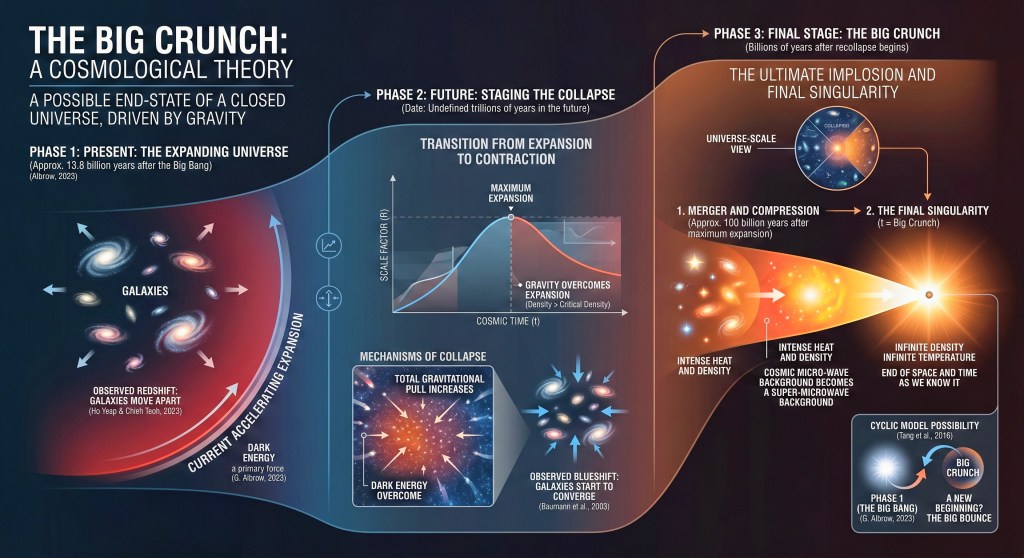
The Big Crunch is a theoretical scenario where the expansion of the universe eventually slows down, stops, and reverses due to the influence of gravity or changes in the properties of dark energy. In this “Big Bang in reverse,” the cosmic scale factor $a(t)$ reaches a maximum and then begins to decrease toward zero, eventually leading back to a super-dense singularity. This reversal occurs if the average energy density of the universe is high enough for gravitational attraction to overcome the repulsive effects of dark energy.
One of the most profound resonances between science and the Quran is found in the description of gravity. In verse 7:187, the Quran uses the term thaqulat (weighs heavily) to describe the final hour in the heavens and the earth. General Relativity models gravity not as a force acting at a distance but as the curvature of the four-dimensional manifold of space-time. The “folding” of space-time described in 21:104 is thus the geometric consequence of the “weight” or density of the universe overcoming expansion.
Recent data from major dark-energy observatories has introduced a potential shift in our understanding of the “cosmological constant” ($\Lambda$). Analysis based on data from the Dark Energy Spectroscopic Instrument (DESI) in Arizona and the Dark Energy Survey (DES) in Chile suggests that dark energy may not be a constant property of space but may evolve over time.
| Observation Source | Key Finding (2025-2026) | Implication for Universal Fate |
| DESI Year 1 Map | Dark energy may be weakening or changing over time. | Expansion could cease and reverse under gravity. |
| Cornell Physicist (Henry Tye) | Negative cosmological constant indicated by new calculations. | The universe acts like a “stretched rubber band” snapping back. |
| Cosmic Lifespan Model | Calculated total lifespan of approximately 33.3 billion years. | We are nearing the “halfway point” of existence. |
| Scale Factor $a(t)$ | Predicted to reach peak in 11 billion years, then contract. | Supports a Big Crunch approximately 20 billion years from now. |
This data provides a quantitative timeline that aligns with the “folding” metaphor. According to the calculations provided by Tye and his team, the universe, currently 13.8 billion years old, will reach its maximum extent in roughly another 11 billion years. At that point, the expansion will stop, and the “crunching” phase will begin, lasting approximately another 8 to 10 billion years before reaching a final singularity. This defines a “mortal” universe with a clear end-point, mirroring the eschatological themes of Surah Al-Anbiya.
The mechanism for this reversal involves a transition where the cosmological constant, previously thought to be positive and stable, tips into negative territory. A negative cosmological constant would exert a contractive pressure rather than a repulsive one. To explain this behavior, physicists have proposed a hypothetical particle of very low mass that behaved like a cosmological constant early in the universe’s life but has since evolved. This particle’s changing effects over time align with the recent observations that dark energy is weakening. This shift in dark energy behavior is described by physicists as the “beginning of the end,” which could manifest in as little as 10 billion years—less than the present age of the cosmos.
Structural Revolutions: Topology, Fold Theory, and String Cosmology
The metaphor of “folding” in 21:104 is not merely poetic but possesses significant topological and structural depth when analyzed through the lens of theoretical physics. The verse compares the folding of the heaven to the folding of a scroll, suggesting a geometric transformation of the spatial manifold. This resonance is explored further in contemporary “Fold Theory,” which posits that reality itself is woven from folds of structure rather than built from discrete particles or fields.
In Fold Theory, spacetime is viewed as a projection of coherence gradients, and matter emerges from recursive depth. The act of “folding the heaven” can be interpreted as a change in these coherence gradients, where the universe returns to a more compact, unified state. This structural approach reframes thermodynamics and entropy as byproducts of structural strain, suggesting that the “folding” of the universe is the release of that strain.
| Fold Theory Concept | Resonance with Quran 21:104 | Implications for Cosmology |
| Recursive Curvature | “Like the folding of a scroll.” | Gravity is a morphic tension in the manifold. |
| Emergent Spacetime | The “heaven” is a constructed sheet. | The universe can be “rolled up” because it is a projection. |
| Structural Resonance | Measurement is a lock-in between layers. | The “writings” are the information stored in the folds. |
| Degeneracy of Extension | Entropy as a result of recursive growth. | The “folding” reverses the increase of entropy. |
Furthermore, modern string theory offers a highly specific mechanism for the “folding” and “unfolding” of the universe through “Instant Folded Strings” (IFSs). These are fundamental strings with unusual properties—they are significantly lighter than typical strings yet extend far beyond their usual length, violating the Null Energy Condition (NEC). In a cyclic cosmology, IFSs play a dual role: they trigger the cosmological “bounce” that prevents a catastrophic singularity and initiate transient epochs of dark-energy domination.
The IFS model describes a universe that undergoes repeated cycles of expansion and contraction. Each cycle begins with a contracting phase that transitions through a period dominated by IFSs, eventually “bouncing” into a new expanding phase. This process is described as a “cyclic cosmic engine capable of indefinite operation”. The Quranic phrase “As We began the first creation, We will repeat it” mirrors this idea of a recurring cosmic cycle triggered by the unique behavior of these folded strings.
Additionally, the transition between these phases is facilitated by an “enhanced symmetry point” where certain fields become massless. This transition allows for the smooth connection of an earlier phase of contraction to the present phase of expansion, a concept known as the “Big Bounce”. This model addresses the horizon and flatness problems without the need for the “exotic physics” of standard inflation, instead relying on the robust smoothing effects of slow contraction.
Metaphysical and Philosophical Interrogation: Time and Entropy
The transition from the current universe to its “repetition” raises profound philosophical questions regarding the nature of time and the preservation of identity. Quran 21:104 offers a unique synthesis that reconciles linear and cyclic conceptions of time. Traditional Islamic thought often emphasizes a linear progression toward the Day of Judgment, but the specific language of “repeating” creation allows for a cyclic interpretation that resonates with the “eternal return” found in both ancient philosophy and modern bouncing cosmologies.
Scholars like Mulla Sadra argue for the “continual renewal of creation” (tajdid al-amthal), suggesting that the universe is being recreated at every moment. In this view, the “Great Folding” at the end of time is the final manifestation of a process that has been occurring on a microscopic scale throughout history. The Big Crunch is not just a physical collapse but a metaphysical return to the “Origin” (Mabda), allowing for a subsequent “Return” (Ma’ad).
A significant philosophical challenge for any cyclic model is the Second Law of Thermodynamics, which states that entropy (disorder) in a closed system must always increase. If the universe were to cycle infinitely, the entropy build-up from each previous cycle would eventually lead to a state of “heat death” where no further cycles are possible.
Modern cyclic models, particularly the Ijjas-Steinhardt (IS) model, solve this “entropy problem” through the concept of entropy dilution. In this model, the volume of space increases exponentially during each expansion phase, diluting the entropy produced in the preceding cycle to a negligible level. This ensures that the entropy density within the Hubble radius—the observable portion of the universe—remains the same after every bounce.
| Cyclic Model Component | Philosophical/Physical Role | Resonance with 21:104 |
| Slow Contraction | Homogenizes and flattens the universe. | “Folding” the heavens to a uniform state. |
| Entropy Partitioning | Separates matter/radiation entropy from gravity. | Satisfying Weyl curvature for a “clean” repeat. |
| Smooth Bounce | Connects contraction to expansion non-singularly. | A controlled process of “repetition.” |
| Net Expansion | Prevents entropy build-up over cycles. | The “scroll” expands between each folding. |
The metaphor of the “scroll for the writings” (al-sijilli li’l-kutub) provides an intriguing solution when viewed through the lens of information theory. If the “writings” represent the information content of the universe, the folding of the scroll suggests the preservation and storage of that data. In modern physics, the debate over whether information is lost in black holes (the information paradox) is central to our understanding of quantum gravity. The Quranic promise of Nu’iduhu (“We shall repeat it”) suggests that the “data” of the first creation is not lost but is used to reconstruct the second creation.
This preservation of information is essential for the concept of resurrection. From a philosophical perspective, for a “repeated” creation to be meaningful, it must maintain a continuity of identity with the first. The “scroll” acts as a celestial storage medium, ensuring that the “writings” of human deeds and cosmic history are available for the Day of Reckoning.
Theological Teleology: Resurrection as a Cosmic Necessity
From a theological standpoint, Quran 21:104 is a declaration of Divine Sovereignty and the absolute certainty of the Afterlife. It frames the end of the universe not as an accident of physics but as a deliberate act of “folding” by the Creator. The verse concludes with a powerful affirmation: “A promise binding upon Us. Indeed, We will do it”. This underscores the Islamic concept of Qudra (Omnipotence)—the same Power that “opened out” the singularity (as described in verse 21:30) is capable of “folding” it back.
| Divine Attribute | Role in Cosmic Cycle | Theological Implication |
| Al-Awwal (The First) | The Initiator of the first creation. | The uncaused Cause of the Big Bang. |
| Al-Akhir (The Last) | The Folder of the heavens. | The definitive end of the current order. |
| Al-Mu’id (The Restorer) | The Repeater of creation. | The ontological basis for Resurrection. |
| Al-Bari (The Originator) | The Designer of the cycle. | Creation is purposeful, not accidental. |
| Al-Qayyum (Sustainer) | The Maintainer of physical laws. | Divine active witnessing sustains the manifold. |
The theological significance of the divine promise of recreation extends beyond the physical universe to the individual human soul. Many commentators interpret “As We began the first creation” as a reference to the biological beginning of man (from a sperm drop or dust) and the “repetition” as his resurrection in a new, immortal body. The logic of the Quran is frequently a fortiori: if God could create humanity from nothing in the first instance, it is even “easier” for Him to recreate them from the existing “records”.
Resurrection is thus presented as a cosmic necessity for justice. A universe that ends in eternal expansion and heat death would be one where the moral actions of individuals have no ultimate consequence. The Big Crunch serves as the physical mechanism that facilitates the “Great Gathering” where all information and beings are brought back to their Source. The “new creation” mentioned in the verse symbolizes a new phase of existence after this cosmic event, which fits with the religious interpretation of rebirth and renewal.
In this theological framework, time is not an autonomous power (al-dahr) but a servant of the divine will. The Quranic worldview rejects the pre-Islamic notion that “nothing destroys us except Time,” affirming instead that God ordains the cycles of life and death. The “folding of the heaven” is the final demonstration that time and space are finite constructs under the dominion of Al-Awwal and Al-Akhir—the First and the Last.
Scientific and Scriptural Convergence: The Timeline of the End
The synthesis of 21:104 with current astrophysical data creates a compelling timeline that bridges revelation and empirical observation. While science provides the mechanism and the mathematics of the Big Crunch, the Quran provides the teleology—the underlying purpose of the collapse and renewal.
Based on the 2026 data analysis from the Cornell team and other dark energy observatories, we can construct a comparative timeline of the universe’s history and its projected future.
| Cosmic Epoch | Time (Scientific Estimate) | Physical Description | Quranic Resonance |
| The Primordial Unity | $t = 0$ | The Big Bang Singularity. | “The heavens and earth were a joined entity.” (21:30) |
| The Expansion | $t = 0$ to $13.8$ billion yrs | Expanding universe; galaxy formation. | “And indeed, We are [the heaven’s] expander.” (51:47) |
| The Turning Point | $t \approx 25$ billion yrs | Expansion stops; cosmological constant reverses. | The start of the “Folding” process. |
| The Contraction | $t \approx 25$ to $33$ billion yrs | Gravity dominates; space-time shrinks. | “Folding the heaven like a scroll.” (21:104) |
| The Big Crunch | $t \approx 33.3$ billion yrs | Collapse to a super-dense state. | Reaching the “Sijill” state of records. |
| The Re-Emergence | $t > 33.3$ billion yrs | The Big Bounce; New Creation. | “As We began… We will repeat it.” (21:104) |
This timeline suggests that we are currently living in the late expansion phase of a vast cosmic cycle. The transition from expansion to contraction is the point where the “scroll” has reached its maximum length and the “Scribe” begins to roll it back up. The recent DESI results, which created the most comprehensive 3D map of our universe, suggest a “major paradigm shift” in which the accelerated expansion will not only cease but eventually reverse.
The “Sijill” as an information-theoretic metaphor is particularly potent in the age of digital storage and quantum computing. If the universe is a “record,” the Big Crunch is a process of data compression where the “writings” (matter/energy states) are concentrated into a singular point. The Quranic phrase “We will repeat it” implies that this information is then “unzipped” or “reconstituted” in the next cycle.
The Sequence of Universal Dissolution: Freeze, Rip, and Crunch
While much focus is placed on the Big Crunch, some Islamic scholars with scientific backgrounds have proposed that the Quranic descriptions of the “Last Day” encompass elements of all three major cosmological theories. They argue that the events of the Day of Judgment may follow a sequence: the Big Freeze, followed by the Big Rip, and culminating in the Big Crunch.
This sequence is derived from different verses describing the end:
- The Big Freeze: Verses describing the sun being “wrapped up” (kuwwirat) and the stars becoming “dim” (inkadarat) suggest a loss of thermal energy.
- The Big Rip: Verses describing the sky “splitting apart” (inshaqqat) or “breaking” (infatarat) suggest the very fabric of space-time tearing under extreme expansion.
- The Big Crunch: Verse 21:104 provides the final “folding” that returns everything to a singularity.
This integrative view suggests that there are no contradictions in the Quranic description; rather, it describes a multi-stage process of cosmic dismantling and reconstitution. The “folding” is the definitive closure of this sequence, ensuring that the “records” of the first creation are finalized before the “repetition” begins.
The “repetition” of creation also finds support in the “Big Bounce” hypothesis, where the Big Crunch is followed immediately by a new Big Bang. This cycle of “breathing in and out” for eternity is supported by models in loop quantum gravity and string theory, which replace the “singularity” (where physics breaks down) with a “quantum bounce” (where new physics begins). Roger Penrose’s “Conformal Cyclic Cosmology” (CCC) even suggests that the far future of an expanding universe “looks” like the Big Bang of a new one, as scale and distance lose their meaning in a massless cosmos.
| Cosmological Model | Mechanism of Rebirth | Connection to 21:104 |
| Big Bounce (LQG) | Quantum pressure triggers a reversal at Planck density. | “As We began… We will repeat it.” |
| Conformal Cyclic (Penrose) | Scale-less future becomes a new Big Bang. | The “folding” as a conformal transformation. |
| Steinhardt Cyclic | Brane collisions in higher-dimensional space. | The “Day” as a periodic collision event. |
| Baum-Frampton | Causal patch retention avoids entropy heat death. | The “clean” start of a new creation. |
These scientific models provide a framework for understanding how a “repetition” can occur without violating the laws of physics. They suggest that the universe is not a one-time event but a robust “cosmic engine” that has the capacity for renewal.
Information Theory and the “Scribe’s” Scroll
The metaphor of the “Sijill” (scroll) and the “Kutub” (writings) invites a deep investigation into the preservation of information in a collapsing universe. In modern information theory, information is considered a physical quantity that cannot be destroyed (unitarity in quantum mechanics).
The Quranic description of the folding of the heaven for the writings suggests that the primary purpose of the collapse is the preservation and finalization of the cosmic record. As the universe contracts, the “density of records” increases. In the Big Crunch scenario, all matter and energy are condensed into a super-dense state, which could be seen as the ultimate “compressed file” of existence.
This aligns with the concept of the “Book of Deeds” in Islamic theology. Every action, every particle interaction, is “written” into the fabric of the universe. The “folding” is the closing of this book, and the “repetition” is the opening of a new volume, where the previous contents are brought to light for judgment. This provides a profound link between physical cosmology and moral accountability.
Furthermore, the “folding” metaphor resonates with the concept of “space folding” or “warp” in theoretical physics, where distant points in space-time are brought together through extreme curvature (wormholes). Some researchers have suggested that the “Last Day” involve such topological transformations, allowing for the “Gathering” of all beings across time and space. Surah al-Kahf is often cited in this context, with its descriptions of space-time curvature and time dilation (as seen in the 309-year sleep of the companions of the cave) providing a precedent for such phenomena.
| Space-Time Phenomenon | Quranic Parallel | Theological/Scientific Insight |
| Singularity | “Joined entity” / “Spring of murky water.” | Singularity as the origin of all matter. |
| Time Dilation | “A day like a thousand years.” | Time is relative and dependent on gravity/velocity. |
| Space Folding | “Folding of the heaven like a scroll.” | Extreme curvature allows cosmic gathering. |
| Wormholes | “Junction of two seas” (in some interpretations). | Inter-dimensional travel and time reversal. |
| Information Preservation | “Sijill for the records.” | The universe as a holographic information record. |
The Ethos of Recreation: A Response to Nihilism
The philosophical and theological commentary on 21:104 would be incomplete without addressing its impact on the human condition. In the face of a vast, potentially ending universe, the verse offers an antidote to the nihilism that often accompanies materialistic worldviews.
The “Big Freeze” or “Heat Death” scenario often paints a bleak picture of the future—a cold, empty void where life is impossible and all history is erased. In contrast, the Quranic “repetition” ensures that the universe has a “Total Lifespan” that is purposeful and capped by a renewal. Knowing the “end points” of life—both for the individual and the cosmos—provides a greater understanding and meaning to the interval between them.
Islamic culture has historically valued recreation and play as means to “renew” the heart and body, a micro-reflection of the macro-cosmic renewal promised in 21:104. The term for recreation in Arabic (tanazzuh) and the concept of “re-creating” (re-ad-vent) both carry the literal meaning of “returning to build” or “refreshing”. The Prophet Muhammad encouraged sports like racing, swimming, and horsemanship as ways to strengthen the body and spirit, fostering a “sporting spirit” that values movement and vitality over inertia.
This cultural emphasis on “refreshment” and “renewal” reflects the theological reality of a God who is constantly “in a new manifestation” (shaan) every day (Quran 55:29). The Big Crunch and subsequent resurrection are the ultimate “recreation”—a restoration of the heart and body to a state of eternal perfection and vitality. The “repetition” is not a burden but a fulfillment of the “natural way of life” (fitra).
Final Synthesis: The Unity of Revelation and Observation
The exhaustive analysis of Quran 21:104 demonstrates a remarkable convergence between 7th-century scripture and 21st-century astrophysics. The verse provides a cohesive narrative that encompasses the origin, current state, terminal phase, and ultimate renewal of the universe.
The linguistic analysis of natawi and sijill provides the geometric and information-theoretic foundation: the universe is a flexible, record-bearing manifold. The scientific analysis of the Big Crunch and the evolution of dark energy provides the physical mechanism: a gravity-driven reversal of expansion. The philosophical analysis of cyclic time and entropy dilution provides the logical framework: a way for the universe to “repeat” without decaying into disorder. Finally, the theological commentary provides the teleological purpose: the resurrection of humanity for ultimate justice and the transition to a new phase of existence.
This “folding of the scroll” is the definitive signature of the Creator—an act of cosmic closure that is as deliberate and precise as the “opening” of the Big Bang. As modern science continues to refine its models with data from DESI, Euclid, and the Rubin Observatory, it increasingly finds itself tracing the very “folds” described over fourteen centuries ago.
Thematic Epilogue: The Cosmic Closure and the Promise of the New Dawn
The study of Quran 21:104 invites a profound reflection on the ultimate destiny of existence. The verse serves as a bridge between the vast, seemingly indifferent expanse of astrophysical space and the intimate, purposeful realm of divine promise. In the image of the folding scroll, we find a metaphor that encapsulates the entirety of cosmic history: a beginning that was an “opening,” a current era that is a purposeful “expansion,” and a future that is a controlled “folding.”
This “folding” is not an act of nihilistic destruction but a transition of states. Just as a scroll is folded once its contents are completed and its records are secured, the universe is folded once its purpose—as a theatre for the manifestation of divine signs and the trial of human consciousness—is fulfilled. The resonance with the “Big Crunch” theory, particularly the latest 2026 data suggesting a “snap-back” in the cosmic manifold, provides a startlingly literal physical counterpart to this spiritual truth.
The promise “As We began… We will repeat it” offers the ultimate consolation to the human spirit. It suggests that death and cosmic collapse are not the final words. The information, the identities, and the “writings” of our lives are preserved within the Divine Record (Sijill), to be reconstituted in a creation that is “binding” and certain. This vision transforms the daunting prospect of a universal end into a “new beginning,” reinforcing the core Islamic tenet that the End is merely the portal to an eternal, renewed Life. In this light, the cosmos is not a runaway explosion in a void, but a carefully scripted scroll, destined to be rolled up by its Author only to be rewritten in the light of an everlasting, blissful Dawn.



Leave a Reply