
Epigraph
يَوْمَ نَطْوِي السَّمَاءَ كَطَيِّ السِّجِلِّ لِلْكُتُبِ ۚ كَمَا بَدَأْنَا أَوَّلَ خَلْقٍ نُّعِيدُهُ ۚ وَعْدًا عَلَيْنَا ۚ إِنَّا كُنَّا فَاعِلِينَ
Al Quran 21:104
Presented by Claude
“The Day when We will fold the heaven like the folding of a [scroll for] records. As We began the first creation, We will repeat it. [That is] a promise binding upon Us. Indeed, We will do it.” (Sūrat al-Anbiyāʾ 21:104) Quranic Arabic Corpus +2
Abstract
This commentary examines Qurʾan 21:104 — a single, dense eschatological verse near the close of Sūrat al-Anbiyāʾ — through three integrated lenses: scientific, philosophical, and theological. The verse contains four interlocking propositions: a cosmic act of “folding” (ṭayy) the heavens; a structural symmetry between origin and ending (“as We began… We will repeat”); the binding character of a divine promise (waʿdan ʿalaynā); and an emphatic guarantee of execution. Each proposition resonates, in distinctive ways, with debates in contemporary cosmology (the Big Crunch, cyclic and bounce models, and the recently revived question of the universe’s ultimate fate after DESI), with classical philosophical problems concerning time, beginnings, and recurrence (Aristotle, Aquinas, Kant, Nietzsche, the Stoics), and with the rich classical Islamic exegetical tradition (al-Ṭabarī, al-Zamakhsharī, al-Rāzī, al-Qurṭubī, Ibn Kathīr). The thesis advanced here is neither concordist nor dismissive: the Qurʾanic verse does not “predict” the Big Crunch, nor is the Big Crunch a “confirmation” of revelation. Rather, the verse and modern cosmology converge on a shared form of cosmic intelligibility — a universe with a definite beginning, a definite end, and a structural symmetry between them — even as they answer different questions, in different registers, with different methods. Reading them together illuminates each.
I. Scientific Commentary: The Folding Heavens and the Fate of the Cosmos
1.1 The Big Crunch in Modern Cosmology
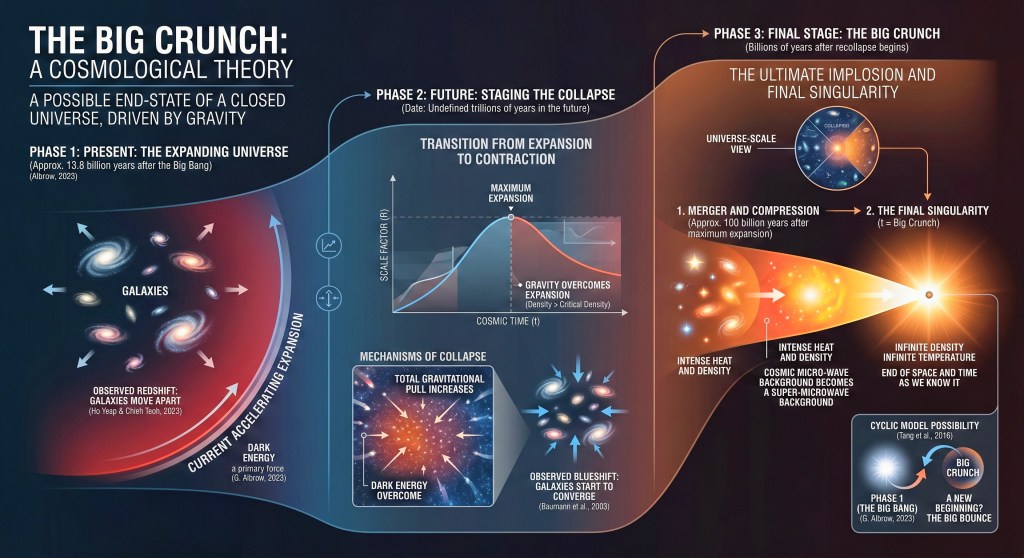
The “Big Crunch” names a class of solutions to Albert Einstein’s field equations of general relativity in which the cosmic expansion that began with the Big Bang eventually reverses and the universe re-collapses, converging asymptotically toward a singular state of arbitrarily high density and temperature. The mathematical foundation was laid by the Russian physicist Alexander Friedmann in 1922, whose equations relating the cosmic scale factor to matter density and curvature admit three classes of solution depending on whether the universe’s average density exceeds, equals, or falls below a critical density (ρ_crit). In an over-dense (closed, k = +1) universe, gravitational attraction eventually overcomes the kinetic expansion; the scale factor reaches a maximum and then contracts, and the contraction phase is, formally, a time-reversal of the expansion. As temperatures rise during collapse, blueshifted background radiation would heat stars to fusion ignition before they merge; in the final moments, the universe approaches a “fireball” of near-infinite temperature in which neither space nor time, in any classical sense, persists. CaltechJodrell Bank Centre for Astrophysics
The discovery in 1998 — through observations of Type Ia supernovae — that cosmic expansion is currently accelerating drove the Big Crunch off the menu of plausible fates for nearly two decades. If the dark energy responsible for that acceleration behaves like a cosmological constant Λ, the universe is destined for asymptotic exponential expansion (“heat death” or, in extreme versions with phantom energy, a “Big Rip”). The Pantheon+ analysis of 1,550 Type Ia supernovae (Brout et al. 2022, ApJ 938, 110) reported a dark-energy equation-of-state parameter w₀ = −0.978⁺⁰·⁰²⁴₋₀·₀₃₁ when combining supernovae with CMB and BAO data, “consistent with a cosmological constant” — leading commentators such as Ethan Siegel to characterize the result as consistent with “a ‘vanilla’ cosmological constant,” and a Big Crunch appeared excluded. Modern Physics
Recent data, however, have reopened the question. The Dark Energy Spectroscopic Instrument (DESI) released its Data Release 1 (Year-1) baryon acoustic oscillation results on April 4, 2024, and unblinded its DR2 (Year-3) results internally in December 2024 before publicly releasing them at the APS Global Physics Summit in Anaheim on March 19, 2025. Per DESI 2024 VI (arXiv:2404.03002), the preference for a time-evolving dark energy equation of state (the w₀w_aCDM model) over a constant Λ stood at “2.6σ for the DESI+CMB combination,” rising to “3.9σ” when the DES-SN5YR supernova sample was added; per the Berkeley Lab DR2 announcement of March 19, 2025, the various combinations of DESI data with CMB, weak-lensing, and supernova datasets now “range from 2.8 to 4.2 sigma.” A controversial 2025 reanalysis of supernova data by Young-Wook Lee’s group at Yonsei University claimed at “99.999 percent confidence” that age-bias correction in standard candles tips the data toward a decelerating, evolving dark energy. George Efstathiou (Institute of Astronomy, Cambridge), in widely reported remarks, judged: “I think that this is just reflecting the messy details of supernovas. The correlation with age is not very tight, so I think it is dangerous to apply a ‘correction’. It looks weak to me.” Most strikingly, in late 2025 Henry Tye (Cornell) published a model invoking an ultralight axion alongside a negative cosmological constant, calculating that the universe will reach maximum expansion in roughly 11 billion years and then collapse, ending in a Big Crunch at a total cosmic age of ~33.3 billion years. Tye’s model is speculative — its margins of error are large and its negative-Λ assumption remains contested — but it illustrates how rapidly the post-DESI landscape has shifted. NOIRLab + 2
The current honest scientific consensus is therefore: heat death remains the most probable fate under a strict ΛCDM model; a Big Rip is possible if dark energy strengthens; and a Big Crunch is once again epistemically live, contingent on whether dark energy is genuinely evolving and whether Λ is, in fact, negative.
1.2 Cyclic and Bouncing Universes
Even where a Big Crunch is unlikely as the final end, the idea of a contracting phase has been incorporated into a family of cyclic and bouncing cosmologies that aim to dissolve the singularity at the apparent beginning by relating it to a prior phase.
The ekpyrotic and cyclic model developed by Paul Steinhardt (Princeton) and Neil Turok (Cambridge) — first proposed in 2001 with Justin Khoury and Burt Ovrut, and formally elaborated in their 2002 papers in Science and on arXiv (hep-th/0111030, hep-th/0111098) — envisions our universe as one in an “endless sequence of cosmic epochs which begin with the Universe expanding from a ‘big bang’ and end with the Universe contracting to a ‘big crunch.’” In their M-theoretic version, the Big Bang is the collision of two parallel four-dimensional branes embedded in a higher-dimensional bulk; the contraction (ekpyrotic) phase smooths and flattens spacetime, generating density perturbations classically rather than through inflation. The name is borrowed from the Stoic ekpyrōsis, the cyclical “conflagration” through which, in Stoic physics, the cosmos dissolves into primordial fire and is reborn — a deliberate philosophical homage. A 2019 reformulation by Anna Ijjas and Steinhardt replaces the singular crunch with a non-singular classical bounce, after which the scale factor grows by an exponential factor in each cycle. arxiv + 3
Roger Penrose’s Conformal Cyclic Cosmology (CCC), popularized in his 2010 Cycles of Time, proposes a different architecture: there is no contraction at all, but rather an infinite succession of aeons, each a Friedmann–Lemaître–Robertson–Walker spacetime, in which the conformally rescaled future timelike infinity of one aeon is identified with the Big Bang singularity of the next. Penrose’s central motivation is the staggering improbability — first published in The Emperor’s New Mind (1989) and reiterated in Cycles of Time — of the low-entropy, low–Weyl-curvature initial state of our universe. Applying the Bekenstein–Hawking entropy formula to the Big Bang singularity, Penrose calculated the relevant volume of phase space at 1 part in 10^(10^123): “In order to produce a universe resembling the one in which we live, the Creator would have to aim for an absurdly tiny volume of the phase space of possible universes, about 1/10^(10^123).” CCC remains contested; the search for predicted “Hawking points” and concentric circles in the cosmic microwave background remains controversial, and major cosmologists (notably Ethan Siegel and others) judge that “the data doesn’t” support CCC over standard inflation. Big Think
Loop quantum cosmology, developed by Abhay Ashtekar, Tomasz Pawłowski, Parampreet Singh, and Martin Bojowald (Pennsylvania State, 2006), replaces the classical Big Bang singularity with a quantum “bounce”: as a contracting predecessor universe approaches Planck-scale density, quantum-gravitational repulsion becomes dominant and the universe rebounds. In Bojowald’s words, certain features of the prior universe are partially preserved across the bounce, while others are quantum-mechanically erased. HandWikiWikipedia
What unites these approaches — for our present interpretive purpose — is a form: cosmic existence understood as bounded, structured episodes, with beginnings and endings related to one another in a principled way.
1.3 The Imagery of “Folding” and Spacetime Contraction
The Arabic verb ṭ-w-y (طوى) — from which the verbal noun ṭayy (طَيّ, “folding”) is derived — denotes the rolling up, folding, or enfolding of something extended, especially the inverse of nashr (نشر, “unfurling, spreading”). In Qurʾanic usage the same root governs Q 39:67, where the heavens are “folded in His right hand” (maṭwiyyātun bi-yamīnih) on the Day of Resurrection. The verse’s imagery is not arbitrary: it is the precise inverse of the cosmogonic verb in Q 21:30, where the heavens and earth were once “a single mass” that God “split asunder” (fa-fataqnāhumā), and the verb pattern in Q 51:47 in which God “expanded” the heaven (innā la-mūsiʿūn), a formulation that several modern Muslim cosmologists (notably Bruno Abd-al-Haqq Guiderdoni and Nidhal Guessoum) treat with appropriate caution as suggestive — not predictive — of cosmic expansion. islamweb + 2
If the cosmogonic act is fatq and tawsīʿ (splitting and expansion), the eschatological act is ṭayy (folding, contraction). The structural inverse is striking. In a Big Crunch scenario, spacetime itself contracts: the cosmic scale factor decreases monotonically toward zero, and what was unfurled in the Big Bang is, mathematically and physically, re-folded. As cosmic inflation in the first 10⁻³² seconds blew up an infinitesimal patch into the observable universe, the time-reversed analogue is a folding of the heavens that returns scale to the Planck regime. The metaphor of the scroll captures something the modern equations also imply: that the apparent vastness of the heavens is, from a sufficiently high vantage, a quantity that can be “contained” — wound up — by the same Power that unfurled it.
This is, of course, resonance, not identity. The Qurʾanic image does not commit to any particular geometry, equation of state, or dark-energy parameter. But the choice of metaphor is theologically and aesthetically apt for a cosmology in which the universe is finite in extent and duration, and in which expansion has a counterpart in contraction.
1.4 “As We Began the First Creation, We Will Repeat It”
The clause kamā badaʾnā awwala khalqin nuʿīduhu introduces a structural symmetry between the universe’s origin and its end. In modern cyclic cosmology, this is precisely the bang–crunch–bang schematic of Steinhardt and Turok and the aeon-to-aeon identification of Penrose: the universe begins as it ends, ends as it begins, and a return to an origin-like state is the precondition for any subsequent phase. Stephen Hawking’s reflection in A Brief History of Time on the symmetry between the “north pole” and “south pole” of cosmic time in the no-boundary proposal voices the same intuition in a different idiom: beginning and end are formally analogous limit-points of a single, finite, self-contained spacetime.
Again, restraint is warranted. The Qurʾanic iʿāda (repetition, return) is not a brute oscillation of matter but the resurrection (al-baʿth) of moral agents for judgment. Yet the form — origin and end as structurally linked, not as accidentally juxtaposed — is shared.
II. Philosophical Commentary: Time, Repetition, and the Modality of Divine Promise
2.1 Cyclical Time, Linear Time, and the Abrahamic Eschaton
The history of philosophical reflection on cosmic time may be schematized — admittedly with some violence to its complexity — as a contest between two intuitions. The cyclical intuition, dominant among the pre-Socratics (Heraclitus, Empedocles, Pythagoras), the Stoics, several Hindu and Buddhist traditions, and the Vedic yuga doctrine, holds that time is structured by recurrence: cosmic events repeat, whether identically or analogically, in great cycles. The linear intuition, articulated most decisively in the prophetic traditions of Judaism, Christianity, and Islam, holds that time is structured by an irreversible movement from creation through providence to a single, decisive consummation.
Qurʾan 21:104 occupies an interesting position in this typology. Its imagery of folding and re-creation might appear cyclical, and the language of iʿāda (“repetition”) could be read in that direction. The classical exegetical tradition, however, was unanimous in resisting any such reading. Fakhr al-Dīn al-Rāzī (d. 1210), in his Mafātīḥ al-Ghayb, treats the verse as decisive evidence for one specific eschatological doctrine: that resurrection involves re-existentiation after sheer non-existence (al-wujūd baʿd al-ʿadam), not merely the recomposition of dispersed parts. The “repetition,” for al-Rāzī, is modally like the first creation — origination from nothing — but it is not a cyclical return to an indistinguishable prior state. The arrow of moral time runs in one direction: deeds are done, recorded, and judged. Internet Archive
2.2 Eternal Recurrence: Stoic Ekpyrōsis and Nietzsche
The most rigorous Western philosophical articulations of cyclicality are the Stoic doctrine of ekpyrōsis and Friedrich Nietzsche’s eternal recurrence. The Stoics held that the cosmos periodically dissolves into primordial fire and is reborn identically — a doctrine deliberately invoked by Steinhardt in naming the “ekpyrotic” model. Nietzsche, in The Gay Science §341 and Thus Spoke Zarathustra, posed the eternal return as a thought-experiment of existential weight: “if a demon were to creep after you” with the news that you must live this life “innumerable times again,” would you affirm it or be crushed by it? Whether Nietzsche held the doctrine cosmologically (as some later notes in Will to Power suggest) or only existentially is contested; what is clear is that he distinguished his version from the “simplistic” cyclicality of the dwarf in Zarathustra by foregrounding the burden and the affirmation of each moment. Wikipedia + 2
Qurʾanic eschatology shares with Nietzsche’s doctrine a moral seriousness about the singular act and its eternal weight, but it inverts the structure. For Nietzsche, the test of value is whether one would affirm the recurrence of one’s life; for the Qurʾan, the test is whether one would affirm one’s deeds before God on a single, irreversible Day. The eternity in question is not the eternity of return but the eternity of consequence. The “repetition” of Q 21:104, on the classical reading, is not the repetition of the same life, but the renewed creation of the same person for the disclosure of what they have done.
2.3 The Phenomenology of Folding
What does it mean ontologically to “fold” the sky? The Qurʾanic figure invites a phenomenological reflection. To fold a scroll is to take what is extended and, through a single act, render it compact without destroying it. Folding presupposes that what is folded was already structured — written upon, inscribed — and that the act of folding contains the inscription rather than abolishing it. Two implications follow.
First, the cosmos in this image is not an empty stage but an inscribed surface. Its history is the writing; its dissolution is the closing of the scroll, not the erasure of what was written. The sky is folded, the deeds remain. This corresponds precisely to the broader Qurʾanic doctrine that everything done in this life is recorded and preserved (the kitāb of deeds), a doctrine reinforced by the polysemy of the verse itself: the scroll-image of the heavens is also the scroll-image of every individual’s deed-record.
Second, folding presupposes an Agent capable of transcending the dimensionality of what is folded. A two-dimensional scroll requires a three-dimensional folder. By analogy, folding a four-dimensional spacetime requires an Agent who is not Himself contained within that spacetime. The image therefore quietly asserts what classical Islamic theology (kalām) explicitly affirms: God’s transcendence of (tanzīh over) the cosmos He creates and dissolves.
2.4 Beginnings, Endings, and Their Antinomies
That the cosmos has a beginning and an end is an assertion philosophically familiar, but also philosophically vexed. Aristotle, in De Caelo and Physics VIII, argued that the cosmos is eternal both in past and future; an absolute beginning of motion or time was, for him, incoherent. Thomas Aquinas, in De Aeternitate Mundi and Summa Theologiae I, q.46, a.2, accepted the doctrine of creation in time on the authority of revelation but held — against both Bonaventure and the rationalist defenders of eternity — that neither the eternity nor the temporal beginning of the world could be demonstrated by reason alone. Immanuel Kant, in the First Antinomy of Critique of Pure Reason (A426/B454), formalized the impasse: pure reason, applied beyond possible experience to the cosmos as totality, produces equally compelling proofs of both a beginning and a beginning-less past, demonstrating only the limits of theoretical reason. Wikipedia + 2
Modern cosmology has not dissolved the antinomy so much as displaced it. The classical Big Bang singularity — proven by the Penrose–Hawking theorems under certain energy conditions — gives the universe a beginning within general relativity, but quantum gravity, eternal inflation, and bounce cosmologies all reopen the question of whether that “beginning” is absolute or merely the boundary of one phase. Qurʾan 21:104, by contrast, requires neither absolute beginning of time as such nor absolute beginning of physical process; it requires only that this creation (hādhā al-khalq, “this creation”) had a beginning and will have an end, and that both are acts of the same God. The verse is therefore compatible with a wide spectrum of cosmological hypotheses, including some that postulate prior phases or quantum bounces. What it excludes is not a multiverse or a prior aeon but the metaphysical thesis that the cosmos is self-grounded and self-terminating.
2.5 Numerical Identity and Qualitative Recurrence
A perennial problem in eschatology: when “the same person” is resurrected, in what sense is it the same? Bishop Joseph Butler’s Analogy of Religion and Locke’s discussions of personal identity raise the issue, and contemporary metaphysics (Derek Parfit) has sharpened it. Al-Rāzī, anticipating the problem, insists that the resurrection is iʿāda of the same soul-body composite by the very person’s identity (bi-ʿaynih), not a mere qualitative duplicate. The Muʿtazilī Zamakhsharī, in his al-Kashshāf, glosses the cosmological version of the problem more rhetorically: the iʿāda is “likened to the ibtidāʾ” in being origination from non-existence (ījāduhu min al-ʿadam). This is what philosophers would later call strict numerical identity recovered after annihilation — a position defensible only if one accepts a metaphysics in which a singular divine act can re-instantiate the very same individual, not a copy. islamweb
2.6 The Modality of “A Promise Binding Upon Us”
The phrase waʿdan ʿalaynā (“a promise binding upon Us”) is among the most theologically dense in the Qurʾan. Its modal force is acute. A promise from God is not a mere prediction; it is, in classical Islamic theology, a self-imposed obligation — one that He freely undertakes and which His own truthfulness (ṣidq) and faithfulness (wafāʾ) guarantee. Al-Zamakhsharī’s grammatical analysis, preserved in al-Rāzī’s Mafātīḥ al-Ghayb (vol. 22), treats waʿdan as a maṣdar muʾakkid (an emphatic verbal noun), with ʿalā carrying the sense of wujūb — obligation. Al-Zajjāj, quoted by al-Qurṭubī, glosses the closing emphasis innā kunnā fāʿilīn as “innā kunnā qādirīna ʿalā mā nashāʾ” — “We have ever been Powerful over what We will.” Together, these clauses establish what philosophers would call a modal necessity of the eschaton: it must occur, not because of metaphysical compulsion external to God, but because of the joint operation of His omnipotence (it can occur) and His self-binding fidelity (it will occur). islamweb + 2
This is the inverse of the Aristotelian unmoved mover, who acts by attracting rather than promising. It is also distinct from a Calvinist absolute decree, since the binding is promissory — an act of self-disclosure to the creature. Leibniz’s distinction between truths of reason and truths of fact is illuminating: the eschaton is, on this Qurʾanic logic, a truth of fact made certain by a truth of divine character.
III. Theological Commentary: The Eschaton, the Scroll, and the Tradition
3.1 Context within Sūrat al-Anbiyāʾ
Sūrat al-Anbiyāʾ (“The Prophets”) is the 21st chapter of the Qurʾan, comprising 112 verses, classified as Meccan and dated by classical and modern scholars to the third Meccan period — a phase of intense polemic with Quraysh leaders over the doctrines of tawḥīd (divine unity), prophethood, and the Hereafter. Its name derives from the catalogue of sixteen to eighteen prophets in vv. 48–91. The sūra exhibits a tripartite ring structure, opening (vv. 1–47) with warnings about the imminence of the Day of Judgment and human heedlessness, narrating prophetic histories at the center, and closing (vv. 92–112) with an eschatological crescendo. Verse 104 stands near this crescendo: it is the cosmic frame within which final judgment occurs.
Two cosmologically rich verses earlier in the sūra are essential context. Q 21:30 — “Have those who disbelieved not considered that the heavens and the earth were a joined entity (ratqan), and We separated them (fa-fataqnāhumā), and made from water every living thing?” — provides the cosmogonic image that v. 104 inverts. Q 21:33 mentions the orbits in which the sun and moon “swim” (yasbaḥūn). The chapter thus brackets prophethood within a cosmic narrative: a heaven that was unfolded will be folded; a creation that was begun will be ended.
3.2 The Classical Tafsīr Tradition on Q 21:104
The interpretive tradition on this verse is unusually rich, and a serious commentary must draw on its key voices.
Al-Ṭabarī (d. 923) in Jāmiʿ al-Bayān reports three views on the meaning of al-sijill: an angel charged with the records (narrated from Ibn ʿUmar via Abū al-Wafāʾ al-Ashjaʿī, and from al-Suddī via Sufyān); a scribe of the Prophet ﷺ (from Ibn ʿAbbās via Abū al-Jawzāʾ); and a written sheet (al-ṣaḥīfa), narrated from Ibn ʿAbbās via ʿAlī b. Abī Ṭalḥa, and from Mujāhid through two chains. Al-Ṭabarī decisively prefers the third: “The most correct view, in our judgment, is that al-sijill here means the ṣaḥīfa, because that is what is recognized in the speech of the Arabs (al-maʿrūf fī kalām al-ʿArab); no scribe of our Prophet ﷺ is known to have been called al-Sijill, nor is there among the angels one of that name.” On the qira’āt, he prefers the singular li’l-kitāb over the plural li’l-kutub, since the meaning concerns “what is written upon” the single scroll. He also reports the alternative gloss attributed to Ibn ʿAbbās via Muḥammad b. Saʿd: “nuhliku kulla shayʾin wa-nufnīhi kamā kāna awwala marra” — “We annihilate everything and reduce it to non-existence as it was at first” — a reading with explicit ex nihilo eschatological force. ksu + 5
Al-Zamakhsharī (d. 1144) in al-Kashshāf — quoted in al-Rāzī and preserved in al-Wāḥidī’s al-Wasīṭ — gives the verse its classic rhetorical analysis. “Awwala khalqin is the object of nuʿīdu; the kāf is restrained by mā; the meaning is: We will repeat the first creation just as We began it, likening the repetition to the origination (tashbīhan li’l-iʿāda bi’l-ibtidāʾ).” On the rhetorical force he writes: “Its origin was its bringing-into-being from non-existence (ījāduhu min al-ʿadam); just as He brought it into being first out of non-existence.” He treats kaṭayyi al-sijilli as iḍāfat al-maṣdar ilā al-mafʿūl (the verbal noun governing its object), with the agent elided: “as the rolling-up by the roller of the scroll.” On waʿdan ʿalaynā: a maṣdar muʾakkid in which ʿalā carries the sense of wujūb / ījāb — an obligation God imposes upon Himself. islamweb + 2
Al-Rāzī (d. 1210) in Mafātīḥ al-Ghayb (vol. 22, pp. 197–199) develops the most philosophically ambitious commentary. He notes the variant reading yawma tuṭwā al-samāʾu (passive) and three vocalizations of al-sijill. Most importantly, he reads the verse as decisive evidence in the kalām dispute over the modality of resurrection. “Some held that God disperses the parts of bodies (yufarriqu ajzāʾa al-ajsām) without annihilating them, then re-composes them — that is the iʿāda. Others held that He annihilates them entirely (yuʿdimuhā bi’l-kulliyya) then re-existentiates them by their very identity. This verse indicates the second view, because He has likened the iʿāda to the ibtidāʾ; and since the ibtidāʾ is not a recomposition of dispersed parts but existence after sheer non-existence, the iʿāda must be likewise.” This reading, distinctive to al-Rāzī, is what gives the verse its full ontological weight. islamweb
Al-Qurṭubī (d. 1273) in al-Jāmiʿ li-Aḥkām al-Qurʾan catalogues four views on sijill and, importantly, identifies two senses of al-ṭayy itself: (i) al-darj — rolling up, the opposite of unfurling, as in Q 39:67; and (ii) “al-ikhfāʾ wa’l-taʿmiya wa’l-maḥw — concealment, effacement, obliteration; for God effaces and erases their traces and dims their stars,” citing Q 81:1–11 (idhā al-shamsu kuwwirat). On kamā badaʾnā he reports both the resurrection-anthropological reading (humanity raised “naked, barefoot, uncircumcised” — ḥufātan ʿurātan ghurlan, citing the famous hadith of Ibn ʿAbbās in Bukhārī and Muslim) and the cosmological reading from Ibn ʿAbbās: “We annihilate everything as it was at first,” then connecting this clause to yawma naṭwī: He folds the heaven, returning it to halāk and fanāʾ. IslamWebSurah Quran
Ibn Kathīr (d. 1373) synthesizes the tradition, preferring Ibn ʿAbbās’s view (per ʿAlī b. Abī Ṭalḥa) that sijill is the scroll/record itself. He cites the powerful tradition of Ibn ʿAbbās preserved in Ibn Abī Ḥātim: “God folds the seven heavens with all the creation in them, and the seven earths with all the creation in them, folding all of that with His right hand, and it is in His hand like a mustard seed (khardala).” He links the verse decisively with the Bukhārī hadith from Ibn ʿUmar: “On the Day of Resurrection, Allah will seize the earths and the heavens will be in His right hand” (Ṣaḥīḥ al-Bukhārī, Tafsīr of Q 39:67). QuranX + 3
The modern commentator Muḥammad al-Ṭāhir Ibn ʿĀshūr (d. 1973) in al-Taḥrīr wa’l-Tanwīr offers a notable refinement: “The verse contains no proof of the annihilation of the heavens but only of the disordering of their system (ikhtilāl niẓāmihā)” — an interpretation he relates to ancient philosophical views (Anaximenes, Pythagoras, Plato) on the heavens’ eventual dissolution. Ibn ʿĀshūr’s reading is striking for its proto-cosmological tenor.
3.3 The Resurrection (al-Baʿth) and the Day of Judgment (Yawm al-Qiyāmah)
Resurrection is among the six articles of Islamic faith and is denied only at the cost of leaving the religion. Q 21:104 is one of its principal scriptural anchors. The hadith preserved by Imām Aḥmad and the two Ṣaḥīḥs, transmitted through Ibn ʿAbbās, places the verse on the Prophet’s own lips as he exhorted his companions: “Innakum maḥshūrūna ilā Allāh ḥufātan ʿurātan ghurlan, kamā badaʾnā awwala khalqin nuʿīduhu, waʿdan ʿalaynā, innā kunnā fāʿilīn” — “You will be gathered before God barefoot, naked, and uncircumcised. As We began the first creation, We will repeat it…” The Prophet’s recitation establishes the verse’s primary referent as bodily, individual resurrection. The cosmic folding and the personal resurrection are one event: the very act that closes the scroll of the heavens opens the scroll of every soul. ksu + 2
3.4 Parallel Verses and Inner-Qurʾanic Resonance
Several verses sharpen the meaning of Q 21:104:
- Q 39:67: “And on the Day of Resurrection the whole earth will be in His grip, and the heavens folded in His right hand (wa’l-samāwātu maṭwiyyātun bi-yamīnih).” Same root ṭ-w-y; same eschatological referent. IslamWeb +2
- Q 30:11: “Allāh yabdaʾu al-khalqa thumma yuʿīduh thumma ilayhi turjaʿūn” — “God begins creation, then He repeats it, then to Him you will be returned.” A direct parallel to the central clause of 21:104. Quranic Arabic Corpus
- Q 10:4: “Innahu yabdaʾu al-khalqa thumma yuʿīduhu li-yajziya alladhīna āmanū…” — links iʿāda explicitly to recompense.
- Q 81:1–14: the dramatic eschatological tableau (sun wrapped up, stars scattered, mountains moved) that al-Qurṭubī invokes to interpret ṭayy as ikhfāʾ (effacement).
- Q 14:48: “Yawma tubaddalu al-arḍu ghayra al-arḍ” — the earth replaced by another earth, suggesting transformation rather than mere annihilation.
3.5 The Linguistic Field of Q 21:104
A precise reading depends on five key terms.
- Ṭ-w-y / ṭayy (طَيّ): Folding, rolling up, the antonym of nashr (spreading). Used both for physical scrolls and, metaphorically, for the closing of an account or the traversal (ṭayy al-arḍ) of a distance.
- Samāʾ (سماء): “Heaven” or “sky,” a feminine collective noun used in the Qurʾan both for the visible firmament and, in plural, for the seven heavens (al-samāwāt al-sabʿ). Its semantic range encompasses what modern science would call the cosmos as observable canopy.
- Sijill (سِجِلّ): A scroll or written record. Linguistically, the term is a loanword: most likely from Byzantine Greek sigíllion (σιγίλλιον), itself from Latin sigillum (“little seal”), via Aramaic/Syriac into seventh-century Arabic. Its appearance in Q 21:104 is its sole Qurʾanic occurrence. In post-Qurʾanic Arabic, sijill came to mean a judicial register or a caliphal diploma; the Egyptian papyri and Syriac sources show its currency in late-antique chancery practice. Its semantic richness — a sealed, authoritative, official document — is theologically significant.
- Kamā badaʾnā (كَمَا بَدَأْنَا): “As We began.” The particle kāf governs a similitude; badaʾnā is first-person plural perfect of bdʾ (initiation, beginning). The grammatical force, per al-Zamakhsharī, is that the iʿāda is structurally analogous to the ibtidāʾ.
- Nuʿīduhu (نُّعِيدُهُ): “We will repeat it” / “We will return it” / “We will bring it back,” from the root ʿ-w-d, denoting return and repetition. The pronoun -hu refers most naturally to khalq (creation) — “we will bring [the creation] back.”
3.6 The Concept of Divine Promise (Waʿd)
In Qurʾanic theology, waʿd is a technical term: a promise that God freely makes and that, by virtue of His perfections, He cannot break. Al-Qurṭubī, drawing on the broader Qurʾanic field (Q 2:177, Q 9:111, Q 39:74), distinguishes the waʿd of God — which is ḥaqq (truth) — from the waʿd of Satan, which is ghurūr (delusion, Q 4:120). The Prophet identified breaking a promise as one of the three signs of the hypocrite (Bukhārī); the waʿd of God is the asymptotic counter-image. In v. 104, the formula waʿdan ʿalaynā — “a promise [that is] upon Us” — is grammatically arresting: it places the obligation upon God Himself. He has bound Himself, and the cosmos is the field of His self-binding.
3.7 Comparative Eschatology: Christian and Jewish Parallels
The image of the heavens being rolled up like a scroll is not unique to the Qurʾan. Isaiah 34:4: “All the host of heaven shall rot away, and the skies roll up like a scroll.” Revelation 6:14: “The sky vanished like a scroll that is being rolled up, and every mountain and island was removed from its place.” Hebrews 1:10–12, citing Psalm 102: “Like a robe you will roll them up.” The Qurʾanic image stands within a recognizable late-antique apocalyptic semantic field. What is distinctive to Q 21:104 is the explicit linkage of the cosmic folding with the re-creation of the cosmos and the binding character of the divine promise. BibleRef.com
In Jewish eschatology, the concept of ʿolam ha-ba (העולם הבא, “the world to come”) names the post-resurrection, perfected order. While ʿolam ha-ba does not appear in the Hebrew Bible and rabbinic opinions vary on its precise nature — Maimonides distinguishing it from the messianic age, Nachmanides identifying it with bodily resurrection — there is broad agreement that the world to come is preceded by a transformation of the cosmic order (tikkun ʿolam), and that it involves divine fidelity to a prior promise. The Qurʾanic iʿāda and the rabbinic ʿolam ha-ba are not equivalent, but they share a structural commitment: the cosmos is not simply terminated but rendered new. WikipediaMy Jewish Learning
3.8 Modern Muslim Engagements with Cosmology
The modern Muslim engagement with Big Bang cosmology and its possible end-states displays a wide spectrum.
At one pole, Maurice Bucaille (d. 1998), a French gastroenterologist whose 1976 La Bible, le Coran et la science launched a global vogue for “scientific miracles” exegesis, treated verses like Q 21:30 (the “joining and separation” of heavens and earth) and Q 51:47 (the “expansion”) as anticipatory of modern cosmological discoveries. Zaghloul El-Naggar (1933–2025), the Egyptian geologist who chaired the Committee of Scientific Notions in the Qurʾan, became known as the “Pioneer of Scientific Miracles,” authoring 45 books and over 150 articles arguing that the Qurʾan “encoded scientific foreknowledge” of phenomena later confirmed by science. Wikipedia + 3
At the other pole, Nidhal Guessoum (American University of Sharjah) in Islam’s Quantum Question: Reconciling Muslim Tradition and Modern Science (2011) and Bruno Abd-al-Haqq Guiderdoni (Director of the Observatory of Lyon, Director of the Islamic Institute for Advanced Studies in Paris) advocate a more disciplined approach. Guessoum argues for a theistic Islamic cosmology grounded in Ibn Rushd’s “double-truth” principle — that revelation and reason cannot truly contradict — while explicitly rejecting “pseudo-scientific exegesis” that claims to find specific scientific findings encrypted in Qurʾanic verses. Guiderdoni, an astrophysicist specializing in galaxy formation and a French convert to Islam, has consistently insisted that the Qurʾan is not a textbook of physics but a guide to spiritual reality, and that the proper Muslim engagement with cosmology lies in meditation upon (tafakkur) the signs (āyāt) of creation rather than scientific prediction. His position, articulated in lectures at Harvard (the 2008 Paul Tillich Lecture) and the University of St Andrews, exemplifies a chastened concordism. ResearchGate + 2
The position taken in this commentary aligns with Guessoum and Guiderdoni: Q 21:104 should not be read as “predicting” the Big Crunch. The verse predates Friedmann by thirteen centuries and operates in a different register — eschatological and moral — than do cosmological models. What is appropriate is to note the resonance: the verse and modern Big Crunch / cyclic cosmologies converge on a structural form (finite cosmos, structural symmetry between origin and end, an Agent-or-mechanism that effects both) without thereby being reducible to one another.
3.9 Divine Action and Physical Law
Classical Islamic theology, especially in its Ashʿarī formulation, denied genuine causal efficacy to created things and held that God is the immediate cause of every event (occasionalism). The Muʿtazila (including al-Zamakhsharī) and the philosophers (al-Fārābī, Ibn Sīnā, Ibn Rushd) gave more autonomy to secondary causes. Either way, however, the cosmic folding of Q 21:104 is uncontroversially direct divine action. Even if expansion and contraction proceed through Friedmann dynamics — even if a Big Crunch is a perfectly natural consequence of a negative cosmological constant operating on Einstein’s equations — the ṭayy is, theologically, what God does through those equations. The natural and the divine are not competitors; the equations are the syntax of a sentence whose semantics is divine.
IV. Thematic Epilogue: The Unity of Origin and End
Three lenses, focused on a single verse, reveal a single insight in three idioms.
The scientific lens reveals that the universe of contemporary cosmology is — perhaps for the first time since the 1990s — once again open to the possibility that its expansion is not eternal. The DESI DR1 (April 2024) and DR2 (March 2025) results, the Yonsei reanalysis, and Tye’s negative-cosmological-constant model do not establish the Big Crunch, but they have restored it as a serious possibility in a way the Pantheon+ data alone would not have. Independently, cyclic and bounce cosmologies — Steinhardt and Turok’s ekpyrotic model, Penrose’s CCC, Bojowald’s loop-quantum cosmology — have consolidated the philosophical insight that whatever happens to our phase, the universe may have a structured, repeating architecture in which beginnings and endings are formally correlated. The Qurʾanic ṭayy — the folding of the heavens — finds a striking metaphorical resonance in the time-reversed scale-factor of a contracting universe, and the clause kamā badaʾnā awwala khalqin nuʿīduhu echoes the bang–crunch–bang schematic in a register utterly unfamiliar to the seventh century.
The philosophical lens reveals that the great antinomies — eternity versus beginning, cyclicity versus linearity, identity versus recurrence — remain unresolved at the speculative level, and that the Qurʾanic verse navigates them with surprising precision. It commits to neither cyclicity (since the iʿāda is moral resurrection, not Stoic ekpyrōsis) nor to a Kantian-style demonstrable absolute beginning (since it speaks of this creation being repeated). It pivots on the modality of promise: the certainty of the eschaton is grounded not in physical necessity but in divine self-binding. The cosmos is not a clock running down; it is a story whose author has bound Himself to its ending.
The theological lens reveals, finally, that the verse is precisely not primarily a cosmological statement. Its purpose, in the rhetorical ecology of Sūrat al-Anbiyāʾ, is to confront seventh-century Meccans (and, by extension, every reader) with the inevitability of accountability. Al-Rāzī’s reading — that iʿāda is re-existentiation after sheer non-existence — and al-Qurṭubī’s gloss of ṭayy as both “folding” and “effacement” together establish that the cosmic event is the frame for the moral event. The heavens are folded so that the deeds may be unrolled. The scroll of the sky is closed; the scrolls of human lives are opened. Ibn ʿAbbās’s tradition of God folding the heavens “like a mustard seed” in His right hand — preserved by Bukhārī and Ibn Abī Ḥātim — is the iconographic counterpart to the modern image of the universe collapsing to a Planck-scale point: a vast totality, in the end, contained. Quran IslamIslamWeb
What remains, after the science is honestly assessed, after the philosophy is rigorously parsed, and after the theology is reverently read, is the convergence of all three on a single proposition: the cosmos has a beginning and an end, and the beginning and the end are intelligible together. Whether this intelligibility is the brute fact of a dark-energy parameter, the structural elegance of a cyclic model, or the binding promise of a personal God is a question on which natural science alone cannot adjudicate. But that the cosmos is such as to invite the question — that it is a scroll, written on, foldable — is itself a remarkable feature of our universe, one that revelation and cosmology, in their distinct vocabularies, both name.
The Qurʾanic verse closes with a verb whose force is decisive: innā kunnā fāʿilīn — “Indeed, We have ever been Doers.” The grammatical perfect, applied to a future event, fuses the eschatological with the eternal: the folding has, in some sense, already been performed in the divine knowledge and will. Modern cosmology, in whatever direction its data eventually settle, will describe how. The verse names Whom, and why: a promise binding upon Us. Indeed, We will do it.





 The Glorious Quran and Science
Leave a comment