
Presented by Zia H Shah MD
Audio teaser: Relativity and Biology in Surah As-Sajdah
Abstract
Surah As-Sajdah, the thirty-second chapter of the Glorious Quran, represents a pivotal discourse within the Meccan corpus, systematically addressing the fundamental tenets of Islamic theology—monotheism (Tawhid), the validity of divine revelation (Risalah), and the certainty of the afterlife (Akhirah). Revealed during the middle Meccan period, this Surah functions as both a rebuttal to the intellectual skepticism of the Quraysh and a profound invitation to contemplate the teleological underpinnings of the universe. This report provides an exhaustive, verse-by-verse commentary that synthesizes classical exegetical frameworks—drawing from the transmitted traditions of Ibn Kathir, Al-Tabari, and Al-Jalalayn—with the contemporary socio-political and psychological insights of scholars such as Sayyid Qutb and Mufti Shafi Usmani. The analysis explores the Surah’s unique integration of cosmic phenomena, human embryology, and historical phenomenology to establish a narrative of total submission to the Divine. Particular emphasis is placed on the concept of Tadbir (Divine Governance), the metaphysical significance of the human spirit (Ruh), and the ethical distinctions between the humble believer and the arrogant transgressor. By examining the Surah’s rhythmic structure and thematic transitions, the report elucidates how the Quran builds an inescapable argument for accountability, presenting the act of prostration (Sajdah) not merely as a physical posture, but as the ultimate intellectual and spiritual realization of man’s position within the created order.
Introduction to the Meccan Context and Thematic Structure
Surah As-Sajdah is predominantly classified as a Meccan surah, revealed during a period when the Prophet Muhammad (PBUH) and his followers faced intense intellectual and psychological resistance from the polytheistic elite of Makkah. Chronologically situated as the 75th revelation according to some traditions, it reflects a stage where the core theological battles of Islam were being fought not through legislation, but through the clarification of existential realities. The naming of the Surah—variously referred to as As-Sajdah (The Prostration), Alif Lam Mim Tanzil (The Revelation), or Surat al-Maḍājiʿ (The Surah of the Beds)—highlights its central motifs: the authority of the Word, the physical submission of the believer, and the private devotion of the night.
The internal structure of the Surah is characterized by a binary rhetorical strategy. It contrasts the vastness of the heavens with the microscopic origin of man, and the eternal delights of the believers with the perpetual regret of the disbelievers. Classical commentators often emphasize the linguistic precision of the text, while contemporary scholars focus on its “emotional intelligence” and ability to address the “perplexed modern society” seeking meaning amidst materialism.
| Feature | Detailed Description |
|---|---|
| Arabic Name | سورة السجدة (Surat as-Sajdah) |
| Meaning | “The Prostration” – referring to Verse 15 |
| Total Verses | 30 Verses (divided into 3 Rukus) |
| Revelation Period | Mid-Meccan; specifically addressing the crystallized opposition of the Quraysh |
| Prophetic Tradition | Recited during the Friday morning prayer (Fajr) and before sleep |
| Key Theological Clusters | Authority of Revelation (1-3); Cosmic/Human Creation (4-9); Resurrection Rebuttal (10-14); Qualities of Faith (15-17) |
Commentary on Verses 1–3: The Ontological Status of the Quran
Verse 1: The Mystery of the Disjointed Letters
The Surah opens with the abbreviated letters Alif. Lam. Mim. These Huroof Muqatta’at are a recurring feature in the Quran, appearing at the beginning of 29 chapters. Classical exegesis, such as that of Al-Jalalayn, often categorizes these as allegorical (Mutashabihat), whose ultimate meaning is reserved for Allah alone. However, within the context of Meccan rhetoric, contemporary scholars like Mufti Shafi Usmani and Sayyid Qutb interpret them as a linguistic challenge to the Arabs. By utilizing the very building blocks of the Arabic language, the Quran signals that while its materials are humanly accessible, its composition and divine authority remain beyond human replication.
Verse 2: The Assertion of Divine Origin
The text proceeds to declare that “the revelation of the Book in which there is no doubt, is from the Lord of all that exists”. This verse establishes the ontological status of the Quran as Tanzil—a sending down or descent from the Divine realm. The phrase “no doubt” (la rayba fih) is not merely a description but a foundational principle. Classical commentary suggests this means that the Quran’s source is so evident through its content and the character of the messenger that any doubt regarding its origin is a reflection of the perceiver’s spiritual blindness rather than any ambiguity in the text itself.
Verse 3: Refuting the Charge of Fabrication
The third verse addresses the specific socio-historical conflict of the time: the accusation by the Meccan elite that the Prophet had “forged” or “fabricated” the text. The Quran seizes control of this narrative by asserting that the book is the absolute Truth (al-Haqq) sent to warn a people—the Arabs—to whom no warner had come before. Mufti Shafi Usmani clarifies that while the call to monotheism reached all nations through the deputies of earlier prophets, the Arabs had been in a state of Fatrah (prophetic interval), necessitating a direct and definitive warner to guide them back to the path of their ancestor Abraham. The transition from the cosmic “Lord of the Worlds” in Verse 2 to the specific “warn a people” in Verse 3 demonstrates the Quran’s ability to move from universal sovereignty to localized pedagogical intervention.
Commentary on Verses 4–6: Cosmic Architecture and Divine Tadbir
Verse 4: The Six Days of Creation and the Throne
Verse 4 provides a foundational cosmological statement: “It is Allah who created the heavens and the earth and whatever is between them in six days; then He established Himself above the Throne”. Classical exegesis, particularly that of Ibn Kathir, cautions against anthropomorphic interpretations of the “Throne” (Arsh), viewing it instead as the apex of creation and the seat of Divine authority.
Contemporary analysis has taken a profound interest in the “six days” mentioned. Scholars like Sayyid Qutb argue that these “days” are not 24-hour solar cycles, as the earth and sun were themselves results of this process, but rather immense epochs or stages of creation known only to God. This verse forces the Meccan audience—who held a tribal and localized concept of authority—to confront a Sovereign who governs the entire cosmic expanse. The reminder that there is “no protector or intercessor” besides Him serves as a direct challenge to the polytheistic belief in intermediary deities.
Verse 5: Divine Governance and Temporal Relativity
In Verse 5, the Quran introduces the complex concept of Tadbir: “He arranges [each] matter from the heaven to the earth; then it will ascend to Him in a Day, the measure of which is a thousand years of what you count”. This verse describes a systematic, two-way management of the universe. Contemporary researchers in Islamic management have identified this as a strategic planning model: the descent of commands (Tanzil) followed by the ascent of deeds and reports (Uruj) for evaluation.
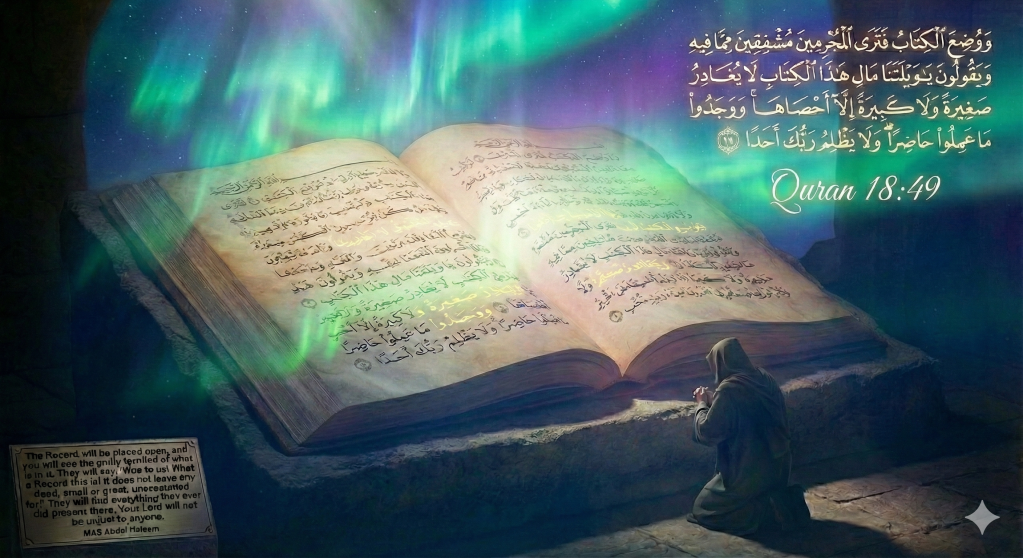
The temporal relativity expressed here is scientifically and philosophically significant. The distance covered by an angelic command in one Divine “Day” is equivalent to 1,000 human years. Classical commentators like Mujahid and Qatadah interpreted this as the speed of angelic movement, covering vast distances in the “blink of an eye”. Contemporary readers often view this through the lens of relativity, recognizing that the Divine perception of time operates on a scale vastly different from human experience.
| Concept | Exegetical Implication |
|---|---|
| Tadbir | The meticulous arrangement and governance of all affairs from the celestial to the terrestrial. |
| Uruj | The return or ascent of all matters back to the Creator for ultimate judgment. |
| Temporal Scale | One Divine day = 1,000 years of human reckoning; signifies the immense scale of Divine activity. |
Verse 6: The Synthesis of Knowledge, Power, and Mercy
Verse 6 serves as a thematic bridge, identifying the Author of this cosmic order as “the Knower of the unseen and the seen, the All-Mighty, the Most Merciful”. Ibn Kathir observes that this combination of attributes—Might (Izzah) and Mercy (Rahmah)—represents the perfection of governance. A sovereign who is purely mighty may be a tyrant, while one who is purely merciful might be weak; Allah is “Almighty in His mercy and Most Merciful in His might,” ensuring that His control of the universe is tempered by compassion for His creation.
Commentary on Verses 7–9: The Excellence and Evolution of the Human Form
Verse 7: The Perfection of the Created Order
The discourse shifts from the macrocosm to the microcosm in Verse 7, stating that God “perfected everything which He created” and “began the creation of man from clay”. Classical commentary clarifies that “perfection” here does not mean that every individual creature is “perfect” in a human aesthetic sense, but that every creation is perfectly designed to fulfill its intended purpose within the cosmic system.
Mufti Shafi Usmani explores the psychological dimension of this “excellence,” noting that even things perceived as “bad” (like anger, scorpions, or disease) have a beauty in their fundamental creation (takwin) because they serve essential functions—anger can defend justice, and disease can test and purify the soul. The mention of “clay” (tin) as the origin of man serves as a grounding reality, reminding the status-conscious Meccan elite of their humble terrestrial foundations.
Verse 8: The Biological Journey of Progeny
Verse 8 transitions from the unique creation of the first man to the biological reproduction of his descendants: “Then He made his offspring from semen of despised water”. The use of the term “despised fluid” (ma’in mahin) is a rhetorical device intended to instill humility. It highlights the paradox of human existence: a creature with the potential for great intellect and spiritual height originated from a fluid that is physically unremarkable and often viewed with disdain.
Verse 9: The Divine Breath and the Endowment of Senses
The climax of the human creation narrative occurs in Verse 9: “Then He fashioned him in due proportion, and breathed into him the soul; and He gave you hearing, sight and the sense of deduction”. Sayyid Qutb argues that the “breathing of the soul” (Ruh) is the defining moment that distinguishes humans from other biological entities, granting them a noble lineage and a mission as Divine vicegerents on earth.
The sequence of sensory endowments is also significant:
- Hearing (Sam’): Traditionally viewed as the primary faculty for receiving revelation.
- Sight (Absar): The faculty for observing the signs (Ayat) of the physical world.
- Hearts/Intellect (Af’idah): The faculty of synthesis and spiritual deduction.
The verse ends with a sharp critique: “Little is the thanks you give!”. This highlights the central tragedy of the human condition in the Quranic view: the possession of immense Divine gifts coupled with a chronic failure to recognize the Giver.
Commentary on Verses 10–14: Rejection, Death, and the Inevitability of Judgment
Verse 10: The Skepticism of Disintegration
The disbelievers are quoted in Verse 10 expressing the primary intellectual objection of the Meccan period: “When we are lost in the earth, shall we indeed be created anew?”. They viewed the physical dispersal and disintegration of the body into dust as an irreversible end. The Quranic response identifies this skepticism not as a genuine intellectual inquiry, but as a symptom of their underlying “denial of the meeting with their Lord”. By denying resurrection, they hope to escape the moral accountability that such a meeting would entail.
Verse 11: The Angel of Death and the Return
Verse 11 provides a sobering response to the skeptics: “Say: ‘The angel of death, who is set over you, will take your souls. Then you shall be brought to your Lord’”. Classical exegesis delves deeply into the role of Malak al-Mawt. Contrary to a purely biological view of death, the Quran presents it as an active “gathering” or “taking in full” of the soul. The phrase “set over you” implies a meticulous Divine assignment, where no soul is overlooked or forgotten.
Verse 12: The Vision of Future Regret
The Surah employs a powerful rhetorical device by shifting the scene to the Day of Judgment: “If you could but see when the criminals shall hang their heads before their Lord (saying): ‘Our Lord! We have now seen and heard, so send us back…’”. Sayyid Qutb notes that this “vivid imagery” brings the future into the present, allowing the reader to experience the humiliation of the “criminals” (mujrimun) who were once arrogant in Makkah. Their request for a “second chance” is denied because the purpose of the worldly test was to believe in the Unseen (Ghayb); belief after physical sight has no transformative value for the soul.
Verses 13–14: Divine Volition and the Punishment of Abandonment
Verse 13 clarifies the nature of Divine guidance: “If We had willed, surely We would have given every person his guidance”. Classical commentators explain that this refers to “compulsory guidance” (making humans like angels). However, God chose to give humans the burden and dignity of free choice, leading to the fulfillment of the Word that Hell will be filled with those who chose rebellion.
Verse 14 introduces the concept of Divine abandonment: “Taste [the punishment] because you forgot the meeting of this Day… indeed, We too will forget you”. As Mufti Shafi Usmani notes, God does not literally “forget,” but He treats the sinners with the disregard and neglect reserved for the forgotten, leaving them to their disgraceful fate.
Commentary on Verses 15–17: The Psychology and Reward of the True Believer
Verse 15: The Prostration as an Epistemic Response
In Verse 15, the Quran describes the true believers: those who, when reminded of the Divine signs, “fall down in prostration and exalt [Allah] with praise… and they are not arrogant”. This is the verse from which the Surah takes its name and is one of the 14 places in the Quran where a physical prostration (Sajdah Tilawah) is required during recitation. The link between prostration and the rejection of arrogance (la yastakbirun) is critical. In the status-driven society of Makkah, putting one’s forehead on the ground was a profound act of social and spiritual leveling.
Verse 16: The Nocturnal Devotion
Verse 16 highlights a specific practice of the elite in faith: “Their sides forsake their beds; they supplicate their Lord in fear and aspiration”. Classical sources link this to the Tahajjud (night prayer), where believers sacrifice physical comfort for spiritual communion. The imagery of “dragging oneself out of bed” (tatajafa) conveys the struggle against the natural desire for rest, driven by a simultaneous dread of God’s distance and a longing for His grace.
| Characteristic | Spiritual Significance |
|---|---|
| Abandoning Beds | Sacrifice of physical comfort and secrecy of devotion. |
| Fear and Hope | The balanced emotional state required for sincere worship. |
| Spending | The manifestation of faith through social generosity and charity. |
Verse 17: The Unfathomable Reward
The reward for these private, sincere acts is described in Verse 17 as “delights of eyes” (qurrata a’yunin) hidden by Allah. Ibn Kathir cites a Hadith Qudsi where Allah says: “I have prepared for My righteous servants what no eye has seen, no ear has heard, and it has never crossed the mind of man”. The “hidden” nature of the reward is a “fitting recompense” (jaza’an) for the hidden nature of their night prayers. This Verse is often cited by contemporary commentators as the ultimate “inspirational quote” for those enduring worldly hardship.
Commentary on Verses 18–22: The Ethical Binary and the Pedagogical Lighter Torment
Verse 18: The Categorical Inequality
The text poses a rhetorical challenge in Verse 18: “Then is one who was a believer like one who was defiantly disobedient? They are not equal”. Classical exegesis defines the Mumin (believer) as one who accepts Divine law, while the Fasiq (sinner/rebel) is one who asserts personal independence and rebellion against God. Contemporary scholars note that this inequality is not just spiritual but existential—the thought patterns and modes of living of these two groups are “markedly different” in this world as well as the next.
Verses 19–20: The Dwellings of Refuge and Regret
Verse 19 promises “Gardens of Refuge” (Jannat al-Ma’wa) as “hospitality” (nuzulan) for believers. The term nuzul implies a welcoming honor given to a guest, emphasizing God’s generosity.
In contrast, Verse 20 describes the Fire as the “refuge” for the rebellious. Ibn Kathir adds the terrifying detail that every time they attempt to escape the Fire, they will be driven back into it, while being rebuked for their previous denial.
Verse 21: The Lighter Torment as a Mercy
A unique theological concept appears in Verse 21: “We will surely let them taste the nearer punishment short of the greater punishment that perhaps they will repent”. Classical commentators like Ibn Abbas and Mujahid identify this “nearer punishment” (al-adhab al-adna) as the calamities of the worldly life—diseases, deaths of kin, failures, and societal disasters like famines or riots.
Contemporary analysis views this as a “divine warning system.” Rather than being purely punitive, these worldly trials are pedagogical; they are designed to “dispel man’s misperceptions” and remind him of his “utter helplessness,” prompting a return to the right path before the inescapable “greater punishment” of the Afterlife.
Verse 22: Retribution against the Criminals
The section concludes by defining the “peak of injustice”: receiving the clear signs (Ayat) of the Lord and then turning away from them. Allah promises to “exact retribution from the criminals,” which Ibn Kathir interprets as avenging the truth in the “strongest possible terms”.
Commentary on Verses 23–25: The Legacy of Moses and the Principles of Guidance
Verse 23: The Continuity of Revelation
Verse 23 introduces the figure of Prophet Moses (AS) and the Torah: “And We certainly gave Moses the Scripture, so do not be in doubt over his meeting”. Commentators have debated the meaning of “his meeting.”
- Classical View: Refers to the Prophet Muhammad’s (PBUH) literal meeting with Moses (AS) during the Night Journey (Isra’) or on the Day of Resurrection.
- Contextual View: It warns the Meccan disbelievers not to doubt that Muhammad is receiving a revelation similar in nature to the one Moses received.
This historical allusion serves to legitimize the Quran by showing it as part of a long tradition of Divine guidance, specifically targeting the skepticism of those who viewed Muhammad’s message as a “novel and new event”.
Verse 24: Leadership, Patience, and Certainty
Verse 24 establishes the “Master Prescription” for leadership: “And We made from among them leaders guiding by Our command when they were patient and [when] they were certain of Our signs”. Mufti Shafi Usmani highlights two essential qualities for any Divine leader:
- Patience (Sabr): Braving every danger, resisting carnal desires, and enduring suffering for the truth.
- Certainty (Yaqin): Firm, unwavering belief in the Divine signs, unswayed by worldly gain.
The Surah warns the Quraysh that just as leadership went to the faithful among the Israelites, it would now pass to those among the Arabs who embraced the Quran with these same qualities.
Verse 25: The Resolution of Differences
In Verse 25, Allah affirms that He will be the final judge between the various factions and sects regarding their differences on the Day of Resurrection. This serves as a reminder that true unity and the final verdict on truth reside with the Creator, not through earthly debates.
Commentary on Verses 26–30: Historical Warnings and the Day of Decision
Verse 26: The Signs in the Ruins
Verse 26 asks: “Has it not become clear to them how many generations We destroyed before them, [as] they walk among their dwellings?”. This refers to the destroyed nations whose ruined cities the Meccans passed on their trade routes to Syria and Yemen. The physical ruins are presented as an empirical proof of the “scourge” that follows the rejection of a Messenger.
Verse 27: The Biological Parable of Resurrection
To counter the skepticism regarding the renewal of life, Verse 27 points to a common natural occurrence: “Have they not seen how We drive water to the parched land, thereby bringing forth crops…?”. If God can cause “treasures of greenery” to emerge from soil that appeared barren and dead, He is certainly capable of bringing humans forth from their “womb of the earth” after they have turned to dust.
Verses 28–30: The Final Decision and the Period of Waiting
The Surah concludes with the disbelievers mockingly asking, “When will be this conquest [or decision], if you should be truthful?”. They ask when God’s help will arrive and when they will be “annihilated” as promised.
Allah instructs the Prophet in Verse 29 to tell them that on the “Day of Decision” (Yawm al-Fath), belief will no longer be of any profit to those who disbelieved, nor will they be granted any respite.
The final Verse 30 provides the ultimate instruction for the Meccan phase: “So turn away from them and wait. Indeed, they are waiting”. This creates a powerful closing image—a “turning of the tables” where both sides are in a state of expectation. The believers wait for Divine victory and the fulfillment of the promise, while the disbelievers wait for the Prophet’s mission to fail.
Thematic Epilogue: Prostration as the Universal Intellect’s Submission
The detailed analysis of Surah As-Sajdah reveals a recurring dialectic between Divine sovereignty and human response. The Surah is not merely a collection of theological arguments; it is a “synthesis of many themes” designed to reshape the human worldview. At its core is the act of Sajdah—the prostration. Within the Quranic framework, prostration is presented as the culmination of the intellect’s journey.
Classical commentators emphasize that prostration is the ultimate sign of abjuring arrogance and Waxing proud. Contemporary thinkers like Sayyid Qutb and Shaykh Amin expand this, suggesting that Sajdah represents the “universal submission of the intellect” once it recognizes its own origin from a “humble fluid” and its dependence on a Sovereign who manages the universe across 1,000-year days.
The Surah provides a complete journey:
- Origin: From clay and the Divine breath.
- Governance: Under the meticulous Tadbir of a Merciful Lord.
- Response: Choosing either the “forsaking of beds” for prayer or the “hanging of heads” in regret.
- Destiny: Either the hidden “delights of eyes” or the “abiding torment” of the Fire.
Ultimately, Surah As-Sajdah invites humanity to kneeling not only with the body but with the heart. It warns that life is short and that the “nearer punishment” of worldly trials exists only to prompt a return to reality. By weaving together history, biology, and cosmology, the Surah leaves the individual to choose their path and await their destiny, having been provided with all the information necessary for an “enlightened choice”. The final “wait” mentioned in the closing verse remains the eternal condition of humanity—waiting for the inevitable Decision where the truth of the Revelation will be manifest to all.


 The Glorious Quran and Science
Leave a comment