
Epigraph
فَمَن يَعْمَلْ مِنَ الصَّالِحَاتِ وَهُوَ مُؤْمِنٌ فَلَا كُفْرَانَ لِسَعْيِهِ وَإِنَّا لَهُ كَاتِبُونَ
If anyone does good deeds and is a believer, his efforts will not be ignored: We record them for him. (Al Quran 21:94)

Presented by Gemini Ultra
Audio teaser: Quantum Physics Records Your Every Effort
Abstract
This research report presents a comprehensive investigation into the theological and scientific dimensions of Quran 21:94, a verse that establishes the conditional nature of divine reward and the meticulous recording of human effort. The analysis synthesizes classical exegesis from authorities such as Ibn Kathir and Al-Jalalayn with contemporary perspectives from Muhammad Asad and modern linguistic scholarship. Central to this study is the embellishment of traditional exegesis with the “Four Books Thesis” propounded by Dr. Zia H. Shah, MD. Dr. Shah, a physician-philosopher, proposes a unified informational architecture of reality wherein the Book of Revelation, the Book of Nature, the Book of Destiny, and the Book of Deeds form a coherent whole. By leveraging modern frameworks such as quantum information theory, the holographic principle, and the simulation hypothesis, this report demonstrates how the Quranic promise of “no denial for effort” aligns with the physical principle of information conservation. The study explores how human consciousness and volition are “written” into the fabric of space-time, suggesting that the “Manifest Book” mentioned in scripture is an ontological reality supported by the latest findings in theoretical physics. The report concludes with a thematic epilogue reflecting on the necessity of a rational sanctuary for the modern believer, where the rigors of empirical science and the certainties of revelation converge to affirm a universe of purpose, justice, and divine awareness.
The Exegetical Foundation: Analysis of Surah Al-Anbiya 21:94
The twenty-first chapter of the Quran, Surah Al-Anbiya (The Prophets), serves as a thematic compendium of human striving and divine response. Verse 94 acts as a pivotal declaration within the chapter’s discourse on the unity of mankind and the ultimate accountability of the individual. The Arabic text of the verse reads: Faman ya’mal mina al-salihati wa huwa mu’minun fala kufrana li-sa’yihi wa inna lahu katibuna. In its most literal sense, the verse promises that whoever performs righteous deeds while possessing faith will find their efforts recognized without denial, for they are being actively recorded.
Linguistic Nuances and Comparative Translations
The rhetorical power of 21:94 is deeply embedded in its linguistic choices, particularly the terms sa’ee (effort) and the negation la kufrana (no denial). In classical Arabic, kufran is most commonly associated with disbelief or ingratitude. By using this specific word to describe God’s acknowledgment of human effort, the Quran employs a powerful anthropopathic metaphor: God guarantees that He will never be “ungrateful” or “disbelieving” toward the smallest righteous act.
| Translation Source | Rendering of Sa’ee | Rendering of La Kufrana | Divine Attribute Mentioned/Implied |
| Yusuf Ali | Endeavour | Not be rejected | God as the Appreciative Recorder |
| Muhammad Asad | Endeavour | Shall not be disowned | God as the Guardian of Moral Effort |
| Sahih International | Effort | No denial | God as the Objective Recorder |
| Arberry | Endeavour | No unthankfulness | God as the Gracious Benefactor |
| Muhammad Sarwar | Righteously striving | Not be neglected | God as the Diligent Keeper of Records |
| Pickthall | Effort | No rejection | God as the Faithful Witness |
The concept of sa’ee signifies not just a finished work, but the process of striving, the exertion of will, and the intentionality behind the action. This distinction is crucial for the contemporary believer, as it suggests that the divine metric of success is tied to the quality of effort rather than the material outcome, which may be beyond human control. Furthermore, the pluralized conclusion wa inna lahu katibuna (“and indeed We, for him, are recorders”) utilizes the royal “We,” signifying the majesty and collective institutional force of the divine command and the angelic agencies tasked with documentation.
Classical Exegesis: The Traditional Paradigm
Classical commentators have long emphasized the dual conditions of faith (iman) and action (amal) established in this verse. Ibn Kathir, in his seminal Tafseer, notes that the verse defines a “believer” as one whose heart is firm in conviction and whose deeds are righteous. He links this verse to Quran 18:30, which asserts that God shall not allow the reward of anyone who does their deeds in the most perfect manner to be lost. For Ibn Kathir, the “recording” mentioned in 21:94 is a literal process wherein every deed is documented in the “Book of Deeds,” a ledger that serves as the primary evidence on the Day of Resurrection.
The Tafsir Al-Jalalayn further clarifies that the recording is performed by guardian angels who are commanded to write down every act to ensure a just requital. In this traditional framework, the “writing” is viewed as a supernatural mechanism, an administrative function of the celestial court that ensures no speck of dust’s weight of injustice is done to the individual. This perspective establishes a linear relationship between moral history and ultimate judgment, where the “Book” is a static but perfect representation of a person’s life.
Contemporary Reflections: Muhammad Asad and the Pluralistic Turn
Modern commentators like Muhammad Asad provide a broader, more inclusive interpretation of the verse’s conditions. Asad argues that the stress on being “a believer withal” serves as an echo of the universalist principle found in Quran 2:62. He posits that even breaches in religious unity—the sectarian divisions mentioned in the preceding verse 93—may not be unforgivable as long as the individual does not engage in the worship of false deities or the abandonment of core moral values. In Asad’s view, 21:94 provides a safety net for the sincere individual within a fragmented religious landscape, prioritizing the “endeavour” of the soul over institutional belonging.
Nouman Ali Khan, in his linguistic analysis, highlights the “attitudinal” warning inherent in this surah. He describes the “I don’t care” attitude of the disbelievers as the primary barrier to the message. For Khan, 21:94 stands in contrast to the heedlessness (ghafleh) of those who treat religion as a game or a distraction. The “effort” recognized in the verse is thus an intentional rejection of the playful, distracted lifestyle in favor of a serious engagement with reality and the signs of the Creator.
Introducing Dr. Zia H. Shah, MD: The Physician-Philosopher
To bridge the gap between these traditional interpretations and the complexities of modern scientific inquiry, one must look to the work of Dr. Zia H. Shah, MD. Dr. Shah is a polymathic intellectual whose professional background as a physician specializing in Pulmonary, Critical Care, and Sleep Medicine informs his metaphysical investigations. Practicing for over four decades and currently serving as the Director of the Internal Medicine Residency Program at Guthrie Lourdes Hospital in New York, Dr. Shah brings the rigors of clinical training to the field of Quranic exegesis.
A Multi-Tradition Synthesis
Dr. Shah is characterized by a radical inclusivity and a refusal to accept the perceived dichotomy between religious orthodoxy and empirical science. He famously describes his worldview through a statement of universal monotheistic heritage: “I am a Jew, a Catholic, a Christian, and a Muslim”. This is not an admission of theological confusion but an affirmation that the “ink of the scholar” must draw from all wells of human knowledge to illuminate the Quran. His motto for his digital archive, The Glorious Quran and Science, is “Bringing All of Christian Scholarship to the Service of the Glorious Quran,” reflecting his belief that Muslim intellectuals must engage with Western academia to refine their own theology.
The “Two Books” Methodology
The core of Dr. Shah’s approach is the revitalization of the “Two Books” theory—the classical idea that God has authored both the Book of Scripture (Revelation) and the Book of Nature (Creation). Shah argues that since both “books” originate from the same divine source, they cannot ultimately conflict. If a tension arises, it is a diagnostic indicator of human error in either scriptural interpretation or scientific data analysis. Shah extends this “signs” (ayat) methodology to the cosmos, arguing that modern astrophysics and biology provide the most majestic commentary on the Quranic attributes of God.
The Four Books Thesis: A Unified Informational Architecture
The most significant development in Dr. Shah’s thought is his “Four Books Thesis,” an expansion of the dual-book tradition into a four-fold informational and biological architecture of reality. This thesis posits that the Quran describes four distinct divine records whose reality is increasingly supported by the “informational turn” in modern physics and cosmology.
Definition and Scope of the Four Books
Dr. Shah identifies the following four divine records as the pillars of a unified Quranic cosmology:
- The Quran itself (Revelation): The literal word of God, known as Qur’an-e tadwini (the composed Quran).
- The Book of Nature (Creation): The cosmos viewed as a readable text, known as Qur’an-e takwini (the cosmic Quran).
- The Book of Destiny or Qadar (The Preserved Tablet): Known as Al-Lawh al-Mahfuz, this represents the pre-programmed informational measure of all physical things.
- The Book of Deeds (Accountability): The Kitab al-A’mal, a continuous recording of human volition and action by angelic recorders (Kiraman Katibin).
Dr. Shah argues that these four books are not merely parallel domains of truth but are mutually constitutive. The Book of Nature establishes the empirical evidence for the divine origin of the Revelation; the Revelation explains the purpose and programmer behind the Book of Destiny; the Book of Destiny provides the computational infrastructure for the Book of Deeds; and the Book of Deeds provides the data for the final judgment described in the Revelation.
The Informational Turn in Modern Physics
The revolutionary aspect of the Four Books Thesis lies in its alignment with “digital physics” and information theory. Dr. Shah leverages John Archibald Wheeler’s “It from Bit” thesis—the idea that every physical entity derives its existence from the registering of information. In this view, information, rather than matter or energy, is the fundamental substrate of reality. This makes the Quranic concept of a “Manifest Book” or a “Clear Record” (Kitabim-Mubin) ontologically respectable in the age of quantum physics.
Book 1 and 2: The Dialogue Between Scripture and Nature
Dr. Shah’s treatment of the first two books focuses on the “sober quality” of the Quran’s descriptions of natural phenomena, which he argues provide the empirical “signs” necessary to establish the veracity of the Revelation.
Ratq, Fataq, and the Big Bang
In his commentary on Quran 21:30—a verse preceding the target 21:94—Shah discusses the “splitting asunder” of the heavens and the earth. He interprets the term ratqan (a joined entity) as the initial singularity of infinite density and zero volume, and fataqnahuma (We separated them) as the inflationary expansion of the Big Bang. He further correlates the Quranic “smoke” (dukhan) in 41:11 with the opaque, hot plasma phase of the early universe, noting that “smoke” is a more physically accurate description than “gas” for a suspension of particles and heat.
The Expanding Universe and Hubble’s Discovery
Shah highlights that the Quran’s reference to an “expanding heaven” in 51:47—revealed in the 7th century—is a profound “coincidence” given that Edwin Hubble only empirically confirmed the expansion of the universe in 1929. For Shah, such correspondences are not “scientific miracles” in a crude apologetic sense but are “signs” intended to provoke deep reflection (Tadabbur) and confirm that the author of the Quran is the architect of the cosmos.
Book 3: Destiny, Qadar, and the Simulation Hypothesis
The “Book of Destiny” or Qadar is traditionally understood as the pre-knowledge of God regarding all events. Dr. Shah provides a contemporary scientific vocabulary for this concept by mapping it onto the Simulation Hypothesis and the fine-tuning of physical constants.
The Universe as Code
Shah argues that if the universe is essentially a computational system—a “divine supercomputer”—then the concept of Qadar is akin to the initial conditions and source code of the simulation. Quran 54:49 states, “Indeed, all things We have created with predestination (Qadar)”. Shah interprets this “measure” as the specific values of physical constants (e.g., the strength of gravity, the mass of an electron) that are so finely tuned that any slight deviation would prevent the formation of atoms, stars, and life.
Occasionalism and Quantum Indeterminacy
Dr. Shah revives the Ash’arite doctrine of Occasionalism—the belief that God is the sole cause of every event—through the lens of quantum mechanics. He proposes that quantum indeterminacy provides the “interface” for divine volition.
- The Mechanism: At the subatomic level, events (like radioactive decay) are probabilistic; physics can predict the likelihood but not the specific outcome of a single event.
- The Theological Insert: Shah suggests that what physics calls “randomness,” theology identifies as the sovereign choice of God. God determines the outcome of every quantum event, sustaining the universe and guiding reality without “breaking” the observable laws of physics at the macroscopic level.
- The “Inshallah” Universe: This framework allows for a “Guided Evolution” wherein God is the “Programmer” who intervenes at the quantum level to direct the biological history of life while maintaining the appearance of natural law.
Book 4: The Book of Deeds and the Quantum Record of Accountability
In the context of Quran 21:94, the “Book of Deeds” (Kitab al-A’mal) is the most critical component of the thesis. The verse explicitly states: “Indeed We, of it, are recorders”. Dr. Shah argues that this recording is not a metaphorical ledger but a literal, physical preservation of information.
The Holographic Principle and Information Preservation
To explain how every human “effort” (sa’ee) can be recorded without loss, Shah invokes the Holographic Principle from black hole physics.
- The Black Hole Information Paradox: Stephen Hawking originally proposed that information falling into a black hole was lost. Later developments by Leonard Susskind and others suggested that information is never lost; instead, it is encoded on the black hole’s two-dimensional event horizon.
- The Cosmic Archive: Shah reads the event horizon as a “memory surface”. He posits that the entire universe may be described as an information structure on a higher-dimensional boundary, ensuring that every quantum event—including every human thought and action—is permanently inscribed.
- Unitarity and Resurrection: The principle of quantum unitarity—that information cannot be destroyed—provides a physical parallel to the Quranic claim that every “small or great” thing is enumerated. Shah’s “Holographic Eschaton” theory suggests that resurrection is the retrieval and “re-rendering” of this quantum information on the Day of Judgment.
Angelic Recorders as Decoherence Fields
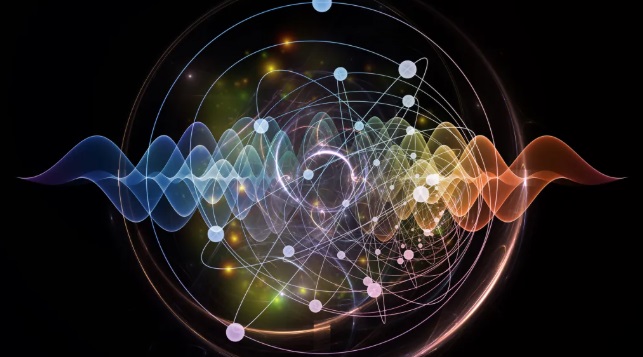
In a multidisciplinary synthesis, Dr. Shah suggests that the “Recording Angels” (Kiraman Katibin) can be understood not as anthropomorphic entities with quills, but as the “decoherence fields” that “write” our actions into the fabric of space-time. In quantum mechanics, decoherence occurs when a system interacts with its environment, effectively “collapsing” its possibilities into a recorded reality. For Shah, this process is the physiological and physical mechanism of accountability mentioned in 21:94.
Guided Evolution: The Biological Record of Creativity
The “Book of Nature” includes the genomic record of life on Earth. Dr. Shah addresses the “Elephant in the Room”—biological evolution—by advocating for a middle path he calls “Guided Evolution”.
Common Ancestry and Endogenous Retroviruses
Unlike many contemporary apologists who reject Darwinian theory, Shah accepts common ancestry as an “established fact” revealed through modern molecular biology. He points to Endogenous Retroviruses (ERVs)—viral DNA segments shared across species—as irrefutable proof of a shared lineage. For Shah, the genome is the “Pristine Historical Archive of Life,” a literal “book” that records the history of divine creativity over millions of years.
Critiquing “God of the Gaps” Theology
Shah sharply contrasts his “God of Natural Law” approach with the “God of the Gaps” strategy employed by figures like Zakir Naik. He argues that Naik’s refusal to engage with genomic data is a “strategic failure” equivalent to the 17th-century Church’s refusal to look through Galileo’s telescope. For Shah, the conflict is not between the Quran and science, but between “Wrong Theology” and science. He contends that a robust Islamic theology must accommodate the truth of evolution while rejecting the materialist “blind watchmaker” thesis.
Consciousness: The Internal Sign of the Divine
The Four Books Thesis positions human consciousness as the ultimate internal witness to the divine. Dr. Shah engages with the “Hard Problem of Consciousness”—why physical processing gives rise to subjective experience—to argue that the soul is not a biological byproduct but a fundamental property of the universe.
The “Receiver” Theory of the Brain
Shah cites philosophers and scientists who view the brain as a “receiver” of consciousness rather than a “generator,” akin to a radio receiving a signal. This implies that if consciousness is not identical to the biological substrate, it can survive the destruction of that substrate (death), fulfilling the eschatological promises of the Quran.
The Neurobiology of Sleep and Revelation
As a sleep disorders specialist, Dr. Shah uses the neurobiology of REM sleep to provide a physiological mechanism for prophetic revelation. He argues that the continuity of the self—the fact that an individual wakes as the “same person” despite a total cessation of active consciousness during sleep—serves as daily empirical evidence for the soul’s independence from the body. This “little death” of sleep is a recurring Quranic metaphor for the ultimate death and resurrection.
Ethical and Social Implications of the Thesis
The synthesis of 21:94 with the Four Books Thesis has profound implications for how the believer engages with the world.
The Restoration of Personal Accountability
Shah’s commentary on verses 88:21-22 and 35:18 emphasizes that there are no human intermediaries in Islam. “No bearer of burdens shall bear the burden of another,” he notes, arguing that every soul is directly accountable to God for its own “effort”. This stands in contrast to the confessional systems of other faiths, placing the weight of moral reflection and repentance squarely on the individual.
The “Inshallah” Universe and Social Justice
The belief in an “Inshallah Universe” governed by occasionalism leads to a constant recognition of divine volition. This does not lead to fatalism; rather, it encourages a “relentless jihad in pursuit of enlightenment” against the “jahiliyya” of ignorance and social injustice. Shah argues that the “victory” of Islam is not a numerical conquest but the triumph of its principles—justice, honesty, and rational thinking—in the hearts and minds of humanity.
| Principle of Victory | Traditional View | Shah’s “Four Books” View |
| Numerical Growth | Expansion of the Muslim population. | Secondary to the quality of individual effort (sa’ee). |
| Political Power | Sovereignty over lands and nations. | Secondary to the implementation of justice and reason. |
| Scientific Dominance | Seen as a Western secular achievement. | Reclaimed as an act of worship (Tafakkur) and a vindication of the “Book of Nature”. |
Comparative Analysis of Accountability Models
The “recording” mentioned in 21:94 can be compared across various theological and scientific models to highlight the unique robustness of the Four Books Thesis.
| Model of Recording | Mechanism of Action | Ontological Status | Implications for 21:94 |
| Classical/Traditional | Angelic scribes with physical/spiritual quills. | Supernatural/External | Establishes the fact of recording without a physical mechanism. |
| Materialist/Secular | Biological memory and social legacy only. | Material/Transient | Negates the promise of “no denial,” as all records eventually decay. |
| Four Books Thesis | Quantum information preservation and holographic encoding. | Physical/Ontological | Provides a “slam dunk” proof for the permanence of human effort (sa’ee). |
Synthesis: 21:94 as the Moral Nexus of Cosmology
When Quran 21:94 is viewed through the lens of Dr. Shah’s thesis, it becomes the moral nexus where the informational architecture of the universe meets human volition. The verse guarantees that the “effort” of the believer is never lost because the universe is designed to remember.
- The Effort (Sa’ee): This is the input—the quantum choice made by the conscious observer.
- The Record (Katibun): This is the storage—the physical inscription of that choice into the cosmic archive via decoherence and information preservation.
- The Reward (La Kufrana): This is the output—the inevitable “re-rendering” of that record in a state of justice and mercy during the “Holographic Eschaton”.
This perspective removes the “magical” elements often assigned to the Day of Judgment and replaces them with a sense of “physical inevitability”. Accountability is not a religious threat imposed from the outside; it is a “logical and physical consequence” of being a conscious participant in an informational system.
Thematic Epilogue: A Rational Sanctuary for the Modern Soul
The exegesis of Quran 21:94, when embellished with the Four Books Thesis of Dr. Zia H. Shah, MD, provides more than just a commentary; it offers a paradigm shift for the modern believer. In an age often characterized by a polarized dichotomy between “blind faith” and “cold materialism,” Shah’s work constructs a “Rational Sanctuary” where the intellect and the spirit find common ground.
The “Four Books” are not merely separate volumes of knowledge; they are the four walls of a single edifice of truth. The Book of Nature provides the foundation of empirical “signs”; the Book of Revelation provides the structural “code” of purpose; the Book of Destiny provides the internal “machinery” of fine-tuning; and the Book of Deeds provides the final “account” of our existence. Within this edifice, the promise of 21:94 is the ultimate guarantee: that no sincere effort, no matter how small, is ever “disowned” or “denied.”
Dr. Shah’s synthesis suggests that the “ink of the physicist” and the “ink of the theologian” are ultimately describing the same reality—a reality where information is sacred, consciousness is fundamental, and justice is an ontological constant. By viewing our lives as a series of “records” inscribed into the holographic fabric of the cosmos, we move from a state of heedlessness to a state of profound awareness. We realize that we are not merely “firewood of Hell” or random biological accidents, but are “recorders” and “strivers” in a universe that is intimately, mathematically, and divinely aware of our every exertion.
This report concludes that the Quranic vision of 21:94, in light of quantum cosmology, restores to the human being a sense of cosmic dignity. It confirms that the “true promise” is not a far-off event of horror, but a “Haq ul Yaqeen” (true certainty) rooted in the very laws of physics that sustain our breath. In the final analysis, to believe is to see that the universe is a “Manifest Book,” and to act righteously is to ensure that our chapter in that book is written with the ink of wisdom, mercy, and enduring effort.



Leave a Reply