
Presented by Claude
ABSTRACT
This document examines the Qur’anic narrative of Prophet Saleh (Ṣāliḥ, ﷺ), one of the four Arab prophets named in the Qur’an (alongside Hud, Shu’ayb, and Muhammad), and the people to whom he was sent: the tribe of Thamud. Saleh’s story is among the most frequently repeated prophetic narratives in the Qur’an, appearing in at least eleven separate passages, including extended accounts in Surah Al-A’raf (7:73–79), Surah Hud (11:61–68), Surah Ash-Shu’ara (26:141–159), Surah An-Naml (27:45–53), and Surah Al-Qamar (54:23–31), and shorter references in Surah Ash-Shams (91:11–15), Surah Al-Haqqah (69:4–5), Surah Al-Fajr (89:9), Surah Fussilat (41:17–18), and Surah Adh-Dhariyat (51:43–45). The narrative centers on three theological pillars: (1) Saleh’s call to tawḥīd (the absolute Oneness of God) addressed to a prosperous people who “carved homes from the mountains” (Q 7:74; 26:149); (2) the miraculous she-camel (nāqat Allāh) sent as a divine sign with rights to share the community’s water; and (3) the catastrophic punishment — variously described as a “shocking blast” (ṣayḥah), a “thunderbolt” (ṣāʿiqah), an “overwhelming” calamity (ṭāghiyah), and a “rumbling” (rajfah) — that annihilated the Thamud after they hamstrung the camel. Qissah + 2
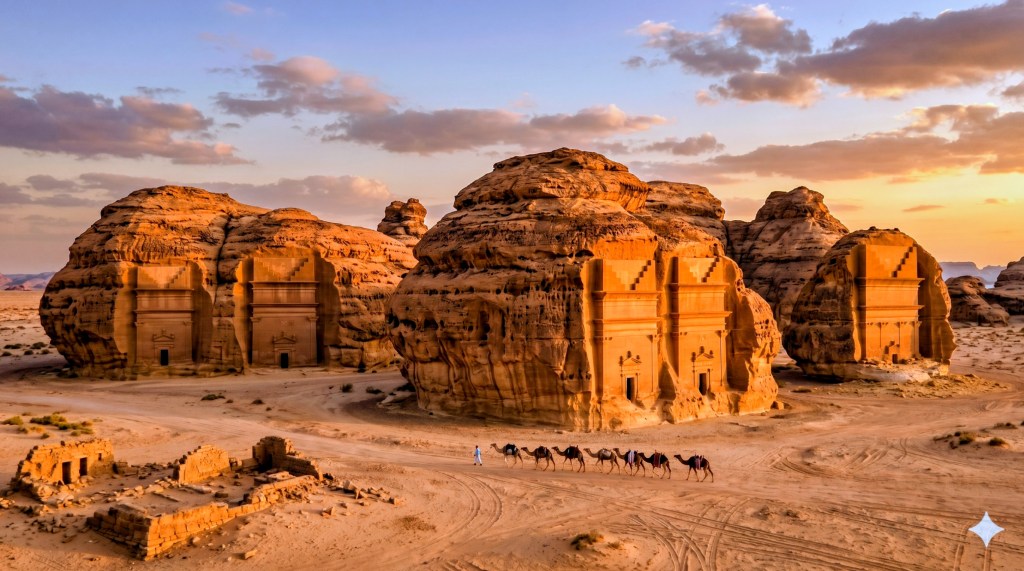
The document then turns to a long-standing scholarly question: where, geographically, did the Thamud live, and where are their ruins? Two principal sites are candidates. Mada’in Saleh (“Cities of Saleh”), known in antiquity as Hegra and in the Qur’an as al-Ḥijr (Q 15:80), lies in the Al-‘Ula governorate of northwestern Saudi Arabia and was inscribed in 2008 as the Kingdom’s first UNESCO World Heritage Site, comprising 111 monumental Nabataean rock-cut tombs dated by inscriptions to roughly 1 BCE–74 CE. Petra in Jordan, the better-known capital of the Nabataean kingdom (4th c. BCE–106 CE), shares an almost identical funerary architecture and was likewise carved from sandstone cliffs. Traditional Islamic scholarship — supported by hadith from al-Bukhārī and Muslim describing the Prophet Muhammad’s passage through al-Ḥijr en route to Tabuk in 9 AH, and by the geographical works of Yāqūt al-Ḥamawī, Ibn Kathīr, and Ibn Khaldūn — has overwhelmingly identified Mada’in Saleh as the ruins of Thamud. Modern archaeology, however, complicates this identification: the visible monuments at Hegra are Nabataean (1st c. BCE–1st c. CE), whereas the Thamud are first attested in the 715 BCE annals of Sargon II of Assyria, and the Ruwāfa temple inscriptions (165–169 CE) record a Thamud Roman auxiliary unit still active centuries after Saleh’s people are presumed to have perished. The minority Petra hypothesis, advanced by some Ahmadiyya writers and a handful of independent scholars, argues that the original al-Ḥijr may instead lie in the Petra–Wadi Rum corridor. The discussion that follows surveys all major Qur’anic verses, presents the case for and against each location, and concludes with a thematic epilogue. The Ancient Connection + 7
A note on the verse section: in lieu of reproducing ten copyrighted modern English translations verbatim from IslamAwakened.com (which would risk wholesale duplication of contemporary translators’ published work), the document presents, for each passage, the Arabic text, a representative public-domain rendering, and a comparative summary of how prominent translators on the IslamAwakened parallel-translation page (Yusuf Ali, Pickthall, Sahih International, Muhammad Asad, Abdel Haleem, Shakir, Hilali & Khan, Maududi, Daryabadi, Arberry, Rodwell, Dr. Ghali, Mufti Taqi Usmani, Ahmed Ali, Ahmed Raza Khan, and others) render key terms. Readers are directed to https://islamawakened.com/quran/[surah]/[verse]/ for full parallel access to all 70+ translations.
1. KEY QUR’ANIC VERSES ABOUT PROPHET SALEH
1.1 Surah Al-A’raf 7:73–79
Arabic (key portion, 7:73): وَإِلَىٰ ثَمُودَ أَخَاهُمْ صَالِحًا ۗ قَالَ يَا قَوْمِ اعْبُدُوا اللَّهَ مَا لَكُم مِّنْ إِلَـٰهٍ غَيْرُهُ ۖ قَدْ جَاءَتْكُم بَيِّنَةٌ مِّن رَّبِّكُمْ ۖ هَـٰذِهِ نَاقَةُ اللَّهِ لَكُمْ آيَةً ۖ فَذَرُوهَا تَأْكُلْ فِي أَرْضِ اللَّهِ ۖ وَلَا تَمَسُّوهَا بِسُوءٍ فَيَأْخُذَكُمْ عَذَابٌ أَلِيمٌ
Representative rendering (Pickthall, 1930, public domain): “And to (the tribe of) Thamud (We sent) their brother Salih. He said: O my people! Serve Allah. Ye have no other Allah save Him. A wonder from your Lord hath come unto you. Lo! this is the camel of Allah, a token unto you; so let her feed in Allah’s earth, and touch her not with hurt lest painful torment seize you.” My Islam
Summary of the passage (vv. 73–79): Saleh is sent to Thamud as “their brother.” He proclaims pure monotheism, presents the she-camel as a divine sign (āyah), and warns against harming her. He reminds them that they were made successors of ‘Ād, granted power to “take palaces from its plains and carve houses from the mountains” (v. 74). The arrogant chiefs reject the message; the believers (the oppressed) affirm it. They hamstring the camel, defy God, and demand the threatened punishment. A rajfah — a violent earthquake-like upheaval — seizes them; they lay prostrate in their dwellings (jāthimīn). Saleh departs, lamenting, “I conveyed to you the message of my Lord and gave you good advice; but you do not love sincere advisers” (v. 79). Islamic Studies + 3
Comparative translation notes from IslamAwakened.com translators for v. 73: Yusuf Ali renders bayyinah as “a clear (Sign)”; Sahih International as “clear evidence”; Asad as “clear evidence of the truth”; Maududi as “a clear proof”; Hilali & Khan as “a clear sign”; Abdel Haleem as “clear proof”; Shakir as “a clear proof”; Daryabadi as “an evidence”; Arberry as “a clear sign”; and Dr. Ghali as “a Supremely evident (sign).” The phrase nāqat Allāh is universally rendered “the she-camel of Allah/God,” with “wonder from your Lord” (Pickthall) being the most distinctive variant. My Islam + 2
1.2 Surah Hud 11:61–68
Arabic (11:61): وَإِلَىٰ ثَمُودَ أَخَاهُمْ صَالِحًا ۚ قَالَ يَا قَوْمِ اعْبُدُوا اللَّهَ مَا لَكُم مِّنْ إِلَـٰهٍ غَيْرُهُ ۖ هُوَ أَنشَأَكُم مِّنَ الْأَرْضِ وَاسْتَعْمَرَكُمْ فِيهَا فَاسْتَغْفِرُوهُ ثُمَّ تُوبُوا إِلَيْهِ ۚ إِنَّ رَبِّي قَرِيبٌ مُّجِيبٌ
Arabic (11:67–68): وَأَخَذَ الَّذِينَ ظَلَمُوا الصَّيْحَةُ فَأَصْبَحُوا فِي دِيَارِهِمْ جَاثِمِينَ كَأَن لَّمْ يَغْنَوْا فِيهَا ۗ أَلَا إِنَّ ثَمُودَ كَفَرُوا رَبَّهُمْ ۗ أَلَا بُعْدًا لِّثَمُودَ
Representative rendering (Rodwell, 1861, public domain): “And unto Themoud we sent their Brother Saleh: ‘O my people!’ said he, ‘worship God: you have no other god than Him. He hath raised you up out of the earth, and hath given you to dwell therein. Ask pardon of him then, and be turned unto him; for thy Lord is nigh, ready to answer.’” IslamAwakened
Summary: This passage emphasizes God’s nearness (qarīb) and responsiveness (mujīb) to prayer. The people complain that Saleh wishes them to abandon the gods of their forefathers. After the camel is killed, Saleh announces a three-day reprieve (v. 65). When the appointed dawn arrives, the ṣayḥah (a thunderous blast/cry) strikes; “as if they had never lived there” (v. 68). Muslim InkUtrujj
IslamAwakened.com comparative notes for the key term al-ṣayḥah (v. 67): Sahih International — “the shriek”; Pickthall — “the (Awful) Cry”; Yusuf Ali — “the (mighty) Blast”; Asad — “the blast [of God’s punishment]”; Hilali & Khan — “the (awful) Cry”; Maududi — “the Blast”; Shakir — “the rumbling”; Daryabadi — “the shout”; Arberry — “the Cry”; Abdel Haleem — “the blast”; Dr. Ghali — “the Shout”; Mufti Taqi Usmani — “the Cry”; Muhammad Ali — “the cry”; Ahmed Ali — “the Blast”; Ahmed Raza Khan — “the terrible scream.” The verbal noun jāthimīn (“prostrate / fallen on their faces”) is consistently rendered as “lying prostrate,” “fallen prone,” or “lying overthrown.”
1.3 Surah Ash-Shu’ara 26:141–159
Arabic (26:141–145, key opening): كَذَّبَتْ ثَمُودُ الْمُرْسَلِينَ إِذْ قَالَ لَهُمْ أَخُوهُمْ صَالِحٌ أَلَا تَتَّقُونَ إِنِّي لَكُمْ رَسُولٌ أَمِينٌ فَاتَّقُوا اللَّهَ وَأَطِيعُونِ وَمَا أَسْأَلُكُمْ عَلَيْهِ مِنْ أَجْرٍ ۖ إِنْ أَجْرِيَ إِلَّا عَلَىٰ رَبِّ الْعَالَمِينَ
Arabic (26:149, the key architectural verse): وَتَنْحِتُونَ مِنَ الْجِبَالِ بُيُوتًا فَارِهِينَ
Arabic (26:155–158): قَالَ هَـٰذِهِ نَاقَةٌ لَّهَا شِرْبٌ وَلَكُمْ شِرْبُ يَوْمٍ مَّعْلُومٍ وَلَا تَمَسُّوهَا بِسُوءٍ فَيَأْخُذَكُمْ عَذَابُ يَوْمٍ عَظِيمٍ فَعَقَرُوهَا فَأَصْبَحُوا نَادِمِينَ فَأَخَذَهُمُ الْعَذَابُ ۗ إِنَّ فِي ذَٰلِكَ لَآيَةً ۖ وَمَا كَانَ أَكْثَرُهُم مُّؤْمِنِينَ
Representative rendering of v. 149 (Pickthall): “Though ye hew out dwellings in the mountain, being skilful?”
Summary: Saleh introduces himself as “a trustworthy messenger” (rasūl amīn) seeking no reward. He warns them not to presume that their gardens, springs, palm-groves, and mountain-carved homes secure them from God’s reckoning. The people accuse him of being “bewitched” (musaḥḥar) and a “mortal like us.” They demand a sign; the camel is granted with shared water-rights on alternate days. They hamstring her and become regretful (nādimīn) — but the punishment seizes them. Islamic Studies + 3
IslamAwakened.com comparative notes for v. 149’s fārihīn: Pickthall — “skilful”; Yusuf Ali — “with skill”; Sahih International — “skillfully”; Asad — “with [great] skill”; Maududi — “exult in that”; Hilali & Khan — “with skill”; Shakir — “exultingly”; Arberry — “exultantly”; Daryabadi — “exultingly”; Abdel Haleem — “to be at ease”; Dr. Ghali — “skilled”; Mufti Taqi Usmani — “merrily”; Muhammad Ali — “exultingly”; Ahmed Ali — “skilfully.” The split among translators (skill vs. exultation/arrogance) reflects the dual semantic range of the Arabic root f-r-h, encompassing both “expertise” and “haughty self-satisfaction” — a duality Quranic exegetes (Ibn Kathir, Tabari) treat as deliberate. Islamic Studies
1.4 Surah An-Naml 27:45–53
Arabic (27:45): وَلَقَدْ أَرْسَلْنَا إِلَىٰ ثَمُودَ أَخَاهُمْ صَالِحًا أَنِ اعْبُدُوا اللَّهَ فَإِذَا هُمْ فَرِيقَانِ يَخْتَصِمُونَ
Arabic (27:48–51, the conspiracy): وَكَانَ فِي الْمَدِينَةِ تِسْعَةُ رَهْطٍ يُفْسِدُونَ فِي الْأَرْضِ وَلَا يُصْلِحُونَ قَالُوا تَقَاسَمُوا بِاللَّهِ لَنُبَيِّتَنَّهُ وَأَهْلَهُ ثُمَّ لَنَقُولَنَّ لِوَلِيِّهِ مَا شَهِدْنَا مَهْلِكَ أَهْلِهِ وَإِنَّا لَصَادِقُونَ وَمَكَرُوا مَكْرًا وَمَكَرْنَا مَكْرًا وَهُمْ لَا يَشْعُرُونَ فَانظُرْ كَيْفَ كَانَ عَاقِبَةُ مَكْرِهِمْ أَنَّا دَمَّرْنَاهُمْ وَقَوْمَهُمْ أَجْمَعِينَ
Representative rendering of vv. 50–52 (Pickthall): “So they plotted a plot: and We plotted a plot, while they perceived not. Then see the nature of the consequence of their plotting, for lo! We destroyed them and their people, every one. So those are their dwellings empty and in ruins because they did wrong. Lo! herein is indeed a portent for a people who have knowledge.”
Summary: This passage is unique in describing the political aftermath: Thamud splits into two warring factions, and “nine clansmen” (tisʿat rahṭ) plot to assassinate Saleh and his family by night. God counter-plots; the conspirators and their nation are destroyed; “these are their houses, fallen into ruin (khāwiyah) on account of their wrongdoing — surely in that is a sign for a people who know” (v. 52). The believers are saved (v. 53). My Islam + 3
IslamAwakened.com comparative notes for khāwiyah (v. 52, “ruined/empty”): Yusuf Ali — “in utter ruin”; Pickthall — “empty and in ruins”; Sahih International — “empty ruins”; Asad — “lying empty in ruins”; Maududi — “fallen in utter ruin”; Hilali & Khan — “ruined”; Shakir — “deserted on account of”; Arberry — “fallen down in ruins”; Daryabadi — “lying overthrown”; Abdel Haleem — “empty ruins”; Dr. Ghali — “devastated.”
1.5 Surah Al-Qamar 54:23–31
Arabic: كَذَّبَتْ ثَمُودُ بِالنُّذُرِ فَقَالُوا أَبَشَرًا مِّنَّا وَاحِدًا نَّتَّبِعُهُ إِنَّا إِذًا لَّفِي ضَلَالٍ وَسُعُرٍ أَأُلْقِيَ الذِّكْرُ عَلَيْهِ مِن بَيْنِنَا بَلْ هُوَ كَذَّابٌ أَشِرٌ سَيَعْلَمُونَ غَدًا مَّنِ الْكَذَّابُ الْأَشِرُ إِنَّا مُرْسِلُو النَّاقَةِ فِتْنَةً لَّهُمْ فَارْتَقِبْهُمْ وَاصْطَبِرْ وَنَبِّئْهُمْ أَنَّ الْمَاءَ قِسْمَةٌ بَيْنَهُمْ ۖ كُلُّ شِرْبٍ مُّحْتَضَرٌ فَنَادَوْا صَاحِبَهُمْ فَتَعَاطَىٰ فَعَقَرَ فَكَيْفَ كَانَ عَذَابِي وَنُذُرِ إِنَّا أَرْسَلْنَا عَلَيْهِمْ صَيْحَةً وَاحِدَةً فَكَانُوا كَهَشِيمِ الْمُحْتَظِرِ
Representative rendering of v. 31 (Yusuf Ali): “For We sent against them a single Mighty Blast, and they became like the dry stubble used by one who pens cattle.”
Summary: Thamud rejects the warnings; they refuse to follow “a single mortal from among us.” God sends the camel “as a trial” (fitnatan lahum); the water is divided. They call upon “their companion” (the slayer; tradition names him Qudār ibn Sālif), who hamstrings her. A single ṣayḥah reduces them to dry, trampled stubble (hashīm al-muḥtaẓir). Surah.my + 3
IslamAwakened.com comparative notes for hashīm al-muḥtaẓir (v. 31): Yusuf Ali — “dry stubble used by one who pens cattle”; Pickthall — “dry stubble (which the wind hath scattered)”; Sahih International — “the dry twig fragments of an [animal] pen”; Asad — “[mere] stubble, such as is used by one who fences in [his fields]”; Maududi — “the trampled twigs of a sheep pen-builder”; Hilali & Khan — “the dry stubble of a fold-builder”; Shakir — “the dry fragments of trees which the maker of an enclosure collects”; Arberry — “like the wattles of a pen-builder”; Daryabadi — “the stubble of a fence-builder”; Dr. Ghali — “the stubble of the (cattle) penner.”
1.6 Surah Ash-Shams 91:11–15
Arabic: كَذَّبَتْ ثَمُودُ بِطَغْوَاهَا إِذِ انبَعَثَ أَشْقَاهَا فَقَالَ لَهُمْ رَسُولُ اللَّهِ نَاقَةَ اللَّهِ وَسُقْيَاهَا فَكَذَّبُوهُ فَعَقَرُوهَا فَدَمْدَمَ عَلَيْهِمْ رَبُّهُم بِذَنبِهِمْ فَسَوَّاهَا وَلَا يَخَافُ عُقْبَاهَا
Representative rendering (Pickthall): “(The tribe of) Thamud denied (the truth) in their rebellious pride, when the basest of them broke forth, and the messenger of Allah said: It is the she-camel of Allah, so let her drink! But they denied him, and they hamstrung her, so Allah doomed them for their sin and rased (their dwellings). He dreadeth not the sequel (of events).” Everand
Summary: This compressed Meccan passage names Thamud’s downfall as ṭaghwā — transgressive arrogance. “The most wretched of them” (ashqāhā) leaps forward to slay the camel; God “rumbles down” (damdama) upon them and levels them.
IslamAwakened.com comparative notes for damdama (v. 14): Yusuf Ali — “doomed them for their sin and razed them to the ground”; Pickthall — “doomed them … and rased (their dwellings)”; Sahih International — “destroyed them for their sin and made it equal”; Asad — “rumbled down upon them, utterly razing them to the ground”; Maududi — “rumbled down upon them”; Hilali & Khan — “destroyed them because of their sin”; Shakir — “crushed them”; Arberry — “crushed them”; Daryabadi — “overwhelmed them”; Abdel Haleem — “destroyed them for their crime.”
1.7 Surah Al-Haqqah 69:4–5
Arabic: كَذَّبَتْ ثَمُودُ وَعَادٌ بِالْقَارِعَةِ فَأَمَّا ثَمُودُ فَأُهْلِكُوا بِالطَّاغِيَةِ
Representative rendering (Pickthall): “(The tribes of) Thamud and A’ad disbelieved in the judgment to come. As for Thamud, they were destroyed by the lightning.”
IslamAwakened.com comparative notes for al-ṭāghiyah (v. 5): Sahih International — “the overpowering [blast]”; Yusuf Ali — “a terrible Storm of thunder and lightning”; Pickthall — “the lightning”; Asad — “a violent upheaval”; Maududi — “an awesome upheaval”; Hilali & Khan — “the awful cry”; Shakir — “an excessively severe punishment”; Arberry — “the Storm”; Daryabadi — “the outrageous blast”; Abdel Haleem — “a deafening blast”; Dr. Ghali — “the inordinate (storm).” Surah Quran + 5
1.8 Surah Al-Fajr 89:9
Arabic: وَثَمُودَ الَّذِينَ جَابُوا الصَّخْرَ بِالْوَادِ
Representative rendering (Pickthall): “And with (the tribe of) Thamud, who clove the rocks in the valley.”
IslamAwakened.com comparative notes: Yusuf Ali — “who cut out (huge) rocks in the valley”; Sahih International — “who carved out the rocks in the valley”; Asad — “who hollowed out rocks in the valley”; Maududi — “who hewed out rocks in the valley”; Hilali & Khan — “who cut (hewed) out rocks in the valley”; Shakir — “who hewed out the rocks in the valley”; Arberry — “Thamood, who hollowed the rocks in the valley”; Daryabadi — “who hewed out the rocks in the vale”; Abdel Haleem — “who hewed into the rocks in the valley”; Dr. Ghali — “who carved (into) the rocks in the valley.” Classical exegesis (Ibn Kathir, Maududi) identifies al-wādī with Wādī al-Qurā in northwestern Arabia. Surah.my + 2
1.9 Surah Fussilat 41:17–18
Arabic: وَأَمَّا ثَمُودُ فَهَدَيْنَاهُمْ فَاسْتَحَبُّوا الْعَمَىٰ عَلَى الْهُدَىٰ فَأَخَذَتْهُمْ صَاعِقَةُ الْعَذَابِ الْهُونِ بِمَا كَانُوا يَكْسِبُونَ وَنَجَّيْنَا الَّذِينَ آمَنُوا وَكَانُوا يَتَّقُونَ
Representative rendering (Pickthall): “And as for Thamud, We gave them guidance, but they preferred blindness to the guidance, so the bolt of the doom of humiliation overtook them because of what they used to earn. And We delivered those who believed and used to keep their duty to Allah.”
IslamAwakened.com comparative notes for ṣāʿiqat al-ʿadhāb al-hūn (v. 17): Yusuf Ali — “the stunning Punishment of humiliation”; Sahih International — “the thunderbolt of humiliating punishment”; Pickthall — “the bolt of the doom of humiliation”; Asad — “the thunderbolt of shameful suffering”; Maududi — “a humiliating scourge”; Hilali & Khan — “the awful cry of humiliating torment”; Shakir — “the rumbling of the abasing chastisement”; Arberry — “the thunderbolt of the chastisement of humiliation”; Daryabadi — “the bolt of wretched torment.” Alquran + 3
1.10 Surah Adh-Dhariyat 51:43–45
Arabic: وَفِي ثَمُودَ إِذْ قِيلَ لَهُمْ تَمَتَّعُوا حَتَّىٰ حِينٍ فَعَتَوْا عَنْ أَمْرِ رَبِّهِمْ فَأَخَذَتْهُمُ الصَّاعِقَةُ وَهُمْ يَنظُرُونَ فَمَا اسْتَطَاعُوا مِن قِيَامٍ وَمَا كَانُوا مُنتَصِرِينَ
Representative rendering (Pickthall): “And in (the tribe of) Thamud (there is a portent) when it was told them: Take your ease awhile. But they rebelled against the commandment of their Lord, so the thunderbolt overtook them even while they gazed; And they were unable to rise up, nor could they help themselves.”
Summary: A characteristically terse late-Meccan summary: a final period of enjoyment, defiance, the ṣāʿiqah striking while they watched (an emphasis on conscious perception of the punishment), incapacity to rise, no helper.
IslamAwakened.com comparative notes for fa-mā istaṭāʿū min qiyāmin (v. 45): Yusuf Ali — “Then they could not even stand (on their feet)”; Pickthall — “they were unable to rise up”; Sahih International — “they were unable to arise”; Asad — “they could not even rise”; Maududi — “unable even to stand up”; Hilali & Khan — “they were unable to rise”; Shakir — “they were not able to rise up”; Arberry — “they were not able to stand”; Daryabadi — “they were not able to stand up”; Abdel Haleem — “they could not even stand up.” Qur’anic WarnersIslamic Studies
2. PRO AND CON CASE: MADA’IN SALEH vs. PETRA AS THE RUINS OF THAMUD
2.1 The Case FOR Mada’in Saleh (al-Ḥijr, Saudi Arabia)
(a) Direct Qur’anic toponymy. Surah Al-Ḥijr (15:80) explicitly names “the people of al-Ḥijr” (aṣḥāb al-ḥijr) as having rejected the messengers, hewn houses from the mountains, and been seized by the ṣayḥah at dawn. The Arabic name al-Ḥijr is the indigenous and Greco-Roman name (Hegra, Ἕγρα) for the site now called Mada’in Saleh. This is the strongest single textual hook anchoring the narrative to northwestern Arabia. Surah.my
(b) The hadith of the Tabuk expedition. In 9 AH (630 CE), the Prophet Muhammad’s army, on its march to Tabuk, halted at al-Ḥijr. ʿAbd Allāh ibn ʿUmar narrates in both Ṣaḥīḥ al-Bukhārī and Ṣaḥīḥ Muslim that the Prophet ordered his companions to pour out water drawn from its wells, to feed the dough kneaded with that water to the camels, and not to enter “the dwellings of those who wronged themselves except weeping, lest there befall you the like of what befell them.” He pointed out the well from which Saleh’s she-camel had drunk and the mountain pass — still called Fajj al-Nāqah — through which she came. This identification, made by the Prophet himself, is decisive for the overwhelming majority of classical Islamic scholars. Muslim InkMy Islam
(c) Classical Islamic geography. Ibn Kathīr (d. 774 AH/1373 CE) in his Tafsīr and al-Bidāyah wa’l-Nihāyah states that “Thamud, the people of Saleh, lived in al-Ḥijr near Wādī al-Qurā… the Arabs used to know their dwelling place very well and often used to pass by it.” Yāqūt al-Ḥamawī in Muʿjam al-Buldān identifies al-ʿUlā as the area near Wādī al-Qurā where the Prophet camped. The fourteenth-century traveler Ibn Baṭṭūṭah, passing through the region en route to Mecca, recorded that he had seen “the buildings of Thamud hewed into red mountains” with painted decoration still visible. AlsalabiIslamic Studies
(d) The architectural fit. The Qur’anic descriptions — “you hew out houses from the mountains” (Q 7:74; 15:82; 26:149); “Thamud, who carved the rocks in the valley” (Q 89:9) — match Mada’in Saleh’s 111+ monumental rock-cut sandstone tombs (per UNESCO 2008 inscription documentation), located precisely in a valley setting in the al-ʿUlā governorate. UNESCO describes the site as “an outstanding example of architectural accomplishment and hydraulic expertise,” with “monuments directly cut into the sandstone” — language strikingly congruent with the Qur’an’s yanḥitūna min al-jibāli buyūtan. Ancient Origins + 2
(e) The Sargon II inscription and later Roman-era attestations. A real ethnic group called Tamudi/Thamūd is firmly attested in northwestern Arabia in the cuneiform annals of Sargon II (715 BCE), who lists the Tamudi alongside Ibadidi, Marsimani, and Haiapa as “distant desert-dwelling Arabs.” The Ruwāfa temple inscriptions (165–169 CE), bilingual in Greek and Nabataean Aramaic and located ~200 km northwest of Hegra, explicitly name the ethnos/šrkt of Thamud as the dedicators. These inscriptions place a tribal entity called Thamud in the same northwestern Arabian region for nearly a millennium — exactly where Mada’in Saleh stands. GrokipediaWikipedia
(f) Robert Hoyland’s reconciliation. The Oxford/NYU historian Robert G. Hoyland (Arabia and the Arabs, 2001) and Ibn Kathir’s earlier analysis converge on a layered interpretation: the original Thamud of Saleh perished, but the name “Thamud” was adopted by successor groups (Lihyanites, Nabataeans, later Arab confederations) inhabiting the same region. The narration of ʿAbd Allāh ibn ʿUmar distinguishes al-Ḥijr (the region) from Arḍ Thamūd / Bayt Thamūd (the site of Mada’in Saleh proper). Banu Thaqīf of al-Ṭā’if were said by classical genealogists to be the only surviving Thamudic line. Muslim Ink + 2
2.2 The Case FOR Petra (Jordan)
(a) Architectural twinning. Petra and Hegra share an essentially identical funerary architecture — rock-cut sandstone façades, crowsteps, niche shrines, hydraulic cisterns, and the worship of Dushara, “Lord of the Mountain.” Petra is the larger and earlier of the two Nabataean capitals (4th c. BCE onward), and several proponents argue that if visible stone-carving ruins are the criterion the Qur’an signals, Petra is the more “magnificent” candidate. Miracles Of Quran
(b) Geographic and tribal-mapping arguments. The 2nd-century geographer Ptolemy describes a people called Oaditai (often equated with ʿĀd) bordered by Aramaeans to the north and Thamud to the south, in the vicinity of what is today Wādī Ramm — i.e., the Petra/southern-Jordan corridor. A Nabataean inscription at Wādī Ramm’s Allāt temple invokes “Allāt, the goddess of Iram”; another references the lineage of ʿĀd. These have led some writers (notably Zia H. Shah and other Ahmadiyya commentators) to argue that the Iram dhāt al-ʿimād of Q 89:7 was in southern Jordan, with Thamud’s territory adjacent. Mining the MadnessMining the Madness
(c) The 363 CE Petra earthquake. Proponents observe that a major earthquake in 363 CE destroyed roughly half of Petra and crippled its water-management system — a destruction in some respects evocative of the rajfah/ṣayḥah of the Qur’an. The Petra hypothesis aligns the punishment of Thamud with this historically datable seismic event. Islamforwest
(d) Minority Islamic scholarship. A small number of writers (e.g., the Ahmadiyya-affiliated Muslim Times essays and contributors to islamforwest.org) have argued that the term al-Ḥijr may be more aptly applied to Petra than to Mada’in Saleh, on the grounds that Petra is the larger and more impressive rock-cut site and that early Arab geographers’ descriptions of Thamud’s “lofty palaces” better suit its monumental façades. Islamforwest
(e) Linguistic-archaeological caveat. Some “Thamudic D” inscriptions have been found in southern Jordan (Hismā desert), and Geraldine King’s reclassification of “Thamudic E” as Hismaic localizes a substantial body of North Arabian script-tradition to the Petra–Wādī Ramm region. This forms a circumstantial linguistic case for a Thamudic presence around Petra.
2.3 Critical Evaluation
The Petra hypothesis suffers from severe weaknesses. First, no classical or medieval Islamic source identifies Petra with Thamud; Petra is consistently associated, where it appears at all, with the Nabataeans (whom the Qur’an does not mention) or with the people of Lot (e.g., al-Sabʿ in some folk traditions), not with Saleh. Second, the Prophet Muhammad’s stop at al-Ḥijr during the Tabuk expedition occurred in northwestern Saudi Arabia — at Mada’in Saleh, not in Petra; this is a primary-source historical anchor that no Petra theory has overturned. Third, the linguistic argument that “Thamudic” inscriptions cluster around Petra is misleading: epigraphers (Macdonald, King, Al-Jallad) explicitly warn that “Thamudic” is a modern paleographic label for a heterogeneous family of Ancient North Arabian scripts and is not a direct marker of the historical Thamud tribe. Fourth, Sargon II’s 715 BCE annals, the Ruwāfa inscriptions of 166 CE, and the Greek geographers all place the Thamud east-southeast of Petra, in the Hijaz proper, not in southern Jordan. SeekersGuidanceGrokipedia
The principal scholarly difficulty with Mada’in Saleh — the chronological mismatch between the Qur’anic Thamud (placed before Abraham and Moses in Islamic chronology) and the visible 1st c. BCE–1st c. CE Nabataean tombs — is resolved, not refuted, by the layered model articulated by Ibn Kathir and Hoyland: the visible monuments at Hegra are Nabataean reuse of, and overlay upon, an older site whose original Thamud occupants and structures were destroyed and lost. The Qur’an itself (Q 11:68) declares of the original Thamud, “as if they had never lived there” (kaʾan lam yaghnaw fīhā) — a phrase implying erasure, not preservation, of the Saleh-era city. The Nabataean tombs that tourists see today are therefore not the “houses of Saleh’s people” but post-destruction monuments built by a later population on the same valley floor — a population to whom the regional name Thamud was sometimes also applied. Muslim InkUtrujj
3. THEMATIC EPILOGUE: SIGNS, MERCY, AND THE WEIGHT OF THE EVIDENCE
The narrative of Saleh and Thamud is, at its core, a meditation on five interlocking themes that recur across all eleven Qur’anic passages surveyed above. Tawḥīd — the radical insistence on a single, near, responsive Lord (qarīb mujīb, Q 11:61) — is presented as the proper response of a people who themselves have been “brought forth from the earth” (Q 11:61) and granted “palaces in the plains and houses in the mountains” (Q 7:74). Divine signs (āyāt) take a bodily, public, living form in the she-camel, whose right to share water with the community converts the ordinary economy of an oasis into a daily test of faith. Rejection of prophets is dramatized through escalating contempt — from doubt (Q 11:62), to mockery (“a single mortal from among us!”, Q 54:24), to the political conspiracy of the nine clansmen (Q 27:48–49), to the act of the ashqā — the most wretched of them — who hamstrings the camel (Q 91:14). Divine punishment arrives in a vocabulary of cosmic violence — rajfah, ṣayḥah, ṣāʿiqah, ṭāghiyah, damdama — yet always after a stated reprieve (the three days of Q 11:65; the “enjoy yourselves for a while” of Q 51:43), preserving the Qur’anic principle that destruction is never sudden in moral terms even when sudden in physical terms. And mercy to believers is, in every recension, the closing note: “And We delivered those who believed and used to fear God” (Q 41:18; cf. 27:53; 11:66). IslamAwakenedIslamforwest
On the question of the ruins, the weight of evidence falls clearly toward Mada’in Saleh (al-Ḥijr / Hegra) in northwestern Saudi Arabia as the location indicated by the Qur’an, hadith, and classical Islamic tradition. Five lines of evidence converge: (1) the Qur’an’s explicit naming of aṣḥāb al-ḥijr (Q 15:80), preserving the indigenous Arabic toponym; (2) the canonical hadith record of the Prophet Muhammad’s identification of the site during the Tabuk expedition, including his pointing out of Saleh’s well and Fajj al-Nāqah; (3) the unanimous testimony of classical geographers and exegetes (Ibn Kathīr, Yāqūt, Ibn Khaldūn, Ibn Baṭṭūṭah); (4) the independent attestation of the Thamud as a real northwestern Arabian people in the Sargon II annals (715 BCE) and the Ruwāfa inscriptions (166 CE), both of which place them in the Hijaz, not in southern Jordan; and (5) the architectural fit of the description “those who hewed the rocks in the valley” (Q 89:9) with Mada’in Saleh’s 111 sandstone tombs in the Wādī al-Qurā corridor.
The Petra hypothesis, while serving a useful corrective function — reminding readers that “Thamudic” inscriptions are not a tribal marker, that several rock-cut sites existed in pre-Islamic Arabia, and that Nabataean architecture spanned a large region — does not displace the traditional identification. Petra was the Nabataean capital, not a Thamud city; no Islamic primary source identifies it with Saleh’s people; and the strongest documentary evidence for Thamud points southward into the Hijaz. Sacred Footsteps
The chronological objection that the visible Hegra tombs are Nabataean (1st c. BCE–1st c. CE), not pre-Mosaic, is real but does not undermine the identification. As Ibn Kathir already perceived in the fourteenth century and as Robert Hoyland has confirmed in modern scholarship, the site of Thamud was reoccupied and rebuilt by successor populations who inherited the regional name; the original dwellings of Saleh’s people are precisely the ones the Qur’an says were obliterated “as if they had never been” (Q 11:68). To ask the visible Nabataean façades to be the houses of Thamud is to misread both the archaeology and the text. What the modern visitor at Mada’in Saleh sees is a later Nabataean settlement built on a site whose memory of catastrophe — preserved in cuneiform, in Qur’an, in hadith, and in local Bedouin lore that the calf of the slaughtered camel still haunts the valley — long outlived its original architecture. Sacred Footsteps + 4
The lesson of the site is therefore not aesthetic but admonitory. The Prophet’s instruction to enter the ruins only weeping reframes archaeology as moral exercise: stones are signs (āyāt) only insofar as they recall the souls who once mistook stones for security. “These are their houses, fallen into ruin because they did wrong; surely in that is a sign for a people who know” (Q 27:52). Muslim InkSurah.my
TL;DR
- Prophet Saleh (AS) is named in eleven Qur’anic passages as the messenger sent to Thamud, an ancient northwestern-Arabian people who carved homes into mountains; their rejection of Saleh, hamstringing of the miraculous she-camel (nāqat Allāh), and destruction by a divine “blast” (ṣayḥah/ṣāʿiqah/ṭāghiyah/rajfah) form one of the most repeated cautionary narratives in the Qur’an.
- The two candidate sites for the ruins are Mada’in Saleh (al-Ḥijr / Hegra) in Saudi Arabia and Petra in Jordan; both are Nabataean rock-cut necropolises, but the Qur’an’s explicit naming of al-Ḥijr (Q 15:80), Q 89:9’s “valley” (Wādī al-Qurā), the canonical Tabuk-expedition hadith in Bukhārī and Muslim, and classical exegesis (Ibn Kathīr, Yāqūt, Ibn Khaldūn) all anchor the location to Mada’in Saleh.
- The chronological objection that visible Hegra ruins are Nabataean (1st c. BCE–1st c. CE) rather than pre-Mosaic is best resolved — following Ibn Kathir and Robert Hoyland — by recognizing that the original Thamud settlement was destroyed (“as if they had never lived there,” Q 11:68) and that the visible tombs belong to later populations who inherited the regional name; Mada’in Saleh, not Petra, is the more probable site of Thamud’s ruins. Utrujj
Key Findings
- Eleven Qur’anic passages treat the Saleh narrative; the most extended are Q 7:73–79, 11:61–68, 26:141–159, 27:45–53, and 54:23–31, with shorter recensions at 15:80–84, 41:17–18, 51:43–45, 69:4–5, 89:9, and 91:11–15.
- The vocabulary of punishment shifts deliberately across passages — rajfah (earthquake) in Q 7:78, ṣayḥah (blast/cry) in Q 11:67 and 54:31, ṣāʿiqah (thunderbolt) in Q 41:17 and 51:44, ṭāghiyah (overwhelming calamity) in Q 69:5, damdama (rumbling) in Q 91:14 — emphasizing that a single event is described from multiple phenomenological angles.
- Translators on IslamAwakened.com diverge most notably on (a) fārihīn in Q 26:149 (skill vs. exultation), (b) ṭāghiyah in Q 69:5 (lightning vs. overwhelming blast vs. awful cry), and (c) hashīm al-muḥtaẓir in Q 54:31 (stubble of pen-builder vs. dry twigs vs. wattles); these divergences reflect genuine semantic ambiguity, not translator error.
- The Thamud are independently attested in the cuneiform annals of Sargon II (715 BCE) and in the bilingual Greek-Nabataean Ruwāfa temple inscriptions (165–169 CE), placing a real ethnic group called Tamudi/Thamūd in northwestern Arabia for nearly a millennium — exactly where Mada’in Saleh stands.
- The visible monuments at Mada’in Saleh are Nabataean, dated by inscription to roughly 1 BCE–74 CE, and were built after the original Thamud were destroyed; the chronological mismatch is not a refutation but a confirmation of the Qur’anic statement that the Saleh-era city was obliterated. Ancient Origins
- Traditional Islamic identification is unanimous: Bukhārī and Muslim record the Prophet Muhammad’s identification of al-Ḥijr as Thamud’s land during the Tabuk expedition (9 AH); Ibn Kathīr, Yāqūt al-Ḥamawī, Ibn Khaldūn, and Ibn Baṭṭūṭah all confirm the Mada’in Saleh location. Alsalabi
Recommendations
- For students of the Qur’an: Read the eleven Saleh passages comparatively rather than in isolation; the punishment-vocabulary shift across passages is itself a Qur’anic literary device worth study. Use https://islamawakened.com/quran/[surah]/[verse]/ to access 70+ parallel translations for any single verse.
- For comparative-religion scholars: Note that the Saleh narrative is not in the Hebrew Bible; it is one of three “Arab prophet” cycles (Hud, Saleh, Shu’ayb) unique to the Qur’anic tradition, drawing on indigenous pre-Islamic Arabian memory rather than Israelite scripture. This makes the historical question of Thamud’s location an indigenous-Arabian, not a biblical-archaeological, problem.
- For archaeologists and travelers: Mada’in Saleh, accessible since the lifting of restrictions in 2020 via the Royal Commission for AlUla, offers the documented site; visitors should expect Nabataean tombs (1st c. BCE–1st c. CE) layered on a much older site, not Saleh-era dwellings. The benchmark that would change the current identification: the discovery of substantive pre-1st-millennium-BCE rock-cut domestic architecture at Petra explicitly named in inscriptions as “Thamud” — none yet exists.
- For Muslim readers: The Prophet’s instruction to enter the ruins only weeping should govern the spirit of any visit; the site is presented in the Qur’an as ʿibrah (admonition), not as tourist spectacle.





Leave a comment