
Epigraph
أَوَلَمْ يَرَوْا كَيْفَ يُبْدِئُ اللَّهُ الْخَلْقَ ثُمَّ يُعِيدُهُ ۚ إِنَّ ذَٰلِكَ عَلَى اللَّهِ يَسِيرٌ
قُلْ سِيرُوا فِي الْأَرْضِ فَانظُرُوا كَيْفَ بَدَأَ الْخَلْقَ ۚ ثُمَّ اللَّهُ يُنشِئُ النَّشْأَةَ الْآخِرَةَ ۚ إِنَّ اللَّهَ عَلَىٰ كُلِّ شَيْءٍ قَدِيرٌ
Do they not see that God brings life into being and reproduces it? Truly this is easy for God. Say, ‘Travel throughout the earth and see how He brings life into being: and He will bring the next life into being. God has power over all things.’ (Al Quran 29:19-20)
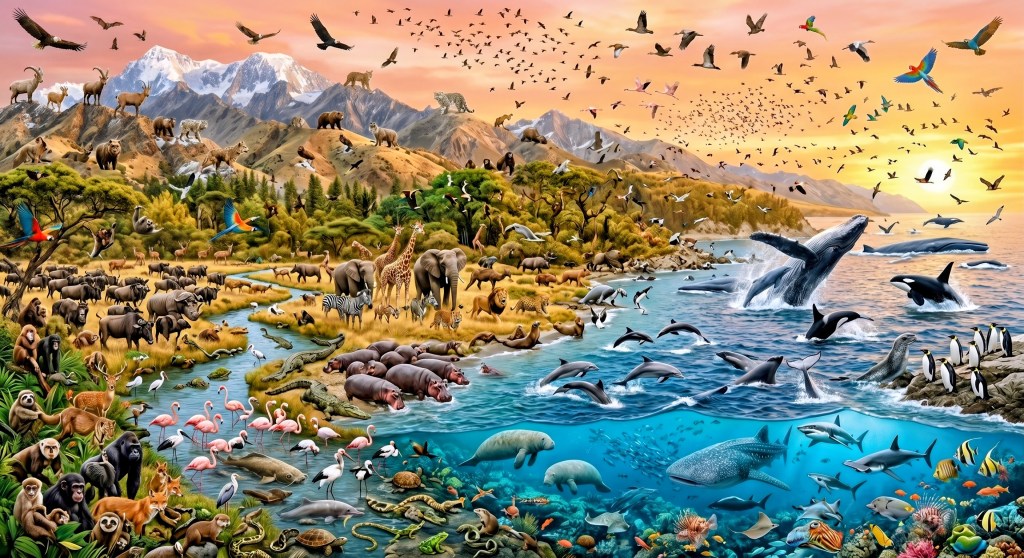
Presented by ChatGPT
Abstract: This commentary examines Quran 29:60 (“How many creatures do not carry their provision – Allah provides for them and you – He is the All-Hearing, the All-Knowing”) from scientific, philosophical, and theological angles. We summarize Dr. Zia H. Shah’s theistic (“guided evolution”) framework and survey global biodiversity and key animal adaptations (echolocation, camouflage, migration, symbiosis, regeneration, extremophily) as “exhibits” of divine providence. By integrating evolutionary biology, ecology, genetics, and developmental science with Quranic insights, we argue that nature’s complexity and beauty are coherent with a wise Creator. We address naturalistic counterarguments (chance, survival, problem of evil) and juxtapose classical/contemporary tafsir, noting cross-references (e.g. Quran 11:6, 6:38). Tables compare taxa/adaptations to theological themes, and mermaid diagrams map adaptation→function→implication. A concluding epilogue synthesizes proofs and the implications for the faith–science dialogue.
Introduction: Zia H. Shah MD and Guided Evolution
Dr. Zia H. Shah MD is a physician in Upstate New York and Chief Editor of The Muslim Times. He has written hundreds of articles on Islam, science, and philosophy. In his work, Dr. Shah champions a “guided evolution” (theistic evolution) paradigm, which holds that God’s creative wisdom underlies natural processes. Rather than seeing evolution as purposeless, he argues that “the laws of biology are [but] God’s habits”. In this view, even random mutations and environmental pressures are instruments of divine will. For example, he notes that an apparently random co‐option of viral genes in mammals (shaping the placenta and brain) can be seen as providential rather than mere accident. Through guided evolution, Dr. Shah maintains, the observable mechanisms of speciation and adaptation (genetics, natural selection, development) are embraced scientifically while affirming God’s ongoing agency. As he explains, “Nature is an expression of qudra (divine power) and hikmah (divine wisdom) working through gradual processes,” and nature itself is a “living scripture” alongside the Quran. This commentary draws heavily on Dr. Shah’s essays (see “Guided Evolution” series) to frame a narrative in which Quran 29:60’s promise of provision is illuminated by biological wonders.
Verse 29:60 in Arabic and Translations
Arabic (Qur’an 29:60):
وَكَأَيِّنْ مِنْ دَابَّةٍ لَّا تَحْمِلُ رِزْقَهَا ۖ اللَّهُ يَرْزُقُهَا وَإِيَّاكُمْ ۚ وَهُوَ السَّمِيعُ الْعَلِيمُ
Translations: The verse is rendered similarly across translations, emphasizing that many creatures do not carry their own provision yet Allah feeds them. For example, Yusuf Ali translates: “How many are the creatures that carry not their own sustenance? It is Allah Who feeds (both) them and you: for He hears and knows (all things)”. Saheeh International similarly reads: “And how many a creature carries not its [own] provision. Allah provides for it and for you. And He is the Hearing, the Knowing”. Hilali–Khan offers: “And so many a moving (living) creature there is, that carries not its own provision! Allah provides for it and for you. And He is the All-Hearer, the All-Knower”. These translations all stress that God sustains those who cannot secure provision themselves, extending the promise to humans as well.
Classical commentators explain that 29:60 was revealed in the context of the Prophet’s migration (Hijrah). As Ibn Kathir notes, Allah says: “And how many a moving creature carries not its provision – Allah provides for it and for you”, meaning animals leave home with no stored food yet God sustains them. This was meant to reassure the emigrants: if God feeds birds and wild animals without effort, He will surely provide for His believers when they abandon their homes for faith. Modern exegesis echoes this: Dr. Khattab (Clear Qur’an) points out that “innumerable animals… do not collect and store their sustenance… Allah provides them their sustenance daily by His grace,” citing a hadith that birds depart hungry and return full from their day’s forage.
Other Quranic verses parallel 29:60’s message. For instance, Surah Hud (11:6) states, “There is no moving creature on earth but its sustenance dependeth on Allah. He knows its habitation and its repository”. Similarly, Surah Al-An‘am 6:38 remarks that “no moving creature on the earth nor a bird that flies with wings… but they are communities like you”, implying all are provided. These verses, classical and contemporary, repeatedly invite reflection on God’s care for all creatures.
Global Animal Biodiversity: An Exhibit of Divine Provision
The astonishing variety of life on Earth itself can be viewed as an exhibition of the verse’s truth. By one count, the IUCN Red List (2025) cataloged about 2.17 million described species – already a massive number: roughly 1 million insects, ~11,000 bird species, ~12,000 reptile species, ~8,700 mammals and other chordates. (These are described species; estimates of total eukaryotic species run from 5–10 million or more, with bacteria/archaea possibly orders of magnitude higher.) Insects alone likely number in the millions of species. Such biodiversity points to the Quran’s metaphor of “creatures (dabbah)” in pairs and communities: God notes that “in everything We have created pairs” (36:36) and that all living communities reflect His signs.
This tapestry of life includes representatives of every major habitat and niche. There are ~34,000 known freshwater and marine fish species, 10,000+ birds, 8,000+ amphibians, millions of arthropods (insects, arachnids, crustaceans), and an enormous microbiome of bacteria and fungi. Each group exhibits specialized traits: for example, marine fishes display adaptations from streamlined bodies to bioluminescent organs; desert mammals like camels and kangaroo rats survive months without water; tundra birds fly to polar summers and back. Even tiny insects, like beetles (350,000+ described species), exhibit astounding variety.
All these species share a common dependence on earthly sustenance. No animal carries enough food to last indefinitely; instead, each has evolved ways to find or process food. Some wander vast distances: e.g. monarch butterflies migrate ~3,000 miles from Canada to Mexico (multigenerationally). Many birds likewise navigate cross-continental migrations. Fish like salmon and tuna travel oceans to spawning or feeding grounds. Others change ecosystems seasonally. Predators like wolves roam ranges in search of prey. Herbivores like wildebeest trek to find grazing. Each of these “traveler” species exemplifies the verse: they do not stockpile provision, but rely on encountering food along the way – and God.
This global survey of life highlights one theological point: infinite variety does not preclude divine order, but rather underscores it. That so many forms exist – from single-celled protists to blue whales to forest elephants – yet all obey ecological laws and receive sustenance, suggests a unifying providence. Dr. Shah would note that this diversity is “the method by which a wise Creator unfolds life’s tapestry – gradually, majestically, and with purpose”. In science, biodiversity reflects niches and evolution; theologically, it reflects “the Fashioner’s” art (Quran 59:24) applying to countless creatures.
Remarkable Adaptations and Zoological Feats
Within the tapestry of biodiversity are countless spectacular adaptations. We survey representative examples – echolocation, camouflage, migration/navigation, symbiosis, regeneration, extremophile survival – and consider both scientific explanations and theological meaning.
Figure: Monarch butterflies in different life stages. The metamorphosis and migration of butterflies (and similarly complex life cycles) showcase nature’s intricate design and God’s sustaining provision. (Image: Zia H. Shah / The Glorious Quran and Science)
Echolocation (Sensory Adaptation): Bats and toothed whales (dolphins, porpoises) independently evolved echolocation – emitting ultrasonic pulses and interpreting echoes to navigate and hunt in darkness. This convergence required profound changes in hearing-related genes. Genome studies show that dozens of genes affecting hearing physiology exhibit convergent amino-acid changes in echolocating bats and dolphins. In other words, unrelated lineages arrived at similar molecular solutions, an impressive case of parallel evolution. Biologically, echolocation exemplifies how natural selection can sculpt new sensory abilities. The protein Prestin, for example, became modified in both bats and whales to permit high-frequency hearing.
Theologically, echolocation invites reflection on “Al-Musawwir” (“The Fashioner of Forms,” 59:24) and “Ar-Rabb” (the Nurturer/Guide). That entirely blind nocturnal creatures can “see” via sound suggests an unseen wisdom at work. One might say these animals “trust” that their Creator has armed them for survival in their niche. As Dr. Shah notes, such complex organs (ears, sonar brain centers) look “beyond mere chance” to intentional design. In summary: echolocation is a function (navigation and hunting), and its theological implication is God’s precise guidance even in unseen realms.
Camouflage and Mimicry (Defensive Adaptation): Many animals employ disguise. Cephalopods (octopus, squid, cuttlefish) are famous: they can instantly change skin color, pattern, and texture to match backgrounds. UCSD researchers describe the pigment xanthommatin as a “nature’s superpower” enabling octopus camouflage. Likewise, insects (stick insects, leaf insects, lizards, arctic hares) visually mimic their environment. From a biology standpoint, camouflage evolves by selection favoring individuals that avoid predation. It involves neural control of chromatophores (pigment cells) and rapid physiological change – a sophisticated feat.
Theologically, camouflage shows God’s artistry and wisdom. The Quran calls God “Al-Baseer” (All-Seeing), who perceives even what we conceal. He equips creatures with hidden patterns. This is a delicate balance: creatures can hide, yet God still “sees” and sustains them. In philosophical terms, camouflage exemplifies how apparent randomness in appearance (a chameleon’s colors) serves survival, reflecting an underlying design. As Dr. Shah writes, the “stunning beauty” of such adaptations “far exceed survival necessities,” hinting at benevolent intent.
Migration and Navigation: Many species migrate vast distances to meet seasonal resources. The monarch butterfly travels up to ~3,000 miles across North America each year. Arctic terns migrate annually from pole to pole (~44,000 miles roundtrip). Salmon navigate from ocean to natal streams. Geese fly along flyways spanning continents. These feats involve magnetoreception, celestial navigation, and inherited migratory “maps.” Science has documented magnetic-sensing cells (magnetite in birds’ beaks) and clock-compass mechanisms (sun/movement cues).
From the verse’s perspective, migration fits the theme: these animals do not carry provisions, yet find food en route and survive. Their trusting journey is analogous to human spiritual journeys. Classical tafsir drew exactly this parallel: emigrants should not worry about livelihood because “all the birds and animals… do not sow or reap… yet your Lord feeds them”. Theologically, migration exemplifies divine provision through natural order. Creatures migrate on schedule, as if with God’s guidance: “Travel through the earth and see… how He began creation” (Quran 29:20) is a similar invitation. The metaphor extends to humans: believers leaving everything for truth are assured God’s sustenance, just as He cares for migratory beasts and birds.
Symbiosis and Mutualism: Many interspecies partnerships sustain life: coral reefs (cnidarians and zooxanthellae algae), mycorrhizal fungi and plant roots, nitrogen-fixing bacteria and legumes, cleaner fish and client fish, and the human microbiome. For instance, corals derive energy from their symbiotic algae, and fungi supply plants with phosphorus while receiving sugars. Biologists see these as co-evolved mutualisms. Ecologically, they illustrate how species co-adapt for mutual benefit – a form of “biotic cooperation.”
Theologically, symbiosis reflects divine harmony and interdependence. The Quran frequently emphasizes that God created pairs and communities (e.g. 36:36, 51:49). When different species rely on each other’s existence, it underscores a unified design. As one scholar puts it, each species is “guided to fulfill the purpose intended for it,” and interconnectedness itself can point to an overarching Purpose. In our table below, we list examples. In short, symbiosis is functionally ecosystem balance, and suggests God’s providential unity across creation.
Regeneration (Restorative Adaptation): Some animals can regrow lost parts: salamanders regrow limbs, starfish regrow arms, planaria regenerate entire bodies from fragments, and zebrafish regrow heart tissue. Axolotl salamanders can regenerate spinal cord, heart, and limbs. These abilities involve cellular reprogramming and developmental biology (stem cells, growth factors). Evolutionarily, regeneration likely evolved multiple times in soft-bodied and some vertebrate lineages as an advantage to heal injury.
From a spiritual viewpoint, regeneration points to God’s mercy and renewal. It evokes themes of resurrection and restoration. In Qur’an 23:14 God is praised as “the best of creators”, breathing spirit into man after formation; analogously, creatures like salamanders recover lost “spirits” of their own body. Muslims often see these processes as signs: God declares “He gives life to the earth after its death” (13:28), and similarly gives life to damaged organs. Therefore, regeneration is physical healing and implies compassionate design – an attribute of the Creator who renews life.
Extremophiles (Survival in Extreme Environments): Some organisms live in seemingly hostile conditions: tardigrades (water bears) survive vacuum, extreme radiation, −272°C to +150°C, going dormant for decades; thermophilic Archaea thrive above 100°C in hydrothermal vents; psychrophilic bacteria live in Antarctic ice; deep-sea fish withstand crushing pressures; desert frogs survive drought. These species have special proteins and biochemistries. For example, thermophiles use heat-stable enzymes that do not denature.
The existence of extremophiles highlights God’s omnipotence and sovereignty over all realms. Even in the “farthest north” or “deepest sea”, life persists under God’s sustenance (Quran 55:33-41). Physically, these adaptations are natural selection at work on pre-existing biochemistry. Theologically, they teach that no environment is beyond divine care. They also imply humility: if God sustains tardigrades in space-like voids, believers can trust His care in the most “harsh” trials.
Adaptations ↔ Functions ↔ Theological Implications
facilitatesensuresenablessupportsallowsachieveEcholocationNavigationCamouflageProtectionMigrationResourceFulfillmentSymbiosisEcosystemBalanceRegenerationHealingExtremophilesSurvivalDivinePrecisionDivineWisdomDivineGuidanceDivineUnityDivineMercyDivineOmnipotenceShow code
Figure: Relationships between animal adaptations, their biological functions, and implied theological themes.
Integrating Science and Faith
Evolutionary Biology & Genetics: Modern science explains many features by mutation, selection, and genetics. For instance, genes for echolocation arose by mutations conferring ultrasensitive hearing. Metamorphosis (butterflies, frogs) is governed by developmental gene cascades (hormones triggering body plan overhauls). Migration is encoded in neural and genetic programs. Yet from theistic view, even these processes are instruments of divine will. As Dr. Shah remarks, “the laws of biology are God’s habits” – meaning life’s mechanisms are part of God’s ordered creation. Thus the non-random appearance of complex adaptations (e.g. camera eyes in insects/mammals, wings in bats/birds) is not a coincidence but direction by a Creator. Zia Shah argues that what science calls “random” can be “random in our limited perspective, not from God’s”. For example, he notes convergent traits (echolocation, eyes, wings) likely reflect underlying purposeful direction even as each mutation arises unpredictably.
Ecology and Systems Biology: Ecology shows interconnected sustenance networks (food webs, nutrient cycles). Species do not exist in isolation: plants rely on pollinators, predators control herbivores, decomposers recycle matter. This system-wide provision can be seen as God’s design for balance. The verse’s promise – “Allah provides for them and you” – parallels ecological theory: all species share one biosphere provisioned ultimately by sunlight (and by God’s will). Contemporary ecology confirms that no species is truly “independent”; even apex predators rely on prey populations. The Quranic view of animals as “communities” (6:38) accords with this.
Developmental Biology: Developmental genetics reveals how species-specific traits emerge through regulated gene expression. But the Quran itself describes life emerging “from a [mere] fluid” and developing through stages (24:45, 32:7–9), echoing embryological truths. Dr. Shah observes that the Qur’anic sequence of human creation (clay → mixed fluids → embryo → soul) “encapsulates the entire evolutionary process”. Likewise, recognizing that all creatures grow from single cells (in Islam, God “expands” each embryo to its perfection – 22:5) underscores that even intricate species were “formed” stage by stage. Developmental switches, like the gene Hox clusters that pattern limbs, reveal unity in life’s design, consistent with divine “fashioning” (59:24).
Counterarguments and Responses
Naturalistic Explanations: Critics assert that adaptation and apparent design can arise purely by chance and necessity (e.g. random mutation + natural selection). They point to the “survival of the fittest” as undirected. Theological responses stress that evolution as a process need not negate divine intent. As noted, Allah can guide through means that appear natural. Dr. Shah cites philosophers who say random events “being random” is compatible with God’s will. Thus, an evolutionary origin for wings or echolocation does not rule out God’s guidance; rather, God could set up laws that tend toward such outcomes. Additionally, the fine-tuning of physical constants (from physics to DNA) can be cited: the same mutations that selection favors work within a very narrow viable range of biochemistry, which Muslims interpret as God’s precise calibration (cf. the “Everything is in a Clear Book” 11:6).
Problem of Evil (Natural Evil): The suffering and brutality in nature (predation, disease, accidents) pose a classic challenge. If God sustains animals, why allow cruelty or starvation? One response is that a world without death would be ecologically untenable – death recycles resources to sustain other life. Also, what we perceive as “evil” may serve a broader good (e.g. predation keeps populations balanced). Philosophically, Islam teaches that worldly life is a test (67:2) and not all events are comprehensible. Some Muslim thinkers suggest that natural processes (pain, death) are part of God’s wisdom beyond human grasp, or a consequence of the created order rather than God’s intention (e.g. destruction in fire – Allah “threatens with fire” in Quranic parables). Importantly, verse 29:60 itself juxtaposes provision with God’s attributes “All-Hearing, All-Knowing”, implying that provision comes with full knowledge – even of suffering. The discourse of guided evolution offers a middle path: divine purpose can coexist with natural struggle, much as a teacher may allow a student to struggle in order to learn.
Apparent Design vs. Chance: Skeptics argue that complexity can trick the mind into seeing design where none is planned. We have responded above: convergence and information-rich structures (e.g. DNA) seem hard to explain by blind chance. Proponents of guided evolution contend that numerous “just-so” examples (like viruses becoming functional genes or eyes evolving >30 times independently) are best understood as aligned with a preordained potentiality in natural laws. In any case, many thinkers agree that science describes how structures come about but cannot address the why – that remains theological. Thus science and faith occupy complementary domains.
Quranic Exegesis and Cross-References
Classical tafsir reinforces that 29:60 exemplifies God’s providence. Ibn Kathir explicitly mentions that God “sends provision to every creature in the appropriate manner, even ants in the depths of the earth, birds in the air and fish in the sea”, citing 11:6. He goes on to relate Jesus’ teaching (Matthew 6:26) about birds fed by God as parallel wisdom. Al-Tabari and others similarly emphasize reliance on God when migrating or in hardship. Contemporary scholars (e.g. Khattab, Ma’arif) highlight the hadith that “birds leave hungry and return satiated” as a living sign.
Beyond 29:60, the Quran frequently links natural provision to divine reminders. For example, 40:79-80 notes cattle provide flesh, milk and labor for humans – “travel then through the earth and see how He provides sustenance”. 16:5–8 lists livestock’s benefits, concluding “He provides for you from them (…), and upon them you are brought forth”. Such verses create a tapestry of evidence: animals sustained without willful foresight, vegetation germinating from soil (6:99), seas yielding fish by God’s leave (16:14), etc. Quran 67:15 even depicts God as One Who “made the earth subservient… and He casts down rain from the sky, therewith producing every good stuff, with which He revives a dead land…” – all analogies of providence. In sum, Quranic exegesis (classical and modern) converges on the theme that observing nature’s provision should reinforce faith, as 29:60 and its parallels explicitly teach.
Comparative Tables of Adaptations and Themes
| Taxon (Example) | Adaptation / Feature | Theological Theme |
|---|---|---|
| Bats & Dolphins (Mammals) | Echolocation (sonar) | God’s precise guidance / unseen provision |
| Cuttlefish, Chameleon | Camouflage (color change/mimicry) | Divine artistry and wisdom in concealment |
| Monarch Butterfly | Metamorphosis & Migration | Transformation / God’s sustaining journey |
| Archaea Bacteria | Thermophily (100+°C survival) | God’s omnipotence even in extreme realms |
| Salmon, Wildebeest | Seasonal migration (navigation) | Trust in God’s provision on life’s journey |
| Coral & Zooxanthellae (Cnidaria) | Symbiosis (mutualism) | Divine unity and interdependence of creation |
| Axolotl (Amphibian) | Regeneration (limb regrowth) | Mercy and renewal by God |
| Honeybee & Flowers | Pollination cooperation | God’s nurturing plan for life cycles |
Table: Representative taxa and adaptations mapped to theological themes. Each adaptation (middle column) enables survival (left) and suggests a divine purpose or attribute (right).
Counterarguments Revisited
Critics may say these examples are explicable by undirected processes. Our response is twofold. Scientifically, evolution by mutation and selection can produce these traits – and we do not deny evolution’s reality. Theologically, however, the interpretation of evolution’s outcomes is key. If one sees only chance, the world looks purposeless; but if one allows for divine direction, then each adaptation becomes a sign of wisdom. As noted, Dr. Shah emphasizes that neither Christianity, Judaism, nor Islam teaches that randomness negates God. Indeed, he cites the Quranic image of God as Ar-Rabb, guiding “from one stage to the next until it reaches its goal of perfection”. Thus a modest yield of evidence is: guided evolution resolves the apparent conflict rather than “proving” God scientifically. It encourages reading nature and scripture together: the book of Nature and the Book of Scripture form one coherent story of life guided with wisdom and purpose.
Finally, the “problem of evil” in nature is not ignored: many theologians view natural suffering as a consequence of creation’s laws (predation as ecological balance) or as a test of faith. While beyond the scope here, we note that the Quran urges humans to ponder nature’s balance (7:56, 30:41) and to trust in God’s justice beyond what appears (6:128, 29:69). In any case, 29:60 itself underscores that even the vulnerable (fleeing emigrants, or any weak creature) will be provided for.
Conclusion and Epilogue: Faith and Science in Harmony
The scientific study of animals – from cataloging millions of species to decoding genomes and ecosystems – reveals a natural world of staggering complexity and order. When interpreted through a theologically informed lens, these facts become signs pointing beyond themselves. Quran 29:60’s reminder that God feeds creatures resonates deeply with biology: no animal is self-sufficient, yet all are sustained. Birds and insects illustrate the verse literally, while genetic convergences and ecological networks illustrate it conceptually. Guided evolution as articulated by Zia H. Shah MD provides a framework: it accepts evolutionary mechanisms (common ancestry, adaptation, chance mutations) but sees their unfolding as God’s chosen method of creation. In this view, the habitats and niches God has prepared (e.g. oceans, forests, tundra) are the sources of provision He controls.
The evidence, we find, does not demand atheism. Rather it invites awe: the very “blind” processes can be seen as instruments of a knowing Creator. Convergence (e.g. echolocation genes) suggests not random chaos but a coherent plan; the fine-tuned biochemistry of life suggests design; the beauty and complexity beyond survival need (e.g. peacock’s plumage, which Dr. Shah mentions) suggests delight and purpose in creation. These insights echo classical tafsir: as God says, “Which of the favors of your Lord will you deny?” (55:13) – indeed, creatures find their provisions by His will.
In the end, 29:60 and the phenomenon of guided evolution together affirm that science and faith need not conflict. The natural world is a “mirror” of divine wisdom. As an epilogue, we reiterate that the Creator who “perfected everything He created” (32:7) has entrusted creatures with survival strategies, ecosystems with balance, and humans with the duty to reflect on these signs. By synthesizing modern biology with Quranic exegesis, we see one consistent narrative: Nature and Scripture tell one story, of life fashioned and sustained by a wise, benevolent Purpose.
References: Key sources used include classical tafsir (Ibn Kathir, Maʿārif, Tafheem) and contemporary translations; scientific reviews and news (OurWorldInData on species counts; Nature Genetics on convergent evolution; UCSD news on octopus camouflage); and Zia H. Shah’s writings on guided evolution. These sources underpin our analysis of the verse and its scientific parallels.
For references please go to the Microsoft Word file:



Leave a Reply