
Presented by Claude
Abstract
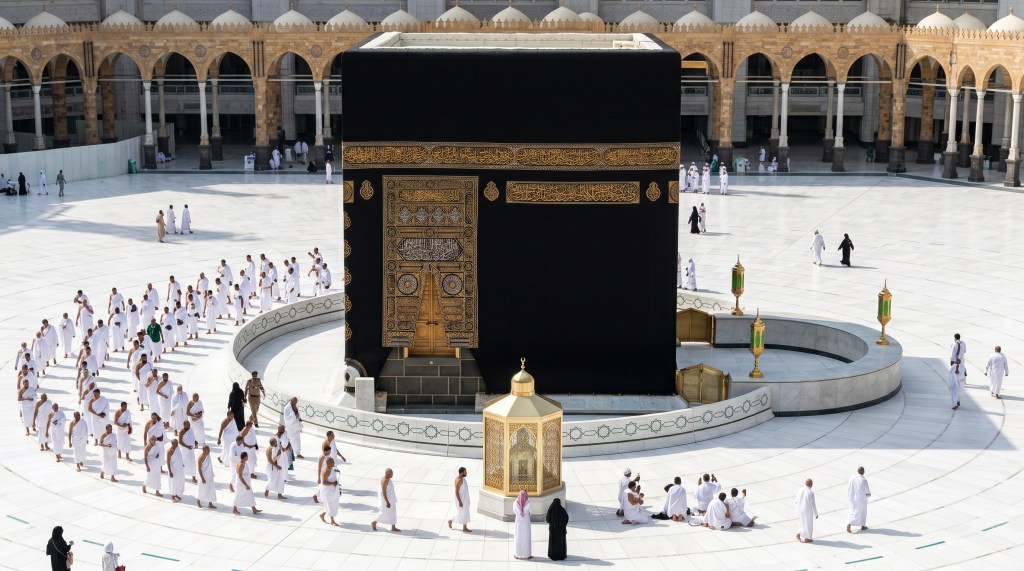
The passage spanning Sūrat al-Anbiyāʾ 21:51–73 stands as one of the Qur’an’s most concentrated and rhetorically brilliant set-pieces on the doctrine of divine unity (tawḥīd). Situated within a sūrah whose very name—”The Prophets”—signals its preoccupation with the unbroken chain of messengers sent by God, the section devoted to Ibrāhīm (Abraham) functions both as historical recollection and as live polemic: classical exegetes including al-Ṭabarī, al-Zamakhsharī, and Sayyid Quṭb note that the immediate addressees were the polytheist Quraysh of seventh-century Mecca, the very tribe that proudly traced its lineage to Abraham and yet had filled the Kaʿbah he built with three hundred and sixty idols. The Qur’anic strategy is therefore elegantly subversive—it confronts the Quraysh with the figure they revere most, showing him to have been the archetypal iconoclast.
The narrative arc of these twenty-three verses moves through five distinct dramatic moments. First, a divine preface (v. 51) establishes that Abraham’s intellectual and spiritual maturity was a gift of grace, anchoring the entire episode in the doctrine that rushd—right judgment—is bestowed by God on those He knows to be worthy. Second (vv. 52–56), Abraham conducts a Socratic interrogation of his father and people, exposing the bankruptcy of “we found our fathers doing this” as a justification for ultimate commitment, and contrasting it with the rational and ontological evidence pointing to “the Lord of the heavens and the earth, who originated them.” Third (vv. 57–58), he moves from speech to symbolic action, shattering the idols save the largest. Fourth and most famously (vv. 59–67), the broken-idol scene precipitates the moment of communal cognitive dissonance: when Abraham invites them to interrogate the surviving idol, his interlocutors momentarily admit (“you yourselves are the wrongdoers!”) only to retreat into the very absurdity they have just acknowledged. Fifth (vv. 68–73), the persecution culminates in the fire ordeal and the divine command “Fire, be cool and safe for Abraham,” followed by his migration to the blessed land and the bestowal of Isaac and Jacob.
This commentary draws on classical tafsīr—Ibn Kathīr, al-Ṭabarī, al-Rāzī’s Mafātīḥ al-Ghayb, al-Qurṭubī, al-Zamakhsharī’s Kashshāf—alongside modern exegetes Sayyid Quṭb (Fī Ẓilāl al-Qurʾān), Abū’l-Aʿlā Mawdūdī (Tafhīm al-Qurʾān), and Muḥammad Asad (The Message of the Qurʾān), and uses M.A.S. Abdel Haleem’s Oxford World’s Classics translation where verified. Central themes explored include rushd, fiṭra, the epistemology of taqlīd (uncritical imitation), the moral psychology of cognitive dissonance, the rhetorical genre of iḥtijāj (disputation), and the application of Abraham’s method to contemporary worldviews.
Verse-by-Verse Commentary
Verse 21:51
Arabic: وَلَقَدْ آتَيْنَا إِبْرَاهِيمَ رُشْدَهُ مِن قَبْلُ وَكُنَّا بِهِ عَالِمِينَ
Translation (Abdel Haleem): “Long ago We bestowed right judgement on Abraham and We knew him well.” My Islam
Commentary: The verse opens with the emphatic particle la-qad (“indeed, certainly”) and the phrase min qabl—”from before”—which Ibn Kathīr, in his Tafsīr al-Qurʾān al-ʿAẓīm, glosses as “from an early age He inspired him with truth and evidence against his people,” cross-referencing 6:83: “And that was Our argument (ḥujjatunā) which We gave Abraham against his people.” The Arabic word rushd is among the densest theological terms in the Qur’an. Mawdūdī, in Tafhīm al-Qurʾān, explicates it as comprehending “righteousness as well as discretion: a person’s ability to distinguish between right and wrong, and to follow whatever is right.” Abdel Haleem renders it “right judgement”; Asad chooses “consciousness of what is right.” The grammatical possessive in rushda-hu—”his rushd”—is significant: al-Rāzī notes that this signals a particular, individuated, prophetic rushd fitted to Abraham’s mission, not merely generic moral wisdom. Surah Quran + 3
The closing clause—wa-kunnā bi-hi ʿālimīn (“and We knew him well”)—is, in al-Zamakhsharī’s reading in the Kashshāf, a subtle defense of divine election against the implicit complaint of the Quraysh that prophethood ought to have come to one of their own grandees. As Mawdūdī observes, the verse “contains a subtle answer to the objection… ‘Why has Allah appointed this man to the office of prophethood?’” recalling 6:124: “God knows best where to place His message.” Theologically, this verse establishes a critical principle: religious certainty is not produced merely by autonomous reason operating on neutral data; it is the convergence of innate disposition (fiṭra), divinely granted rushd, and reasoned reflection on the cosmos. This will prove crucial for the dialogue that follows—Abraham’s arguments are not arbitrary cleverness but the articulation of a truth the human soul is structured to recognize. Surah QuranMy Islam +2
Verse 21:52
Arabic: إِذْ قَالَ لِأَبِيهِ وَقَوْمِهِ مَا هَٰذِهِ التَّمَاثِيلُ الَّتِي أَنتُمْ لَهَا عَاكِفُونَ
Translation (Abdel Haleem): “He said to his father and his people, ‘What are these images to which you are so devoted?’” Quran411My Islam
Commentary: The interrogative mā hādhihi (“what are these?”) is rhetorically devastating. As al-Zamakhsharī notes in the Kashshāf, Abraham does not begin with the verb who—as if to ask after the identity of personal deities—but with what, the demonstrative for things, reducing the alleged gods to mere objects. The word tamāthīl (sing. timthāl), translated by Haleem as “images” and by other translators as “statues,” refers, as the Shīʿī commentary Tafsīr Nūr al-Thaqalayn observes, to “lifeless statues” devoid of agency. Ibn Kathīr emphasizes that the term frames the dispute precisely as idolatry, not generic religious devotion. Al-Islam
The verb ʿākifūn—from the root ʿ-k-f, the same root as iʿtikāf (spiritual seclusion in the mosque)—signifies persistent, devoted, almost meditative attachment. Abdel Haleem’s “so devoted,” Pickthall’s “pay devotion,” and Mawdūdī’s “devoutly clinging” all attempt to capture this nuance. The cruelty of the irony is that the very vocabulary of true worship is being applied to inert matter.
Classical exegetes including al-Ṭabarī note the parallel narrative in 19:42, where Abraham asks his father “Why do you worship something that can neither hear nor see, nor benefit you in any way?” and in 37:85, where the same question recurs. The disclosure of Abraham’s questioning to “his father and his people” together is significant: this was not a private philosophical doubt but a public challenge. Sayyid Quṭb in Fī Ẓilāl al-Qurʾān highlights how this opening question is the seed of every subsequent prophetic confrontation in the sūrah—a single child’s “what is this?” against the inherited consensus of an entire civilization. Mawdūdī, building on Ibn Kathīr, notes that for the Meccan audience this was particularly cutting because the Quraysh were “the descendants of Prophet Abraham and were proud of their relationship with him”—and yet here was their celebrated ancestor categorically denouncing what they themselves practiced around the Kaʿbah. My Islam
Verse 21:53
Arabic: قَالُوا وَجَدْنَا آبَاءَنَا لَهَا عَابِدِينَ
Translation (Abdel Haleem): “They replied, ‘We found our fathers worshipping them.’” Quran411My Islam
Commentary: This verse is the Qur’an’s most concentrated diagnosis of the epistemology of taqlīd (blind imitation). Ibn Kathīr observes tersely: “they had no other evidence apart from the misguided actions of their forefathers.” There is no appeal to argument, scripture, prophecy, miracle, or rational consideration—only the bare fact of inheritance. The verb wajadnā (“we found”)—a verb of discovery rather than verification—captures something essential about how religious convictions are most often acquired: by immersion, not interrogation. Al-Rāzī, in Mafātīḥ al-Ghayb, takes this verse as a paradigmatic refutation of the principle that custom alone can ground ultimate metaphysical commitment. My Islam
The Qur’an returns to this same anti-traditionalist polemic at 2:170, 5:104, 31:21, and 43:22–24, where it is made explicit: “Even if their fathers understood nothing and were not guided?” The point is not that tradition is inherently illegitimate—the Qur’an itself preserves prophetic tradition—but that tradition cannot serve as the ultimate warrant when the truth-claim under examination concerns the very nature of reality. Sayyid Quṭb reads the response as embodying jāhiliyya in its purest form: “the surrender of the rational faculty to the dead weight of accumulated custom.” Asad similarly observes that this is “the typical answer of those who have abdicated their power of independent thought.”
The verse anticipates a sociological insight that modern psychology has only re-discovered: belief systems are predominantly transmitted by social inheritance, not by individual investigation. The Qur’an is not naively scandalized by this fact; rather, it identifies the moment at which an inherited belief is challenged as the moment at which the human being must become responsible for it.
Verse 21:54
Arabic: قَالَ لَقَدْ كُنتُمْ أَنتُمْ وَآبَاؤُكُمْ فِي ضَلَالٍ مُّبِينٍ
Translation (Abdel Haleem): “He said, ‘You and your fathers have clearly gone astray.’” Quran411My Islam
Commentary: Abraham’s reply refuses the rhetorical move that would have made the dispute polite: he does not exempt the revered ancestors. Ḍalāl mubīn—”manifest, clear-cut error”—is a recurring Qur’anic phrase (cf. 3:164; 26:97) used precisely when the speaker wishes to foreclose any compromise with falsehood. Al-Qurṭubī in his Jāmiʿ li-Aḥkām al-Qurʾān notes that the prefacing la-qad (“indeed, certainly”) and the doubled subject pronoun antum—syntactically redundant but rhetorically emphatic—lend the statement the force of solemn judicial declaration.
The classical exegetes uniformly read this verse as a courageous and even reckless act of public truth-telling, the kind that prophets are uniquely commissioned to perform. Ibn Kathīr observes that Abraham is essentially saying: “Speaking to your fathers whose actions you cite as evidence would be the same as speaking to you. Both you and they are misguided and are not following any straight path.” The Shīʿī Tafsīr al-Mīzān of Ṭabāṭabāʾī notes that Abraham’s deliberate refusal to spare ancestors is essential to the structure of his argument: if reverence for forebears could insulate the past from critique, then no false belief could ever be uprooted.
Sayyid Quṭb’s reading is striking: he sees in this verse the moment when the prophetic word breaks the spell of jāhilī social cohesion, at the cost of the prophet’s standing within the community. The pastoral application is profound—genuine religious renewal always requires speaking truthfully about the inherited errors of one’s own community, not merely the errors of others.
Verse 21:55
Arabic: قَالُوا أَجِئْتَنَا بِالْحَقِّ أَمْ أَنتَ مِنَ اللَّاعِبِينَ
Translation (Abdel Haleem, close rendering): “They said, ‘Have you brought us the truth, or are you one of those who jest?’” Quran411Englishkuran
Commentary: The interrogative a-jiʾtanā bi-l-ḥaqq (“have you brought us the truth?”) sets up a stark binary: either Abraham is delivering serious metaphysical news, or he is min al-lāʿibīn—”among the players, jesters.” Mawdūdī observes that the people’s question reveals their inability even to take Abraham’s claim seriously: “They were so sure of the truth of their creed that they could never imagine that anyone could be serious in declaring it to be false.” Ibn Kathīr renders the same point: “These words that you are saying, are you speaking in jest or are you telling the truth? For we have never heard such a thing before.” QuranX +2Surah Quran
The root l-ʿ-b (play, sport) is theologically loaded in Qur’anic usage. At 21:16 of this very sūrah, God declares: “We did not create the heavens and earth and everything between them in jest (lāʿibīn).” Al-Zamakhsharī notes the rhetorical irony: the people accuse Abraham of treating ultimate things as play, when in fact it is they who have built their lives around playthings (statues), and the Qur’an itself diagnoses their entire worldview as a kind of cosmic laʿib. Asad observes that the question is also a thinly veiled threat—”if you are jesting, that is one matter; if you are serious, you have crossed a dangerous line.”
This pattern—where the bringer of inconvenient truth is first dismissed as unserious before being persecuted as dangerous—recurs throughout the Qur’an and across history. The pastoral lesson is that the daʿwah-bearer should not be surprised when initial dismissal hardens into hostility once the seriousness of the claim becomes undeniable.
Verse 21:56
Arabic: قَالَ بَل رَّبُّكُمْ رَبُّ السَّمَاوَاتِ وَالْأَرْضِ الَّذِي فَطَرَهُنَّ وَأَنَا عَلَىٰ ذَٰلِكُم مِّنَ الشَّاهِدِينَ
Translation (Abdel Haleem): “He said, ‘Listen! Your true Lord is the Lord of the heavens and the earth, He who created them, and I am a witness to this.’” My IslamIslamAwakened
Commentary: The particle bal (“rather, on the contrary”) sweeps aside the false binary the people had offered. This is, in al-Rāzī’s analysis, Abraham’s positive theological declaration—the constructive moment of the dispute, not merely the destructive. Three points are crucial. First, Abraham identifies their true Lord—Rabbukum, “your Lord”—reminding them that whether they acknowledge Him or not, the Sustainer of their lives is the same God who sustains the cosmos; the question is only whether they will recognize Him. Second, the divine title used is Rabb al-samāwāt wa-l-arḍ: not a tribal patron-deity but the universal Creator, demolishing in one phrase the entire economy of localized polytheism. Third, the verb faṭara-hunna—from f-ṭ-r—signifies origination from nothing, “splitting open” or “bringing forth”; this is the very root from which fiṭra (the innate human disposition toward God) is derived.
The theological significance is profound. Asad and al-Rāzī both observe that faṭara points to creation ex nihilo, and Mawdūdī notes that the verse parallels 6:79 (“I have turned my face toward Him who originated [faṭara] the heavens and the earth”), which itself follows Abraham’s reasoned consideration of the stars, moon, and sun. The two passages together (6:74–83 and 21:51–73) sketch a complete philosophical theology: the cosmological argument from contingency (the setting stars) joins the moral-rational argument from the helplessness of idols. Al-Rāzī, characteristically, exploits this verse for an extended kalām discussion of the dalīl al-ḥudūth—the proof of God from the originatedness of bodies.
The closing phrase wa-anā ʿalā dhālikum mina-sh-shāhidīn—”I am a witness to this”—frames the prophet not as a mere arguer but as an experiential testifier, shāhid. This is, on Quṭb’s reading, the moment when prophetic daʿwah moves from polemic to confession.
Verse 21:57
Arabic: وَتَاللَّهِ لَأَكِيدَنَّ أَصْنَامَكُم بَعْدَ أَن تُوَلُّوا مُدْبِرِينَ
Translation (close rendering): “By God, I will plot against your idols once you have turned your backs and gone away.”
Commentary: The oath wa-tallāhi—a solemn form using t- as the oath particle (less common than bi- or wa-)—signals, in the Kashshāf, the gravity of the resolve. The verb la-akīdanna, with its emphatic nūn of corroboration, comes from kayd, often translated “scheme” or “plot,” but as al-Qurṭubī notes, here used in a positive sense to mean “design, stratagem in service of truth.” 21:57 is one of the rare passages where a prophet announces in advance an act of pious provocation. Mawdūdī observes that Abraham did not yet “spell out how he intended to demonstrate the helplessness of their idols,” but the audience knew enough to be on notice. Islamic StudiesIslamic Studies
There is a textual question raised by some commentators: did Abraham say this aloud to his people, or only to a smaller circle, or even soliloquize to himself? Ṭabāṭabāʾī’s al-Mīzān and the Tafsīr al-Ṣāfī opt for the more cautious view that Abraham did not openly announce his plan to the entire populace, since this would seem incautious. Other commentators, including Ibn Kathīr, take the verse at face value: Abraham was bold and did not hide his intention. The latter reading better fits the pattern of prophetic courage that the sūrah is constructing. The verse also resonates with 37:89–93, where Abraham excuses himself from the festival and breaks the idols. Al-Islam
The phrase baʿda an tuwallū mudbirīn—”after you have turned and gone away”—indicates strategic timing: Abraham waits not out of cowardice but because the demonstration requires that the idols be alone, undefended, with no human protector to obscure their helplessness. This is itself a teaching: the daʿwah of Abraham was reasoned, intentional, and shrewd, not impulsive.
Verse 21:58
Arabic: فَجَعَلَهُمْ جُذَاذًا إِلَّا كَبِيرًا لَّهُمْ لَعَلَّهُمْ إِلَيْهِ يَرْجِعُونَ
Translation (Abdel Haleem): “He broke them all into pieces, but left the biggest one for them to return to.” My Islam
Commentary: Judhādh—”fragments, broken pieces”—is a hapax legomenon in the Qur’an, appearing only here. Al-Zamakhsharī notes the deliberate concrete physicality of the word: not “destroyed” but “shattered into shards,” a vivid image meant to stress the utter fragility of the idols. The phrase illā kabīran lahum—”except a big one of theirs”—introduces the dramatic device upon which the entire argument will pivot.
The exegetes split on the referent of the pronoun in laʿallahum ilayhi yarjiʿūn (“that they may return to it/him”). Mawdūdī summarizes: “If we consider the pronoun to refer to the chief idol, the verse implies a subtle sarcasm against their polytheistic creed; for if they really believed in their gods, they should have suspected that the supreme deity had struck down the lesser ones.” The alternative reading takes the pronoun as referring to Abraham himself: “that they may return to Abraham”—i.e., come to interrogate him, providing him an opportunity to expose their error. Both readings are theologically productive, and Ibn Kathīr accepts both. QuranX + 2
What is unmistakable is the rhetorical genius of leaving the largest idol untouched. Abraham creates a scenario in which the polytheistic logic is forced to collapse on itself: either the surviving idol is responsible (in which case it should be able to explain), or the smaller idols were victims of an attack their alleged divinity should have prevented (in which case their divinity is refuted), or human agency is responsible (in which case where was the protective power of the gods?). Quṭb describes this as a “trap of light”—an act calibrated not to humiliate but to compel reflection.
Verse 21:59
Arabic: قَالُوا مَن فَعَلَ هَٰذَا بِآلِهَتِنَا إِنَّهُ لَمِنَ الظَّالِمِينَ
Translation (close rendering): “They said, ‘Who has done this to our gods? He must be one of the wrongdoers!’” Quran411 +2
Commentary: The word ẓālimīn—wrongdoers, transgressors—is, as Sayyid Quṭb observes with sharp irony, the very word that will shortly be turned back on them in v. 64. They unconsciously diagnose themselves while attempting to diagnose the iconoclast. Linguistically, ẓulm in its broadest Qur’anic sense means “putting a thing in other than its proper place”—and idolatry is the paradigmatic form of ẓulm, as 31:13 makes explicit (“Indeed, shirk is great ẓulm“). The vocabulary thus ironizes the speakers in advance.
Note also the pronoun bi-ālihatinā—”to our gods.” The exegetes observe that this possessive bespeaks an emotional rather than philosophical commitment: these are our gods, identity-markers and tribal totems, not necessarily entities whose existence and powers have been independently verified. Al-Rāzī sees in this a subtle clue to how idols typically function in any society: not as conclusions of reason but as extensions of group identity.
Verse 21:60
Arabic: قَالُوا سَمِعْنَا فَتًى يَذْكُرُهُمْ يُقَالُ لَهُ إِبْرَاهِيمُ
Translation (Abdel Haleem): “Some said, ‘We heard a youth called Abraham talking about them.’” My Islam
Commentary: The word fatā (“youth, young man”) is significant. Mawdūdī notes that the term is honorific in classical Arabic—conveying chivalry, energy, and integrity rather than mere age—and resonates with the Qur’an’s portrayal of the aṣḥāb al-kahf (Companions of the Cave) at 18:13, also called fityah. Ibn ʿAbbās is reported in al-Ṭabarī’s Jāmiʿ al-Bayān as understanding this as an indication that Abraham’s confrontation with idolatry began in his youth, fitting with the min qabl of v. 51.
The phrase yadhkuruhum—”speaking of them” or “mentioning them”—is, in Ibn Kathīr’s reading, euphemistic for “criticizing them, speaking ill of them.” The tafsīr of al-Qurṭubī notes that the witnesses are conceding that Abraham had been publicly known for his anti-idolatry stance. The phrasing yuqālu lahu Ibrāhīm—”he is called Abraham”—has a faintly distancing quality, as if the name is unfamiliar or the speakers are reluctant to name him too intimately. Quṭb reads this as the typical sociology of dissent: the dissenter is identified, named, marked.
Verse 21:61
Arabic: قَالُوا فَأْتُوا بِهِ عَلَىٰ أَعْيُنِ النَّاسِ لَعَلَّهُمْ يَشْهَدُونَ
Translation (Abdel Haleem): “They said, ‘Bring him before the eyes of the people, so that they may witness [his trial].’” Islamic StudiesMy Islam
Commentary: The phrase ʿalā aʿyuni-n-nās—”before the eyes of the people”—indicates a public spectacle. This is, in Mawdūdī’s analysis, exactly what Abraham wished: “he wished that the matter should not remain confined to the priests and the attendants but the common people also should be present there to witness that their deities were helpless.” The intention of the persecutors is to make a deterrent example; the providential effect is to provide Abraham with the largest possible audience for his dialectical demonstration. There is a direct parallel with the public confrontation between Mūsā and the magicians in 20:59 (“the day of the festival, when the people are assembled in the morning”). In both cases, the prophetic teacher accepts the public stage on which the persecutor wishes to humiliate him, knowing that truth requires witnesses. QuranXMy Islam
The verb yashhadūn—”that they may witness, testify”—is etymologically related to shahāda (testimony, witnessing). The Qur’anic resonance is profound: the persecutors think they are summoning witnesses against Abraham; in reality they are summoning witnesses to the bankruptcy of their own theology.
Verse 21:62
Arabic: قَالُوا أَأَنتَ فَعَلْتَ هَٰذَا بِآلِهَتِنَا يَا إِبْرَاهِيمُ
Translation (Abdel Haleem): “They asked, ‘Was it you, Abraham, who did this to our gods?’” My Islam
Commentary: The interrogation is direct, with the emphatic doubled a-anta (“was it you?”)—a syntactic foregrounding that reflects both their incredulity and their attempt to corner him. Al-Rāzī notes that this style of question is also a legal challenge, demanding a yes-or-no answer. Abraham’s answer in the next verse will refuse precisely this binary, replacing it with an invitation to investigate.
The phrasing bi-ālihatinā (“to our gods”) again betrays the proprietary, identity-based ownership of these deities. As Quṭb observes, the very plural ālihatinā is theologically unintelligible: gods, in the strict sense, cannot be enumerable, possessable, or vulnerable.
Verse 21:63
Arabic: قَالَ بَلْ فَعَلَهُ كَبِيرُهُمْ هَٰذَا فَاسْأَلُوهُمْ إِن كَانُوا يَنطِقُونَ
Translation (Abdel Haleem): “He said, ‘No, it was done by the biggest of them—this one. Ask them, if they can talk.’” My Islam
Commentary: This is one of the most discussed verses in classical tafsīr literature. The surface meaning—”the biggest one did it”—appears at first blush to be a falsehood, since Abraham himself is the agent. The classical solution, which is the consensus across Sunni and Shīʿī tafsīr, is that Abraham’s statement is tawriya—a deliberately polysemous utterance whose surface meaning is at variance with the speaker’s underlying intent, used not to deceive but to provoke the listener into independent reflection. Al-Qurṭubī, al-Rāzī, and the Hanafī scholar Muftī Muḥammad Shafīʿ in Maʿārif al-Qurʾān all argue that Abraham’s words are technically true on their intended construal: they constitute an iḥtijāj (disputation) in which the proposition is offered conditionally—”if these are gods, then ask the largest one; he can answer for them.” The conditional clause in kānū yanṭiqūn (“if they can speak”) signals exactly this dialectical character. Quran.com
There is a famous ḥadīth in al-Bukhārī and Muslim describing three “lies” of Abraham. Mawdūdī, with characteristic boldness, holds that the ḥadīth should be re-interpreted, since “it is far better to discard a tradition according to which a Prophet is accused of being a liar.” Other scholars argue more moderately that the ḥadīth uses the word kadhib in its broader Arabic sense of “statement at variance with surface fact” rather than its narrower moral sense of “deception”—since Abraham was patently not trying to deceive anyone but to expose error.
The deeper rhetorical point, on which all commentators agree, is that Abraham’s statement is an invitation: fa-sʾalūhum—”go and ask them.” This is the core of his Socratic method. Al-Zamakhsharī highlights the rhetorical brilliance: Abraham does not argue that the idols cannot be gods; he asks them to argue with their own gods and observe the result. The interlocutors are forced into the position of having to acknowledge, on their own initiative, the muteness of the deities they worship. My Islam
Verse 21:64
Arabic: فَرَجَعُوا إِلَىٰ أَنفُسِهِمْ فَقَالُوا إِنَّكُمْ أَنتُمُ الظَّالِمُونَ
Translation (close rendering): “So they turned to one another and said, ‘You yourselves are the wrongdoers!’” Quran.com
Commentary: Fa-rajaʿū ilā anfusihim—literally, “they returned to themselves.” Ibn Kathīr explains: “they blamed themselves for not taking precautions and protecting their gods.” But the deeper Qur’anic phrase suggests a movement into the self, an interior return, a momentary recovery of fiṭra. Quṭb describes this as an intibāh—an awakening, a flash of clarity in which the suppressed innate disposition surfaces and the individual sees through the inherited fiction. The word ẓālimūn—”wrongdoers”—is precisely the term they had hurled at Abraham in v. 59; now it has been turned, by their own honest reflection, against themselves. The mirror has been held up. QuranX
This verse is, on the unanimous reading of the classical and modern commentators, the climactic moment of cognitive dissonance in the entire passage. Asad calls this “the moment of truth.” Mawdūdī describes it as the instant when “they realized that they themselves were in the wrong, because they had set up helpless idols as deities.” The rhetorical method has worked: not through forensic argument alone but through a setup that made the absurdity of their creed self-evident. My Islam
The pastoral and apologetic significance is enormous: the most powerful daʿwah is often not the one that lectures but the one that creates a structured occasion for the interlocutor’s own fiṭra to speak. This is the dialogical method par excellence.
Verse 21:65
Arabic: ثُمَّ نُكِسُوا عَلَىٰ رُءُوسِهِمْ لَقَدْ عَلِمْتَ مَا هَٰؤُلَاءِ يَنطِقُونَ
Translation (Abdel Haleem): “But then they lapsed again and said, ‘You know very well these gods cannot speak.’” My Islam
Commentary: Nukisū ʿalā ruʾūsihim—”they were turned upside down on their heads”—is one of the most arresting metaphors in the Qur’an. There are two classical readings. The first, attested in al-Ṭabarī, is that they hung their heads in shame. The second, preferred by Mawdūdī and most modern exegetes, is psychological-metaphorical: their thinking was inverted; the brief moment of clarity was overturned by the weight of stubbornness. Mawdūdī writes: “the right interpretation is that on hearing Abraham’s reply they realized they had erred… [but] this realization was soon replaced by a bigoted adherence to their original position. And adamance, as we know, prevents people from thinking rationally.” My Islam + 2
The particle thumma (“then”) signals the temporal and logical sequence: first an honest moment, then a relapse. This pattern—a flash of self-recognition swiftly suppressed by ego, fear, social pressure, or vested interest—is a recurring Qur’anic diagnosis (cf. 2:74; 6:43). Quṭb reads it as the human heart’s tragic capacity to see and yet refuse what it has seen.
The argument they offer is itself a self-refutation: “you know very well these do not speak.” Al-Rāzī notes the philosophical absurdity: they are essentially saying, “you know our gods cannot speak”—which means they know it too. They have just confessed that their objects of worship are mute matter, and yet they intend to continue worshipping them. This is, in the precise modern sense, cognitive dissonance: holding two incompatible beliefs and refusing to integrate them.
Verse 21:66
Arabic: قَالَ أَفَتَعْبُدُونَ مِن دُونِ اللَّهِ مَا لَا يَنفَعُكُمْ شَيْئًا وَلَا يَضُرُّكُمْ
Translation (close rendering): “He said, ‘Do you then worship, instead of God, that which can neither benefit you in anything nor harm you?’” Englishkuran
Commentary: Abraham presses the contradiction. The phrase mā lā yanfaʿukum… wa-lā yaḍurrukum—”that which neither benefits you nor harms you”—identifies the basic functional criterion of any object of worship. Ibn Kathīr glosses: “if they cannot speak and they can neither benefit you nor harm you, then why do you worship them instead of Allah?” Al-Qurṭubī notes that this principle is repeated across the Qur’anic critique of polytheism (see 5:76, 10:18, 22:12, 25:55). Surah Quran
The theological depth is significant. To worship a thing is to ascribe to it the power to bless or curse, save or damn. Idols, being inert, can do neither. But—and this is the powerful extension that the modern application requires—the same critique applies to anything human beings invest with ultimate hope when it lacks the capacity to bear that hope. Money cannot save, fame cannot console at the grave, the nation cannot judge with perfect justice, the self cannot know itself perfectly. Whatever is finite, contingent, and impotent cannot be the proper object of ultimate concern.
Al-Rāzī expounds this verse as the Qur’an’s articulation of what philosophers would call the argument from divine attributes: a true God must have qudrah (power), and the inability of the idols to even defend themselves is a refutation of the entire ontology of polytheism.
Verse 21:67
Arabic: أُفٍّ لَّكُمْ وَلِمَا تَعْبُدُونَ مِن دُونِ اللَّهِ ۖ أَفَلَا تَعْقِلُونَ
Translation (close rendering): “Shame on you and on what you worship besides God! Do you not use your reason?”
Commentary: The interjection uffin—”fie!” “shame!” “ugh!”—is a particle of disgust. Al-Jalālayn glosses it as “a putrid thing be upon you.” Notably, the same interjection is forbidden by the Qur’an at 17:23 in the context of speaking to one’s parents—indicating its forceful, even harsh, character. Yet here Abraham employs it not against persons primarily but against the absurdity of their conduct. The sharpness is intentional; some realities deserve outrage. QuranX
The closing question afalā taʿqilūn—”do you not reason?” or “do you not use your ʿaql?”—is one of the most frequently recurring rhetorical devices of the Qur’an. The Qur’an demands not merely belief but the activation of reason. Asad and Mawdūdī both note that the verse establishes a foundational Islamic commitment: ʿaql (reason) and waḥy (revelation) are not enemies; rather, true revelation invokes reason, and a creed that asks one to suspend reason is, by Qur’anic standards, suspect. Ibn Kathīr concludes: “He defeated them in argument and left them with no way out.” This is in some ways the climax of Abraham’s dialectical engagement; from here forward, the conflict shifts from argument to violence. QuranX
Verse 21:68
Arabic: قَالُوا حَرِّقُوهُ وَانصُرُوا آلِهَتَكُمْ إِن كُنتُمْ فَاعِلِينَ
Translation (close rendering): “They said, ‘Burn him! Stand by your gods, if you are going to do anything!’”
Commentary: When argument fails, force is summoned. Al-Qurṭubī observes that the call unṣurū ālihatakum—”help your gods!”—is a tragicomic admission: gods who can be defended only by their worshippers are not gods. The phrase in kuntum fāʿilīn—”if you are doers, if you mean to act”—is interpreted by al-Rāzī as a goading cry by the priestly establishment, presumably to mobilize a wavering populace. The verse exposes a key sociology: idolatry is sustained as much by social pressure and institutional vested interest as by belief. When the intellectual ground gives way, the institutional ground hardens.
The proposed punishment—burning—is according to all classical commentators (Ibn Kathīr, al-Ṭabarī, al-Qurṭubī) literal. Asad, in a noted minority position, holds that the fire may be metaphorical, “an allegorical allusion to the fire of persecution which Abraham had to suffer.” Most exegetes, however, take the historical reading as the natural one, and the parallel verse 29:24 (“God saved him from the fire”) seems to confirm a literal event.
Verse 21:69
Arabic: قُلْنَا يَا نَارُ كُونِي بَرْدًا وَسَلَامًا عَلَىٰ إِبْرَاهِيمَ
Translation (Abdel Haleem): “But We said, ‘Fire, be cool and safe for Abraham.’” My Islam
Commentary: Few verses in the Qur’an convey divine sovereignty over creation with such economical splendor. The imperative kūnī—”Be!”—directed at the elemental fire echoes the creative imperative kun fa-yakūn (“Be, and it is”). The fire, addressed in the feminine vocative yā nār, is commanded to take on two qualities: bardan (coolness) and salāman (safety/peace).
Ibn Kathīr preserves a reading from Ibn ʿAbbās: “Were it not for the fact that Allah said wa-salāman (and safety), Ibrāhīm would have been harmed by the coldness.” The point is theologically rich: God’s protection is not merely the negation of harm but the positive bestowal of well-being. As Quṭb develops the point, salām in this verse is the same word that is the standard greeting between Muslims, the description of Paradise, and one of God’s own names (as-Salām). The fire becomes, paradoxically, a site of peace. Surah Quran
The miracle has been the subject of philosophical reflection for centuries. Al-Rāzī addresses it as an instance of God’s omnipotence over secondary causes—not the suspension of natural law but a divinely ordained exception that demonstrates the contingency of those laws. The pastoral and existential implication is profound: the ultimate concerns that “burn” the human being—persecution, suffering, loss—need not consume those who are with God. Abraham’s fire becomes the model of every believer’s trial. My Islam
Verse 21:70
Arabic: وَأَرَادُوا بِهِ كَيْدًا فَجَعَلْنَاهُمُ الْأَخْسَرِينَ
Translation (Abdel Haleem): “They planned to harm him, but We made them suffer the greatest loss.” My Islam
Commentary: The verse uses kaydan—a “scheme, stratagem”—the same word used (in the opposite direction) by Abraham in v. 57 when he announced his “plot” against the idols. The literary correspondence is exquisite: human kayd against the prophet versus prophet’s kayd against falsehood; God’s overriding response shows whose plot prevails.
Al-akhsarīn—the superlative of “loser”—indicates not merely failure but the most catastrophic kind: not just the loss of an immediate stratagem, but the loss of standing before God, the loss of the very dignity they sought to assert. Al-Qurṭubī links this to 35:39 and 11:22 (where the same root frames eschatological loss). Mawdūdī comments: “the unbelievers had contrived an evil plan against him, but Allah abased them all.” Quranopedia
The verse closes the dramatic cycle: persecution is overthrown not by human resistance but by divine action. The lesson is not quietism—Abraham did act, did speak, did endure—but rather that the final outcome of any genuine prophetic confrontation lies beyond human calculation.
Verse 21:71
Arabic: وَنَجَّيْنَاهُ وَلُوطًا إِلَى الْأَرْضِ الَّتِي بَارَكْنَا فِيهَا لِلْعَالَمِينَ
Translation (close rendering): “We delivered him and Lot to the land which We blessed for all peoples.”
Commentary: The verse marks the hijra (migration) of Abraham. He leaves Mesopotamia (ʿIrāq, with its great urban civilizations of Ur and Babylon) and travels with his nephew Lūṭ (Lot) toward the al-arḍ allatī bāraknā fīhā li-l-ʿālamīn—”the land which We blessed for all peoples.” The classical exegetes uniformly identify this as the region of greater Syria (al-Shām) and Palestine. Ibn Kathīr: “Allah saved him from the fire and brought him out from among them, migrating to the land of al-Shām, to the sacred regions thereof.” Mawdūdī adds: “It is one of the most fertile regions in the world; moreover, it was blessed for two thousand years with more Prophets than any other region of the world.”
The phrase li-l-ʿālamīn—”for all peoples, for the worlds”—is striking: the blessedness of this land is universal, not parochial. Asad observes that the term hints at the land’s role as the cradle of subsequent prophetic traditions—Abrahamic faith branching here into Israelite prophecy and ultimately, through Ishmael, into the Arabian rebirth that would become Islam.
The structural pattern daʿwah–persecution–migration–blessing is recurring and prototypical: it foreshadows the Prophet Muḥammad’s own hijra from Mecca to Medina. As Quṭb observes, the Qur’anic narration of Abraham is also a coded reassurance to the Prophet that what looked like defeat would become victory.
Verse 21:72
Arabic: وَوَهَبْنَا لَهُ إِسْحَاقَ وَيَعْقُوبَ نَافِلَةً ۖ وَكُلًّا جَعَلْنَا صَالِحِينَ
Translation (close rendering): “We bestowed on him Isaac and—as an additional gift—Jacob, and We made each of them righteous.” Clear QuranNoble Quran
Commentary: Wahabnā (“we bestowed/gifted”) emphasizes that progeny is sheer divine grace, not entitlement. Isaac (Isḥāq) is the directly granted son; Jacob (Yaʿqūb) is described as nāfilatan—an “additional gift,” an extra, a supererogatory bonus. The classical exegetes including al-Ṭabarī and Ibn Kathīr take this as meaning that Abraham had asked God for one son in his old age and received both a son and a grandson (Jacob being Isaac’s son). This grace-laden language frames the lineage of the prophets as wholly God’s giving, not Abraham’s achievement.
The phrase wa-kullan jaʿalnā ṣāliḥīn—”and each of them We made righteous”—is theologically important. Righteousness, like rushd in v. 51, is divinely bestowed. Al-Rāzī notes the consistency of Qur’anic theology: from the patriarch’s rushd to his grandchildren’s ṣalāḥ, all is the work of grace.
This verse implicitly addresses the Quraysh’s pride in lineage by pointing out that what they regard as tribal inheritance is in truth divine bestowal—an honor God grants and can withdraw.
Verse 21:73
Arabic: وَجَعَلْنَاهُمْ أَئِمَّةً يَهْدُونَ بِأَمْرِنَا وَأَوْحَيْنَا إِلَيْهِمْ فِعْلَ الْخَيْرَاتِ وَإِقَامَ الصَّلَاةِ وَإِيتَاءَ الزَّكَاةِ ۖ وَكَانُوا لَنَا عَابِدِينَ
Translation (Abdel Haleem): “We made all of them leaders, guiding others by Our command, and We inspired them to do good works, to keep up the prayer, and to give alms: they were Our true worshippers.” My Islam
Commentary: The capstone verse of the passage. Abraham, Isaac, and Jacob are made aʾimmah (sing. imām)—leaders, guides, models of conduct. Mawdūdī translates: “We made them into leaders to guide people in accordance with Our command.” This recalls the famous declaration in 2:124, where God says to Abraham, “I shall make you a leader for the people,” and Abraham asks, “And from my offspring?”—to which God replies that the covenant of leadership does not extend to wrongdoers.
The phrase yahdūn bi-amrinā—”they guide by Our command”—is essential. Their guidance is not autonomous moral teaching; it is the transmission of divine direction. The three pillars mentioned—fiʿl al-khayrāt (doing good works), iqāmat al-ṣalāt (establishing prayer), ītāʾ al-zakāt (giving alms)—structure their religious life and constitute, in nuce, the practical core of the Abrahamic and Islamic ethos.
The closing description wa-kānū lanā ʿābidīn—”they were worshippers of Us [alone]”—closes the loop opened in v. 52 (“what are these statues to which you are devoted?”). The verbal root ʿ-b-d (to worship) appears at both the beginning and end of the passage: in v. 53 (ʿābidīn) the people falsely apply it to themselves vis-à-vis idols; here it is applied truly to the patriarchs vis-à-vis God. The contrast is the entire point. Sayyid Quṭb describes this final verse as the “victory of monotheism vindicated in lineage and in worship.” The persecutor’s fire fades, and the prophetic line continues, pure, dedicated, and alone in its devotion.
Thematic Epilogue: Abraham’s Mirror — Exposing Cognitive Dissonance Then and Now
The Abraham of Sūrat al-Anbiyāʾ is among the most rhetorically sophisticated figures in scripture. He does not merely declare; he interrogates. He does not merely refute; he sets up scenarios in which his interlocutors must refute themselves. To call his method “Socratic” is in a sense correct, but the resemblance is superficial: where Socrates aimed at the aporia of philosophical perplexity, Abraham aimed at the intibāh of awakened fiṭra—at returning the human soul to a recognition it already, dimly, possesses. The narrative sequence of 21:51–73 is an anatomy of how he does this and why his method remains pertinent across every age in which human beings construct surrogate gods.
The Strategies of Abrahamic Daʿwah. Five distinct strategies operate together in this passage. First, the question that names the absurdity: “What are these images to which you are so devoted?” This is the simple question that outsiders are uniquely positioned to ask and that insiders have long ago stopped asking. Abraham’s question is rhetorical not because it has an obvious answer but because it forces the audience to articulate, in their own words, what they have ceased to examine. Second, the diagnosis of taqlīd: when the people answer, “we found our fathers worshipping them,” Abraham’s reply does not refute the existence of inheritance but the sufficiency of inheritance as a warrant for ultimate truth. Third, the positive theology: the alternative to the false god is not the void but the true God, “the Lord of the heavens and the earth, who originated them.” Abraham does not stop at deconstruction; he constructs. Fourth, the demonstration of impotence: the broken-idol scene is a parable enacted in space and time, designed so that the polytheistic premises collapse without Abraham having to argue them down. Fifth, the appeal to ʿaql: “do you not use your reason?” The insistence on the human capacity—indeed responsibility—to reason is the connective tissue of the entire encounter. Abraham, the Qur’an makes clear, is not asking his people to suspend reason but to exercise it.
For the Modern Agnostic. The contemporary agnostic typically defines his stance as a humble acknowledgment of epistemic limits: “I cannot know whether God exists, so I will withhold judgment.” This is, on its face, an admirable epistemic humility. But Abraham’s mirror reveals a tension. The agnostic who genuinely suspends judgment must also suspend the practical orientations that depend on a positive or negative answer. Yet in practice, agnosticism almost always slides into functional atheism—living, deciding, planning, loving, mourning as if God does not exist. The question Abraham would press, gently, is the one we might phrase: “If you cannot know whether He is, why do you live as if He is not?” The neutrality of agnosticism, examined honestly, often turns out to be a default vote for the proposition it claims to bracket.
There is also a question about the quality of the agnostic’s investigation. Abraham did not arrive at tawḥīd by taking the question lightly. The companion passage at 6:74–83 shows him reasoning through the night, watching star, moon, and sun, and only after this lived inquiry rejecting the cosmologies of his time. The agnostic owes the question that same seriousness: not the casual disengagement of “no one can really know,” but the patient investigation that prophets, philosophers, and mystics have undertaken for millennia. Fiṭra is gentle but persistent; it whispers in moments of awe, gratitude, moral clarity, suffering, and love. To suppress those whispers in the name of philosophical caution is itself a stance, not a neutrality.
The pastoral note here is critical. Many agnostics arrive at their position not from intellectual obstinacy but from genuine wounds—religious abuse, the problem of evil, the disappointment of inadequate teachers, the encounter with believers who behave abominably. Abraham’s example is also one of patience: he is fatā, the noble youth who endures persecution without ceasing to extend the invitation. The dāʿī, the apologist, the Muslim friend across the table, must imitate that patience. The doubts of the sincere agnostic are not the kayd of the persecutor; they are often, in the prophetic understanding, the seeking heart still in motion.
For the Modern Atheist. The new atheism of the early twenty-first century—in figures such as Dawkins, Dennett, Harris, and Hitchens—has been characterized in the philosophy-of-science literature as a form of scientism: the metaphysical claim that the methods of empirical science exhaust the avenues of valid knowledge. But scientism is not itself a scientific claim; it is a philosophical thesis about science, and—when scrutinized—a self-undermining one (the proposition “only empirically verifiable claims are valid” cannot itself be empirically verified). Abraham’s mirror is not impertinent here. He would press: “What you worship instead of God—has it shown you the criteria by which it judges itself? Does the proposition at the foundation of your worldview satisfy its own demands?” Academia.edu
The deeper Abrahamic critique of secular ideologies is the suggestion that the human heart cannot, in fact, sustain itself on materialism alone. Tim Keller, drawing on the prophetic tradition shared with Islam, has argued in Counterfeit Gods that the heart is “an idol-factory,” constantly elevating finite goods to ultimate status. The new atheist critique of religion has a fair point: religious people do worship their tribe, their nation, their certainty. But the critique cuts both ways. The materialist no less than the polytheist tends to absolutize something. For some it is science itself, for others the nation, the market, “progress,” the algorithm, technology, the self. These functional gods exact the same ultimate concern, demand the same sacrifices, and—Abraham’s verse 21:66 suggests—exhibit the same incapacity to “benefit you in anything or harm you” in the dimensions that ultimately matter: the moment of grief, the prospect of death, the longing for justice that no human institution will deliver. Timothy Keller
The cognitive dissonance Abraham exposed in his people has its modern analogue in the secular consciousness that denies cosmic purpose while living with intense purposiveness, denies objective moral reality while reacting with absolute moral indignation to injustice, denies the soul while grieving the dead as if they were more than meat. The prophetic gentleness here is not to scold this dissonance but to name it lovingly: here is a contradiction at the heart of your life; what would resolve it?
For the Modern Polytheist (Literal and Functional). Literal polytheism in the historical sense remains alive in many traditions, but the more pervasive form in modernity is functional polytheism—the parceling out of ultimate concern among multiple finite goods. Money is the god of security; status is the god of significance; the nation is the god of belonging; the romantic partner is the god of meaning; the child is the god of legacy; ideology is the god of certainty; the curated self on social media is the god of presence. None of these, on its own, claims theological status; together, they constitute a polytheistic regime no less binding than the temple full of tamāthīl in ancient Mesopotamia.
Abraham’s diagnostic question—”what are these to which you are so devoted?”—is, applied to the modern polytheist, a question about where one’s attention, time, and anxiety are most invested. The Abrahamic claim is not that money, family, country, and ambition are evil, but that none of them is large enough to bear the weight of the ultimate. When pressed into that role, they crack: family disappoints, money disappears, the nation fails, the body decays. Their cracking is not a tragic accident; it is a metaphysical inevitability. To love a finite thing infinitely is to crush both it and oneself. Medium
The Qur’anic alternative is not the monotheism of suppression—the refusal to love anything but God—but the tawḥīd of orientation: every legitimate love properly ordered under the love of God, becomes itself purer, lighter, more durable. Family loved under God is loved without being divinized; work undertaken for God is undertaken without becoming idolatrous. Lā ilāha illā Allāh is therefore not a suppression of human attachment but its rectification.
The Dialogical Method. What unites the application across agnostic, atheist, and polytheist is Abraham’s preference for dialogue over diatribe. He asks, sets up scenarios, invites reflection, refuses easy binaries, and is willing to suffer the cost of his honesty. The Qur’an consistently models jidāl bi-llatī hiya aḥsan—”dispute in the better way” (16:125; 29:46). The contemporary Muslim engaged with secular interlocutors is invited to imitate this. Lecturing rarely persuades; setting up a context in which the interlocutor’s own fiṭra can speak does. The most important question is often not the one we answer but the one we ask. Abraham asked, “What are these statues?”—a question that sounds naïve but contains a civilization’s worth of latent critique.
Fiṭra, ʿAql, and the Limits of Persuasion. Two truths in tension complete this reflection. The first is that human beings are, on the Qur’anic teaching, made for tawḥīd: the orientation toward the One God is built into our created nature (30:30). No one, however lost, is permanently sealed against that orientation. The second is that human beings are, also on the Qur’anic teaching, capable of suppressing this nature with extraordinary persistence (v. 65: “they lapsed again”). The dāʿī must hold both truths without flattening either. We may not condescend to the agnostic, atheist, or polytheist, because they are made for the same truth we ourselves only haltingly grasp. But we may not despair of them either, because their fiṭra is closer to them than their own jugular vein, and one well-asked question may yet—by the grace of the One who said kūnī bardan wa-salāman—turn the fire of their certainties into a place of peace.
Abraham did not see the fruit of his daʿwah in his lifetime within Mesopotamia. He left as an exile, with one nephew. Yet from him sprang Isaac, Jacob, the twelve tribes, the prophets of Israel, Ishmael, the Arabian renewal, and through Muḥammad, a world community. The lesson for the contemporary Muslim engaged with skeptics, doubters, secularists, and idolaters of every stripe is that the work of breaking idols and pointing toward the Lord of the heavens and the earth is patient work. Its measure is not immediate persuasion but faithful witness. We are called to be, in our small way, aʾimmah yahdūn bi-amrihi—leaders guiding by His command—through the same fivefold strategy of question, diagnosis, positive theology, demonstration, and appeal to reason that Abraham embodied. And we are promised that the One who made the fire cool for His friend can yet, by inscrutable grace, cool the fires of ideology and doubt for the seeking hearts of our age.




Leave a Reply