
Presented by Zia H Shah MD
Audio teaser:
Abstract
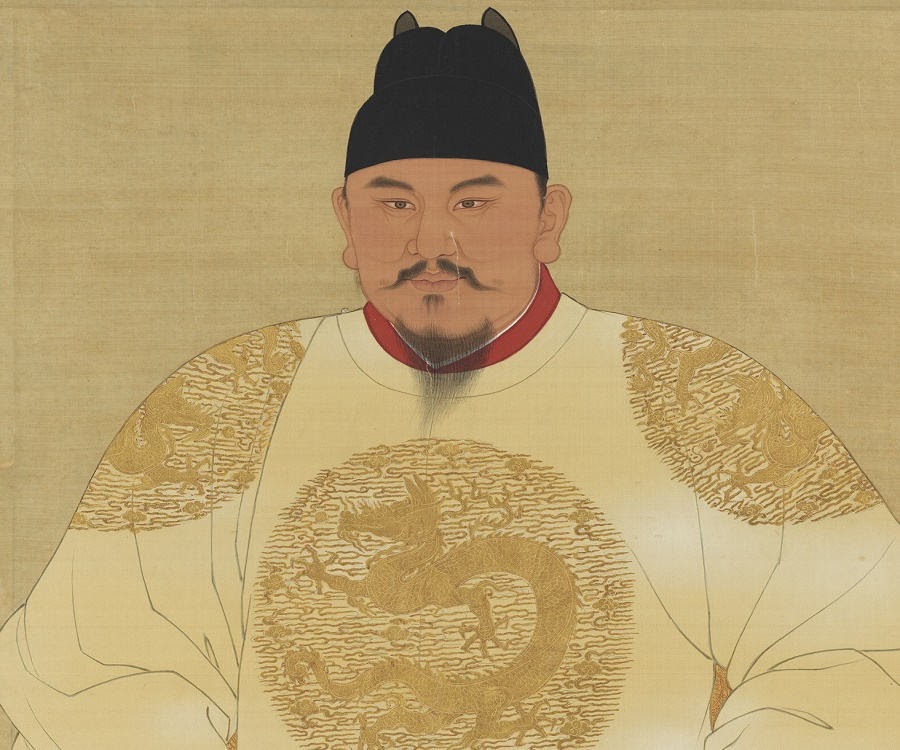
The reign of Emperor Hongwu (r. 1368–1398), born Zhu Yuanzhang, stands as a pivotal epoch in the trajectory of Chinese civilization, marking the restoration of indigenous Han sovereignty after nearly a century of Mongol-led Yuan rule. Beyond the traditional narrative of a peasant-monk turned autocrat, Hongwu’s tenure was characterized by a sophisticated and paradoxical relationship with Islam and the Muslim community. Despite his own foundations in Confucian ethics, Buddhist monasticism, and Red Turban millenarianism, Hongwu emerged as a singular patron of the Islamic faith in China, an era many historians identify as the “Golden Age” of Chinese Islam. This report provides a detailed biographical and analytical examination of his life, from his origins in destitution to his radical restructuring of the imperial bureaucracy. Central to this study is his “Hundred-word Eulogy” (百字讃), a poetic tribute to the Prophet Muhammad that remains inscribed in the mosques he commissioned, such as the Jingjue Mosque in Nanjing. Through an exhaustive review of administrative reforms—including the Great Ming Code and the land registration systems—and the instrumental roles of Muslim military and scientific elites, this analysis elucidates how Hongwu’s pragmatic inclusive policies forged a durable Sino-Islamic identity. The report explores the second-order implications of his social engineering, his military expansion into the frontiers of Yunnan, and his institutionalization of Islamic science, ultimately characterizing his reign as a masterclass in the utilization of religious pluralism for dynastic stability.
The Formative Crucible: Poverty, Plague, and the Huai River Plain
The origins of Zhu Yuanzhang are rooted in the systemic collapse of the Yuan Dynasty during the second quarter of the 14th century. Born on October 21, 1328, in Zhongli village, Haozhou (modern-day Fengyang, Anhui Province), he was the youngest of four sons in a family of impoverished tenant farmers. At birth, he was named Zhu Chongba, a designation reflecting the low social status of his family; later in adulthood, he adopted the name Zhu Xingzong, eventually assuming the moniker Zhu Yuanzhang during his years as a rebel commander. The environment of his youth was one of extreme precariousness. The Yuan administration, characterized by institutionalized ethnic discrimination and overtaxation, had allowed vital infrastructure to fall into disrepair.
The year 1344 served as the primary inflection point in his early life. A catastrophic sequence of drought and the subsequent flooding of the Yellow River destroyed the regional harvests, triggering a famine exacerbated by a virulent plague. Within weeks, the seventeen-year-old Zhu witnessed the death of his father, Zhu Shizhen (originally Zhu Wusi), his mother, Chen Erniang, and his eldest brother. The family was so destitute that they lacked the funds for proper burial rites. It was only through the intervention of a neighbor, Liu Jizhu, who donated a plot of land, that Zhu was able to inter his family, a site that would later be transformed into the Fengyang Mausoleum. This experience of absolute loss and the failure of the state to protect the “base” of society—the peasantry—informed his lifelong philosophy of suspicion toward the gentry and his dedication to agricultural stability.
With his family gone, Zhu entered the Huangjue Temple as a novice monk, seeking the basic sustenance that the secular world could no longer provide. However, the monastery’s resources were soon exhausted, and he was sent out to wander as a beggar monk. For three years, Zhu traversed the central and eastern provinces of China, personally witnessing the suffering of the populace and the fragmentation of Yuan authority. This period of “itinerant mendicancy” was crucial; he learned the geography of the heartland and the nuances of the various secret societies and rebel movements forming in the shadows of the collapsing empire. He returned to the temple around the age of twenty-four, where he finally acquired the literacy that would distinguish him from other rebel leaders.
Table 1: Chronology of the Formative Years
| Year | Event | Implication |
|---|---|---|
| 1328 | Birth as Zhu Chongba in Haozhou | Rooting of personal identity in the peasant class. |
| 1344 | Family dies of plague/famine | Lifelong distrust of wealthy officials and empathy for the poor. |
| 1344–1348 | Mendicant begging and monastery life | Development of resilience and geographic knowledge. |
| 1352 | Joins Guo Zixing’s rebel force | Entry into the political-military arena of the Red Turbans. |
The Revolutionary Ascent: The Red Turbans and the Unification of China
The catalyst for Zhu’s transition from a monk to a revolutionary was the destruction of the Huangjue Temple by Yuan troops during a sweep for local insurgents in 1352. Facing certain death if he remained, Zhu joined a local insurgent group that was part of the broader Red Turban rebellion. The Red Turbans were a millenarian sect affiliated with the White Lotus Society, combining elements of Manichaeism, Buddhism, and Daoism with the promise of overthrowing the “dark” Mongol rule in favor of a “Prince of Light”.
Zhu’s ascent was characterized by military discipline and tactical brilliance. Unlike many rebel contemporaries who favored looting, Zhu emphasized the protection of civilians and the recruitment of Confucian scholars to provide ideological legitimacy to his movement. He joined the forces of Guo Zixing, a leader who recognized Zhu’s potential and eventually married his foster daughter, Ma Xiuying (the future Empress Ma), to him. This marriage provided Zhu with the necessary social capital to rise within the command structure. After Guo’s death, Zhu emerged as the dominant leader of the faction.
The Strategic Conquest of Nanjing and the Lake Poyang Campaign
The central turning point in the establishment of the Ming was the capture of Nanjing in 1356. Strategically situated on the Yangtze River, Nanjing became Zhu’s base of operations. Over the next decade, he engaged in a brutal war of attrition and maneuver against rival Han rebel factions, most notably Chen Youliang, who controlled the central Yangtze.
The Battle of Lake Poyang in 1363 stands as one of the most significant naval engagements in world history. Despite being outnumbered, Zhu utilized superior coordination and fire-ship tactics to decimate Chen’s fleet, securing control over southern and central China. Following this victory, he moved systematically against the last Yuan remnants and rival groups. In early 1368, Zhu officially proclaimed the founding of the Ming (“Brilliant”) Dynasty, adopting the era name Hongwu (“Vastly Martial”) and making Nanjing the imperial capital. By September 1368, his armies captured Khanbaliq (Beijing), ending the Yuan Dynasty’s control over China proper.
The Imperial Architecture: Restructuring the State
As Emperor Hongwu, Zhu Yuanzhang was determined to create a society of self-sufficient rural communities ordered in a rigid system that would guarantee the permanent security of his dynasty. His administration was marked by a shift toward “High Despotism,” characterized by the total centralization of authority in the hands of the emperor.
The Abolition of the Chancellery and Civil Service Reform
In 1380, following the execution of Chancellor Hu Weiyong on charges of treason, Hongwu abolished the Secretariat and the post of Chancellor entirely. This radical move meant that the Six Ministries (Personnel, Revenue, Rites, War, Justice, and Public Works) reported directly to him, placing an immense administrative burden on the sovereign but ensuring no single official could rival his power. To staff this bureaucracy, he restored and eventually refined the Confucian examination system, ensuring that officials were selected based on merit and their knowledge of the Classics. However, he remained deeply suspicious of the scholar-bureaucrat class, often using his secret police—the Embroidered Uniform Guard—to monitor and purge those he deemed disloyal.
The Great Ming Code (Da Ming Lü)
The legal cornerstone of the era was the Da Ming Lü, promulgated in its final version in 1397. Hongwu sought a code that was clear, simplified, and capable of enduring for centuries. The Code emphasized Confucian family values, but also included significant reforms such as the prohibition of the private enslavement of Chinese citizens and the granting of legal protections to the peasantry. It was structured into categories corresponding to the Six Ministries, a framework that influenced Chinese law until the early 20th century.
Table 2: The Six Ministries of the Ming Dynasty
| Ministry | Responsibility under Hongwu | Significance |
|---|---|---|
| Personnel | Appointment and evaluation of officials | Centralized meritocratic control. |
| Revenue | Taxation, census, and land registration | Funded the million-man standing army. |
| Rites | State ceremonies, rituals, and religion | Enforced Confucian orthodoxy. |
| War | Management of the Weiso military system | Maintained border security. |
| Justice | Oversight of the legal system and penal code | Applied the Great Ming Code. |
| Public Works | Construction of the Great Wall and canals | Enhanced infrastructure and defense. |
The Sovereign and the Prophet: The Hundred-word Eulogy
A remarkable and often under-discussed aspect of Hongwu’s reign was his relationship with Islam. While he was a staunch advocate of Confucian statecraft, he demonstrated a level of tolerance and even admiration for Islamic monotheism that was unprecedented for a non-Muslim Chinese emperor. This respect culminated in the composition of the Baizizan (Hundred-word Eulogy), a 100-character poem written in praise of the Prophet Muhammad and the faith of Islam.
The poem was not a mere literary exercise; Hongwu ordered it to be inscribed on plaques in mosques across the empire, including those he personally commissioned in Nanjing, Xi’an, and Yunnan. This official endorsement served a dual purpose: it acknowledged the loyalty of the Muslim generals who had helped him secure the throne and integrated the Muslim community into the moral fabric of the Ming state.
The Text of the Hundred-word Eulogy (百字讃)
The poem is written in a traditional style with verses of four characters each. It reflects an understanding of the Prophet’s role as a teacher, a protector of the poor, and a recipient of the divine word.
Chinese Text: 乾坤初始 天籍注名 大聖西鴻 昭應大明 授受天經 三十部冊 普度眾生 主宰萬靈 法朝威儀 萬世依循 降伏魔厲 清真歸一 穆罕默德 至貴聖人 (Note: Standardized version derived from mosque plaques in Nanjing and Xi’an).
English Translation: Since the creation of the Universe, God had decreed to appoint, This great faith-preaching man, From the West he was born, He received the Holy Scripture, A Book in thirty parts, To guide all creation, Master of all Rulers, Leader of the holy ones, With support from the Divine, To protect his nation, With five daily prayers, He silently prays for peace, His heart directed towards Allah, Giving power to the poor, Saved from misfortune, Seen through the Unseen, Away from the souls and spirits, Free from all errors, His religion, Pure and True, Muhammad, The most noble Great Prophet.
Analysis of the Poem’s Significance
The poem highlights several key themes. First, it identifies Muhammad as a “Mercy to the World,” a role emphasized in Islamic scripture, and recognizes the Qur’an as a complete guide for creation. Second, it adopts the term Qingzhen (清真), meaning “Pure and True,” to describe Islam. This was a critical semantic shift; by using this term, Hongwu helped standardize the Chinese name for Islam, aligning it with concepts of clarity and enlightened truth. Third, the poem emphasizes the Prophet’s role in “protecting the nation” and “praying for peace,” themes that would have resonated deeply with an emperor obsessed with stability after decades of chaos.
The second-order implication of this eulogy was the creation of a “Sino-Islamic” synthesis. By framing the Prophet as a “Sage” (Shengren), a term usually reserved for Confucius or ancient legendary rulers, Hongwu signaled to his subjects that Islam was a respected, orthodox path within the Chinese cultural landscape. This helped facilitate the assimilation of Muslims into Han society—a process that involved adopting Chinese surnames and language while retaining their distinct faith and dietary laws.
The Crescent in the Court: Influential Muslims of the Early Ming
The Hongwu Emperor’s patronage of Islam was largely driven by the indispensable role Muslims played in his military and administration. During the founding of the Ming, over ten high-ranking military commanders and numerous court officials were of Muslim or Hui descent.
The Famed Muslim Generals
These commanders were not merely soldiers; they were the architects of the Ming’s tactical superiority over the Mongols. Many Hui Muslims today claim that the name “Hui” is partially derived from the Chinese word for “thanks” or “barracks,” a tribute to their role in the revolution.
- Hu Dahai: An undisputed Hui Muslim general and one of Hongwu’s earliest supporters. He was instrumental in capturing Nanjing and parts of Zhejiang before his death in 1362.
- Chang Yuchun: Described as Hongwu’s “right-hand man,” he was a legendary spearman and tactician. While his Muslim identity is sometimes disputed by secular historians, Hui oral tradition and genealogical studies strongly place him within the Muslim community.
- Mu Ying: An adopted son of Hongwu and a capable general who played a leading role in the conquest of Yunnan in 1381. He and his descendants were made hereditary governors of Yunnan, ensuring the province remained a bastion of Ming power and a center of Islamic learning for over two centuries.
- Lan Yu: A brilliant but ill-fated commander who led the Ming armies to a decisive victory over the Northern Yuan at Lake Buyur in 1388. Despite his service, he was executed in 1393 during one of Hongwu’s purges due to his increasing arrogance and the threat he posed to the throne.
- Ding Dexing: A faithful commander who served from the earliest days of the rebellion. He is listed as an undisputed Hui officer in Ming records.
Table 3: Key Muslim Figures in the Early Ming Court
| Figure | Role | Significance |
|---|---|---|
| Mu Ying | Adopted Son / General | Secured Yunnan and fostered Islam in the Southwest. |
| Hu Dahai | General | Vital early supporter of the revolution. |
| Zheng He | Admiral (later reign) | Born during Hongwu’s reign; later became the Ming’s greatest explorer. |
| Empress Ma | Spouse (Empress) | Traditionally claimed to have had Muslim family roots. |
| Zhamaluding | Scientist / Missionary | Advised the emperor on astronomical and calendar reforms. |
The Mystery of Empress Ma’s Roots
Historiography regarding Empress Ma (Ma Xiuying) is complex. While official Ming records describe her as the daughter of Ma Gong from Suzhou, many Chinese Muslim traditions insist she was of Hui descent. The surname “Ma” is a common phonetic substitution for “Muhammad” in Chinese Muslim communities. While evidence remains speculative, her compassionate influence on Hongwu—often urging him to spare lives and help the poor—is well-documented and consistent with the ethical values praised in the emperor’s eulogy.
Institutional Support: Science, Astronomy, and the Huihui Bureau
Hongwu’s pragmatism extended to the scientific realm. Recognizing the superiority of Islamic astronomy and mathematics (inherited from the Abbasid and Ilkhanid traditions), he established the Huihui Astronomical Bureau in 1368. This bureau operated alongside the traditional Chinese bureau, allowing for a synthesis of knowledge.
Under his direction, Arabic and Persian astronomical texts were translated into Chinese. The resulting works, such as The Book of Astronomy and the Huihui Calendar System, remained influential for decades. Hongwu even ordered Han astronomers to study under Hui scholars to facilitate cross-civilizational learning. This was a remarkable act of intellectual openness, driven by the practical need for accurate calendars to manage agriculture—the foundation of his empire.
The Mosque as an Imperial Monument: Architectural Patronage
Out of respect for Muslim loyalty and as a sign of imperial favor, Hongwu ordered the construction and restoration of mosques in several key cities, including Nanjing, Xi’an, Yunnan, Fujian, and Guangdong. These mosques were designed in a Sino-Islamic style, where the exterior mirrored traditional Chinese temple architecture, while the interior preserved Islamic liturgical requirements.
The Jingjue Mosque of Nanjing (净觉寺)
The Jingjue Mosque is the most prominent monument to Hongwu’s patronage. Located in the capital of Nanjing, it was commissioned by a decree in 1388 and completed in 1392. Its entrance features an imperial tablet with the inscription “Bestowed by Imperial Order” (Chi Ci). This designation afforded the mosque protection from local officials and signaled its status as a state-recognized institution.
The architectural layout of the Jingjue Mosque includes:
- Symmetrical Axis: Following Chinese palace planning, the mosque is organized along a central corridor with several courtyards (sahns).
- Westward Orientation: Unlike traditional Chinese buildings that face south, the prayer hall is oriented toward Mecca (west).
- Aniconic Decoration: The interior avoids depictions of animals or humans, utilizing intricate wood carvings and Arabic calligraphy instead.
The Great Mosque of Xi’an
While the Great Mosque of Xi’an was founded during the Tang Dynasty, its current form is largely the result of Hongwu’s extensive reconstruction in 1384. Covering 1.23 hectares, it is one of the largest and best-preserved premodern mosques in China. It serves as a physical manifestation of the synthesis Hongwu promoted—a place where the “Mandate of Heaven” and the message of the Prophet could coexist.
Table 4: Notable Mosques Influenced by the Hongwu Emperor
| Mosque | Location | Key Event | Architectural Style |
|---|---|---|---|
| Jingjue Mosque | Nanjing | Commissioned 1388 | Sino-Islamic with Imperial Tablet. |
| Great Mosque of Xi’an | Xi’an | Reconstructed 1384 | Traditional Chinese Courtyards. |
| Songjiang Mosque | Shanghai | Rebuilt 1391 | Hui Muslim Chinese Palace style. |
| Huaisheng Mosque | Guangzhou | Renovation 1390 | Early Tang origin; 14th-century repair. |
Administrative Reforms for Social Stability
Hongwu’s achievements for Islam were nested within a broader framework of radical administrative reforms. His primary goal was to rebuild a country ravaged by war and to instill orthodox values in his subjects.
Yellow Registers and Fish-scale Registers
To secure the tax base and control population mobility, Hongwu implemented two interlocking systems of registration. The Yellow Registers (Huangce) recorded households and populations, grouped into tens and hundreds for mutual responsibility. The Fish-scale Registers (Yulin Tuce) were detailed maps of land parcels, recording their quality and ownership to prevent wealthy estates from evading taxes. These systems allowed the emperor to stabilize the agrarian economy and protect the peasants from exploitation.
The Weiso (Guard-Post) System
Hongwu’s military was organized into the Weiso system, where soldiers were given land to cultivate during times of peace. This meant that the standing army—which exceeded one million troops—could largely support itself without burdening the peasantry. Many of these guard-posts were manned by Muslim soldiers, particularly in the border regions of the Northwest and Southwest, leading to the permanent settlement of Muslim communities in these areas.
Fiscal and Monetary Policies
In an attempt to facilitate trade without the export of precious metals, Hongwu issued paper currency (Da Ming Bao Chao). However, due to a lack of understanding of inflation and overprinting, the paper money eventually lost value, a rare failure in his otherwise meticulously managed state. He also instituted a “Maritime Embargo” (Haijin) to prevent pirate attacks and limit the influence of merchants, whom he viewed with suspicion. This isolationism paradoxically helped the land-based Muslim communities flourish as they became the primary intermediaries for inland Silk Road trade.
The Later Reign: Suspicion, Purges, and Consolidation
As Hongwu grew older, his pragmatic caution devolved into paranoia and cruelty. He became increasingly suspicious of his high-ranking officials and generals, leading to a series of massive purges in the 1380s and 1390s. Tens of thousands of people were executed during these campaigns, including former associates like Lan Yu.
Despite this internal violence, he remained committed to the legacy of the Ming. He granted principalities to his many sons, stationing them as military princes along the northern borders to guard against a Mongol return. When his eldest son and heir, Zhu Biao, died prematurely in 1392, Hongwu broke with tradition by naming his grandson, Zhu Yunwen (the future Jianwen Emperor), as his successor, setting the stage for the civil war that would erupt after his death.
Thematic Epilogue: The Legacy of a Multi-confessional Autocrat
Emperor Hongwu was a figure of profound contradictions. A peasant who became a despot, a monk who became a warrior, and a Confucian restorer who was also a patron of Islam. His biography is not merely a record of conquest, but a study in how a ruler can utilize religious pluralism to strengthen a centralized state. By writing the Hundred-word Eulogy and building mosques, Hongwu did more than tolerate a minority; he incorporated Islam into the spiritual architecture of the Ming Dynasty.
His legacy for Islam in China is the “Hui” identity—a community that is ethnically and linguistically Han but spiritually Muslim. Through his policies of assimilation and patronage, he ensured that Islam was no longer viewed as a “foreign” faith of the Mongol oppressors, but as a “Pure and True” religion of loyal Ming subjects. The mosques he built and the words he wrote remain today as a testament to an era where the Mandate of Heaven and the Crescent were not in conflict, but in a delicate, imperial balance.
Under Hongwu, the Ming Dynasty achieved a level of stability and cultural coherence that allowed it to endure for nearly three hundred years. His administrative tools, from the registry systems to the Great Ming Code, provided the infrastructure for a flourishing society. While his later years were marred by the cruelty typical of the “High Despotic” tradition, his foundational work in synthesizing Han tradition with Islamic loyalty remains one of the most successful experiments in multicultural governance in imperial history. The Hongwu Emperor remains an extraordinary monarch, whose “vastly martial” reign was underpinned by a nuanced and lasting respect for the spiritual diversity of his realm.

 The Glorious Quran and Science
Leave a comment