
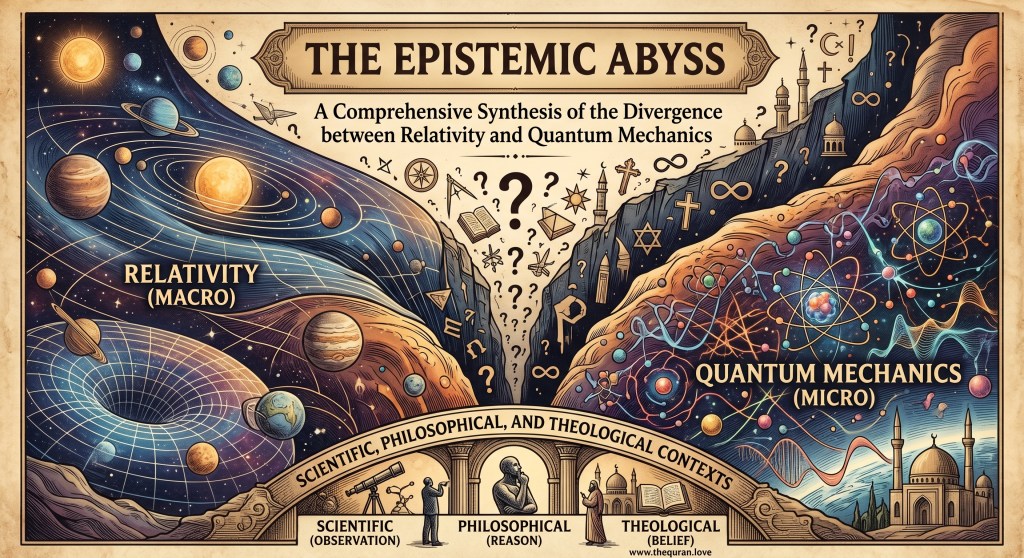
Presented by ChatGPT
Abstract
The familiar slogan that “relativity governs the macro-world while quantum mechanics governs the micro-world” is useful in the classroom, but it is not the deepest map of modern physics. Quantum theory is not confined to tiny things, and relativity is not confined to large ones. The more exact statement is that quantum mechanics has already been reconciled with special relativity in quantum field theory, whereas general relativity still lacks a universally accepted quantum completion. So the problem is not that the two great theories are wholly mute to one another; it is that they do not yet share a single, fully coherent, empirically confirmed language at the places where both should apply at once.
That unresolved junction appears in the deepest regions of black holes, in the earliest moments of cosmology, and near the Planck scale, where intense gravity and quantum effects should both matter. There the difficulty is not a single missing equation but a cluster of mismatches: a disagreement about what spacetime is, a conflict over the status of time itself, a breakdown of ordinary perturbative quantization, and the fact that quantum theory remains philosophically unsettled even before gravity is added. The result is a century-long search for quantum gravity that has produced major partial advances, serious candidate frameworks, and growing experimental ingenuity, yet still no final theory. Philosophically, this does not show that science is futile; it shows that science can be exact without being exhaustive, objective without achieving a view from nowhere, and progressively truthful without being metaphysically complete.
The actual fault line
The slogan “large versus small” hides the real structure of the problem. Quantum field theory already combines quantum mechanics with special relativity and underwrites the Standard Model’s description of electromagnetism and the strong and weak interactions. The sharper fracture line is between quantum theory and general relativity, because general relativity makes spacetime itself dynamical rather than treating it as a fixed arena in which physics unfolds. In that sense, the two theories already partially “talk,” but their conversation breaks down precisely where gravity can no longer be treated as a merely classical backdrop.
The crisis becomes unavoidable in “border regions” of physics: black-hole interiors, cosmological singularities, and the ultra-early universe. General relativity predicts singularities there, and authoritative explanations from both physics institutes and NASA-style educational sources explicitly treat those singularities as signs of the classical theory’s incompleteness, not as triumphant final answers. The search for quantum gravity arises because the domains where general relativity speaks most dramatically are also the domains where its classical assumptions are least trustworthy.
Why the merger resists us
At the scientific level, the first tension is ontological. General relativity says gravity is not just another force on spacetime; gravity is the geometry of spacetime. Standard quantum theory, by contrast, is usually formulated with states, operators, amplitudes, and fields evolving against some background structure. Many quantum-gravity approaches differ precisely over whether a viable theory must be “background independent,” meaning that even geometry itself is subject to quantum treatment rather than presupposed from the start.
The second tension concerns time. In general relativity, time is local, relational, and dynamical; clocks run differently depending on gravitational circumstances, and there is no single universal temporal parameter built into the world. In ordinary quantum theory, by contrast, time usually enters as an external parameter with respect to which states evolve. That is why the literature on quantum gravity speaks so persistently of a “problem of time”: the two frameworks do not merely assign different values to the same variable; they assign different roles to time in the architecture of reality.
The third tension is mathematical. When gravity is treated perturbatively like the other quantum fields, the ordinary renormalization strategy that works so well in particle physics introduces an infinite tower of independent parameters. That destroys the kind of finite predictive economy physicists typically demand from a fundamental theory. Yet this is not utter defeat. Reviews and overviews of effective quantum gravity emphasize that gravity can still be treated as a predictive effective field theory at low energies; the problem is not that quantum gravity says nothing, but that the standard perturbative route does not seem to yield a final ultraviolet-complete theory on its own.
A fourth difficulty is often overlooked: quantum theory itself is not philosophically settled. The operational core works astonishingly well, but there remains no consensus on what that success means metaphysically. Contemporary philosophical overviews still report no consensus on what quantum theory tells us about reality; review literature on the measurement problem likewise emphasizes that decoherence explains the suppression of observable interference between macroscopic alternatives, yet does not by itself explain why one determinate outcome is observed. Work on measurement in relativistic quantum field theory adds a further wrinkle, because an instantaneous collapse picture sits uneasily with relativity of simultaneity and causal structure. So the attempt to merge relativity and quantum theory confronts not just an external incompatibility between two theories, but an internal unfinished business within quantum theory itself.
What the candidate bridges achieve and where they fail
It would therefore be false to say there has been no contact at all between the frameworks. Quantum field theory in curved spacetime already allows physicists to study quantized matter on classical gravitational backgrounds, and it yields the celebrated result that black holes are not entirely black but radiate. That is an authentic bridge between the two domains. But it is also a limited one: matter is quantized while spacetime remains classical. This is a partial conversation, not yet a final synthesis.
Beyond that partial bridge, the candidate programs remain plural. String theory is attractive because a gravitational mode arises naturally within its quantum structure, making it a natural candidate for quantum gravity and, in more ambitious versions, for broader unification. Loop quantum gravity proceeds differently, trying to quantize geometry directly and taking Einsteinian background independence very seriously. Asymptotic safety seeks a nonperturbative ultraviolet fixed point that would render gravity predictive at arbitrarily high energies. And there are even nonstandard alternatives in which gravity may remain classical while quantum theory is modified, rather than the other way around. Philosophically, this diversity matters because it shows that the live options are not just mathematically different solutions to one fixed problem; they encode different judgments about what the problem itself really is.
No program, however, has yet won the decisive empirical contest. Accessible reference sources still state that no complete theory of quantum gravity exists, and recent research commentary continues to describe the field as experimentally underconstrained and methodologically crowded. At the same time, review literature from the last two years makes clear that the situation is no longer one of pure armchair speculation: laboratory proposals at the interface of quantum mechanics and gravity have become increasingly concrete, and massive quantum systems are now being developed as plausible probes of low-energy quantum-gravitational behavior.
The experimental frontier is therefore hopeful but chastening. A 2026 open-access study on a one-milligram torsional pendulum shows real progress toward the sort of precision control that future tests of gravity-mediated entanglement may require. But a 2025 paper also argued that, in a broader quantum-field-theoretic setting, theories with classical gravity can still generate entanglement. That means even a positive tabletop signal may not instantly settle whether gravity is fundamentally quantum. The question is not only hard because the experiments are delicate; it is hard because the interpretation of what would count as decisive evidence is itself under active revision.
What this means philosophically
Philosophically, the present situation is a textbook case of underdetermination. The evidence available at a given time can be insufficient to choose uniquely among rival theories, and the general philosophical literature states that point plainly. Quantum theory already illustrates the problem internally through multiple approaches to measurement and ontology; quantum gravity extends it across the frontier of fundamental physics, where serious programs differ not only in formalism but in world-picture. The result is not chaos, but a discipline forced to recognize that empirical adequacy, conceptual clarity, and metaphysical finality need not arrive together.
History makes the lesson sharper. The philosophy of science literature on realism and theory change stresses that empirically successful theories have often later been revised, restricted, or abandoned. That does not imply that current science is worthless. It implies that scientific knowledge grows through correction, replacement, and retention, rather than through instant possession of final truth. The fracture between general relativity and quantum theory is therefore not a proof that science has failed; it is a concentrated reminder that science is historically powerful and historically fallible at the same time.
This is where the notion of objectivity becomes crucial. Philosophical analysis of scientific objectivity does not simply endorse a fantasy of a perfectly perspective-free grasp of reality. It repeatedly returns to the difficulty, and perhaps impossibility, of a complete “view from nowhere.” What survives criticism is a leaner, more disciplined idea of objectivity: not omniscience, but methods, communities, and practices that reduce bias, expose error, and make claims answerable to evidence and criticism. On that account, the authority of science lies less in total enclosure of reality than in publicly corrigible contact with it.
My own judgment is that the unresolved relation between relativity and quantum theory does demonstrate a limit to human knowledge in an important sense, but not in the sense of nihilism. It demonstrates a limit to totalization. We can know truly without knowing exhaustively; we can formulate equations of extraordinary reach without standing outside the world to survey it whole. By extension—and this is an inference, not an experimental theorem—other human domains should be approached with even greater humility. If the most exact science we possess does not secure a final, aperspectival mastery of being, then political judgment, moral reasoning, historical understanding, and self-knowledge should certainly not pretend to possess one.
Ayat al-Kursi and the horizon of knowledge
The Qur’anic clause you want to weave into this discussion is intellectually apt because it concerns not ignorance in the crude sense, but the non-encompassing character of creaturely knowledge. The translation on renders the relevant segment of 2:255 as saying that no one can grasp any of God’s knowledge except what He wills to reveal, and the tafsir pages on and explain the clause as a statement that created beings receive only that portion of knowledge that is granted to them, never an encompassing totality.
Your two supplied essays—[The Double-Slit Experiment and the Horizon of Knowledge](https://thequran.love/2026/05/12/the-double-slit-experiment-and-the-horizon-of-knowledge/) and %5BThe Quantum Epistemic Wall](https://thequran.love/2026/05/12/the-quantum-epistemic-wall-wave-particle-duality-and-the-boundaries-of-divine-knowledge-in-the-light-of-ayatul-kursi-2/)—are strongest where they resist a simplistic “physics proves scripture” rhetoric. The first explicitly says that the double-slit experiment does not prove theology and is better read as an epistemic and metaphysical reflection on the difference between predictive success and exhaustive comprehension. The second sharpens that reflection into the image of an “epistemic wall,” arguing that in quantum measurement one often gains one kind of access only by surrendering another, so that knowledge is real yet structurally bounded.
If that is the intended use of the verse, the analogy is philosophically respectable. Quantum mechanics does not verify revelation in the way an experiment verifies a scattering amplitude or constrains a parameter. But the structure of quantum theory—complementarity, noncommutativity, decoherence without full closure, competing interpretations, and unresolved measurement theory—does furnish a modern intellectual image of finite knowing. The verse then names, in theological language, something the physics also suggests in formal language: human knowledge is fruitful, granted, partial, and non-encompassing. It reaches reality; it does not surround it.
Open questions and limits
Three cautions are necessary. First, physics has not proved that a final unified theory is impossible; it has only failed, so far, to produce one that is both broadly accepted and empirically decisive. Second, some present obstacles may be contingent, not permanent: future data, new mathematical ideas, or a reformation of quantum theory itself could alter today’s picture substantially. Third, the relation between the scientific material and the Qur’anic clause is interpretive rather than demonstrative. It can deepen a worldview; it cannot compel one the way experimental results can rule out a model.
Thematic epilogue
The deepest lesson of the relativity-quantum divide may be that reality is intelligible without being fully capturable. Human reason has built one magnificent language for continuity, curvature, and gravitation, and another for quanta, amplitudes, and superposition. Each language is astonishingly powerful in its province. Yet where the universe is hottest, densest, and nearest to its own beginnings, those languages no longer sit together in peace. There, theory becomes frontier, and frontier becomes humility. The failure is not the collapse of reason; it is reason discovering that to know the world is not the same thing as to contain it.
Seen in that light, the verse from 2:255 is not hostile to science. It is hostile only to the fantasy that the knower may become sovereign over all that is. Science remains one of the noblest forms of disciplined human inquiry precisely because it reaches so far while still disclosing its own edges. And perhaps that is the most fitting final harmony between physics, philosophy, and revelation here: not that mystery defeats knowledge, but that knowledge reaches its highest dignity when it learns where mastery ends and wonder rightly begins.
For references please go to Microsoft Word file:





Leave a Reply