
Presented by Gemini
Audio teaser: The Divine Code of Biology and Physics
Abstract
This comprehensive research report provides a multidisciplinary analysis of the Quranic passage 6:37-41, integrating classical Islamic exegesis with contemporary zoology, theoretical physics, and metaphysical philosophy. The report begins by contextualizing the human demand for empirical signs (ayat) and the divine response that redirects intellectual inquiry toward the natural world. Central to the investigation is verse 6:38, which identifies non-human creatures as “communities” (umam) analogous to human societies. This assertion is substantiated through a deep dive into modern ethology and sociobiology, specifically examining the emergent complexity of avian murmurations, the social hierarchies of hymenoptera, and the neurobiological foundations of altruism. The analysis then transitions into a philosophical examination of Leibniz’s Question of Questions—why there is something rather than nothing—utilizing the Principle of Sufficient Reason to argue for a Necessary Being. This is further supported by a detailed exposition of cosmic fine-tuning, demonstrating how the biophilic properties of the universe and the fundamental constants of physics point toward an intentional Creator. Finally, the report explores the theological and psychological dimensions of verses 6:39-41, focusing on the Fitra (primordial nature) and the human instinctual call to the Divine in moments of existential crisis. The synthesis reveals a universe that is not a collection of brute facts but a semiotic system where biological order, mathematical precision, and human consciousness converge to testify to the attributes of God.
Verse 37: The Sovereignty of Power and the Nature of Miracles
The discourse begins with the recurring historical tension between the human demand for supernatural validation and the divine presentation of the natural world as the ultimate sign. The Arabic text of verse 6:37 provides the linguistic foundation for this dialectic:
وَقَالُوا۟ لَوْلَا نُزِّلَ عَلَيْهِ ءَايَةٌۭ مِّن رَّبِّهِۦ ۚ قُلْ إِنَّ ٱللَّهَ قَادِرٌ عَلَىٰٓ أَن يُنَزِّلَ ءَايَةًۭ وَلَـٰكِنَّ أَكْثَرَهُمْ لَا يَعْلَمُونَ
The English translation by MAS Abdel Haleem captures the essence of this exchange: “They also say, ‘Why has no sign been sent down to him from his Lord?’ Say, ‘God certainly has the power to send down a sign,’ though most of them do not know.”
The request for a “sign” (ayah) by the contemporaries of the Prophet Muhammad was often a demand for a tangible, sensory-defying miracle—a portent equivalent to the staff of Moses or the she-camel of Salih. The divine response distinguishes between the capacity to perform such acts and the wisdom of their implementation. While the text affirms that God is Qadir (Capable/Determiner) of sending any sign, it highlights a profound ignorance (la ya’lamun) among the questioners. This ignorance is twofold: first, it pertains to the “secrets behind His actions” and the wisdom of delaying requested miracles; and second, it refers to the failure to recognize that the universe itself, in its regularities and biological complexity, is an ongoing miracle that exceeds any singular supernatural event.
Theologically, the refusal to grant a specific, requested miracle is framed as an act of Mercy (Rahmah). Historical precedents indicate that when a people are shown the specific miracle they demanded and subsequently persist in disbelief, they are subject to immediate and total destruction. Thus, the delay is a preservation of the human agency and a call to a higher form of intellect—one that does not require the suspension of natural law to recognize the Lawgiver.
Verse 38: The Zoological Evidence for Divine Craftsmanship
The pivot from the supernatural to the natural is most forcefully expressed in verse 6:38, a verse that has profound implications for modern biology and animal ethics. The Arabic text states:
وَمَا مِن دَآبَّةٍۢ فِى ٱلْأَرْضِ وَلَا طَـٰٓئِرٍۢ يَطِيرُ بِجَنَاحَيْهِ إِلَّآ أُمَمٌ أَمْثَالُكُم ۚ مَّا فَرَّطْنَا فِى ٱلْكِتَـٰبِ مِن شَىْءٍۢ ۚ ثُمَّ إِلَىٰ رَبِّهِمْ يُحْشَرُونَ
MAS Abdel Haleem translates this as: “All the creatures that crawl on the earth and those that fly with their wings are communities like yourselves. We have missed nothing out of the Record– in the end they will be gathered to their Lord.”
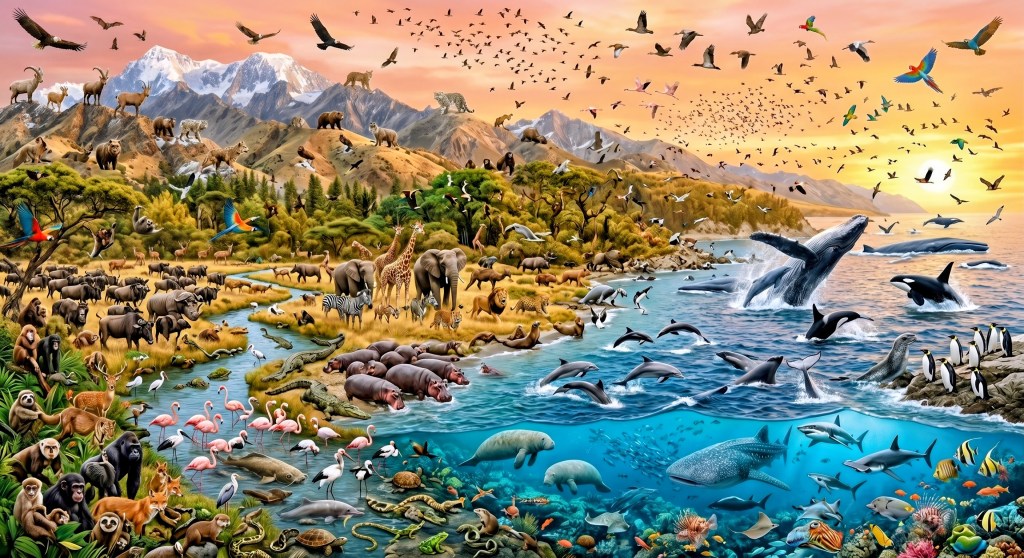
This verse posits a radical ontological equalization between human and non-human life by employing the term Umam (communities/nations) to describe animals and birds. In the Islamic worldview, an Ummah is not merely a collection of individuals but a group characterized by shared purpose, social structure, and divine accounting.
The Myrmecological and Melittological Models of Social Order
Modern zoology provides an extensive empirical basis for the Quranic description of animal societies as “communities like you.” The study of social insects—ants (myrmecology) and bees (melittology)—reveals levels of social organization that mirror, and sometimes exceed, the complexity of human industrial and political structures.
Ant colonies function as “superorganisms” where collective intelligence governs every facet of life. This coordination is not the result of a centralized command but of decentralized interaction protocols.
| Social Dimension | Zoological Mechanism | Theological Implication |
|---|---|---|
| Division of Labor | Specialized castes (queens, workers, foragers, soldiers) manage construction, defense, and brood care. | Reflects the divine “inspiration” and purposeful distribution of roles in creation. |
| Communication | Sophisticated pheromone trails and chemical signaling for environmental awareness and threat response. | Points to an inherent “language” and social consciousness granted to all creatures. |
| Collective Decision-Making | Emergent problem-solving through simple individual interactions leading to complex colony-level outcomes. | Demonstrates a “regulated fixed scheme” and non-random design in nature. |
| Environmental Control | Ants and bees regulate nest temperatures and humidity with extreme precision through collective movement. | Evidence of the “intentionality and thought” invested in the design of each animal. |
The recognition of worker ants as a “female sisterhood”—documented in the Quran’s reference to a female ant (namlatun) in Surah An-Naml—preceded the scientific verification by Pierre André Latreille in 1798 by over a millennium. This “sisterhood” manages all colony operations, illustrating a sophisticated community that operates through mutual satisfaction of needs and distribution of responsibilities.
Avian Murmuration: The Mathematics of Emergent Complexity
The “birds that fly with their wings” are specifically highlighted in verse 38 as communities like humans. One of the most spectacular examples of this communal life is the starling murmuration—a collective behavior where thousands of birds move as a single, fluid entity.
Scientific research into murmurations has transitioned from purely descriptive observations to mathematical modeling. In 1987, Craig Reynolds developed the “Boids” simulation, showing that complex flocking behavior emerges from just three simple rules: separation (avoiding crowding), cohesion (moving toward the center), and alignment (matching velocity). However, subsequent studies by researchers at Princeton and elsewhere found that the reality is even more precise: starlings coordinate their movements with their seven closest neighbors, regardless of the distance between them.
This “topological distance” interaction results in “scale-free correlation,” meaning a change in direction by a single bird ripples through the entire flock instantly, allowing for near-perfect predator evasion. Such behavior characterizes the flock as a “critical system,” finely balanced and responsive to environmental changes. Theologically, these murmurations serve as a “sign” (ayah) of a universe governed by deep mathematical order rather than capricious forces. If the “community” of starlings can achieve such perfect coordination without a centralized leader, it invites human reflection on the source of that ingrained guidance.
Altruism and the Neurobiology of Cooperation
The social complexity of animal communities extends into the realm of “moral-like” behaviors, such as cooperation and altruism. In evolutionary biology, altruism refers to behaviors where an individual reduces its own fitness to increase the fitness of another. While early Darwinian models emphasized competition, modern science increasingly recognizes that “nature is inherently cooperative”.
Cooperative behaviors have been documented across a vast array of species:
- Vampire Bats: Share food with unrelated members of the colony who have failed to feed, exhibiting “reciprocal sacrifice”.
- Cleaner Fish: Engage in a cleaning symbiosis with larger host fish, where the host suppresses its predatory instinct to allow the cleaner to feed on parasites—a behavior requiring repeated interactions and individual recognition.
- Ravens: Guide wolves to prey, demonstrating inter-species cooperation that benefits both groups.
- Marine Mammals: Sperm whales have been observed adopting abandoned dolphins of other species.
The neurobiology of these behaviors suggests they are not merely “voluntary choices” in the human sense but are “hardwired” mechanisms. Neurochemicals like serotonin, oxytocin, and neuropeptides modulate these social propensities in both humans and mammals, creating a “social behavior network” in the brain that responds with pleasure to cooperation. This provides a biological basis for the Quranic assertion that these creatures are “communities like yourselves,” sharing the fundamental substrates of sociality, empathy, and mutual aid.
The Record: Information as the Template of Existence
Verse 38 further declares: “We have missed nothing out of the Record” (or “the Book”). This statement invites a comparison between the theological concept of the “Preserved Tablet” (Al-Lawh al-Mahfuz) and the modern biological concept of genetic information.
The Divine Record vs. The Genetic Ledger
In Islamic theology, the “Record” represents God’s absolute omniscience (Al-‘Alim). Every creature’s name, sustenance, lifespan, and actions are inscribed in this eternal knowledge before their physical existence.
| Theological Category | Metaphysical Function | Scientific Correlation |
|---|---|---|
| Al-Lawh al-Mahfuz | The “Preserved Tablet” containing the unalterable decree of all events. | The “Information Space” of the laws of physics and initial conditions. |
| The Clear Record (Imam Mubin) | Focuses on the “Unseen” world: the origins, roots, and seeds of things. | The DNA/Genome: the digital code containing the potentiality of all biological forms. |
| The Clear Book (Kitab Mubin) | Focuses on the “Manifest” world: the ledger of divine power and the actualized forms. | The Phenotype/Epigenetics: the physical expression of life in the “page of time”. |
The insight that “nothing is missed” resonates with the discovery that every biological trait—from the 40,000 muscles in an elephant’s trunk to the clear hollow tubes of a polar bear’s fur—is a result of a highly specific informational sequence. This information-centric view of life suggests that the “Book” of nature is not a metaphor but a literal description of a universe constructed from code. The motion of particles and the growth of organisms are described in Islamic philosophy as a “writing and copying” of these divine principles onto the “Tablet of Appearance and Dissolution”.
Resurrection and the Moral Worth of Animals
The verse concludes with a profound eschatological statement: “in the end they will be gathered to their Lord.” Classical scholarship, including the tafsir of Al-Tabari and Ibn Kathir, maintains that animals will be resurrected on the Day of Judgment to receive justice.
This “Retribution of the Animals” serves several theological functions:
- Attribute of Justice (Al-Adl): It demonstrates that God’s justice is so absolute that even the “non-obligated” creatures who suffered injustice from their peers will be vindicated.
- Anti-Anthropocentrism: It establishes that animal life has intrinsic moral worth beyond its utility to humans.
- Human Accountability: If animals are to be judged for their interactions with one another, the human responsibility (Khalifah) toward them becomes even more grave.
The Prophet Muhammad’s command to show kindness to all living creatures—noting that “treating animals with kindness is an act of charity”—flows directly from this recognition of their status as “communities” deserving of divine concern.
Philosophical Inquiry: Why Is There Something Rather Than Nothing?
The detailed order of animal communities and the precision of the biological “Record” inevitably lead to the primary question of metaphysics: Why is there anything at all? This question, popularized by Gottfried Wilhelm Leibniz, provides the philosophical framework for the theological commentary on God as the Necessary Being.
Leibniz’s Argument from Contingency
Leibniz’s “Contingency Argument” is a pillar of natural theology. It rests on the Principle of Sufficient Reason (PSR), which states that for every fact or existent thing, there must be a reason why it is so and not otherwise.
The logic is summarized in the following syllogism:
- Everything that exists has an explanation of its existence (either in the necessity of its own nature or in an external cause).
- If the universe has an explanation of its existence, that explanation is God.
- The universe exists.
- Therefore, the explanation of the universe’s existence is God.
The Nature of Necessary vs. Contingent Existence
Leibniz distinguished between “Necessary Beings” and “Contingent Beings.” A contingent being is something that could have failed to exist; its non-existence entails no logical contradiction. The universe is a collection of contingent entities—planets, stars, animals, and physical laws—none of which must exist. Furthermore, modern cosmology indicates the universe is not eternal but began approximately 13.8 billion years ago.
Because the universe is contingent and finite, its “Sufficient Reason” cannot be found within the series of contingent things themselves. To avoid an infinite regress of reasons, there must be a being whose existence is “self-explanatory” and “logically necessary”—one whose nature is to exist. This being, termed ipsum esse subsistens (existence itself) in Catholic philosophy and Al-Wajib al-Wujud (The Necessary Existent) in Islamic philosophy, is the God of the Quran.
Attributes Derived from the PSR
From the Leibnizian argument, several divine attributes can be logically inferred:
- Immateriality: Since the cause of the universe (which includes all matter) must be outside the universe.
- Eternity/Timelessness: Since the cause of time must be unrestricted by time.
- Omnipresence: Since the cause of all space must be present at every point in space.
- Omnipotence: Since the cause must have the power to bring all potential into existence from nothing.
The “something” of the universe—this specific, biological, and complex something—is therefore not a brute fact but a deliberate selection from an infinite range of possible worlds.
The Biophilic Universe: Scientific Evidence for Fine-Tuning
The philosophical argument for a Necessary Being is complemented by the scientific discovery that the universe is “fine-tuned” for life. This “biophilic” property suggests that the constants of nature are not random but fall within extremely narrow, improbable ranges necessary for complex organisms to exist.
The Fine-Tuning of Physical Constants
Theoretical physics has identified several dimensionless constants that, if altered by a fraction, would render the universe a chaotic, lifeless void.
| Constant | Value/Ratio | Variance Limit | Impact of Change |
|---|---|---|---|
| Cosmological Constant (Λ) | 1.289×10−52m−2 | 1 part in 10120 | If slightly more positive, the universe flies apart; if negative, it collapses before stars form. |
| Strong Nuclear Force | 1 (relative strength) | 2% variance | If 2% stronger, diprotons would be stable and all hydrogen would fuse into helium instantly. |
| Nuclear Efficiency (ϵ) | 0.007 | 0.006 to 0.008 | If 0.006, hydrogen could not bond and no chemistry is possible; if 0.008, no hydrogen would survive the Big Bang. |
| Gravitational Constant (G) | 6.674×10⁻¹¹ | 1 part in 1040 | If stronger, stars burn out in millions (not billions) of years; if weaker, stars never form. |
| Expansion Rate of Big Bang | Velocity of expansion | 1 part in 1060 | Any deviation would cause either immediate “Big Crunch” or too-rapid expansion for galaxy formation. |
The Layered Fine-Tuning of Biology
The “fine-tuning” argument has recently expanded into the realm of liquid dynamics. A 2023 study published in Science Advances suggests that the fundamental constants sit within a narrow “sweet spot” that allows liquids to flow properly inside living cells. If these constants shifted by only a few percent, the viscosity and diffusion of water and blood would change dramatically. Water could become “as sticky as tar,” making cellular motion and blood circulation impossible.
This represents a “second layer” of fine-tuning: the universe is not only tuned for the existence of matter and stars but also for the specific “delicate liquid dynamics” that biological communities depend on. The polarity of the water molecule, fit uniquely for life, is a “downstream” effect of these higher-level physical constants. This multi-layered precision reinforces the concept of a Creator who is Al-Hakim (The All-Wise) and Al-Latif (The Subtly Kind), attending to the microscopic needs of a cell as much as the macroscopic needs of a galaxy.
Verse 39: The Pathology of Rejection
Having presented the overwhelming evidence of animal communities and cosmic order, the passage addresses the human response of denial. The Arabic text of verse 6:39 reads:
وَٱلَّذِينَ كَذَّبُوا۟ بِـَٔايَـٰتِنَا صُمٌّۭ وَبُكْمٌۭ فِى ٱلظُّلُمَـٰتِ ۗ مَن يَشَإِ ٱللَّهُ يُضْلِلْهُ وَمَن يَشَأْ يَجْعَلْهُ عَلَىٰ صِرَٰطٍۢ مُّسْتَقِيمٍۢ
MAS Abdel Haleem translates: “Those who reject Our signs are deaf, dumb, and in total darkness. God leaves whoever He will to stray, and sets whoever He will on a straight path.”
Theologically, this verse describes a “spiritual pathology” where the refusal to contemplate the ayat (signs) leads to a state of sensory and intellectual deprivation. This is not an arbitrary punishment but a natural consequence of cognitive closure.
Cognitive Bias and Spiritual Blindness
The exegete Sayyid Abul Ala Maududi explains that “God lets them go astray” by holding back the opportunity for observing His signs from those who choose to remain in ignorance. This is a psychological reality: the same signs—the green leaf, the murmuration of starlings, the fine-tuned constants—that lead a seeker to faith can lead a prejudiced observer to atheism or materialism.
The “darkness” mentioned is plural (Zulumat), suggesting that the paths of error and confusion are manifold, whereas the “straight path” (Sirat Mustaqim) of truth is singular. Those who reject the signs are like the “deaf and dumb” because they have lost the ability to “hear” the message of the cosmos and “speak” the language of gratitude.
Verses 40-41: The Existential Anchor and the Fitra
The passage concludes by appealing to the most basic human instinct—the urge to call upon a Higher Power in moments of extreme distress.
قُلْ أَرَءَيْتَكُمْ إِنْ أَتَىٰكُمْ عَذَابُ ٱللَّهِ أَوْ أَتَتْكُمُ ٱلسَّاعَةُ أَغَيْرَ ٱللَّهِ تَدْعُونَ إِن كُنتُمْ صَـٰدِقِينَ (40) بَلْ إِيَّاهُ تَدْعُونَ فَيَكْشِفُ مَا تَدْعُونَ إِلَيْهِ إِن شَآءَ وَتَنسَوْنَ مَا تُشْرِكُونَ (41)
MAS Abdel Haleem translates: “Say, ‘Think: if the punishment of God or the Hour should come to you, would you call on anyone other than God, if you are being truthful?’ No indeed, it is on Him that you would call. If it were His will, He could remove whatever harm made you call on Him, and then you would forget what you now associate with Him.”
The Primordial Nature (Fitra)
This appeal identifies the Fitra—the innate, natural disposition with which every human being is created. The Fitra is described as the “default factory settings” of the human soul, characterized by a spiritual awareness of God and a recognition of truth and goodness.
While external influences (parents, culture, environment) can “bury” or “pollute” the Fitra, it can never be entirely erased. In moments of existential threat—the “shipwreck” scenario—the artificial layers of culture and ego fall away, and the soul reverts to its original state of dependency on the One.
The Shipwreck Scenario: From Ikrimah to Universal Intuition
The historical case of Ikrimah ibn Abi Jahl serves as a living commentary on these verses. Fleeing Mecca after its conquest, Ikrimah found himself on a ship caught in a terrifying storm. When the passengers began to call exclusively on the One God, abandoning their idols, Ikrimah realized the internal contradiction of his polytheism. His logic was simple and devastating: if only God can save in the sea, only God can save on land. This “re-alignment” with his Fitra led to his conversion and lifelong commitment to Islam.
Theologically, this phenomenon demonstrates that “monotheism is ingrained in the human soul”. The tragedy noted in verse 41 is the tendency of humans to “forget” this moment of clarity once the danger passes, returning to their old associations—a cycle of “heedlessness” that the Quran seeks to break.
Thematic Epilogue: The Synthesis of Divine Attributes and Human Dependence
The commentary on Quran 6:37-41 weaves together four distinct but interlocking threads of evidence for God the Creator.
First, the Zoological Evidence presented in verse 38 establishes God as Al-Khaliq (The Creator) and Al-Hakim (The Wise). The existence of sophisticated “communities” among ants, bees, and birds—functioning with emergent intelligence and mathematical precision—demonstrates that the animal kingdom is not a product of blind chance but a carefully designed social order.
Second, the Record and the Meta-physics of Information reveal God as Al-Alim (The All-Knowing). The presence of an all-encompassing “Book”—paralleled by the digital information in DNA—shows that existence is preceded by a precise informational blueprint. The sustenance of every creature, from the microscopic to the majestic, testifies to God as Ar-Razzaq (The Provider).
Third, the Philosophical and Physical Foundations of the universe establish God as the Necessary Being (Al-Wajib al-Wujud). The biophilic fine-tuning of the constants of physics and the basic question of “why there is something rather than nothing” point toward a cause that is immaterial, eternal, and omnipotent.
Fourth, the Psychological Evidence of the Fitra reveals God as Al-Wadud (The Loving) and Al-Mujib (The Responder to Prayer). The innate human instinct to call upon the One in times of distress is the internal compass that validates the external signs in the universe.
The overarching message to humanity is one of Dependency. Just as the starling depends on the mathematical rules of the murmuration and the ant depends on the chemical signals of its sisterhood, the human depends on the fine-tuned constants of the cosmos and the guidance of the Creator. To recognize this is to be set on the “straight path”; to ignore it is to remain in the “total darkness” of sensory and spiritual deprivation. The passage thus invites a holistic engagement with reality, where science, philosophy, and theology converge to celebrate the unity and mercy of the Lord of all the worlds.





Leave a Reply