
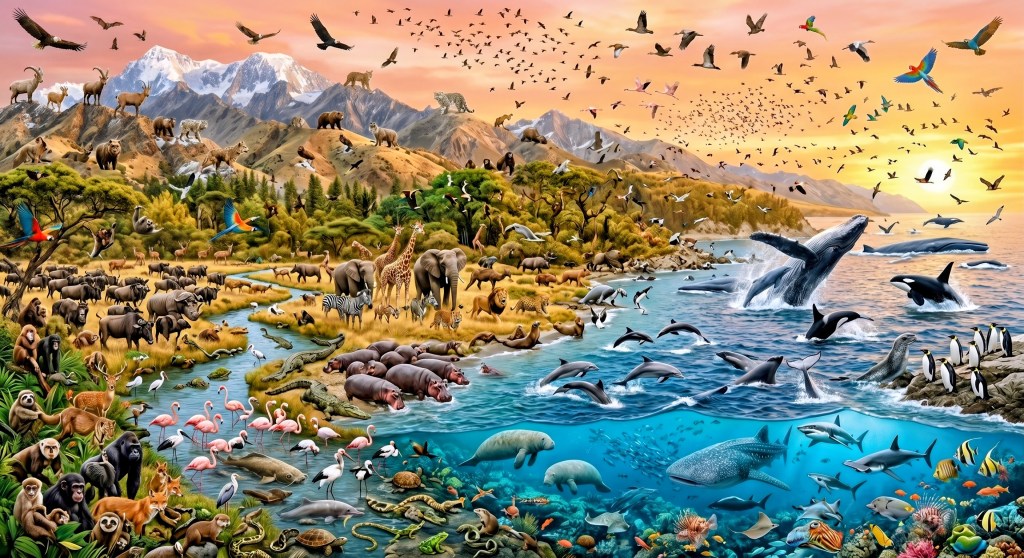
Presented by ChatGPT
Abstract
Qur’an 6:37–41 answers a demand for a spectacular miracle by redirecting attention to a deeper and more pervasive order of signs: the intelligibility of creation itself, the structured life of animal communities, the moral blindness of those who refuse to read those signs, and the existential truth that in extremity creatures turn back toward the One on whom they depend. Verse 38 is especially rich. Classical commentary takes “communities like yourselves” to mean that animals are not chaotic fragments of matter but ordered kinds with provision, affairs, and destinies under divine knowledge; many commentators also connect the verse to a final gathering in which even wrongs among animals are righted. Modern zoology does not show that every species lives in identical ant-like colonies, but it does show that animal life is pervasively organized: by kinship, signaling, collective movement, social learning, division of labor, migration, culture, reproductive systems, ecological networks, and community structure. On a scientific reading, the verse is strikingly consonant with the fact that life is nested in levels of organization from organism to population to community to ecosystem. On a philosophical reading, zoology becomes one part of a cumulative case: not a mathematical proof of God, but a sign of Creator, wisdom, knowledge, providence, justice, and unity. When that case is widened to include the life-permitting structure of the cosmos and the contingency of existence itself, the passage becomes a profound statement of natural theology joined to revealed theology.
The Passage
The Arabic text of 6:37–41, as transmitted in standard verse editions, is as follows.
٣٧ وَقَالُوا۟ لَوْلَا نُزِّلَ عَلَيْهِ ءَايَةٌۭ مِّن رَّبِّهِۦ ۚ قُلْ إِنَّ ٱللَّهَ قَادِرٌ عَلَىٰٓ أَن يُنَزِّلَ ءَايَةًۭ وَلَـٰكِنَّ أَكْثَرَهُمْ لَا يَعْلَمُونَ
٣٨ وَمَا مِن دَآبَّةٍۢ فِى ٱلْأَرْضِ وَلَا طَـٰٓئِرٍۢ يَطِيرُ بِجَنَاحَيْهِ إِلَّآ أُمَمٌ أَمْثَالُكُم ۚ مَّا فَرَّطْنَا فِى ٱلْكِتَـٰبِ مِن شَىْءٍۢ ۚ ثُمَّ إِلَىٰ رَبِّهِمْ يُحْشَرُونَ
٣٩ وَٱلَّذِينَ كَذَّبُوا۟ بِـَٔايَـٰتِنَا صُمٌّۭ وَبُكْمٌۭ فِى ٱلظُّلُمَـٰتِ ۗ مَن يَشَإِ ٱللَّهُ يُضْلِلْهُ وَمَن يَشَأْ يَجْعَلْهُ عَلَىٰ صِرَٰطٍۢ مُّسْتَقِيمٍۢ
٤٠ قُلْ أَرَءَيْتَكُمْ إِنْ أَتَىٰكُمْ عَذَابُ ٱللَّهِ أَوْ أَتَتْكُمُ ٱلسَّاعَةُ أَغَيْرَ ٱللَّهِ تَدْعُونَ إِن كُنتُمْ صَـٰدِقِينَ
٤١ بَلْ إِيَّاهُ تَدْعُونَ فَيَكْشِفُ مَا تَدْعُونَ إِلَيْهِ إِن شَآءَ وَتَنسَوْنَ مَا تُشْرِكُونَ
Following the wording you supplied from M.A.S. Abdel Haleem, the passage reads:
“They also say, ‘Why has no sign been sent down to him from his Lord?’ Say, ‘God certainly has the power to send down a sign,’ though most of them do not know: all the creatures that crawl on the earth and those that fly with their wings are communities like yourselves. We have missed nothing out of the Record– in the end they will be gathered to their Lord. Those who reject Our signs are deaf, dumb, and in total darkness. God leaves whoever He will to stray, and sets whoever He will on a straight path. Say, ‘Think: if the punishment of God or the Hour should come to you, would you call on anyone other than God, if you are being truthful?’ No indeed, it is on Him that you would call. If it were His will, He could remove whatever harm made you call on Him, and then you would forget what you now associate with Him.”
The Inner Logic of the Verses
The first movement of the passage is polemical and epistemological. The disbelievers ask for a sign, but the reply does not deny divine power: God can send whatever sign He wills. Classical commentators say the issue is not inability but wisdom. Some explain that if a demanded miracle were granted and still rejected, destruction would follow, as with earlier peoples; a modern exegetical summary makes the same point and adds that the verse turns the reader toward the signs already strewn across creation. The passage therefore distinguishes between epistemic sufficiency and moral receptivity: the world can already be saturated with evidence while its meaning remains unseen by those who want spectacle rather than truth.
Verse 38 is the hinge. Classical exegesis takes umam not merely as “crowds” but as kinds, species, or organized communities. One set of classical glosses says animals are communities like humans in creation, sustenance, and affairs; another says the divine Book leaves out nothing of their provision, lifespan, and condition. A later tafsir stresses that the verse implies a final gathering of animals and that divine justice extends so far that even injuries among beasts are addressed, which is reinforced by an authenticated Prophetic report about the hornless sheep receiving redress from the horned one. The theological force is immense: animal life is neither metaphysically disposable nor administratively forgotten. It lives under knowledge, measure, provision, and justice.
Verse 39 then turns from zoology to anthropology. Those who deny the signs are “deaf” and “dumb” not because they lack sensory organs, but because they refuse rightful interpretation; they are in darkness because the data of the world have ceased to be luminous for them. A traditional modern commentary interprets divine misguidance here not as irrational arbitrariness, but as God’s leaving people to the path they persistently choose, while guidance is granted to those who sincerely seek truth and make use of the signs placed before them. Philosophically, this is a profound account of moral cognition: evidence alone does not compel fidelity, because persons are not passive cameras but willing readers of reality.
Verses 40–41 move from creation to crisis. The Qur’an asks a devastatingly simple question: when punishment or the Hour arrives, whom will you actually call upon? The point is not merely rhetorical. The passage assumes that beneath idolatry, distraction, and self-sufficiency there remains a deeper recognition of dependence. One expository tradition explicitly says the verse draws attention to another sign within the self: when terror strips away illusion, even hardened people discover how quickly their practical theology collapses into appeal to the One. Modern empirical work on religion and crisis offers an intriguing parallel; for example, cross-national data during the early months of the pandemic found a marked rise in prayer-related searching, consistent with the broader finding that crisis often intensifies religious coping. The Qur’anic claim is stronger than sociology, but sociology does echo its phenomenology.
Animal Communities and the Book of Nature
The most important scientific clarification is this: if verse 38 were read to mean that every animal species lives in the same kind of permanent, highly social grouping, zoology would correct that reading. Sociality is a continuum, not a binary. Some species are highly eusocial, some loosely gregarious, some pair-bonded, some seasonally social, some largely solitary. Recent work on so-called solitary mammals even argues that many are less nonsocial than once thought, showing nonrandom and sometimes amicable interactions outside the obvious contexts of mating. At the same time, biology and philosophy of biology both recognize that organisms are nested in higher levels of organization: group, population, community, ecosystem, and biosphere. So the best scientifically serious reading of “communities like yourselves” is wider than “always living in herds”: it includes species-level organization, patterned interaction, and ecological belonging.
Across insects, the evidence is extraordinary. Eusociality in ants, termites, bees, and wasps involves overlapping generations, cooperative brood care, and divisions of labor so elaborate that biologists routinely speak of colonies as superorganismic systems. Reviews of collective decision-making in insect societies describe distributed sensing, recruitment, consensus formation, and labor allocation that no single individual centrally commands. This is not sentimental projection. It is hard zoological fact: animal communities can store information, coordinate labor, regulate risk, and behave as integrated wholes. In Qur’anic terms, the verse’s language of umam fits not just at the poetic level but at the level of observed natural history.
Among vertebrates, the same pattern appears under different forms. Mammalian social evolution includes kin-based groups, cooperative defense, reproductive skew, alloparental care, and multilevel societies. Schooling fish can improve navigation and collective sensing in noisy environments. Many migrations are shaped not only by genes but by learning and social influence. Animal culture is now documented broadly enough that one major review says there is no doubt it is widespread across vertebrates and invertebrates, marine and terrestrial. Cetaceans provide dramatic examples: pilot whales form extremely cohesive pods, and contemporary work on whale communication suggests highly structured, efficient vocal systems. None of this erases differences between taxa; rather, it reveals a common principle of organized life expressed in many forms. Zoology, taken as a whole, looks less like a heap of unrelated organisms than like a world of ordered living nations.
This is also why verse 38 should not be reduced to visible grouping alone. Biological science is saturated with the language of function and information. Standard philosophical treatments note that biology centrally relies on concepts such as genetic code, transcription, translation, proofreading, signaling, and information carriage; the same is true for animal communication, where calls, scents, shapes, and colors transmit information about food, identity, danger, and mating. Modern biology explains many functions through natural selection and organizational maintenance, and mainstream biology does not endorse a crude “design against evolution” polemic. But that very success raises a deeper metaphysical question: why is reality such that matter can instantiate coding, signaling, memory, coordination, norm-governed error correction, and ecological fit at all? Evolution can model and explain proximate pathways; it does not by itself settle the ultimate question of why a law-governed and information-bearing cosmos exists in which evolution is possible.
The verse becomes even more powerful when one asks what these communities do for human life. Major global assessments state plainly that the biosphere is what humanity depends on. A landmark assessment of pollination concluded that 75% of food crops and nearly 90% of wild flowering plants depend at least in part on animal pollination. Recent work on tropical forests reports that 81% of tropical trees rely on animals for seed dispersal, while reviews of faunal ecosystem services emphasize pest control, disease regulation, pollination, and seed dispersal as key services provided by animal populations. In other words, animals are not only “communities like yourselves”; they are also among the conditions of your own survival. Theologically, that deepens the verse. God’s creatorship is not displayed in zoological beauty alone, but in a providential web on which humanity continuously lives.
From Zoology to a Life-Permitting Cosmos
If verse 37 rebukes the demand for a dazzling intervention, verse 38 implies an alternative theology of signs: the lasting miracle is not the interruption of nature but the intelligibility, fecundity, and lawful order of nature itself. Philosophy of fine-tuning describes situations in which phenomena depend sensitively on parameters lying within very narrow ranges; one standard reference notes that small changes in such parameters can produce radically different outcomes, and that many physicists treat life as delicately dependent on laws, constants, and early cosmic conditions. A major review of the scientific literature on cosmic fine-tuning likewise summarizes the claim that the set of physical laws, parameters, and initial conditions permitting intelligent life may be very small. The Qur’anic answer to “Why no sign?” can thus be read as: you are already standing inside the sign.
Scientific honesty, however, requires care. Not every fine-tuning claim is equally strong, and the literature contains important nuance. One astrophysical paper found that a sizable fraction of parameter space might still allow stars powered by nuclear fusion, suggesting that “star-permitting” is not itself vanishingly rare. But the same broader line of work also shows that a habitable universe needs much more than stars: chemically usable temperatures, long-lived stellar burning, sufficient time for biological evolution, atmospheric retention, complex biospheres, and a very large hierarchy between gravitational and electromagnetic strength. So the strongest theistic inference is cumulative, not simplistic. It does not say, “Any tiny change anywhere and absolutely nothing survives”; rather, it says that the total package required for a stable, chemically rich, life-supporting cosmos is profoundly nontrivial.
The deepest expansion of the passage comes when one moves from fine-tuning to contingency. A standard treatment of the cosmological argument says the question arises from human curiosity about why there is something rather than nothing, and from the desire for a full or best explanation of contingent existence. That question is not answered merely by appealing to a quantum vacuum, because a vacuum is not “nothing” but a law-governed physical state. Philosophers disagree sharply about whether contingency arguments succeed, and that disagreement matters. But the Qur’anic movement here aligns with the form of the question: do not ask only for another event within the world; ask what it means that there is a world, that it is ordered, that it is life-bearing, and that its animal communities are intelligible at every scale. Zoology becomes one chapter in a wider metaphysical astonishment.
Theological Synthesis
From these verses, natural theology flows into revealed theology. Zoology by itself does not yield the whole doctrine of God. But zoology, ecology, and cosmology can function as signs from which several divine attributes are intelligibly inferred. Ordered species and ecological fit point toward knowledge and wisdom. Provision, niche-structure, and biospheric dependence point toward lordship and sustaining care. The comprehensive “Record” evokes exhaustive knowledge rather than neglect. The gathering of animals and rectification of even subhuman wrongs point toward justice. The fact that in crisis beings turn to one ultimate refuge points toward unity. In the passage, those attributes are not abstractly listed; they are enacted through a sequence: power in verse 37, providential order in verse 38, guidance and judgment in verse 39, and sole refuge in verses 40–41.
This also protects the passage from two opposite mistakes. The first mistake is a shallow scientism that says zoology has explained animals, therefore God is unnecessary. The second is an anti-scientific piety that invokes God only where biology is still ignorant. The verses do neither. They do not oppose causes within creation to God; they treat creation’s very regularity as revelatory. On this reading, evolutionary processes, ecological interactions, and animal behavior are not competitors to divine action but modes within a created order whose existence, lawfulness, and directedness toward flourishing are themselves signs. God is not inserted where mechanism stops; God is the reason there is a mechanism-bearing reality at all.
The moral edge of the passage is equally important. By calling animals “communities like yourselves,” the Qur’an decenters human arrogance. Humans are not the only organized society under God, not the only recipients of care, and not the only creatures whose lives matter in the divine economy. The later emphasis on animal gathering and redress intensifies that lesson. If even nonhuman creatures are not forgotten, then human beings, who knowingly harm and exploit, cannot plead insignificance. Verse 38 therefore underwrites an ethic of humility, mercy, and responsibility toward animal life. It is not modern sentimentalism to say so; it flows directly from the verse’s view of animals as real communities under divine regard.
Finally, verse 39 clarifies why such a world can be visible and yet spiritually unreadable. Misguidance here is not best understood as sheer irrational divine caprice. A careful exegetical reading says that God lets those remain astray who insist on closing themselves to the signs, while He guides the sincere seeker by opening the same world as a path to truth. The difference, then, is not whether there are signs, but whether one is willing to be instructed by them. Zoology can become mere data. It can also become doxology. The world does not force the second, but the passage insists that the world continuously invites it.
Epilogue
Taken together, Qur’an 6:37–41 offers a theology of signs more demanding than the hunger for spectacle. The opponents ask for a miracle descending from above; the Qur’an answers by unveiling miracles already swarming below, flying overhead, and silently inhabiting the structure of existence itself. Animal life appears not as a random menagerie but as a plurality of ordered nations; the biosphere appears not as accidental scenery but as a providential matrix on which humanity depends; the cosmos appears not as brute fact but as a life-permitting order whose very being provokes the question of ultimate explanation; and the human soul appears not as self-sufficient but as a creature that, when stripped by danger, remembers where real dependence lies. In this way verse 38 is not an isolated natural-history remark. It is the axis of the whole passage. It turns the desire for an external sign into the discipline of reading creation itself, and from that reading there emerges a cumulative vision of God as Creator, Knower, Sustainer, Guide, Judge, and the One to whom every community returns.
For references, please go the Microsoft Word file:




Leave a Reply