
Presented by ChatGPT
Executive Summary
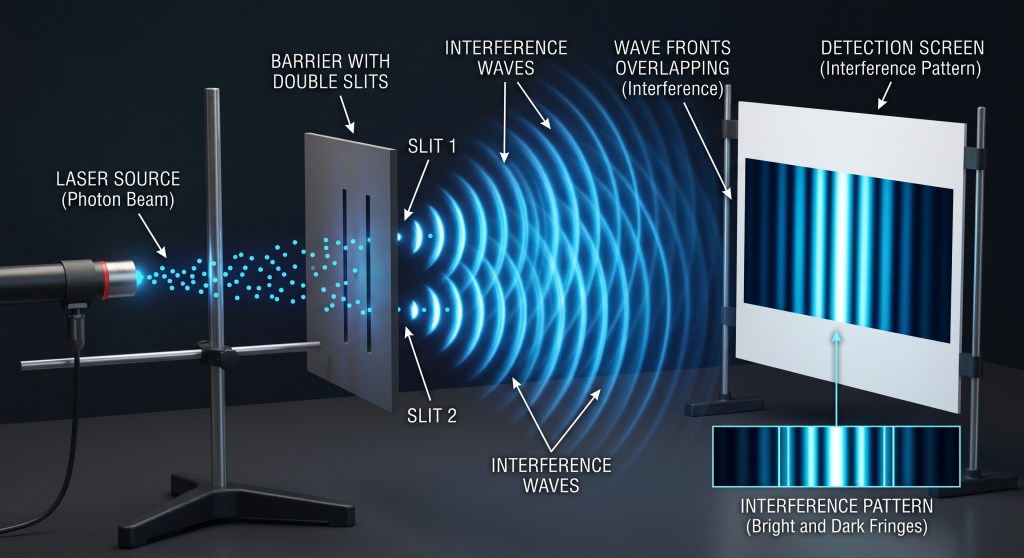
The double-slit experiment remains the clearest laboratory demonstration that the quantum world resists everyday categories. When both slits are open and no which-path information is available, the probability pattern on the screen contains an interference term; when path information becomes available, the interference is reduced or disappears. This is true for light, electrons, atoms, and increasingly large molecules. Modern work has sharpened, not dissolved, the mystery: decoherence explains why interference is suppressed in open systems, but it does not by itself decide why one definite outcome is experienced; delayed-choice and quantum-eraser experiments show that the experimental context matters in precisely quantifiable ways without implying usable signals to the past; weak-measurement experiments map average flow-like structures through the interferometer without collapsing the standard quantum formalism into a single interpretation.
Philosophically, the experiment is not one puzzle but several: what sort of thing the wavefunction is, whether measurement reveals or creates facts, whether causality is fundamental or emergent, and whether “the observer” is epistemic, physical, or both. The major interpretive frameworks answer these questions differently. A Copenhagen-style family emphasizes complementarity and the context of measurement; Many-Worlds relocates definiteness into branching structure; de Broglie–Bohm adds determinate trajectories guided by the wave; objective-collapse models modify the dynamics so that collapse is real; QBism treats quantum states as an agent’s normative expectations rather than a mirror of microscopic reality. The experiment underdetermines these metaphysical options, which is why it is scientifically productive and philosophically inexhaustible at the same time.
Read as commentary on the Qur’anic phrase وَلَا يُحِيطُونَ بِشَيْءٍ مِّنْ عِلْمِهِ إِلَّا بِمَا شَاءَ, the experiment does not prove theology, nor should it be conscripted into a simplistic “scientific miracle” argument. Its stronger value is epistemic and metaphysical: nature is intelligible, but not exhaustively graspable; human inquiry advances by permission through lawful regularities, but it does not become sovereign over being itself. The verse says that creatures do not encompass anything of divine knowledge except what He wills; the double-slit experiment dramatizes, in a modern scientific register, the difference between successful prediction and total comprehension.
Abstract
This report offers a scientifically and philosophically rigorous study of the double-slit experiment, framed as a commentary on the Qur’anic clause “and they do not encompass anything of His knowledge except what He wills” in Qur’an 2:255. It begins with the experiment’s historical and physical foundations, then presents the core quantum formalism of interference, complementarity, and decoherence. It surveys major interpretations of quantum theory—Copenhagen, Many-Worlds, de Broglie–Bohm, objective collapse, and QBism—and reviews modern experimental developments including weak measurements, delayed-choice designs, quantum erasers, and interference with single photons, electrons, atoms, molecules, polypeptides, and very large nanoparticles. Philosophically, it examines ontology, epistemology, causality, and the observer’s role. Theologically, it argues that the verse is best read not as a substitute for physics but as a higher-order statement about the finitude of creaturely knowledge, the conditional grant of intelligibility, and the asymmetry between divine knowing and human modeling. Where a detail could not be recovered verbatim from the requested source, it is explicitly marked as unspecified rather than guessed.
The Qur’anic Phrase and Its Translation Witnesses
The phrase in context occurs inside Ayat al-Kursi, which affirms divine self-subsistence, sovereignty, knowledge, permission, and preservation: “He knows what is before them and what is behind them, and they do not grasp any of His knowledge except what He wills.” Classical and modern English renderings cluster around three motifs—human non-encompassment, the selective grant of knowledge, and divine will/permission as the condition of access. Classical tafsir likewise explains the clause as denying independent creaturely access to the unseen and affirming that any real knowledge possessed by creatures is granted, not self-originating.
The requested comparison page is urlIslamAwakened 2:255 comparison pagehttps://www.islamawakened.com/quran/2/255/. The browsing tool identified that page, but direct opening returned a 403 error, so the table below relies on IslamAwakened translator pages and accessible search snippets. Where the exact segment could not be exposed verbatim in that accessible layer, it is marked unspecified rather than reconstructed from memory.
| Translator | Year if available | Rendering of وَلَا يُحِيطُونَ بِشَيْءٍ مِّنْ عِلْمِهِ إِلَّا بِمَا شَاءَ | URL |
|---|---|---|---|
| John Medows Rodwell | Unspecified on IslamAwakened page | “yet nought of His knowledge shall they grasp, save what He willeth.” | urlIslamAwakened pagehttps://www.islamawakened.com/quran/2/st17.htm |
| Yusuf Ali (Orig. 1938) | 1938 | “Nor shall they compass aught of His knowledge except as He willeth.” | urlIslamAwakened pagehttps://www.islamawakened.com/quran/2/st31.htm |
| Yusuf Ali (Saudi Rev. 1985) | 1985 | “Nor shall they compass aught of His knowledge except as He willeth.” | urlIslamAwakened pagehttps://www.islamawakened.com/quran/2/st30.htm |
| Muhammad Asad | Unspecified on IslamAwakened page | “whereas they cannot attain to aught of His knowledge save that which He wills [them to attain].” | urlIslamAwakened pagehttps://www.islamawakened.com/quran/2/st20.htm |
| Wahiduddin Khan | Unspecified on IslamAwakened page | “They can grasp only that part of His knowledge which He wills.” | urlIslamAwakened pagehttps://www.islamawakened.com/quran/2/st38.htm |
| Talal Itani | 2012 | “and they cannot grasp any of His knowledge, except as He wills.” | urlIslamAwakened pagehttps://www.islamawakened.com/quran/2/st56.htm |
| Dr. Laleh Bakhtiar | Unspecified on IslamAwakened page | “And they will not comprehend anything of His knowledge, but what He willed.” | urlIslamAwakened pagehttps://www.islamawakened.com/quran/2/st46.htm |
| T.B. Irving | Unspecified on IslamAwakened page | “while they embrace nothing of His knowledge except whatever He may wish.” | urlIslamAwakened pagehttps://www.islamawakened.com/quran/2/st47.htm |
| Shakir | Unspecified on IslamAwakened page | “and they cannot comprehend anything out of His knowledge except what He pleases,” | urlIslamAwakened pagehttps://www.islamawakened.com/quran/2/st26.htm |
| Abdul Hye | Unspecified on IslamAwakened page | “And they cannot gain access to anything out of His knowledge except what He wills.” | urlIslamAwakened pagehttps://www.islamawakened.com/quran/2/st75.htm |
| Syed Vickar Ahamed | Unspecified on IslamAwakened page | “They shall not understand the smallest fragment of His knowledge except as He wills.” | urlIslamAwakened pagehttps://www.islamawakened.com/quran/2/st28.htm |
| Bilal Muhammad | 2018 | “And they will not grasp any of His knowledge except as He wills.” | urlIslamAwakened pagehttps://www.islamawakened.com/quran/2/st71.htm |
| Mir Aneesuddin | Unspecified on IslamAwakened page | “and they cannot encompass anything from His knowledge except that which He wills (to impart);” | urlIslamAwakened pagehttps://www.islamawakened.com/quran/2/st60.htm |
| Ali Ünal | Unspecified on IslamAwakened page | “and they do not comprehend anything of His Knowledge save what He wills.” | urlIslamAwakened pagehttps://www.islamawakened.com/quran/2/st7.htm |
| Shabbir Ahmed | Unspecified on IslamAwakened page | “No one can encompass a trace of His Knowledge but through His Laws.” | urlIslamAwakened pagehttps://www.islamawakened.com/quran/2/st25.htm |
| Mustafa Khattab | 2018 | “but no one can grasp any of His knowledge—except what He wills ˹to reveal˺.” | urlIslamAwakened pagehttps://www.islamawakened.com/quran/2/st69.htm |
| Arthur John Arberry | Unspecified on IslamAwakened page | “and they comprehend not anything of His knowledge save such as He wills.” | urlIslamAwakened pagehttps://www.islamawakened.com/quran/2/st10.htm |
| Maududi | Unspecified on IslamAwakened page | “And they cannot comprehend anything of His knowledge save whatever He Himself pleases to reveal.” | urlIslamAwakened pagehttps://www.islamawakened.com/quran/2/st45.htm |
| Umm Muhammad (Sahih International) | Unspecified on IslamAwakened page | “and they encompass not a thing of His knowledge except for what He wills.” | urlIslamAwakened pagehttps://www.islamawakened.com/quran/2/st29.htm |
| Hamid S. Aziz | Unspecified on IslamAwakened page | Unspecified in accessible snippet; the IslamAwakened page for 2:255 was identifiable, but the requested segment was not exposed verbatim in the retrievable snippet. | urlIslamAwakened pagehttps://www.islamawakened.com/quran/2/st15.htm |
As a philological matter, the table shows substantial agreement across translators on the central sense: the clause denies comprehensive creaturely possession of knowledge and makes any true access derivative of divine willing. The differences are mainly stylistic—“grasp,” “compass,” “comprehend,” “attain,” “embrace”—with some renderings adding an interpretive gloss such as “to reveal” or “to impart.”
The Experiment and the Formalism
The modern story begins with the optical double-slit as developed from the work of Thomas Young, but the quantum version became decisive when the same logic was extended to electrons, atoms, and molecules. Electron interference through manufactured slits was already demonstrated in the early 1960s, and the now-iconic single-electron buildup measurements showed that the pattern emerges from individual detection events accumulated over time. Later experiments observed the buildup of matter-wave interference from single-atom detections, while matter-wave interferometry extended the effect to large organic molecules, polypeptides, and nanoparticles with masses reaching into the (10^5) dalton range.


In the simplest textbook description, if the amplitudes associated with the two slits are (\psi_1(x)) and (\psi_2(x)), then the screen probability density is [ P(x)=|\psi_1(x)+\psi_2(x)|^2 =|\psi_1(x)|^2+|\psi_2(x)|^2+2,\mathrm{Re}!\left[\psi_1^*(x)\psi_2(x)\right]. ] The last term is the interference term. It exists only when the two alternatives remain coherent. If the particle becomes entangled with a path-sensitive detector, so that the joint state is (\psi_1|D_1\rangle+\psi_2|D_2\rangle), the visibility depends on the overlap (\langle D_1|D_2\rangle); when the detector states become fully distinguishable, the interference term vanishes in the reduced screen statistics. In two-path form, this tradeoff is captured quantitatively by Englert’s inequality (V^2 + D^2 \le 1), relating fringe visibility (V) and path distinguishability (D).
This point matters because the “mystery” is often misstated. The issue is not that quantum theory has no mathematics for the experiment; it has exquisitely accurate mathematics. The issue is that the same formalism allows several distinct ontological readings. The wavefunction predicts the pattern with extreme precision, but the theory does not, on pain of contradiction with experiment, allow us to treat “which slit” as a classical fact whenever the interference term is present. In other words, predictive mastery outruns intuitive picturing. That is precisely where the experiment becomes a philosophical event.
Decoherence is the modern bridge between idealized interference and ordinary macroscopic experience. In general terms, decoherence occurs when uncontrolled environmental entanglement suppresses the off-diagonal terms of the reduced density matrix in an effectively classical basis. In double-slit language, the environment becomes a kind of ubiquitous, unintended which-path monitor. This has been observed directly in matter-wave interferometry, including collisional decoherence with fullerenes, and developed theoretically for Talbot–Lau arrangements. But decoherence is not identical to a fundamental collapse; it explains the disappearance of observable interference in reduced subsystems, not by itself the selection of one unique outcome from among the decohered alternatives.
Read beside Qur’an 2:255, the formal lesson is already suggestive. Human beings can write the amplitude, calculate the visibility, and engineer the detector overlap. Yet the very success of the formalism also reveals an asymmetry: what is granted is operational access to lawlike structure, not transparent possession of the real “from God’s side,” so to speak. The verse does not denigrate knowledge; it relativizes it. The experiment does not abolish intelligibility; it disciplines claims of total conceptual enclosure.
Modern Experimental Extensions
Weak-measurement experiments pushed the discussion beyond the crude binary of “interference present” versus “which-path measured.” In a much-discussed 2011 experiment, average trajectories of single photons in a two-slit interferometer were reconstructed from weak values, providing a flow-like picture closely related to trajectories in Bohmian analyses. Later work examined nonlocal and “surreal” Bohmian trajectories and quantified momentum disturbance in double-slit which-way measurements. These results do not settle the ontology of trajectories, but they make the structure of quantum propagation experimentally richer than a simple slogan about “wave or particle” suggests.
Delayed-choice experiments, inspired by ideas associated with John Archibald Wheeler, ask whether the decision to reveal interference or path-like information can be made only after the quantum system has entered the interferometer. The modern review literature shows that such experiments do not require retroactive signaling into the past; rather, they reveal that assigning a classical, pre-existing wave-or-particle identity independently of the whole measurement arrangement is not sustainable. Entanglement-enabled delayed-choice experiments and even satellite-scale implementations extend this point without changing the core lesson.
Quantum-eraser experiments sharpen the distinction between disturbance and information. The original proposal by Marlan O. Scully and Kai Drühl showed that interference can be lost when which-path information is in principle available, and then restored in suitable coincidence subensembles when that information is erased. The celebrated delayed-choice quantum eraser experiment realized this logic experimentally, and later variants extended it to other sources and settings. The important point is not mystical causation backward in time, but the conditional structure of quantum statistics: the total unconditioned data need not display fringes, while appropriately sorted subensembles can.
The scale of interference experiments has grown dramatically. High-precision reviews summarize atom and molecule interferometry across many platforms. Large organic molecules showed robust quantum interference in 2011; a native polypeptide was observed in matter-wave interference in 2020; and 2026 work reported quantum interference for even larger nanoparticles, pushing coherence into regimes once thought implausibly macroscopic. These experiments matter not only for quantum foundations but also for testing decoherence mechanisms and constraining objective-collapse models.
Theologically, these advances are striking because they show that “permission” in the verse need not be read as arbitrariness. Knowledge is granted through stable, discoverable order. Human beings do not know quantum phenomena by seizing them absolutely; they know them through delicate, permission-like windows opened by the lawful structure of creation itself—vacuum isolation, phase stability, entanglement control, timing, and decoherence management. The Qur’anic point is therefore not anti-scientific. It is that scientific access is real but contingent.
Interpretations and Philosophical Stakes
The family called “Copenhagen,” associated above all with Niels Bohr and often, more loosely, with Werner Heisenberg, insists that complementary experimental arrangements disclose mutually exclusive but jointly necessary aspects of quantum systems. Historically, scholars of the foundations caution that “the Copenhagen interpretation” is not a single, perfectly unified doctrine, and that Bohr’s own view did not amount to a simple privileging of subjective consciousness. Still, the central moral remains: quantum properties are not describable as context-free classical attributes. In that register, the double-slit experiment says not “reality is irrational,” but “reality is not obliged to fit pre-quantum picturing.”
The Many-Worlds or relative-state approach begins with Hugh Everett III. Here the Schrödinger evolution is taken as universally valid; apparent collapse is replaced by branching structure in which different outcomes are realized in different branches of the total state. In a double-slit context, the disappearance of visible interference at macroscopic scale is understood through decoherence, which separates branches effectively. This view preserves unitary dynamics and removes fundamental collapse, but it pays for that with a much heavier ontology. The philosophical gain is dynamical economy; the metaphysical cost is a plurality of effectively real branches.
The de Broglie–Bohm framework, systematized by David Bohm, adds hidden variables—most centrally, actual particle configurations—guided by the wavefunction. In the double-slit experiment, particles pass through definite trajectories while the guiding wave passes through both slits and shapes the distribution. For many people this feels ontologically clearer than Copenhagen, because a single actual world is retained. But it also accepts explicit nonlocal structure and a wavefunction defined on configuration space. Weak-measurement reconstructions and Bohmian analyses of interference patterns make this interpretation especially vivid in two-slit discussions, though they do not force acceptance of Bohmian ontology.
Objective-collapse models, including the GRW/CSL family, treat collapse as a genuine physical process built into the dynamics. Their attraction is straightforward: they aim to solve the measurement problem by making one outcome actually happen, not merely appear. Their advantage is that they are in principle empirically distinguishable from standard quantum theory, which is why increasingly massive interference experiments and precision noise measurements matter so much. To date, experimental work has constrained substantial regions of collapse-model parameter space rather than confirming a breakdown of standard quantum mechanics.
QBism, developed by figures including Christopher A. Fuchs and N. David Mermin, interprets the quantum state as an agent’s personal probability assignment constrained by the normative structure of quantum theory rather than as a direct picture of microscopic reality. In this framework, the double-slit experiment concerns expectations about possible experiences generated by interventions on the world. QBism’s strength is that it dissolves some pseudo-problems born of reifying the wavefunction too quickly. Its weakness, for many critics, is that it seems to leave too much of the ontology underdescribed. Nonetheless, it powerfully highlights the distinction between what the formalism tells an agent to expect and what exists independently of that formalism.
The philosophical implications are therefore layered. Ontologically, the experiment presses the question of what kind of thing the wavefunction is. Epistemologically, it distinguishes prediction from transparent understanding. Causally, it undermines naïve classical narratives while preserving extremely strict mathematical regularities. Regarding the observer, it blocks casual anthropocentrism: in most serious accounts, what matters is not a magical human gaze but information, entanglement, contextuality, or physical interaction. Here the verse from Ayat al-Kursi becomes illuminating: the limit is not that beings know nothing, but that their knowledge is bounded, granted, and never exhaustive of the Real.
Commentary on the Verse
The phrase “they do not encompass anything of His knowledge except what He wills” can be read at three levels relevant to the double-slit experiment.
At the first level, it speaks of divine epistemic totality. The verse presents God as the one who knows what is before creatures and what is behind them; creaturely knowing is derivative and partial. In quantum physics, the formalism delivers an extraordinarily successful account of correlations, amplitudes, and measurement statistics, but it does not collapse all metaphysical questions into a single, empirically forced worldview. The human achievement is real and magnificent, yet it remains non-encompassing. This is not a failure of science; it is a mark of finitude.
At the second level, it speaks of permission. The same verse that limits knowledge also affirms order: intercession is by permission, and knowledge access is by permission. Scientifically, this resonates not with randomness against reason, but with the idea that intelligibility arrives through stable mathematical and experimental conditions. The reason the double-slit experiment is repeatable is that nature is not chaos. The reason it remains mysterious is that lawful predictability does not entail total metaphysical transparency. Permission, in this commentary, can be read as the condition under which creation is both knowable and not self-grounding to the knower.
At the third level, it speaks of epistemic humility without epistemic surrender. One should not infer from quantum mystery that reason is useless, nor from quantum calculation that reason is omnipotent. The better posture is disciplined humility: build the interferometer, derive the Born probabilities, test duality relations, extend coherence to larger masses, and still admit that the final ontology remains contested. In Qur’anic terms, one knows truly but not totally; in philosophical terms, one has warranted access without absolute enclosure. This is a stronger and more intellectually honest position than either scientistic triumphalism or anti-scientific retreat.
One caution is essential. The verse should not be used as a license to baptize ignorance. “God wills” in the scriptural clause does not mean “stop asking.” The Qur’anic worldview repeatedly invites reflection on signs in creation, while also denying that creation becomes self-explanatory apart from God. Theological commentary is therefore strongest when it honors both poles: inquiry and humility, explanation and transcendence, experiment and metaphysical reserve. The double-slit experiment serves this balance unusually well because it is at once one of the most precise and one of the most conceptually unsettling achievements in science.
Thematic Epilogue
The double-slit experiment is often presented as a scientific shock to common sense. That is true, but it is not the deepest truth about it. Its deepest truth is that reality remains intelligible without becoming domesticated. The fringes appear with mathematical fidelity; the detector statistics obey exact rules; decoherence, entanglement, and complementarity can be measured with extraordinary precision. Yet at the point where one asks, “What is the world, finally, that such rules are true of it?”, consensus fractures. The experiment therefore stands at a threshold where scientific realism, metaphysical caution, and epistemic humility are all forced into conversation.
That threshold is where Qur’an 2:255 speaks with unusual force. They do not encompass anything of His knowledge except what He wills is not an invitation to abandon inquiry; it is a refusal to confuse access with mastery. The scientist is not rebuked here, but situated. Every successful model, every interference trace, every decoherence curve, every delayed-choice setup, every larger mass brought into coherent superposition—these are real acquisitions of knowledge. But they are acquired within a horizon not produced by the knower. The verse names that horizon. The double-slit experiment lets us feel it.
For references please go to Microsoft Word file:




Leave a Reply