
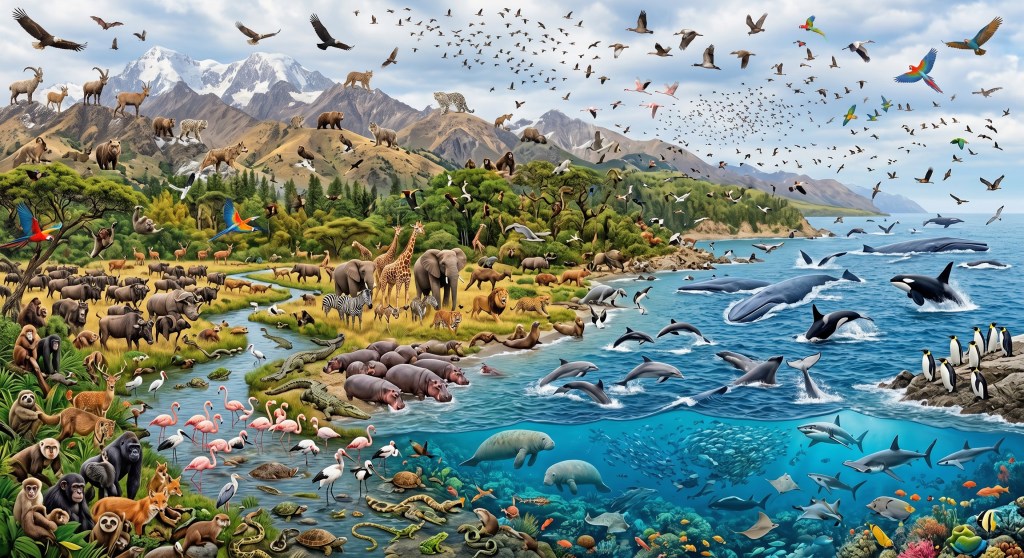
Presented by Claude
Abstract
This commentary undertakes a sustained reading of Sūrat al-Anʿām, verses 37 through 41 — a passage that, in twelve lines of Qur’anic Arabic, traverses the entire epistemology of belief: the demand for a miraculous sign, the redirection of that demand to the signs already woven into creation, the staggering declaration that “all the creatures that crawl on the earth and those that fly with their wings are communities like yourselves” (umamun amthālukum), the theology of guidance and misguidance, and finally the phenomenology of prayer in extremis, where the human soul, stripped of pretense, discovers that it has always been a monotheist. My argument is fourfold. First, the passage’s literary architecture moves from outward sign (verse 38) to inward sign (verses 40–41), framing all theistic argument as a single integrated āyāt-discourse. Second, verse 38’s claim that animals are umam — communities — anticipates with uncanny precision what modern ethology, sociobiology, and cognitive zoology have empirically established over the past seventy years: that honeybees deliberate democratically, that orcas inherit dialects matrilineally, that crows manufacture tools and hold funerals, that elephants mourn, that bacteria converse, and that consciousness has evolved independently along at least two great branches of life. Third, this zoological turn is part of a broader natural theology that the Qur’an inaugurates and that the Islamic tradition, from al-Ghazālī’s kalām cosmological argument to Said Nursi’s “Book of the Universe,” has continually deepened — a natural theology that today finds powerful corroboration in the fine-tuning of physical constants, the mathematical intelligibility of nature, and the informational signature of the living cell. Fourth, the closing verses (40–41) anchor all of this in a phenomenological argument from the structure of the praying soul: in genuine crisis, monotheism is not learned but remembered. Across this synthesis I draw on the classical Sunni mufassirūn (al-Ṭabarī, al-Rāzī, al-Zamakhsharī, al-Qurṭubī, Ibn Kathīr), Shia commentators (al-Ṭabarsī, ʿAllāmah Ṭabāṭabāʾī), Sufi readers (Ibn ʿArabī, Qushayrī, Rūzbihān Baqlī, Rūmī), and modern voices (Said Nursi, Muhammad Asad, Fazlur Rahman, Seyyed Hossein Nasr). The conclusion: Q 6:37–41 furnishes, in compressed form, what may be the Qur’an’s most comprehensive case for theism — and one whose evidentiary base has only deepened with time. My Islam
I. The Passage and Its Place in the Sūra
Sūrat al-Anʿām (“The Cattle”) is, by near-unanimous tradition, a late-Meccan revelation. Al-Suyūṭī in al-Itqān and the report of Ibn ʿAbbās preserved in al-Ṭabarānī state that it descended in a single night accompanied by seventy thousand angels — a tradition cited approvingly by Ibn Kathīr at the head of his tafsīr of this sūra. Its setting is polemical: the Prophet Muḥammad ﷺ confronts a sophisticated pagan opposition that has begun to demand miraculous signs as the price of belief. The sūra’s response is sustained and structural: it is not signs that are lacking but eyes to read them.
Verses 37–41 form a tight rhetorical unit within that response. The Arabic and Abdel Haleem’s English are as follows:
Verse 37:
وَقَالُوا لَوْلَا نُزِّلَ عَلَيْهِ آيَةٌ مِّن رَّبِّهِ ۚ قُلْ إِنَّ اللَّهَ قَادِرٌ عَلَىٰ أَن يُنَزِّلَ آيَةً وَلَٰكِنَّ أَكْثَرَهُمْ لَا يَعْلَمُونَ
“They also say, ‘Why has no sign been sent down to him from his Lord?’ Say, ‘God certainly has the power to send down a sign,’ though most of them do not know.”
Verse 38:
وَمَا مِن دَابَّةٍ فِي الْأَرْضِ وَلَا طَائِرٍ يَطِيرُ بِجَنَاحَيْهِ إِلَّا أُمَمٌ أَمْثَالُكُم ۚ مَّا فَرَّطْنَا فِي الْكِتَابِ مِن شَيْءٍ ۚ ثُمَّ إِلَىٰ رَبِّهِمْ يُحْشَرُونَ
“All the creatures that crawl on the earth and those that fly with their wings are communities like yourselves. We have missed nothing out of the Record — in the end they will be gathered to their Lord.” My IslamQuranX +2
Verse 39:
وَالَّذِينَ كَذَّبُوا بِآيَاتِنَا صُمٌّ وَبُكْمٌ فِي الظُّلُمَاتِ ۗ مَن يَشَإِ اللَّهُ يُضْلِلْهُ وَمَن يَشَأْ يَجْعَلْهُ عَلَىٰ صِرَاطٍ مُّسْتَقِيمٍ
“Those who reject Our signs are deaf, dumb, and in total darkness. God leaves whoever He will to stray, and sets whoever He will on a straight path.” Tafsirq
Verse 40:
قُلْ أَرَأَيْتَكُمْ إِنْ أَتَاكُمْ عَذَابُ اللَّهِ أَوْ أَتَتْكُمُ السَّاعَةُ أَغَيْرَ اللَّهِ تَدْعُونَ إِن كُنتُمْ صَادِقِينَ
“Say, ‘Think: if the punishment of God or the Hour should come to you, would you call on anyone other than God, if you are being truthful?’”
Verse 41:
بَلْ إِيَّاهُ تَدْعُونَ فَيَكْشِفُ مَا تَدْعُونَ إِلَيْهِ إِن شَاءَ وَتَنسَوْنَ مَا تُشْرِكُونَ
“No indeed, it is on Him that you would call. If it were His will, He could remove whatever harm made you call on Him, and then you would forget what you now associate with Him.”
The dialectical structure is exquisite. Verse 37 poses the objection. Verse 38 responds not by performing a miracle but by reframing the entire ontology of miracle: every creature is a sign, every species a verse. Verse 39 explains why this argument, sufficient in principle, fails in practice — there are inner organs of perception, and they can be closed. Verses 40–41 then turn the camera around: if you wish to see God’s sign, look not only at the world but at yourself in extremity, and ask whom you address when the masks of polytheism fall away.
II. Verse 37 — The Demand for a Sign and the Saturation of Signs
The objection in verse 37 — lawlā nuzzila ʿalayhi āyatun min rabbihi, “why has no sign been sent down to him from his Lord?” — is a refrain across the Meccan sūras (cf. 10:20; 13:7, 27; 20:133; 21:5; 29:50). Al-Ṭabarī, in Jāmiʿ al-Bayān, glosses the Quraysh’s demand as a request for a specific evidentiary miracle of their own choosing — a spring from the ground, a house of gold, an angel descending publicly — the kind of miracle catalogued in 17:90–93. Ibn Kathīr makes the same connection explicit, citing 17:59 (“Nothing prevents Us from sending miraculous signs except that previous peoples denied them”) and 26:4 (“If We willed, We could send down to them from the heaven a sign, to which they would bend their necks in humility”). Tafsirq
The Qur’anic response in the second clause of verse 37 — qul inna Allāha qādirun ʿalā an yunazzila āyatan — concedes the divine power but denies the divine intent. Al-Rāzī’s Mafātīḥ al-Ghayb treats this verse in its characteristic dialectical fashion, raising what the tradition calls masāʾil (questions): why does God not send the requested sign? Razi’s answer aligns with the classical kalām tradition: a miracle compelling assent under threat of immediate annihilation (as with previous nations) would void the moral structure of taklīf, religious responsibility. Faith must be free, which means evidence must be sufficient without being coercive.
But the deeper response, withheld here and unfolded in verse 38, is that the demand is misconceived from the start. The disbelievers ask for an āyah while standing inside an inexhaustible library of them. As Said Nursi observes throughout the Risāle-i Nūr, the Qur’an uses the word āyah and its plural āyāt hundreds of times — Nursi tabulates the count of certain key words: the heavens 310 times, the earth 451 times, creation 262 times, and the word āyāt “meaning for the most part ‘sign’ rather than (Qur’anic) ‘verse’ 382” times — “pointing out that these are signs and witnesses making known God.” For Nursi, the universe is al-kitāb al-kabīr, the Great Book, of which the Qur’an is the inspired reading guide; everything from the seed to the supernova is “a luminous letter testifying to its Maker.” Bediuzzamansaidnursi
The closing clause of verse 37 — wa-lākinna aktharahum lā yaʿlamūn, “but most of them do not know” — is therefore not a lament over the audience’s ignorance of metaphysics. It is a lament over their failure to see.
III. Verse 38 — Umam Amthālukum: Animals as Communities
A. The Verse in Classical Tafsīr
The single phrase umamun amthālukum — “communities like yourselves” — is among the most arresting in the entire Qur’an, and the classical mufassirūn have wrestled with it from the start.
Al-Ṭabarī (d. 310/923) reads the verse as a divine self-defense against the charge of inattention: how could God be heedless of human deeds when He is not heedless of the action “of anything that creeps on the earth, small or large, nor of any bird that flies on its two wings”? He has made all of these into ajnāsan mujannasa wa-aṣnāfan muṣannafa — “classified genera and categorized kinds — which know each other as you know each other, and act in what they are subjected to as you act, and whatever deeds they perform are preserved against them, and all of that is recorded in the Mother of the Book.” Ṭabarī cites Mujāhid (no. 13211): umamun amthālukum means “categorized kinds known by their names”; Qatāda (no. 13213): “The birds are an ummah, the jinn are an ummah, and humankind is an ummah“; al-Suddī (no. 13214): “creatures like yourselves” (khalqun amthālukum). Most strikingly, Ṭabarī also preserves a minority report from Ibn ʿAbbās via ʿIkrima (no. 13219) that “the death of the beasts is their gathering (ḥashr)” — i.e., that yuḥsharūn refers not to eschatological resurrection but to death itself. This minority view is rejected by the consensus. quran + 3
Al-Zamakhsharī (d. 538/1144), in al-Kashshāf, brings his characteristic linguistic precision to bear: the word ummah derives from amm, “to intend” or “to head toward,” so an ummah is a body unified by a common direction, instinct, or end. Animals form umam in the sense that each species moves toward its own characteristic livelihood, mating, locomotion, and habitat. The likeness to humans (amthālukum) is therefore real but not univocal: animals resemble us in being constituted communities under divine governance, sharing in the rizq (sustenance) and tadbīr (governance) that the Lord apportions. The Academy for Learning Islam
Al-Rāzī, in Mafātīḥ al-Ghayb, raises several questions on this verse: in what sense, precisely, are animals “like us”? He enumerates likenesses: in being created and sustained by God; in having appointed life-spans; in being divided into species and subspecies with distinguishing characteristics; in possessing a measure of perception, choice, and instinct; in being subject to a meticulous divine reckoning recorded in the Preserved Tablet. Razi denies that animals share in taklīf — moral-legal responsibility — but affirms that they share in a kind of cognitive and social life that mirrors ours in form even where it differs in degree.
Al-Qurṭubī (d. 671/1273) emphasizes the juridical and ethical consequences: since animals are umam, they must be treated with the respect due to communities under God’s care. He cites the famous hadith of the woman punished for imprisoning a cat and the hadith of the man rewarded for giving water to a thirsty dog. The verse, on Qurṭubī’s reading, grounds the Islamic ethic of iḥsān (excellence) extended to all creatures.
Ibn Kathīr (d. 774/1373) consolidates the previous tradition and stresses the verse’s epistemic punch line: God’s omniscient knowledge encompasses every creature without exception. He cites the parallel verse 11:6: “There is no creature on earth whose provision is not guaranteed by God; He knows where it lives and where it dies — all is recorded in a clear book.” Quran.comQuran.com
B. The Shia Reading
The major Imāmī mufassirūn deepen these themes. Al-Ṭabarsī (d. 548/1153), in Majmaʿ al-Bayān, focuses on the justice-logic of the animal ḥashr: if animals suffer in this world — and they evidently do, from predation, hunger, disease, and human cruelty — then divine justice (ʿadl, a foundational principle of Shia kalām) requires that they receive recompense. As Tabarsi puts it: “The Almighty Allah resurrects the animals to give them what they are eligible for; that is, recompense for the pain they suffered in the world, and He exacts revenge for some from others, while what they were deserving of reaches them.” Tabarsi reports three positions on the eschatological status of animals: that their recompense is eternal; that it is time-bound; and that God continues to bless them perpetually by tafaḍḍul (gracious bestowal). He cites the famous hadith narrated by Abū Hurayra that on the Day of Resurrection, “the hornless sheep will exact retribution from the horned ram; then He will say, ‘Be dust,’ and they will all oblige.” Wikipedia + 5
ʿAllāmah Muḥammad Ḥusayn Ṭabāṭabāʾī (d. 1981), in al-Mīzān, develops the most philosophically sophisticated modern reading. For Ṭabāṭabāʾī, the verse establishes that every species of animal is a self-contained community under a Lord, with its own rizq, its own ajal (term), its own internal differentiation and social organization. The likeness to human community is therefore ontological, not merely metaphorical: animals are under the same Lord, recorded in the same Book, and gathered to the same eschaton. The implication is anti-anthropocentric in the precise sense Tabataba’i intends: humans are one ummah among the umam of God, distinguished by ʿaql (intellect) and taklīf (responsibility), but not by ontological isolation. The Academy for Learning Islam
C. The Sufi Reading
The Sufi mufassirūn read the verse as opening onto a vision of cosmic theophany. Al-Qushayrī (d. 465/1074), in Laṭāʾif al-Ishārāt, treats every verse of the Qur’an as a doorway to interior meaning, with no exoteric apparatus blocking the way; on 6:38, the Sufi reading is that each community of creation manifests a distinct aspect of the divine ṣifāt (attributes) — the bee manifests al-Ṣāniʿ (the Artificer), the ant manifests al-Ḥakīm (the Wise), the lion al-Qahhār (the Subduer), the dove al-Wadūd (the Loving), and so forth.
Rūzbihān Baqlī (d. 606/1209), in ʿArāʾis al-Bayān, writes a tafsīr ṣūfī ishārī — purely allusive Sufi commentary — that treats animal communities as veils of divine self-disclosure (tajallī): every species is a particular face of the Real, a particular modality of His Being.
Ibn ʿArabī (d. 638/1240) is the most systematic. In Chapter 198 of al-Futūḥāt al-Makkiyya, he associates the twenty-eight letters of the Arabic alphabet with primordial divine letters, each corresponding to a divine name and a category of creatures. As William Chittick summarizes Ibn ʿArabī’s vision, “all things are living words articulated in the breath of the All-Merciful; life is the sphere of Mercy that embraces everything.” Ibn ʿArabī criticizes those who treat the Qur’anic notion of inanimate or animal speech (cf. 17:44; 27:18) as merely metaphorical: the ahl al-kashf, the people of unveiling, “can directly perceive the speech of all things, which reveals that all creation is alive and aware.” The Arabic word bahīma — “dumb beast” — derives, Ibn ʿArabī notes, from a root meaning “obscure”: it reflects the difficulty humans have in perceiving animal tasbīḥ (glorification), not any deficiency in the animal. The Matheson Trust + 2
Mawlānā Rūmī, in the Mathnawī (III.3901ff., Nicholson trans.), sets the verse in a vast evolutionary-spiritual frame:
“I died as mineral and became a plant, / I died as plant and rose to animal, / I died as animal and I was man. / Why should I fear? When was I less by dying? / Yet, once more, I shall die as man, to soar / With angels blessed; but even from angelhood / I must pass on; all except God doth perish.” Medium + 2
For Rūmī, the great chain of being is not a hierarchy of separation but a continuum of ascent, and the animal ummah is the immediate ancestor of the human in spiritual genealogy. Seyyed Hossein Nasr reads this as a metaphysical ascent within the divine archetypes, in which biological evolution may be one outward sign among others.
D. The Modern Synthesis
Muhammad Asad, in The Message of the Qur’an, translates umamun amthālukum as “[God’s] creatures like yourselves,” and supplies a luminous footnote: the verse asserts that “man can detect God’s ‘signs’ or ‘miracles’ in all the life-phenomena that surround him, and should, therefore, try to observe them with a view to better understanding ‘God’s way’ (sunnat Allāh) — which is the Qur’anic term for what we call ‘laws of nature.’” Alim
Said Nursi‘s “Book of the Universe” reaches its most sustained expression here. For Nursi, every animal community is a stamped page — a muhrun of divine craftsmanship — and the variety of umam is the variety of the divine al-Asmā’ al-Ḥusnā manifesting themselves through created mirrors. “It is clearly, self-evidently, Divine Mercy,” he writes in The Words, “which, without forgetting or confusing any of them, raises, nurtures, and administers the four hundred thousand different plant and animal species on the earth at precisely the right time, and with perfect order, wisdom, and beneficence, and stamps the Seal of Divine Oneness on the face of the globe of the earth.” Nur
Fazlur Rahman, in Major Themes of the Qur’an, situates the verse within his larger account of the Qur’anic worldview as a taqdīr-cosmology: every creature is given a qadar (measure), and the system of measured creatures constitutes the sunnat Allāh. Rahman emphasizes that the Qur’an’s natural theology is not a deistic argument for an absent watchmaker; it is an ongoing testimony to a sustaining, intimately involved Creator.
Seyyed Hossein Nasr brings the ecological note: in works such as Religion and the Order of Nature and Man and Nature, he reads 6:38 as the Qur’anic foundation for a non-anthropocentric Islamic environmental ethic. Every species is an ummah, every ummah glorifies its Lord (17:44; 24:41), and to extinguish a species is to silence one of the voices of cosmic tasbīḥ.
IV. The Zoological Confirmation: Animal Communities in the Light of Modern Science
The remarkable thing about verse 38 is that the more we have learned about animal life over the past hundred and fifty years, the more the verse’s plain claim — that animals form communities like ourselves — has been vindicated in the very details modernity once dismissed. What follows is a survey of accessible, well-attested examples. Each is offered as a contemporary footnote to the Qur’anic umamun amthālukum.
A. The Hive: Bees and the Democracy of the Swarm
The Qur’an’s most extensive treatment of an insect community is in Sūrat al-Naḥl (16:68–69), where God speaks of inspiring (awḥā) the bee, of its labyrinthine houses in the mountains and trees, and of the healing honey of varied hues produced from “the paths of her Lord made easy for her.” The Bedouin in seventh-century Arabia had no inkling of what modern apiology has revealed, but the verse names exactly the most astonishing feature of the colony: the bee acts under guidance.
Karl von Frisch’s Nobel-winning discovery of the waggle dance in the 1940s, and the work of his student Martin Lindauer (beginning in 1949) and later Thomas Seeley’s decades of research at Cornell on house-hunting swarms, have decoded what is unquestionably a language. A scout bee returning from a candidate nest site performs a figure-eight dance on the vertical comb whose duration, angle relative to vertical, and vigor encode, respectively, the distance to the site, its direction relative to the sun, and its quality. Other scouts read the dance, fly to inspect the site themselves, and if they concur, dance for it in turn. Seeley’s Honeybee Democracy (Princeton, 2010) documents how a swarm of approximately ten thousand bees, having sent out roughly three hundred scouts to evaluate ten to twenty potential homes, converges on the best available site through a quorum-sensing mechanism in which dancers are programmed to stop dancing after a fixed period regardless of personal conviction — an engineered safeguard against the tyranny of the loud first voice. As Seeley writes, the swarm’s process is “a product of disagreement and contest rather than consensus or compromise” that “consistently yields excellent collective decisions.” A swarm of bees deliberates better than most human committees. Cornell ChronicleCornell Chronicle
This is umamun amthālukum with a vengeance. The bees have not merely a community but a polity, with elections, debate, time-limited speech, and reliable convergence on truth. Said Nursi’s intuition that the bee is “a small but significant epistle of the All-Wise Maker” gains in evidentiary depth with each Seeley experiment.
B. The Colony: Ants, Termites, and the Invention of Agriculture
The Qur’an names the ant only once, in 27:18, where an ant warns her colony of the approach of Solomon’s army — a passage Sufi exegetes have always read as evidence of intra-species communication ratified by revelation.
Modern myrmecology shows that Atta leafcutter ants of the New World tropics maintain underground fungus gardens — they cultivate a specific fungus, Leucoagaricus gongylophorus, feeding it leaf fragments and protecting it with antibiotic-producing Pseudonocardia bacteria carried on their bodies. This is agriculture, with crop, pesticide, and even a kind of livestock symbiont. The phylogeny is precisely dated. Mueller et al. (2008), “The evolution of agriculture in insects,” in PNAS, concluded that “ant agriculture had a single origin ≈50 million years ago,” while “the leaf-cutter ants evolved remarkably recently (≈8–12 million years ago)” — meaning that fungiculture in ants predates human agriculture by a factor of roughly five thousand even in its most recent leafcutter form. Dorylus and Eciton army ants conduct organized raids with vanguards, flanking columns, and rearguards. Honeypot ants store food in living workers. Slave-making Polyergus species conduct slave raids. Termite mounds in southern Africa engineer airflow with such precision that the architect Mick Pearce explicitly imitated them in designing the Eastgate Centre in Harare, which functions without conventional air conditioning. PNASPNAS
The eusocial insects together — bees, wasps, ants, termites — represent a vast share of all terrestrial animal biomass. The Qur’an’s umam is, biomass-wise, largely insects.
C. The Pod: Cetaceans, Songs, and Matrilineal Dialects
The seas yield a parallel revolution. Bottlenose dolphins, studied by Diana Reiss, Vincent Janik, and others, address each other by signature whistles — individual names that function exactly as proper nouns. Sperm whales communicate in stereotyped click patterns called codas that differ between vocal clans in the same ocean basin and are inherited matrilineally. Humpback whale songs evolve over years and propagate horizontally across populations in waves of cultural transmission; Garland et al. (2011), “Dynamic Horizontal Cultural Transmission of Humpback Whale Song at the Ocean Basin Scale,” Current Biology, identified eleven distinct song types spreading west-to-east across the South Pacific in just two years and concluded that “the level and rate of change is unparalleled in any other nonhuman animal and thus involves culturally driven change at a vast scale.” ScienceDirect
The orca (Orcinus orca) is the showpiece. The matrilineal pods of the Pacific Northwest, studied for half a century, consist of a female matriarch, her sons and daughters, and her daughters’ offspring; males remain with their mothers for life, an arrangement almost unmatched in the mammalian world. Each pod has its own dialect of pulsed calls, learned in infancy by long apprenticeship, and stable across generations. As Hal Whitehead and Luke Rendell’s foundational Behavioral and Brain Sciences paper “Culture in Whales and Dolphins” (2001) established, orca cultures “appear to have no parallel outside humans, and represent an independent evolution of cultural faculties.” Resident pods perform “greeting ceremonies”: two lines of orcas line up facing each other, hold formation for ten to thirty seconds, then mingle. Different pods in the same waters have different prey preferences and hunting techniques — Salish Sea residents eat Chinook salmon and decline to switch to abundant sockeye, in what Howard Garrett of Orca Network has called a cultural “rule” so strong that it holds even against severe nutritional cost. Genesishow + 4
To say that orcas form umamun amthālukum is no longer a poetic stretch. They live in distinct nations, with distinct languages, mores, and traditions, governed by elder matriarchs whose memory of distant feeding grounds keeps their families alive through droughts and lean years.
D. The Politics: Chimpanzees, Bonobos, and Gorillas
Frans de Waal’s classic Chimpanzee Politics: Power and Sex Among Apes (1982), based on the Arnhem Zoo colony in the Netherlands, demonstrated that chimpanzee males form coalitions, switch sides strategically, reconcile after fights, and replace alpha males not merely by force but by alliance — a pattern de Waal compared explicitly to Machiavelli. The triumvirate of Yeroen, Luit, and Nikkie at Arnhem played out, before de Waal’s recording equipment, a sequence of betrayals and reconciliations indistinguishable in structural logic from any human royal court. “The roots of politics,” de Waal concluded, “are older than humanity.” Amazon + 2
Wild chimpanzees in Gombe (Goodall) and Mahale (Nishida) wage what can only be called wars — the four-year “Gombe Chimpanzee War” of 1974–1978 saw one community systematically annihilate a splinter group. Bonobos, by contrast, resolve conflict through sex and form female-bonded coalitions that suppress male aggression. Mountain gorillas live in stable harems led by silverbacks who mediate disputes. The great apes do not merely share genes with us; they share the recognizable shapes of political and familial life.
E. The Herd: Elephants, Matriarchy, and Mourning
Cynthia Moss’s Amboseli Elephant Research Project (AERP), founded in 1972 and the longest-running study of any land mammal, has documented elephant societies of staggering complexity. African elephants live in multi-generational matrilineal families led by the oldest female, whose memory of distant water sources during droughts is the difference between survival and starvation. Joyce Poole has catalogued more than thirty distinct mourning behaviors: elephants returning to the bones of relatives years after death, gently turning the skulls with their trunks, standing vigil for hours, covering corpses with branches and earth. WikipediaAnimals Around The Globe
Echo, the matriarch Moss followed for thirty-six years, led a family of forty elephants and was known by name to the rangers who watched her die in May 2009. The matriarch Theodora of the “T” family, first recorded by Moss and Harvey Croze in 1973, died in 2023 at age fifty-seven, having survived five droughts and brought her entire family through the worst of them. These are histories of nations, not herds. Global VoicesGlobal Voices
F. The Pack: Wolves and Cooperative Hunters
Wolves live in family packs typically composed of a breeding pair and their offspring of multiple years. They hunt cooperatively, with role differentiation — some wolves drive prey, others flank, others ambush. They mourn pack members; they teach pups; they have facial signals and an elaborate vocal repertoire. The 1995 reintroduction of wolves to Yellowstone has, through trophic cascade documented by William Ripple and Robert Beschta, restructured the entire ecosystem, demonstrating that a wolf pack is not just a community for itself but a keystone in the community of all its neighbors.
Cooperative hunting is widespread. Lionesses use coordinated ambushes; African wild dogs achieve hunt-success rates among the highest of any large predator through tireless team pursuit; orcas in the Antarctic generate coordinated waves to wash seals off ice floes — and have been observed returning seals to the ice to allow younger pod members to practice the technique, an act of pedagogy that approaches the threshold of culture.
G. The Murder of Crows: Corvid Cognition
The corvids — crows, ravens, jays, magpies, jackdaws — have brains the size of a human thumb yet match great apes on many cognitive tasks. The New Caledonian crow named Betty, in a 2002 Oxford experiment by Alex Kacelnik and colleagues, was given a straight piece of wire she had never seen before and a tube containing food beyond reach; she spontaneously bent the wire into a hook to retrieve the food. Wild New Caledonian crows manufacture hook tools from pandanus leaves, tearing them into stepped, tapered, or wide shapes that are consistent within populations and variable between them — culturally transmitted, in other words, by young crows watching older crows. Unteachable Courses
Crows and ravens hold what observers have called “funerals” — gatherings around a dead conspecific that combine investigation, vocalization, and what looks for all the world like collective remembrance. Dr. Kaeli Swift’s work at the University of Washington has documented these behaviors systematically. New Caledonian crows can plan three steps ahead in tool tasks (Boeckle et al., “New Caledonian crows plan for specific future tool use,” Proceedings of the Royal Society B, 287:20201490, November 2020). They recognize human faces and hold grudges across years.
H. The Sky-Bridge: Migratory Birds and Their Navigation
The Arctic tern (Sterna paradisaea) executes one of the most extreme migrations known. Egevang et al. (2010), PNAS, tracking terns with miniature geolocators, concluded that “the total distance traveled in a lifetime may exceed 2.4 million km, equivalent to approximately three return journeys to the Moon.” The bar-tailed godwit holds the absolute record for non-stop avian migration: a juvenile bird tagged “234684” flew approximately 13,560 km from Alaska to Tasmania without stopping for food or rest between October 13 and 24, 2022, breaking the previous record of approximately 12,854 km set in 2020 by the male “4BBRW,” as documented by the USGS and Guinness World Records. European robins and other songbirds navigate using a quantum mechanism in their eyes — radical-pair magnetoreception, in which the cryptochrome protein responds to the geomagnetic field through electron-spin coherence. PNASGuinness World Records
The Qur’an’s mention of ṭāʾirin yaṭīru bi-janāḥayhi — “a bird that flies with its two wings” — is taken in classical tafsir as a deliberately emphatic phrase. Modern aerodynamics, still grappling with the flight mechanics of small insects, confirms the wisdom of that emphasis.
I. The Reef: Cleaner Fish, Mutualism, and the Mind of the Octopus
Coral reefs are umam in convocation. Cleaner wrasse fish maintain “cleaning stations” where larger fish queue for parasite removal; the wrasses honor the truce by not biting their clients’ gills, and clients honor it by not eating the cleaners. Redouan Bshary’s experiments have shown that cleaner wrasses recognize regular clients, prioritize them, and even punish cheating partners. Kohda and colleagues, in PLOS Biology (2019), provoked a major scientific controversy by claiming that cleaner wrasses pass the mirror self-recognition test, placing them — if the result holds — in the cognitive company of great apes, dolphins, and elephants.
The octopus, an evolutionary cousin separated from us by some six hundred million years, possesses approximately two-thirds of its half-billion neurons in its arms. As Peter Godfrey-Smith argues in Other Minds (Farrar, Straus and Giroux, 2016), the cephalopods are “an independent experiment in the evolution of large brains and complex behavior” — they evolved minds separately. Octopuses solve puzzles, recognize individual humans, escape from sealed jars, use coconut shells as portable armor (a documented case of tool use in invertebrates), and arguably dream. Umamun amthālukum — a community like ours — emerged twice on this planet, by two independent paths. WikipediaGoodreads
J. The Town: Prairie Dogs and the Linguistic Genius of Rodents
Con Slobodchikoff of Northern Arizona University has spent more than thirty years decoding the alarm calls of Gunnison’s prairie dogs. He has demonstrated that their squeaks contain not just predator category — coyote, hawk, dog, human — but predator description: color of clothing, size, shape, speed, even whether a human appeared with a gun on a previous day. As Slobodchikoff phrases it: “In one tenth of a second, they say, ‘Tall thin human wearing blue shirt walking slowly across the colony.’” Different prairie dog colonies have regional dialects; Dennis, Shuster, and Slobodchikoff (2020), in Animal Behaviour, demonstrated that the calls of one black-tailed colony differ from those of another in ways correlating with geographic distance, “similar to that observed in human dialects resulting from cultural diffusion.” Prairie dogs have even been observed using deceptive alarm calls — a losing combatant in a fight giving a false coyote alarm to send his opponent diving for the burrow. Deception, dialect, description: prairie dogs satisfy three of linguistics’ central criteria for language. Animal Cognition + 3
K. The Smallest Community: Microbial Quorum Sensing
If verse 38 names dābbah (creature that crawls) and ṭāʾir (creature that flies), modern biology adds a tier of creatures the seventh-century world had no instruments to see: bacteria. Bonnie Bassler of Princeton, developing Mike Silverman’s earlier work on Vibrio fischeri, has shown that bacteria communicate via quorum sensing — secreting autoinducer molecules that allow them to count their numbers and switch on group behaviors only when a threshold is reached. V. fischeri bioluminesce only when dense enough to be useful to their squid hosts; V. cholerae and Staphylococcus aureus coordinate virulence gene expression through quorum sensing. Biofilms — bacterial cities with circulatory channels, division of labor, and architectural integrity — are now understood as the dominant mode of bacterial life. Bassler has shown that bacteria “speak multiple languages”: species-specific autoinducers for intra-species coordination, and a universal autoinducer (AI-2) that enables cross-species communication. HHMI + 5
The Qur’an’s umamun amthālukum extends, then, all the way down. Even the bacterium is in an ummah; even the bacterium counts heads.
V. The Theological Argument from Zoology: Divine Names and Attributes
The classical Islamic theological tradition reads creation as a manifestation (tajallī) of God’s names (al-Asmā’ al-Ḥusnā). The argument from animal communities, when made fully, is not merely an argument from design but an argument that derives from each feature of created life a specific divine attribute on which we then depend.
If animals form orderly communities under apportioned sustenance, then there is al-Razzāq, the Provider, whose name the Qur’an invokes in 51:58: “Indeed, it is God who is the Provider; He is the Strong, the Firm.” Q 11:6 makes the connection to 6:38 explicit: every dābbah has its rizq guaranteed.
If the orca matriarch leads her family with memory and care; if the elephant grandmother knows the water-hole forty kilometers away; if the mother wolf returns to her cubs with food in her stomach to regurgitate; then there is al-Raḥmān and al-Raḥīm, the Mercifully Compassionate, whose mercy (as the hadith in al-Bukhārī and Muslim says) is divided into a hundred parts of which only one was sent down to earth, “from which the mare lifts her hoof from her foal lest she trample it.” Said Nursi reads each instance of animal nurture as a stamped seal of divine mercy on the page of creation.
If the bee swarm chooses the best home through a deliberative process more reliable than most human committees; if the leafcutter ant cultivates a fungus with antibiotic-secreting bacteria for ten million years without crop failure; if the octopus opens a jar from inside; then there is al-Ḥakīm, the Wise, the source of the wisdom that animals do not generate but participate in.
If God knows where every fish swims and every bird alights, if “not a leaf falls but He knows it, nor a grain in the dark places of the earth, nor anything fresh or dry, but is in a clear Record” (6:59), then there is al-ʿAlīm, the Knower.
If “We have missed nothing out of the Record” (mā farraṭnā fī l-kitābi min shay’), then there is al-Muḥṣī, the Recorder, the One who counts. And if every creature is finally to be gathered to its Lord (ilā rabbihim yuḥsharūn), then there is al-Bāʿith, the Resurrector, and al-ʿAdl, the Just, in whom Tabarsi anchored his reading of animal eschatology.
The animal umam, on this reading, are not random data points cited in an external natural-theology argument. They are the very alphabet in which the divine names are written. As Ibn ʿArabī said: every creature is a kalimah — a word — in the Breath of the All-Merciful.
VI. Broadening the Argument: From Zoology to Cosmos
Verse 38, on Nursi’s reading, is one window into the Great Book of the Universe. The same argumentative structure — every ordered community of being is an āyah — opens onto domains whose existence the seventh-century audience could not have anticipated. I take seven of them in turn.
A. The Cosmological Constant: Fine-Tuning at the Largest Scale
In 1987, Steven Weinberg published in Physical Review Letters a paper titled “Anthropic Bound on the Cosmological Constant” (vol. 59, no. 22, pp. 2607–2610). Weinberg argued that Λ “should not be so large as to prevent the formation of gravitationally bound states,” and theoretical estimates from quantum field theory exceed the observed value by a factor of roughly 10¹²⁰ — the “cosmological constant problem,” one of the most severe fine-tuning problems in physics. Had Λ been larger by a modest amount, the universe would have expanded too rapidly for galaxies, stars, and planets to form; had it been substantially negative, the universe would have collapsed before stars could ignite. ADS + 2
Sir Martin Rees, the Astronomer Royal, in Just Six Numbers (1999), catalogues five other constants on which our existence equally hangs. The number ε = 0.007 — “the fraction of mass converted to energy when hydrogen fuses to helium” — controls whether stars can burn stably and whether elements heavier than hydrogen can ever form. Rees writes: “If it were 0.006 or 0.008, we could not exist.” At ε = 0.006, no fusion; at ε = 0.008, “all hydrogen would have fused in the early universe — no stars, no water.” The number N ≈ 10³⁶ measures the ratio of electromagnetic to gravitational force between two protons; if gravity were much stronger, stars would be tiny and short-lived, leaving intelligent life no time to evolve. The remaining numbers: Ω (matter density), λ (dark-energy density, ≈ 0.7), Q ≈ 10⁻⁵ (amplitude of primordial density fluctuations), and D = 3 (spatial dimensions). nkimberly + 2
Sir Roger Penrose, in The Road to Reality (2004) and The Emperor’s New Mind (1989), calculates that the precision required in the initial low-entropy state of the Big Bang is “1 part in 10^(10^123)” — an exponent itself larger than the number of subatomic particles in the observable universe. Penrose writes: “In order to produce a universe resembling the one in which we live, the Creator would have to aim for an absurdly tiny volume of the phase space of possible universes, about 1/10^(10^123).” Scienceandculture
B. The Carbon Resonance: Fine-Tuning at the Atomic Scale
In 1953, Fred Hoyle, attempting to explain how stars manufacture carbon, predicted that the carbon-12 nucleus must possess a previously unknown excited state at approximately 7.65 MeV — without which the triple-alpha process (the fusion of three helium-4 nuclei into one carbon-12) would proceed far too slowly to populate the universe with carbon. The state was found at Caltech by Willy Fowler’s team almost exactly where Hoyle had predicted (Dunbar et al., 1953). Without this resonance, no carbon; without carbon, no organic chemistry, no biology. Hoyle, who began life an atheist, was so struck by the chain of coincidences (including the absence of an analogous spoiler resonance in oxygen-16) that he later wrote: “A common-sense interpretation of the facts suggests that a superintellect has monkeyed with physics, as well as with chemistry and biology.”
The historian of science Helge Kragh has rightly cautioned that Hoyle did not in 1953 frame the prediction in explicitly anthropic terms — that interpretation was retrofitted from the 1980s onward. But the bare physical fact remains: had the carbon-12 resonance been a few percent higher or lower in energy, or had the corresponding state in oxygen-16 been at a slightly different level, the elemental basis of life would not exist. Semantic ScholarDocslib
C. The Contingency Argument: Leibniz’s Question
“Why is there something rather than nothing?” Gottfried Wilhelm Leibniz posed this question, in his 1697 essay De rerum originatione radicali, as the ultimate question of metaphysics. Every contingent being depends for its existence on another; the chain of contingent beings, however long, cannot of itself supply the sufficient reason for the existence of the chain. There must be, Leibniz argued, a Necessary Being — ens necessarium — whose existence is given through its essence and which grounds the existence of all else.
The argument is Islamic before it is Leibnizian. Ibn Sīnā (Avicenna) in the Kitāb al-Shifā’ and al-Najāt distinguished between the wājib al-wujūd (necessary being) and the mumkin al-wujūd (contingent being): every contingent thing requires a cause sufficient to give it existence, and unless the chain terminates in a Necessary Being, nothing would exist at all. Mullā Ṣadrā deepened the argument in al-Asfār al-Arbaʿa, grounding contingency in the modulation of being (tashkīk al-wujūd) itself.
D. The Kalām Cosmological Argument: From al-Ghazālī to Modern Cosmology
The most influential Islamic philosophical argument for God’s existence is the kalām cosmological argument, formulated most clearly by al-Ghazālī (d. 1111) in Tahāfut al-Falāsifa: “Every being which begins has a cause for its beginning; now the world is a being which begins; therefore, it possesses a cause for its beginning.” Al-Ghazālī’s argument was directed against the falāsifa — al-Fārābī, Ibn Sīnā — who had inherited from Aristotle the doctrine of the eternal universe. His central move was to argue, via considerations about the impossibility of an actual infinite, that the universe must have had a temporal beginning, and therefore a transcendent Creator who brought it into existence. FandomReasonable Faith
This argument, dormant in Western philosophy for centuries, was reinvigorated by William Lane Craig’s 1979 monograph The Kalām Cosmological Argument. The Cambridge Companion to Atheism (2007) notes (p. 183) that more articles in contemporary philosophy journals have been devoted to the kalām argument than to any other formulation of a theistic argument; “theists and atheists alike cannot leave the kalam argument alone.” Modern Big Bang cosmology, which since the 1965 discovery of the cosmic microwave background has converged on the proposition that the universe had a finite beginning roughly 13.8 billion years ago, has supplied the second premise of al-Ghazālī’s syllogism with empirical content. Reasonable Faith
E. The Argument from Consciousness
Why is there something it is like to be a bat? Thomas Nagel’s 1974 essay so titled has occasioned half a century of philosophical work, and David Chalmers’s 1995 distinction between the “easy problems” and the “hard problem” of consciousness has only deepened the puzzle. We can in principle explain the function of perception, attention, and memory in physical terms; we cannot in any current framework explain why these functions are accompanied by qualia — the redness of red, the painfulness of pain. The Qur’anic position, articulated in 17:85, is that “the spirit is from the command of my Lord, and of knowledge you have been given only a little.” Said Nursi treats consciousness (shuʿūr) as the highest of the divine bounties, the very faculty through which the kitāb al-kabīr becomes legible.
F. Wigner’s Unreasonable Effectiveness of Mathematics
In 1960, the Nobel laureate Eugene Wigner published an essay whose title has become proverbial: “The Unreasonable Effectiveness of Mathematics in the Natural Sciences” (Communications on Pure and Applied Mathematics 13: 1–14). Wigner observed that mathematical structures developed by pure mathematicians for their internal beauty turn out, again and again, to be exactly the structures needed to describe physical reality. Group theory becomes the language of elementary particle physics; complex analysis the language of quantum mechanics; Riemannian geometry the language of general relativity. Wigner concluded: “The miracle of the appropriateness of the language of mathematics for the formulation of the laws of physics is a wonderful gift which we neither understand nor deserve. We should be grateful for it and hope that it will remain valid in future research.” Wigner’s “miracle” admits a natural theistic interpretation: the universe is intelligible because it is the expression of a Mind, and our minds resonate with its mathematical structure because they are made fī aḥsani taqwīm, “in the most beautiful pattern” (95:4). WikipediaGoodreads
G. The Origin of Life: Biological Information
The cell is not merely a chemical system; it is, as Paul Davies argues in The Fifth Miracle (1999), “an information-processing system that uses a sophisticated mathematical code.” The genetic code — three-letter codons specifying twenty amino acids — is symbolic: there is no chemical necessity dictating that GGC must specify glycine, only a translation system, embodied in transfer RNAs and aminoacyl-tRNA synthetases, that enforces the mapping. Internet ArchiveAmazon
Hubert Yockey, in two 1977 Journal of Theoretical Biology papers (“On the information content of cytochrome c” and “A calculation of the probability of spontaneous biogenesis by information theory”), calculated the probability of generating cytochrome c — a 110-residue protein — spontaneously from an amino acid pool at approximately 1 in 10⁷⁵. PubMedReasons to Believe
Craig Venter’s 2016 synthesis of JCVI-syn3.0 (Hutchison et al., “Design and synthesis of a minimal bacterial genome,” Science 351:aad6253, March 25, 2016) produced the smallest known viable genome: 531,560 base pairs encoding 473 genes. The JCVI press release accompanying that publication contained the following remarkable admission from Venter and colleagues: “Our attempt to design and create a new species, while ultimately successful, revealed that 32% of the genes essential for life in this cell are of unknown function, and showed that many are highly conserved in numerous species. All the bioinformatics studies over the past 20 years have underestimated the number of essential genes by focusing only on the known world.” Roughly one-third of life’s irreducible machinery remains a black box. The origin of biological information, on the current state of the science, remains an open and acutely difficult problem; and the existence of a code crying out for a coder is the kind of āyah that verse 38 quietly anticipates. Astrobiology +2 + 4
None of these arguments individually establishes theism in a way no skeptic could resist; together, they constitute what the philosopher Richard Swinburne calls a cumulative case. Their common thread is the one verse 38 makes explicit: every ordered community of being is a sign, and the proper response to signs is not the demand for more but the opening of eyes already closed.
VII. Verse 39 — The Deaf, the Dumb, and the Darkness
The transition to verse 39 — wa’lladhīna kadhdhabū bi-āyātinā ṣummun wa-bukmun fī l-ẓulumāt — is exact and devastating. Those who reject the signs are “deaf, dumb, and in total darkness.” The deafness and dumbness, classical mufassirūn unanimously note, are not physical. They are the deafness of faculties capable of hearing yet refusing to hear, and the dumbness of tongues capable of confessing yet refusing to confess. The “darkness” (al-ẓulumāt, in the plural) is, on Razi’s reading, a layered darkness — the darkness of ignorance overlaid by the darkness of prejudice overlaid by the darkness of attachment to ancestral custom overlaid by the darkness of fear.
This verse is also where the great theological debate over guidance (hidāyah) and misguidance (iḍlāl) takes hold of the passage. The Muʿtazila — for whom human libertarian freedom must be preserved at all costs — read man yashaʾi Allāhu yuḍlilhu (“whomever God wills, He leads astray”) as God’s abandonment of those who through their own choice have first abandoned guidance: God does not actively misguide but withholds further illumination from those who refuse the light already given. The Ashʿarīs and Māturīdīs read the verse more strongly: divine will is comprehensive, and human responsibility is real through kasb (acquisition), the human appropriation of divine acts. Tabataba’i’s reading in al-Mīzān harmonizes these: God’s iḍlāl is itself a just response, not an arbitrary one, and follows upon the human’s own iʿrāḍ (turning away).
The phenomenology that links verse 39 to verse 38 is precise. The world is saturated with āyāt; the eye is given to see them; if seeing nevertheless fails, the failure must lie in the observer. The Qur’an’s diagnosis is not anti-intellectual — quite the contrary. It is an account of how the heart’s prior orientation conditions what the mind can take in. As Nursi formulates it: “Belief is light, unbelief is darkness.” The same data — the bee dance, the orca dialect, the carbon resonance, the cosmological constant — yield revelation to one observer and noise to another. The variable is not the world but the eye.
Sufi exegesis presses this further. For Qushayrī and Baqlī, the ẓulumāt are the veils of selfhood: the noisy self (nafs), the distracted heart (qalb), the conditioned reason (ʿaql) — each, when uncleansed, becomes a layer between the seeker and the signs. The signs do not change; the veils thicken. Tazkiyah — purification — is the work of removing veils, and the result is what Ibn ʿArabī calls kashf, the unveiling at which “the people of unveiling can directly perceive the speech of all things.” mehbooba
VIII. Verses 40–41 — The Phenomenology of Crisis Prayer
The final movement of the passage turns from outward sign to inward sign — from the bee and the orca to the trembling human heart in extremity. Qul ara’aytakum in atākum ʿadhābu Allāhi aw atatkumu l-sāʿatu a-ghayra Allāhi tadʿūn in kuntum ṣādiqīn: “Say: think — if the punishment of God or the Hour should come to you, would you call on anyone other than God, if you are being truthful?”
The Qur’an here deploys a recurring strategy that may be called the argument from existential transparency. The polytheist of Mecca may sacrifice to al-Lāt and ʿUzzā in good weather; in the storm at sea (cf. 10:22, 17:67, 29:65, 31:32), in the desert with no caravan in sight, in the night of plague — when the masks of social religion are torn off — he prays not to al-Lāt but to Allāh. Maududi, in Tafhīm al-Qurʾān, identifies this as “a Sign — man’s own state of mind … a clear proof of the existence of One God, and of the urge of God-worship that has been embedded deep in the heart of every human being.” Ibn Kathīr supplies the historical illustration: ʿIkrima ibn Abī Jahl, fleeing Mecca after the conquest, was caught in a storm at sea; the polytheists on the ship cried, “Be sincere now to your gods, for your gods cannot save you here!” — and ʿIkrima reasoned that if monotheism is real only at sea it is real also on land, and returned to embrace Islam. QuranX
The argument, properly stated, is not psychological reductionism. It is not the claim that monotheism is only a coping mechanism. The Qur’an’s claim runs in the opposite direction: the soul’s spontaneous turn to the One in extremity is evidence of the soul’s fiṭra, its innate orientation, the imprint of the divine covenant of 7:172 (“Am I not your Lord? They said: Yes, we testify”). What crisis does is strip away; what remains is the original orientation. As Nursi formulates it, the human soul “possesses a comprehensiveness like being a point of focus of a thousand and one Divine Names,” and when external supports are removed, what remains is the focal point. Nur
Verse 41 completes the argument: bal iyyāhu tadʿūn fa-yakshifu mā tadʿūna ilayhi in shāʾa wa-tansawna mā tushrikūn. “No indeed, it is on Him that you would call; and if it were His will, He could remove whatever harm made you call on Him — and then you would forget what you now associate with Him.” There is biting irony in the last clause. The crisis prayer is genuine; it is heard; relief is granted; and as soon as ordinary life resumes, the human forgets — tansawn — and reverts to the false gods. This is the predicament of religious psychology in every age: the foxhole conversions that do not survive the safe return home. The Qur’an’s response is not to dismiss the foxhole prayer as fake but to call the safe-return forgetfulness shirk — to insist that the truth glimpsed in extremity is the truth full stop, and that the post-crisis amnesia is the lie.
Sufi exegesis reads verses 40–41 as a map of the spiritual life. Qabḍ and basṭ, contraction and expansion — the spiritual states under whose alternation, Qushayrī teaches in his Risāla, the sālik (wayfarer) gradually learns the difference between dependence on circumstance and dependence on God. The function of balāʾ (trial) is to teach what verse 38’s bees and orcas show in the outer world: that every creature, in every state, is under a Lord. The mature believer is the one who can do in calm what the disbeliever does only in storm — call on God alone.
IX. Thematic Epilogue: Reading the Two Books
In the Islamic tradition there is an old saying — sometimes attributed to ʿAlī ibn Abī Ṭālib, often associated with Said Nursi, sometimes simply embedded in the anonymous wisdom of the ḥukamāʾ — that “God has written two books, the Book of Revelation and the Book of Creation, and they cannot contradict, for they share an Author.” Qur’an 6:37–41, read as a unit, is a sustained meditation on the relationship between these two books and on the human faculty of reading.
The disbelievers of verse 37 want a third book — a custom-ordered miracle, fitted to their specifications. The Qur’an refuses on epistemic principle: the two existing books are more than enough. The Book of Creation, in verse 38, is then opened to a single page — the page of animal communities — and the page proves so dense that fourteen centuries of zoology have only begun to read it. Verse 39 explains why some readers fail: deafness, dumbness, and darkness are not in the books but in the eyes. Verses 40–41 then turn the reader to a third book, the book of the self, in which the same testimony appears in interior script — written in the fiṭra, legible only in extremity, signed by the same Author.
The cumulative argument, when assembled, has a particular shape. From the bee’s democracy and the orca’s dialect we read al-Ḥakīm; from the elephant’s mourning and the wolf mother’s regurgitated food we read al-Raḥmān; from the carbon resonance and the cosmological constant we read al-Khabīr and al-Muqaddir; from the unreasonable effectiveness of mathematics we read al-Ḥaqq; from the genetic code we read al-Mubdiʿ, the Originator; from the crisis prayer we read what we already knew — that the soul has a Lord and remembers Him at the bottom of every storm.
There is a particular generosity in the Qur’an’s strategy here. It does not ask the disbeliever to abandon reason; it asks him to follow reason further than he has been willing to follow it. The bee, the orca, the carbon nucleus, the praying heart in the storm — these are not propaganda. They are observations, and the Qur’an’s claim is simply that observation, sustained and honest, leads to the same destination from any starting point. Umamun amthālukum: every community of being, from the bacterial biofilm to the human polis to the galactic cluster, is testimony — and the testimony is one.
What modernity has added to the verse — democratic bee swarms, matrilineal orca pods, planning crows, leafcutter agriculture, quorum-sensing microbes, fine-tuned constants, hard problems of consciousness, unreasonably effective mathematics, informational genomes — is not a refutation of the seventh-century claim but an unfolding of its content. The Qur’an’s wager was that creation, properly read, would only get more eloquent over time. The wager has held.
The conclusion proper to the passage is therefore not a doctrine but a practice. The Qur’an does not end verses 37–41 with a creed; it ends with an invitation: think (verse 40), and remember (verse 41 by implication). To do what the passage asks is, on any given day, to do something very ordinary — to watch a bird, to read a paper on quorum sensing, to sit with a dying person, to pray in a storm and remember the prayer in calm weather. The disbeliever asks for a sign. The Qur’an replies: you are sitting in a library, and every creature is a letter, and the alphabet, if you are willing to learn it, will spell the only word that matters.
wa-mā tawfīqī illā bi-Allāh.





Leave a Reply