
Presented by Gemini
Audio teaser:
Abstract
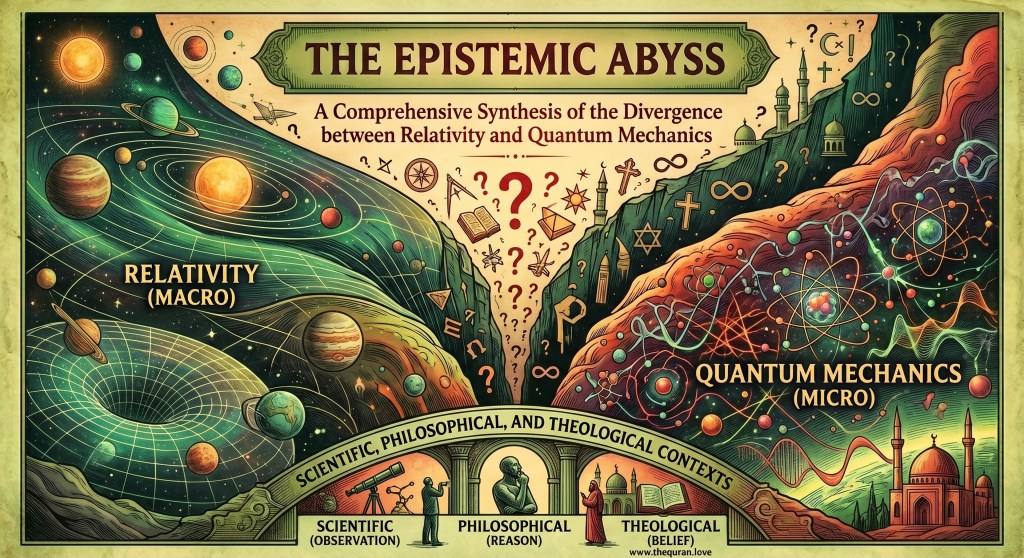
The current state of theoretical physics is characterized by a profound and persistent dualism between General Relativity, the framework governing the macroscopic cosmos, and Quantum Mechanics, the ruleset of the subatomic domain. For over a century, these two pillars of modern science have remained mathematically and conceptually irreconcilable, representing a fundamental “Great Schism” in our understanding of reality. This report provides an exhaustive technical and philosophical analysis of this divergence, examining the core conflicts of non-renormalizability, the nature of spacetime singularities, and the black hole information paradox. It incorporates the most recent advancements as of 2026, including the “bootstrapping” revival in string theory and the Wilson Loop observables in reformulated quantum gravity. Beyond the technical impasse, this analysis explores the deeper implications of this failure as a definitive limit to human knowledge. Drawing upon the epistemological frameworks of Immanuel Kant and the mathematical constraints of Kurt Gödel’s Incompleteness Theorems, the report posits that the universe may possess an inherent “Quantum Epistemic Wall.” This scientific boundary is further embellished through a transdisciplinary lens, utilizing the Double-Slit experiment and the specific theological clauses of Ayat al-Kursi (the Verse of the Throne) from the Quran to illustrate the demarcation between the observable phenomenal world and the inaccessible Divine Knowledge. The report concludes with a thematic epilogue reflecting on the necessity of intellectual humility in the face of an ultimately transcendent reality.
The Architectural Dualism: General Relativity and the Geometry of the Macro-World
The foundational structure of modern cosmology is built upon the Einsteinian revolution of 1915, which replaced the Newtonian concept of gravity as a force with a geometric description of spacetime itself. General Relativity (GR) operates on the principle that mass and energy do not simply move through a pre-existing stage but actively define the curvature of that stage. This relationship, formalized in the Einstein Field Equations, treats spacetime as a smooth, continuous four-dimensional manifold. Within this framework, gravity is not an external influence but a manifestation of the “metric tensor,” which provides a deterministic and local account of planetary motion, gravitational lensing, and the expansion of the universe.
The success of General Relativity at macroscopic scales is nearly unparalleled in scientific history. It has predicted the existence of black holes, the precise perihelion precession of Mercury, and the ripples in spacetime known as gravitational waves, which were directly observed over a century after their theoretical prediction. However, the theory relies on a fundamental assumption of continuity. In the relativistic world, space can be divided infinitely, and the laws of physics remain consistent regardless of the scale. This “smoothness” is essential for the differential geometry that underpins the theory, allowing for the calculation of geodesics—the shortest paths through curved spacetime.
Despite its macro-world dominance, GR encounters an insurmountable barrier when scaled down to the micro-world. At the Planck scale—roughly $10^{-35}$ meters—the smooth curvature of spacetime is expected to give way to “quantum foam,” a state of violent, unpredictable fluctuations. Here, the deterministic logic of relativity fails. The theory predicts “singularities,” points of infinite density and zero volume, which represent the mathematical breakdown of its own equations. These singularities, found at the heart of black holes and the origin of the Big Bang, suggest that General Relativity is an incomplete description of the universe, an “effective theory” that lacks the resolution to describe the fundamental substrate of reality.
The Quantum Tapestry: Probability, Discreteness, and the Micro-World
While General Relativity masters the large, Quantum Mechanics (QM) governs the small, providing a framework for electromagnetism and the nuclear forces. QM is characterized by three radical departures from classical and relativistic physics: quantization, probability, and non-locality. In the quantum realm, physical properties such as energy, momentum, and position are not continuous but come in discrete “quanta”. Matter and energy exhibit a dual nature, behaving as both particles and waves, a phenomenon encapsulated in the wave function, $\Psi$.
The evolution of a quantum system is described by the Schrödinger equation, which provides the probability amplitude for various outcomes rather than a single, deterministic result. This probabilistic nature introduces the “observer effect,” where the act of measurement causes the “collapse of the wave function,” forcing a system from a superposition of states into a single, definite reality. This introduces a fundamental subjectivity into the physical world that is absent from the objective, geometric framework of relativity.
Furthermore, quantum mechanics allows for “entanglement,” where particles become linked such that the state of one instantaneously influences the state of another, regardless of distance. This non-locality defies the relativistic principle that no information can travel faster than the speed of light, creating a tension that Einstein famously described as “spooky action at a distance”. As of 2026, experiments have repeatedly confirmed these non-local connections, suggesting that the “smooth” fabric of relativity may be an emergent property of a deeper, quantized information network.
Core Comparison of Relativistic and Quantum Frameworks
| Characteristic | General Relativity (Macro) | Quantum Mechanics (Micro) |
| Spacetime Structure | Smooth, continuous manifold | Discrete, quantized “quanta” |
| Causality | Deterministic, local | Probabilistic, non-local |
| Scale of Influence | Galactic, planetary, laboratory | Atomic, subatomic |
| Mathematical Tool | Differential Geometry (Tensors) | Linear Algebra (Hilbert Spaces) |
| Force Description | Geometric curvature | Particle exchange (Gauge bosons) |
| Primary Metric | Metric Tensor ($g_{\mu\nu}$) | Wave Function ($\Psi$) |
| The Inevitable Limit | Singularities (Infinities) | Measurement/Observer Effect |
The Technical Impasse: Non-Renormalizability and the Mathematical Clash
The reason these two theories “do not talk to each other” is rooted in the mathematical failure of Quantum Field Theory (QFT) when applied to gravity. In standard QFT, the three non-gravitational forces are “renormalizable.” This means that the infinite values arising from point-like particle interactions can be canceled out through mathematical subtractions, allowing for finite, accurate predictions. However, gravity behaves differently. The gravitational coupling constant, $G_N$, has dimensions of inverse mass-squared ($1/M^2$), which causes the number of infinities to grow exponentially with higher energy scales.
When physicists attempt to quantize gravity by introducing the “graviton”—the hypothetical particle of the gravitational field—the theory becomes “non-renormalizable”. At the Planck scale, the gravitational interactions become so strong that they would require an infinite number of parameters to describe, rendering the theory useless for making meaningful predictions. This is not merely a matter of scientific terminology; it is a fundamental clash between a “smooth” geometry and a “chunky” quantum stage.
The Black Hole Information Paradox
The divergence is most apparent in the study of black holes. According to General Relativity, black holes are simple objects defined only by mass, charge, and spin; all other information about matter falling into them is lost. Conversely, the principles of Quantum Mechanics insist that information must be preserved (unitary evolution). If a black hole evaporates via Hawking radiation, and that radiation is purely thermal and contains no information, then information is effectively deleted from the universe, violating quantum law.
Resolving this paradox is a central goal of modern physics, leading to theories like the Holographic Principle, which suggests that the information of a 3D volume is encoded on its 2D boundary. However, as of 2026, a fully consistent theory that satisfies both the geometric requirements of the event horizon and the informational requirements of quantum states remains elusive.
The 2026 Landscape: String Theory and Loop Quantum Gravity
The search for a “Theory of Everything” (TOE) has produced several competing candidates, with String Theory and Loop Quantum Gravity (LQG) remaining the most prominent.
String Theory and the “Bootstrapping” Revival
String theory proposes that the fundamental building blocks of the universe are not point particles but tiny, vibrating strings. These strings exist in 10 or 11 dimensions, with the extra dimensions curled up too small to be seen. In 2025 and 2026, the theory has seen a revival through “bootstrapping” research. Physicists demonstrated that if certain constraints, such as “ultrasoftness” (the smooth behavior of particle collisions at high energies), are applied, the resulting mathematical framework must be string theory.
Despite these mathematical successes, string theory faces the “Landscape Problem,” where it predicts at least $10^{500}$ different possible universes, making it untestable in our macroscopic world. Critics argue that the theory is “undead,” continuing to exist as a mathematical masterpiece while failing to produce experimental evidence.
Loop Quantum Gravity and the Wilson Loop Observable
Loop Quantum Gravity (LQG) takes a different approach by attempting to quantize spacetime itself rather than the forces within it. In 2026, research into the “Wilson Loop” observable has provided a breakthrough in computing the quantized geometry of spacetime. This observable measures the “holonomy” of gravity around a loop, showing that area and volume come in discrete “atoms of space”.
A significant 2026 finding indicates that at the Planck scale, the fundamental forces may “disappear” or become indistinguishable, leaving only the interaction between matter and the discrete geometry of spacetime. This suggests that the smooth laws of relativity are merely a large-scale average of a much more complex, discrete network.
Comparative Status of Leading Unification Candidates (2026)
| Theory | Basic Unit | Spacetime Approach | Key 2026 Development | Primary Challenge |
| String Theory | 1D vibrating strings | Background-dependent | “Ultrasoftness” as a unique identifier | $10^{500}$ possible solutions |
| Loop Quantum Gravity | Spin networks/loops | Background-independent | Wilson Loop observable eigenstates | Recovery of smooth GR at macro-scales |
| Asymptotic Safety | Spacetime fractals | Metric-based | Exploration of trans-Planckian structure | Mathematical “fixed point” proof |
| Causal Dynamical Triangulations | Discrete building blocks | Causal structure focus | Modeling emergence of 4D spacetime | High computational intensity |
| Celestial Holography | Symmetries at null infinity | 2D/4D Duality | Bridging infrared and ultraviolet scales | Restricted to specific geometries |
The Philosophical Limits of Human Knowledge
The inability to unify these two theories after a century of effort suggests that the impasse may not be a temporary scientific hurdle but a permanent boundary of human cognition. Philosophically, this reality aligns with several historical and modern frameworks that define the limits of what we can know.
Kantian Epistemology and the “Phenomenal” Barrier
Immanuel Kant’s Critique of Pure Reason (1781) provides a foundational insight into this limitation. Kant argued that human beings do not experience “reality as it is” (the noumenon) but only reality as it appears through our cognitive filters (the phenomenon). He proposed that space and time are not external realities but “irremovable spectacles” through which our perception is enabled.
The conflict between GR and QM can be viewed as a collision between two different “spectacles” of the human mind. One set of spectacles (relativity) filters the world into geometry and continuity, while the other (quantum) filters it into probability and discreteness. Because we cannot step outside our own conceptual frameworks, we find it impossible to reconcile these two modes of representation into a single “thing-in-itself”. Our reason, when pushed beyond the shores of experience—as it is at the Planck scale—falls into “antinomies,” or logical contradictions that cannot be resolved within human logic.
Gödel’s Incompleteness and the Computational Wall
In the realm of logic and mathematics, Kurt Gödel demonstrated that any sufficiently powerful axiomatic system contains statements that are true but unprovable within that system. This “Incompleteness Theorem” has profound implications for the “Theory of Everything”. It suggests that even if a complete theory exists, it may be impossible for any algorithmic or computational framework—including the human brain or its technological extensions—to “prove” or fully simulate it.
New research in 2026 has applied Gödel’s theorems to the foundations of physics, mathematically demonstrating that the laws of the universe require “non-algorithmic understanding”. This finding challenges the “simulation hypothesis,” arguing that because reality possesses “Gödelian truths” that cannot be reached by step-by-step logic, the universe cannot be a simulation running on a computer. This represents a hard mathematical limit to the scope of scientific inquiry; there is a “hidden realm beneath reality” that computation alone cannot reach.
Language and the Container of Thought
Human knowledge is further constrained by the tools of communication. As the “Language Insufficiency Hypothesis” suggests, language evolved to describe concrete objects and immediate macro-experiences. Concepts like “the beginning of time” or “quantum superposition” fall outside the scope of our linguistic frameworks. We are forced to use metaphors (strings, loops, waves) that are inherently inadequate, creating “illusions of mapping” where we mistake our linguistic models for reality itself. The “epistemic abyss” is thus partly a result of our inability to articulate truths that exist beyond the reach of human grammar and logic.
The Double-Slit Experiment: A Metaphor for the Horizon of Knowledge
The Double-Slit experiment stands as the definitive empirical proof of the “Horizon of Knowledge”. In this experiment, particles such as electrons create an interference pattern (behaving as waves) when they pass through two slits unobserved. However, the moment an observer tries to determine which slit a particle went through, the interference pattern disappears, and the particle behaves like a solid “bullet”.
This “Quantum Epistemic Wall” suggests that the act of gaining information about the world fundamentally alters the nature of the world itself. There is a boundary where human observation terminates and reality “hides” its underlying state. Science, rather than peeling back the layers to reveal a final truth, finds that the more it probes, the more the “true” nature of things recedes behind a veil of probability.
Theological Embellishment: Ayat al-Kursi and the Boundaries of Knowledge
The scientific and philosophical limits explored above find a striking parallel in the theological clauses of the “Verse of the Throne” (Ayat al-Kursi, Quran 2:255). This verse is often cited as the “Crown Verse” due to its sublime description of Divine transcendence and the finitude of human perception.
The Clause of Enclosure and Permission
One of the most relevant clauses in the verse states:
“He knows what is before them and what is behind them, and they cannot encompass anything of His knowledge except what He pleases”.
Linguistically, the term “encompass” (yuhi-toona) implies a total and exhaustive understanding, a “wrapping around” of a subject. The verse asserts that human beings are fundamentally incapable of this kind of totalizing knowledge. This theological “enclosure” maps precisely onto the scientific “epistemic walls” identified in 2026 physics.
- “What is before them and what is behind them”: In a scientific context, this represents the totality of the spacetime manifold—the causal history of the universe (the Big Bang) and its future evolution. While we can see “behind” us through telescopes and “before” us through equations, our view is always filtered through the “irremovable spectacles” of our senses.
- “Except what He pleases”: This suggests that information is not a passive commodity to be “taken” by science, but something “granted” or “willed”. The collapse of the wave function in the Double-Slit experiment can be seen as a physical manifestation of this clause: we only see the “particle” (the definite reality) when the “wave” (the infinite possibility of Divine knowledge) is collapsed into a form we can perceive.
The “Kursi” and the Macro-Micro Governance
The verse further states that His “Kursi” (often translated as Throne or Chair, but interpreted as “Knowledge” or “Authority”) extends over the heavens and the earth. This provides a theological framework for a unified reality that science cannot yet achieve. Where Relativity and Quantum Mechanics “do not talk to each other,” the “Kursi” represents the single, underlying authority that encompasses both scales without contradiction.
The fact that the “preservation of both tires Him not” indicates a level of computational and sustaining power that exceeds the limits described by Gödel or Kant. While humans hit a wall of complexity and “non-algorithmic” barriers, the Divine Knowledge operates as a “self-subsisting” (Al-Qayyum) reality that maintains the coherence of the cosmos from the subatomic to the galactic.
Synthesis: The Meaning of the Impasse
The centennial failure to unify General Relativity and Quantum Mechanics is perhaps the most profound discovery of modern science. It is a scientific “negative result” that proves the existence of a ceiling to human understanding.
Second-Order Insights: Why the Divergence Persists
The persistent dualism of physics is likely not a matter of “finding the right equation” but a result of the human mind’s inability to process “non-dual” realities. Relativity and Quantum Mechanics are two distinct “maps” of the same terrain, created by a mind that can only navigate one scale at a time. The “unification” we seek may require a leap in cognitive evolution or a “non-algorithmic understanding” that lies beyond the current human biological and linguistic architecture.
Furthermore, the 2026 research into Wilson Loops and “ultrasoftness” suggests that at the most fundamental level, the concepts we use to define our world—space, time, particles, and forces—may themselves be illusions or emergent “mirages”. If space and time are themselves made of discrete “quanta,” then the “smooth” world of Relativity is a statistical average, and the “chunky” world of Quantum Mechanics is a glimpse of the machinery. But the “machinist” (the thing-in-itself) remains behind the “Quantum Epistemic Wall”.
Data Comparison: The Scales of Unification
| Force/Scale | Theoretical Framework | Particle/Quanta | Renormalizable? | Role in TOE |
| Electromagnetism | QED | Photon | Yes | Fully Unified |
| Weak Nuclear | Electroweak Theory | W/Z Bosons | Yes | Fully Unified |
| Strong Nuclear | QCD | Gluon | Yes | Fully Unified |
| Gravity (Micro) | Quantum Gravity | Graviton | NO | The Missing Link |
| Gravity (Macro) | General Relativity | Spacetime Curvature | N/A | Validated Foundation |
Conclusions and Future Outlook
The Divergence between General Relativity and Quantum Mechanics remains the greatest challenge in science, but it also provides the greatest insight into the human condition.
As of 2026, the scientific community is moving toward an acceptance of “effective theories”—the idea that we may never have a single “Theory of Everything” that is both consistent and complete. Instead, we may have a “patchwork” of theories, each valid within its own domain but separated by “epistemic abyss” boundaries. The mathematical proofs from UBC Okanagan and the bootstrapping findings in string theory both suggest that the universe is “built upon an understanding that lies outside the reach of any algorithm”.
The theological integration suggests that this “unreachability” is a feature, not a bug, of the universe. The “Quantum Epistemic Wall” is the boundary where human “will” and “observation” meet their match in the “Divine Will” and “Omniscience”. This reality necessitates a shift from “Scientism”—the belief that science can eventually know everything—to a more humble, nuanced “Scientific Philosophy” that recognizes the “Pillars of Hercules” at the edge of human experience.
Thematic Epilogue: The Mirror and the Veil
The story of 21st-century physics is the story of a mirror that has begun to see its own limits. For centuries, science was viewed as a window through which we looked at the world. But at the Planck scale and at the event horizon of a black hole, that window has become a mirror, reflecting only the limitations of the human sensory and cognitive apparatus.
The incompatibility between the “smooth” macro-world and the “chunky” micro-world is the “crack” in the mirror. We cannot fix the crack because the crack is in us—in our language, our logic, and our evolutionary history. We are like the thirsty traveler chasing a mirage in the desert; every time we think we have reached the “water” of a unified theory, it recedes just beyond our grasp, revealing only the vast, shimmering expanse of the “unseen”.
Yet, this “epistemic abyss” is not a cause for despair. It is an invitation to awe. The realization that “they encompass nothing of His knowledge except what He wills” is the ultimate intellectual humility. It suggests that the universe is not a dead machine to be solved, but a living, transcendent reality that we are privileged to witness, but never to possess.
In the final analysis, the fact that Relativity and Quantum Mechanics “do not talk to each other” is the universe’s most profound sermon. It tells us that we live in a world of profound mystery, where the “seen” and the “unseen” are held together by a Knowledge that is too high for us to attain, yet too close for us to ignore. The search for the Theory of Everything will continue, not because we expect to find a final equation, but because the very act of reaching for the “Horizon of Knowledge” makes us more human, more humble, and more aware of the infinite majesty that lies just beyond the wall.




Leave a Reply