
Presented by Claude
Abstract
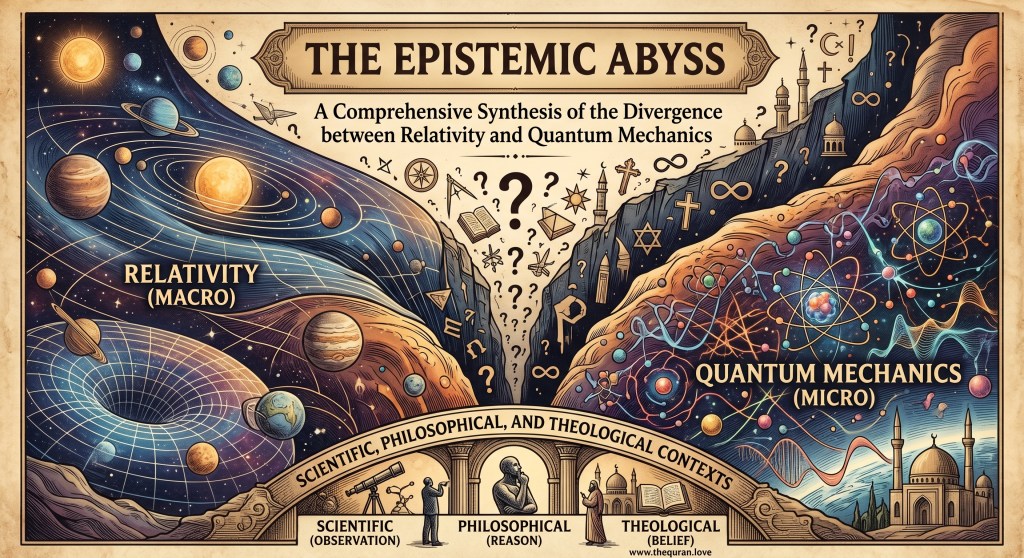
For more than a century, twentieth- and twenty-first-century physics has rested on two pillars that refuse to share a roof. Einstein’s theory of relativity — special and general — governs the macroscopic world: gravitation, cosmology, black holes, the curvature of spacetime, the expansion of galaxies. Quantum mechanics governs the microscopic: the granular world of photons, electrons, quarks, wave-particle duality, the uncertainty principle, the strange logic of superposition and entanglement. Each theory, taken on its own terms, achieves predictive precision so extraordinary that it borders on the miraculous. Yet a century of strenuous effort — by minds as eminent as Einstein, Wheeler, Hawking, Penrose, Weinberg, Witten, Rovelli, and Smolin — has failed to weld them into a single coherent description of reality. As of 2026, there is still no empirically confirmed theory of quantum gravity. String theory, loop quantum gravity, causal dynamical triangulations, asymptotic safety, causal set theory, and supergravity each glimpse a fragment of the bridge and each fall short. This essay treats that century-long failure not as a temporary embarrassment to be erased by the next genius, but as a window onto something deeper: an epistemic horizon built into the very condition of being a creature who knows. Drawing equally on the physics-philosophical literature and on the Qur’anic verse of Ayat-ul-Kursi (Qur’an 2:255) — and in particular the clause وَلَا يُحِيطُونَ بِشَيْءٍ مِّنْ عِلْمِهِ إِلَّا بِمَا شَاءَ, “and they encompass nothing of His knowledge except what He wills” — the essay argues that the inability to enclose reality within a single mathematical formalism is precisely what one would expect of a finite intellect operating inside a created order whose ultimate intelligibility belongs to its Author. Kant’s noumenon, Wittgenstein’s silence, Gödel’s incompleteness, Popper’s falsifiability, Kuhn’s paradigms, Bohr’s complementarity, and the Qur’anic notion of iḥāṭa (encompassing) converge on a single point: knowledge is real, but it is not sovereign. It is granted. It is partial. It is, in the deepest sense, an act of permission.
I. The Two Pillars of Modern Physics
To understand the gap, one must first feel the height of what stands on either side of it.
Relativity is, in its essence, a theory of geometry. Einstein’s special theory of 1905 dissolved the Newtonian assumption that space and time are independent stages on which events unfold. Instead, space and time are stitched into a single four-dimensional fabric, spacetime, whose intervals are invariant across all inertial observers. Ten years later, general relativity completed the radicalization. Gravity, Einstein showed, is not a force at all but the curvature of spacetime itself, induced by the presence of mass and energy. Planets do not orbit because something pulls them; they follow geodesics — the straightest possible paths — through curved geometry. The equations are deterministic, continuous, and exquisitely beautiful. Their predictions, from the bending of starlight and the precession of Mercury’s perihelion to gravitational waves and the existence of black holes, have been confirmed to extraordinary precision. They describe a classical world: smooth, deterministic, and continuous, where every event has a definite location and every trajectory a definite history. SciliftNumber Analytics
Quantum mechanics, born only twenty years later in the work of Planck, Bohr, Heisenberg, Born, Schrödinger, and Dirac, describes a different universe altogether — the universe of the very small. Here, energy is quantized in discrete packets; particles do not have definite positions until measured; pairs of “complementary” properties such as position and momentum cannot be simultaneously known with arbitrary precision (Heisenberg’s uncertainty principle, Δx·Δp ≥ ℏ/2); identical particles can be entangled across arbitrary distances, displaying correlations Einstein famously called “spooky action at a distance.” The wavefunction Ψ(x,t), governed by the Born rule P(x)=|Ψ(x)|², “represents a ‘wave of probability’ rather than a physical displacement of a medium,” as the Quantum Epistemic Wall essay puts it. The Standard Model of particle physics, built atop quantum field theory, has predicted phenomena such as the anomalous magnetic moment of the electron to roughly twelve significant digits. thequran
Einstein himself, despite being the father of quantum theory’s first quantum (the photon of his 1905 paper on the photoelectric effect), never accepted that the probabilistic character of quantum mechanics was final. His correspondence with Max Born preserves the most famous protest in the history of modern science: “I, at any rate, am convinced that He does not play dice.” The retort, characteristically, came from Bohr: “Einstein, stop telling God what to do.” The Einstein-Bohr debates at the Solvay Conferences of 1927 and 1930 form the philosophical bedrock of every subsequent foundational dispute in quantum theory. IAEA
These two cathedrals work. Each, within its domain, is empirically unfalsified by any current observation. Yet the moment one attempts to put them in the same room — to ask, for instance, what happens at the center of a black hole, or in the first 10⁻⁴³ seconds after the Big Bang, or whether the gravitational field of a particle in superposition is itself in superposition — the languages stop translating. Relativity speaks of a smooth, classical geometry; quantum mechanics speaks of a discrete, probabilistic, observer-implicated state space. As one popular summary of the situation puts it, when one tries to “quantize gravity,” the mathematics “explodes into uncontrollable infinities.” Onoff
The deeper conceptual rift is this. Quantum field theory presupposes a fixed spacetime stage on which fields propagate; general relativity insists that the stage itself is dynamic, shaped by the very matter and energy it contains. A truly quantum theory of gravity would have to quantize the stage itself — to allow spacetime to be in superposition, to fluctuate, perhaps to be discrete at the smallest scales. No one has yet shown how to do this in a way that survives experimental scrutiny.
The double-slit experiment, the centerpiece of both essays at the heart of this reflection, is perhaps the most economical demonstration of the quantum-side strangeness. When coherent light, electrons, atoms, or even large organic molecules pass through two parallel slits and onto a detector, they produce an interference pattern — the unmistakable signature of waves. But fire them one at a time, and the pattern still builds up: each individual quantum interferes with itself. Add a detector capable of revealing which slit each particle traversed and the interference vanishes; particles behave as particles again, depositing themselves in two simple clumps. As Richard Feynman put it in The Character of Physical Law: “We choose to examine a phenomenon which is impossible, absolutely impossible, to explain in any classical way, and which has in it the heart of quantum mechanics. In reality, it contains the only mystery.” And famously: “I think I can safely say that nobody understands quantum mechanics… Do not keep saying to yourself, if you can possibly avoid it, ‘But how can it be like that?’ because you will get ‘down the drain,’ into a blind alley from which nobody has escaped.” thequran + 3
Roger Penrose, in The Road to Reality and Shadows of the Mind, has gone further than most senior physicists in insisting that the foundations of quantum mechanics are not merely interpretively contested but physically incomplete. He has proposed, in the so-called “Penrose interpretation,” that gravitational effects play a role in objective wave function collapse — that the superposition of significantly different gravitational fields cannot persist, and that the collapse itself is a real physical process at the gravitational scale. He has also famously argued, in his Orchestrated Objective Reduction (Orch-OR) hypothesis with Stuart Hameroff, that consciousness itself may involve non-computable processes connected to this gravitational collapse. Whether or not one accepts Penrose’s specific proposal — most physicists do not — its existence underscores how deeply the foundational questions remain open. As Penrose has bluntly put it: “Quantum mechanics makes absolutely no sense.” Schrödinger himself, looking back on the theory he had helped create, lamented: “I do not like it, and I am sorry I ever had anything to do with it.” ColoradoColorado
These confessions matter. They come not from skeptics or outsiders but from the very architects of the edifice. They distinguish, as the first source article emphasizes, between predictive mastery and intuitive comprehension. The mathematics is exact. The picture is not. The experiment, that article notes, “becomes a philosophical event.” thequran
II. The Failed Quest for Unification
Einstein himself, in his last three decades, sought a unified field theory that would extend general relativity into a framework also embracing electromagnetism — and, by implication, the still-uncrystallized strong and weak forces and the new quantum world. He died in 1955 with the project unfinished. He never used the phrase “theory of everything.” The phrase came later, popularized as the search took on programmatic form: a single mathematical structure that would derive the Standard Model of particle physics, the four fundamental forces, and the curvature of spacetime from a small number of axioms. Princeton University
By 2026 the landscape of candidate programs looks something like this:
String theory and its M-theoretic descendants. Born in the late 1960s as a model of the strong force and revived in the 1980s as a candidate quantum theory of gravity, string theory replaces point particles with one-dimensional vibrating “strings.” Its great structural virtue is that it incorporates gravity automatically: the spectrum of a closed string contains a massless spin-2 excitation with the right properties to be the graviton. Its great structural cost is that consistency demands ten spacetime dimensions (eleven for M-theory) and a supersymmetry that has yet to be observed in any accelerator, including the Large Hadron Collider. Compactifying the extra dimensions yields, by recent estimates, on the order of 10⁵⁰⁰ distinct possible “vacua” — the so-called string landscape — each defining a different effective four-dimensional physics. As Lee Smolin has lamented, “It is not an exaggeration to say that hundreds of careers and hundreds of millions of dollars have been spent in the last thirty years in search for signs of grand unification, supersymmetry, and higher dimensions. Despite these efforts, no evidence for any of these hypotheses has turned up.” Carlo Rovelli, surveying the field in Scientific American, observes that string theory “has not delivered after half a century.” The 2024 Handbook of Quantum Gravity, a 4,315-page Springer compendium, devotes roughly two-thirds of its bulk to string theory and allied fields, an index of where institutional gravity continues to pull even as empirical confirmation withholds itself. Quanta Magazine + 5
Loop quantum gravity (LQG). Pioneered by Abhay Ashtekar in 1986 and developed by Rovelli, Smolin, and others, LQG begins from the opposite intuition: do not seek a “theory of everything”; instead, simply quantize general relativity in four dimensions, taking diffeomorphism invariance — the deep symmetry of GR — seriously. The result is a picture in which space itself is discrete: a network of “spin foams” and “spin networks,” in which quantities such as area and volume come in irreducible quanta on the order of the Planck length. LQG predicts no singularities (the Big Bang is replaced by a “big bounce”), needs no extra dimensions, and is, in its kinematic sector, mathematically well-defined. Yet its dynamics — the so-called Hamilton constraint — remains incompletely understood, and it has not yet recovered, in a controlled limit, the smooth classical spacetime of general relativity. As Rovelli himself concedes, LQG too “hasn’t exactly brought home abundant bacon.” Onoff + 3
Asymptotic safety. Pursued under the leadership of Martin Reuter and colleagues, this program asks whether quantum gravity, though “perturbatively non-renormalizable,” might be renormalizable in a non-perturbative sense, governed by an ultraviolet fixed point of the renormalization group flow. Numerical evidence is suggestive; mathematical control remains incomplete.
Causal dynamical triangulations. A computational approach in which spacetime is approximated by a sum over simplicial geometries respecting causality. It has succeeded in generating a four-dimensional, de Sitter-like spacetime from microscopic ingredients, but it has not yet made testable predictions distinguishing it from its rivals.
Causal set theory. Proposed by Rafael Sorkin and others, this approach posits that spacetime at the deepest level is a discrete partial order — a “causal set” — from whose combinatorial structure both geometry and matter emerge. Its predictions, including a small but nonzero cosmological constant of roughly the observed magnitude, are tantalizing but not conclusive.
Supergravity, twistor theory, non-commutative geometry, postquantum-classical gravity, and others continue as active programs, each capturing a piece, none seizing the whole.
The empirical landscape has shifted in one important way. Tabletop tests of quantum gravity — long thought impossible because of the absurd weakness of the gravitational interaction — have become realistic experimental proposals. The Bose-Marletto-Vedral experiment, now under active development in laboratories from Imperial College London to the Netherlands, would place two micrometer-scale masses in spatial superposition and ask whether their gravitational interaction can entangle them. A positive result would constitute the first direct evidence that gravity is fundamentally quantum. As one 2025 review put it, the experimental program represents a “key milestone” — but at the time of this writing, no laboratory has succeeded. The technological demands are extreme: temperatures near 10 millikelvin, vacua several orders of magnitude purer than current art, and isolation from environmental decoherence at unprecedented levels. arxiv + 2
Meanwhile, the deeper problem revealed by every attempted route is the non-renormalizability of gravity in perturbative quantum field theory. As the Stanford Encyclopedia of Philosophy entry on quantum gravity puts it, “These technical problems are closely related to a set of daunting conceptual difficulties.” The infinities that arise when one tries to compute quantum corrections to graviton exchange cannot be absorbed into a finite number of physical parameters, as they can in quantum electrodynamics. As one essayist observed on Edge.org, “renormalization fails utterly in the case of quantum gravity… Infinity remains infinity. Fail.” This non-renormalizability is what defines, technically, the Planck scale — roughly 10⁻³⁵ meters, 10⁻⁴³ seconds, 10¹⁹ GeV — as the regime where quantum and gravitational effects become comparable. It is also a regime thirteen orders of magnitude beyond any energy currently accessible to direct experimental probe at the Large Hadron Collider. Stanford Encyclopedia of Philosophy + 3
This is the situation, as of 2026, after a century of work and the deployment of arguably the largest pool of theoretical talent ever concentrated on a single problem. The two great theories still do not speak to one another. As Adnan Masood succinctly puts it in his 2026 Medium survey, “We have two beautifully perfect rulebooks for reality — Einstein’s smooth, continuous spacetime and the jittery, pixelated world of quantum mechanics” — and the unification “remains the ultimate black box.” Medium
III. Philosophical Implications: The Limits of the Knower
Why has this gap proven so obstinate? The standard answer — we have not yet been clever enough — is plausible but not the only one available. A more philosophically searching answer is that we are bumping up against not a contingent inadequacy of human cleverness but a structural limit on what a finite knower can know about a system of which she is also a part.
Consider six classical witnesses to that idea.
Immanuel Kant, in the Critique of Pure Reason (1781), distinguished between the phenomenon — the world as it appears to a mind structured by the forms of intuition (space, time) and the categories of understanding (causality, substance, quantity) — and the noumenon, the “thing in itself,” the world as it is independent of all knowing. Kant’s claim was not that the noumenon does not exist; it was that the noumenon is in principle inaccessible to human cognition. “Things as they are in themselves are not and cannot be known by us; what we know are merely their appearances.” Kant called the noumenon a Grenzbegriff, a limiting concept — a No Trespassing sign at the edge of what reason can establish. He famously said that he had “denied knowledge in order to make room for faith.” It is striking that Niels Bohr, in formulating his principle of complementarity at Como in 1927, was reading and explicitly invoking Kant. Complementarity — the doctrine that wave-like and particle-like descriptions are mutually exclusive but jointly necessary aspects of the same quantum phenomenon — is Kantian to the core: which face of the noumenon shows itself depends on which experimental apparatus the phenomenal knower has set up. Medium + 2
Ludwig Wittgenstein, in the Tractatus Logico-Philosophicus (1921), drew a different but congenial line. Language, he argued, can only picture facts within a logical space already given. About what lies outside that space — the mystical, the ethical, the ground of meaning itself — language cannot speak. The final proposition of the Tractatus is famous: “Wovon man nicht sprechen kann, darüber muss man schweigen” — “Whereof one cannot speak, thereof one must be silent.” Wittgenstein also wrote, “The limits of my language mean the limits of my world.” The implication for physics is direct: if our mathematical language has been developed inside a world of macroscopic objects, definite trajectories, and Euclidean intuitions, it should not be surprising that it stutters when forced to picture a regime — the Planck scale, the singularity, the gravitational superposition — for which those very intuitions are not designed. WikiquoteSlate
Kurt Gödel’s incompleteness theorems (1931) are often invoked, sometimes too loosely, in this context. The First Incompleteness Theorem shows that any consistent formal system rich enough to encode elementary arithmetic must contain true statements that cannot be proved within the system. The Second Theorem shows that such a system cannot prove its own consistency. As John Myers and F. Hadi Madjid argue in a 2018 arXiv paper, “We show how Gödel’s incompleteness theorems have an analog in quantum theory… We prove that the set of explanations of given evidence is uncountably infinite.” Wanpeng Tan, in a 2020 paper provocatively titled No Single Unification Theory of Everything, argues that “in light of Gödel’s undecidability results… physics and the Universe may be indeterministic, incomplete, and open in nature, and therefore demand no single unification theory of everything.” Some philosophers caution, rightly, that strict Gödel results apply to formal axiomatic systems containing arithmetic, not directly to empirical theories, and that the analogy can be overdrawn. Stephen Hawking himself, in his lecture Gödel and the End of Physics, qualified the connection as “analogous.” But even the analogy is suggestive: it reminds us that the dream of a closed, self-justifying axiomatization of reality — a “final theory” answering all questions about itself — has been mathematically shown to be unattainable for any system with the expressive richness physics surely possesses. arxiv + 6
Karl Popper and Thomas Kuhn add two further dimensions. Popper’s criterion of falsifiability — that a theory’s scientific status depends on its capacity to be empirically refuted — begins to fray when applied to theories whose distinctive predictions lie at Planck-scale energies thirteen orders of magnitude beyond any accelerator. String theory’s critics, including Smolin and Peter Woit, have argued that the program, in its current state, fails Popper’s test. Defenders counter that internal mathematical consistency and the recovery of low-energy physics constitute legitimate scientific virtues. Kuhn, for his part, taught us to see physics not as a steady accumulation of truths but as a sequence of paradigms — frameworks of assumptions, exemplars, and shared problem-solving practices — punctuated by revolutionary shifts in which one paradigm is replaced by another that is, in important respects, incommensurable with its predecessor. The current standoff between relativity and quantum mechanics has the marks of a pre-revolutionary moment: two paradigms, each successful in its sphere, neither translatable into the other, awaiting a revolution neither can predict.
Bohr’s complementarity and Heisenberg’s uncertainty principle, formulated in the same weeks of 1927, are usually classified as physics. They are also among the most philosophically loaded propositions of the twentieth century. The uncertainty principle places a fundamental, non-removable limit on the joint precision with which conjugate variables can be known. Heisenberg initially construed this as a disturbance imposed by measurement; Bohr corrected him: the deeper point is that position and momentum cannot be simultaneously defined for a quantum system without specifying a complementary experimental arrangement. As the Stanford Encyclopedia of Philosophy puts it, “It is not so much the unknown disturbance which renders the momentum of the electron uncertain but rather the fact that the position and the momentum of the electron cannot be simultaneously defined in this experiment.” Stanford Encyclopedia of Philosophy + 3
Add to these five witnesses the measurement problem in quantum mechanics — the still-unresolved question of why and how the smooth, unitary evolution of the Schrödinger equation gives way, upon measurement, to a definite outcome — and the underdetermination of interpretation: Copenhagen, Many-Worlds, de Broglie-Bohm pilot waves, GRW/CSL objective collapse, QBism, relational interpretations. Each is empirically equivalent to the others; none can be experimentally singled out. The mathematics is one; the metaphysics is many. As the first source article observes, the experiment “underdetermines these metaphysical options, which is why it is scientifically productive and philosophically inexhaustible at the same time.” thequran
Put together, these strands suggest that the failure to unify GR and QM may not be a contingent failure at all. It may be a symptom of a deeper condition: the inherent finitude of any knower whose conceptual apparatus has been forged inside, and is constrained by, the very world she seeks to enclose. As Lee Smolin observes, “we no longer can do experiments over and over again. There’s one experiment, which is the universe as a whole.” NBC News
A century of unbroken effort, prodigious mathematical sophistication, and zero empirical confirmation is not yet proof that the goal is unreachable. But it is, at minimum, evidence — strong evidence — that some boundary stands in the way that is not merely technical.
IV. The Qur’anic Horizon: Ayat-ul-Kursi and the Epistemic Wall
It is precisely here that the Qur’anic verse traditionally regarded as the greatest in the entire Book — Ayat-ul-Kursi, the Verse of the Throne, Qur’an 2:255 — becomes more than a devotional formula. It becomes a philosophical claim about the structure of created knowing.
The full verse reads, in Saheeh International’s translation: “Allah — there is no deity except Him, the Ever-Living, the Sustainer of [all] existence. Neither drowsiness overtakes Him nor sleep. To Him belongs whatever is in the heavens and whatever is on the earth. Who is it that can intercede with Him except by His permission? He knows what is [presently] before them and what will be after them, and they encompass not a thing of His knowledge except for what He wills. His Kursī extends over the heavens and the earth, and their preservation tires Him not. And He is the Most High, the Most Great.”
The clause that concerns us — وَلَا يُحِيطُونَ بِشَيْءٍ مِّنْ عِلْمِهِ إِلَّا بِمَا شَاءَ — has been rendered into English by dozens of translators across more than a century. As the second article catalogues, the central translations cluster around three recurring motifs: human non-encompassment, the selective grant of knowledge, and divine will as the condition of access. Marmaduke Pickthall (1930): “while they encompass nothing of His knowledge save what He will.” Yusuf Ali (1938/1985): “Nor shall they compass aught of His knowledge except as He willeth.” Muhammad Asad: “whereas they cannot attain to aught of His knowledge save that which He wills [them to attain].” Mustafa Khattab (2018): “but no one can grasp any of His knowledge — except what He wills [to reveal].” Maududi: “And they cannot comprehend anything of His knowledge save whatever He Himself pleases to reveal.” Aisha Bewley: “They do not comprehend anything of His knowledge except what He wills.” The Saudi-revised Sahih International: “and they encompass not a thing of His knowledge except for what He wills.” thequran + 9
The Arabic verb yuḥīṭūna derives from the root ḥ-w-ṭ, meaning to surround, encircle, fence in, encompass. As the second source article emphasizes, iḥāṭa in classical Arabic lexicography refers to “a knowledge that is exhaustive, covering the existence, genus, quantity, essence, and reality of a thing. To ‘encompass’ something is to stand outside of it and view it in its entirety, leaving no part hidden or uncertain.” It is, in other words, exactly the kind of knowing that a “theory of everything” is supposed to deliver — a description so total that nothing of the system being described stands outside it. thequran
The Qur’an, in this clause, denies precisely that kind of knowing to creatures. Iḥāṭa belongs to God alone. What is granted to humans is not the totality but a slice — bi-mā shā’a, “as He wills” — a portion conditioned by the granting Will. Classical Islamic tafsir is remarkably consistent on this point. Ibn Kathir, in his Tafsīr al-Qur’ān al-ʿAẓīm, writes that the clause “asserts the fact that no one attains any part of Allah’s knowledge except what Allah conveys and allows.” Mufti Muhammad Shafi Usmani, in his Ma’ariful Qur’an, paraphrases: “man and the rest of the created beings cannot cover even a part of Allah’s infinite knowledge except a certain part which Allah Almighty Himself allows to be given out of His knowledge. This is all one can know.” Al-Tabari, al-Qurtubi, al-Baghawi, and al-Maududi converge with this reading. Jannat Al QuranQuran.com
There is, moreover, a remarkable detail attributed by Ibn Kathir to Ibn ʿAbbās (d. 687 CE), the cousin of the Prophet and one of the most authoritative early exegetes: the Kursī itself — the “throne” or “footstool” mentioned later in the same verse — is, on one reading, al-ʿilm, the divine knowledge. Ad-Dahhāk transmits Ibn ʿAbbās: “If the seven heavens and the seven earths were flattened and laid side by side, they would add up to the size of a ring in a desert, compared to the Kursī.” In this reading, the vastness of the Kursī is the vastness of the divine epistemic field; and human creatures, immersed in this field, can no more encompass it than a fingerprint can encompass the ocean it touches. thequranQuran.com
This is not anti-rationalism. It is, on the contrary, a careful theological cartography of the boundary between the knowable and the knowable-only-as-granted. The Islamic intellectual tradition produced, in the centuries between the eighth and the twelfth, a sustained meditation on exactly this boundary.
Ibn Sīnā (Avicenna, d. 1037), the great philosopher-physician of Bukhara and Hamadan, developed a metaphysics centered on the distinction between the Necessary Being (wājib al-wujūd) — God, whose existence is identical with His essence — and contingent beings (mumkin al-wujūd) whose existence is borrowed and whose intelligibility is therefore received. For Ibn Sīnā, human knowledge culminates in conjunction (ittiṣāl) with the Active Intellect, the lowest of the celestial intelligences, from which intelligible forms flow into the receptive human mind. The crucial point for our purposes is that, in this scheme, even the highest human knowledge is structurally receptive rather than constitutive: it is given, not seized. The light of the intellect is borrowed light.
Al-Ghazālī (d. 1111), in his Tahāfut al-Falāsifa and his monumental Iḥyāʾ ʿUlūm al-Dīn, developed a tiered epistemology in which sense perception, reason (ʿaql), intuition, and revealed knowledge each occupy a legitimate but bounded sphere. After his celebrated crisis of doubt, al-Ghazālī wrote that what restored him was “not rational arguments or logical proofs” but “the effect of a light (nūr) which God cast into his breast.” Reason remained for him indispensable; but its sovereignty was relativized. He distinguished, as Islamic philosophical tradition long has, between ʿālam al-mulk — the world of creation accessible to the senses — and ʿālam al-malakūt — the invisible world of divine governance. Knowledge of the former is real but incomplete; knowledge of the latter, when granted at all, is granted. The Sufi scholar Reza Shah-Kazemi paraphrases the Ghazālian paradox sharply: “the highest knowledge transcends all knowledge to a point that it can be called ignorance.” This is not obscurantism. It is the recognition that iḥāṭa — the encompassing gaze from outside — is not a creaturely possession. Ghazali + 2
The double-slit experiment, read through this lens, becomes startlingly apt. As the second source article frames it, the experiment is “the physical proof of this theological limit: we hit a wall where our ability to know one thing (position) necessitates our ignorance of another (momentum).” When both slits are open and no which-path information is available, the particle behaves as a wave: an interference pattern of probability builds up across the screen, fringe by fringe, particle by particle, even when fired one at a time. The very moment a detector capable of revealing which slit the particle traversed becomes operative — even, as the MIT experiments using laser-trapped atoms have shown, when the physical disturbance is minimized to the quantum limit, so that what changes is the mere availability of information — the interference vanishes, and the particles behave as classical corpuscles. As the second article puts it: “the mere availability of information — the potential for the observer to know the path — causes the wave nature to disappear.” thequranthequran
This is precisely the iḥāṭa-denial of Ayat-ul-Kursi rendered into laboratory geometry. The creature cannot stand outside the quantum object and view it in its entirety. To know one face is to lose the other. To impose the question of “where” is to dispel the answer to “how-as-wave”; to ask “how-as-wave” is to forfeit the answer to “where.” The Englert inequality V² + D² ≤ 1, which formally bounds the trade-off between fringe visibility and path distinguishability, can be read as a mathematical signature of this same epistemic asymmetry: total path knowledge (D=1) entails zero wave visibility (V=0), and vice versa.
The first source article presses the point with theological care: the verse “does not denigrate knowledge; it relativizes it. The experiment does not abolish intelligibility; it disciplines claims of total conceptual enclosure.” And again: “what is granted is operational access to lawlike structure, not transparent possession of the real ‘from God’s side,’ so to speak.” This is the asymmetry the Qur’an names. The creature can write the wave function, derive the Born probabilities, engineer the detector overlap, test duality relations, extend matter-wave coherence into the 10⁵-dalton range achieved by molecular interferometry, and even — in 2023, in temporal slits realized at Imperial College London using indium-tin-oxide metamaterials and femtosecond optical gates — interfere light with itself across the dimension of time. All of this is real knowledge, hard-won, and not to be despised. But none of it is iḥāṭa. None of it stands outside the system and beholds it whole. thequran + 2
The second source article articulates this in a phrase worth lingering over: “We are knowers who are always, and fundamentally, limited by the ‘Throne’ of a Knowledge that we can never fully surround, but in which we are eternally invited to wonder.” Knowledge here is participatory rather than panoptic. We are inside the Kursī, not above it. Our measurements are not Olympian gazes; they are interactions of one part of creation with another, governed by laws we did not write. thequran
It is significant, theologically, that the clause does not merely deny encompassing — it pairs the denial with a positive grant: “except what He wills.” The wall is not a closed door but a threshold. Permission is given, and given lawfully. As the first article observes, “knowledge is granted through stable, discoverable order. Human beings do not know quantum phenomena by seizing them absolutely; they know them through delicate, permission-like windows opened by the lawful structure of creation itself — vacuum isolation, phase stability, entanglement control, timing, and decoherence management. The Qur’anic point is therefore not anti-scientific. It is that scientific access is real but contingent.” thequran
The Qayyūm — the Self-Subsistent, the Sustainer of all existence — is named at the very opening of Ayat-ul-Kursi. In the second article’s gloss, “if the wave function never collapsed, reality would remain a ‘blur’ of unmanifested possibilities. The ‘preservation’ (ḥifẓ) mentioned at the end of the verse, which ‘does not tire Him,’ can be seen as the continuous maintenance of the physical constants and the decoherence processes that allow a stable, macroscopic world to exist for conscious experience.” Whether or not one accepts this reading as a strict exegetical inference — and the second source article is admirably careful, elsewhere, not to baptize ignorance or conscript quantum mechanics into “scientific miracle” arguments — its structural resonance is striking. The Qayyūm sustains; without sustenance, no measurement, no decoherence, no classical world. The verse’s claim is not that physics is wrong but that physics, in the Qur’an‘s vocabulary, is one of the āyāt — the signs — by which the lawful contingency of creation is made present to the mind that asks. thequran
V. Synthesis: Wave-Particle Duality as Sign
What, then, is the synthesis?
It is not the deflationary syncretism that says “physics is theology” or “theology is just metaphors for physics.” Neither discipline survives that move with its integrity intact. The first source article warns explicitly against such conscription: “the verse should not be used as a license to baptize ignorance. ‘God wills’ in the scriptural clause does not mean ‘stop asking.’ The Qur’anic worldview repeatedly invites reflection on signs in creation, while also denying that creation becomes self-explanatory apart from God.” thequran
The synthesis is, rather, a convergence at the boundary. Physics, after a century of unequaled effort, has located a wall it has not been able to scale: the wall between the quantum and the gravitational, the discrete and the continuous, the observer-implicated and the observer-independent. Philosophy, from Kant through Wittgenstein and Gödel to Popper, Kuhn, Bohr, and Heisenberg, has independently described that wall as structural — built into the constitution of any finite knower. The Qur’an, fourteen centuries before either discipline took its modern form, named that wall in a single clause: they encompass nothing of His knowledge except what He wills.
The convergence is not, of course, an argument for theism in the apologetic sense. A naturalist may accept every detail of the physics-philosophical limit while denying that it implies any granting Will. What the convergence offers is something subtler: a grammar of humility that the three discourses share. Each, in its own register, says: there is a real difference between predicting a phenomenon and enclosing it; between modeling the world and being its author; between knowing one’s slice and standing outside the whole.
The double-slit experiment dramatizes this grammar with unique vividness. When we open both slits and ask the universe to show us a wave, it does. When we close one slit, or place a detector, and ask it to show us a particle, it does. But we cannot have both at once — not because the universe is hiding something from us, but because the complete description of what is “really” happening is not a creaturely possession. As Bohr argued against Heisenberg, complementary aspects are mutually exclusive but jointly necessary; one cannot stand outside the whole arrangement and behold the noumenon directly. The wave is real. The particle is real. Their simultaneous presentation is not refused arbitrarily but constitutively. Englert’s inequality is its mathematics; the Qur’anic iḥāṭa is its theology.
Likewise the gap between general relativity and quantum mechanics. We can write Einstein’s field equations and predict the rotation of binary pulsars to within parts per trillion. We can write the Standard Model Lagrangian and predict particle cross-sections to comparable precision. We cannot write the equation that unifies them — not because we are stupid (we are not), but because the act of unification appears to require standing outside both stages at once, which a creature embedded in a single stage cannot do.
This is not despair. It is, on the contrary, the discovery of a participatory mode of knowing that is neither scientism’s triumphalism nor anti-scientism’s retreat. The second source article puts it well: “the pursuit of knowledge is a sacred act of participation in the Divine Decree. The interference pattern is a sign (āyah) of a deeper, unobservable unity, and the ‘collapse’ into a localized particle is a mercy that allows for the existence of a stable world.” On either of two readings — the strictly theological or the philosophically agnostic — what physics has shown is that the world is intelligible without being domesticable, predictable without being possessable, real without being transparent. thequran
It is worth noting, finally, that the Islamic intellectual tradition has long held that the very intelligibility of creation is itself a sign — an āyah — of the One who made it intelligible. The Qur’an enjoins reflection (tadabbur, tafakkur) on the natural world hundreds of times. The medieval Islamic sciences — astronomy in the hands of al-Bīrūnī and al-Tūsī, optics in the hands of Ibn al-Haytham, medicine and metaphysics in the hands of Ibn Sīnā, mathematics in the hands of al-Khwārizmī — were pursued not in spite of Ayat-ul-Kursi but in its light. The point was never to refuse knowledge; the point was to know that one’s knowing is placed, given by a hand whose totality of giving exceeds any individual gift. Contemporary Muslim thinkers in dialogue with science — among them Seyyed Hossein Nasr, Bruno Guiderdoni, Mehdi Golshani, and Nidhal Guessoum — have variously sought to recover this register of “sacred science,” in which inquiry is real, lawful, productive, and at the same time bounded.
The post-Newtonian Western tradition, by contrast, has occasionally been tempted by what we might call epistemological imperialism — the assumption that everything that exists must, in principle, be exhaustively describable by the mathematical language we have at hand. The history of twentieth-century physics is, among other things, the gradual chastening of that assumption. Heisenberg’s uncertainty principle. Gödel’s incompleteness. Bohr’s complementarity. The measurement problem. The persistent failure of quantum gravity. Each, in its way, has repeated the Qur’anic clause in a different idiom: and they encompass nothing of His knowledge except what He wills.
VI. Thematic Epilogue: The Humility of the Knower
There is a particular kind of awe that comes from standing at a boundary one did not place. The boundary between sea and shore. The boundary between sleep and waking. The boundary between the part of a great song one understands and the part one only feels. Modern physics, in its highest achievements, has led human beings to such a boundary. The boundary between general relativity and quantum mechanics. The boundary between the prediction of an interference pattern and the comprehension of the wave function that produces it. The boundary between the equations that work and the world they purport to describe.
That this boundary has resisted a century of brilliant assault is not, on reflection, an embarrassment. It is a gift — though a strange one. It is the gift of being knowers who are not gods. It is the gift of inhabiting a world whose intelligibility precedes us, whose laws were not negotiated with us, whose ultimate description is not in our keeping. It is, in the Qur’an’s idiom, the gift of having been allowed to grasp some — never all — of what the Kursī contains.
It is fashionable, in some quarters, to read the failure of unification as a defeat for science. Lee Smolin himself has called certain features of the situation a kind of crisis. But there is another way to read it. Science is the most disciplined form of legitimate knowing we have ever devised. It is precise where intuition is loose, public where private is silent, falsifiable where dogma is closed. Its limits, when they appear, are not signs of its failure but of its honesty. A discipline that could be exhaustively closed in a single formal system would be a discipline that had ceased to encounter the world. A discipline that admits, after a century of effort, that the world it studies has not yielded its final secret is a discipline that has remained faithful to its object.
And what the Qur’anic clause adds — for those for whom it speaks — is the suggestion that the secret which has not yielded is not merely absent. It is held. It belongs to the ʿilm of the One who knows what is before us and what is behind us, whose Kursī encompasses heavens and earth, whose preservation of the cosmos does not tire Him. The wall the physicist runs into in the laboratory is the same wall the contemplative runs into in prayer: the wall that says, thus far, and as I will, and no further unless I will it.
To live with that wall in good faith is to do two things at once: to keep working at it, and to know that one is not its master. To extend the matter-wave interference into ever larger masses; to design the tabletop experiment that might, in the next decade, see gravity entangle two micro-mirrors; to refine the loop quantum gravity calculation, the asymptotic safety estimate, the causal set prediction — and at the same time, to recite the great verse of the Qur’an at the end of the day’s work and to know that one’s labors are not in vain because they are not total, that one’s models are signs (āyāt) precisely because they are not iḥāṭa, that one’s grasp is real because it is granted.
Einstein, the architect of the larger pillar, refused on his deathbed to surrender the conviction that “He does not play dice.” Bohr, the architect of the other, refused on his deathbed to surrender complementarity. Feynman wrote that nature’s imagination “is far greater than the imagination of man.” Schrödinger lamented that he had ever had anything to do with the theory he co-founded. Penrose continues to insist that “quantum mechanics makes absolutely no sense.” Each, in his own language, was pointing toward the same threshold. Ayat-ul-Kursi names that threshold with the calm of a verse that knows what is on both sides of it: He knows what is before them and what is behind them, and they encompass nothing of His knowledge except what He wills. Wonders of PhysicsColorado
A century after Einstein and Bohr, a millennium and a half after the verse first was recited, the two utterances still meet — if one is willing to listen — at exactly the same boundary. The physics has done its work. The verse has done its work. Between them stretches a horizon at which the honest knower can only stop, bow, and continue working. Wovon man nicht sprechen kann, darüber muss man schweigen — and beyond the silence, where speech ends, the great verse continues to be recited, night and morning, in the languages of every continent: there is no god but He, the Living, the Self-Subsistent, neither slumber overtakes Him nor sleep, and they encompass nothing of His knowledge except what He wills.
It is enough. It is, perhaps, the most enough that finite beings can have.



Leave a Reply