
Presented by Claude
- Sūrat al-Mulk opens by declaring God’s absolute sovereignty (al-mulk) and, strikingly, names death before life in 67:2 — a sequence the classical mufassirūn read as a deliberate jolt to attention, and which this commentary develops into a cumulative “argument from consciousness to God”: against a cosmic background that is overwhelmingly inert, lifeless, and entropic, the emergence of conscious life is not a banal accident but a sign (āya) of a Transcendent Mind.
- The philosophical spine of the case is the irreducibility of subjective experience — Chalmers’s “hard problem,” Nagel’s What Is It Like to Be a Bat? and Mind and Cosmos, and Jackson’s “Mary’s Room” — marshalled (following Swinburne and Moreland) as evidence that consciousness resists physicalist reduction and points to a prior Mind; the essay engages the physicalist replies (Dennett/Frankish illusionism, emergentism, panpsychism) fairly.
- The Qur’anic call in 67:3–4 to “look again… do you see any rifts?” finds a modern echo in cosmic fine-tuning (Rees’s six numbers; the 10¹²⁰ cosmological-constant problem) and the apparent rarity of life (Fermi paradox, Rare Earth), all repurposing Richard Dawkins’s own phrase — the “anaesthetic of familiarity” — toward a theistic re-awakening of wonder, exactly as developed in Dr. Zia H. Shah’s corpus on thequran.love.
Key Findings
- The death-before-life ordering of 67:2 is a recognized exegetical crux with multiple classical explanations (al-Rāzī, al-Zamakhsharī, al-Qurṭubī), and is the natural anchor for a consciousness-based natural-theology reading.
- Six named translations diverge meaningfully on key terms (tabāraka, al-mulk, tafāwut, fuṭūr, khāsiʾ, ḥasīr), and capturing these differences enriches the commentary. Pickthall uniquely reverses 67:2 to “life and death.”
- The “argument from consciousness” is a live, citable position in analytic philosophy of religion (Swinburne, The Existence of God, 2004; Moreland, Consciousness and the Existence of God, 2010), grounded in Chalmers (1995), Nagel (1974, 2012), and Jackson (1982).
- The “anaesthetic of familiarity” phrase originates with Richard Dawkins (Unweaving the Rainbow, 1998) — an atheist source whose phrase can be turned theistically, a rhetorically powerful move; Dawkins himself uses the exact image of being “jolt[ed]… out of our anaesthetic of familiarity.”
- Dr. Zia H. Shah’s corpus directly supplies the thesis, including an article titled “Consciousness and the Inert Universe: The Need for a Prior Mind,” making the commentary continuous with the platform’s existing voice.
Details
Scholarly Abstract
This commentary offers an interdisciplinary reading of Sūrat al-Mulk (Q 67:1–4), integrating classical Islamic exegesis, the contemporary philosophy of mind, and modern cosmology. Verses 1–4 establish God’s absolute dominion (al-mulk), name the creation of death before life as the arena of moral trial (67:2), and summon the reader to repeated, critical contemplation of a flawless cosmic order (67:3–4). Reading the passage through the lens of the philosophical “argument from consciousness,” we argue that the verse’s distinctive ordering — death, then life — directs attention to the extraordinary, non-trivial fact of conscious life arising within an otherwise inert universe. Drawing on David Chalmers’s “hard problem of consciousness,” Thomas Nagel’s What Is It Like to Be a Bat? and Mind and Cosmos, and Frank Jackson’s knowledge argument, and situating these alongside Richard Swinburne’s and J. P. Moreland’s theistic “argument from consciousness,” we contend that subjective experience resists exhaustive physical explanation and is most economically interpreted as a sign of a Transcendent Creator. We connect this to cosmic fine-tuning and the rarity of life, and we deploy — against its author’s intent — Richard Dawkins’s image of the “anaesthetic of familiarity” to recover the Qur’anic summons to tafakkur (reflection). Throughout we integrate the corpus of Dr. Zia H. Shah MD.
I. The Arabic Text and Transliteration (Q 67:1–4)
67:1 — تَبَارَكَ ٱلَّذِي بِيَدِهِ ٱلۡمُلۡكُ وَهُوَ عَلَىٰ كُلِّ شَيۡءٖ قَدِيرٌ Tabāraka alladhī bi-yadihi l-mulku wa-huwa ʿalā kulli shayʾin qadīr.
67:2 — ٱلَّذِي خَلَقَ ٱلۡمَوۡتَ وَٱلۡحَيَوٰةَ لِيَبۡلُوَكُمۡ أَيُّكُمۡ أَحۡسَنُ عَمَلٗاۚ وَهُوَ ٱلۡعَزِيزُ ٱلۡغَفُورُ Alladhī khalaqa l-mawta wa-l-ḥayāta li-yabluwakum ayyukum aḥsanu ʿamalan wa-huwa l-ʿazīzu l-ghafūr.
67:3 — ٱلَّذِي خَلَقَ سَبۡعَ سَمَٰوَٰتٖ طِبَاقٗاۖ مَّا تَرَىٰ فِي خَلۡقِ ٱلرَّحۡمَٰنِ مِن تَفَٰوُتٖۖ فَٱرۡجِعِ ٱلۡبَصَرَ هَلۡ تَرَىٰ مِن فُطُورٖ Alladhī khalaqa sabʿa samāwātin ṭibāqan, mā tarā fī khalqi l-Raḥmāni min tafāwut; fa-rjiʿi l-baṣara hal tarā min fuṭūr.
67:4 — ثُمَّ ٱرۡجِعِ ٱلۡبَصَرَ كَرَّتَيۡنِ يَنقَلِبۡ إِلَيۡكَ ٱلۡبَصَرُ خَاسِئٗا وَهُوَ حَسِيرٞ Thumma rjiʿi l-baṣara karratayni yanqalib ilayka l-baṣaru khāsiʾan wa-huwa ḥasīr.
II. Six Named English Translations
Q 67:1
- Sahih International: “Blessed is He in whose hand is dominion, and He is over all things competent —”
- Yusuf Ali: “Blessed be He in Whose hands is Dominion; and He over all things hath Power;—”
- Pickthall: “Blessed is He in Whose hand is the Sovereignty, and, He is Able to do all things.”
- Muhammad Asad: “HALLOWED be He in whose hand all dominion rests, since He has the power to will anything:”
- Maududi: “Blessed is He in Whose Hand is the dominion of the Universe, and Who has power over everything;”
- Maulana Muhammad Ali (Lahore): “Blessed is He in Whose hand is the Kingdom, and He is Possessor of power over all things,”
Q 67:2
- Sahih International: “[He] who created death and life to test you [as to] which of you is best in deed — and He is the Exalted in Might, the Forgiving —”
- Yusuf Ali: “He Who created Death and Life, that He may try which of you is best in deed: and He is the Exalted in Might, Oft-Forgiving;—”
- Pickthall: “Who hath created life and death that He may try you which of you is best in conduct; and He is the Mighty, the Forgiving,”
- Muhammad Asad: “He who has created death as well as life, so that He might put you to a test [and thus show] which of you is best in conduct, and [make you realize that] He alone is almighty, truly forgiving.”
- Maududi: “Who created death and life that He might try you as to which of you is better in deed. He is the Most Mighty, the Most Forgiving;”
- Maulana Muhammad Ali (Lahore): “Who created death and life that He might try you — which of you is best in deeds. And He is the Mighty, the Forgiving,”
(Note: Pickthall uniquely reverses the order to “life and death,” departing from the Arabic al-mawt then al-ḥayāt — worth flagging, since the death-first ordering carries the verse’s distinctive theological weight.)
Q 67:3
- Sahih International: “[And] who created seven heavens in layers. You do not see in the creation of the Most Merciful any inconsistency. So return [your] vision [to the sky]; do you see any breaks?”
- Yusuf Ali: “He Who created the seven heavens one above another: No want of proportion wilt thou see in the Creation of (Allah) Most Gracious. So turn thy vision again: seest thou any flaw?”
- Pickthall: “Who hath created seven heavens in harmony. Thou (Muhammad) canst see no fault in the Beneficent One’s creation; then look again: Canst thou see any rifts?”
- Muhammad Asad: “[Hallowed be] He who has created seven heavens in full harmony with one another: no fault wilt thou see in the creation of the Most Gracious. And turn thy vision [upon it] once more: canst thou see any flaw?”
- Maududi: “Who created the seven heavens one upon another. You will see no incongruity in the Merciful One’s creation. Turn your vision again, can you see any flaw?”
- Maulana Muhammad Ali (Lahore): “Who created the seven heavens alike. Thou seest no incongruity in the creation of the Beneficent. Then look again: Canst thou see any disorder?”
Q 67:4
- Sahih International: “Then return [your] vision twice again. [Your] vision will return to you humbled while it is fatigued.”
- Yusuf Ali: “Again turn thy vision a second time: (thy) vision will come back to thee dull and discomfited, in a state worn out.”
- Pickthall: “Then look again and yet again, thy sight will return unto thee weakened and made dim.”
- Muhammad Asad: “Yea, turn thy vision [upon it] again and yet again: [and every time] thy vision will fall back upon thee, dazzled and truly defeated…”
- Maududi: “Then turn your vision again, and then again; in the end your vision will come back to you, worn out and frustrated.”
- Maulana Muhammad Ali (Lahore): “Then turn the eye again and again — thy look will return to thee confused, and fatigued.” (Verify against a print edition of his 2010 English Translation and Commentary.)
III. Classical Tafsīr (al-Ṭabarī, al-Zamakhsharī, al-Rāzī, al-Qurṭubī, Ibn Kathīr)
“Tabāraka.” The commentators agree this is an intensive (superlative) form from the root b-r-k (barakah): glory, greatness, abundance, permanence, and multiplicity of goodness. Maududi summarizes the consensus: it signifies “that Allah is infinitely noble and great; He is superior to everything beside Himself in His essence and attributes and works; His beneficence is infinite, and His excellences are permanent and everlasting.” The sūra is consequently nicknamed Tabāraka. My Islam
“Bi-yadihi al-mulk” / “al-mulk.” Because al-mulk is used absolutely (definite, unrestricted), it cannot bear a limited meaning; it denotes God’s total sovereignty over all that exists. Ibn Kathīr: “the dominion is in His Hand. This means that He deals with all of His creatures however He wishes and there is none who can reverse His decree. He is not questioned concerning what He does because of His force, His wisdom and His justice.” “In His hand” is not anthropomorphic but denotes total power and authority shared by none. Islamic StudiesIslamBasics
Why death before life (67:2). This is the passage’s most-discussed crux. The mufassirūn note that death appears to name a “non-existence” that cannot obviously be “created,” and offer several harmonizing readings, several explicitly attributed to the named classical authorities:
- Death is itself an existential created reality, not mere privation — the removal/transition of the soul, a positive phenomenon (a view consistent with al-Qurṭubī’s reading that death is “an existential phenomenon… a transition from one realm of existence to another,” 18/206).
- Death is mentioned first because it is more pertinent to the verse’s theme of trial and admonition (attributed to al-Zamakhsharī, 4/134, and al-Rāzī, 30/55; also al-Qurṭubī, 18/206) — the thought of death is the more powerful spur to righteousness.
- The creation of life is evident to all, whereas that death too is “created” is less obvious; so death is named first for emphasis (al-Rāzī).
- In our own essence, prior to God’s gift, we are “dead”; life is subsequent to that — non-existence precedes existence chronologically, so death is mentioned first.
- Order matching the syntax of trial: death is placed first so that “life” sits adjacent to “that He may test you,” since the trial occurs during life (al-Qurṭubī, 18/207).
Al-Rāzī also notes that the two divine names closing the verse — al-ʿAzīz (the Mighty) and al-Ghafūr (the Forgiving) — function together: warning the heedless (none escapes His might) and consoling the penitent (forgiveness remains open).
“Liyabluwakum ayyukum aḥsanu ʿamalan.” The mufassirūn stress that God says “best [aḥsanu] in deed,” not “most [akthar] in deed”: quality, sincerity, and obedience — not quantity — are weighed. Ibn ʿUmar reports the Prophet ﷺ pausing at “best in deed” to explain it as the one most scrupulous in avoiding the forbidden and readiest to obey.
“Sabʿa samāwātin ṭibāqan.” Seven heavens “in layers / one above another / in conformity.” Maulana Muhammad Ali glosses ṭibāq as “conforming or corresponding to one another,” suiting the verse’s theme of uniformity in nature; he draws “special attention to spiritual laws, which also work uniformly.” Ibn Kathīr notes the debate over whether the heavens are contiguous or separated by space, preferring the latter.
“Mā tarā fī khalqi al-Raḥmāni min tafāwut.” Tafāwut means imbalance, incongruity, want of proportion, lack of coordination. Ibn Kathīr: creation “is done in a flawless manner… having no disunion, conflict, inconsistency, deficiency, flaw or defect.” Maulana Muhammad Ali highlights “the regularity and uniformity of the laws working in nature.” Tafsirq
“Fa-rjiʿi al-baṣara hal tarā min fuṭūr.” Fuṭūr denotes cracks, rifts, fissures, a thing split or broken apart. The verse challenges the observer: look hard at the sky — do you find any rupture? Ibn ʿAbbās, Mujāhid, al-Ḍaḥḥāk and al-Thawrī gloss it as flaw/split. IslamBasics
“Yanqalib ilayka al-baṣaru khāsiʾan wa-huwa ḥasīr” (67:4). Karratayn (“twice”) is glossed by Qatāda as “look again and again.” Khāsiʾ: Ibn ʿAbbās — “humbled/humiliated”; Mujāhid and Qatāda — “despised,” i.e., returning unable to find any flaw. Ḥasīr: Ibn ʿAbbās — “exhausted”; Mujāhid, Qatāda and al-Suddī — “broken-down fatigue from weakness.” The gaze comes back defeated precisely because no defect can be found, however many times one searches — a verse that licenses repeated, instrument-aided empirical scrutiny. Quran OQuran O
IV. “Death before Life” and the Anaesthesia of Familiarity
The opening of al-Mulk performs a deliberate inversion. Where ordinary human attention foregrounds life and treats death as the alien intruder, the verse names al-mawt first. Read in concert with the natural-theology thrust of 67:3–4, this inversion can be developed thus: the default, baseline state of the cosmos is death — inert matter, radiation, entropy, lifelessness. Against that overwhelming backdrop, life — and supremely, conscious life — is the astonishing, non-default phenomenon. By naming death first, the verse “jolts us out of the anaesthesia of familiarity”: it strips away the habituation by which we take our own breathing, seeing, loving, and thinking for granted, and reframes them as a creative miracle.
The phrase itself is instructive. Richard Dawkins coined “the anaesthetic of familiarity” as the title of Chapter 1 of Unweaving the Rainbow (1998), where he writes: “There is an anaesthetic of familiarity, a sedative of ordinariness which dulls the senses and hides the wonder of existence. For those of us not gifted in poetry, it is at least worth while from time to time making an effort to shake off the anaesthetic.” Dawkins even describes phenomena vivid enough to be “quite alien enough to jolt us out of our anaesthetic of familiarity.” Dawkins intends this naturalistically — wonder without God. But the diagnosis is one scripture made first: the Qur’an’s repeated summons to tadabbur and tafakkur (reflection on the āyāt, signs, in the horizons and within the self) is precisely a program for shaking off habituation. The commentary thus reclaims an atheist’s image for a theistic end: 67:2’s death-first ordering is the Qur’an’s own anaesthetic-breaking device.
V. The Cumulative Argument from Consciousness
The central intellectual thread: the emergence of consciousness in an inert universe is best explained by a prior Mind. The case is cumulative, built from several mutually reinforcing strands.
1. Chalmers’s hard problem (1995). In “Facing Up to the Problem of Consciousness” (Journal of Consciousness Studies 2, no. 3, pp. 200–219), David Chalmers distinguishes the “easy problems” (functions: discrimination, integration, reportability — explicable mechanistically) from the hard problem: why is all this information-processing “accompanied by experience at all?” “When we think and perceive, there is a whir of information-processing, but there is also a subjective aspect.” Functional explanation, however complete, leaves an explanatory gap: it tells us what the system does but not why there is “something it is like” to be it. Chalmers concludes we must either eliminate consciousness or admit it as a fundamental feature of reality “on par with gravity and electromagnetism.”
2. Nagel’s bat (1974). In “What Is It Like to Be a Bat?” (Philosophical Review) Thomas Nagel argues that “an organism has conscious mental states if and only if there is something that it is like to be that organism.” This subjective character “is not captured by any of the familiar, recently devised reductive analyses of the mental, for all of them are logically compatible with its absence.” Even complete objective knowledge of a bat’s echolocating brain would not yield knowledge of what it is like, from the inside, to be a bat. The first-person point of view is not reducible to the “view from nowhere” of physical science.
3. Nagel’s Mind and Cosmos (2012). Nagel — an atheist — argues in Mind and Cosmos: Why the Materialist Neo-Darwinian Conception of Nature Is Almost Certainly False (Oxford University Press) that the failure to account for mind threatens “to unravel the entire naturalistic world picture.” Since minds arose through evolution, “the standard materialist version of evolutionary biology is fundamentally incomplete,” and “the cosmological history that led to the origin of life… cannot be a merely materialist history, either.” An adequate nature must “explain the appearance in the universe of materially irreducible conscious minds, as such.” Nagel proposes a non-theistic “natural teleology”; the commentary should present this honestly — Nagel does not infer God — while noting that his teleology is, for the theist, a halfway house pointing beyond itself. Critics (e.g., the Notre Dame Philosophical Reviews notice) hold his analyses controversial and suggest the subtitle be softened to “might possibly be false”; this should be acknowledged.
4. Jackson’s knowledge argument / Mary’s Room (1982). In “Epiphenomenal Qualia” (Philosophical Quarterly 32, no. 127, pp. 127–136), Frank Jackson imagines Mary, a brilliant scientist confined to a black-and-white room who “acquires… all the physical information there is to obtain” about color vision. When she leaves and first sees red, she learns something new — what it is like to see red. If she gains new knowledge, then physical knowledge did not exhaust the facts; hence qualia are non-physical. (The commentary should note Jackson himself later retreated toward physicalism, and that the argument’s force is contested — but it remains a canonical statement of the irreducibility intuition.)
5. The theistic argument from consciousness (Swinburne; Moreland). Richard Swinburne (The Existence of God, Oxford, 2004) and J. P. Moreland (Consciousness and the Existence of God: A Theistic Argument, Routledge, 2010) convert these intuitions into evidence for theism. Moreland argues that “the existence of finite, irreducible consciousness (or its regular, law-like correlation with physical states) provides evidence for the existence of God,” and rejects rival explanations (Searle’s contingent correlation, O’Connor’s emergent necessitation, McGinn’s mysterianism, Skrbina’s panpsychism, Clayton’s emergent monism). The logic: conscious minds are wildly improbable on naturalism but unsurprising if reality is grounded in a supreme Mind. The “exceptional-point-of-view problem” (Jansen & Blondé, Metaphysica, 2021) — that I find myself as a conscious subject experiencing the viewpoint of one tiny brain in a vast indifferent universe — is far less surprising on theism.
6. Engaging the physicalist replies (fairly).
- Illusionism (Dennett, Frankish). Keith Frankish and Daniel Dennett hold that phenomenal consciousness is an “introspective illusion”: there are no qualia, only representations as if there were. Illusionism “replaces the hard problem with the illusion problem” — explaining why we are so powerfully disposed to judge we are phenomenally conscious. The commentary’s rejoinder: the illusion is “extraordinarily resistant to dissolution” — even philosophers who accept illusionism report that experience still seems phenomenal — so the illusion problem may be as hard as the hard problem; and to call one’s own undeniable inner life an illusion borders on self-refutation (Christof Koch likens eliminativism to “Cotard’s syndrome,” the delusion of being dead). The Unfinishable MapWikipedia
- Emergentism posits consciousness as a novel property emerging from complexity; critics (Moreland) reply it is disanalogous to ordinary emergence and merely relabels the mystery.
- Panpsychism makes consciousness fundamental and ubiquitous (Koch, via Integrated Information Theory), avoiding God; but it faces the “combination problem” and, the theist notes, concedes the central point — that consciousness is fundamental, not derivative — while declining to identify the fundamental Mind.
VI. Fine-Tuning and the Rarity of Life: The Inert Cosmic Background
67:3–4’s invitation to “look again… do you see any rifts?” maps onto two modern bodies of evidence that sharpen the consciousness argument by establishing how exceptional life is.
Fine-tuning. Martin Rees (Just Six Numbers: The Deep Forces That Shape the Universe, 1999) frames cosmic fine-tuning via six dimensionless constants — N (ratio of electromagnetic to gravitational force, ~10³⁶), ε (strength of nuclear binding, ~0.007), Ω (the density parameter), Λ (the cosmological constant), Q (the ratio of gravitational binding energy to mass-energy, ~10⁻⁵), and D (the number of spatial dimensions, 3) — and concludes: “These six numbers constitute a ‘recipe’ for a universe. Moreover, the outcome is sensitive to their values: if any one of them were to be ‘untuned’, there would be no stars and no life.” The cosmological constant is the showcase: the quantum-theoretic zero-point-energy sum overshoots the observed value by some 120 orders of magnitude — a discrepancy that Hobson, Efstathiou and Lasenby’s textbook General Relativity: An Introduction for Physicists (2006) calls “probably the worst theoretical prediction in the history of physics.” Sir Fred Hoyle, reflecting on the carbon-12 resonance, wrote: “A common sense interpretation of the facts suggests that a superintellect has monkeyed with physics, as well as with chemistry and biology, and that there are no blind forces worth speaking about in nature” (“The Universe: Past and Present Reflections,” Engineering and Science 45, Nov. 1981). Paul Davies concludes in The Cosmic Blueprint (1988, p. 203): “The impression of design is overwhelming.” Interpretations split between design, brute fact, and multiverse (with the anthropic principle functioning as a selection effect). Dr. Shah’s own essay on 67:3–4 marshals exactly this material.
The rarity of life. Against fine-tuning’s life-permitting frame stands the apparent lifelessness of the observable universe. The Fermi paradox (“Where is everybody?”) confronts the expectation of a cosmos “teeming with life” with the silence we actually observe. The Rare Earth hypothesis (Ward & Brownlee, Rare Earth: Why Complex Life Is Uncommon in the Universe, 2000) argues that complex life required an improbable concatenation of astrophysical and geological conditions, leaving much of the galaxy as “dead zones.” And the formal analysis of abiogenesis uncertainty by Sandberg, Drexler & Ord (“Dissolving the Fermi Paradox,” arXiv:1806.02404, Future of Humanity Institute, Oxford, 2018) concludes in its abstract: “When the model is recast to represent realistic distributions of uncertainty, we find a substantial ex ante probability of there being no other intelligent life in our observable universe.” The theological upshot: life, and consciousness above all, stands out as extraordinary against a background that is overwhelmingly dead — precisely the contrast 67:2 foregrounds by naming death first.
VII. Dr. Zia H. Shah’s Corpus on thequran.love
Dr. Zia H. Shah MD (Chief Editor of The Muslim Times) has built, across thequran.love and themuslimtimes.info, an interlocking corpus that supplies this commentary’s thesis nearly verbatim.
- On the inert universe and prior Mind: in “Consciousness and the Inert Universe: The Need for a Prior Mind” (Nov 19, 2025), Shah opens: “Consciousness – our immediate, irreducible experience of being – resists explanation by ordinary physics or chemistry. How can raw, inert matter (like diamonds, water, or coal) become conscious?” He concludes: “Consciousness will lead to God if we can expose the incoherence of all the alternative explanations,” and “You are reading these lines… and in my view that is proof enough that God exists.” thequran
- On the first-person “elephant in the room”: in “Is Our Consciousness a Hallucination?” (Jan 5, 2025), Shah writes that consciousness researchers commit “a very basic fallacy. There is an elephant in the room! They are all trying to study the third person perspective of different aspects of consciousness, while it is by definition the first person’s experience of it to which others simply have no access.” thequran
- On transcendence (tawḥīd / tanzīh): in “Can Consciousness Be Only Explained In the Light of the Quran?” (Feb 1, 2025), Shah calls consciousness “the final frontier of… the scientific enterprise… an interface capable of receiving messages from beyond, from the transcendent God of Abrahamic faiths, Judaism, Christianity and Islam.” He frames consciousness as lying “at the sacred boundary between the finite and Infinite,” citing Q 6:103 (“Eyes cannot reach Him but He reaches the human consciousness. And He is the Incomprehensible, the All-Aware”). In a companion piece he states: “The only reality that can explain our consciousness is the transcendent God of the Abrahamic faiths, Judaism, Christianity, and Islam, best presented by the Quran.” thequran
- On Eccles and dualist-interactionism: Shah invokes “Neurologist John Eccles (Nobel laureate)” who “argued for a dualistic interaction, with the mind as a nonphysical element interacting with brain micro-structures” (“Consciousness Beyond the Brain,” Oct 16, 2025).
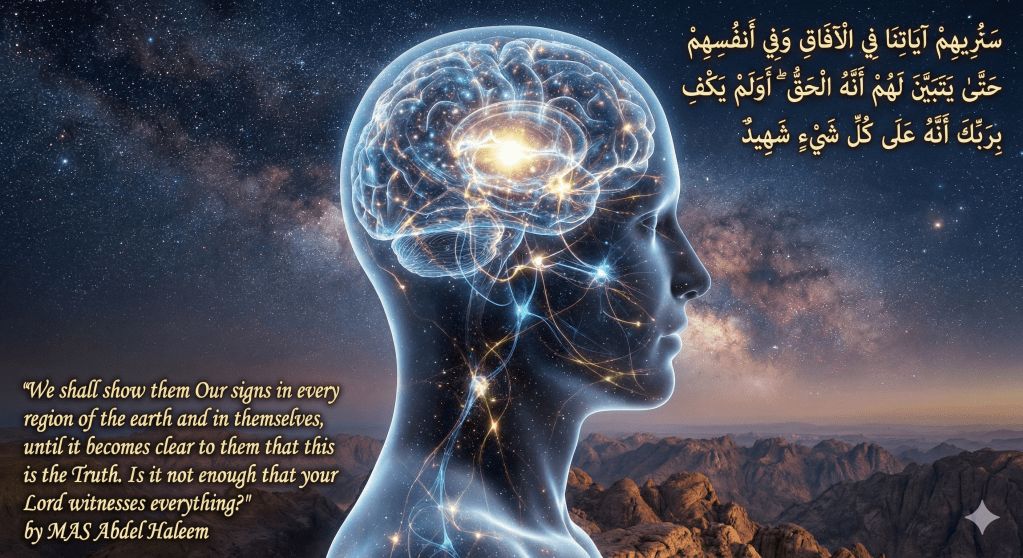
- On consciousness as a Qur’anic sign: in “The Glorious Quran 41:53 – Human Consciousness as a Sign Leading to God” (Jan 26, 2026), the thesis is that “signs in the horizons” (fine-tuning) and signs “within ourselves” (consciousness) converge, with the conclusion that “consciousness leads to God.” thequranThequran
- On fine-tuning and 67:3–4 specifically: “A Perfect Order: Scientific Reflections on Quran 67:3–4 and Cosmic Fine-Tuning” (Apr 18, 2025) reads the verses’ “look again” as an anticipation of the scientific method and gathers the fine-tuning evidence (Rees, Guth, Hoyle, Davies, Hawking, the 10¹²⁰ problem). Shah notes there that “the more we scrutinize the cosmos — ‘returning our vision’ again and again — the more we find an exquisite, seemingly intentional order rather than randomness,” and ends with the reader “humbled by the universe’s fine-tuned splendor” — a direct echo of 67:4.
(Note: Shah’s standard byline is “Written and collected by Zia H Shah MD” or “Presented by… with the help of ChatGPT,” and several 2026 pieces are written in the third person about “the Zia H. Shah Paradigm”; the strongest unambiguously first-person statements are those in the Feb 1 and Jan 5, 2025 articles. Citations should preserve this nuance.)
VIII. Theological and Philosophical Framing
In Islamic natural theology, the cosmos is a tissue of āyāt — signs that point beyond themselves to their Author. Q 67:3–4 is a paradigm: it does not merely assert design but commissions the reader to test it empirically, repeatedly, with the confident prediction that the searching gaze will return “humbled and fatigued,” having found no flaw. Consciousness, on this reading, is the āya lodged “within ourselves” (cf. Q 41:53), the most intimate evidence of a Mind behind minds. The Transcendent God of tawḥīd and tanzīh — beyond the reach of vision yet reaching human awareness (Q 6:103) — is precisely the kind of being whose existence would render conscious subjects unsurprising. The death-before-life ordering of 67:2 then reads as a pedagogy of wonder: by foregrounding the inert default of the universe, it positions life and mind as gifts to be accounted for, and answered for, in deeds.
Thematic Epilogue
Sūrat al-Mulk begins with sovereignty and ends its opening movement with a defeated, reverent gaze. Between the two lies a single, transformative reordering: death before life. Modern knowledge has, unwittingly, vindicated the verse’s instinct. The universe is, in cold fact, a vast theatre of death — entropic, irradiated, silent across billions of light-years, its constants balanced on a knife-edge that need not have permitted a single living cell. That anything sees, suffers, loves, or wonders at all is the deepest anomaly in the cosmos. The “hard problem” names our inability to derive that inner light from matter alone; the bat and Mary’s Room show that no third-person inventory captures the first-person fact; Nagel concedes that materialist nature “almost certainly” cannot account for it. The believer reads all this as 67:4 foretold: look again, and again — and the gaze comes back humbled, not because the cosmos is chaotic, but because it is too ordered, too fine, too alive with mind to be its own author. The anaesthetic of familiarity wears off; the wonder it concealed turns out to be a sign; and the sign, followed home, terminates in the One in Whose hand is the dominion.




Leave a Reply