
Presented by Claude
Abstract
This essay offers a sustained commentary on Sūrat al-Ṣāffāt 37:99–111, the Qur’ānic account of Abraham’s dream-vision concerning the sacrifice of his son, the son’s consenting submission, the divine ransom by a “great sacrifice” (dhibḥ ʿaẓīm), and the enduring blessing pronounced upon Abraham. Reading the verses with attention to their Arabic lexicon (ru’yā, ḥalīm, aslamā, tallahu lil-jabīn, balā’ mubīn, muḥsinīn), the essay synthesizes classical Sunnī and Shīʿī tafsīr (al-Ṭabarī, al-Zamakhsharī, al-Rāzī, al-Qurṭubī, Ibn Kathīr, al-Qummī), engages biblical parallels (Genesis 22; Hebrews 11; Romans 4; James 2; John 1), situates the episode within the documented ritual world of Bronze- and Iron-Age West-Semitic child sacrifice (Carthage, Molek, Tophet), and undertakes a comparative philosophical reading against Søren Kierkegaard’s Fear and Trembling and Emmanuel Levinas’s ethical critique of it. A dedicated section argues, with reference to Qur’ān 5:32 and 22:37, that—far from endorsing human sacrifice—the passage decisively forecloses it, transmuting the archaic logic of human immolation into a permanent rite of sharing meat with the poor (qurbān/udḥiyah) at ʿĪd al-Aḍḥā. The thematic epilogue draws together submission (islām), trust (tawakkul), divine unity (tawḥīd), and the sanctity of the human person as one coherent moral grammar inherited from the father of monotheism through both his sons, Ishmael and Isaac.
I. The Text in Arabic and Translation
The passage—As-Saffat (The Rangers / Those Who Set the Ranks), verses 99–111—reads in Saheeh International’s careful rendering:
(99) And [Abraham] said, “Indeed, I will go to [where I am ordered by] my Lord; He will guide me. (100) My Lord, grant me [a child] from among the righteous.” (101) So We gave him good tidings of a forbearing boy. (102) And when he reached with him [the age of] exertion, he said, “O my son, indeed I have seen in a dream that I [must] sacrifice you, so see what you think.” He said, “O my father, do as you are commanded. You will find me, if Allāh wills, of the steadfast.” (103) And when they had both submitted and he put him down upon his forehead, (104) We called to him, “O Abraham, (105) You have fulfilled the vision.” Indeed, We thus reward the doers of good. (106) Indeed, this was the clear trial. (107) And We ransomed him with a great sacrifice, (108) And We left for him [favorable mention] among later generations: (109) “Peace upon Abraham.” (110) Indeed, We thus reward the doers of good. (111) Indeed, he was of Our believing servants. Quran.com + 3
The verses are framed by Abraham’s hijrah toward God after his confrontation with the idolaters (cf. 21:51–70; 29:24–26) and the prayer “Rabbi hab lī mina al-ṣāliḥīn.” The lexicon is dense:
- ghulām ḥalīm (“forbearing boy,” v. 101): the only two human beings in the entire Qur’ān to receive this epithet are Abraham himself (11:75) and this son. The shared adjective binds father and son in moral identity before any test is mentioned.
- arā fī al-manām (“I see/saw in the dream,” v. 102): the imperfect verb (arā) implies a recurring vision; classical reports speak of three successive nights, anchoring the dream as waḥy (revelation) rather than reverie. Quran.com
- fa-nẓur mādhā tarā (“see what you think”): the consultation, in the same verb (ra’ā) that describes Abraham’s seeing, makes the son a co-participant in interpreting the vision.
- fa-lammā aslamā (“when they had both submitted,” v. 103): the verb is in the dual, aslamā, the very root of islām. The text does not say Abraham submitted his son; it says both of them surrendered themselves to God.
- tallahu lil-jabīn (“he laid him down on the side of his forehead”): a vivid, almost tender clinical phrase; the Arabic lexicographers note the act of turning the face sideways, suggesting Abraham would not look directly upon his son’s face. Quran.com
- qad ṣaddaqta al-ru’yā (“you have confirmed/fulfilled the vision,” v. 105): not “you have completed the slaughter,” but “you have made the vision true”—the truth of the dream consisted in the will, not in the deed.
- al-balā’ al-mubīn (“the manifest trial,” v. 106): balā’ carries both “test” and “ordeal”; mubīn means “clarifying”—a trial that discloses what was already there.
- dhibḥ ʿaẓīm (“a great/momentous sacrifice,” v. 107): an offering that is, in Maududi’s phrase, “great because it ransomed a faithful servant like Abraham for a patient and obedient son like Ishmael.” My Islam
- muḥsinīn (“doers of good,” vv. 105, 110): from iḥsān, the apex of religious life in the famous Gabriel-ḥadīth—to worship God as if you see Him.
II. The Identity of the Son: Ishmael as the Dhabīḥ
The Qur’ān does not name the son in v. 102, but the surrounding architecture of the sūrah and the bulk of the Sunnī and Shīʿī exegetical tradition identifies him as Ishmael (Ismāʿīl). Ibn Kathīr presents the case with a force that has become canonical: after the entire episode concludes in v. 107, the very next verse announces, “And We gave him good tidings of Isaac, a prophet from among the righteous” (37:112). Since glad tidings of Isaac come after the ransom, the son who walked to the place of sacrifice cannot have been Isaac. Ayah Surah QuranQuran.com
Ibn Kathīr further cites a chain of authorities—ʿAlī ibn Abī Ṭālib, Ibn ʿUmar, Abū Hurayra, Saʿīd ibn al-Musayyab, Saʿīd ibn Jubayr, al-Ḥasan al-Baṣrī, Mujāhid, al-Shaʿbī, Muḥammad ibn Kaʿb al-Quraẓī, and Imām Aḥmad ibn Ḥanbal—who held that the dhabīḥ was Ishmael. He records ʿAbd Allāh ibn Aḥmad’s question to his father: “Which of the sons was to be sacrificed?” The reply was unambiguous: “Ismāʿīl.” Al-Shaʿbī adds the material datum that “I saw the horns of the ram in the Kaʿbah”—the ram’s horns hung in the sanctuary until the siege of Ibn al-Zubayr (73 AH), when both they and parts of the Kaʿbah perished. The Meccan loci of the rite—Minā, the jamarāt, the well of Zamzam—all belong to Ishmael’s geography, not Isaac’s. Surah Quran + 7
There is therefore no need, on the Qur’ānic reading, to negotiate between competing names. Ishmael is the firstborn of the friend of God (khalīl Allāh), the elder brother whose mother Hagar’s running between Ṣafā and Marwah is incorporated into the rites of ḥajj, the boy beside whom Abraham raised the foundations of the Sacred House (2:127), and the prophet whom the Qur’ān calls “true to the promise” (ṣādiq al-waʿd, 19:54). In the Islamic memory, the near-sacrifice is the apex of his life because it is the moment at which submission reveals itself as the family inheritance. Studio Arabiya + 2
III. The Dream as Revelation: Classical Tafsīr
Classical commentators were unanimous that the dreams of prophets are a species of revelation (ru’yā al-anbiyāʾ waḥy). ʿUbayd ibn ʿUmayr’s dictum to this effect is preserved by Ibn Kathīr at this very verse. Fakhr al-Dīn al-Rāzī, in Mafātīḥ al-Ghayb, devotes careful attention to why the command came through a dream rather than direct verbal revelation: the mediated form deepens the ordeal, because a dream admits of interpretation and excuse, but Abraham, refusing all hermeneutic escape-hatches, took it at its sternest. The wisdom, al-Rāzī writes (as paraphrased by Mufti Muhammad Shafīʿ in Maʿārif al-Qurʾān), is that “the purpose of the great Creator here was neither to have Ishmael actually slaughtered, nor to make it binding upon Abraham that he slaughter him ultimately; instead, the purpose was to give the command that he should, on his part, do everything necessary to slaughter him and take all steps leading to slaughter.” Had the command been verbal, either the test would have been hollowed out by foreknowledge of abrogation, or the literal command would have had to be revoked. The dream allowed Abraham’s will, not Ishmael’s blood, to be the actual offering. Quran.com + 3
Al-Qurṭubī, in al-Jāmiʿ li-Aḥkām al-Qurʾān, notes the threefold repetition of the dream as the establishment of certainty (tawātur), the consultative gesture as a sign of the son’s maturity, and the substitution of the ram as God’s mercy that “is greater than His wrath.” Al-Zamakhsharī’s al-Kashshāf, while characteristically terse, glosses aslamā as “they both surrendered themselves wholly to the command of God, the father resolved to slaughter, the son resigned to be slaughtered,” and reads qad ṣaddaqta al-ru’yā as proof that “the truth of the vision consisted in the intention and the readiness, not in the consummated act.” Al-Ṭabarī, who in his Tārīkh surveys both naming traditions, in any case treats the moral architecture of the episode—dream, consultation, consent, ransom—as the substance of the lesson rather than the genealogical question. A later, Shīʿī, current—anchored in Tafsīr al-Qummī and developed by al-Ṭūsī and al-Ṭabrisī—reads the “great sacrifice” of v. 107 typologically as a foreshadowing of the martyrdom of al-Ḥusayn at Karbalāʾ; the ram from paradise becomes a sign that the ultimate “great sacrifice” lies ahead in salvation history. Academia.eduAl-Islam
Across all of these readings the consensus is striking: the dream is real revelation; the dream is also a pedagogical instrument; the value of the act lies in surrender, not slaughter; the substitute ram is divine mercy and divine teaching at once.
IV. The Son’s Consent: A Mutual Islām
The most theologically generative phrase in the passage may be the dual verb of v. 103, fa-lammā aslamā: “when they both submitted.” The Qur’ān refuses to construe the event as a father’s solitary deed. It is a covenantal act of two wills converging on one obedience. The son’s preceding speech makes this consent explicit: “Yā abati, ifʿal mā tuʾmar—O my father, do what you are commanded; you will find me, in shāʾ Allāh, of the patient” (37:102). Three features of this answer reward attention. My IslamEquranekareem
First, the son recognises that what looks like a private dream is in fact a divine command (mā tuʾmar, “what you are commanded”). The exegetes praise the boy’s spiritual acuity in seeing this. Second, he conditions his patience on God’s will (in shāʾ Allāh), refusing to claim a virtue he has not yet enacted—a beautiful instance of adab before the Lord. Third, he describes himself in advance as one of al-ṣābirīn, joining the company that the Qur’ān elsewhere honors with God’s company: “Allāh is with the patient” (2:153). Quran.com
This consensual structure is decisive for the philosophical and ethical reading developed below. Where Genesis 22 leaves the son largely mute (he asks where the lamb is, and Abraham answers, “God will provide,” v. 8), the Qur’ān grants the son a speaking part and a deliberative role. Whatever else it is, the Qur’ānic Aqedah is not a private encounter between a father and his god with a child as object; it is a covenantal scene in which two believers together place themselves in God’s hands. Islām, the very name of the religion, is here exhibited in its perfect form: not the submission of one human will to another, but the joint surrender of two wills to the One.
V. Biblical Parallels and Echoes
The Qur’ān is conscious of standing in conversation with the Hebrew Bible and the New Testament; it confirms, corrects, and completes their narratives (cf. 5:48). A scholarly reading thus benefits from juxtaposing 37:99–111 with the relevant biblical material—not in order to litigate the question of identity, which the Qur’ān has settled, but to enrich the spiritual texture of the episode and recognise the deep continuities of the Abrahamic imagination.
Genesis 22, the ʿAqēdat Yiṣḥāq (“binding of Isaac”), opens with the divine summons “Take your son, your only son, whom you love” (Gen 22:2). The threefold address (“your son… your only son… whom you love”) is a literary device of unbearable pathos. Abraham rises early, saddles his donkey, takes two servants, and walks three days toward the mountain in the land of Moriah. The boy carries the wood; the father carries the fire and the knife. The son asks the most famous question of the chapter: “Behold the fire and the wood, but where is the lamb for a burnt offering?” Abraham replies, “God himself will provide the lamb for a burnt offering, my son” (Gen 22:7–8). At the altar he binds the boy (the Hebrew root ʿqd, whence Aqedah), reaches for the knife, and is stopped by the Angel of the LORD: “Do not lay your hand on the boy” (Gen 22:12). Abraham looks up and sees “a ram caught in a thicket by his horns,” and offers it “instead of his son” (Gen 22:13). The place is named YHWH-Yirʾeh—”the LORD will provide,” or “on the mountain of the LORD it shall be seen” (Gen 22:14). The chapter closes with the climactic seventh blessing on Abraham: “By myself I have sworn… because you have done this and have not withheld your son… I will indeed bless you, and I will multiply your offspring as the stars of heaven and as the sand that is on the seashore… and in your offspring shall all the nations of the earth be blessed” (Gen 22:16–18). The Qur’ānic verse 108—”And We left for him [favorable mention] among later generations: peace upon Abraham”—is the structural counterpart of this final blessing. Biblical Archaeology SocietyBiblical Archaeology Society
The New Testament reads the binding through the lens of faith. Hebrews 11:17–19 frames Abraham’s act as the supreme exhibit of faith: “By faith Abraham, when he was tested, offered up Isaac… He considered that God was able even to raise him from the dead, from which, figuratively speaking, he did receive him back.” James 2:21–23 turns the same event toward the unity of faith and works: “Was not Abraham our father justified by works when he offered up his son Isaac on the altar? You see that faith was active along with his works… and the scripture was fulfilled that says, ‘Abraham believed God, and it was reckoned to him as righteousness’; and he was called the friend of God.” Paul, in Romans 4, makes Abraham the father of all who believe—”the father of us all”—precisely because he trusted the God “who gives life to the dead and calls into existence the things that do not exist” (Rom 4:17). And John the Baptist’s identification of Jesus as “the Lamb of God, who takes away the sin of the world” (John 1:29) trades on the same sacrificial grammar, while in Romans 8:32 Paul’s phrase, “He who did not spare his own Son but gave him up for us all,” is an unmistakable echo of Gen 22:12. Eitan Bar
The Qur’ānic title for Abraham—”khalīl Allāh,” the friend of God (4:125)—is the very phrase used in James 2:23 and in 2 Chronicles 20:7 and Isaiah 41:8. The Qur’ān calls Muslims to follow “the religion of your father Abraham” (millat abīkum Ibrāhīm, 22:78); and identifies the very purpose of revelation as the recovery of the ḥanīf, the upright primordial monotheism that “Abraham was neither a Jew nor a Christian, but he was upright in faith, a Muslim” (3:67). All three traditions—Jewish, Christian, Islamic—agree that whatever else this narrative is, it is the founding act of faith. Quran Gallery AppQuran.com
VI. Historical Context: Child Sacrifice and Its Repudiation
To read 37:99–111 as if it stood outside history is to miss its iconoclasm. The world into which Abraham came was a world in which the gods could, and did, demand human blood. The archaeological and textual record from the second and first millennia BCE is unambiguous on this point.
Deuteronomy 12:31 condemns the Canaanites because “they even burn their sons and daughters in the fire to their gods.” Leviticus 18:21 forbids passing children “through the fire to Molech.” 2 Kings 3:27 records the Moabite king Mesha sacrificing his firstborn on the wall of his besieged city. The Phoenician colony of Carthage, in modern Tunisia, has yielded the tophet—an open-air precinct of urns containing the cremated remains of infants, often under stelae dedicated to Baʿal Hammon and Tanit. At Carthage’s Salammbô tophet alone, excavations from 1921 through the 1970s under the American Schools of Oriental Research (with Lawrence Stager’s later ASOR-led seasons) yielded over 20,000 cremation urns alongside some 6,000 stelae, with parallel tophets at related Phoenician sites in Sardinia, Sicily, and Malta. After decades of revisionist scholarship that tried to interpret the tophet as a mere cemetery for naturally deceased infants, the January 2014 paper by Paolo Xella, Josephine Quinn (Oxford), Valentina Melchiorri, and Peter van Dommelen in Antiquity concluded, in the words of the University of Oxford press release of 23 January 2014, that “the archaeological, literary, and documentary evidence for child sacrifice is overwhelming and, we believe, conclusive: they did kill their children.” A parallel 2014 Antiquity paper by Patricia Smith and colleagues (Hebrew University and Harvard) demonstrated, as the Biblical Archaeology Society summarised, that “the evidence from the Carthage Tophet shows a preference for a specific age-range—under three months old—which, moreover, does not correlate with the expected pattern of mortality rates in antiquity.” Bible Archaeology + 3
It is against this dark backdrop that Genesis 22 and Qur’ān 37 must be read. Both narratives stage the demand for the child—and then categorically deny it. The God of Abraham is not Moloch. The hand is stayed; a ram is provided; the child returns home. The Talmud (Taʿanit 4a), reflecting on Jeremiah 19’s denunciation of child sacrifice in the Valley of Hinnom, declared that such a thing “never crossed God’s mind.” The Aqedah, on this reading, is not a celebration of child sacrifice but its decisive repudiation—a polemic in narrative form, distinguishing the God of Abraham from the molk of the Canaanites. Maimonides, in the Guide for the Perplexed (III.24), draws the same lesson: the binding teaches “the limit of love and fear of God”—and, simultaneously, that God does not demand it. The Qur’ānic episode performs the same theological labour for the Arabian context, where pre-Islamic Arabs had been known to bury infant daughters alive (a practice the Qur’ān condemns in 81:8–9 and 16:58–59). WikipediaWikipedia
The pedagogical structure is exact. In the surrounding cultures, a god commanded the child and received the child. In Abraham’s narrative, the God who commands does not receive—and thereby teaches that He never wanted the child in the first place. What He wanted was the heart.
VII. Why This Story Cannot Be Used to Suggest That Islam Endorses Human Sacrifice
A polemical reading sometimes alleges that because Abraham was ready to slaughter his son and is praised for it, Islam (and indeed all three Abrahamic faiths) harbours a latent endorsement of human sacrifice. This reading is exegetically untenable and morally inverted. The episode is, in fact, one of the strongest anti-human-sacrifice texts in the world’s scriptural canon. Five observations make the point.
(1) The vision was not consummated. The Qur’ān is precise: Abraham saw in a dream that he was sacrificing his son (37:102), and what he was praised for was the fulfilment of the vision (v. 105), not the slaying. As-Suddī and others noted in the classical tradition that the knife passed over the neck without cutting; the verse calls the act “fulfilled” before any blood was shed. The “great sacrifice” (v. 107) substitutes a ram for the boy. Whatever else the story means, it means that God did not, in the end, want the boy’s life. QuranXAlim
(2) God Himself stops the act and names it a trial. “Indeed, this was the clear trial” (hādhā la-huwa al-balā’ al-mubīn, v. 106). The Arabic balā’ often connotes the disclosure of moral character. The dream did not communicate God’s eternal desire that children be slain; it disclosed Abraham’s eternal readiness to give God whatever God asked. The retraction of the demand reveals what God actually willed.
(3) The Qur’ān’s most general teaching on human life forbids the act categorically. Qur’ān 5:32 declares: “Because of that, We decreed upon the Children of Israel that whoever kills a soul, unless for a soul or for corruption [done] in the land, it is as if he had slain mankind entirely. And whoever saves one, it is as if he had saved mankind entirely.” The classical commentators—Ibn Kathīr, al-Ṭabarī, al-Qurṭubī—read the verse universally: “There is no difference between one life and another” (Ibn Kathīr). The verse is set in the Qur’ān after the story of Cain and Abel (5:27–31), making explicit that the murder of even a single soul deranges the moral order of the entire cosmos. Whatever else the Qur’ān permits, it does not permit private religious slaughter of human beings; the only lawful taking of life is judicial, for proven capital offences. The dream of Abraham, by not being executed, sits squarely within this prohibition rather than against it.
(4) The Qur’ān explicitly tells us what God wants from sacrifice—and it is not flesh. “Their meat will not reach Allāh, nor will their blood, but what reaches Him is piety from you” (lan yanāla Allāha luḥūmuhā wa-lā dimāʾuhā wa-lākin yanāluhu al-taqwā minkum, 22:37). This verse is dispositive against any sacrificial theology that locates the value of the act in the physical act of killing. What ascends to God is taqwā, godward consciousness; what falls to earth in the form of meat is then to be distributed to the poor. The ritual is, in effect, a moral economy of compassion, not an offering of blood. Islam Awakened
(5) The festival commemorating the event is, sociologically, a festival of feeding the poor. Across the Muslim world the meat of the qurbān is divided into three: one third for the family, one third for friends and relatives, one third for the destitute. The festival is the largest annual transfer of high-quality protein to the global poor; it is the structural opposite of human sacrifice. As the Prophet ﷺ said, “Whoever slaughtered the sacrifice before the (Eid) prayer, has only slaughtered for himself; and whoever slaughtered it after the prayer, his rite is complete and he has acted according to the Sunnah of the Muslims” (Bukhārī)—the act is constituted as worship precisely by being situated within communal prayer and communal sharing, not in isolation.
Taken together, the Qur’ānic episode is therefore best read as the moment at which God forecloses human sacrifice for the Abrahamic community for all time. The willingness is praised; the act is forbidden. The lesson is that submission belongs only to God, and that God’s claim on us extends to every part of our lives—precisely so that none of His creatures may claim our blood from us in His name. In a deep sense, the verse 5:32 is the Qur’ānic gloss on the verse 37:107: the ransom of one life is the saving of all life.
VIII. The Philosophy of Submission: Engaging Kierkegaard
The most philosophically ambitious modern reading of Abraham’s trial is Søren Kierkegaard’s Fear and Trembling (1843), published under the pseudonym Johannes de silentio. Kierkegaard’s Abraham is the “knight of faith” who, on the strength of a private command from God, performs what Kierkegaard calls a “teleological suspension of the ethical.” “The story of Abraham,” he writes in Problema I, “contains just such a teleological suspension of the ethical… [Abraham] transgressed the ethical altogether and had a higher telos outside it, in relation to which he suspended it” (Hong & Hong trans., Princeton UP, 1983, p. 59). “Faith,” he continues, “is namely this paradox that the single individual is higher than the universal” (Hong & Hong, p. 55). The act is intelligible only “by virtue of the absurd”—”for there could be no question of human calculation, and it was indeed the absurd that God who required it of him should the next instant recall the requirement” (Lowrie trans., 1941, p. 46). Abraham, on this picture, is radically alone: “he said nothing to Sarah, nothing to Eleazar” (Lowrie, p. 23). “Abraham remains silent—but he cannot speak. Therein lies the distress and anguish. … He speaks no human language… he speaks in a divine tongue, he speaks with tongues” (Hong & Hong, pp. 113–114). Goodreads + 2
This reading has been enormously influential, but Emmanuel Levinas, in his 1963 essay “Existence et éthique” (collected in Noms propres, 1976; English in Proper Names, trans. Michael B. Smith, Stanford UP, 1996), objects on ethical grounds: “Violence emerges in Kierkegaard at the precise moment when, moving beyond the aesthetic stage, existence can no longer limit itself to what it takes to be an ethical stage and enters the religious one, the domain of belief” (Proper Names, p. 72). Levinas insists that “it is not at all clear that Kierkegaard located the ethical accurately. As the consciousness of a responsibility towards [autrui], the ethical does not disperse us into the generality… On the contrary, it individuates the person” (Proper Names, p. 76). For Levinas, the height of the divine is the height of the ethical: “the attribute of height by which the divine is described, and by which it surpasses the human, is precisely its ethical content” (Proper Names, pp. 73–74). The Akedah’s true moment of revelation, on this reading, is not Abraham’s readiness to kill but the angel’s command not to. academia
The Qur’ānic version of the episode is, by its internal structure, much closer to Levinas than to Kierkegaard. Three differences are decisive.
First, there is no silence. Abraham speaks to his son (“O my son, indeed I have seen…”), and asks him to reflect (“fa-nẓur mādhā tarā—so see what you think”). The Qur’ānic Abraham is not de silentio’s “knight” who cannot make himself understood; he is a father in dialogue with his son.
Second, there is no solitary individual standing in an absolute relation to the Absolute over the head of the universal. The verb aslamā is dual: “they both submitted.” The act is intersubjective from the start. Asma Barlas, in “Abraham’s Sacrifice in the Qur’an: Beyond the Body” (Scripta Instituti Donneriani Aboensis 23 [2011]: 55–71), observes that whereas Kierkegaard’s Abraham is “a witness and not a teacher” who “does not speak, he does not tell his secret to his loved ones,” the Qur’ān precisely shows Abraham telling, asking, and being answered; “while the family may be Abraham’s, Abraham himself is not identical in the Qur’an and the Bible and neither are his trials” (p. 55). Studia Orientalia ElectronicaSemantic Scholar
Third, there is no teleological suspension of the ethical, because the ethical is never suspended. The son consents. The command itself, the exegetes insist, never required the actual taking of his life—as al-Rāzī puts it, “the purpose was the will, not the deed.” Reuven Firestone notes in Journeys in Holy Lands: The Evolution of the Abraham-Ishmael Legends in Islamic Exegesis (SUNY Press, 1990) and his earlier essay “Abraham’s Son as the Intended Sacrifice (al-Dhabīḥ, Qur’ān 37:99–113): Issues in Qur’ānic Exegesis” (Journal of Semitic Studies 34, no. 1 [1989]: 95–131) that the dual aslamā in Q 37:103 makes the act a mutual surrender to God, philologically incompatible with a Kierkegaardian “silence” or unilateral suspension. There is, indeed, an ordeal—al-balā’ al-mubīn. But the ordeal is not the breach of ethics; it is the disclosure that submission to God is the deepest ethics, which God Himself confirms by stopping the knife and giving the ram.
The Qur’ānic Abraham is thus neither Kant’s “fanatic” (who must refuse a command apparently to kill his son because no genuine moral law could require it) nor Kierkegaard’s “knight” (who must perform what looks like murder on the strength of an absurd faith). He is the prophetic exemplar of islām understood as a stance: total openness to God’s command, which God in turn shows to be saturated with mercy. Submission and ethics are not in tension; they are mutually disclosing. In this respect, the Islamic reading subtly displaces the entire Kierkegaardian framework: the religious is not “above” the ethical, because the religious is the ethical when both are referred to their source in God. The knight of faith is replaced by the ḥalīm (the forbearing one): father and son together.
IX. Theological Themes: Tawḥīd, Tawakkul, Iḥsān
Several great Qur’ānic doctrines converge in this passage. First and most fundamentally, tawḥīd—the absolute oneness of God. The episode is staged after Abraham’s lifelong polemic against idols (37:83–98); his readiness to surrender his only son is the inner counterpart of his outward iconoclasm. He has cleared the world of false gods; now he clears his own heart of any rival to the True God, including the rival of his own paternal love. The reward is not the loss of the son but the consecration of the love.
Second, tawakkul, trust in God. Abraham’s prayer in v. 99—”I am going to my Lord; He will guide me”—is the keynote of the whole passage. The son’s “in shāʾ Allāh… you will find me of the patient” is its echo. Trust is not the certainty that the worst will not happen; it is the conviction that whatever happens is under the providence of the One who cannot will evil for His servants.
Third, iḥsān, excellence or beautiful conduct. Verses 105 and 110—”thus do We reward the muḥsinīn“—frame the episode. Iḥsān, defined by the Prophet ﷺ as “to worship God as though you see Him,” is precisely the inner posture that the dream tests. Abraham acts as though he sees God; God, in turn, sees him, and stops the knife.
Fourth, the testing of the prophets. The Qur’ān is candid that prophets are tested more severely than other believers, because their testimony must be borne in the flesh of their lives. Abraham faces the fire (21:69), the loss of his homeland (29:26), the binding of his son. Each test is what 2:124 calls “words” by which God tried him, “which he fulfilled.”
Fifth, the ransom motif. The “great sacrifice” (dhibḥ ʿaẓīm) is divine grace materialised. Maududi captures it well: the ram is “great” not in size but in the moral weight of what it accomplishes—it ransoms not only Ishmael but, prospectively, every animal slaughtered in commemoration thereafter, and through them every poor family that eats the meat. The ransom motif is found across the Qur’ān—God ransoms Joseph from the well, Moses from Pharaoh, the Prophet ﷺ from his enemies—because the God of the Qur’ān is al-Fattāḥ, the Opener of ways.
Sixth, the prophethood of Ishmael alongside Isaac and Abraham. The Qur’ān refuses any preference of one brother over the other (2:136): “We make no distinction between any of them.” Verses 112–113 of the same sūrah complete the picture by announcing the birth of Isaac and the blessing “upon him and upon Isaac.” Islam is the religion of the God of Abraham, of the older brother Ishmael, and of the younger brother Isaac. The millat Ibrāhīm is a household before it is a creed.
X. ʿĪd al-Aḍḥā, Qurbānī, and the Living Memory of the Sacrifice
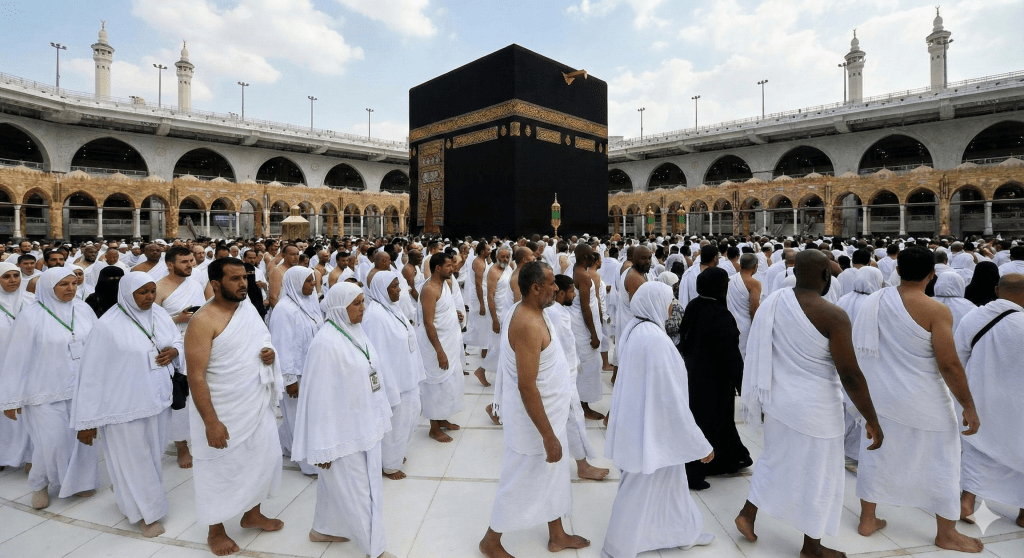
The ritual life of the Muslim community embeds this passage in its calendar. ʿĪd al-Aḍḥā (the Festival of Sacrifice) falls on the 10th of Dhū al-Ḥijjah, the climactic day of the ḥajj, immediately after the Day of ʿArafah (9 Dhū al-Ḥijjah), the pinnacle of the pilgrimage. In 2026, subject to moon sighting, the festival is expected to begin on Wednesday, 27 May 2026 with the Eid prayer and continue through Saturday, 30 May 2026, per the calendars published by Islamic Relief UK, Muslim Aid, and Islamic Relief Australia. Islamic Relief UKMuslim Aid
The animal sacrifice—called qurbān (from the root q-r-b, “to draw near”) in much of the Muslim world, or udḥiyah (related to ḍuḥā, the forenoon, when the slaughter is performed)—is governed by detailed fiqh across the four Sunnī schools. The Hanafi school holds qurbān to be wājib (obligatory) on every adult Muslim in possession of niṣāb (the threshold of wealth at which Zakāt also becomes due); the Mālikī, Shāfiʿī, and Ḥanbalī schools hold it to be sunnah muʾakkadah (an emphasized practice). Permissible animals are sheep, goats, cows, and camels; a sheep or goat counts for one share, while a cow or camel may be shared by up to seven persons. The animal must be healthy, of proper age (six months for sheep by majority opinion; one year for goats; two for cattle; five for camels), and free of disqualifying defects (blindness, lameness, missing more than a third of an ear or horn, severe emaciation). The slaughter must occur after the ʿĪd prayer on 10 Dhū al-Ḥijjah and within the days of tashrīq—through 12 Dhū al-Ḥijjah in the majority view, through 13 Dhū al-Ḥijjah in the Ḥanbalī view—and is performed with a sharp knife and the formula “Bismillāh, Allāhu akbar.” Islamic Relief UK + 2
The Prophet ﷺ is reported to have said, “Whoever slaughtered before the (Eid) prayer, has only slaughtered for himself; and whoever slaughtered after the prayer, his rite is complete and he has acted according to the Sunnah of the Muslims” (Ṣaḥīḥ al-Bukhārī). The meat is then divided into thirds: one third for the household, one third for relatives and friends (including non-Muslims), one third for the poor. The selling of any part of the sacrifice—including the hide—is forbidden by an explicit prophetic prohibition: “Whoever sells the skin of his sacrifice, there is no sacrifice for him” (Ṣaḥīḥ al-Bukhārī 1716). Human Appeal Inc. + 2
Spiritually, the rite is governed by 22:37—the meat does not reach God; taqwā does. The slaughter is a re-enactment of Abraham and Ishmael’s submission and of God’s mercy in providing the substitute. The rituals of ḥajj that surround it—the running between Ṣafā and Marwah in memory of Hagar’s search for water, the drinking of Zamzam in memory of the miracle that saved Ishmael’s life, the casting of pebbles at the three jamarāt in memory of Abraham, Hagar, and Ishmael stoning Satan when he tried successively to dissuade each from obedience—each anchors the festival of the 10th into the geography of the family that produced this story. International charities translate the rite into immense annual transfers of food. Islamic Relief’s 2025 qurbani programme, according to its official 2025 impact report, “distributed qurbani to over 3.2 million people across 29 countries,” and Human Appeal’s April 2026 GlobeNewswire press release reported having reached over 1.1 million beneficiaries across 20 countries—making ʿĪd al-Aḍḥā among the largest coordinated acts of food charity in the world. Studio Arabiya + 3
The festival is, in this respect, the public liturgical answer to the question the dream of Abraham was meant to provoke: how should one love God? Answer: by entrusting Him with everything one has; by accepting the substitute He provides; by sharing the gift with the poor; by remembering that one was once spared.
XI. The Sanctity of Life: Reading 5:32 with 37:107
Qur’ān 5:32 stands as the Qur’ān’s most explicit statement of the sanctity of the human person:
Because of that, We decreed upon the Children of Israel that whoever kills a soul—unless for a soul or for corruption [done] in the land—it is as if he had slain mankind entirely. And whoever saves one—it is as if he had saved mankind entirely.
The verse is structured as a divine decree on the Children of Israel in the aftermath of Cain’s murder of Abel (5:27–31); but by classical consensus, including Ibn Kathīr’s careful reading, the principle is universal—”there is no difference between one life and another.” The Talmudic precursor (Mishnah Sanhedrin 4:5) carries the same hyperbolic ethic. The verse turns each individual human life into the moral equivalent of the whole human race; the killing of one is, in moral weight, the killing of all.
Reading 5:32 alongside 37:107 produces a single coherent doctrine. The “great sacrifice” by which Ishmael was ransomed is the divine demonstration that one human life is, in God’s economy, of infinite worth. God will not have the child; God provides the ram; God establishes a perpetual rite in which the saving of life is commemorated by the sharing of food. The decree of 5:32 is the legal-ethical correlate of the narrative of 37:99–111. Together they teach what the Qur’ān 6:151 makes explicit as a commandment of the Decalogue type: “Do not kill the soul which God has made sacred, except by right.”
It is therefore a category error to derive from 37:99–111 any sanction for human sacrifice. The episode does the opposite: it draws a permanent line between the God of Abraham and the gods who demanded blood. The willingness of the father is celebrated; the slaughter of the son is forbidden. The ram is provided so that, in every generation, the willingness can be renewed without the slaughter ever recurring. ʿĪd al-Aḍḥā is the festival of the not-sacrificed son.
XII. Two Brothers, One Submission
Verses 112–113 of the same sūrah extend the blessing to Isaac: “And We gave him good tidings of Isaac, a prophet from among the righteous. And We blessed him and Isaac.” The Qur’ānic theology of Abraham is irreducibly familial. The line of prophecy proceeds through both brothers: through Isaac to Jacob, the Twelve Tribes, Joseph, Moses, David, Solomon, Jesus; through Ishmael to the Arab peoples and, in the fullness of time, to Muḥammad ﷺ. The two genealogies are not rivals but the two branches of a single tree planted by Abraham at the foundation of the Kaʿbah (2:127). Ayah Surah Quran
The Qur’ān’s testimony of faith (2:136) explicitly enfolds both lines: “Say: We believe in God and what was sent down to us, and what was sent down to Abraham, Ishmael, Isaac, Jacob, and the Tribes…” The Prophet ﷺ in his daily taḥiyyāt invokes “blessings upon Muḥammad and upon the family of Muḥammad as You blessed Ibrāhīm and the family of Ibrāhīm.” The very form of the daily prayer binds the Muslim to the household of Abraham.
That household is defined by submission. Sarah’s laughter (Gen 18:12), Hagar’s running (Ṣaḥīḥ al-Bukhārī 3362), Abraham’s silence before the fire (21:69), Ishmael’s “do as you are commanded,” Isaac’s eventual fatherhood of Jacob—each is a moment of islām. The Qur’ān calls Abraham himself an ummah, a community in himself (16:120), because he embodied in one life the faith that an entire community is meant to live. His two sons inherit that faith, and through them so does every believer who turns toward the Kaʿbah in prayer. My Islam
XIII. Thematic Epilogue: The Geometry of Surrender
What, finally, does Qur’ān 37:99–111 say? It says that the deepest form of love is not the love that clings but the love that lets go. It says that God is not the molk who devours children but the raḥmān who provides the ram. It says that obedience is not the suspension of the ethical but its perfection. It says that the visions of prophets are true even when they are not enacted, because the truth of a vision can lie in the will it elicits. It says that fatherhood is consultation, that sonship is consent, that the family is the first place where islām is learned. It says that the sacrifice God wants does not reach Him as flesh; only piety reaches Him. It says that a single human life is, in God’s reckoning, equivalent to all human life—and therefore that no human institution, religious or political, has the right to take it.
It says, finally, that the religion of Abraham is the religion of his older son and of his younger son together: a religion of total surrender to the One God of mercy, in which the knife is always stayed at the last moment, and the ram is always provided, and the meat is always shared with the poor. To recite “salāmun ʿalā Ibrāhīm“—”peace upon Abraham”—is to enter that geometry of surrender, and to discover, with the patriarch, that the God who tested him is the God who would never have wanted what He asked.
The knife did not fall. That is the entire substance of the story. The willingness was the offering; the mercy was the answer; the festival is the memory; the sanctity of life is the law that follows. In the Qur’ānic imagination, every act of qurbān is a renewed reading of 37:107—”And We ransomed him with a great sacrifice”—and a renewed pledge that no human being will ever again be the offering, because the One in whose name the offering is made has Himself decreed that whoever saves a single soul saves all of humanity.
Here is the PDF file:



Leave a Reply