
Presented by Claude
ABSTRACT
This essay argues that Qurʾān 39:42 — the verse in Sūrat al‑Zumar declaring that God “takes the souls at the time of their death and those that have not died, in their sleep” — provides a unifying lens through which sleep, death, hibernation, and bodily resurrection appear not as isolated curiosities but as members of a single metaphysical family: states of suspended life that God reversibly governs. We begin with the Arabic text, a literal translation, and fifty English renderings drawn primarily from the IslamAwakened parallel corpus and supplementary scholarly sources, allowing the reader to feel the verse’s semantic field across translators from George Sale (1734) to contemporary editions. We then read the verse through three lenses. Scientifically, modern sleep neuroscience confirms a daily “minor death” (al‑mawt al‑aṣghar): consciousness is suspended, the default‑mode network deactivates, and identity is gathered up and re‑issued upon waking. Philosophically, Ibn Sīnā’s “flying man,” al‑Ghazālī’s account of the soul’s nightly ascent, and Mullā Ṣadrā’s substantial motion converge with Plato’s Phaedo and Descartes’ cogito to make sleep both an epistemic proof of dualism and a rational argument from analogy for resurrection. Theologically, classical exegetes (al‑Ṭabarī, al‑Qurṭubī, al‑Rāzī, Ibn Kathīr, al‑Suyūṭī, the Jalālayn) unanimously read the verse as proof that the One who restores consciousness each morning can restore life on the Last Day. We then survey hibernation, torpor, brumation, estivation, diapause, and cryptobiosis across all animal classes — from bears with hearts beating nine times a minute, Arctic ground squirrels supercooled to −2.9 °C, wood frogs frozen 65–70 % solid, common poorwills dormant for forty‑five days, African lungfish cocooned in mud for up to four to five years, and tardigrades revived after exposure to near absolute zero and the vacuum of space, to Panagrolaimus kolymaensis nematodes revived from Siberian permafrost approximately 46,000 years old. We conclude that the cosmos itself is structured as a liturgy of dormancy and renewal, and that Qurʾān 39:42 names the principle that unites them. Scientific American + 4
I. THE ARABIC TEXT, TRANSLITERATION, AND BASELINE TRANSLATION
Arabic (Qurʾān 39:42, Sūrat al‑Zumar):
اللَّهُ يَتَوَفَّى الْأَنفُسَ حِينَ مَوْتِهَا وَالَّتِي لَمْ تَمُتْ فِي مَنَامِهَا ۖ فَيُمْسِكُ الَّتِي قَضَىٰ عَلَيْهَا الْمَوْتَ وَيُرْسِلُ الْأُخْرَىٰ إِلَىٰ أَجَلٍ مُّسَمًّى ۚ إِنَّ فِي ذَٰلِكَ لَآيَاتٍ لِّقَوْمٍ يَتَفَكَّرُونَ Quran.com
Transliteration: Allāhu yatawaffā al‑anfusa ḥīna mawtihā wa‑llatī lam tamut fī manāmihā; fa‑yumsiku al‑latī qaḍā ʿalayhā al‑mawta wa‑yursilu al‑ukhrā ilā ajalin musammā; inna fī dhālika la‑āyātin li‑qawmin yatafakkarūn. quranxQuran O
Baseline English: “God takes the souls (in full) at the time of their death, and those that have not died, in their sleep. He withholds those upon which He has decreed death and releases the others until an appointed term. Indeed, in that are signs for a people who reflect.”
The pivotal verb is yatawaffā — from the root w‑f‑y, meaning “to take in full,” “to collect what is due in completeness.” Classical lexicographers (Rāghib al‑Iṣfahānī, Mufradāt) note that tawaffī is the same verb used for collecting a debt: God collects the soul as one collects what belongs to one. The verse uses this single verb for both dying and sleeping — a linguistic decision that anchors the entire argument that follows.
II. FIFTY ENGLISH TRANSLATIONS OF QURʾĀN 39:42
The following renderings are drawn primarily from the IslamAwakened parallel‑translation corpus (which compiles roughly seventy English versions), supplemented by Quran.com, QuranX, Qurano, the Quranic Arabic Corpus, and IslamicStudies.info.
- Sahih International — “Allah takes the souls at the time of their death, and those that do not die [He takes] during their sleep. Then He keeps those for which He has decreed death and releases the others for a specified term. Indeed in that are signs for a people who give thought.” Recite Quran +4
- Marmaduke Pickthall (1930) — “Allah receiveth (men’s) souls at the time of their death, and that (soul) which dieth not (yet) in its sleep. He keepeth that (soul) for which He hath ordained death and dismisseth the rest till an appointed term. Lo! herein verily are portents for people who take thought.” My Islam +2
- Abdullah Yusuf Ali (Saudi Rev. 1985) — “It is Allah that takes the souls (of men) at death; and those that die not (He takes) during their sleep: those on whom He has passed the decree of death, He keeps back (from returning to life), but the rest He sends (to their bodies) for a term appointed; verily in this are Signs for those who reflect.” My Islam +2
- Abdullah Yusuf Ali (Orig. 1938) — “It is God that takes the souls (of men) at death; and those that die not (He takes) during their sleep: those on whom He has passed the decree of death, He keeps back (from returning to life), but the rest He sends (to their bodies) for a term appointed; verily in this are Signs for those who reflect.”
- Mohammad Habib Shakir — “Allah takes the souls at the time of their death, and those that die not during their sleep; then He withholds those on whom He has passed the decree of death and sends the others back till an appointed term; most surely there are signs in this for a people who reflect.” quranoquranx
- Muhammad Sarwar — “God will receive their souls when they die. Their souls do not die when they are sleeping. During people’s sleep He withholds those souls which He has decreed to die and releases the others for an appointed time. In this there is evidence (of the Truth) for the thoughtful people.” quranx
- Muhammad Muhsin Khan & Taqi‑ud‑Din al‑Hilali — “It is Allah Who takes away the souls at the time of their death, and those that die not during their sleep. He keeps those (souls) for which He has ordained death and sends the rest for a term appointed. Verily, in this are signs for a people who think deeply.” Noble Quran +2
- A. J. Arberry (1955) — “God takes the souls at the time of their death, and that which has not died, in its sleep; He withholds that against which He has decreed death, but looses the other till a stated term. Surely in that are signs for a people who reflect.” Islam Awakenedquranx
- M. A. S. Abdel Haleem (2004) — “God takes the souls of the dead and the souls of the living while they sleep — He keeps hold of those whose death He has ordained and sends the others back until their appointed time — there truly are signs in this for those who reflect.”
- Abdul Majid Daryabadi — “Allah it is who taketh away souls at the time of their death, and those which die not in their sleep: then He withholdeth those on which He hath decreed death, and sendeth back the rest for an appointed term. Verily herein are signs for a people who ponder.”
- Ahmed Ali — “God gathers up the souls of those who die, and of those who do not die, in their sleep; then He keeps back those ordained for death, and sends the others back for an appointed term. Surely there are signs in this for those who reflect.” quranx
- Ahmed Raza Khan (rendered by Faridul Haque) — “It is Allah Who gives death to living beings at the time of their demise, and to those who do not die, during their sleep; so He restrains the soul on which the decree of death has been passed, and leaves the other till the appointed term; indeed in this are signs for people who reflect.” qurano
- Amatul Rahman Omar — “Allāh takes away the souls (of human beings) at the time of their death and (also) of those who are not (yet) dead during their sleep. He detains (the souls of) those against whom He passes the verdict of death and sends (back those of) others till a fixed period of time. There are signs in this for a people who would reflect.”
- Ali Quli Qarai — “Allah takes the souls at the time of their death, and those who have not died, in their sleep. Then He retains those for whom He has ordained death and releases the others until a specified time. There are indeed signs in that for a people who reflect.” quranx
- Ali Ünal — “God takes the spirits at the time of the death of (the souls), and in their sleep those (of the ones) that have not died. He withholds (the spirits of) those for whom He has decreed death, and the rest He sends back (to their bodies to live on) for a term appointed by Him. Surely in that are signs (important lessons) for people who reflect and are mindful.” Quran O
- Hamid S. Aziz — “Allah takes the souls at the time of their death, and those that die not during their sleep; then He withholds those on whom He has passed the decree of death and sends the others back till an appointed term; most surely there are signs in this for a people who reflect.”
- Sayyid Abul Aʿlā Maududi — “It is Allah Who takes away the souls of people at the hour of their death, and takes away at the time of sleep the souls of those that have not died. Then He retains the souls of those against whom He had decreed death and returns the souls of others till an appointed time. Surely there are Signs in this for a people who reflect.” My Islam + 2
- Muhammad Asad (1980) — “It is God [alone that has this power — He] who causes all human beings to die at the time of their [bodily] death, and [causes to be as dead], during their sleep, those that have not yet died: thus, He withholds [from life] those upon whom He has decreed death, and lets the others go free for a term set [by Him]. In [all] this, behold, there are messages indeed for people who think!”
- Muhammad Mahmoud Ghali — “Allah takes up the selves at the time of their death and the ones which have not died, in their sleeping. Then He holds back the ones against which He has decreed death, and sends (forth) the others till a stated term. Surely in that are indeed signs for a people who meditate.” My IslamMy Islam
- Mufti Muhammad Taqi Usmani — “Allah fully takes away the souls (of the people) at the time of their death, and (of) those who do not die, in their sleep. Then He withholds those on whom He had decreed death, and sends others back, up to an appointed term. Surely, in this, there are signs for a people who ponder.” Quran Oqurano
- Talal Itani (Clear Quran) — “God takes the souls at the time of their death, and those that have not died during their sleep. He retains those for which He has decreed death, and He releases the others until a predetermined time. In that are signs for people who reflect.” quranx
- Wahiduddin Khan — “It is God who takes away men’s souls upon their death and the souls of the living during their sleep. Then He withholds those for whom He has ordained death and restores the souls of others for an appointed term. There are certainly signs in this for those who reflect.” quranx
- Dr. Mustafa Khattab (The Clear Quran) — “˹It is˺ Allah ˹Who˺ calls back the souls ˹of people˺ upon their death as well as ˹the souls˺ of the living during their sleep. Then He keeps those for whom He has ordained death, and releases the others until ˹their˺ appointed time. Surely in this are signs for people who reflect.” Quran.com + 3
- Qaribullah & Darwish — “Allah takes away souls at the time of their death (the temporary death of sleep), and those who do not die during their sleep; He withholds that upon which He has decreed death, but turns loose the other till a stated term. Surely, there are signs in this for a nation who contemplate.”
- Safi‑ur‑Rahman al‑Mubarakpuri — “It is Allah Who takes away the souls at the time of their death, and those that die not during their sleep. He keeps those (souls) for which He has ordained death and sends the rest for a term appointed. Verily, in this are signs for a people who think deeply.”
- Faridul Haque — “It is Allah Who gives death to living beings at the time of their demise, and to those who do not die, during their sleep; so He restrains the soul on which the decree of death has been passed, and leaves the other till the appointed term; indeed in this are signs for people who reflect.”
- Ruwwad Translation Center — “Allah takes away the souls at the time of their death and of those who do not die during their sleep. He withholds the souls of those on whom He has decreed death, and releases others until an appointed term. Indeed, there are signs in this for people who reflect.” qurano
- Literal (IslamAwakened) — “God makes the selves die (at the) time of its death/lifelessness, and which did not die in its sleep, so He holds/seizes which He ordered the death/lifelessness on it, and He sends the other(s) to a named/identified term/time; that, truly in that, are evidences/signs to a nation thinking.”
- M. Farook Malik — “It is Allah Who recalls the souls of men upon their death, and of the living during their sleep. He withholds the souls of those on whom He has passed the decree of death, and restores the rest till an appointed term. Surely there are signs in this for those who think.” alim
- Musharraf Hussain — “Allah takes away the souls of people dying and the souls of the living during their sleep. He keeps hold of those whose time of death has come, but sends back others, so they will die at their fixed time. In this are lessons for thinkers.” IslamAwakened
- Al‑Muntakhab fī Tafsīr al‑Qurʾān al‑Karīm — “Allah disembodies the souls at the time of physical death and during physiological sleep. He detains the soul whose body is destined to die during sleep and sends back the other to embody its material being for a predetermined point of time, a phenomenon and a process highly indicative of Allah’s Omnipotence and Mysterious controlling power for those who exercise their intellect and do reflect.” alim
- Tafsīr al‑Jalālayn (Eng. Feras Hamza) — “God takes the souls at the time of their death, and, He takes, those that have not died in their sleep — in other words, He takes them during sleep. Then He retains those for whom He has ordained death and releases the others until an appointed term, that is, until the time of their death… Truly in that are signs, indications, for a people who reflect.”
- Quranic Arabic Corpus (Univ. of Leeds, word‑by‑word) — “Allah takes the souls at the time of their death, and the one who does not die in their sleep. Then He keeps the one whom He has decreed for them the death, and sends the others for a term specified. Indeed, in that surely are signs for a people who ponder.”
- Tanwīr al‑Miqbās (attributed to Ibn ʿAbbās) — “Allah taketh to Himself the souls of people at the time of their death, and that soul which dieth not yet in its sleep. He keepeth that soul for which He hath ordained death and dismisseth the rest till an appointed term. Herein — in keeping and releasing souls — verily are portents, signs and admonitions, for people who reflect on this.” QuranXQuranX
- A. L. Bilal Muhammad et al. (2018) — “God removes the souls at the time of death; and those who did not die, He removes their soul while they sleep. He then keeps those whom death has chosen, and He sends the others back for a time to be announced. Indeed in this are signs for those who reflect.”
- Syed Vickar Ahamed — “It is Allah, Who takes the souls at their death; and from those who do not die during their sleep (He takes as they sleep): those for whom He has ordered death, He does not let them return to life, but He sends the others (back to their bodies) for a length of time; truly in this are Signs for those who reflect.”
- Dr. Munir Munshey — “At the time of death, Allah takes full possession of the soul of the deceased, and also the souls of those who are asleep and not dead. He then holds back those for whom He has decreed death. He sends back the souls of others for an appointed time. In that, indeed, is a sign for a nation that ponders.”
- Dr. Kamal Omar — “God takes back the consciousness/souls at the time of their death, and the one who has not died, He will take their consciousness/soul in their sleep. He keeps the one whom He has decided death for them and sends the others back for a limited period. Indeed, there are signs in that for people who think.”
- Shabbir Ahmed (QXP) — “It is Allah Who takes their ‘Conscious’ upon death, and of the living during their sleep. He withholds it for those upon whom He has passed the decree of death, and restores the others until an appointed time. Herein, behold, are Signs for people who think.” Islam Awakened
- George Sale (1734) — “God taketh unto Himself the souls of men at the time of their death; and those who die not He also taketh in their sleep: and He withholdeth those on whom He hath passed the decree of death, but sendeth back the others till a determined period. Verily herein are signs unto people who consider.”
- John Medows Rodwell (1861) — “God taketh souls unto Himself at death; and during their sleep those who do not die: and He retaineth those on which He hath passed a decree of death, but sendeth the others back till a time that is fixed. Herein are signs for the reflecting.”
- Edward Henry Palmer (1880) — “God takes to Himself souls at the time of their death; and those which die not He takes in their sleep; and He holds back those on whom He has decreed death, and sends others back till their appointed time — verily, in that are signs unto a people who reflect.”
- Richard Bell (1937) — “Allah takes the souls at the time of their death, and those that have not died in their sleep; He retains those for whom He has decreed death, and sends back the others till an appointed term. Verily, in that are signs for a people who reflect.”
- N. J. Dawood (Penguin, 1956) — “God gathers in the souls of men upon their death, and the souls of the living during their sleep. Those that are doomed He keeps with Him, and restores the others for a time ordained. Surely there are signs in this for thinking men.”
- T. B. Irving (The Noble Qurʾān, 1985) — “God gathers in souls at the time of their death, and those that have not died, during their sleep. He holds back the ones for whom He has ordained death, and sends the others forth till a stated deadline. In that are signs for folk who think.”
- Sher Ali (Ahmadiyya, 1955) — “Allah takes away the souls of human beings at the time of their death; and during their sleep of those also that are not yet dead. And then He retains those against which He has decreed death, and sends back the others till an appointed term. In that surely are Signs for a people who reflect.”
- Maulana Muhammad Ali (1917) — “Allah takes the souls at the time of their death, and those that die not, during their sleep. Then He withholds those on whom He has passed the decree of death and sends the others back till an appointed term. Surely there are signs in this for a people who reflect.”
- Rashad Khalifa (Authorized English Version, 1989) — “GOD puts the souls to death when the end of their life comes, and also at the time of sleep. Thus, He takes some back during their sleep, while others are allowed to continue living until the predetermined time of their death. This should provide lessons for people who reflect.”
- Bijan Moeinian — “When a person dies, God takes his soul back. When a person sleeps, his soul is also temporarily taken away from him. The soul of those whose time of death has been ordained will not be returned; the others will be sent back for the remainder of their predetermined life span. There are indeed lessons in this for those who think.”
- Dr. Laleh Bakhtiar (The Sublime Quran, 2007) — “God calls souls to Himself at the time of their death, and those that die not in their sleep. He holds back those for whom He decreed death and sends back others until a term, that which is determined. Truly, in this are signs for a folk who reflect.”
III. SCIENTIFIC COMMENTARY: THE NEUROLOGY OF SLEEP AS A “MINOR DEATH”
Modern neuroscience has, almost without intending to, vindicated the Qurʾānic intuition that sleep is a category of death. During non‑rapid‑eye‑movement (NREM) sleep — particularly its deepest stage, slow‑wave sleep — large cortical regions enter coordinated, low‑frequency delta oscillations. The thalamocortical relay that gates sensory information into awareness goes offline. The default‑mode network — the cortical hub linked to autobiographical memory, the sense of being a continuous self, and inner narrative — drops sharply in activity. In REM sleep, paradoxically, cortical activity resembles wakefulness, yet voluntary movement is paralyzed by brain‑stem mediated atonia, and the dreaming mind has no anchor to external reality. In both stages, the subject as a conscious agent is not present.
This is precisely the Qurʾān’s claim: the nafs — the conscious self — is taken. Researchers like Sam Parnia (NYU) and the Dutch cardiologist Pim van Lommel have documented that, in cardiac arrest, conscious self‑report does not cease at the moment of clinical death but persists, in some patients, for minutes afterward; conversely, in deep anesthesia and slow‑wave sleep, conscious self‑report is gone while the body lives. The boundary between “alive” and “conscious” is therefore not a single line but two distinct biological events, and Qurʾān 39:42 separates them with surgical precision: the soul whose body still lives is released; the soul whose body has died is retained.
Classical Muslim physicians and theologians intuited this. Al‑Ghazālī, in Iḥyāʾ ʿulūm al‑dīn, calls sleep al‑mawt al‑aṣghar, “the lesser death,” and death al‑nawm al‑akbar, “the greater sleep.” Ibn Kathīr, citing the cross‑reference Qurʾān 6:60 (“It is He Who takes your souls by night”), notes that the verse names two distinct wafayāt — soul‑takings — one partial and reversible, one complete.
The “mystery of consciousness returning upon waking” is, to neuroscience, still genuinely a mystery. We do not know why the subjective sense of being oneself, with continuous memories and a unified perspective, reconstitutes each morning out of the silent slow oscillations of the night. The hard problem of consciousness is hardest precisely here. The Qurʾān’s answer — that the self is sent back by the One who took it — is, at minimum, a metaphysically coherent description of what physically happens.
Near‑death experiences (NDEs) extend this thread. Across cultures, patients revived from cardiac arrest report a recognizable phenomenology: detachment from the body, a sense of luminous expansion, encounters with deceased relatives, and an unwillingness to return. From a neurological standpoint these may be explained by hypoxia‑induced gamma surges (the “death wave” documented in human and rodent dying brains); from a theological standpoint they hint at what the Qurʾān describes — that the nafs withdraws and is, in some cases, “sent back.”
IV. PHILOSOPHICAL COMMENTARY: SLEEP, IDENTITY, AND THE ARGUMENT FROM ANALOGY
Philosophically, Qurʾān 39:42 sits at the intersection of three classical problems: mind/body dualism, personal identity across time, and the rational warrant for belief in resurrection.
Ibn Sīnā (Avicenna, d. 1037) formulated the famous “Floating Man” thought experiment in Kitāb al‑Shifāʾ: imagine a fully grown adult created instantaneously, floating in empty space, with all sensory channels blocked. Would he still know that he exists? Ibn Sīnā answers yes — the nafs (rational soul) is self‑aware prior to and independently of the body’s sensory traffic. Sleep is, for Avicenna, an empirical analogue of the Floating Man: the sensory apparatus is offline, yet the subject reconstitutes upon waking, demonstrating that the self is not reducible to its body. As the Internet Encyclopedia of Philosophy notes, Avicenna’s argument “prefigures by 600 years the Cartesian cogito and the modern philosophical notion of the self.” Ua
Al‑Ghazālī (d. 1111), in the Iḥyāʾ and al‑Munqidh min al‑Ḍalāl, develops a tripartite theology of soul‑states: waking, sleep, and death. Sleep, he argues, is a daily rehearsal for the soul’s separation from the body. In dreams, the soul travels to the ʿālam al‑mithāl, the world of similitudes, and brings back symbolic knowledge — which is why, the Prophet said, true dreams are “one of forty‑six parts of prophecy.” If the soul can leave the body nightly and return with intelligible content, the resurrection is no longer metaphysically extraordinary; it is the natural extension of what already happens.
Mullā Ṣadrā (d. 1640) in al‑Asfār al‑Arbaʿa radicalized this with his doctrine of al‑ḥaraka al‑jawhariyya — substantial motion. For Ṣadrā, the soul is generated with the body but evolves through degrees of being; bodily resurrection is not the re‑assembly of decomposed atoms but the soul’s reappearance in a body proportionate to its acquired ontological grade. Sleep, on this view, is a low‑amplitude version of that process: a brief withdrawal followed by re‑manifestation.
The Western canon parallels these arguments. Plato’s Phaedo has Socrates ask, on the eve of his execution, “Is not death the opposite of life? And do they not come from one another?” — the same argument from cyclical reciprocity. Descartes in the Meditations uses the dreaming/waking ambiguity as the wedge that opens the cogito: I can doubt the body, but not the doubter. Leibniz in the Monadology describes the monad’s nightly retraction as a microcosm of resurrection.
The shared structure is the argument from analogy for resurrection: if every twenty‑four hours God can withdraw the conscious self, suspend it without a heartbeat of awareness, and re‑issue it at dawn — and if this is so routine that we forget it is miraculous — then resurrection after the longer “night” of death is not a violation of nature but its grand reprise. As Tafsīr al‑Jalālayn glosses: “verily in that are signs… that the One who does this is able to resurrect people after their death for reckoning and recompense.” qurano
The phenomenology is decisive. From the inside, falling asleep and waking the next morning is experientially identical to dying and being resurrected. There is no felt interval. The eight hours pass as a single eye‑blink. If God offers this proof daily, the Qurʾān insists, only those who refuse to reflect can fail to read it.
V. THEOLOGICAL COMMENTARY: CLASSICAL TAFSĪR AND THE TWO SOUL‑TAKINGS
The classical tafsīr tradition treats 39:42 as a locus classicus for Islamic eschatology.
Al‑Ṭabarī (d. 923) in Jāmiʿ al‑Bayān gathers reports from Ibn ʿAbbās, Mujāhid, and al‑Suddī. Ibn ʿAbbās is recorded as saying: “He keeps the souls of the dead and sends back the souls of the living, and He does not make any mistakes.” Al‑Suddī adds that the released soul lives “for the rest of their lives.” Al‑Ṭabarī fixes the doctrinal grammar: there are two wafayāt. The first is the wafāt al‑mawt — the complete soul‑taking at death — wherein the soul is detained (yumsiku). The second is the wafāt al‑nawm — the partial soul‑taking at sleep — wherein the soul is released (yursilu) until the appointed term. Surah QuranQuranX
Al‑Qurṭubī (d. 1273) in al‑Jāmiʿ li‑Aḥkām al‑Qurʾān draws on ʿAlī ibn Abī Ṭālib’s reported saying that the soul during sleep is connected to the body by a luminous beam, like a tether, and is fully recalled only at death. He also harmonizes 39:42 with 6:60 (“It is He Who takes your souls by night and knows what you have wrought by day”), and with 40:11 (“Our Lord, You caused us to die twice and gave us life twice”), reading the “two deaths” as the death of sleep and the death of departure.
Fakhr al‑Dīn al‑Rāzī (d. 1209) in Mafātīḥ al‑Ghayb develops the philosophical argument: if God can sever and restore the soul–body bond daily, the resurrection is rationally a fortiori possible. He explicitly calls the verse a burhān ʿaqlī ʿalā al‑maʿād — a rational demonstration of the return.
Ibn Kathīr (d. 1373) emphasizes that the verse uses the greater death then the lesser, while 6:60 uses the lesser then the greater — a chiastic balance the Qurʾān deploys to teach that both are equally under divine sovereignty. He records the prophetic supplications: “Bismika Allāhumma amūtu wa aḥyā” (“In Your name, O Allah, I die and I live”) said upon lying down, and upon waking “al‑ḥamdu lillāh alladhī aḥyānā baʿda mā amātanā wa ilayhi al‑nushūr” (“Praise be to God who gave us life after He had caused us to die, and unto Him is the resurrection”). The Prophet thus institutionalized the verse’s metaphysics as a twice‑daily personal liturgy.
Tafsīr al‑Jalālayn (al‑Maḥallī and al‑Suyūṭī) glosses: “Verily, in this are signs… that the One who does this is able to resurrect people after their death for reckoning and recompense.” This is the verse’s eschatological pivot: sleep is presented not as poetic metaphor but as evidentiary āya — a sign in nature for the doctrine of baʿth (resurrection).
Cross‑references thicken the doctrine. Qurʾān 6:60 (“He takes your souls by night”); Qurʾān 30:25 (“then when He calls you, out of the earth, suddenly you come forth”); Qurʾān 36:51 (“the Trumpet will be blown, and behold, from the graves to their Lord they will hasten”); Qurʾān 50:42 (“the day they hear the Cry in truth — that is the Day of Coming Forth”). The pattern is consistent: nature is built on the rhythm of withdrawal and return.
In sum, the classical tradition reads 39:42 as a triple proof: (1) divine sovereignty over life and death, (2) the metaphysical reality of the nafs as separable from the body, and (3) the rational warrant for bodily resurrection.
VI. HIBERNATION AS A SIGN OF RESURRECTION
If sleep is the daily proof of soul‑withdrawal, hibernation is its seasonal magnification. In hibernating animals, life itself — not merely consciousness — is suspended, sometimes for months or years, and then restored. The Qurʾān calls reflective people to look at such phenomena as āyāt. Modern biology, working entirely on its own terms, has populated this signpost with extraordinary detail.
A. A Vocabulary of Dormancy
- Hibernation — prolonged seasonal torpor in endotherms, weeks-to-months of suppressed metabolism, low body temperature, and reduced heart rate, often punctuated by brief arousal episodes.
- Torpor — a shorter (often daily) bout of metabolic suppression. Hummingbirds and some bats use torpor nightly.
- Brumation — reptilian winter dormancy: slowed metabolism without the deep regulated drop of mammalian hibernation, since reptiles are ectotherms.
- Estivation (aestivation) — summer/drought dormancy.
- Diapause — a developmentally programmed pause, common in insects and some fish embryos, mediated by hormones.
- Cryptobiosis (“hidden life”) — the most extreme form, with metabolism undetectable. Subcategories include anhydrobiosis (without water), cryobiosis (frozen), anoxybiosis (without oxygen), and osmobiosis (high salinity). Science Array
Each is, in its way, a biological gloss on yatawaffā — a complete or partial taking that is reversible by a known cause.
B. Hibernation by Animal Class
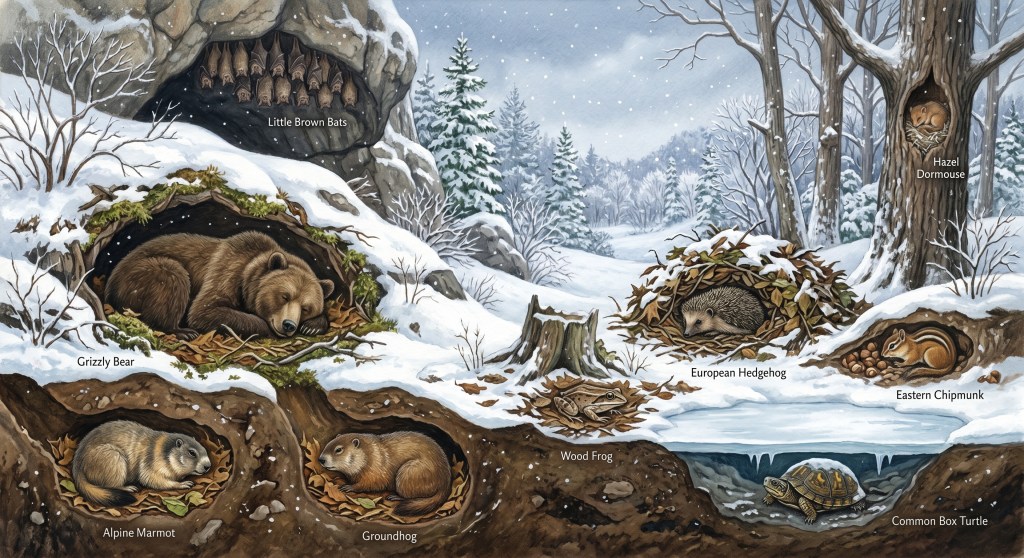
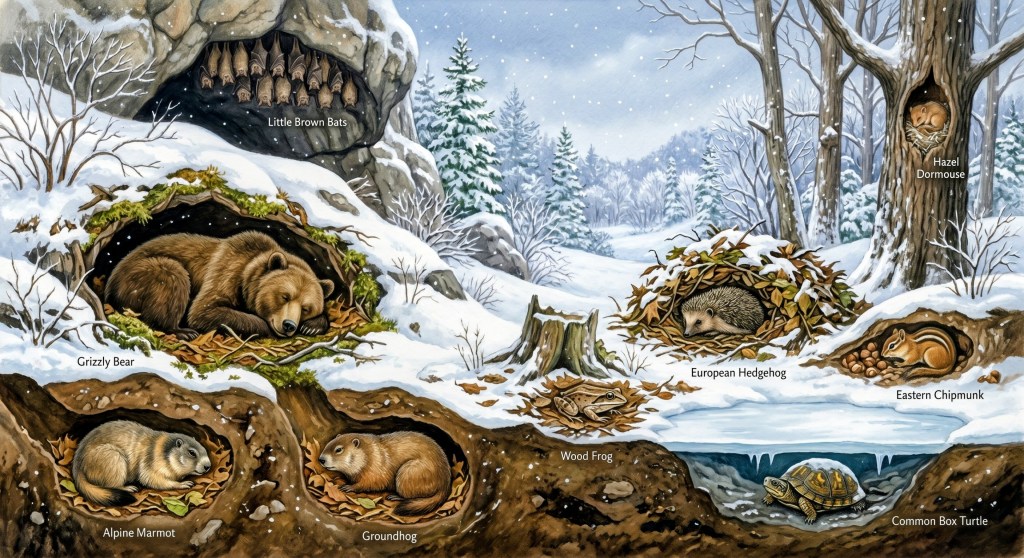
Mammals. The American black bear (Ursus americanus) hibernates five to seven months without eating, drinking, urinating, or defecating. Studies by Øivind Tøien and colleagues at the University of Alaska Fairbanks (Science, 2011) recorded heart rates dropping from a summer 55 bpm to a mid‑hibernation 9 bpm — with intervals up to 20 seconds between beats — while metabolic rate fell to 25 % of basal levels and core body temperature dropped only modestly to a mid‑hibernation mean near 33 °C. Bears uniquely preserve muscle and bone mass through dormancy, recycle urea into protein, and (in females) give birth and nurse cubs while still in torpor. nih + 2
The Arctic ground squirrel (Urocitellus parryii) is the most extreme mammalian hibernator known. Brian Barnes (UAF) demonstrated that their core body temperature drops to −2.9 °C — below the freezing point of fresh water — without ice crystallization, an unprecedented mammalian “supercooled” state. Heart rate falls to about one beat per minute. They hibernate seven to eight months and remain conscious only about twelve days of the winter; every two to three weeks they shiver violently to reheat to 37 °C and immediately re‑cool, an “interbout arousal” essential to brain repair. Scientific American + 4
Other true mammalian hibernators include bats of many species (heart rate dropping from ~400 to ~25 bpm), the European hedgehog (Erinaceus europaeus), the edible dormouse (Glis glis) — which can hibernate continuously for up to 11.4 months, the longest recorded hibernation of any wild mammal under natural conditions (Bieber et al., J. Comp. Physiol. B, 2015) — alpine and woodchuck marmots (Marmota spp.), and eastern chipmunks (Tamias striatus), which arouse every few days to feed from cached seeds. ScienceDaily
Monotremes (egg‑laying mammals) also hibernate: the short‑beaked echidna (Tachyglossus aculeatus) drops its body temperature to about 5 °C and has been recorded in torpor for up to 20 days at a stretch; platypus show daily torpor in cold streams.
The most theologically poignant mammalian case is the fat‑tailed dwarf lemur (Cheirogaleus medius), the only known primate to undergo true hibernation. Endemic to Madagascar’s dry deciduous forests, it hibernates up to seven months in tree hollows, its metabolism falling to roughly 2 % of active levels, body temperature tracking ambient down to ~5 °C. Studies by Kathrin Dausmann (Hamburg) and Peter Klopfer (Duke) revealed unique brain physiology — and a 2025 study (Blanco, Smith, Greene, Lin, and Klopfer, Biology Letters, Feb. 12, 2025) found that “telomeres were maintained or even lengthened during hibernation, but shortened immediately thereafter.” A primate, our nearest hibernating cousin, has been “taken in its sleep” for half its life, and emerges biologically younger. Biology Insights + 7
Also notable: pygmy possums (Cercartetus spp.) of Australia, which can hibernate twelve months in captivity; deer mice and other small rodents with daily torpor; and the Madagascar tenrec (Setifer setosus), the only other tropical mammalian hibernator.
Birds. Birds were long assumed not to hibernate. The exception is the common poorwill (Phalaenoptilus nuttallii), a nightjar of the American West. The Hopi name for the bird translates as “the sleeping one.” In 1946 Edmund Jaeger documented a poorwill torpid in a rock crevice in California’s Chuckwalla Mountains for the entire winter. Modern radio‑telemetry has confirmed continuous torpor bouts of up to 45 days, with body temperature falling to about 5 °C and oxygen consumption dropping more than 90 %. The poorwill is, to our knowledge, the only bird that truly hibernates. American Bird ConservancyAmerican Bird Conservancy
Hummingbirds (Trochilidae) use daily torpor with stunning intensity. With the highest metabolism per gram of any vertebrate, they would starve overnight if they maintained homeothermy. Instead, body temperature falls from ~40 °C to as low as 4–18 °C, heart rate from 1,200 to ~50 bpm, breathing becomes intermittent, and metabolic rate plummets by up to 95 %. They appear, as Blair Wolf of the University of New Mexico put it, comatose: “You wouldn’t even know it was alive if you picked it up.” Swifts and nightjars show similar shallow torpor in cold weather. biorxiv + 4
Reptiles. Reptilian dormancy is properly called brumation. Garter snakes (Thamnophis sirtalis) form spectacular communal hibernacula in Manitoba’s Narcisse dens, with tens of thousands intertwined. Box turtles (Terrapene carolina) brumate in shallow burrows; tortoises dig deep underground; crocodilians estivate in mud holes during droughts.
The most astonishing reptilian case is the painted turtle hatchling (Chrysemys picta). Hatchlings supercool to about −3.3 °C without freezing by purging ice‑nucleating agents from their bodies; others tolerate brief partial freezing, surviving up to 53 % of body water converted to ice for periods of ~24–54 hours (Storey et al., PNAS, 1988). Adult painted turtles, frozen out of air by ice cover, survive months under the pond at 1–4 °C without breathing, reducing metabolism by 99 % and tolerating extreme lactic acidosis buffered by calcium from their shells. Nature
Amphibians. The wood frog (Rana sylvatica) is the most famous “resurrection animal.” Its range extends north of the Arctic Circle, and when winter arrives, the frog allows up to 65–70 % of its total body water to convert to extracellular ice (Costanzo & Lee, J. Exp. Biol., multiple papers). The frog’s liver, within minutes of ice nucleation on the skin, mobilizes massive glycogenolysis, releasing blood glucose concentrations that would induce diabetic coma in humans, plus urea, which together act as colligative cryoprotectants. The heart stops. Breathing ceases. Brain electrical activity is undetectable. For weeks, by any normal definition, the frog is dead. When spring warms the soil, the heart resumes, glucose is reabsorbed, and the frog hops away. Other freeze‑tolerant amphibians include the spring peeper (Pseudacris crucifer), gray tree frog (Hyla versicolor), and chorus frog. Spadefoot toads (Scaphiopus spp.) estivate in desert soil for up to a year between rains, sealed in mucus envelopes. Soviet biologists at the Magadan Institute of Northern Biology reportedly revived a Siberian salamander (Salamandrella keyserlingii) that had been frozen for 90 years. ResearchGate + 2
Fish. The four species of African lungfish (Protopterus annectens, P. aethiopicus, P. dolloi, P. amphibius) estivate in subterranean mud cocoons during drought, surviving documented periods of up to four to five years without water or food (Smith, 1930; Chew & Ip reviews). As ponds dry, the lungfish digs vertically, secretes a paper‑thin mucus cocoon that hardens around it (recently shown to be living tissue with antimicrobial granulocyte activity, Science Advances, 2021), and reduces metabolic rate by ~70 %, breathing through a narrow air tube to the surface. The South American lungfish (Lepidosiren paradoxa) uses a similar strategy. The Antarctic icefish (Channichthyidae) lives without hemoglobin in waters supercooled below 0 °C, defended by antifreeze glycoproteins. Killifish (Nothobranchius furzeri) deposit eggs that undergo embryonic diapause at three discrete developmental stages, allowing the species to survive years of drought as eggs in dry mud. The Company of Biologists + 3
Invertebrates. Insect dormancy is governed by diapause. Monarch butterflies (Danaus plexippus) overwinter in Mexican fir forests in reproductive diapause. The Arctic woolly bear caterpillar (Gynaephora groenlandica) undergoes the freeze/thaw cycle for an average of 7 springs, and may continue for up to 14 summers (13 winters) before pupating, spending roughly 90 % of its life frozen. Honeybees (Apis mellifera) form winter clusters in which thoracic shivering maintains hive temperature near 33 °C. Land snails seal themselves into their shells with mucus epiphragms and estivate for months to years; brine shrimp (Artemia) cysts can remain viable for decades in dry salt flats, reviving in minutes when rehydrated. Missoula Butterfly House & Insectarium + 2
The royalty of cryptobiosis is the tardigrade (“water bear,” phylum Tardigrada). When dehydrated, tardigrades retract their legs into a “tun” state in which metabolic activity is undetectable. In this state, they have survived: temperatures from −272 °C (one degree above absolute zero) to +151 °C; pressures up to six times those of the deepest ocean trench; the vacuum and ultraviolet radiation of open space (ESA’s FOTON‑M3 mission, 2007: 68 % survival of 3,000 tardigrades exposed for ten days, with successful reproduction after); ionizing radiation thousands of times the human lethal dose. Specimens have revived from museum moss specimens dehydrated for 120 years. Three molecular keys have been identified: the Dsup protein (Damage suppressor) which physically shields DNA; intrinsically disordered CAHS proteins that vitrify the cytoplasm into a protective glass; and betalain pigments that quench free radicals. Nematodes show similar anhydrobiosis; Panagrolaimus kolymaensis nematodes were revived from Siberian permafrost approximately 46,000 years old (Shatilovich et al., PLOS Genetics, July 27, 2023). Biology Insights + 7
C. Special Features of Hibernation
- Cryoprotection: Glucose in wood frogs; glycerol in insects; trehalose in tardigrades and brine shrimp; antifreeze glycoproteins (AFGPs) in icefish. Smithsonian Magazine
- Heart rate reduction: Down to ~1 bpm in Arctic ground squirrels, 4 bpm in hedgehogs, 9 bpm in bears with 20‑second pauses between beats, undetectable in frozen wood frogs.
- Metabolic suppression: 95 % in hummingbirds nightly; 98 % in dwarf lemurs seasonally; 99 % in painted turtles under ice; undetectable in tardigrade tun state.
- Body temperature regulation: Down to −2.9 °C in Arctic ground squirrels (supercooled); to ambient (~5 °C) in dwarf lemurs and poorwills; only modest 4–5 °C drop in bears; near absolute zero tolerable in tardigrade tun.
- Breathing changes: Cessation in wood frogs; cloacal respiration in turtles under ice; intermittent breathing with multi‑minute pauses in hummingbirds and hibernating bears.
- Brain activity: Near‑silent in deep mammalian hibernation; REM‑like in dwarf lemurs; completely absent in frozen wood frogs and tardigrades.
- Memory preservation: Ground squirrels show synaptic pruning during hibernation followed by rapid synaptic regrowth on arousal — a process that intrigues Alzheimer’s researchers. Memories acquired before hibernation are retained. Scientific American
- Tissue preservation: Bears do not lose significant muscle mass over five months of immobility; lungfish hearts and brains undergo controlled remodeling but retain function over years.
- Reproductive embedding: Bears give birth during hibernation; killifish embryos pause development for years; the dwarf lemur’s telomeres actually lengthen during dormancy. New England Primate Conservancy
VII. CONNECTING HIBERNATION TO RESURRECTION
These phenomena are not, by themselves, theological. They are biological facts. But Qurʾān 39:42 invites a particular hermeneutic of nature: inna fī dhālika la‑āyāt — “indeed in that are signs.” The verse declares that the rhythm of withdrawal and return is itself a sign‑system pointing to resurrection.
The argument structure runs as follows. First, the Qurʾān’s epistemology is empirical in a distinctive sense: it directs attention to phenomena fī al‑āfāq wa fī anfusikum — “in the horizons and in yourselves” (Qurʾān 41:53). Second, it argues from observable to unobservable by analogy of greater and lesser: “We send down water on the dead earth and revive it — thus is the resurrection” (Qurʾān 50:11). Third, sleep and hibernation furnish the strongest analogy of all, because in them life is genuinely suspended.
If a wood frog can be frozen with no heartbeat for weeks and resume, if a tardigrade can be revived after a century of dehydration, if a Panagrolaimus nematode can be revived after 46,000 years in permafrost, if a lungfish can sleep four years in baked mud, if an Arctic ground squirrel’s body can drop below the freezing point of water without ice forming in its blood — then the minimum claim of the Qurʾānic resurrection (that God can re‑constitute life from quiescent matter) is, in our world, already routine.
This methodology has a long pedigree. Al‑Rāzī used the seed and the rain. Al‑Jāḥiẓ in Kitāb al‑Ḥayawān (9th c.) catalogued animal dormancy with empirical care. In the modern period, Saʿīd Nursī’s Risāle‑i Nūr devotes long passages to seasonal death and rebirth as a “sign of resurrection” (ḥashr), arguing that “spring is a resurrection enacted before our eyes.” Contemporary Muslim scientists writing on faith and reason — Mehdi Golshani, Nidhal Guessoum, Bruno Guiderdoni — have continued the project.
The deep claim is this: the universe is structured as a recurring cycle of imsāk (holding) and irsāl (release). Night withdraws light; dawn releases it. Winter withdraws life; spring releases it. Sleep withdraws consciousness; waking releases it. Death withdraws the soul; resurrection releases it. Each level is the same grammar enacted on a longer time scale. To deny the last while affirming the first, the Qurʾān suggests, is not skeptical but inconsistent.
VIII. THEMATIC EPILOGUE
There is a moment, just before sleep, when we cease to track our own ceasing. The room is there, then it is not; the self that monitored the room dissolves into a softness that does not know its own softness; and the next thing we know, it is morning. We pass through what the Qurʾān calls a wafāt, a soul‑taking, and we do it so casually that we mistake it for nothing. Yet between the closing of the eyes and the opening of them lies a chasm into which kings and empires have disappeared. The Companions called this the lesser death, al‑mawt al‑aṣghar, and we, in our forgetfulness, call it bedtime.
The hibernating animals of the world are commentary on this verse. Somewhere in Alaska tonight, an Arctic ground squirrel lies curled in a nest of caribou hair, its heart beating once a minute, its blood liquid at −2.9 °C, supercooled below the freezing point of water. Somewhere in the Madagascan dry forest a fat‑tailed dwarf lemur — a primate, our cousin — has been “asleep” since April and will not stir until November, its telomeres lengthening inside its skin. In a frozen Ohio pond a wood frog is two‑thirds ice, glucose surging through tissues that no longer beat; spring will find it leaping. In a baked Sahelian mudbank a Protopterus lungfish has been cocooned in its own mucus for three dry years, and waits, breathing through a straw of dust, for the rain. In a pellet of dried moss from a Himalayan monastery a tardigrade in its tun state has held still for who knows how many decades; a drop of water will return it to motion. In Siberian permafrost a nematode has just been revived after forty‑six millennia.
These are not metaphors. They are the everyday work of God. The Qurʾān asks us to notice them because, in our own bedrooms each night, we enact the same physics on a shorter time scale. The morning is a small resurrection rehearsing the great one. Spring rehearses what the Trumpet will declare. The dwarf lemur waking from seven months of stillness is the same astonishment, written in fur and slow blood, as the human soul will be when it is told to come forth.
What 39:42 finally teaches is that the universe is not built around permanence but around cycles, and that the cycles are not closed. The withdrawal is always followed by a release, the imsāk by an irsāl, the night by the day, until — and here is the verse’s pivot — the appointed term. Then the release comes from a different direction. The soul that has been daily returned to its body will, one day, be returned instead to its Lord.
Until then, the hibernating animals keep their silent vigil, and the verse stands as a sign placed in the architecture of nature itself: that the One who takes can give back, that the stillness is not the end of the story, and that — as the Prophet said upon waking — al‑ḥamdu lillāh alladhī aḥyānā baʿda mā amātanā wa ilayhi al‑nushūr: “All praise is due to God who gave us life after He caused us to die, and unto Him is the gathering.”




Leave a comment