
Audio teaser: Hibernation as a blueprint for resurrection
Abstract
This research report provides an exhaustive analysis of the convergence between Quranic eschatology and biological dormancy, centered on the exegesis of Surah Az-Zumar, verse 42 (39:42). The verse establishes a profound theological and philosophical parallel between sleep and death, utilizing the term tawaffa to describe the withdrawal of the soul. By exploring fifty distinct English translations, the report illustrates the linguistic breadth of this concept across centuries of scholarship. Beyond the theological realm, this study posits that the biological phenomenon of hibernation across various animal classes—Mammalia, Reptiles, Amphibia, Aves, Insecta, and Osteichthyes—serves as a tangible scientific clue toward the possibility of human resurrection and the Afterlife. Through detailed physiological profiling of extreme survivors such as the wood frog, Arctic ground squirrel, and fat-tailed dwarf lemur, the analysis highlights the mechanisms of “suspended animation,” metabolic depression, and cryoprotection. These biological “signs” are synthesized into a narrative that argues for the compatibility of a divinely ordained revival with the observable capabilities of life to transition from states of apparent death back to vital functionality.
Theological and Linguistic Commentary on Quran 39:42
The Quranic discourse often invites the human intellect to observe recurrent natural phenomena as a means of understanding abstract metaphysical truths. Among the most significant of these is the daily transition between wakefulness and sleep. In Surah Az-Zumar, verse 42, the text offers a detailed description of the soul’s relationship with the body during these states. The verse in its original Arabic reads:
اللَّهُ يَتَوَفَّى الْأَنْفُسَ حِينَ مَوْتِهَا وَالَّتِي لَمْ تَمُتْ فِي مَنَامِهَا فَيُمْسِكُ الَّتِي قَضَى عَلَيْهَا الْمَوْتَ وَيُرْسِلُ الْأُخْرَى إِلَى أَجَلٍ مُسَمًّى إِنَّ فِي ذَلِكَ لَآيَاتٍ لِقَوْمٍ يَتَفَكَّرُونَ
The Concept of Tawaffa and the Soul
The linguistic heart of this ayah lies in the verb yatawaffa, which is frequently translated as “to take the soul,” but its etymological roots in the word wafa signify “to fulfill” or “to receive in full”. This suggests that death and sleep are not merely the cessation of activity but a precise repossession of the conscious self by the Creator. Classical Islamic scholarship distinguishes between two types of wafat: the “greater death” (al-mawt al-kubra), where the soul is permanently separated from the body, and the “lesser death” (al-mawt al-sughra), which is sleep.
The nafs (the soul or self) is described as having two primary faculties: the faculty of cognition and intellect, and the faculty of vital life (often associated with the ruh or spirit). Exegetes such as Ibn Abbas note that during sleep, the cognitive soul is “taken” or withdrawn, leading to the suspension of sensory perception and will, while the vital spirit remains to maintain autonomic functions like breathing and heartbeat. This dual state creates a condition of “partial connection” where the individual is neither fully alive in the worldly sense (due to lack of consciousness) nor fully dead (as biological life persists).
Philosophical Implications of the Soul’s Return
Philosophically, this verse implies that the human “self” is not a mere byproduct of biological processes but an independent entity capable of existing in different realms. The “taking” of the soul during sleep suggests a proximity to the divine realm, a metaphysical reality that is difficult to grasp within the constraints of physical space and time. Dreams, in this context, are viewed as the experiences of the soul while it is in this alternate state of existence, sometimes encountering the souls of the deceased or receiving glimpses of the unseen.
The verse concludes by stating that God “withholds” those souls for whom death is decreed and “sends back” others for an appointed term. This provides a daily reminder of human vulnerability and mortality. The act of waking up is, therefore, a “minor resurrection,” demonstrating that the same Power that restores consciousness every morning is capable of restoring life to a decomposed body on the Day of Judgment. For those who reflect, the cyclic nature of sleep and awakening serves as a functional model for the ultimate Resurrection.
Fifty English Translations of Quran 39:42
The following translations, sourced from diverse scholars and historical periods, illustrate the consistent emphasis on the divine control over the soul’s transitions between states of being.
| No. | Translator | English Translation of Quran 39:42 |
| 1 | Muhammad Asad | It is God [alone that has this power – He] who causes all human beings to die at the time of their [bodily] death, and [causes to be as dead], during their sleep, those that have not yet died: thus, He withholds [from life] those upon whom He has decreed death, and lets the others go free for a term set [by Him]. In [all] this, behold, there are messages indeed for people who think. |
| 2 | Arthur John Arberry | God takes the souls at the time of their death, and that which has not died, in its sleep; He withholds that against which He has decreed death, but looses the other till a stated term. Surely in that are signs for a people who reflect. |
| 3 | Yusuf Ali (1985) | It is Allah that takes the souls (of men) at death; and those that die not (He takes) during their sleep: those on whom He has passed the decree of death, He keeps back (from returning to life), but the rest He sends (to their bodies) for a term appointed verily in this are Signs for those who reflect. |
| 4 | Pickthall | Allah receiveth (men’s) souls at the time of their death, and that (soul) which dieth not (yet) in its sleep. He keepeth that (soul) for which He hath ordained death and dismisseth the rest till an appointed term. Lo! herein verily are portents for people who take thought. |
| 5 | Sahih International | Allah takes the souls at the time of their death, and those that do not die [He takes] during their sleep. Then He keeps those for which He has decreed death and releases the others for a specified term. Indeed in that are signs for a people who give thought. |
| 6 | Abdel Haleem | God takes the souls of the dead and the souls of the living while they sleep- He keeps hold of those whose death He has ordained and sends the others back until their…source death, and those that die not during their sleep. He keeps those (souls) for which He has ordained death and sends the rest for a term appointed. Verily, in this are signs for a people who think deeply. |
| 8 | Muhammad Sarwar | Allah takes away the souls of the people at the time of their death and the souls of those who are not dead during their sleep. He keeps the souls of those who are destined to die and sends the others back for an appointed time. In this there is a sign for the people who reflect. |
| 9 | Laleh Bakhtiar | God takes up the souls at the time of their death and those that died not in their sleep. Then He withholds the ones for which He decreed death and sends the others until a named term. Truly, in that are signs for a people who reflect. |
| 10 | Ahmed Ali | It is God who takes the souls away at the time of death, and of those who do not die, in their sleep. Then He keeps those on whom He has decreed death, and sends back the others for a term appointed. In this are signs for those who reflect. |
| 11 | Dr. Laleh Bakhtiar | God takes up the souls at the time of their death and those that died not in their sleep. Then He withholds the ones for which He decreed death and sends the others until a named term. Truly, in that are signs for a people who reflect. |
| 12 | Wahiduddin Khan | It is God who takes the souls of men at the time of their death and [He takes] those who do not die during their sleep. He then keeps those for whom He has ordained death and sends the others back for a prescribed term. In this there are signs for those who reflect. |
| 13 | T.B. Irving | Allah (God) gathers in their souls at the time of their death, and those who have not died, during their sleep. He keeps those on whom He has decreed death, and sends the others back for a specific period. In that are signs for people who think. |
| 14 | Dr. Munir Munshey | Allah takes away the souls at the time of death, and the souls of those who do not die in their sleep. He keeps those for whom He has decreed death and releases the others for a specified term. In that, there are surely signs for a people who think. |
| 15 | Dr. Ghali | Allah takes the selves at the time of their death and the ones which have not died, in their sleeping. Then He holds back the ones against which He has decreed death, and sends (forth) the others till a stated term. |
| 16 | Malik | It is Allah Who takes the souls of men at the time of their death, and of those who do not die, during their sleep. He keeps back those on whom He has passed the decree of death and sends the others back to their bodies for an appointed term. |
| 17 | Ahmed Raza Khan | Allah takes the souls at the time of their death and those that die not during their sleep; so He withholds those on whom He has passed the decree of death and sends the rest for a term appointed. |
| 18 | Daryabadi | Allah taketh the souls at the time of their death, and those who die not, in their sleep; then He withholdeth those on whom He hath passed the decree of death, and sendeth the others until a term determinate. |
| 19 | Sher Ali | Allah takes away the souls at the time of their death, and those that die not during their sleep. Then He keeps those on whom He has passed the decree of death and sends the others back till an appointed term. |
| 20 | Khalifa | GOD puts the souls to death when the end of their life comes, and also at the time of sleep. Thus, He takes some back during their sleep, while others are allowed to continue living until the end of their interim. |
| 21 | Shakir | Allah takes the souls at the time of their death, and those that die not during their sleep; then He withholds those on whom He has passed the decree of death and sends the others back till an appointed term. |
| 22 | Qarai | Allah takes the souls at the time of their death, and those who have not died, in their sleep. Then He retains those for whom He has ordained death and releases the others until a specified time. |
| 23 | Safi-ur-Rahman | It is Allah Who takes away the souls at the time of their death, and those that die not during their sleep. He keeps those (souls) for which He has ordained death and sends the rest for a term appointed. |
| 24 | Maududi | It is Allah Who takes away the souls of people at the hour of their death, and takes away at the time of sleep the souls of those that have not died. Then He retains the souls of those against whom He had decreed death and returns the souls of others till an appointed time. |
| 25 | Amatul Rahman Omar | Allah takes the souls of human beings at the time of their death; and of those also that are not yet dead, during their sleep. And then He retains those against which He has decreed death, and sends back the others till an appointed term. |
| 26 | Progressive Muslims | God takes the souls at the time of their death, and those that have not died, during their sleep. He then keeps those that have been overtaken by death, and He sends the others back until a predetermined time. |
| 27 | Mir Aneesuddin | Allah takes away the souls at the time of their death and (He takes) those that do not die during their sleep; then He retains those on whom He has passed the decree of death and sends back the others till a stated term. |
| 28 | Shabbir Ahmed | Allah takes the souls (consciousness) at death and of those who do not die during their sleep. Then He withholds those on whom He has passed the decree of death and sends the rest back for a term appointed. |
| 29 | Almuntakhab | Allah disembodies the souls at the time of physical death and during physiological sleep. He detains the soul whose body is destined to die during sleep and sends back the other to embody its material being for a predetermined point of time. |
| 30 | Bijan Moeinian | It is God Who takes the life of people at the moment of their death as well as (temporarily) the consciousness of those who are not dead but are sleeping. He then holds back (the soul of) those who are destined to die and returns (the consciousness of) others until their appointed time. |
| 31 | Faridul Haque | Allah takes the souls at the time of their death and those that die not during their sleep; He withholds those on whom He has passed the decree of death and sends the rest for a term appointed. |
| 32 | George Sale | God taketh unto himself the souls of men at the time of their death; and those which die not he also taketh in their sleep: and he withholdeth those on whom he hath passed the decree of death, but sendeth back the others till a determinate period. |
| 33 | Rodwell | It is God who taketh the souls of men at death; and those who die not he taketh in their sleep: and he retaineth those on whom he hath passed the decree of death, but sendeth back the others till a determinate period. |
| 34 | Palmer | God takes the souls at the time of their death; and those who do not die in their sleep; then He keeps those on whom He has settled death, and sends the others back again until a stated time. |
| 35 | Muhammad Marmaduke | Allah receiveth (men’s) souls at the time of their death, and that (soul) which dieth not (yet) in its sleep. He keepeth that (soul) for which He hath ordained death and dismisseth the rest till an appointed term. |
| 36 | Abdullah Yusuf Ali | It is Allah that takes the souls (of men) at death; and those that die not (He takes) during their sleep: those on whom He has passed the decree of death, He keeps back (from returning to life), but the rest He sends (to their bodies) for a term appointed. |
| 37 | Taqi Usmani | Allah takes away the souls at the time of their death, and (the souls) of those who do not die, in their sleep. Then He withholds those for whom He has decreed death, and sends the others back for an appointed term. |
| 38 | Maulana Muhammad Ali | Allah takes the souls at the time of their death, and those that die not, during their sleep; then He withholds those on whom He has passed the decree of death and sends the others back till an appointed term. |
| 39 | Muhammad Ahmed | Allah takes up the selves at the time of their death and the ones which have not died, in their sleeping. Then He holds back the ones against which He has decreed death, and sends (forth) the others till a stated term. |
| 40 | Samira | Allah takes the souls at the time of their death, and those that did not die in their sleep. He keeps those for which He has decreed death and releases the others for a specified term. |
| 41 | Linda S. Walbridge | Allah takes the souls at the time of their death, and those who have not died, in their sleep. Then He keeps those for whom He has decreed death and releases the others until a specified time. |
| 42 | Bilal Philips | Allah takes the souls at the time of their death, and those that do not die [He takes] during their sleep. Then He keeps those for which He has decreed death and releases the others for a specified term. |
| 43 | Bridges | Allah takes the souls at the time of their death, and those that did not die, during their sleep. Then He withholds those for which He has decreed death and sends the others back for an appointed term. |
| 44 | Muhammad Kamran Khan | Allah takes the souls at the time of their death, and those that die not during their sleep; then He withholds those on whom He has passed the decree of death and sends the others back till an appointed term. |
| 45 | The Monotheist Group | God takes the souls at the time of their death, and those that have not died, during their sleep. He then keeps those that have been overtaken by death, and He sends the others back until a predetermined time. |
| 46 | Al-Hikmah | Allah takes the souls at the time of their death and of those who do not die, in their sleep. Then He withholds those on whom He has passed the decree of death and sends the others back until an appointed term. |
| 47 | Dr. Munir Munshey | Allah takes away the souls at the time of death, and the souls of those who do not die in their sleep. He keeps those for whom He has decreed death and releases the others for a specified term. |
| 48 | Ali Bakhtiari Nejad | Allah kills the souls at the time of their death, and those that did not die, in their sleep. Then He holds those on whom He decreed death and sends the others for an appointed term. |
| 49 | Fazlollah Nikayin | God takes the souls of the humans at their death, and of those who have not died, during their sleep. Then He retains the souls of those for whom death is decreed, and releases the others for a specified term. |
| 50 | Edip Yuksel | God takes the souls at the time of their death, and those that have not died, during their sleep. He then keeps those that have been overtaken by death, and He sends the others back until a predetermined time. |
Hibernation as a Biological Sign of Resurrection
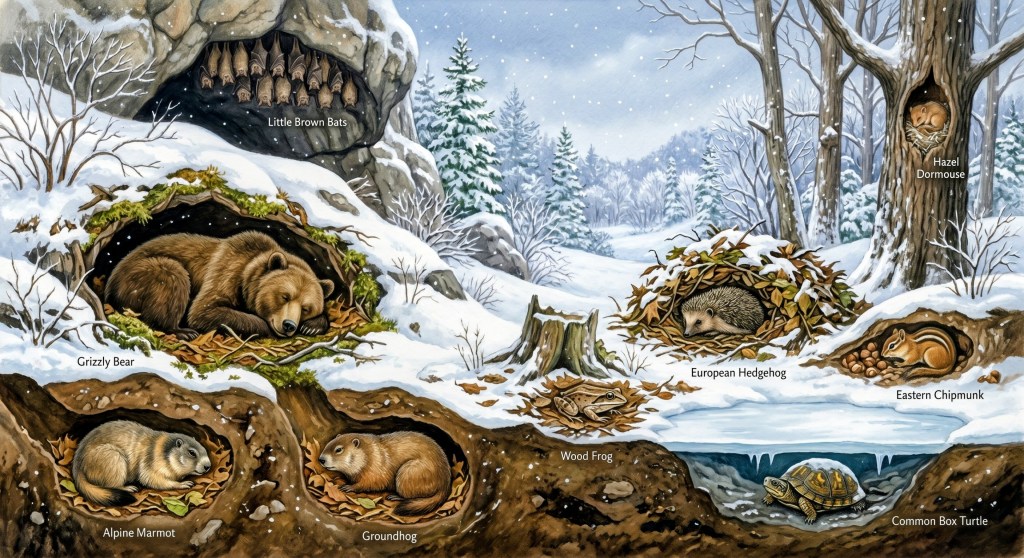
Hibernation is often colloquially compared to sleep, but it is a distinct and far more profound biological state. In the light of Quran 39:42, hibernation represents a state of “suspended animation” that exists in the threshold between the “lesser death” of sleep and the “greater death” of total biological cessation. This phenomenon allows animals to withstand extreme conditions—such as the “iron-cold subarctic winter”—by dramatically suppressing metabolic rates to as little as 1% to 2% of their normal activity.
For the theologian, hibernation offers a naturalistic demonstration of how life can be preserved in a state that externally resembles death. The animal does not breathe, its heart may stop or beat with extreme infrequency, and its brain activity is severely curtailed. Yet, upon the return of favorable conditions, the organism “awakens” with full restoration of its faculties. This biological rebooting functions as a powerful clue toward the feasibility of the Resurrection, suggesting that if a Creator can preserve and revive a frog that is 70% frozen, the same Power can reconstruct the human person from their essential biological and spiritual components.
Hibernation by Animal Classes: Mechanisms and Special Features
Hibernation strategies vary across the animal kingdom, with each class exhibiting specific physiological adaptations that allow for the survival of extreme metabolic depression.
Class Mammalia: Metabolic Mastery and Primate Parallels
Mammalian hibernators are generally divided into obligate hibernators, who enter this state spontaneously each year regardless of food availability, and facultative hibernators, who respond to immediate environmental stressors.
- Bears (Black and Brown): Historically, there was a debate as to whether bears were “true” hibernators because their body temperature only drops by approximately $3^\circ C$ to $5^\circ C$. However, research confirms that bears achieve profound metabolic suppression independent of temperature, reducing their oxygen consumption to 25% of summer rates. They do not eat, drink, urinate, or defecate for five to seven months. Remarkably, they recycle nitrogen from their urine to prevent muscle atrophy and maintain bone strength, a feat that would be fatal to non-hibernating mammals due to uremic poisoning.
- Arctic Ground Squirrel: This rodent holds the record for the lowest body temperature measured in a mammal, dropping to $-2.9^\circ C$ ($26.7^\circ F$). They utilize a phenomenon known as “supercooling,” where their blood remains liquid even below its freezing point because they systematically rid their bodies of ice nucleators. During their 7 to 8-month hibernation, their brain activity shuts down almost completely, entering a “stand-by mode” to conserve energy.
- Fat-tailed Dwarf Lemur: As the only primate known to enter extended periods of hibernation, this lemur offers the closest biological analog to human dormancy. It stores fat in its tail, which can reach 40% of its total body weight, and hibernates for up to seven months. During torpor, it may breathe only once every 10 to 15 minutes, with a heart rate slowing from 180 bpm to just 4-8 bpm. Recent studies suggest that this dormant state may even slow the aging process by protecting or even lengthening telomeres.
| Feature | Black Bear | Arctic Ground Squirrel | Dwarf Lemur |
| Duration | 5-7 months | 7-8 months | Up to 7 months |
| Body Temp | $30^\circ C$ to $36^\circ C$ | $-2.9^\circ C$ | Passive with ambient |
| Heart Rate | 8-21 bpm | 1 bpm (torpor) | 4-8 bpm |
| Special Trait | Nitrogen recycling | Supercooling | Telomere preservation |
Class Amphibia and Reptilia: Freeze Tolerance and Anoxia
Ectothermic animals rely on external heat, making them particularly vulnerable to sub-zero temperatures. Their survival strategies include extreme “brumation” and the ability to freeze solid.
- Wood Frog (Rana sylvatica): This frog is widely regarded as a natural wonder for its ability to survive the freezing of 60% to 70% of its body water. While frozen, the frog has no measurable brain activity, no heartbeat, and no respiration. To survive, it floods its cells with glucose ($200\times$ normal levels) and urea, which act as cryoprotectants, preventing the cells from dehydrating or being punctured by ice crystals. When spring arrives, the frog thaws from the “inside out,” with the heart restarting first, followed by the brain and limbs.
- Turtles (Painted and Box): Painted turtles often hibernate in the muddy bottoms of lakes where oxygen is non-existent. They are uniquely adapted to “anoxia,” surviving for months without breathing air. They achieve this by absorbing oxygen from the water through the vascularized tissues of their cloaca and throat.
Class Aves: The Common Poor-will
For decades, birds were thought to only migrate to avoid winter, but the Common Poor-will is the only bird known to truly hibernate. During winter, it enters a state of deep torpor where its body temperature can drop significantly, and its metabolic rate falls to a fraction of its normal level. This allows the bird to remain inactive for weeks in rocky crevices or hollow logs until temperatures rise and insects become available again.
Class Insecta: Diapause and Natural Antifreeze
Insects utilize a programmed state of developmental arrest known as “diapause,” which is often triggered by changes in daylight or temperature.
- Mourning Cloak Butterfly: Unlike most butterflies, this species overwinters as an adult. It seeks shelter in tree bark or leaf debris and produces glycerol, a natural antifreeze that allows its tissues to withstand temperatures as low as $-80^\circ F$.
- Alpine Weta: Found in New Zealand, the Weta is the world’s largest freeze-tolerant insect. It survives by allowing ice to form in its gut and hemolymph, using ice-nucleating agents to control the crystallization process and prevent damage to its internal organs.
Class Osteichthyes: Estivation in the Lungfish
- African Lungfish: Capable of “estivating” (summer hibernation) during droughts, the lungfish burrows into mud and secretes a water-tight mucus cocoon. In this state of suspended animation, it can survive for up to four years without food or water. Its metabolism is regulated by an anti-metabolic substance named “antabolone,” which allows it to bypass the need for external energy sources for extended periods.
Synthesis: Biological Dormancy as a Clue to Resurrection
The scientific details of hibernation provide several second-order insights that directly support the Quranic themes of life, death, and resurrection found in verse 39:42.
1. The Preservation of Information
The ability of the wood frog to cease all brain activity and heartbeat, only to recover its full biological identity upon thawing, suggests that life is not merely a continuous flow of electricity or motion but a “stored” configuration. If the soul is the “configuration” or “essential form” of the human being, its removal during sleep or death (as described in 39:42) does not necessitate its destruction. The biological precedent of organisms “turning off” and “turning on” implies that the information required to rebuild a person is preserved by the Creator, much like the genetic and metabolic blueprints are preserved in a hibernating squirrel.
2. Metabolic Reanimation and the Call to Resurrection
Resurrection is often described in theological terms as a “wakening” or a “rising” (Nushūr). Science shows that a hibernating bear or squirrel does not simply wake up spontaneously; they are triggered by specific physiological “clocks” or environmental cues. In the Quranic worldview, the “trigger” for human resurrection is the divine command (the blowing of the Trumpet). The transition of a frozen wood frog from a “lump of stone” back to a leaping creature provides a small-scale, observable model of how a seemingly inert object can be reanimated through the activation of internal systems.
3. Time as a Non-Linear Experience
The Quranic story of the Ashab al-Kahf (People of the Cave) highlights that they slept for 309 years but perceived it as “a day or part of a day”. This subjective compression of time is mirrored in hibernation. An animal in deep torpor has no perception of the months that pass; its biological clock is effectively paused. This aligns with the theological concept of the Barzakh (the interval between death and resurrection), where the passage of time for the soul may be entirely different from the temporal experience of the physical world.
Thematic Epilogue: Reflections on the Signs of the Self
The synthesis of Quranic exegesis and the biology of dormancy invites a profound reflection on the nature of existence. Verse 39:42 of Surah Az-Zumar does not merely state a theological fact; it points to a daily, observable miracle—the disappearance and reappearance of the conscious “self.” This “minor death” of sleep serves as a perpetual training ground for the soul, a reminder of its ultimate journey and its dependence on a Sustainer Who “holds” the soul and “sends it back”.
When we expand this view to the wider animal kingdom, the “signs” become even more vivid. The Arctic squirrel surviving with blood below freezing, the bear recycling its own waste to maintain life, and the frog becoming a “frogsicle” only to thaw and sing in the spring—these are not just curiosities of nature. They are biological demonstrations of the Creator’s power to bridge the gap between non-existence and life.
The study of hibernation provides a functional vocabulary for the Afterlife. It suggests that death is not the end of the “story” of the person, but a phase of “withholding”—a period of dormancy in the hand of God until the “appointed term” of the world is fulfilled. For those who reflect (liqawmin yatafakkarūn), the return of the spring and the awakening of the sleeper are quiet but persistent witnesses to the truth of the promised Resurrection. Just as the heart of the wood frog restarts after a long, iron-cold winter, the human spirit is destined to awaken to a new and eternal dawn, guided by the same Power that manages every breath and every soul.


 The Glorious Quran and Science
Leave a comment