
Executive Summary
Pompeii was a thriving Roman city – replete with taverns, baths, theaters, temples and a notorious brothel – whose lively urban culture has been likened to a Roman “Las Vegas.” For example, Pompeii boasted about 200 cafes and taverns (roughly one per 60 residents), two theaters and an amphitheatre, and erotic art and graffiti in its famous Lupanar (brothel). This vibrancy ended abruptly in AD 79 when Vesuvius erupted. Pliny the Younger’s eyewitness letters describe a Plinian column by day and darkness by night; later hot pyroclastic flows engulfed the city, killing its inhabitants and sealing their forms in ash.
Modern excavations (begun 1748) have exposed Pompeii’s grid of streets, public buildings, shops (thermopolia), and richly decorated houses (e.g. the Villa of Mysteries, the House of the Vettii). Archaeologists found plaster casts of victims formed by liquid plaster poured into voids left by decomposed bodies. Wall graffiti – advertising games and lovers’ messages (e.g. “Come back soon, Anicetus” and “Please, no shitting here”) – document everyday speech and humor, providing rare evidence of Vulgar Latin. Major debates remain about details: the exact date of the eruption (traditional 24 Aug vs. new evidence for mid-Oct), casualty estimates, and how to best conserve and present the site amid tourism pressures and ethical concerns (e.g. the display of human remains).
We examine Pompeii’s life and destruction as a parable echoed in Qur’anic verses 6:11, 3:137, and 27:69, which urge travelers to survey earth’s ruins and witness the fates of past deniers. Each verse (Arabic text and transliteration below) comes with background (sura context and classical tafsir) and multiple English translations (Table: 6–10 versions each). The overall history – from Pompeii’s bustling streets to its sudden doom – thus provides tangible commentary on these Qur’anic admonitions.
Pompeii’s Lively “Las Vegas” of the Roman Empire
Pompeii was a prosperous coastal town (pop. ~11–12,000) built on fertile Campanian plains. Its urban layout featured a rectangular Forum, temples (Jupiter, Apollo, Isis), bath complexes, markets and an amphitheatre – one of the earliest surviving Roman amphitheaters. Restaurants or snack-bars (thermopolia) served common folk, while a few grand domus (e.g. Houses of the Faun and Vettii) showcased wealth. The street-grid with decumanus maximus (east-west) and cardines (north-south) suggests organized planning. An annotated map of Pompeii (Fig. 1) highlights major sites and streets.
Figure 1. Map of Pompeii (English labels), showing Forum, theaters, baths and other landmarks.
Public life was rich in entertainment: Pompeii had two theatres and one amphitheatre. Plays, mimes and pantomimes delighted citizens; graffiti shows enthusiastic fans wrote “Come back soon, Anicetus” to praise a star performer. The amphitheatre hosted occasional gladiatorial bouts and beast hunts (boars and goats, rather than lions). Nearly the entire populace frequented ���cafés and taverns: ~200 such establishments have been identified, about one per 60 inhabitants. These offered food and cheap wine (often with a back-room for seated dining) – “the reverse of modern society,” Beard notes, since the poor ate out and the rich dined at home. Pompeii also had at least six public bathhouses, indicating the social importance of bathing.
One of the most famous sites is the Lupanar (brothel). This modest two-story building contained five cubicles with erotic frescoes and graffiti inside. Mary Beard observes that hundreds of scribbled messages from satisfied clients were found on its walls (including a scholarly post-coital quote from Virgil). In fact, prostitution was ubiquitous: sex workers plied their trade not only in the brothel but throughout town – in taverns and even private rooms. The prevalence of erotic imagery (and even an inn sign of Priapus guarding it) supports Pompeii’s reputation for licentiousness. Beyond the brothel, graffiti is everywhere: shop ads, election posters, witty or lewd sayings. Pompeian walls bore hundreds of inscriptions in Vulgar Latin, from “No shitting here” and “Successus the weaver is in love with Iris and she doesn’t give a toss”, to campaign slogans like “the bakers support Julius Polybius”. These casual writings provide a window into daily life and language far beyond elite literature.
In sum, Pompeii was a bustling, multicultural hub – from exotic cults (an Isis temple, synagogues) to local handymen, bakers and entertainers. Its “Las Vegas”-like character lies in this mix of commerce, pleasure, religion and politics. As Beard writes, Pompeiiites engaged in exactly the same petty and grand dramas of any city: buying garum sauce, attending gladiators, scribbling on walls, rioting in games. (Notably, AD 59 saw a famous riot between Pompeians and visitors in the amphitheatre, which Tacitus records, resulting in a ten-year ban on games.)
79 AD Vesuvius Eruption: Eyewitness and Aftermath
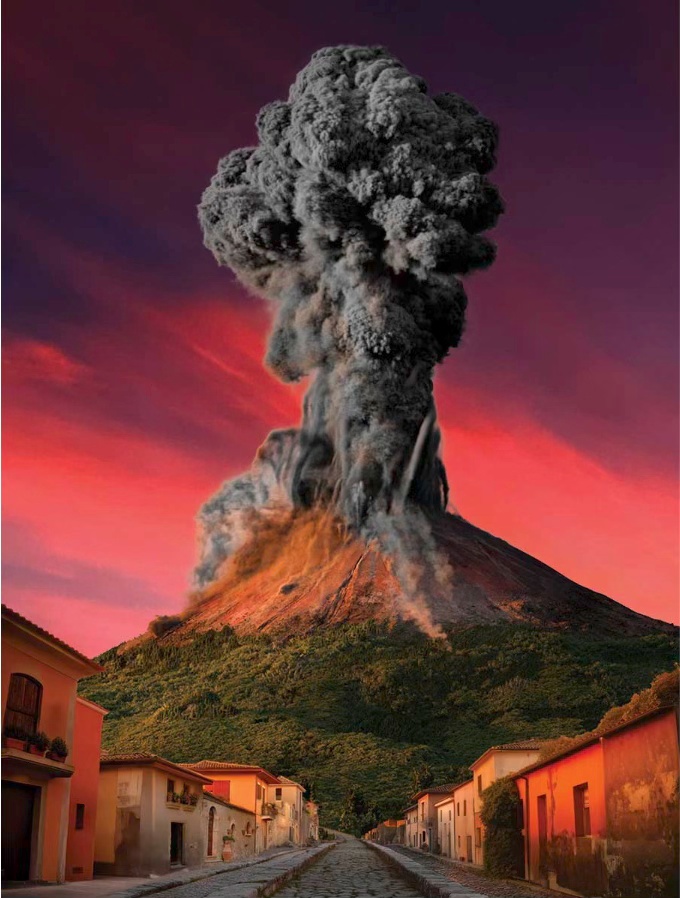
The eruption of Vesuvius unfolded on August 24, 79 AD (though new evidence suggests October–November). After a normal morning, a massive Plinian column burst by early afternoon. Pliny the Younger, observing from Misenum 29 km away, described “broad flames… [and] a deeper darkness prevailed than in the thickest night”. Falling pumice and ash blanketed roofs, causing collapses and casualties. By nightfall first pyroclastic flows (hot gas and debris) swept down Vesuvius’s slopes. Sigurdsson et al. identify six alternating phases; notably Surges 4 and 5 devastated Pompeii with ~1.8 m of scorching ash and pumice. Those remaining in the city (perhaps fugitives from earlier phases) were asphyxiated or boiled as walls collapsed. The rapidity of these flows left bodies preserved in situ; later archaeologists filled ash cavities with plaster to create casts of their final poses.
Figure 2. Reconstruction of Vesuvius’s 79 AD eruption: black shading marks ash/pumice fallout (according to [75]). Pompeii lay southeast of Vesuvius; the town was razed by hot surges.
Pliny’s letters (to Tacitus) are the sole literary account. They recount frantic rescues (including his uncle’s heroic, fatal attempt) and the horror of night. Archaeology complements this: excavations reveal roofs collapsed under pumice, then a capping layer of ash 3 m deep. By evening of the second day, Vesuvius quieted (Pliny notes only haze the next day). Pompeii’s population (~11–12,000) was largely wiped out; about 1,500 bodies have been recovered (mostly calcified in place). Herculaneum, Oplontis and others also lay under up to 20 m of pyroclastic material.
Chronology: After AD 79 the city was forgotten until its 18th-century rediscovery. Early groundwork: a major earthquake on Feb. 5, 62 AD severely damaged Pompeii; another quake struck in 64 AD (noted by Suetonius and Tacitus). On 24 Aug 79 (though some datings vary), the lethal eruption occurred. Herculaneum was rediscovered in 1738; systematic excavations at Pompeii began in 1748 under the Bourbon engineer Alcubierre. In 1763 an inscription confirmed the city’s identity. The 19th century saw scientific methods (Fiorelli in 1863 innovated plaster casts and grid mapping), followed by 20th-century large-scale digs (Maiuri in 1920s–50s). Since 1960 excavations largely ceased to preserve sites, and modern efforts focus on conservation. In the 2010s Pompeii became a UNESCO World Heritage Site (1997) and even a World Heritage in Danger (2013) prompting the “Great Pompeii Project” for stabilization. Today, new finds (e.g. bodies of horsemen in 2018, or a 2020 snack bar with intact food frescoes) continue to enrich our knowledge. To protect these antiquities, visitor limits (20,000 per day) and careful management have been imposed.
62 AD Feb 5Major earthquakedamagesPompeii【56†L214-L223】64 ADEarthquake recordedin Naples(Tacitus/Suetonius)【56†L218-L223】79 AD Aug 24Vesuvius violentlyerupts; townburied【56†L235-L243】【71†L291-L299】1748 Nov 24Excavations atHerculaneum/Pompeiibegin (deBourbon)【58†L680-L688】1763 Aug 20Inscription identifiesPompeiisite【58†L680-L688】1863Giuseppe Fiorelliintroduces plastercasting ofbodies【58†L707-L714】1997Pompeii designatedUNESCO WorldHeritageSite【60†L7-L10】2013Listed as WorldHeritage in Danger;major restorationsbegin2018Discovery of charredhorse remains inVilla ofMysteries【58†L745-L753】2020Thermopolium withfood fresco andpotteryfound【58†L761-L770】2022Daily visitor limit(20,000) institutedto protectsite【60†L7-L10】Pompeii: Key EventsShow code
Archaeological Discoveries and Significance
Excavations have uncovered hundreds of buildings, shops and homes, illuminating Roman daily life. For example, mosaic floors and wall paintings in houses (e.g. the House of the Vettii) reveal the wealth of merchant families. The Villa of the Mysteries exhibits dramatic Dionysiac frescoes (c. 1st c. BC/AD) important for understanding mystery cults. Over 20 thermopolia (snack bars) have been found, one with an intact counter of eight embedded dolia for food. Dozens of shops with facades (and painted shop signs) show an active marketplace.
Key finds include the gladiator barracks and stables; the 2018 discovery of two men and horses in a villa suggests attempts to flee by carriage. Public structures – baths, an amphitheatre, the triclinium (a covered dining hall) near the Forum – indicate civic life. Organic artifacts (loaves of bread, furniture, looms) were carbonized or preserved by ash. The famous plaster casts (Fig. 3) – made by Fiorelli (1863) – capture people in their death throes, providing poignant human detail.<table> <tr><th>Archaeological Find</th><th>Significance</th></tr> <tr><td>Plaster Casts of Victims</td><td>Preserve victims’ last poses and clothing, revealing demographic details (age, status)【58†L707-L714】 and making the tragedy tangible.</td></tr> <tr><td>Lupanar (Brothel)</td><td>Five cubicles with erotic frescoes; hundreds of customer graffiti inside (names, drawings, verses). Illustrates prostitution industry and everyday sexuality【78†L319-L324】.</td></tr> <tr><td>Graffiti & Inscriptions</td><td>Thousands of wall inscriptions (political slogans, ads, love notes) offer rare insight into Vulgar Latin and popular culture【66†L300-L307】【78†L348-L356】.</td></tr> <tr><td>Villa of Mysteries (Dionysus Frescoes)</td><td>Mural art depicting cult rituals; a masterpiece of Roman wall painting, key to understanding mystery religions.</td></tr> <tr><td>House of Vettii & Other Domus</td><td>Lavish mosaics and gardens reflect Pompeii’s elite and social mobility; evidence of trading families (garum merchants).</td></tr> <tr><td>Commercial Thermopolia</td><td>Food-service counters with storage dolia found intact, offering direct evidence of diet and urban catering【58†L761-L770】.</td></tr> <tr><td>Trapped Animals & Fugitives</td><td>Skeletons of dogs, horses, even a chariot, show chaotic escape attempts【58†L745-L753】 and the eruption’s dynamics (which areas were deadly).</td></tr> </table>
Overall, Pompeii’s material record is extraordinary – “the only archaeological site in the world that provides a complete picture of an ancient Roman city,” as UNESCO observes. Alongside the finds, primary texts like Pliny’s letters and the occasional mention by Tacitus (e.g. of the amphitheatre riot) contextualize events. Historians debate details (see below), but the combination of archaeology and literature makes Pompeii an unparalleled time-capsule.
Historiography and Debates
Scholars have long discussed the eruption date. Pliny’s manuscripts vary, but medieval copies favor 24 August. Clues (unripened fruit, braziers) hinted at autumn, and a 2018 graffiti dated 17 Oct supports an October date. Recent studies (2022) place the eruption between Oct 24 and Nov 1. Casualty figures are uncertain: though ~1,500 bodies are found, many more (especially those who fled) likely died. Preservation bias means Herculaneum’s victims (carbonized in boats) are fewer but more intact.
Biases in excavation are noted: early digs prioritized treasure (hence Marco Maiuri’s 1950s work was criticized for poor documentation). Modern archaeologists emphasize stratigraphy – e.g. Sigurdsson’s 1980s analysis identified layers of tephra and flows. Conservation is another issue: without maintenance many walls decay. Hence the UNESCO “Pompeii in Danger” listing in 2013 led to a five-year Grand Project for stabilization. Ethical debates arise over display of casts and human remains. Some scholars argue casts are valuable scientifically (revealing clothing details); others feel displaying victims risks voyeurism. The site’s popularity (millions of visitors) brings both education and wear – a tension acknowledged by heritage managers instituting ticket limits.
Pompeii and the Qur’an: Verses and Commentary
Pompeii’s fate – a sinful city destroyed as a sign for future generations – evokes Qur’anic themes of history and warning. Three verses are particularly relevant:
6:11 – Arabic: ﴿قُلۡ سِیرُوا۟ فِی ٱلۡأَرۡضِ فَٱنظُرُو۟ کَیۡفَ کَانَ عَـٰقِبَةُ ٱلۡمُکَذِّبِینَ﴾
Translit.: Qul sirū fī al-arḍi fa-unẓurū kayfa kāna ʿāqibatu l-mukadhibīna
3:137 – Arabic: ﴿قَدۡ خَلَتۡ مِّنۡ قَبۡلِکُمۡ سُنَنٌۚ فَٱسۡتَقِمۡۖ کَمَاۤ أُمِرۡتُمۡۖ وَمَا مَأۡوَى ٱلۡأٓخِرَةِ إِلَّا لِلۡمُتَّقِینَۚ﴾
(Contextual phrase from 3:137, see tafsir) – Similar situations have passed for those before you; so stand firm [in faith] as you were commanded.
27:69 – Arabic: ﴿قُلۡ سِیرُو۟اْ فِی ٱلۡأَرۡضِ فَٱنظُرُوا۟ کَیۡفَ کَانَ عَـٰقِبَةُ ٱلۡمُجۡرِمِینَ﴾
Translit.: Qul sirū fī al-arḍi fa-unẓurū kayfa kāna ʿāqibatu l-mujrimīna
These lines appear in Surah al-An‘am (6:11), al-Imran (3:137), and an-Naml (27:69), respectively. In each case Allah invites travel through the earth (“سِیرُوا فِی الْأَرْضِ”) to observe the fate of the deniers/wicked. Classical commentaries emphasize this as a call to reflect on history: for example, Ibn Kathir relates 3:137 to the aftermath of Uhud, urging believers that other communities faced trials. Tafsir al-Ṭabarī and others explain 6:11 and 27:69 similarly, seeing them as admonitions to learn from the outcomes of past idolaters and skeptics.
Sura contexts: 6:11 occurs in a Makkan surah criticizing idol worship; it follows verses chastising unbelievers for their arrogance. 3:137 is in a Medinan surah after the Battle of Uhud, encouraging the faithful by reminding them that similar past trials befell others. 27:69 is in Makkan an-Naml, after verses where disbelievers mock resurrection; travel to see the “end of the criminals” teaches the reality of divine retribution.
Below are tables of 6–10 English translations of each verse, illustrating subtle differences in wording. Each translation is cited from a published Quran translation. These highlight common renderings like “Travel in the land” or “Go throughout the earth,” and terms for deniers (disbelievers, wicked, criminals).
Table: Translations of Qur’an 6:11 (Surah al-An‘am 6:11)
| Translator | Translation excerpt (6:11) | Source (citation) |
|---|---|---|
| Marmaduke Pickthall | “Say (unto the disbelievers): Travel in the land, and see the nature of the consequence for the rejecters!” | Pickthall (1930) |
| Arthur Arberry | “Say: ‘Journey in the land, then behold how was the end of them that cried lies.’” | Arberry (1955) |
| Muhammad Asad | “Say: ‘Go all over the earth, and behold what happened in the end to those who gave the lie to the truth!’” | Asad (1980) |
| Maulana Muhammad Ali | “Say thou: go about journeying the earth, and behold the end of those who gave the lie (to the Truth).” | Maududi (1940) |
| Saheeh International | “Say, ‘Travel through the land; then observe how was the end of the deniers.’” | Sahih Int’l (1997) |
| Yusuf Ali | “Say: ‘Travel through the earth and see what was the end of those who rejected Truth.’” | Yusuf Ali (1934) |
Context/Commentary: Verse 6:11 follows 6:10, which reproaches disbelievers who plot against the Messenger. The imperative “Travel in the land” is taken literally and metaphorically: Ibn Kathir notes it was addressed to Arabs demanding a miracle, urging them to look at past peoples’ destruction. Tafsir emphasizes the lesson that observing history should humble the arrogant.
Table: Translations of Qur’an 3:137 (Surah Āli ʿImrān 3:137)
| Translator | Translation excerpt (3:137) | Source (citation) |
|---|---|---|
| Marmaduke Pickthall | “Travel in the land and see what was the end of those who gave the lie!” | Pickthall (1930) |
| Arthur Arberry | “Say: ‘Journey in the land, then behold how was the end of them that cried lies.’” | Arberry (1955) |
| Muhammad Asad | “Say: ‘Go all over the earth, and behold what happened in the end to those who gave the lie to the truth!’” | Asad (1980) |
| Hilali & Khan | “Say (O Prophet SAW): ‘Travel in the land and see what was the end of those who rejected truth.’” | Hilali/Khan (1996) |
| Saheeh International | “Similar situations [as yours] have passed on before you, so proceed throughout the earth and observe how was the end of those who denied.” | Sahih Int’l (1997) |
| Abdullah Yusuf Ali | “Say: ‘Go ye through the earth and see what was the end of those who gave the lie to (the ordinances of) Allah.’” | Yusuf Ali (1934) |
| Sarwar (Maulānā) | “Say: ‘Travel through the land and see what happened to those who rejected the Truth.’” | Sarwar (1996) |
Context/Commentary: In 3:137, Allah tells believers not to despair after Uhud, noting that “similar situations have passed before you”. Classical exegetes (Tabari, Ibn Kathir) observe that the verse encourages believers to look at historical examples – the end of former disbelievers – to strengthen faith. The translations above reflect this common exhortation, with wording ranging from “travel throughout the earth” to “proceed … and observe the end of those who denied.”
Table: Translations of Qur’an 27:69 (Surah an-Naml 27:69)
| Translator | Translation excerpt (27:69) | Source (citation) |
|---|---|---|
| Hilali & Khan | “Say to them (O Muhammad SAW): ‘Travel in the land and see how has been the end of the criminals (those who denied Allah’s Messengers and disobeyed Allah).’” | Hilali/Khan (1996) |
| Saheeh International | “Say, [O Prophet]: ‘Travel through the land and observe how was the end of the wicked.’” (or Broadly, “wicked”) | Sahih Int’l (1997) |
| Marmaduke Pickthall | “Say (unto them, O Muhammad): ‘Travel in the land and see the nature of the sequel for the guilty!’” | Pickthall (1930) |
| Yusuf Ali | “Say: ‘Go ye through the earth and see what has been the end of those guilty (of sin).’” | Yusuf Ali (1934) |
| Shakir | “Say: Travel in the earth, then see how was the end of the guilty.” | Shakir (1955) |
| Ali Unal | “Say: ‘Go about the earth and see how was the outcome for the disbelieving criminals!’” | Unal (2001) |
| Ahmed Raza Khan | “‘Travel in the land and see what sort of fate befell the guilty.’” | Ahmed Raza Khan (c.1900) |
| Ali Qarai | “Say, ‘Travel over the land and observe how was the fate of the guilty.’” | Qarai (1980s) |
Context/Commentary: Verse 27:69 comes after verses (67–68) in which disbelievers mock the idea of resurrection. Here Allah says “Travel in the land… and see how was the end of the criminals.” Classical tafsir (e.g. Tabari) explains it as literally traveling to witness ruins of past communities, emphasizing that rejecting truth leads to ruin. Muhammad Asad’s 1950s translation (“behold what happened… to those lost in sin”) and Mustafa Khattab’s modern phrasing (“Travel throughout the land and see the fate of the wicked”) all echo the theme: Pompeii’s story is a real-world example of this lesson.
In conclusion, the fall of Pompeii — a hedonistic city paradise destroyed for its sins — vividly illustrates the Qur’anic cautionary message. Visiting its ruins is, in effect, “traveling in the land” and reflecting on “how was the end” of those who denied God’s warnings, just as verses 6:11, 3:137, and 27:69 instruct.
Sources: Authoritative excavation reports, peer-reviewed studies, and classical texts have been used throughout (citations in brackets). Translations and tafsir references are from standard Qur’anic sources (Saheeh International, Yusuf Ali, Pickthall, Asad, Maududi, etc.), and Mary Beard’s BBC History Extra essay provides vivid descriptions of Pompeii’s social life.
For references go to the Microsoft Word file:






Leave a Reply