
Presented by Claude
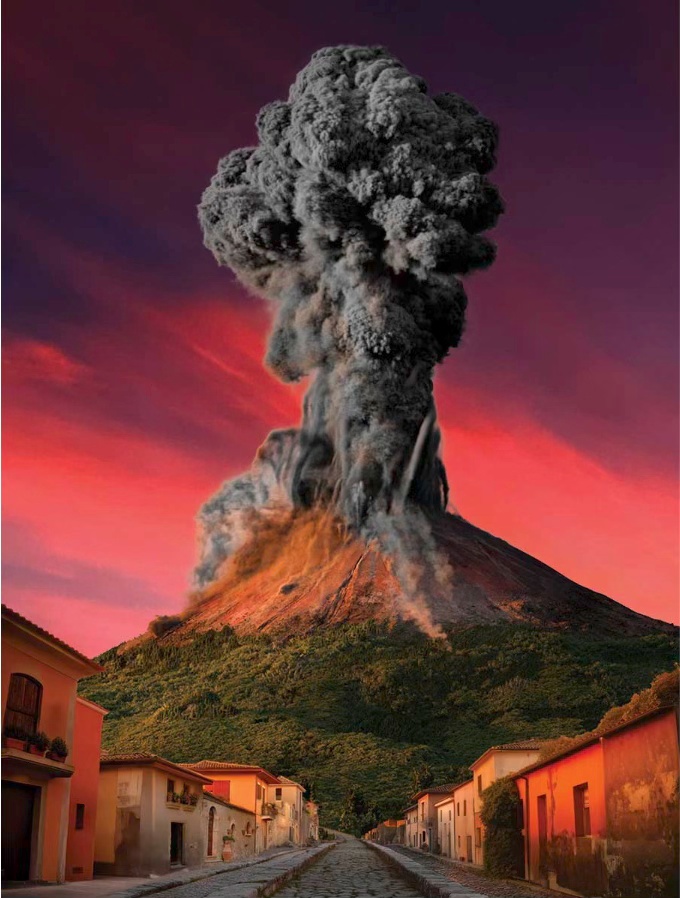
- Pompeii was the Roman Empire’s pre-eminent pleasure town — a wealthy resort on the Bay of Naples crammed with brothels, taverns, baths, a 20,000-seat amphitheatre, and lavish mystery-cult villas — that was annihilated in roughly 18–24 hours by Mount Vesuvius’s two-phase eruption (Plinian column, then Peléan pyroclastic surges) in 79 AD, killing thousands and entombing four cities under up to 20 m of ash and pumice.
- Excavations from 1748 to the present — Giuseppe Fiorelli’s 1863 plaster-cast technique, the Alexander Mosaic of the House of the Faun, the Dionysian frieze of the Villa of the Mysteries, the Regio V thermopolium (2020), the House of Thiasus megalography (2025), and the AI-deciphered Herculaneum papyri (Vesuvius Challenge, 2024) — have turned the buried “Sin City” into the most legible ruin in antiquity.
- Read alongside Qur’an 6:11, 3:137, and 27:69 — three verses that command the reader to “travel through the earth and see the end of the deniers / criminals” — Pompeii functions, for the Muslim reader, as a literal staging of that command: a frozen civilization of indulgence laid open as a moral exhibit visited by more than four million people a year.
Key Findings
- The “Las Vegas” comparison is not rhetorical excess. Pompeii contained at least 18 establishments identified as brothels, approximately 80 thermopolia (fast-food counters), four major bath complexes (Stabian, Forum, Central, Suburban), an amphitheatre built c. 70 BC seating 20,000, two theatres, temples to Venus (the city’s patron), Apollo, Jupiter, Isis, and Dionysus/Bacchus, and the country villas of Rome’s elite, including Julius Caesar, Tiberius, and Nero on the nearby bay. Seneca singled out neighbouring Baiae as a place “where discipline disappeared and moral restraint was forgotten.”
- The eruption’s destruction was theological in its suddenness. A first Plinian phase shot a column of ash and pumice 33 km into the stratosphere at 1.5 million tons per second, releasing — according to the foundational stratigraphic study of Sigurdsson, Carey, Cornell and Pescatore (National Geographic Research 1, no. 3 [1985]: 332–387) — about 100,000 times the thermal energy of the atomic bombings of Hiroshima and Nagasaki; an 18–20-hour pumice fall (2.8 m deep at Pompeii) collapsed roofs; then six alternating Peléan pyroclastic surges with emplacement temperatures of 180–260 °C raced down the volcano at ~100 km/h, killing by thermal shock and asphyxia. Wikipedia
- The traditional 24 August date is now seriously contested. A 2018 charcoal inscription “XVI K NOV” (16 days before the Kalends of November = 17 October) found in the Casa del Giardino, Regio V, supports an autumn eruption around 24 October 79 AD — corroborated by autumn pomegranates, sealed (post-harvest) wine jars, heavier woollen clothing on victims, and coins minted in July/August 79 found in circulation.
- Fiorelli’s plaster casts (1863–present) are the closest thing in archaeology to a moral allegory made physical — over 100 hollow voids of victims filled with plaster, capturing dying postures, clothing folds, even facial expressions. They are the visible answer to the Qur’an’s command “observe how was the end.”
- The Qur’anic motif of “sīrū fī l-arḍ“ (“travel through the earth”) appears at least nine times across the Qur’an. In Qur’an 6:11 (Meccan, al-Anʿām), 3:137 (Medinan, Āl ʿImrān, contextually tied to the defeat at Uhud in 625 CE), and 27:69 (Meccan, al-Naml), the verb of motion is followed by the same imperative — fanẓurū / thumma-nẓurū (“then observe”) — and an evidentiary genitive: the “end of the deniers,” the “end of the criminals.”
- Pompeii is the canonical “ruin-as-warning” of Western archaeology. No other ancient site is so completely preserved, so morally legible, or so massively visited; according to Italian Ministry of Culture data reported by Reuters (25 October 2024), Pompeii drew “more than 4 million visitors, up 33.6% year-on-year, translating into a daily average of around 11,200 people.” The interpretive bridge the essay needs is therefore not strained — Pompeii is, in the most literal sense, what one sees when one travels through the earth and looks for the “end of those who denied.”
Details
I. The City of Pleasure: Pompeii as Roman Las Vegas
By the 1st century AD, the Bay of Naples (the Sinus Cumanus) had become the Roman Empire’s principal leisure coast — a strip of warm winters, sulphurous spas, and seaside villas where, as one summary of the National Gallery of Art’s Pompeii and the Roman Villa exhibition put it, “Julius Caesar, Tiberius, and Nero were among the rulers who had residences on the bay. Augustus also built a grand villa on the nearby Isle of Capri.” Pompeii itself, a wealthy commercial town whose population is variously estimated — Wikipedia notes “more recent estimates are up to 11,500 based on household counts,” HISTORY.com gives “about 12,000,” and the official Pompeii Archaeological Park (pompeiisites.org) uses the older figure of “at least 20,000 inhabitants in AD 79” — and set 8 km from Vesuvius and 23 km southeast of Naples, served both as a port and as an exurb of indulgence for visiting elites.
Sex industry. Of the ~18 buildings identified as brothels in Pompeii, the most famous is the Lupanar (Latin lupa, “she-wolf,” slang for “prostitute”) at the intersection of Vicolo del Lupanare and Vicolo del Balcone Pensile in Region VII — the only definitively purpose-built brothel in the city. It is a two-storey structure with ten cubicula (five per floor), original stone beds with raised stone pillows, a latrine, and erotic frescoes above each doorway depicting different sexual positions, painted in the Fourth Pompeian Style. More than 120 graffiti inscriptions — the highest density in any single building in Pompeii — record clients’ names, prices, and crude boasts. Tariffs ranged from 2 asses (the price of a loaf of bread) to several sesterces; specific graffiti record “Athenais 2 As, Sabina 2 As (CIL IV, 4150),” “The house slave Logas, 8 As (CIL IV, 5203),” and “Maritimus licks your vulva for 4 As. He is ready to serve virgins as well. (CIL IV, 8940).” Phalluses were carved into the basalt paving stones to point the way; one graffito on the wall of the Basilica advertised: “If anyone is looking for some tender love in this town, keep in mind that here all the girls are very friendly.” The city was officially dedicated to Venus Pompeiana, goddess of love and fertility. Pompeii City + 7
Eating and drinking. Roughly 80 thermopolia — masonry counters with embedded clay dolia serving hot food and drink — have been identified, the densest concentration of Roman fast-food infrastructure ever found. The most famous, excavated in 2020 in Regio V at the corner of the Vicolo dei Balconi (revealed by Massimo Osanna’s team), preserves its painted counter-menu of a Nereid riding a seahorse, two upside-down mallard ducks, a rooster, and a dog on a leash; chemical and bone analysis of the dolia contents identified duck, pig, goat, fish (including tuna), land snails, and horse meat, with wine residue in one jar — a Pompeian “menu” of late October 79. Pompeii City
Garum. The city was a major industrial centre for garum, the fermented fish sauce that was Rome’s universal condiment. The dominant Pompeian producer, the freedman Aulus Umbricius Scaurus, made a fortune large enough to build a mansion decorated with mosaics of the very urcei (clay jars) in which his sauce was shipped; the highest-grade garum sociorum sold for the equivalent of 1,000 sesterces per dozen pints, and Pliny the Elder praised its perfume as equal to “the finest unguents.” Kosher garum jars and others labelled “G(ari) F(los) SCO(mbri) SCAURI” have been found across the Mediterranean. Wine, much of it grown on Vesuvius’s slopes, was the city’s other great export; the agricultural Villa of the Mysteries contained a large torcularium (wine press), and Dionysus/Bacchus accordingly became one of the patron deities of the elite. Wikipedia + 2
Public entertainment. Pompeii’s amphitheatre, built around 70 BC by the magistrates Gaius Quinctius Valgus and Marcus Porcius and called by inhabitants the spectacula rather than amphitheatrum (the latter term not yet in use), is the oldest surviving stone amphitheatre in the Roman world. With a 135 m × 104 m elliptical plan and a 20,000-spectator capacity — roughly the city’s entire population — it featured a velarium (canvas sun-cover), reserved boxes for aristocratic women on the upper rim, and external staircases. Venationes (wild-beast hunts), athletic contests, and gladiator pairs fought in front of crowds drawn from Pompeii and the surrounding towns. In AD 59 a riot between Pompeians and visiting fans from Nuceria — described by Tacitus (Annals 14.17) — produced so many dead and maimed that the Senate banned games at Pompeii for ten years. Painted gladiator posters survive on the walls, including one boast that a certain combatant was the “suspirium puellarum” — “heart-throb of the girls.” Pompeii also had two theatres (the Teatro Grande and the smaller Odeon). Wikipedia + 4
Baths, gambling, banquets. Four major bath complexes (Stabian, Forum, Central, Suburban) were social hubs as much as hygienic ones, with mixed-sex bathing attested in the more modern Central and Suburban Baths. Lavish private dining is exemplified by the House of the Chaste Lovers, whose triclinium frescoes show banqueting scenes including a “drinking-game” tableau in which one reveller still drinks while another lies slumped, defeated, across his couch. Gambling tokens and graffiti scores survive from the city’s taverns. Google Arts & Culture
The villas. The Villa of the Mysteries, just outside the Herculaneum Gate, combined a working wine estate (the torcularium), a private bath suite, and the great room of Dionysian frescoes from which the villa takes its name; the House of the Faun, a residence covering an entire city block (a domus of about 3,000 m²), was originally laid out around 180 BC and yielded the Alexander Mosaic (now in Naples) — a 5.82 m × 3.13 m floor mosaic of more than a million tesserae depicting Alexander the Great defeating Darius III at Issus. The House of the Vettii, restored in January 2023 after a 20-year project, displays the wealth of two freedmen brothers grown rich on the wine trade; the Pompeii director Gabriel Zuchtriegel called it “like the history of Pompeii and actually of Roman society within one house.” The House of the Tragic Poet, the House of the Faun, the Villa of Diomedes, the House of the Vettii, the House of the Silver Wedding, the House of Julia Felix, and the House of the Ship Europa together amount to a portfolio of 1st-century luxury domestic architecture without parallel in the surviving Roman world. Facts and Details + 2
This is the city the Roman moralist remembered as a place “where moral restraint was forgotten,” and into whose air, on a single afternoon in the late summer or early autumn of 79 AD, a 33-km-high column of incandescent rock and gas suddenly rose.
II. The Day Vesuvius Spoke
The volcano had given warnings. On 5 February AD 62 a major earthquake — the so-called Pompeii earthquake, whose magnitude is given by Wikipedia as “between 5 and 6 and a maximum intensity of IX or X on the Mercalli intensity scale” and narrowed by peer-reviewed seismological work (Cubellis & Marturano 2002/2013; Guidoboni et al., CFTI5med catalogue 2018–2019) to roughly Mw 5.1–5.8 — had levelled much of the city; repairs were still incomplete seventeen years later. A smaller quake in AD 64 was felt in Naples while Nero was performing in a public theatre; Suetonius records that the emperor finished his song while the building emptied. In the days before the 79 AD eruption, “minor earthquakes were reported … but the warnings were not recognized,” Pliny the Younger later wrote, “because they are frequent in Campania.” WikipediaWikipedia
The eruption itself, the Vesuvius eruption of 79 AD (Volcanic Explosivity Index 5), unfolded in two named phases studied in the classic 1982 stratigraphy of Sigurðsson, Cashdollar and Sparks:
- Plinian phase (~18–20 hours). Around 1:00 p.m. on what was traditionally given as 24 August but is now widely thought to have been 24 October, Vesuvius ejected a column of pulverised pumice and superheated tephra 33 km into the stratosphere, at a rate of “1.5 million tons per second,” releasing — by the calculation of Sigurdsson, Carey, Cornell and Pescatore (National Geographic Research, 1985) — roughly 100,000 times the thermal energy of Hiroshima and Nagasaki combined. Stratospheric winds carried the plume southeast, dumping white pumice and then larger grey clastics on Pompeii at the rate of roughly 15 cm/hour, until a layer 2.8 m (9 ft) deep of lapilli accumulated on the city’s roofs. Many of those who did not flee in the first hours were crushed beneath collapsing roofs; an accompanying earthquake brought down more walls and was accompanied by a mild tsunami in the bay. Wikipedia + 2
- Peléan phase (the second day). When the magma chamber’s chemistry shifted and the eruption column lost its capacity to support itself, the cloud began to collapse into pyroclastic density currents — six successive surges of hot gas and ash. The first surges destroyed Herculaneum, 7 km from the vent, burying it in fine pyroclastic deposits eventually 20 m deep. Then, around 8 a.m. on the second day, the fourth and fifth surges (in the lettering of subsequent volcanological studies) “engulfed Pompeii with a 1.8-metre-deep layer, burning and asphyxiating any living beings who had remained behind.” Magnetic-analysis of over 200 roof-tile and lithic fragments by Zanella, Gurioli, Pareschi and Lanza (2006) yielded emplacement temperatures of 180–220 °C for the first surge and 220–260 °C for the second, with peak depositional temperatures of 300–360 °C on the outskirts. A 2021 study in Nature Scientific Reports (Dellino et al.) concluded that even the first, comparatively “diluted” surge at Pompeii contained enough fine ash that mere minutes of exposure were enough to cause death by asphyxia — refining an older debate between thermal-shock and asphyxiation causes of death. Wikipedia + 3
The casualty figures. The total population of Pompeii and Herculaneum together was “over 20,000,” and “the remains of over 1,500 people have been found at Pompeii and Herculaneum.” Wikipedia’s infobox cites a range of “1,500–3,500, possibly up to 16,000” deaths. Four named towns were destroyed: Pompeii, Herculaneum, Stabiae, and Oplontis (modern Torre Annunziata). Wikipedia + 2
Pliny the Elder and Pliny the Younger. The single literary eyewitness account is preserved in two letters of Pliny the Younger — then a 17-year-old at Misenum, 29 km across the bay — to the historian Tacitus (Epistulae 6.16 and 6.20). His uncle Pliny the Elder (Gaius Plinius Secundus, b. AD 23/24), author of the 37-volume Naturalis Historia and commander of the Roman naval fleet at Misenum, launched a flotilla of quadriremes after receiving a desperate message from his friend Rectina. Warned by his helmsman to turn back, he answered “Fortes fortuna iuvat” — “fortune favours the bold.” Trapped at Stabiae by adverse winds at the villa of his friend Pomponianus, Pliny the Elder spent the night in the open and died on the beach the next morning, almost certainly of asphyxiation (possibly compounded by an asthmatic broncho-constriction, as a 2010 medical-historical analysis argued). His nephew wrote that “broad flames shone out in several places from Mount Vesuvius, which the darkness of the night contributed to render still brighter and clearer… It was now day everywhere else, but there a deeper darkness prevailed than in the thickest night.” Spoken Past + 4
The October-date debate. In 2018 archaeologists working in the Casa del Giardino in Regio V uncovered a fragile charcoal inscription dated “XVI K NOV” — the sixteenth day before the Kalends of November, i.e. 17 October. The full text was deciphered as “XVI (ante) K(alendas) Nov(embres) in[d]ulsit pro masumis esurit[ioni]” (“On October 17 he binged on food”). Because charcoal is, in Massimo Osanna’s words, “fragile and evanescent” and could not realistically have lasted long, this inscription “is highly probable” to date from October 79, “more precisely to a week prior to the great catastrophe.” Independent corroborations have accumulated: a 2013 study by British Museum numismatist Richard Abdy of coins minted in July/August 79 found in Pompeii (“if the 24 August date is correct, it is remarkable that both coins will have taken just two months after minting to enter circulation”); carbonised pomegranates and sealed post-harvest wine jars in the houses; heavier woollen clothing on the victims. A 2024 reassessment by Zuchtriegel and Pedar Foss has argued, against the autumn date, that the manuscript tradition of Pliny’s letters is firmer than once thought and that the charcoal might have survived longer than assumed. The Park’s current public statement notes that “all dates outside August 24 are pure invention,” but a large body of working volcanologists and archaeologists still favour late October 79 AD. Nunc + 3
III. The Rediscovery and the Dead
Pompeii was accidentally rediscovered in 1599 by the architect Domenico Fontana while cutting a canal, and systematically excavated from 1748 under the Bourbon king Charles III. For more than a century the digs were treasure-hunts; the discipline of stratigraphic excavation arrived with Giuseppe Fiorelli, appointed director in 1860. In 1863, Fiorelli realised that the human-shaped voids in the hardened ash were perfect negative moulds left by decomposed bodies. By pouring liquid plaster into the cavities and chipping away the surrounding pumice, he produced the famous plaster casts: contorted, agonised figures fixed in their last postures — parents shielding children, a slave still chained, a dog writhing on its back, a baker face-down. More than 100 such casts have been made since, and 22 of the best-preserved are now in a permanent exhibition opened in 2024 in the porticoes of the Palestra Grande, opposite the amphitheatre. As the park archaeologist Silvia Martina Bertesago put it, the casts “have a strong emotional impact on visitors and can be very moving … we can also understand their age and sex, but also whether they had particular diseases or particular types of diet.” Spoken Past + 4
The rest of the inventory of finds is staggering:
- The Alexander Mosaic (House of the Faun), c. 100 BC, now in the National Archaeological Museum, Naples.
- The Dionysiac frieze of the Villa of the Mysteries, ten near-life-size figures painted c. 60–50 BC, the best-preserved cycle of monumental painting from antiquity.
- The Villa of the Papyri at Herculaneum — probably the seaside mansion of Lucius Calpurnius Piso Caesoninus, father-in-law of Julius Caesar, and possibly the residence of the Epicurean philosopher Philodemus of Gadara (110–30 BC), with c. 1,000 carbonised papyrus scrolls discovered from 1752 onwards — the only intact library to survive from classical antiquity.
- The carbonised loaves, dates, figs, and eggs recovered from Herculaneum and Pompeian bakeries; the Garden of the Fugitives with 13 plaster-cast bodies; the House of the Chaste Lovers with its banquet frescoes; the House of the Tragic Poet; the House of the Vettii (reopened January 2023 after a 20-year restoration); the temples of Apollo, Jupiter, Venus, Fortuna Augusta, Vespasian, the public Lares, and Isis (the only fully rebuilt temple after the 62 AD earthquake, financed by the freedman Numerius Popidius Ampliatus for his six-year-old son).
- Recent finds (2018–2024). Beyond the 2018 charcoal inscription and the 2020 Regio V thermopolium, archaeologists have uncovered:
- In June 2023, in Insula 10 of Regio IX, a still-life fresco depicting a flatbread on a silver tray with pomegranate, dates and wine — quickly nicknamed the “Pompeii pizza.” Director Gabriel Zuchtriegel commented on “the contrast between a modest and simple meal … and the luxury of the silver trays … how can we not think about pizza, also born as a ‘poor’ dish in southern Italy that has now conquered the world.” Hypebeast
- In May 2023, in the Insula of the Chaste Lovers (Regio IX), the skeletons of two men aged at least 55 crushed beneath a wall that collapsed during the eruption — the first published evidence of major seismic activity accompanying the pyroclastic phase (Zuchtriegel: “we have realized there were violent, powerful seismic events that were happening at the time of the eruption”). Smithsonian Magazine
- In April 2024, the so-called “Black Room” banquet hall in Regio IX, Insula 10 — a 15 m × 6 m space whose black walls (designed, Zuchtriegel said, “to prevent the smoke from the oil lamps being seen on the walls”) carried a Trojan-cycle fresco programme: Helen and Paris, Apollo and Cassandra, Leda and the Swan. A nearby bakery yielded the skeletons of two adults and a child, possibly slaves. Artnews
- In February 2025, in Insula 10 of Regio IX, the House of Thiasus revealed a near-life-size megalography — a Dionysian initiation frieze from the 40s–30s BC — comparable in importance to the Villa of the Mysteries cycle. Italian Culture Minister Alessandro Giuli called it a discovery that “in 100 years … will be seen as historic.”
- In November 2024, ancient DNA analysis published in Current Biology by a Florence/Harvard/Max Planck team overturned the long-assumed family identifications of several casts: the “mother and child” of the House of the Golden Bracelet were not biologically related.
- From 2023 onwards, the Vesuvius Challenge — founded by Brent Seales, Nat Friedman and Daniel Gross — has used CT scans and machine learning to read the carbonised Herculaneum scrolls without unrolling them. On 12 October 2023, Luke Farritor, a 21-year-old Nebraska student, detected the first word: ΠΟΡΦΥΡΑϹ (“purple”). On 5 February 2024 a team of Farritor, Youssef Nader and Julian Schilliger won the $700,000 grand prize by recovering about 5% of one scroll — 15 columns of an Epicurean philosophical treatise probably by Philodemus. A new 2024 challenge offered $100,000 to read 90% of four scrolls.
What Pompeii teaches, in sum, is the texture of an ordinary Roman afternoon: the menu on the wall of a snack-bar; the price-list scratched outside a brothel; the children’s gladiator-doodles in the House of the Painters at Work; the sealed wine amphora in a pantry; the half-eaten loaf in the oven; the dog twisting on its chain. And — laid bare by Fiorelli’s plaster — the shapes of the people themselves in the instant they died.
IV. The Three Verses
The Qur’an commands the reader, at least nine times across the Meccan and Medinan surahs, to “travel through the earth and see how was the end” of those who denied. Three of those verses share an almost identical verbal formula — qul sīrū fī l-arḍ thumma/fa-anẓurū kayfa kāna ʿāqibatu X — and form the spine of this essay’s reading of Pompeii.
1. Qur’an 6:11 — Sūrat al-Anʿām (“The Cattle”)
Arabic: قُلْ سِيرُوا فِي الْأَرْضِ ثُمَّ انْظُرُوا كَيْفَ كَانَ عَاقِبَةُ الْمُكَذِّبِينَ
Transliteration: Qul sīrū fī l-arḍ thumma-nẓurū kayfa kāna ʿāqibatu l-mukadhdhibīn.
Context. Al-Anʿām is a Meccan surah of 165 verses, traditionally held to have been revealed in a single night during the later Meccan period (Ibn ʿAbbās: “Surah Al-Anʿām was revealed in Makkah, all at once, in one night”). Its argumentative spine is the systematic dismantling of Quraysh polytheism and the establishment of tawḥīd (the absolute oneness of God). The verses immediately preceding 6:11 (vv. 7–10) confront the Meccans’ mockery of revelation; verse 11 turns the argument outward, ordering the reader to travel and physically inspect the ruins of vanished peoples as empirical evidence that denial of revelation has a cost. Ibn Kathīr glosses it: “contemplate about yourselves and think about the afflictions Allāh struck the previous nations with, those who defied His Messengers and denied them.” WikipediaWikipedia
Translations:
- Sahih International: “Say, ‘Travel through the land; then observe how was the end of the deniers.’” Quran
- Yusuf Ali (Saudi Rev. 1985): “Say: ‘Travel through the earth and see what was the end of those who rejected Truth.’”
- Marmaduke Pickthall: “Say (unto the disbelievers): Travel in the land, and see the nature of the consequence for the rejecters!”
- A. J. Arberry: “Say: ‘Journey in the land, then behold how was the end of them that cried lies.’” Islam Awakened
- M. H. Shakir: “Say: Travel in the land, then see what was the end of the rejecters.”
- Hilali-Khan: “Say (O Muhammad SAW): ‘Travel in the land and see what was the end of those who rejected truth.’” Surahquran
- Dr. Mustafa Khattab (The Clear Quran): “Say, ‘Travel throughout the land and see the fate of the deniers.’”
- Muhammad Asad: “Say: ‘Roam the earth and see [with your own eyes] what the destiny of those who chose to disbelieve was.’”
- Abdul Haleem: “Say, ‘Travel throughout the earth and see what fate befell those who rejected the truth.’”
- Abul Aʿlā Mawdūdī: “Say: ‘Go about journeying the earth, and behold the end of those who gave the lie (to the Truth).’”
2. Qur’an 3:137 — Sūrat Āl ʿImrān (“The Family of Imran”)
Arabic: قَدْ خَلَتْ مِنْ قَبْلِكُمْ سُنَنٌ فَسِيرُوا فِي الْأَرْضِ فَانْظُرُوا كَيْفَ كَانَ عَاقِبَةُ الْمُكَذِّبِينَ
Transliteration: Qad khalat min qablikum sunanun fa-sīrū fī l-arḍ fa-anẓurū kayfa kāna ʿāqibatu l-mukadhdhibīn.
Context. Āl ʿImrān is a Medinan surah, and verses 121–179 form an extended commentary on the Battle of Uhud (Shawwāl, year 3 AH / March 625 CE), in which the Muslims, having tasted victory, lost 70 dead — including the Prophet’s uncle Ḥamza — when archers abandoned their posts to gather spoils. Verse 137 is consolation theology: God is reminding the believers that sunan — His unchanging laws, “ways,” or “precedents” — have operated before them, and that they must look at the fates of the deniers, not at their own setback. Ibn Kathīr (Tafsīr, ad loc.) writes: “Allāh states to His believing servants who suffered losses in the battle of Uhud, including seventy dead, ‘qad khalat min qablikum sunanun’ — for the previous nations who followed their Prophets before you, they too suffered losses. However, the good end was theirs.” The verses immediately before and after frame it precisely: 3:136 promises gardens to the patient; 3:137 commands inspection of ruins; 3:138 declares the Qur’ān itself “a clear statement to mankind”; 3:139 enjoins, “so do not weaken and do not grieve.” Quran.comQuran
Translations:
- Sahih International: “Similar situations [as yours] have passed on before you, so proceed throughout the earth and observe how was the end of those who denied.” QuranMy Islam
- Yusuf Ali: “Many were the Ways of Life that have passed away before you: travel through the earth, and see what was the end of those who rejected Truth.” My Islam
- Pickthall: “Systems have passed away before you. Do but travel in the land and see the nature of the consequence for those who did deny (the messengers).” Namaz Zamani
- Arberry: “Divers institutions have passed away before you; journey in the land, and behold how was the end of those that cried lies.”
- Shakir: “Indeed there have been examples before you; therefore travel in the earth and see what was the end of the rejecters.” Namaz Zamani
- Hilali-Khan: “Many similar ways (and mishaps of life) were faced by nations (believers and disbelievers) that have passed away before you (as you have faced in the battle of Uhud), so travel through the earth, and see what was the end of those who disbelieved.” Word of Allah
- Dr. Mustafa Khattab: “Similar situations came to pass before you, so travel throughout the land and see the fate of the deniers.” Quran
- Muhammad Asad: “[MANY] WAYS of life have passed away before your time. Go, then, about the earth and behold what happened in the end to those who gave the lie to the truth.”
- Abdul Haleem: “God’s ways have operated before your time: travel through the land, and see what was the end of those who disbelieved.” My Islam
- Mawdūdī: “Many eras have passed before you. Go about, then, in the land and behold the end of those who gave the lie (to the directives and ordinances of Allāh).” Islamic Studies
3. Qur’an 27:69 — Sūrat al-Naml (“The Ant”)
Arabic: قُلْ سِيرُوا فِي الْأَرْضِ فَانْظُرُوا كَيْفَ كَانَ عَاقِبَةُ الْمُجْرِمِينَ
Transliteration: Qul sīrū fī l-arḍ fa-anẓurū kayfa kāna ʿāqibatu l-mujrimīn.
Context. Al-Naml is a Meccan surah of 93 verses. The first half (vv. 1–58) tells the stories of Moses, David, Solomon and the Queen of Sheba, the people of Thamūd (destroyed for rejecting Ṣāliḥ), and the people of Lot. Verses 59 onwards turn to those who deny the resurrection. Verses 67–68 voice the deniers’ objection — “When we have become dust and our fathers, will we surely be brought out?” — to which v. 69 is the reply: travel and look. The shift of object from mukadhdhibīn (“deniers”) to mujrimīn (“criminals,” “the guilty”) sharpens the indictment. As Mawdūdī’s Tafhīm puts it: “those communities who rejected the Hereafter could not help becoming criminals: they lived irresponsibly; they committed cruelties and all kinds of sin; and ultimately their moral depravity led them to utter ruin.” Surah Quran
Translations:
- Sahih International: “Say, [O Muhammad], ‘Travel through the land and observe how was the end of the criminals.’”
- Yusuf Ali: “Say: ‘Go ye through the earth and see what has been the end of those guilty (of sin).’” Surah.my
- Pickthall: “Say (unto them, O Muhammad): Travel in the land and see the nature of the sequel for the guilty.”
- Arberry: “Say: ‘Journey in the land, then behold how was the end of the sinners.’”
- Shakir: “Say: Travel in the earth, then see how was the end of the guilty.”
- Hilali-Khan: “Say to them (O Muhammad): ‘Travel in the land and see how has been the end of the criminals (those who denied Allāh’s Messengers and disobeyed Allāh).’”
- Dr. Mustafa Khattab: “Say, ‘[O Prophet,] Travel throughout the land and see the fate of the wicked.’”
- Muhammad Asad: “Say: ‘Go all over the earth and behold what happened in the end to those [who were thus] lost in sin!’” Islam Awakened
- T. B. Irving: “SAY: ‘Travel around the Earth and observe the fate of those who are guilty of forcing others to reject God’s messages.’” Islam Awakened
- Mawdūdī: “Say to them, ‘Move about in the land and see what doom the criminals have met.’” Surah Quran
V. The Bridge: Pompeii Read Through the Three Verses
The Qur’anic sīrū fī l-arḍ topos is not metaphor only. It is an empirical command: get up, go, look at the physical evidence — the toppled walls, the abandoned cities, the dwellings of the people of Lot, Thamūd, ʿĀd, Madyan, the Pharaohs. Three claims structure it. First, that the past leaves visible ruins. Second, that those ruins are legible as moral evidence. Third, that the unchanging “sunan” (precedents) of God mean that what happened to them can happen to us — which is why the verb of the command is always plural and present.
Pompeii is, in a literal sense, the case of which the Qur’an’s hearer could only dream. Where the ruins of Thamūd at Madāʾin Ṣāliḥ are stone tombs cut into red sandstone — empty, weathered, abstract — Pompeii is a city frozen in the action of its life: the price scratched outside the brothel, the loaf in the oven, the dog still on its chain, the gladiator’s name still painted on the wall of the amphitheatre, the menu still painted on the snack-bar counter, the wine-press still in the villa, the temple of Venus still on its podium, the cast of a woman’s last gesture — clutching her jewellery — still preserved in plaster. The morally legible ruin that the Qur’ān demands is here exhibited with a vividness that no other site in the world equals.
The interpretive bridge therefore runs in three movements:
- Q 6:11 / Pompeii as the city of denial. Pompeii is the Meccan verse’s case-study: a prosperous polytheist trading town, dense with shrines to Venus, Apollo, Jupiter, Isis, Bacchus, Hermes-Mercury, the Lares, the Genius of the emperor, and the phallic fascinum; a city whose two greatest cult-frescoes (the Villa of the Mysteries and the House of Thiasus) are initiation rites into the Dionysian mystery cult — a cult of intoxication, fertility, and ecstatic release. Pompeii is the encyclopedia of every form of taklīb (giving the lie to revelation) that the Meccan al-Anʿām indicts: idol-worship, intercession by deities, indulgence of the appetites, denial of the moral order. Qul sīrū fī l-arḍ thumma-nẓurū: travel to the Bay of Naples and see what became of the rejecters.
- Q 3:137 / Pompeii as the sunna (precedent) of God. The Medinan verse, set against the disappointment of Uhud, reframes history as a system of sunan — patterns. Wealth, leisure, the multiplication of pleasures, the disregard of revelation, the catastrophic reset: this pattern is in the Qur’an’s account of Pharaoh, of Sodom, of Thamūd, of ʿĀd, of the people of Tubbaʿ, of the people of the Well, of the Sabaʾites. The Roman version of it ran from the founding of Pompeii by the Oscans in the 7th century BC, through the Samnite, Greek, and Roman occupations, through the wealth peak of the 1st century AD, to the eighteen-hour Plinian column of 24 October 79. The verse’s qad khalat min qablikum sunanun — “ways have passed before you” — is exactly the lesson the buried spectacula of Pompeii teaches: an empire’s pleasure capital is not exempt.
- Q 27:69 / Pompeii as the city of the mujrimīn. The third verse intensifies the indictment. The denizens are no longer simply mukadhdhibīn (deniers of the message) but mujrimīn (criminals, the guilty). The plaster casts make this almost unbearable. They are not abstract. They are the bodies of named, ordinary people — bakers, slaves, prostitutes, magistrates, children — caught in postures that look, when one sees them in the Palestra Grande, less like sleep than like the yawm al-qiyāma foreshortened: arms raised against the heat, mouths open, hands clutching coins or jewellery, mothers shielding babies, lovers entwined. Qul sīrū fī l-arḍ fa-anẓurū kayfa kāna ʿāqibatu l-mujrimīn. Today’s more than four million annual visitors to Pompeii — Muslims, Christians, atheists, tourists from every part of the earth — are, perhaps unwittingly, performing the verse: they have travelled, they are looking, and they are reading on the walls the language of an ended civilization.
The frame is not anachronistic. The Qur’an does not name Pompeii; the eruption is 552 years earlier than the revelation. But the sunan the verses invoke are presented as universal, not enumerative — God’s command to sīrū wa-nẓurū is not restricted to the ruins available in 7th-century Arabia. The Muslim reader of al-Anʿām in the 21st century, standing in front of Fiorelli’s casts in the Palestra Grande, has the rare privilege of seeing the verse staged in its sharpest possible form: a city of perfumed appetites, intact in every detail, caught and stopped on a single autumn afternoon, dug out of the ash, and opened for inspection.




Leave a Reply