
Standing in the Divine Gaze: Muraqaba, Mindfulness, and the Phenomenology of Watchfulness — A Comparative-Religion Reading of Dr. Francesca Bocca-Aldaqre’s “What Is Muraqaba”
- Dr. Francesca Bocca-Aldaqre’s YouTube lecture “What Is Muraqaba | Mindfulness in Islam | Muraqaba Is Powerful Than Meditation | Is Mindfulness Haram” argues that Islam already possesses a contemplative technology — muraqaba — that is structurally similar to but theologically more powerful than secular/Buddhist mindfulness, and that the question “is mindfulness haram?” is best answered not by prohibition but by re-anchoring contemplative practice in the Qur’anic divine name al-Raqib (The Watchful) and in the Hadith-of-Gabriel definition of ihsan.
- The decisive comparative-religion point is a reversal of subject and object: in Buddhist vipassana and in MBSR-style secular mindfulness the practitioner observes his or her own mental states (self-as-observer), whereas in salat, dhikr and muraqaba the worshipper is the observed — standing before an All-Watchful God whose gaze (Qur’an 4:1; 50:16-19) constitutes the entire phenomenology of the practice.
- A growing scholarly literature (Malik Badri’s Contemplation; Nazila Isgandarova’s 2018/2019 paper “Muraqaba as a Mindfulness-Based Therapy in Islamic Psychotherapy” in the Journal of Religion and Health; Hooman Keshavarzi and Amber Haque’s 2013 founding article on Traditional Islamically Integrated Psychotherapy [TIIP], later developed with Abdallah Rothman, Fahad Khan, Bilal Ali and Rania Awaad) supports the kind of position Bocca-Aldaqre advances: Muslims need not import secular mindfulness wholesale, because the Islamic tradition contains its own indigenous, theologically integrated contemplative discipline.
Key Findings
1. Bocca-Aldaqre’s scholarly profile. Francesca Bocca-Aldaqre (b. Piacenza, 14 September 1987) is an Italian theologian, neuroscientist and convert to Islam. She holds an MSc in Neuro-Cognitive Psychology and a PhD in Systemic Neuroscience from Ludwig-Maximilians-Universität Munich, and a Diploma in Islamic Psychology from Cambridge Muslim College. She has taught Islamic civilisation at Università Vita-Salute San Raffaele in Milan, directs the Istituto Islamico di Studi Avanzati (IISI), serves as dean of psychology at the International Open University (Gambia), and is a Visiting Lecturer at Blogging Theology Academy. Her published works include Sotto il suo passo nascono i fiori. Goethe e l’Islam (La Nave di Teseo, 2019), Nietzsche in Paradiso (Mimesis, 2021), the posthumously co-authored Manuale di Teologia Islamica with Massimo Campanini (Le Monnier, 2021), and Manifesto dell’Islam Italiano (Mimesis, 2024). Her scholarly project consistently reads Western thinkers (Goethe, Nietzsche, Heidegger) through Islamic categories and brings classical ‘ilm al-nafs into dialogue with neuroscience. The Thinking Muslim + 2
2. The argument of the YouTube lecture. The video — published on Bocca-Aldaqre’s channel “Islamic Psychology with Dr. Francesca” — opens: “Mindfulness is one of the most popular tools for stress, anxiety, and emotional balance. But as Muslims, we must ask an important question: Is mindfulness co[mpatible with Islam]?” The title’s three claims structure the talk: (a) muraqaba is the Islamic equivalent and antecedent of mindfulness; (b) it is more powerful than secular meditation because of its theological telos; (c) the haram/halal question is therefore mis-framed — what is impermissible is the metaphysical baggage of certain non-Islamic meditative systems, not the cultivation of present-moment, God-conscious attention itself. Although a verbatim transcript of this specific video could not be retrieved during research (the YouTube page returned HTTP 429 and no third-party transcript site has indexed it), the conceptual framework is documented in her parallel long-form interview on The Thinking Muslim (Ep. 232, June 2025), where she states: “classical scholars like Al-Ghazali already wrote a thousand years ago about the importance of muraqaba — meaning watching your intentions, your actions, your words; being present and aware of what you’re doing… one of the earliest manuals of Islamic psychology where what he’s telling us is: be aware of yourself every day; there is this muraqaba cycle, the attention towards oneself every day should go through it, and it is about effort, it is about intention, it is about evaluation — so there is no mystical escape to that.” She frames Islamic psychology’s distinctive contribution as “be with what is and be with Allah” (a phrase she attributes to her teacher Dr. Abdallah Rothman), explicitly distinguishing Islamic muraqaba from acceptance-based Western therapies that derive ultimately from Stoicism or Buddhism.
3. Etymology and classical definition of muraqaba. The Arabic noun murāqaba derives from the trilateral root r-q-b (ر ق ب), “to watch, observe, regard attentively, guard.” In pre-Islamic Arabian usage a murāqib was a watcher of the night sky scanning for the rising of stars to guide travel; the lexicon of Lisān al-ʿArab gives derivatives including raqīb (observer, sergeant), marqab (watchtower), and raqaba (neck, that which is held erect). The classical Sufi technical definition is given by al-Qushayrī (d. 465 AH / 1072 CE) in his Risāla and by al-Jurjānī (d. 816 AH / 1413 CE): muraqaba is “the servant’s enduring knowledge and conviction that the Truth — glory be to Him — is supervisor over his outward and inward states.” Al-Ghazālī (d. 505 AH / 1111 CE) treats muraqaba as obligatory God-consciousness in book XXXVIII of the Iḥyāʾ ʿUlūm al-Dīn (“On Vigilance and Self-Examination”), opening with the Hadith of Gabriel and the Qur’anic verses on divine watching, and arguing that “it is the obligation of the creation to be in constant awareness of its Creator.” Ibn al-Qayyim al-Jawziyya (d. 751 AH / 1350 CE) in his Madārij al-Sālikīn makes muraqaba a station (maqām) on the path to God, defining true taqwa as “obedience to Allah with watchfulness and consciousness (muraqaba).” Imam Junayd al-Baghdadi famously said his teacher in muraqaba was a cat watching a mouse-hole — “not one of its hairs was moving.” British Psychological Society + 7
4. The Qur’anic ground of muraqaba: the name al-Raqib. God names Himself al-Raqīb (The Ever-Watchful) on three occasions in the Qur’an. The most famous occurrence is the opening verse of Surat al-Nisāʾ: “O mankind, fear your Lord, who created you from one soul… inna Allāha kāna ʿalaykum raqība” — “Indeed Allah is ever Watchful over you” (Qur’an 4:1). The same epithet appears in Qur’an 5:117 (Jesus to God: “but when You took me up, You were the Watcher over them”) and Qur’an 33:52 (“Allah is ever Watcher over all things”). Surat Qāf 50:16–18 deepens this with the famous declaration of divine immanence: “We created man, and We know what his soul whispers to him; and We are nearer to him than his jugular vein… not a word does he utter but there is a watcher (raqīb) by him ready [to record].” Classical tafsirs (Maarif al-Qur’an, Ibn Kathir) read “nearer than the jugular vein” as describing the all-encompassing reach of divine knowledge and angelic presence. To live in continuous awareness of this verse is precisely muraqaba. DeensisterS + 4
5. The Hadith of Gabriel and ihsan. The locus classicus for the link between muraqaba and ihsan is the famous Hadith of Gabriel preserved in both Bukhari and Muslim. ʿUmar ibn al-Khattāb narrates that the angel Jibrīl came in the form of a man and asked the Prophet successively about islām (the five pillars), īmān (the six articles of faith), and finally iḥsān. The Prophet answered: “Iḥsān is to worship Allah as though you see Him, and though you see Him not, He surely sees you” (an taʿbuda Allāha ka-annaka tarāhu, fa-in lam takun tarāhu fa-innahu yarāka). For Sufi and Islamic-psychological authors alike, this hadith is the practical charter of muraqaba: it institutionalises the awareness of being seen by God as the apex of religion. As one classical translation of al-Ghazālī’s chapter has it: “Worship God as if you were looking at Him; though you see Him not, He sees you.” Tasawuf + 2
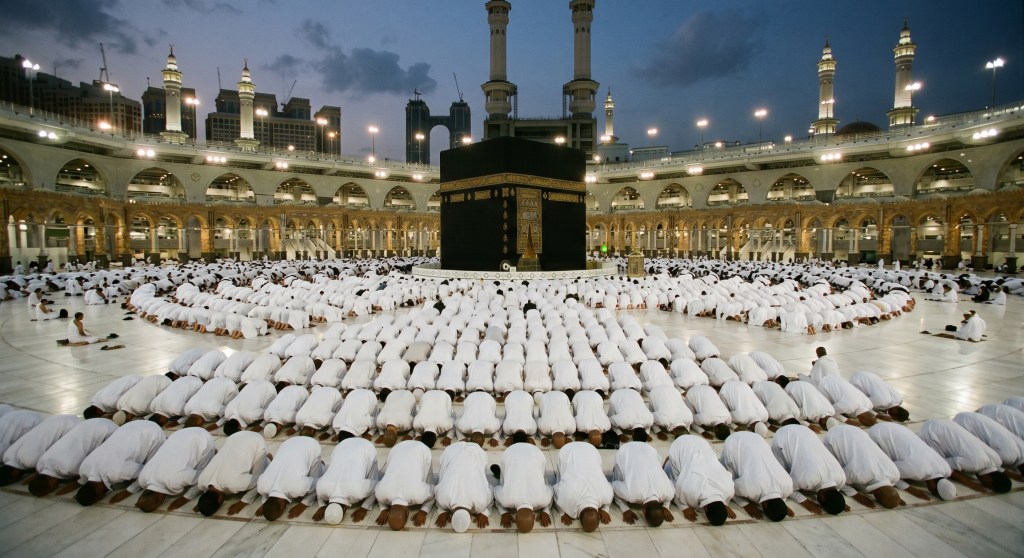
6. Salat as ritualised muraqaba. The five-times-daily ritual prayer (ṣalāt) is the formal vessel of muraqaba. It opens with niyya (intention) and takbīr al-iḥrām (“Allāhu akbar”), proceeds through standing (qiyām), bowing (rukūʿ), prostration (sujūd) and sitting (julūs), and is constituted by recitation of the Fatiha and other Qur’anic passages. The Prophet forbade looking up to the sky during prayer; Ibn Taymiyya, as Ibn al-Qayyim reports in Madārij al-Sālikīn, glossed this as “the utmost manifestation of reverence (adab) toward Allah.” Two terms in the Islamic tradition specify the inner state of presence in salat: khushūʿ (humble attentiveness) and the avoidance of ghafla (heedlessness). An empirical study by Khadeeja Ahmed and Omar Yousaf of the University of Hertfordshire, “An exploration of mindfulness during the Islamic prayer in British and Pakistani Muslims” (Cogent Psychology 12:1, art. 2456335, published online 22 January 2025), surveyed 78 Muslim participants (38 UK-based and 40 Pakistan-based) and found that “prayer frequency, importance of paying undivided attention to prayer, and the religious orientation of quest scores positively predicted 36% (adjusted R²) of the variance in mindfulness during worship scores, F(3, 76) = 14.94, p < .001” — i.e., that salat already functions, sociologically and psychologically, as a structured mindfulness practice. Taylor & Francis OnlineTaylor & Francis Online
7. Dhikr (Zikr-e-Ilahi). Dhikr, “remembrance of God,” is enjoined dozens of times in the Qur’an (“O you who believe, remember Allah with much remembrance” — Q 33:41). It takes audible and silent forms; the Naqshbandi Sufi order traditionally favours silent dhikr — Khwaja Baha al-Din Naqshband: “I preferred the silent because it is stronger and more advisable.” Practically, dhikr employs short Arabic formulae (subḥān Allāh, al-ḥamdu li-llāh, Allāhu akbar, lā ilāha illā Allāh) or single divine names repeated rhythmically, often integrated with breath and posture. Al-Ghazālī wrote: “Dhikr is, in its reality, the progressive Power of the Named One on the heart, while the dhikr itself wears away and disappears” — capturing the way the technique dissolves into the encounter it aims at. BaharemadinahBaharemadinah
8. Muraqaba as Sufi maqām. In the Naqshbandi, Mevlevi and Azeemiyyah orders muraqaba is the central inner practice, often paired with dhikr and tasawwur-e-shaykh (visualisation of the shaykh). A representative Naqshbandi formulation (cited in the article “Sufism,” Wikipedia, summarising classical sources) is: “He is to collect all of his bodily senses in concentration, and to cut himself off from all preoccupation and notions… and turn his full consciousness towards God Most High while saying three times: ‘Ilāhī anta maqṣūdī wa-riḍāka maṭlūbī — my God, You are my Goal and Your good pleasure is what I seek.’ Then he brings to his heart the Name of the Essence — Allāh — and as it courses through his heart he remains attentive to its meaning… The seeker remains aware that He is Present, Watchful, Encompassing of all, thereby exemplifying the saying [of the Prophet]: ‘Worship God as though you see Him, for if you do not see Him, He sees you.’” The Azeemiyya tradition systematises muraqaba into three maqamat moving from sleep-like trance through hidden universal awareness to perpetual presence; this is the framework of Khwaja Shamsuddin Azeemi’s Muraqaba: The Art and Science of Sufi Meditation (Houston: Plato Publishing). WikipediaWikipedia
9. Secular mindfulness (MBSR) — origin and definition. Jon Kabat-Zinn (born Jon Kabat, 5 June 1944), a molecular biologist who completed his PhD at MIT in 1971 under the Nobel laureate Salvador Luria, founded the Stress Reduction Clinic at the University of Massachusetts Medical Center in 1979 and developed Mindfulness-Based Stress Reduction (MBSR) drawing on his training with the Zen teacher Philip Kapleau, the Vietnamese Mahayana master Thích Nhất Hạnh, and the Korean Seon master Seung Sahn (with whom he was a founding member of the Cambridge Zen Center). He defines mindfulness as “the awareness that emerges through paying attention on purpose, in the present moment, and non-judgementally to things as they are” (Williams, Teasdale, Segal & Kabat-Zinn, The Mindful Way through Depression, 2007). Kabat-Zinn himself, interviewed by Ville Husgafvel (Contemporary Buddhism 19/2, 2018), describes his MBSR books as the “root texts for this new lineage” and grounds the programme in a “universal dharma foundation” rooted in pan-Buddhist (especially Mahāyāna and non-dual) teachings on the cessation of suffering — even when delivered in secular medical packaging. Wikipedia + 2
10. Buddhist contemplative practice. In Theravada Buddhism mindfulness (Pali sati; Sanskrit smṛti) is one of the seven factors of awakening and the foundation of the Satipaṭṭhāna Sutta. Ānāpānasati — mindfulness of in- and out-breathing — is taught by the Buddha in Majjhima Nikāya 118 as the foundational technique. Buddhist meditation classically divides into samatha (calm-abiding, leading through the jhānas to deep concentration) and vipassanā (insight, leading to direct perception of the three marks of existence: anicca — impermanence, dukkha — suffering, and anattā — non-self). The soteriological telos is liberation (nibbāna) from the cycle of dependent origination through dispelling the illusion of a substantial, persisting self. Modern lay vipassana movements (S. N. Goenka, Mahasi Sayadaw) revived these practices in 18th- to 20th-century Myanmar and brought them to Western practitioners — including Kabat-Zinn.
11. The decisive contrast: subject and object of the watching. Here Bocca-Aldaqre’s specific contribution comes into sharpest relief. In secular mindfulness and Buddhist vipassana the meditator is the observer — the what of the practice is one’s own breath, sensations, thoughts, emotions; the how is non-judgmental, accepting, friendly attention (Crane et al., 2017). The transformative claim of Buddhism is that this introspective gaze reveals the absence of a self (anattā) and dissolves clinging. In Islamic muraqaba, by structural inversion, the primary observer is God, not the worshipper. The worshipper does indeed attend to his own intentions, words and actions — Ibn al-Qayyim and al-Ghazālī both prescribe daily muḥāsaba (self-accounting) — but this self-attention is animated and grounded by the prior fact that al-Raqīb sees first and sees more. The phenomenology is therefore not that of the self examining itself, but of the self standing before a knowing Other. The Sufi maxim is “ye seek Him with the very gaze He has bestowed on you.” Bocca-Aldaqre’s claim that muraqaba is “more powerful” than meditation rests on this point: contemplation grounded in the divine attribute generates an ethical accountability (taqwa), a relational warmth (love and awe of God), and a metaphysical orientation (toward the encounter on the Day of Judgement) that secular mindfulness, by its methodological subtraction of God, cannot in principle generate. nih
12. The “haram” question and the contemporary debate. Several Muslim scholarly bodies have warned against importing meditation techniques laden with non-Islamic theology — IslamWeb (Fatwa 282283 et al.) advised that “the Muslim is commanded to avoid imitating the disbelievers in whatever is peculiar to them, even a certain sitting posture (that is a part of their polytheistic rituals),” though the same fatwa permits breathing exercises pursued strictly for health on the advice of a qualified Muslim physician. The dominant scholarly position represented by Bocca-Aldaqre, Malik Badri, Nazila Isgandarova (Journal of Religion and Health 58:4, 1146–1160, doi 10.1007/s10943-018-0695-y, 2018/2019), Abdallah Rothman and Hooman Keshavarzi (Applying Islamic Principles to Clinical Mental Health Care, Routledge, 2020) is constructive rather than prohibitive: secular techniques (breath awareness, body scan, present-moment attention) may be employed by Muslims when re-embedded in an Islamic theological frame — most naturally, in muraqaba and salat. Junaid Shabir, an Assistant Psychologist in the NHS Birmingham and Solihull Mental Health Trust, writes in The Psychologist (BPS, 2024): “When I initially introduce mindfulness or meditation to Muslim patients on the ward, there is often a sense of hesitancy… They sometimes feel unmotivated to engage, often stating, ‘I have Islam, why would I need that?’ or ‘I pray, which is enough for me.’ However, meditation, from a purely linguistic perspective, was practiced by the righteous Islamic figures of the past through muraqabah.” Shabir’s adaptation echoes Bocca-Aldaqre’s pedagogical move. British Psychological Society
13. The Islamic-psychology research programme. Malik Babikr Badri (14 February 1932 – 8 February 2021) — often called by the IIIT and the International Association of Islamic Psychology “the father of modern Islamic psychology,” and holder of the Ibn Khaldun Chair at the International Islamic University Malaysia (IIUM) after earning his PhD at the University of Leicester in 1961 — published Al-Tafakkur min al-Mushāhada ilā al-Shuhūd (1991), translated and revised as Contemplation: An Islamic Psychospiritual Study (IIIT, 2000; new edition 2018). Reviewing the book in American Journal of Islam and Society, the reviewer summarises his central thesis: “While meditation is primarily derived from Eastern religions and aims at altering states of consciousness, Islamic contemplation is derived from Qur’anic injunctions and aims to seek insightful knowledge of God as the Creator and Sustainer of the universe.” Badri’s contemplation (tafakkur) and Bocca-Aldaqre’s muraqaba thus differ in emphasis but converge on a common thesis: the object of the contemplative act is God and His signs (āyāt), and the subject is held in being by God’s prior knowledge of him. Traditional Islamically Integrated Psychotherapy (TIIP) was first articulated by Hooman Keshavarzi and Amber Haque in their 2013 International Journal for the Psychology of Religion paper (vol. 23, 230–249) and subsequently developed with Abdallah Rothman, Fahad Khan, Bilal Ali and Rania Awaad (Applying Islamic Principles to Clinical Mental Health Care, Routledge, 2020). The model — now taught through the Khalil Center (USA), Ibn Haldun University (Türkiye), Usul Academy, and Hamad bin Khalifa University’s College of Islamic Studies in Qatar — embeds this contemplative anthropology in a formal clinical-training model that locates the practitioner “between a ‘clinician’ and a ‘spiritual’ healer,” using muraqaba and muhasaba as core psycho-spiritual interventions. IIIT + 7
Details
1. Presenting the video and its author
The video at https://www.youtube.com/watch?v=tQ2-2Rld_6U is hosted on Bocca-Aldaqre’s official channel (“Islamic Psychology with Dr. Francesca,” UCQnpbKXR6_3atmD16UlJk1Q), which describes its mission as “reviving the timeless wisdom of ‘Ilm al-Nafs (Islamic Psychology) in the modern world… bridging the gap between classical Islamic scholarship and contemporary mental well-being… through Tazkiyah al-Nafs (purification of the soul).” The title compresses three theses: (a) What is Muraqaba? — a definitional/etymological project; (b) Muraqaba [is more] Powerful than Meditation — a comparative-evaluative claim; (c) Is Mindfulness Haram? — a fiqhī/ethical question. The visible description begins: “Mindfulness is one of the most popular tools for stress, anxiety, and emotional balance. But as Muslims, we must ask an important question: Is mindfulness co[mpatible with Islam?]” youtubeYouTube
Bocca-Aldaqre’s parallel long-form treatment of the same material is available in her interview on The Thinking Muslim (Episode 232, June 2025) and in the curriculum of her Diploma in Islamic Psychology at Blogging Theology Academy. There she stresses that “classical scholars like Al-Ghazali already wrote a thousand years ago about the importance of muraqaba — meaning watching your intentions, your actions, your words; being present and aware of what you’re doing.” She rejects what she calls the “mystical escape” reading of muraqaba: “it is about effort, it is about intention, it is about evaluation.” She presents Islamic psychology’s distinctive note in a phrase she attributes to her teacher Dr. Abdallah Rothman: “be with what is and be with Allah” — a deliberate intensification of Kabat-Zinn’s “be with what is” through the addition of the theistic object. The same talk makes clear her general methodological stance: Islamic psychology “borrows from… the West some techniques that we might find helpful,” but the goal of “cultivating a sound heart as defined in the Qur’an” and “the relationship of servanthood” is “indeed specific to Islam, so it can’t be taken from somewhere else.”
The author’s authority for these claims is unusual and worth pausing over. Bocca-Aldaqre is one of very few European scholars combining doctoral-level training in systemic neuroscience (LMU Munich) with a Diploma in Islamic Psychology from Cambridge Muslim College and active service as a counsellor and a faculty dean (International Open University, Gambia). She thus operates inside both the empirical and the traditional discourses she compares, and her positions cannot be dismissed either as romantic anti-modernism or as uncritical adoption of clinical orthodoxy.
2. The concepts
Muraqaba. From the Arabic root r-q-b (ر ق ب) the lexicon gives a cluster of meanings — to watch, observe, guard, keep an eye on — and a cluster of nouns: raqīb (observer), marqab (watchtower), raqaba (the neck, what is held upright in alertness). The most-cited classical definition is al-Qushayrī’s in the Risāla: muraqaba is “for one to be aware that one’s Lord is perpetually aware of His subordinates.” Crucially this is a reciprocal awareness — the servant becomes aware of God’s awareness of him. Al-Ghazālī, in book XXXVIII of the Iḥyāʾ ʿUlūm al-Dīn (“On Vigilance and Self-Examination”), opens with the Hadith of Gabriel and the verses on divine watching: “Is He not then the One who watches over everything which the soul earns?” (Q 13:33); “Knoweth he not that God doth see?” (Q 96:14); “For God examines thee” (Q 89:14). Ibn al-Mubārak (d. 181/797), one of al-Ghazālī’s authorities, defined muraqaba pragmatically: “Act always as if you saw God Almighty and Majestic.” ʿAbd al-Wāḥid b. Zayd added: “When my master watches me I take notice of nothing else.” British Psychological Society + 3
Sufi orders (Naqshbandi, Mevlevi, Azeemiyya, Chishti, Qadiri, Shadhili) elaborate muraqaba as a multi-stage spiritual technology, and some Salafi-leaning scholars critique these elaborations as bidʿa. The classical kernel — muraqaba as continuous God-consciousness rooted in al-Raqib and ihsan — is, however, agreed on across these tendencies (al-Ghazālī, Ibn al-Qayyim and Ibn Taymiyya all endorse it).
Al-Raqib. The Qur’an names Allah al-Raqīb explicitly three times (4:1; 5:117; 33:52); the root r-q-b appears 24 times in the Qur’an in six derived forms, with the highest density in Surat al-Nisāʾ. The threefold theological force of the name — God knows, God sees, God preserves and guards — is what makes muraqaba possible. To know oneself watched is the adab (etiquette, comportment) appropriate to one who knows there is a Watcher.
Salat. The five daily prayers — fajr, ẓuhr, ʿaṣr, maghrib, ʿishāʾ — constitute the formal training in muraqaba. Their fixed sequence (intention, takbīr, recitation of al-Fātiḥa and a further passage, rukūʿ, sujūd, taslīm) and the conventional postures bind body and mind together. The Qur’an itself describes salat reflexively: “Establish prayer for My remembrance” (Q 20:14); “Prayer restrains from indecency and evil, and the remembrance of Allah is greater” (Q 29:45). The internal state aimed at is khushūʿ (Q 23:1–2: “Successful indeed are the believers — those who in their prayer are humbly attentive”). The Prophet’s saying “the closest a servant is to his Lord is when he is in sujūd” makes the most physically humble posture the most intimate spatial metaphor of nearness.
Dhikr. The Qur’anic command to remember God is constant (Q 33:41, “remember Allah with much remembrance”; Q 13:28, “verily, in the remembrance of Allah do hearts find rest”; Q 2:152, “remember Me; I will remember you”). Dhikr is canonically performed in formulae (subḥān Allāh, al-ḥamdu li-llāh, Allāhu akbar, lā ilāha illā Allāh), as litanies (awrād), and as single-Name repetition (hu, Allāh). In Sufi practice it is paired with breath and posture and is the typical scaffolding for muraqaba. Al-Ghazālī’s gloss — that the Named gradually displaces the name in the heart — captures the trajectory of the practice toward unmediated presence.
Secular mindfulness. Defined by Kabat-Zinn as “the awareness that emerges through paying attention on purpose, in the present moment, and non-judgementally to things as they are.” Its 8-week MBSR curriculum at UMass has been validated for chronic pain, anxiety, depression relapse (MBCT), addiction (MBRP), and stress reduction in many populations. The content of the attention is the practitioner’s own experience; the frame is health and adaptation rather than salvation.
Buddhist meditation. In Pāli sources, sati (“recollection, mindfulness”) is one of the seven factors of awakening (bojjhaṅgā); the Satipaṭṭhāna Sutta enumerates four foundations — body, feelings, mind, mental objects. Ānāpānasati (mindfulness of breathing) is the practical entry point, and the Visuddhimagga of Buddhaghosa (5th c. CE) lists 40 meditation objects within the samatha pole. Vipassanā cultivates direct insight into the three marks (anicca, dukkha, anattā). The aim is liberation (nibbāna) — the cessation of clinging and rebirth. Mahāyāna developments add bodhicitta (mind of awakening for all beings), emptiness (śūnyatā) and non-dual presence; these latter strands, as Ville Husgafvel (2018) demonstrates, deeply inform Kabat-Zinn’s MBSR even when not labelled.
3. Similarities and differences
Similarities. All three traditions — secular mindfulness, Buddhist meditation, and Islamic salat/dhikr/muraqaba — share at least seven structural features: (i) attentional focus, often anchored on the breath or a verbal repetition; (ii) interiority, a turning of the senses inward; (iii) posture, with a stable, upright bodily comportment; (iv) temporal regularity, daily or twice-daily practice; (v) present-moment awareness, an explicit cultivation of “now”; (vi) calming and de-arousal, measurable as decreases in sympathetic activation, blood pressure, and cortisol; (vii) training of attention as such, with measurable carryover into everyday cognitive control. Empirical Islamic-psychology work — Nazila Isgandarova, “Muraqaba as a Mindfulness-Based Therapy in Islamic Psychotherapy” (Journal of Religion and Health 58:4, 1146–1160, 2018/2019), and the 2025 Ahmed & Yousaf study of mindfulness during salat in Cogent Psychology — explicitly maps these benefits onto Islamic ritual practice. DeepDyve
Differences. Where the traditions diverge is in (i) the metaphysical frame: a Creator–creature ontology in Islam versus a non-theistic dependent-origination ontology in Buddhism versus a methodologically agnostic ontology in MBSR; (ii) the object of attention: God-as-watching-me (muraqaba), my-own-experience-as-marked-by-impermanence (vipassana), or my-own-experience-as-it-is (MBSR); (iii) the aim: God-consciousness and salvific encounter (Islam), liberation from the cycle of birth-and-death (Buddhism), or health and equanimity (MBSR); (iv) the anthropology: a substantial soul (rūḥ/nafs) intended for ultimate accountability in Islam, no-self (anattā) in canonical Buddhism, and a tacit naturalistic self in secular mindfulness; (v) the ethical entailments: the Sharīʿa in Islam; the Eightfold Path and the Five Precepts in Buddhism; no formal ethical code in MBSR.
The central thematic difference — observer and observed. All three practices involve a “watching.” The decisive question is who is the watcher and who is the watched. In MBSR and vipassana the practitioner is principally the watcher of his own mental states; the goal is more accurate, less reactive perception of one’s own experience. Bocca-Aldaqre’s argument is that in muraqaba the polarity is reversed: the watcher is God; the watched is the self. The Qur’anic raqīb is the Subject of seeing, and the worshipper is the object of His knowledge: “Indeed Allah is ever Watchful over you” (4:1); “We are nearer to him than his jugular vein” (50:16); “not a word does he utter but there is a watcher by him ready” (50:18). The practical phenomenology is therefore not introspection but standing-before: the worshipper composes himself in the presence of one who already sees more deeply than the worshipper can see. The Hadith of Gabriel’s definition of iḥsān — “Worship Allah as if you see Him; though you see Him not, He surely sees you” — is the exact joint where the two polarities meet. The worshipper acts as if he saw (a phenomenology of imagined or sought visibility), while knowing he is seen (a phenomenology of being-seen). The whole practice is the inhabiting of this reciprocal but asymmetrical mutual gaze. AHEADQuran.com
This is what generates the claim that muraqaba is “more powerful” than secular meditation. The claim is not empirical (in fMRI terms, default-mode-network deactivation during salat or dhikr may look much like that during vipassana). It is teleological: muraqaba is more powerful in the sense that it produces (a) ethical accountability — because the Watcher is a Judge; (b) relational love — because the Watcher is a Beloved; (c) ontological grounding — because the Watcher is the Creator; and (d) eschatological orientation — because the watching extends to the Day of Judgement, when angels (Q 50:17–18) testify with their own watching. Secular mindfulness can produce calmer humans; muraqaba is designed to produce servants (ʿibād).
4. The contemporary debate and the haram question
There exists a small but vocal strand within contemporary Muslim discourse holding that any practice originating in Buddhist or Hindu meditation is bidʿa (innovation) or even shirk (associationism). IslamWeb’s fatwa 282283 represents a balanced version of the cautious view: imitating polytheistic ritual posture is forbidden, but health-oriented breath exercises validated by a qualified Muslim doctor and stripped of metaphysical content are permitted. The more constructive and now-dominant scholarly position — which Bocca-Aldaqre articulates and which she shares with Malik Badri, Nazila Isgandarova, Hooman Keshavarzi, Amber Haque, Abdallah Rothman, Fahad Khan, Rania Awaad, Bilal Ali and others — holds that the question “is mindfulness haram?” is itself slightly mis-posed. The right question is: In what theological frame is contemplative practice being offered? When the frame is Buddhist soteriology or post-Buddhist secular naturalism, the Muslim who adopts it uncritically is in tension with tawḥīd. When the techniques (breath awareness, posture, present-moment attention) are re-embedded in muraqaba, they are not only permissible but, on the testimony of al-Ghazālī and Ibn al-Qayyim, obligatory as expressions of taqwa and iḥsān. Bocca-Aldaqre’s lecture, judging from its title and the conceptual material she develops in her other public lectures, lands squarely in this constructive position.
It is worth flagging an honest caveat: the present essay relies for the specific content of the video on its title, the visible portion of its description, the channel’s mission statement, and Bocca-Aldaqre’s published and recorded statements on the same themes elsewhere; the precise wording of her arguments inside the video itself could not be transcribed in full. The conceptual reconstruction offered here is internally consistent with her documented positions but should be checked against the video as time permits.
5. The TIIP/Islamic-psychology research programme
The most institutionally developed Islamic-psychology response to the contemporary mindfulness wave is Traditional Islamically Integrated Psychotherapy (TIIP), first articulated in Hooman Keshavarzi and Amber Haque’s 2013 paper in the International Journal for the Psychology of Religion (vol. 23, 230–249) and developed in Keshavarzi, Khan, Ali and Awaad (eds.), Applying Islamic Principles to Clinical Mental Health Care (Routledge, 2020). Rothman’s chapter “An Islamic Theoretical Orientation to Psychotherapy” in Al-Karam (ed.), Islamically Integrated Psychotherapy: Uniting Faith and Professional Practice (Templeton, 2018) further situates the TIIP practitioner “between a ‘clinician’ and a ‘spiritual’ healer” and explicitly draws on muraqaba and muhasaba as core interventions for the nafs alongside conventional CBT-style work on cognition (ʿaql) and behavior. Khalil Center’s three-tier certification, Usul Academy’s diploma, and Hamad bin Khalifa University’s M.Sc. in Counseling (Islamic) Psychology institutionalise this framework. Malik Badri’s Contemplation: An Islamic Psychospiritual Study (IIIT, 2000; new edition 2018), originally published in Arabic in 1991 with a preface by Yusuf al-Qaradawi, provided the intellectual seed: Islamic tafakkur (contemplative reflection on God’s signs in creation) is presented as a positive, indigenous, Qur’anic alternative to imported altered-state meditation. Bocca-Aldaqre’s lecture stands clearly in this lineage. DOKUMEN.PUB + 3
My parting thought, of one who has practiced sleep medicine for 30 years in USA is to start from a shared platform of meditation, which has gained universal practice and then gradually transform from there to a mind set that rather than you just examining your state of mind, transfer the thought that each and every state of mind that you are in, during Salat, Zikr e Illahi and every waking moment of your life your state of mind or consciousness is being watched by Allah’s loving gaze. And this is not only being observed, but will be brought to life and revealed in Afterlife:
وَحُصِّلَ مَا فِي الصُّدُورِ
“And all that is in the hearts is made public.” (Al Quran 100:10)





Leave a Reply