
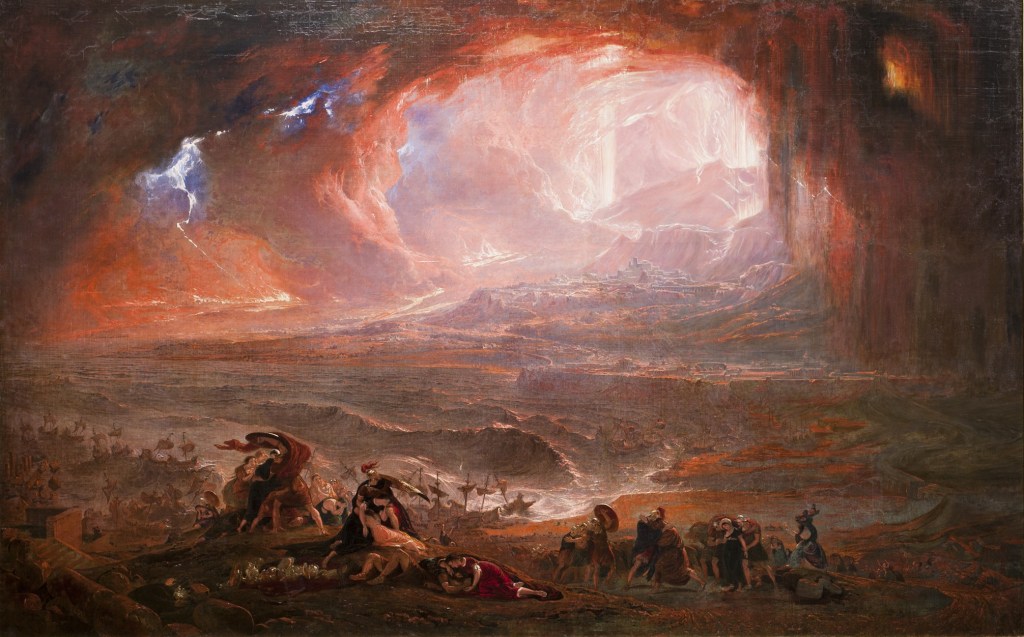
Presented by Gemini
Nestled along the scenic crescent of the Bay of Naples, the ancient Roman city of Pompeii operated as a premier playground for the empire’s ruling class and wealthy elite. If Rome was the political and administrative heart of the empire, Pompeii was its capital of pleasure—an ancient analogue to modern Las Vegas. It was a bustling resort hub characterized by opulent wealth, unchecked consumerism, and a social landscape dedicated to sensory gratification and transient luxury.
The urban design of Pompeii reflected its hedonistic reputation. Elite Romans constructed expansive vacation villas (domus) adorned with intricate, polychromatic floor mosaics and vivid frescoes depicting mythological tales of indulgence. The city’s economy thrived on the production and export of high-grade Campanian wine, luxury garum (fish sauce), and speculative real estate. At the center of Pompeian recreation were its massive public amenities: grand thermal baths where citizens mingled naked, an amphitheater hosting brutal gladiatorial spectacles, and a dense network of cauponae (taverns) and popinae (fast-food bars) lining the cobblestone streets.
Most emblematic of Pompeii’s “Sin City” environment was the Lupanar—a purpose-built, multi-room state brothel located near the city center. Its walls were explicitly decorated with erotic frescoes that served both as a visual menu for patrons and a testament to the city’s highly permissive sexual commerce. Phallic imagery was carved directly into the paving stones of the streets and displayed as protective talismans on shopfronts, interweaving commercial enterprise with fertility motifs and explicit carnal themes. It was a society operating at the pinnacle of material comfort and secular indulgence, insulated by wealth and structurally indifferent to the volatile geology of the fertile mountain looming over its northern horizon.
The Cataclysm of 79 AD: Vesuvius Unbound
The illusion of permanent luxury dissolved in 79 AD when Mount Vesuvius unleashed a cataclysmic eruption that fundamentally altered the geography of the Campanian plain. While historical accounts traditionally placed the event on August 24 based on surviving transcriptions of Pliny the Younger’s letters, modern multi-disciplinary archaeological and volcanological research has overturned this date. Analyses of autumnal agricultural remains, heavy woolen clothing worn by victims, and the orientation of stratospheric tephra dispersion—which aligns perfectly with autumnal high-altitude wind regimes—firmly establish that the eruption occurred later in the year, specifically in October (Paone, 2020; Rolandi et al., 2008).
The destruction of Pompeii occurred in two distinct, terrifying phases:
1. The Plinian Phase
The eruption commenced with a tremendous phreatomagmatic blast that shattered the volcanic conduit, generating a sustained convective column of gas and volcanic debris that penetrated the atmosphere. This column reached heights between 26 and 32 kilometers, injecting massive quantities of volcanic ash, sulfur dioxide, and phonolitic magma into the stratosphere (Barbante et al., 2013; Sigurdsson et al., 1982). For roughly 18 to 20 hours, a relentless rain of white and subsequently grey pumice (lapilli) fell upon Pompeii, accumulating a suffocating blanket up to 3 meters deep (Paone, 2020; Sigurdsson et al., 1982). While this initial phase allowed a significant portion of the population to flee the region, the sheer weight of the accumulating stone caused the widespread structural failure and collapse of building roofs, trapping and crushing those who sought shelter indoors (Paone, 2020; Sparice et al., 2024).
2. The Peléan Phase and Pyroclastic Currents
On the second day of the eruption, the overextended convective column suffered a series of total structural collapses. This triggered the Peléan phase, characterized by the generation of highly turbulent, ground-hugging pyroclastic currents (PDCs) and detached ash cloud surges that raced down the slopes of Vesuvius at hurricane speeds (Pensa et al., 2023; Sigurdsson et al., 1982). The initial dilute surges to strike the urban centers reached extreme temperatures ranging from 495°C to 555°C (Pensa et al., 2023). Exposure to this intense thermal energy caused instant death for anyone remaining above ground due to thermal shock, vaporizing soft tissues and freezing the victims’ skeletal remains in sudden, lifelike stances (Pensa et al., 2023). Subsequent, dense basal undercurrents progressively entombed the city under meters of hot volcanic ash, sealing the entire civilization in a concrete-like matrix (Pensa et al., 2023).
Archaeological Findings: Preserving the Moment of Ruin
Because Pompeii and its neighboring cities were entombed rapidly by successive layers of pyroclastic material, the site was protected from atmospheric weathering, decay, and human intervention for nearly seventeen centuries, leaving an unprecedented archaeological record (Sparice et al., 2024).
Among the most remarkable and informative archaeological findings are:
- Fiorelli’s Casts: In the 19th century, archaeologist Giuseppe Fiorelli recognized that the decomposed soft tissue of buried humans left distinct hollow voids within the hardened ash layers. By carefully injecting liquid plaster into these cavities prior to excavation, archaeologists captured the precise physical forms, facial expressions, and clothing folds of the victims in their final moments of agony, asphyxiation, or thermal shock.
- Organic and Epigraphic Preservation: The anaerobic environment created by the ash fall preserved everyday organic materials that are normally lost to history. Excavations have revealed charred, unbroken loaves of bread still inside bakeries, carbonized wooden furniture, and sophisticated luxury goods. Notably, advanced radiocarbon and chemical biomapping authenticated a glass bottle filled with approximately 0.7 liters of solidified olive oil from the Vesuvius sites, representing the oldest surviving bulk residue of olive oil in the world (Sacchi et al., 2020).
- Syn-Eruptive Seismicity: Recent multi-disciplinary investigations combining anthropology, volcanology, and structural engineering have revealed that the city’s destruction was not caused solely by falling ash and pyroclastic surges. Stratigraphic data demonstrates that the caldera-forming phase of Vesuvius was accompanied by violent, concurrent seismic shocks (Sparice et al., 2024). These earthquakes triggered severe masonry failures and structural collapses, inflicting fatal crush injuries on residents independent of the volcanic ash asphyxiation (Sparice et al., 2024).
- Deep Volcanic Chronostratigraphy: Modern geoarchaeological trenching dug below the 79 AD Roman street level has uncovered a complex geological framework consisting of at least eight late Pleistocene to Holocene tephra layers originating from historical eruptions of Somma-Vesuvius and the Campi Flegrei (Sparice et al., 2025). This reveals that Pompeii was built directly upon the debris of older, prehistoric natural catastrophes, highlighting a cyclic pattern of geological instability that its Roman inhabitants completely ignored (Sparice et al., 2025).
History and Destruction as a Quranic Commentary
When viewed through a theological lens, the history, luxury, and abrupt obliteration of Pompeii serve as an empirical commentary on the spiritual laws governing human civilizations. In contemporary discourse regarding revelation, all validated scientific and historical truths are recognized as a dynamic source of commentary (tafsir) on the Holy Quran. In the modern era, accelerated by artificial intelligence, humanity is experiencing exponential growth in its ability to synthesize physical reality, archaeological discovery, and divine text into a cohesive understanding of natural and moral laws.
Crucially, the tragedy of Pompeii emphasizes a universal moral theme shared across all major faiths and philosophical traditions: the intrinsic vulnerability of human arrogance and the transient nature of material indulgence. This analysis promotes interfaith tolerance and shared reflection, presenting the ruined city not as an isolated sectarian target, but as an enduring, cross-cultural sign (ayah) for all of humanity to observe and ponder.
The Quran repeatedly commands human beings to physically explore the earth to analyze the remains of past civilizations. Three specific verses directly frame this empirical exercise:
Verse 1: Surah Al-An’am (6:11)
Arabic Text
قُلْ سِيرُوا فِي الْأَرْضِ ثُمَّ انظُرُوا كَيْفَ كَانَ عَاقِبَةُ الْمُكَذِّبِينَ
Contextual Exposition
Surah Al-An’am is a Meccan chapter revealed during a period of intense tribulation and social friction. The powerful elites of the Quraish tribe routinely mocked the Prophet Muhammad, dismissing his warnings of ultimate moral accountability and demanding immediate, physical miracles—such as an angel descending from heaven or a physical book falling from the sky—to prove his legitimacy. In response, Allah instructs the Prophet to direct their attention away from superficial spectacles and toward the empirical evidence written into the landscape of the earth. This verse serves as a divine mandate for historical exploration and archaeology. It challenges the wealthy deniers to step outside their comfort zones, travel through the geography of the world, and witness the physical, skeletal remains of societies that once possessed superior material strength but were utterly erased due to their moral complacency and rejection of truth.
Eight English Translations
- Sahih International: Say, “Travel through the land; then observe how was the end of the deniers.”
- Abdullah Yusuf Ali: Say: “Travel through the earth and see what was the end of those who rejected Truth.”
- Marmaduke Pickthall: Say: Travel in the land, and see the nature of the consequence for the rejecters!
- M.H. Shakir: Say: Travel in the land, then see what was the end of the rejecters.
- Muhammad Asad: Say: “Go all over the earth, and behold what was the end of those who gave the lie to the truth!”
- M.A.S. Abdel Haleem: Say, ‘Travel through the land and see what was the end of those who rejected the truth.’
- Dr. Mustafa Khattab (The Clear Quran): Say, ˹O Prophet,˺ “Travel throughout the land and see what was the end of the deniers.”
- Arthur John Arberry: Say: ‘Journey in the land, then behold how was the end of those that cried lies.’
Verse 2: Surah Ali ‘Imran (3:137)
Arabic Text
قَدْ خَلَتْ مِن قَبْلِكُمْ سُنَنٌ فَسِيرُوا فِي الْأَرْضِ فَانظُرُوا كَيْفَ كَانَ عَاقِبَةُ الْمُكَذِّبِينَ
Contextual Exposition
In contrast to the Meccan verses, Surah Ali ‘Imran is a Medinan chapter, and verse 137 was revealed in the painful aftermath of the Battle of Uhud. The early Muslim community had just suffered a severe strategic defeat, resulting in heavy casualties, physical injuries to the Prophet, and profound psychological distress. To console the believers and broaden their perspective, Allah introduces the profound concept of Sunan—the fixed, immutable, and universal laws that govern history, human societies, and the natural world. This verse explains that historical events are not random occurrences; rather, they operate under divine cosmic laws where societies rise and fall based on their ethical foundations. By telling the distressed believers to travel the earth and examine the ruined monuments of past deniers, the text reorients their minds toward long-term historical realities, proving that while material power may experience temporary fluctuations, the ultimate consequence (‘aqibah) of corruption and arrogance is structural collapse.
Eight English Translations
- Sahih International: Many decrees have passed before you; so travel through the land and observe how was the end of the deniers.
- Abdullah Yusuf Ali: Many were the Ways of Life that have passed away before you: travel through the earth, and see what was the end of those who rejected Truth.
- Marmaduke Pickthall: Systems have passed away before you. Do but travel in the land and see the nature of the consequence for those who did deny (the messengers).
- M.H. Shakir: Already have examples been passed before you, therefore travel in the land and see what was the end of the rejecters.
- Muhammad Asad: [Many] ways of life have passed away before your time. Go, then, all over the earth and behold what was the end of those who gave the lie to the truth!
- M.A.S. Abdel Haleem: Ways of life have passed before you, so travel through the land and see what was the end of those who rejected the truth.
- Dr. Mustafa Khattab (The Clear Quran): Similar situations have passed before your time, so travel throughout the land and see what was the end of the deniers.
- Arthur John Arberry: Ways have passed before you; journey in the land, and behold how was the end of those that cried lies.
Verse 3: Surah An-Naml (27:69)
Arabic Text
قُلْ سِيرُوا فِي الْأَرْضِ فَانظُرُوا كَيْفَ كَانَ عَاقِبَةُ الْمُجْرِمِينَ
Contextual Exposition
Surah An-Naml is a Meccan chapter focused heavily on the themes of divine signs in nature, the histories of past prophets, and the inevitability of the Day of Judgment. Immediately preceding this verse, the text highlights the absolute skepticism of the disbelievers regarding bodily resurrection: they scoffed, saying, “What! When we are dust and our forefathers, shall we really be brought forth?” They viewed accountability as a fairytale. In response, this verse shifts the argument from theoretical metaphysics to immediate, observable physical reality. Instead of using the word al-mukadhibeen (the deniers), this verse uses al-mujrimeen (the criminals, wicked, or culprits). It links intellectual denial directly to moral and social criminality—such as exploitation, systemic injustice, and uncontrolled corruption. The Prophet is told to command them to look at the skeletal remains of past cities as physical proof that a nation’s crimes eventually catch up to it within the physical timeline of this world, long before the arrival of the next.
Eight English Translations
- Sahih International: Say, “Travel through the land and observe how was the end of the criminals.”
- Abdullah Yusuf Ali: Say: “Travel through the earth and see what was the end of those who were guilty (of sin).”
- Marmaduke Pickthall: Say (unto them, O Muhammad): Travel in the land and see the nature of the consequence for the guilty!
- M.H. Shakir: Say: Travel in the earth, then see what was the end of the guilty.
- Muhammad Asad: Say: “Go all over the earth and behold what was the end of those who were lost in sin!”
- M.A.S. Abdel Haleem: Say, ‘Travel through the land and see what was the end of the guilty.’
- Dr. Mustafa Khattab (The Clear Quran): Say, “Travel throughout the land and see what was the end of the wicked.”
- Abdul Majid Daryabadi: Say thou: travel through the earth and see what manner of end was that of the culprits.
Synthesis: Pompeii as a Living “Ayah” (Sign)
The modern archaeological excavation of Pompeii offers an extraordinary, literal fulfillment of these Quranic injunctions. When the text commands humanity to travel and “see what was the end” of decadent, guilty societies, Pompeii stands as a uniquely preserved historical laboratory.
In most historical collapses, a civilization decays slowly over centuries; its buildings are dismantled, its artifacts are scattered, and its people disperse, leaving only fragmented clues for future generations. Pompeii, however, was caught in a terrifying geological snapshot. Because it was sealed instantaneously by 500°C pyroclastic surges and co-seismic wall collapses, the city did not merely die—it was frozen in its exact state of systemic excess (Pensa et al., 2023; Sparice et al., 2024).
When modern visitors travel to Pompeii today, they walk down streets where the graffiti of political vanity, the tavern tables of gamblers, and the explicit murals of the brothels are perfectly visible. More strikingly, Fiorelli’s plaster casts present the human form in its rawest state of vulnerability: individuals huddled over their gold coins, families holding one another in a futile attempt to ward off the toxic ash, and wealthy citizens trapped beneath the very roofs that symbolized their luxury.
Science and geology do not contradict this spiritual message; rather, they provide the empirical commentary that explains it. The realization that Pompeii was built on ancient, prehistoric volcanic tephra layers demonstrates a recurring pattern of human ignorance: societies repeatedly choose short-term material comfort in high-risk zones, completely blind to the long-term historical and natural laws (sunan) that govern their environment (Sparice et al., 2025). The preservation of organic artifacts, like 2,000-year-old olive oil, underscores the vulnerability of human achievements (Sacchi et al., 2020). Ultimately, the buried city of Pompeii stands as a powerful, shared cross-cultural reminder that material luxury, unchecked indulgence, and structural arrogance can be permanently erased in a single afternoon by the universal laws embedded within our planet.
References
Barbante, C., Kehrwald, N. M., Marianelli, P., Vinther, B. M., Steffensen, J. P., Cozzi, G., Hammer, C. U., Clausen, H. B., & Siggaard-Andersen, M.-L. (2013). Greenland ice core evidence of the 79 AD Vesuvius eruption. Climate of the Past, 9(3), 1221–1232. https://doi.org/10.5194/cp-9-1221-2013 Cited by: 32
Camardo, D. (2013). Herculaneum from the AD 79 eruption to the medieval period: analysis of the documentary, iconographic and archaeological sources, with new data on the beginning of exploration at the ancient town. Papers of the British School at Rome, 81, 303–340. https://doi.org/10.1017/s0068246213000123 Cited by: 26
Paone, A. (2020). The Somma-Vesuvius Activity with a Focus to the AD 79 Eruption: Hazard and Risk. In Forecasting Volcanic Eruptions. IntechOpen. https://doi.org/10.5772/intechopen.89989 Cited by: 0
Pensa, A., Giordano, G., Corrado, S., & Petrone, P. P. (2023). A new hazard scenario at Vesuvius: deadly thermal impact of detached ash cloud surges in 79CE at Herculaneum. Scientific Reports, 13(1). https://doi.org/10.1038/s41598-023-32623-3 Cited by: 11
Rolandi, G., Paone, A., Di Lascio, M., & Stefani, G. (2008). The 79 AD eruption of Somma: The relationship between the date of the eruption and the southeast tephra dispersion. Journal of Volcanology and Geothermal Research, 169(1-2), 87–98. https://doi.org/10.1016/j.jvolgeores.2007.08.020 Cited by: 77
Sacchi, R., Cutignano, A., Picariello, G., Paduano, A., Genovese, A., Siano, F., Nuzzo, G., Caira, S., Lubritto, C., Ricci, P., D’Auria, A., Di Pasquale, G., Motta, A., & Addeo, F. (2020). Olive oil from the 79 a.d. Vesuvius eruption stored at the Naples National Archaeological Museum (Italy). npj Science of Food, 4(1). https://doi.org/10.1038/s41538-020-00077-w Cited by: 13
Sigurdsson, H., Cashdollar, S., & Sparks, S. R. J. (1982). The Eruption of Vesuvius in A.D. 79: Reconstruction from Historical and Volcanological Evidence. American Journal of Archaeology, 86(1), 39–51. https://doi.org/10.2307/504292 Cited by: 300
Sparice, D., Amoretti, V., Galadini, F., Di Vito, M. A., Terracciano, A., Scarpati, G., & Zuchtriegel, G. (2024). A novel view of the destruction of Pompeii during the 79 CE eruption of Vesuvius (Italy): syn-eruptive earthquakes as an additional cause of building collapse and deaths. Frontiers in Earth Science, 12. https://doi.org/10.3389/feart.2024.1386960 Cited by: 5
Sparice, D., Di Vito, M. A., Amato, V., Amoretti, V., Russo, A., Talamo, P., & Zuchtriegel, G. (2025). Unveiling the Volcanic History of Ancient Pompeii (Italy): New Insights from the Late Pleistocene to Holocene (Pre-79 CE) Stratigraphy. Quaternary, 8(1), 4. https://doi.org/10.3390/quat8010004 Cited by: 5




Leave a Reply