
Presented by Claude
Abstract
This essay traces the Arabic-Islamic concept of bidʿah (بدعة) from its lexical roots to its contested life in jurisprudence, sectarian polemic, and lived Muslim history. Linguistically, the triliteral root ب-د-ع (b-d-ʿ) denotes the origination of something wholly without precedent; from it spring the divine attribute al-Badīʿ (“Originator,” Qur. 2:117; 6:101), the term bidʿah (“innovation”), and verbal nouns such as ibtidāʿ and active participles such as mubtadiʿ. The Qurʾān itself uses derivatives of the root in four places, in tones ranging from positive (divine creation), through neutral (Q 46:9, the Prophet denying he is a “novelty” among messengers), to critical (Q 57:27, on monasticism “they invented”). Around the famous prophetic hadith kullu bidʿatin ḍalālah (“every innovation is misguidance”), classical jurists — al-Shāfiʿī, al-ʿIzz ibn ʿAbd al-Salām, al-Nawawī, Ibn Ḥajar al-ʿAsqalānī — articulated a dual or fivefold taxonomy distinguishing bidʿah ḥasanah (good innovation) from bidʿah sayyiʾah / ḍalālah (misguided innovation), while al-Shāṭibī and Ibn Taymiyya pushed in the opposite direction, treating any addition to worship as blameworthy. The essay argues that, sociologically, the label “bidʿah” has functioned at least as often as a polemical weapon — deployed selectively between Sunnī and Shīʿī, Salafī and Ṣūfī, Ashʿarī and Ḥanbalī, traditionist and rationalist — as it has as a neutral juristic category. To illustrate, it surveys a series of historical innovations that were once resisted but are now broadly normalized: the codification of the Qurʾān under Abū Bakr and ʿUthmān; the diacritical and vocalic marking of the muṣḥaf by Abū al-Aswad al-Duʾalī, Naṣr ibn ʿĀṣim, and al-Khalīl ibn Aḥmad; ʿUmar’s congregational Tarāwīḥ (“an excellent innovation!”); ʿUthmān’s second adhān for Jumuʿah; the codification of grammar, uṣūl, kalām, and Sufism; minarets, domes, and miḥrābs; coffee; printing; loudspeakers. The essay closes with a thematic epilogue proposing Qurʾān 13:17 — the parable in which the flood-foam (zabad) is cast off as scum while what benefits people remains in the earth — as the proper criterion: time, benefit, and endurance, rather than sectarian familiarity, ought to judge what is genuine innovation and what is mere froth.

I. The Lexical Foundation: The Root ب-د-ع
The Arabic root ب-د-ع (b-d-ʿ), common to a dense family of Qurʾānic and post-Qurʾānic derivatives, denotes “to originate, to invent, to bring forth a thing without prior model.” Classical lexicographers (Ibn Manẓūr’s Lisān al-ʿArab; al-Fīrūzābādī’s Qāmūs; al-Rāghib al-Iṣfahānī’s Mufradāt) gloss the verb badaʿa / abdaʿa as the act of creating something lā ʿalā mithāl sābiq — not according to a previous pattern. Pre-Islamic Arabic preserved usages such as bidʿ al-ṭarīq (“pioneering a path”) that were neutral or even laudatory; in classical Arabic literary criticism, bidʿah could mark outstanding poetic invention.
The principal derivatives are:
- Badīʿ (بديع) — an intensive form meaning “originator” or “wondrously unprecedented.” Used in Q 2:117 and 6:101 of God Himself, it is enumerated among the divine names (asmāʾ al-ḥusnā) as al-Badīʿ: “the One whose creating has no precedent, no equal, and no parallel.”
- Bidʿ (بِدْع) — a noun form designating “a new thing, the first of its kind”; used of the Prophet in Q 46:9.
- Bidʿah (بدعة) — the verbal noun denoting “innovation, novelty”; in early juristic literature it acquires the technical sense of a religious novelty.
- Ibtidāʿ (ابتداع) — the act of inventing or originating; in Q 57:27 it carries a critical edge.
- Mubtadiʿ (مبتدع) — the active participle, “innovator,” often pejoratively applied to heretics.
- Mubdiʿ (مبدع) — another active participle, “the one who originates,” used in praise of God or human creativity.
The crucial point — frequently lost in modern polemics — is that the lexical core is morally neutral. As the Minhaj-ul-Qurʾān entry observes, “in its literal sense, the word Bidʿah has no negative connotations; it plainly refers to anything that comes into existence that is novel or not previously known.” The negative valence is a juristic, not lexical, accretion.
II. The Qurʾānic Occurrences
The root ب-د-ع appears in four Qurʾānic verses, with distinct semantic registers.
1. Q 2:117 (al-Baqarah) — Positive: God as Originator
بَدِيعُ السَّمَاوَاتِ وَالْأَرْضِ ۖ وَإِذَا قَضَىٰ أَمْرًا فَإِنَّمَا يَقُولُ لَهُ كُن فَيَكُونُ Badīʿu s-samāwāti wa-l-arḍ, wa idhā qaḍā amran fa-innamā yaqūlu lahu kun fa-yakūn. “Originator of the heavens and the earth. When He decrees a matter, He only says to it, ‘Be,’ and it is.” (Sahih International)
Ibn Kathīr glosses Badīʿ here as “He who created [the heavens and the earth] when nothing resembling them existed,” citing Mujāhid and al-Suddī, and immediately notes that “all new matters are called bidʿah.” This early exegetical move already entangles the lexical and the technical: the Quranic badīʿ belongs to God (positive, even sublime), but the human counterpart, bidʿah, becomes morally freighted.
2. Q 6:101 (al-Anʿām) — Positive: God as Originator, refuting divine progeny
بَدِيعُ السَّمَاوَاتِ وَالْأَرْضِ ۖ أَنَّىٰ يَكُونُ لَهُ وَلَدٌ وَلَمْ تَكُن لَّهُ صَاحِبَةٌ “Originator of the heavens and the earth. How could He have a child while He does not have a companion?”
The verse polemicizes against attributing offspring to God: only One who originates ex nihilo requires no consort. The divine badāʿa is here a theological proof for tawḥīd.
3. Q 46:9 (al-Aḥqāf) — Neutral / self-descriptive
قُلْ مَا كُنتُ بِدْعًا مِّنَ الرُّسُلِ Qul mā kuntu bidʿan min ar-rusul… “Say, ‘I am not something new among the messengers, nor do I know what will be done with me or with you. I only follow that which is revealed to me…’”
Here bidʿ means a “novelty” or “unprecedented thing.” The Prophet Muḥammad is instructed to deny that he constitutes a bidʿ among prophets — that is, his mission is not without precedent; many messengers preceded him. Mawdūdī’s commentary explains: “My being appointed as a Messenger is not a novel event of its kind in the world… Many Messengers have come before me.” The usage is morally neutral; the negation is rhetorical, addressing Meccan demands that a “true” prophet should be utterly unprecedented in nature, accompanied by miracles or angels.
4. Q 57:27 (al-Ḥadīd) — Critical: invented monasticism
وَرَهْبَانِيَّةً ابْتَدَعُوهَا مَا كَتَبْنَاهَا عَلَيْهِمْ إِلَّا ابْتِغَاءَ رِضْوَانِ اللَّهِ فَمَا رَعَوْهَا حَقَّ رِعَايَتِهَا Wa rahbāniyyatan ibtadaʿūhā mā katabnāhā ʿalayhim illā ibtighāʾa riḍwāni Llāhi fa-mā raʿawhā ḥaqqa riʿāyatihā. “But monasticism — which they invented; We did not prescribe it for them — only seeking Allah’s pleasure. Yet they did not observe it with due observance.” The Academy for Learning Islam
This is the only Qurʾānic occurrence in which an ibtidāʿ is a human act, and it has long divided exegetes. Some — Mufti Shafīʿ in Maʿārif al-Qurʾān, and parts of the Mālikī tradition — emphasize that rahbāniyyah sits grammatically inside a list of praiseworthy qualities (raʾfah, raḥmah), so the verse criticizes not the original innovation but the failure to keep it. Al-Qurṭubī, by contrast, treats rahbāniyyah as a separate clause and reads the verse as condemning the innovation itself. The Prophet’s reported saying “lā rahbāniyyata fī l-Islām” (“there is no monasticism in Islam,” Musnad Aḥmad) is invoked on the second view. Crucially, the verse demonstrates that the Qurʾān does not condemn innovation as such: it condemns innovations that are misobserved, or that displace divine prescription. Quran.comQuranX
Across these four loci a clear pattern emerges: when the root b-d-ʿ describes God, it is sublime; when it describes the Prophet, it is denied in a rhetorical sense; when it describes a human-invented religious practice (Q 57:27), it is admonitory but not unequivocally condemnatory.
III. The Technical Concept: Bidʿah as Religious Innovation
The technical sense — bidʿah as “innovation in religion” — crystallized in the early hadith corpus and matured in subsequent fiqh and uṣūl. The locus classicus is a hadith narrated by ʿĀʾishah and by Jābir, recorded in Ṣaḥīḥ Muslim and elsewhere: “Whoever introduces into this affair of ours that which is not from it, it is rejected” (man aḥdatha fī amrinā hādhā mā laysa minhu fa-huwa radd); and the Friday-sermon formula attributed to the Prophet: “…fa-inna khayra l-ḥadīthi kitābu Llāh, wa khayra l-hadyi hadyu Muḥammad, wa sharra l-umūri muḥdathātuhā, wa kullu bidʿatin ḍalālah” — “the worst of affairs are their innovations, and every innovation is misguidance.”
Yet a counter-current is equally early. ʿUmar ibn al-Khaṭṭāb, on instituting congregational Tarāwīḥ in Ramaḍān behind a single imam (Ubayy ibn Kaʿb), exclaimed: “Niʿmati l-bidʿatu hādhihi” — “What an excellent innovation this is!” (Ṣaḥīḥ al-Bukhārī 2010). The companion’s use of the same noun in praise of his own act, in the lifetime of the first generation, forced jurists to grapple with the seeming contradiction.
The dual classification (al-Shāfiʿī). Imam al-Shāfiʿī’s response, transmitted by al-Bayhaqī in Manāqib al-Shāfiʿī and by Ibn ʿAsākir, is foundational: “al-muḥdathātu min al-umūri ḍarbān: aḥaduhumā mā uḥditha yukhālifu kitāban aw sunnatan aw atharan aw ijmāʿan fa-hādhihi l-bidʿatu l-ḍalālah, wa al-thāniyatu mā uḥditha min al-khayri lā khilāfa fīhi li-wāḥidin min hādhihi wa hādhihi muḥdathatun ghayru madhmūmah” — “Innovations are of two kinds: that which contradicts the Qurʾān, Sunnah, athar, or ijmāʿ — that is misguided innovation; and that which is of the good and contradicts none of these — that is a praiseworthy novelty.” A separate reported formulation from al-Shāfiʿī divides bidʿah into maḥmūdah (praiseworthy) and madhmūmah (blameworthy).
The fivefold classification (al-ʿIzz ibn ʿAbd al-Salām). The 7th/13th-century Damascene Shāfiʿī jurist al-ʿIzz ibn ʿAbd al-Salām (d. 660/1262), in his Qawāʿid al-Aḥkām, generalized this further. Innovations, he argued, are evaluated by their underlying maṣlaḥah and fall under the five sharʿī rulings:
- wājib — obligatory innovations: e.g., learning naḥw (grammar) to understand the speech of God and His Messenger; the composition of uṣūl al-fiqh; the discipline of al-jarḥ wa-l-taʿdīl (narrator-criticism);
- maḥrūm/ḥarām — prohibited innovations: e.g., the doctrines of the Jabriyyah, Qadariyyah, Murjiʾah, Mujassimah;
- mandūb — recommended innovations: e.g., the building of schools (madāris) and ribāṭs, congregational Tarāwīḥ, every act of good unknown to the early generations;
- makrūh — disliked innovations: e.g., excessive ornamentation of mosques;
- mubāḥ — permissible innovations: e.g., the use of sieves for flour, varied foods, garments, and houses.
Imām al-Nawawī (d. 676/1277) endorsed al-ʿIzz’s fivefold scheme in his commentary on Ṣaḥīḥ Muslim; Ibn Ḥajar al-ʿAsqalānī (d. 852/1449) reproduced and approved it in Fatḥ al-Bārī, glossing “kullu bidʿatin ḍalālah” as referring specifically to “that which has no evidence either specifically or generally” — i.e., not to every novelty without exception, but to those uncovered by any scriptural principle. The Mālikī Ibn Ḥajar al-Haytamī (d. 974/1567) and the Ḥanafī al-Munāwī (d. 1031/1622) likewise upheld the fivefold scheme.
The restrictive view (al-Shāṭibī, Ibn Taymiyya, contemporary Salafism). Pushing the opposite way, the Mālikī Andalusian al-Shāṭibī (d. 790/1388), in al-Iʿtiṣām, restricts bidʿah in its technical sense to acts of worship not founded in revealed evidence, and argues that al-ʿIzz’s fivefold scheme conflates the lughawī (linguistic) and sharʿī (technical) senses; sharʿī bidʿah, he contends, can never be wājib, mandūb, or mubāḥ — only blameworthy. Ibn Taymiyya (d. 728/1328), and his student Ibn al-Qayyim, take a parallel line in Iqtiḍāʾ al-Ṣirāṭ al-Mustaqīm: the so-called “good” innovations of the early caliphs were in fact rooted in the Prophet’s Sunnah and so are not, properly, bidʿah. Contemporary Salafī scholarship (Ibn Bāz, al-Albānī, Ibn al-ʿUthaymīn) follows this line, often citing the hadith “every innovation is misguidance” as definitionally exclusive of “good” novelties.
The tension between these two camps is not resolvable by appeal to the texts alone; it is, at root, a hermeneutical disagreement over how to reconcile the kullu bidʿatin ḍalālah hadith with ʿUmar’s niʿmati l-bidʿah. The dominant Sunnī jurisprudential mainstream — Shāfiʿīs, most Ḥanafīs, most Mālikīs, the Ashʿarī-Māturīdī traditions — has historically followed the al-Shāfiʿī / al-ʿIzz / al-Nawawī / Ibn Ḥajar line. Salafī and proto-Salafī currents have followed al-Shāṭibī and Ibn Taymiyya.
IV. Selective Application: Bidʿah as Polemical Weapon
The juristic dispute, however, is only half the story. The accusation of bidʿah has, throughout Islamic history, served as a discursive weapon, regularly deployed against rival sects and movements while being withheld from one’s own innovations.
- Sunnī ↔ Shīʿī. Sunnī polemicists denounce Shīʿī ritual innovations — the third clause of the adhān (ashhadu anna ʿAlīyyan walīyu Llāh); commemorations of ʿĀshūrāʾ with self-flagellation; mourning gatherings for the imams — as bidʿah. Shīʿī polemicists, conversely, label ʿUmar’s congregational Tarāwīḥ and ʿUthmān’s second adhān as Sunnī innovations: classical Shīʿī sources in Wasāʾil al-Shīʿah expressly cite ʿUmar’s “what an excellent bidʿah” as evidence of caliphal departure from the Prophet’s Sunnah.
- Ashʿarī ↔ Ḥanbalī. The Ḥanbalī traditionists (aṣḥāb al-ḥadīth) of 3rd/9th-century Baghdad branded kalām as bidʿah; the Ashʿarīs counter-branded literalist anthropomorphism (tajsīm, tashbīh) as bidʿah. Ibn Taymiyya was put on trial more than once for his Ashʿarī-impugning theological positions.
- Salafī ↔ Ṣūfī. Modern Salafī polemics target Ṣūfī practices — mawlid, visiting graves, dhikr circles, tawassul, use of the misbaḥa, devotional poetry such as the Burdah of al-Būṣīrī — as classic bidʿah. Ṣūfīs respond by citing the al-Shāfiʿī / al-Nawawī classification and by drawing attention to Salafī innovations of method (printing fatwas via social media; institutional structures such as the modern Saudi Permanent Committee for Iftāʾ; novel concepts such as tawḥīd al-ḥākimiyyah).
- Traditionists ↔ Rationalists. The Muʿtazila were anathematized by the ahl al-ḥadīth as innovators (ahl al-bidʿah), while themselves dismissing the literalists as crude ḥashwiyyah. The same dynamic re-emerges, in different vocabulary, between contemporary reformist/modernist trends (Fazlur Rahman; Muhammad ʿAbduh; Muhammad Shahrur) and their neo-traditionalist critics.
The historian Bernard Haykel, writing on Salafism, and the anthropologist Talal Asad have both noted how a tradition’s self-innovations tend to be invisibilized — reframed as restoration, return, or iḥyāʾ (revival) — while the other‘s innovations are tagged with the marked term bidʿah. The most rigorous Sunnī jurists were aware of this asymmetry: al-Nawawī, Ibn Ḥajar, and al-Suyūṭī all wrote, in part, to defuse the accusation of bidʿah against practices that pious generations of Muslims found beneficial.
V. Historical Examples: Innovations Once Condemned, Now Normalized
A long catalogue of practices and institutions that today constitute the very furniture of Muslim life were once viewed by some — and in several cases by very weighty authorities — as objectionable innovations.
1. The codification of the Qurʾān. When ʿUmar urged Abū Bakr after the Battle of Yamāmah (12 AH/633 CE) to compile the scattered Qurʾān into a single muṣḥaf, Abū Bakr famously replied (Ṣaḥīḥ al-Bukhārī, Faḍāʾil al-Qurʾān): “How can I do a thing that the Messenger of Allah did not do?” (kayfa afʿalu shayʾan lam yafʿalhu Rasūlu Llāh?). ʿUmar pressed him; Abū Bakr’s heart was “opened” by God to the wisdom of the act; and the task was assigned to Zayd ibn Thābit, who, as Imām Layth ibn Saʿd (d. 175 AH) records, “would not write a single verse except with two witnesses.” Some two decades later (c. 25 AH/646 CE) the third caliph ʿUthmān, alarmed by reports from Ḥudhayfah ibn al-Yamān of divergent recitations in Iraq and Sham, commissioned a standardization committee (Zayd ibn Thābit, ʿAbd Allāh ibn al-Zubayr, Saʿīd ibn al-ʿĀṣ, ʿAbd al-Raḥmān ibn al-Ḥārith), produced canonical codices for the major garrison cities, and ordered competing manuscripts destroyed. Ibn Masʿūd in Kūfa initially objected — preferring his own codex — and his protest is preserved in Ibn Saʿd’s Ṭabaqāt. Today, no Sunnī or Shīʿī Muslim disputes the propriety of the codification; it is the bedrock of the muṣḥaf in every hand. Yaqeen Institute for Islamic Research
2. Diacritical marks (iʿjām / naqṭ) and vowels (tashkīl / ḥarakāt). The bare Hijazi script of the early muṣḥaf was rasm only — no consonantal dots, no vowel marks. As Islam spread beyond Arabia, mispronunciation threatened meaning. In Baṣrah, under the governorship of Ziyād ibn Abīhi (d. 53/673), the grammarian-companion Abū al-Aswad al-Duʾalī (d. 69/688) — instructed by Ziyād after he heard a man misread rasūluhu (nominative) as rasūlihi (genitive) in Q 9:3, reversing the verse’s meaning — introduced a system of large coloured dots above, below, and beside letters to indicate the three short vowels (fatḥa, kasra, ḍamma) and the sukūn. Later, under al-Ḥajjāj ibn Yūsuf (governor of Iraq, d. 95/714), Naṣr ibn ʿĀṣim al-Laythī and Yaḥyā ibn Yaʿmar introduced consonantal dots (iʿjām) to distinguish ambiguous letter-shapes (b/t/th, j/ḥ/kh, etc.). Finally, the great Baṣran linguist al-Khalīl ibn Aḥmad al-Farāhīdī (d. 175/791) reformed Abū al-Aswad’s coloured-dot system into the modern shapes of fatḥa (small alif), ḍamma (small wāw), and kasra (small yāʾ), and introduced the shaddah, hamzah, and madda. Each step was resisted by a current of pious opinion as a bidʿah upon the muṣḥaf; each step has long since been universally adopted. Islamiccenter + 2
3. Congregational Tarāwīḥ. Discussed above. The Prophet led the night prayer in Ramaḍān a few times in congregation, then withdrew for fear it would become obligatory (akhshā an tufraḍa ʿalaykum). In the first year(s) of ʿUmar’s caliphate (c. 14 AH), seeing the people scattered in the mosque each praying separately, ʿUmar instituted a single congregation under Ubayy ibn Kaʿb and remarked, “Niʿmati l-bidʿatu hādhihi.” Some — chiefly Shīʿī commentators — read this as evidence that ʿUmar knew he had innovated; the Sunnī mainstream interprets the term in its linguistic sense, since the practice itself had a foundation in the Prophet’s own intermittent congregation. Either way, it is today universally Sunnī. Sunnah.com
4. The first (second) adhān of Jumuʿah. Reported in al-Bukhārī (Friday-Prayer book, hadith 916) on the authority of al-Sāʾib ibn Yazīd: in the time of the Prophet, Abū Bakr, and ʿUmar, the Friday adhān was given once — after the imam ascended the minbar. When the population of Medina swelled under ʿUthmān, he ordered an additional adhān to be given earlier from al-Zawrāʾ (an elevated platform in the market) to alert distant worshippers. Ibn Ḥajar comments in Fatḥ al-Bārī (2/394): “It is apparent that at that time people in all countries followed the practice of ʿUthmān, since he was a caliph whose orders were obeyed… Everything that was not practiced at the time of the Prophet is considered bidʿah, some of which are good and others are not.” The verse-quotation is itself a vignette in the classical mainstream’s pragmatic accommodation of post-prophetic novelty. IIUM + 3
5. The sciences of hadith (muṣṭalaḥ al-ḥadīth). Isnad-criticism, the disciplines of jarḥ wa-taʿdīl, ʿilal, the technical vocabulary of ṣaḥīḥ, ḥasan, ḍaʿīf, mawḍūʿ — none of these exist in the Prophet’s time. They are the work of 2nd–4th/8th–10th century scholars (al-Bukhārī d. 256, Muslim d. 261, Ibn Maʿīn d. 233, Aḥmad ibn Ḥanbal d. 241, al-Tirmidhī d. 279, Ibn Mājah d. 273, al-Dāraquṭnī d. 385, Ibn al-Ṣalāḥ d. 643). Without them, no Salafī today could authenticate a single hadith. Al-ʿIzz ibn ʿAbd al-Salām explicitly classifies al-jarḥ wa-l-taʿdīl as an obligatory bidʿah.
6. Codification of Arabic grammar (naḥw). Tradition attributes its founding to Abū al-Aswad al-Duʾalī under the instruction of ʿAlī ibn Abī Ṭālib, with the Baṣran (al-Khalīl, Sībawayh) and Kūfan (al-Kisāʾī, al-Farrāʾ) schools maturing the discipline in the 2nd/8th century. Again, al-ʿIzz lists naḥw as an obligatory innovation, since without it the Qurʾān cannot be properly understood by non-Arabs.
7. The schools of jurisprudence (madhāhib) and uṣūl al-fiqh. Neither the Ḥanafī, Mālikī, Shāfiʿī, nor Ḥanbalī school existed in the Prophet’s time. Their codification (and the parallel codification of Jaʿfarī, Zaydī, and Ibāḍī jurisprudence among Shīʿī and Khārijī communities) was a post-prophetic development. The discipline of uṣūl al-fiqh, foundational to all Islamic legal reasoning, is attributed in its first systematic form to al-Shāfiʿī’s Risālah (c. 199/815). The very tools by which modern Muslims declare anything ḥalāl or ḥarām are themselves innovations.
8. Minarets, domes, miḥrābs. The Prophet’s mosque in Medina was a roofless palm-trunk and mud-brick enclosure. The first minarets — towers from which the adhān could be called — appeared under the Umayyads: K. A. C. Creswell identifies the four ṣawāmiʿ erected on the Mosque of ʿAmr ibn al-ʿĀṣ in Fusṭāṭ in 53/673 by the governor Maslamah ibn Mukhallad as the earliest. The Caliph al-Walīd added four corner-towers to the Prophet’s Mosque c. 88–91/707–710 in his refurbishment. The miḥrāb niche is also attributed to the same al-Walīd refurbishment. Monumental domes — the Dome of the Rock (72/691), the dome over the prayer hall of the Umayyad Mosque (96/715) — are post-prophetic adoptions of late-antique Christian-Byzantine architectural vocabulary. Strict literalists periodically condemned domes and elaborate minarets as un-prophetic; the modern Muslim world is unimaginable without them. World History EncyclopediaWikipedia
9. Verse numbering, juzʾ division, surah headings. The Qurʾān as we hold it today contains numerous orthographic and editorial conventions absent from the ʿUthmānic codex: numerical demarcation of verses, division into 30 ajzāʾ (developed in the early centuries for monthly recitation cycles), the marking of aḥzāb and rukūʿāt, the addition of surah titles, the basmalah as a numbered or unnumbered opening — all are products of later editorial labor, much of it Mamluk and Ottoman. None of it was done by the Prophet.
10. Mawlid al-Nabī. The celebration of the Prophet’s birthday (12 Rabīʿ al-Awwal in the Sunnī tradition, 17 Rabīʿ in the Shīʿī) is unattested in the first three centuries of Islam. Public celebrations are first documented under the Shīʿī Fāṭimids of Cairo (4th/10th century), and a major Sunnī celebration is recorded at the court of the Atabeg Muẓaffar al-Dīn Kökböri of Irbil in 604/1207, attended by Ibn Khallikān and described in his Wafayāt al-Aʿyān. Subsequent legal treatises arrayed on both sides include:
- In defense: Ibn Ḥajar al-ʿAsqalānī (in a fatwa cited by al-Suyūṭī); al-Suyūṭī’s Ḥusn al-Maqṣid fī ʿAmal al-Mawlid (where he writes that “the celebration of Mawlid is a good thing, and it encourages people to express their love and devotion for the Prophet Muḥammad”); al-Sakhāwī; Ibn al-Ḥājj al-ʿAbdarī (with reservations on attendant excesses); Ibn Kathīr’s late-life Mawlid Rasūl Allāh, which describes “the Night of the Prophet’s birth” as “a magnificent, noble, blessed and holy night.” Quran4Ever + 3
- Against: Ibn Taymiyya in Iqtiḍāʾ al-Ṣirāṭ al-Mustaqīm, who wrote that “Commemorating the birth of the Prophet and taking it as a season, as some people do, may be rewarded — because of their good intentions and their reverence for the Messenger of Allah — but the act itself” he classified as a bidʿah unobserved by the Salaf; al-Fākihānī (d. 734/1334); al-Shāṭibī; and in modernity the Wahhābī-Salafī tradition (Ibn Bāz, al-Albānī). Quran4Ever
The debate remains live; most of the Sunnī world, particularly the Ashʿarī-Māturīdī Sufi-influenced majority (al-Azhar, Deobandī “Barelwī” tradition, the Maghrib, West Africa, South Asia, much of Southeast Asia), observes the mawlid. Saudi and Salafī-influenced regions do not.
11. Misbaḥa / subḥa — prayer beads. The Prophet is reported to have counted tasbīḥ on his fingers or with pebbles; the use of a string of beads first appears in the practice of early ascetics and Sufis. By the 9th/15th century, al-Suyūṭī had to compose a treatise (al-Minḥah fī l-Subḥah) defending the practice against scholars who decried it as bidʿah. The contemporary Salafī position — articulated by Shaykh Ibn al-ʿUthaymīn — concedes that the misbaḥa is not ḥarām nor strictly bidʿah, since pebble-counting has scriptural precedent, but recommends fingers as better. In most of the Muslim world, misbaḥas are ubiquitous. Wikipedia + 2
12. Coffee. The arrival of coffee from Yemen — borne via Sufi night-vigils, where it stayed practitioners awake for dhikr — into Mecca around 905/1500 ignited a fierce sixteenth-century controversy. In 1511 the Meccan muḥtasib Khāʾir Bey, on the advice of jurists, banned coffee and ordered beans burned in the streets, classing it as a stimulant analogous to khamr and as a bidʿah introduced into religious ritual. The Mamluk sultan in Cairo reversed the ban; coffee was re-banned in 1525 and again in 1539. Under the Ottomans, the Şeyhülislâm Ebussuûd Efendi issued a fatwa against coffee in 1543: as the Ottoman historian Refik Ahmet Sevengil records, “ships had arrived bearing cargo of coffee beans. As a result of the fatwa, the bags of beans were dumped in the sea.” Sultan Murad III again decreed prohibition in 1583. Within a few decades the prohibition collapsed; by the late 16th century the Şeyhülislâm Bostanzade Mehmed Efendi issued a counter-fatwa, in verse, declaring suspicions about coffee groundless. Coffee houses (qahwa-khānahs) proliferated from Istanbul to Cairo to Damascus, then to Europe. Today coffee is simply Muslim culture; the bidʿah charge has evaporated. Medievalists + 5
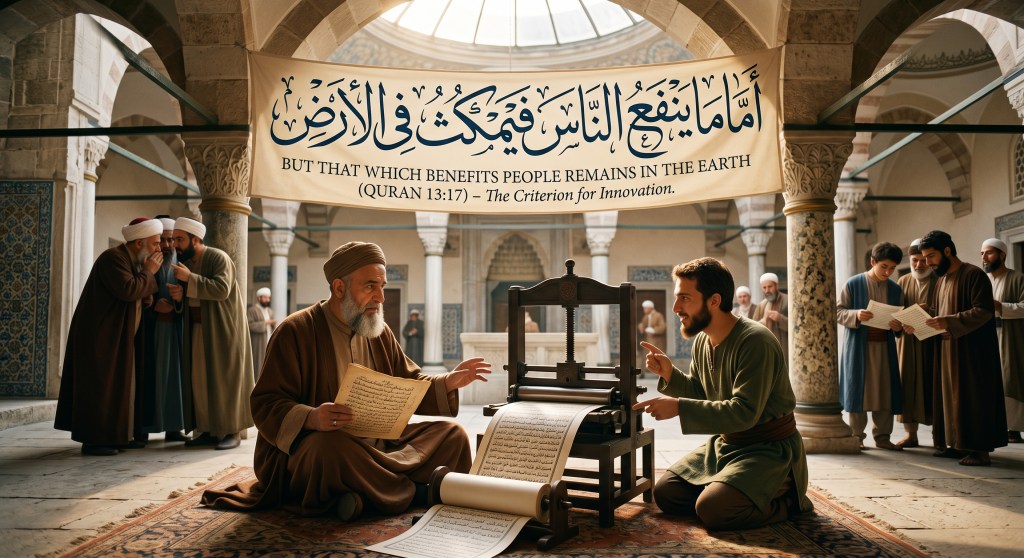
13. The printing press. The most consequential negative case. The Gutenberg press (c. 1450) was known to the Ottomans by the 1480s. As the economic historian Jared Rubin documents in Rulers, Religion, and Riches: Why the West Got Rich and the Middle East Did Not (Cambridge University Press, 2017, Ch. 5), “The Ottomans explicitly forbade the printing press in 1485 (printing in the Arabic script was punishable by death), and there is no record of this restriction being lifted until 1727.” Selim I’s 1515 confirmation of the prohibition is documented in Coşgel, Miceli & Rubin, “The Political Economy of Mass Printing” (Journal of Comparative Economics 40[3], 2012: 357–71). Jewish, Armenian, and Greek presses operated in Ottoman lands; Muslims could not. The reasons offered combined: (a) preservation of the calligraphers’ guild; (b) fear that printed muṣḥafs would be inaccurate or desecrated; (c) the broader argument that printing the Qurʾān was a bidʿah, since the Prophet had not done it; and (d) concern that print would diffuse heresy and weaken scholarly gatekeeping. The first Muslim-operated Ottoman press, that of İbrahim Müteferrika, opened in Istanbul in 1727 but was permitted to print only secular books — explicitly forbidden, by fatwa, from printing religious works. The first printed Ottoman edition of the Qurʾān, as documented by Necmettin Gökkır of Istanbul University, “took place in 1874 and had already been widely distributed in the Ottoman-controlled world.” Meanwhile, the first printed Qurʾān in Arabic had been produced in Venice in 1537 by Paganino Paganini (mostly destroyed because of typographic errors). Rubin’s broader judgment is stark: “The Ottomans’ failure to adopt the printing press is one of the great missed opportunities of economic and technological history. In Western Europe, the press provided a host of new economic and educational opportunities that were simply unthinkable prior to the press.” The bidʿah charge against printing is now a historical curiosity; every contemporary Muslim home, including Salafī ones, contains printed Qurʾāns and printed books of hadith. Substack + 6
14. Loudspeakers and microphones. Per the Wikipedia article “Loudspeakers in mosques” (citing the Sultan Mosque’s own history), “The first known installation of a microphone–loudspeaker set occurred in 1936 in the Sultan Mosque in Singapore; it was reported that the summons to prayer could ‘carry more than a mile’.” In South Asia, the foundational Ḥanafī fatwa was issued by Mawlānā Ashraf ʿAlī Thānwī of Deoband in Ramadan 1346/February 1928, in which he initially classified loudspeaker use in obligatory prayer as ḥarām — both because of doubts about whether the amplified sound was the muʾadhdhin’s “real” voice and because it constituted a novelty in worship. Mufti Muḥammad Shafīʿ later reversed the verdict, holding that the loudspeaker is a wasīlah (instrumental means) for transmitting the human voice, and the means take the ruling of their ends. Saudi Dār al-Iftāʾ (Ibn Bāz) and the Egyptian Dār al-Iftāʾ, and the contemporary islamqa.info network, agree: the loudspeaker is not bidʿah. The fatwa-history demonstrates precisely the pattern this essay is tracking: a technology was initially impugned, then accommodated as scholars worked through the issue, and now is so naturalized that contemporary noise-ordinance challenges to adhān loudspeakers in India and Europe are litigated under entirely different categories. Wikipedia + 4
15. Solar/scientific timekeeping. The fixing of the daily prayer times by clock and almanac (rather than by direct observation of sun and shadow) is a modernity. The use of scientific lunar-conjunction calculations to determine the start of Ramaḍān — accepted by Turkey, by ISNA in North America, and by major fiqh councils — was controversial well into the 21st century; many Salafī authorities still insist on ruʾyah (physical sighting) and class calculation as bidʿah. Within a generation or two, this too will likely have followed coffee and the loudspeaker into normalization.
16. Tafsīr, kalām, taṣawwuf as organized disciplines. None of these disciplines existed under the name in the Prophet’s day. Tafsīr as a written genre matures with Muqātil ibn Sulaymān (d. 150/767) and al-Ṭabarī’s Jāmiʿ al-Bayān (d. 310/923). Kalām — speculative theology — arose in the 2nd/8th century in the form of Muʿtazilī and proto-Ashʿarī polemics. Taṣawwuf as a defined path took shape from al-Junayd (d. 297/910) onward, with the great institutional consolidations of the ṭuruq coming in the 6th/12th century (Qādiriyyah, Suhrawardiyyah, Rifāʿiyyah). The very Ḥanbalī polemicist Ibn al-Jawzī (d. 597/1201), in Talbīs Iblīs, criticized later Sufi excesses, but is himself the author of Ṣifat al-Ṣafwah — a positive biography of early Sufis. Even Ibn Taymiyya wrote favorably of “ṣūfiyyat ahl al-Sunnah” such as al-Junayd, while opposing pantheistic monism (waḥdat al-wujūd). All three disciplines are now mainstream.
17. Building schools (madāris), endowments (awqāf), and the institutional ʿulamāʾ. Al-Niẓām al-Mulk’s foundation of the Niẓāmiyyah madrasa in Baghdad in 459/1067 was a bidʿah in the literal sense — no such institution had existed before. Al-ʿIzz ibn ʿAbd al-Salām, again, classifies it as a praiseworthy or recommended bidʿah. The contemporary academy at al-Azhar (founded 359/970 by the Fāṭimids), Dār al-ʿUlūm Deoband (1283/1866), and every modern Islamic seminary is heir to that innovation.
The cumulative force of this catalogue is striking: the religious world that contemporary Muslims inhabit is constituted by accepted bidʿahs. To deny this is not piety but historical illiteracy.
VI. Why the Inconsistency? The Mechanics of Selective Application
Why does X strike a particular community as bidʿah ḥasanah but Y strike them as bidʿah ḍalālah? Several factors recur:
- In-group sponsorship. Innovations introduced by figures one already venerates are reclassified as “Sunnah of the Rightly-Guided Caliphs” (per the hadith ʿalaykum bi-sunnatī wa sunnati l-khulafāʾ al-rāshidīn) or as “consensus of the early community.” ʿUmar’s tarāwīḥ and ʿUthmān’s adhān are read this way by all of Sunnī Islam.
- Out-group association. Innovations associated with the rival sect attract the bidʿah label even when functionally equivalent to in-group novelties. Sunnī polemic regards Shīʿī commemorations as bidʿah; Shīʿī polemic returns the favor.
- Sensory familiarity. What one grew up with is “religion”; what one did not is “innovation.” The South Asian Muslim raised with mawlid processions experiences them as Islam itself; the Saudi Salafī raised without them experiences them as Persian or Sufi importation.
- Political utility. Bidʿah-charges have historically served the legitimation of regimes (the Abbasid Miḥnah against the Hanbalis as “innovators”; Ibn Taymiyya jailed by Mamluk Ashʿarī authorities; the Saudi-Wahhābī alliance branding the Ottoman state and its Sufi networks as innovators).
- Temporal lag. Today’s bidʿah is yesterday’s outrage and tomorrow’s Sunnah. Coffee, printing, and microphones all illustrate the gradient by which the label becomes inoperative as the practice naturalizes.
This sociological observation does not collapse the juristic category. Some innovations genuinely depart from Qurʾān and Sunnah. But it does mean that the application of the category cannot be done responsibly on the strength of emotional reaction or sectarian alignment.
VII. Epilogue — Qurʾān 13:17 as the Criterion
If the application of bidʿah is so often distorted by partisanship, what criterion ought to guide the believer who genuinely wishes to discriminate the wheat from the chaff? The Qurʾān itself, in the parable of Sūrat al-Raʿd, verse 17, offers a model:
أَنزَلَ مِنَ السَّمَاءِ مَاءً فَسَالَتْ أَوْدِيَةٌ بِقَدَرِهَا فَاحْتَمَلَ السَّيْلُ زَبَدًا رَّابِيًا ۚ وَمِمَّا يُوقِدُونَ عَلَيْهِ فِي النَّارِ ابْتِغَاءَ حِلْيَةٍ أَوْ مَتَاعٍ زَبَدٌ مِّثْلُهُ ۚ كَذَٰلِكَ يَضْرِبُ اللَّهُ الْحَقَّ وَالْبَاطِلَ ۚ فَأَمَّا الزَّبَدُ فَيَذْهَبُ جُفَاءً ۖ وَأَمَّا مَا يَنفَعُ النَّاسَ فَيَمْكُثُ فِي الْأَرْضِ ۚ كَذَٰلِكَ يَضْرِبُ اللَّهُ الْأَمْثَالَ
“He sends down water from the sky, and the valleys flow according to their measure, and the torrent bears on its surface a swelling foam. And from that which they smelt in the fire, seeking ornament or utensil, comes a foam like it. Thus does God strike the parable of truth and falsehood. As for the foam, it passes away as scum; but as for that which benefits the people, it remains in the earth. Thus does God strike parables.” (Sahih International)
The verse contains a double image: water from heaven flowing through valleys, and metal ore smelted in fire. Both processes generate something that looks prominent — the foam on the flood, the slag on the molten ore — and something that is useful but unobtrusive — the water that abides in the land, the pure metal that becomes ornament or tool. The foam rises (rābiyan) and is visible; but it is precisely what is cast away as jufāʾ — the worthless scum thrown onto the banks. What benefits people (mā yanfaʿu l-nās) is what remains.
The classical commentators agree this is a parable of truth (ḥaqq) and falsehood (bāṭil), and they agree further that the determinant of which is which is endurance through time. Al-Ṭabarī, in Jāmiʿ al-Bayān, opens his commentary on this verse: “This is a parable that God has struck for truth and falsehood, and for belief in Him and disbelief. The likeness of truth in its firmness (thabāt) and falsehood in its dissipation (iḍmiḥlāl) is like water which God sent down from the sky to the earth.” He explicitly identifies “the abiding water which God sent down from the sky” as truth, and “the foam from which no benefit is derived” as falsehood. He further records, on the authority of Qatādah: “just as this foam dissipated and became scum from which no benefit is hoped, likewise falsehood dissipates from its people; and just as this water remained in the earth so the earth became fertile and brought forth its plants, likewise the truth remains for its people.”
Al-Qurṭubī, in al-Jāmiʿ li-Aḥkām al-Qurʾān (9/266–267), draws the moral most pertinent to a study of bidʿah: “For even if falsehood may be ascendant at certain times and situations, it will pass away (yaḍmaḥill) just as foam and dross/filth (khabath) pass away.” Falsehood, in other words, may rise to the surface — may look popular, dominant, even sublime — but the test of duration unmasks it. Truth, conversely, abides in the earth, quietly nourishing. He adds a second classical reading: “Some have said that the intended meaning of this parable is about the Qurʾān and how it enters into the hearts. God likened the Qurʾān to water due to how much good it brings and its enduring benefit, and He likened the hearts to river valleys.”
Ibn Kathīr, in Tafsīr al-Qurʾān al-ʿAẓīm, draws out the simile’s structure with arresting clarity: “This noble āyah contains two parables which affirm that truth remains and increases, while falsehood diminishes and perishes.” He cites ʿAbd Allāh ibn ʿAbbās (through ʿAlī ibn Abī Ṭalḥah): the foam is doubt (shakk); what remains in the earth is certainty (yaqīn). And he applies the parable directly to the heart’s reception of revelation: “This Ayah indicates that hearts differ, for some of them can retain substantial knowledge while others cannot entertain knowledge, but rather are bothered by knowledge.”
Ibn Taymiyya, in Majmūʿ al-Fatāwā (2/419), invokes the same parable: God “likened the īmān and Qurʾān that He sends down to the hearts… to the water whose rushing flow carries away foam… But as for the water and materials that do benefit people, these are like the truth which is beneficial, so it settles and remains in the heart.” That even Ibn Taymiyya — sternest of bidʿah-watchers — reads the verse this way is significant: the test is bayna l-nafʿ wa l-jufāʾ, between what benefits and what is cast off as scum.
The parable supplies a criterion that cuts through both directions of selective application. It does not ask: did your favored faction introduce this practice? Nor: did your disfavored faction introduce it? It asks: Has it endured? Does it benefit people? The test is time and benefit — thabāt and nafʿ — not affective familiarity, sectarian loyalty, or rhetorical aggression.
Applied to the historical catalogue above, the parable reads as a vindication of much that was once denounced. The codification of the Qurʾān, the dotting and vowelling of its text, the disciplines of hadith, grammar, uṣūl, and tafsīr, the institution of the madrasa, the use of coffee, printing, and amplification — these have yamkuthu fī l-arḍ: they have remained, and they have benefited people. The Qurʾānic test pronounces in their favor. Conversely, ephemeral fashions and partisan slogans that briefly rābiyan — rise and swell — only to disappear in the next generation are, by the same test, jufāʾ: cast off as scum.
The criterion has a humbling implication for every party to the bidʿah debate. Salafīs are invited to ask whether their own modern institutional forms — the satellite channel, the international congress, the printed multi-volume Fatāwā Lajna Dāʾima, the smartphone fatwa app — pass the test. Sufis are invited to ask the same of certain ritual elaborations. Shīʿah are invited to ask the same of certain practices; Sunnīs of theirs. The Qurʾān does not flatter; it weighs.
It is also possible to read 13:17 as a counsel for epistemic patience: do not pronounce a final verdict on a new practice in the heat of its first appearance. The foam, after all, looks impressive when it first surges down the wadi. Let it run; come back in a generation, in a century. What remains — sustaining life, irrigating fields, watering crops — is what God ordained to endure. What does not is what He cast off. Qatādah’s words bear repeating: “the water remained in the earth so the earth became fertile and brought forth its plants — likewise the truth remains for its people.”
In a Muslim world torn by mutual accusations of bidʿah, where the same act is in one country a sunnah and in another a heresy, perhaps the most faithful posture is the one the Qurʾān itself models in this verse: less haste in the labeling, more attention to the test of endurance and benefit, and a humility before the recognition that the One who is Badīʿ al-Samāwāt wa-l-Arḍ alone originates without precedent. The rest of us, even when we innovate well, are only valleys of different capacity, receiving the rain.
A brief caveat on contested matters. The classification of bidʿah remains live and contested, particularly regarding the mawlid, tawassul, and amplified muʾadhdhins in mosques. This essay has tried to present multiple scholarly viewpoints fairly. Where I have suggested that the dominant pre-modern Sunnī mainstream followed the al-Shāfiʿī / al-ʿIzz / al-Nawawī / Ibn Ḥajar line on dual or fivefold classification, I am stating a historical-juristic observation, not endorsing every practice that line has accommodated. The Qurʾān 13:17 criterion proposed in the epilogue is itself an interpretive proposal, not a juristic ruling; it is offered as a counter-weight to emotional and sectarian application of the label, not as a substitute for the careful reasoning of qualified scholars within their traditions.




Leave a Reply