
Presented by Gemini
Abstract
The concept of Bid’ah (innovation) within Islamic discourse has undergone a profound transformation, moving from its literal linguistic definition of “unprecedented creation” to a highly charged polemical tool used for theological gatekeeping. While early Islamic scholarship recognized a distinction between praiseworthy (hasanah) and blameworthy (sayyi’ah) innovations, historical and sectarian dynamics frequently corrupted this balance. In practice, the label of Bid’ah has often been weaponized selectively: novel ideas introduced by one’s own theological camp are framed as progressive understandings or necessary adaptations, while identical adjustments by competing sects are condemned as heretical deviations.
By analyzing the linguistic roots of the word, its Quranic usage, and key historical turning points—such as the institutionalization of congregational prayers, the compilation of the Quran itself, and the adoption of modern technologies like the printing press and loudspeakers—this paper demonstrates how initial resistance to the unfamiliar routinely gives way to systemic integration. Ultimately, human emotions, sectarian biases, and the “anesthesia of familiarity” distort our immediate judgment of new ideas. This study proposes that the ultimate criterion for evaluating any religious nuance or evolutionary understanding should be shifted away from emotional reactivity and placed upon the pragmatic, enduring benchmark established in the Quran (13:17): that which benefits humanity survives, while the superficial foam of human dispute evaporates over time.

Linguistic Root and Quranic Context
To understand how Bid’ah became such a controversial term, we have to look at its structural roots in the Arabic language. The word stems from the root B-D-B (ب-د-ع), which literally means to originate, innovate, or bring something into existence cleanly from scratch, without any prior model, template, or example.
In the regular linguistic sense, it is a neutral term. It describes the act of making something completely new. In the text of the Glorious Quran, this root appears in a few distinct contexts, highlighting both divine perfection and human agency:
1. Cosmic Creation without a Template
The Quran uses this root to describe God’s absolute creative power.
“He is the Originator (Badi’) of the heavens and the earth…” (Surah Al-Baqarah, 2:117 and Surah Al-An’am, 6:101)
Here, Badi’ signifies that God did not copy a pre-existing universe; He authored reality itself entirely anew.
2. Continuity of the Prophetic Message
When applied to human experience, the Quran uses the root to signify something that is unprecedented or startlingly out of place.
“Say, ‘I am not an innovation (bid’an) among the messengers, nor do I know what will be done with me or with you…’” (Surah Al-Ahqaf, 46:9)
In this verse, the Prophet Muhammad is instructed to tell his detractors that he is not a strange, unprecedented phenomenon in human history. He isn’t a “new creation” out of nowhere; he follows a long line of historical prophets who carried the exact same core truth.
3. Human Innovations in Practice
The root appears again when discussing how human beings add new dimensions to their spiritual lives out of an intense desire to please God.
“…And monasticism, they innovated it (ibtada’uha); We did not prescribe it for them except that they desired the pleasure of Allah. But they did not observe it with right observance…” (Surah Al-Hadid, 57:27)
This is a highly nuanced verse. It acknowledges that a group of believers created a completely new spiritual lifestyle (monasticism) that was not explicitly commanded in their original law. The critique here isn’t aimed at the act of creating the new path itself—the text notes they did it to seek God’s pleasure—but rather at their inability to sustain it and live up to its high demands over time.
The Socio-Religious Dynamic: The Weaponization of “Newness”
As Islamic history progressed and distinct schools of law, theology, and politics developed, the technical religious meaning of Bid’ah shifted. It came to mean an unauthorized addition, omission, or alteration to the established practice of Islam.
However, a recurring psychological and sociological bias consistently skews how this label is applied:
- The Anesthesia of Familiarity: Human beings are naturally comforted by what is old and deeply rattled by what is new. If a practice has been around for three generations, it receives an automatic pass; it feels ancient, sacred, and safe. If a practice is introduced today, it triggers immediate suspicion.
- Sectarian Double Standards: When an influential scholar or group introduces a new conceptual framework, a fresh commentary, or a socio-religious practice that aligns with our goals, it is warmly categorized under the legal umbrella of Maslahah Mursalah (public interest) or Bid’ah Hasanah (a beautiful/praiseworthy innovation). But if a rival sect or an intellectual opponent introduces a nuanced understanding to navigate changing times, the defensive walls go up. The exact same mechanism of adaptation is suddenly rebranded as a dangerous Bid’ah Dalalah (misguided innovation) designed to corrupt the faith.
Historical Case Studies: From Condemned to Indispensable
History has a brilliant way of cutting through the emotional fog of contemporary arguments. When we look back, we find a long list of practices, tools, and concepts that were initially met with fierce resistance, labeled as heretical innovations, but eventually became completely normalized parts of Islamic life.
| The Innovation / Concept | Initial Resistance & Bid’ah Accusation | Historical Evolution & Final Acceptance |
| The Compilation of the Quran into a Single Book | After the Battle of Yamama, when many Quran memorizers died, Umar ibn al-Khattab suggested collecting the scattered texts into a single book. Abu Bakr initially recoiled, asking: “How can I do something that the Messenger of Allah did not do?” | Realizing that the preservation of the faith depended on it, Abu Bakr and the companions agreed. Today, the compiled Mushaf is the very foundation of Islamic life worldwide, showing that procedural innovations can be essential for survival. |
| Institutionalizing Tarawih Prayers | During the Prophet’s lifetime, he prayed the nightly Ramadan prayers in congregation for a few nights but stopped, worrying it might become an official obligation. People prayed individually or in small groups. | Umar ibn al-Khattab later gathered everyone under a single reciter. When he saw the organized congregation, he famously remarked: “What an excellent innovation (Bid’ah) this is!” It transitioned from a fragmented practice to a beautiful, unifying staple of Ramadan. |
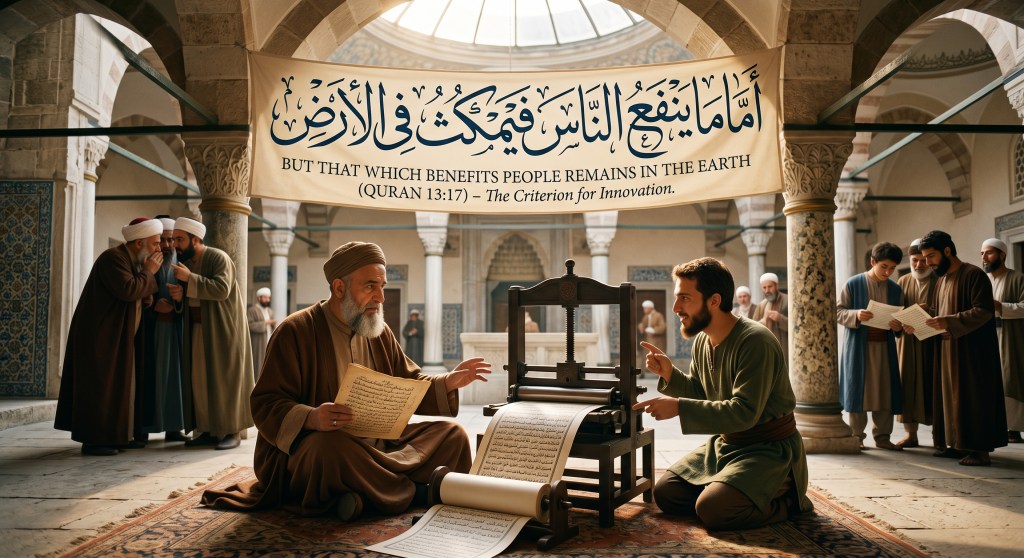
| The Printing Press | When movable type printing spread to the Muslim world in the 15th and 16th centuries, Ottoman authorities and religious guilds heavily resisted it. Printing Islamic texts in Arabic script was banned for long periods out of fear it would desecrate the holy word and replace calligraphers. | The ban isolated communities from rapid literacy and knowledge sharing. Eventually, the pragmatism of education won out. Today, printing the Quran and classical texts is the primary way Islamic knowledge is democratized and preserved globally. |
| Loudspeakers and Microphones | In the early 20th century, when electronic amplification was introduced, many traditionalist scholars across the Muslim world issued fatwas condemning microphones. They argued that using an electronic device for the Adhan (call to prayer) or the sermon was a forbidden Bid’ah, questioning if a prayer led by an amplified voice was even valid. | Over a few decades, the clear utility of allowing thousands of worshippers to hear the sermon shifted public opinion entirely. Today, a mosque without a sound system is practically unimaginable. |
| Sectarian Rituals & Commemorations | Over centuries, practices like the Mawlid (celebrating the Prophet’s birthday) or the specific public commemorations of Ashura were heavily criticized by opposing factions. One camp would call it a loving expression of faith; the other would label it a heretical Bid’ah. | Despite ongoing theological debates among purists, these practices became deeply embedded cultural and spiritual anchors for hundreds of millions of Muslims, proving that emotional expressions of devotion often outlast legalistic bans. |
Thematic Epilogue: Letting History Judge via Quran 13:17
When we step away from the emotional heat of sectarian disputes, we realize that human judgment is far too easily compromised by tribal loyalty, fear of change, and the comfort of the familiar. If we rely strictly on the immediate reactions of religious factions to evaluate new nuances in understanding, new scientific commentaries, or adaptations to changing times, we risk stifling the natural, exponential growth of human knowledge.
We need a better yardstick—one that is objective, patient, and divine. The ultimate criterion for evaluating any innovation or development in the understanding and practice of religion is beautifully laid out in the cosmic imagery of Surah Ar-Ra’d:
“He sends down water from the sky, and the valleys flow according to their capacity, and the torrent carries a rising foam. And from that [ore] which they heat in the fire, desiring adornments or utensils, is a foam like it. Thus Allah presents truth and falsehood. As for the foam, it vanishes, [being] cast off; but as for that which benefits the people, it remains on the earth. Thus Allah presents examples.” (Surah Ar-Ra’d, 13:17)
This verse provides the perfect pragmatic framework for the evolution of human thought and religious practice. When a new idea, a fresh scientific commentary, or a new methodology is introduced, it always stirs up the waters. It creates commotion, anxiety, and a layer of superficial “foam”—the loud arguments, the emotional fatwas, the reflexive sectarian condemnations, and the defensive posturing of friends and foes alike.
But the Quran tells us to look past the foam.
The divine law of history is simple: utility and benefit determine longevity.
If a new nuance in understanding or a structural adaptation is empty, toxic, or genuinely harmful to the core of the faith, it will eventually lose its utility. It will dry up, be cast off, and vanish like the froth on a rushing river. But if that new idea helps humanity understand the cosmos better, if it aligns with good science, blends human hearts in interfaith tolerance, or helps people live out the spiritual realities of the Quran in a changing world, it will sink into the soil. It will endure because it bears fruit.
Let us stop letting our immediate emotional reflexes or our comfort with the familiar be the gatekeepers of truth. Let us give new insights the breathing room to be tested. History, guided by the profound wisdom of Quran 13:17, is the only judge we need; what truly benefits humanity will always remain firmly rooted in the earth.





Leave a comment