
The intersection of abstract mathematics and biological architecture is one of the most compelling signatures of design in the natural world. When we look at the arrangement of leaves, seeds, and petals—a study known as phyllotaxis—we aren’t looking at random growth. We are looking at a living manifestation of a precise mathematical algorithm.
In the Quran, the concept of Ahsan (from verse 32:7: “He who perfected and made beautiful everything He created”) beautifully encapsulates this exact reality: the flawless marriage of maximum functional efficiency with breathtaking aesthetic symmetry.
1. The Mathematical Blueprint: Fibonacci and Phi
To understand how plants build themselves, we have to look at two deeply intertwined mathematical concepts: the Fibonacci Sequence and the Golden Ratio.
- The Sequence: A numerical progression where each number is the sum of the two preceding it: $1, 1, 2, 3, 5, 8, 13, 21, 34, 55, 89, 144, \dots$
- The Ratio ($\phi$): If you divide any Fibonacci number by the one before it (e.g., $55/34$ or $89/55$), the ratio rapidly converges on an irrational constant known as the Golden Ratio:$$\phi \approx 1.6180339887\dots$$
From this ratio, we derive the Golden Angle, which is roughly 137.5°. This specific angle is the mathematical secret behind the plant kingdom’s structural perfection.
2. Manifestation in the Plant Kingdom
When a plant grows, it produces new cells, leaves, or seeds from a tiny central tip called a meristem. To ensure survival, the plant must choose an angle of rotation for each new growth so they don’t block one another.
If a plant used a simple fraction of a circle (like 90° or 180°), leaves would grow directly on top of each other, creating columns that block lower leaves from sunlight and rain. The plant requires an “unreasonable” number that never repeats as a clean fraction. That number is the Golden Ratio.
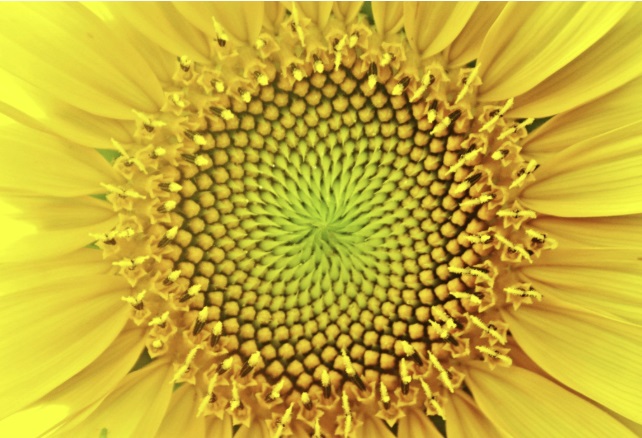
The Flawless Fibonacci Spirals of a Sunflower Head. Source: Racide / Getty Image
The Sunflower Seed Pattern
Look closely at the center of the sunflower above. The seeds are not packed in simple rows or grids. Instead, they form a mesmerizing matrix of intersecting spirals curving both clockwise and counter-clockwise.
If you count the spirals winding to the right, and then count the spirals winding to the left, you will almost always find two consecutive numbers from the Fibonacci sequence. For example:
- Small sunflowers: 21 and 34 spirals
- Medium sunflowers: 34 and 55 spirals
- Large sunflowers: 55 and 89 (or even 89 and 144) spirals
Beyond Sunflowers: A Universal Dynamic
| Plant Structure | Fibonacci / Golden Ratio Manifestation |
| Pinecones | Scales spiral outward in counts of 8 and 13, or 13 and 21. |
| Pineapples | The hexagonal skin segments create three distinct sets of spirals, usually numbering 5, 8, and 13. |
| Leaf Arrangement | Trees like oaks and apple trees sprout leaves at a rotational fraction of a circle that corresponds directly to Fibonacci ratios (e.g., a 2/5 or 3/8 turn between successive leaves). |
3. The Concept of Ahsan: Where Efficiency Meets Elegance
This is where science seamlessly transitions into the theological framework of Ahsan. In Arabic, Ahsan implies two simultaneous realities: perfection of function (optimization) and perfection of form (beauty).
The Golden Angle ($137.5^\circ$) is the exact mathematical definition of optimization. Computer simulations demonstrate that if the growth angle is shifted by even a fraction of a single degree (say, to $137.4^\circ$ or $137.6^\circ$), the entire pattern collapses. The seeds instantly form ugly, linear clusters, leaving open gaps of wasted space and drastically reducing the number of seeds the flower can carry.
The Aesthetic Surplus
By utilizing $\phi$, the plant achieves 100% packing efficiency—no space is wasted, every leaf gets maximum sunlight, and every seed is perfectly protected. Yet, the byproduct of this hyper-efficient engineering is a visually stunning spiral pattern that human consciousness instinctively recognizes as beautiful.
This convergence is a profound challenge to metaphysical naturalism. A purely blind evolutionary mechanism could find a crude, “good enough” utilitarian layout to survive. It does not require a mathematically elegant, cross-species geometric harmony that doubles as an artistic masterpiece.
As Zia H Shah MD frequently emphasizes in his critiques of unguided evolution, the universe exhibits a persistent “aesthetic surplus.” The fact that the deep mathematical laws of nature produce biological forms that are both structurally optimized and visually magnificent points directly to a conscious Designer. The mathematical code written into the DNA of the plant kingdom is the invisible hand of the Creator executing the law of Ahsan—ensuring that the fabric of reality is structurally perfect, biochemically viable, and radiantly beautiful.


Leave a Reply