

Presented by Zia H Shah MD
Abstract:
Water is the substance of life, and its continuous circulation through the environment – the water cycle – underpins ecosystems and human civilization. The Holy Qur’an, Islam’s sacred scripture, revealed in 7th-century Arabia, contains numerous verses describing natural phenomena, including an astoundingly accurate depiction of the water cyclethemuslimtimes.info. This chapter offers a comprehensive exploration of the water cycle in the Qur’an, integrating modern scientific insights, classical Qur’anic exegesis, and theological reflections. We begin by outlining the modern scientific understanding of the water cycle and contrasting it with historical conceptions held by various cultures and in other religious texts. We then delve into the Qur’anic verses on precipitation, groundwater, clouds, and winds – presenting them in Arabic and English – to show how they remarkably correspond to scientific realities unknown at the time of revelation. Dr. Maurice Bucaille’s analysis in The Bible, The Qur’an and Science is highlighted, emphasizing his view that the Qur’an’s statements on nature are free of the myths prevalent in antiquity and in surprising harmony with contemporary sciencethemuslimtimes.infothemuslimtimes.info. In contrast, we address misconceptions and scientific errors in earlier scriptures and legends – from the Biblical Book of Genesis to ancient mythologies – to underscore the Qur’an’s unique preservation of factual knowledgethemuslimtimes.infothemuslimtimes.info. Throughout, we also draw attention to the spiritual and ethical dimensions of water in Islam: water as a divine blessing, a symbol of creation and resurrection, and a trust for humanity to cherish. In conclusion, a thematic epilogue ties together the divine wisdom apparent in the Qur’anic treatment of the water cycle with a call to ecological responsibility, urging a shared interfaith commitment to safeguarding the precious water resources of our planet.
Introduction
Water is universally regarded as a source of life and spiritual purity. In virtually every faith tradition, water holds symbolic and ritual importance – from baptism in Christianity to the cleansing ablutions in Islam and Hinduism. The critical role of water is also a point of convergence between science and spirituality. Modern science tells us that life on Earth depends on the complex but elegantly balanced water cycle, while scriptures often use water as a metaphor for divine mercy, creation, and sustenance. Nowhere is this convergence more apparent than in the Holy Qur’an’s discourse on water. The Qur’an — revered by Muslims as the literal word of God revealed to Prophet Muhammad ﷺ — speaks of water over and over again (water is referenced at least 85 times in the Qur’anthemuslimtimes.info), linking it to life (“We made from water every living thing” (Qur’an 21:30)) and guidance for humanity. For an interfaith audience, examining what the Qur’an says about the water cycle offers a fascinating case study of how an ancient religious text can align with modern scientific understanding and simultaneously impart profound ethical and spiritual lessons.
This chapter will first summarize the scientific view of the water cycle and recall how humanity’s understanding of it evolved over time. We will then explore key Qur’anic verses on various stages of the water cycle – evaporation, cloud formation, winds, rain, infiltration into the ground, and the regeneration of life – providing both the original Arabic and translations. In doing so, we will see through Qur’anic exegesis (tafsīr) how Muslim scholars have understood these verses, and how modern commentators like Dr. Maurice Bucaille have highlighted their remarkable accuracythemuslimtimes.info. Next, we will contrast the Qur’an’s statements with earlier beliefs and scriptures. Historically, before the 17th century, many theories about rain and rivers were speculative or simply incorrectthemuslimtimes.info. Even in the Bible’s Book of Genesis, for example, the natural water cycle is absent – rain is not mentioned prior to the Flood, and an archaic cosmology prevailsthemuslimtimes.infothemuslimtimes.info. By comparison, the Qur’anic perspective – emerging in 7th-century Arabia – stands out for its clarity and accuracy on these natural processes. Finally, we will reflect on the spiritual messages entwined with the Qur’an’s descriptions of the water cycle: lessons about gratitude, humility, resurrection, and our moral responsibility to protect this divine gift. The epilogue will tie these threads together, considering how recognizing water as a sacred trust can foster a shared ecological ethic across faith communities.
Before we proceed, it is worth noting the Qur’an’s own emphasis on studying nature. Islamic scripture repeatedly encourages believers to observe the world as a sign (āyah) of God’s wisdom. In fact, there are hundreds of Qur’anic verses inviting reflection on natural phenomena – far more than the verses detailing religious lawthemuslimtimes.info. This ethos is encapsulated in the verse: “In the creation of the heavens and earth, and in the alternation of night and day, and in the ships that sail the sea… and in the water which God sends down from the sky giving life to the earth after its death… are signs for those who use reason” (Qur’an 2:164). Muslims historically took such verses as inspiration for inquiry into astronomy, agriculture, geology, and more. Thus, exploring the water cycle in the Qur’an is very much in keeping with the scripture’s interweaving of faith with intellectual curiosity. It is in this spirit of seeking knowledge and understanding across religious and scientific lines that we begin our exploration.
The Water Cycle: A Scientific Overview
The water cycle, also known as the hydrologic cycle, is the continuous circulation of water within the Earth’s atmosphere, land, and oceans. Through this cycle, water is endlessly recycled and redistributed, changing forms among liquid, vapor, and ice. A modern scientific description of the water cycle includes several key processes:
- Evaporation: Sunlight warms bodies of water (oceans, lakes, rivers), causing liquid water to vaporize into water vapor (gas) that rises into the atmosphere. Each second, an immense volume of water evaporates from the Earth’s surface – on the order of 16 million tons of water from the oceans alonethemuslimtimes.info. Over the course of an hour, roughly 5.13 × 10^14 kilograms of water (513 trillion kilograms) falls as precipitation worldwide, balancing the huge amount of water constantly evaporatingthemuslimtimes.info. This dynamic exchange maintains a fairly consistent level of moisture in the air.
- Transpiration: Plants also contribute to atmospheric moisture by releasing water vapor from their leaves. This process, known as transpiration, is essentially evaporation of water from plant tissues. Together, evaporation and transpiration (collectively termed evapotranspiration) move water from the Earth’s surface into the sky.
- Condensation and Cloud Formation: As water vapor rises with warm air, it cools and condenses into tiny water droplets or ice crystals, forming clouds. Dust and salt particles carried by winds act as nuclei to seed cloud formation. In fact, winds are crucial for “fertilizing” the atmosphere with these particles, without which moisture would not readily coalesce into cloudsthemuslimtimes.info. High in the troposphere, billions of microdroplets merge, and clouds grow. The Qur’an poetically alludes to this when it says: “Do you not see that God drives the clouds, then gathers them together and piles them up until you see rain pour from their midst?” (Qur’an 24:43)themuslimtimes.info. Modern observers from airplanes can indeed appreciate how massive cloud banks resemble mountains from above – a visual hinted at in the same Qur’anic verse which speaks of “mountains” of cloudsthemuslimtimes.info.
- Precipitation (Rain, Snow, Hail): When cloud droplets become large enough (by continued condensation and coalescence), gravity causes them to fall as precipitation. Depending on conditions, this can be rain, snow, sleet, or hail. Rain is the most common form, replenishing freshwater to the land. The cycle’s importance to life is evident: rainfall irrigates crops, fills aquifers, and sustains all terrestrial ecosystems. The Qur’an highlights this life-giving aspect repeatedly: “He sends down water from the sky, and therewith We bring forth plants of every kind; We bring forth green vegetation…” (Qur’an 6:99), and “Look then at the imprints of God’s mercy – how He brings the earth back to life after its death” (Qur’an 30:50)themuslimtimes.infothemuslimtimes.info. In these verses, rain is directly equated with God’s mercy, reviving barren land just as divine mercy revives souls.
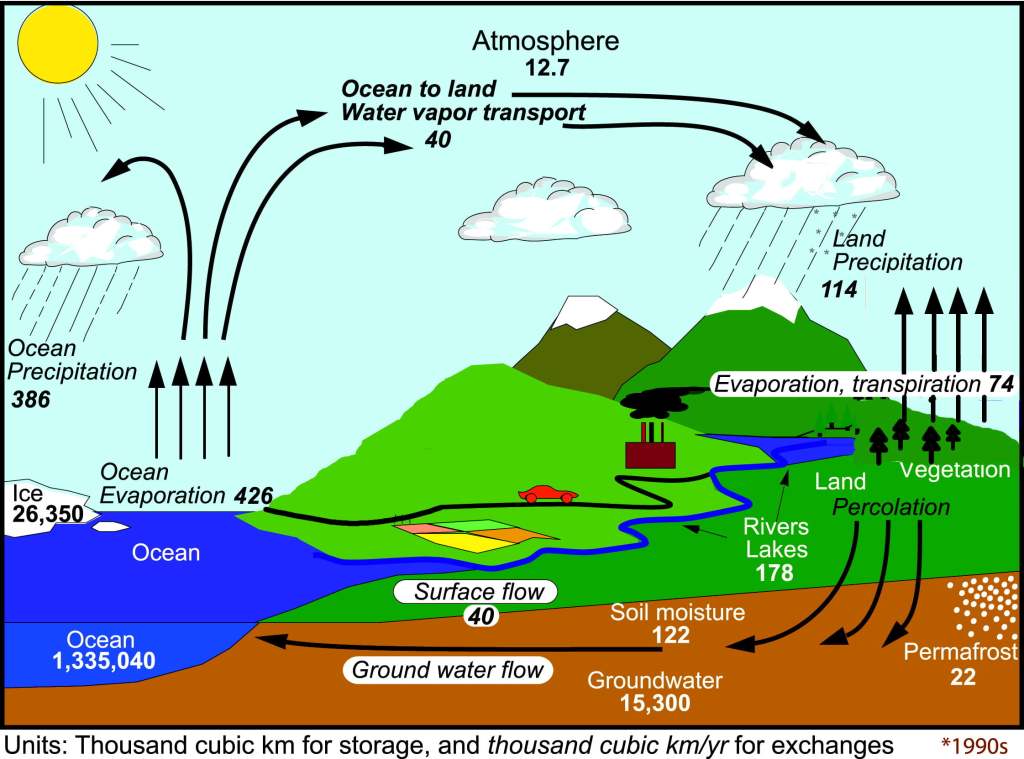
Diagram of the global water cycle, illustrating key processes such as evaporation from oceans, condensation into clouds, precipitation (rainfall), runoff in rivers, and groundwater flow (NASA, public domain). The Qur’an alludes to each of these stages with remarkable accuracythemuslimtimes.info.
- Runoff and Surface Water: Much of the precipitation that falls on land runs off into streams and rivers, eventually making its way back to the oceans. This surface runoff is guided by gravity and the terrain’s slope. Rivers thus act as the Earth’s arteries, transporting water across continents. Ancient peoples observed rivers but didn’t fully grasp their connection to rainfall. The Qur’an, however, makes this connection explicit: “He sends down water from the sky so that the rivers flow according to their measure” (Qur’an 13:17)themuslimtimes.infothemuslimtimes.info. In other words, rainfall determines river flow rates – a fact confirmed by hydrology. Early scientific pioneers like the French scientist Pierre Perrault demonstrated this quantitatively in the 17th century by measuring rainfall in a watershed and the flow of the Seine River, finding that rain alone could account for the river’s volumethemuslimtimes.infothemuslimtimes.info. This debunked the old idea that rivers were fed primarily by subterranean water or a mythical ocean inside the Earth.
- Infiltration and Groundwater: A portion of rainfall seeps into the ground, replenishing soil moisture and percolating down to refill underground reservoirs (aquifers). This underground water may resurface later as springs or wells, or slowly drain into lakes and oceans via sub-surface flows. The Qur’an anticipates this concept of groundwater storage with striking precision: “We sent down water from the sky according to measure and lodged it in the ground, and We are certainly able to withdraw it” (Qur’an 23:18)themuslimtimes.infothemuslimtimes.info. In another verse, God asks us to ponder: “Say, if all your water were to sink deep into the earth, who could bring you flowing water in its place?” (Qur’an 67:30)themuslimtimes.infothemuslimtimes.info. These verses not only acknowledge the rainwater’s infiltration into the earth and the existence of aquifers, but also remind the listener of human dependence on these hidden water stores. In fact, 23:18 explicitly notes that God can withhold that groundwater – an allusion to wells running dry – which aligns with our modern understanding that groundwater can be depleted or become inaccessible. Geologists today speak of “fossil water” deep underground and caution that over-extraction can indeed make water “sink away” beyond reach, exactly as the Qur’an cautions.
- Recycling and Continuation: Water that has runoff to oceans, or re-emerged from springs, will eventually evaporate and continue the cycle anew. The cycle has no real beginning or end point; it is a continuous loop maintaining Earth’s water balance. The Qur’an conveys this continuity by often using present tense or participial forms, describing God as one who “sends” water, “brings forth” life with it, and so on – implying an ongoing, active process. “He sends down water from the sky, and the valleys flow according to their measure… then it (flood) carries foam…” (Qur’an 13:17) illustrates how rainfall in each catchment is portioned exactly to what its rivers can carrythemuslimtimes.infothemuslimtimes.info. Modern hydrology indeed shows that climate and geography set a river’s flow capacity, preventing (in most cases) the land from being overwhelmed on a regular basis.
In summary, the scientific view of the water cycle encompasses solar-driven evaporation, atmospheric transport of water vapor by wind, condensation into clouds, precipitation back to Earth’s surface, and the collection of water in rivers, ground, and oceans to complete the loop. This understanding crystallized only in the last few centuries of human history. It wasn’t until the late Renaissance and early Enlightenment (16th–17th centuries) that thinkers like Bernard Palissy, Pierre Perrault, and Edme Mariotte provided experimental evidence that rain alone sustains rivers, overturning millennia of misconceptionsthemuslimtimes.infothemuslimtimes.info. Yet, as we will see, the Qur’an – 1000 years before Palissy – contains passages that map surprisingly well onto this modern hydrological cycle, speaking of “winds that carry clouds,” “water descending from the sky,” “springs gushing forth,” and the measured apportionment of rain and river flowthemuslimtimes.infothemuslimtimes.info. To appreciate how exceptional this is, we first consider what people believed about the water cycle in ancient times and how those beliefs found their way (or failed to) into earlier scriptures.
Ancient and Medieval Views of the Water Cycle
For most of recorded history, the workings of the water cycle were mysterious and subject to imaginative theories. Lacking modern instrumentation, ancient scholars could directly observe some elements – rain falls from clouds, rivers flow to the sea, the sun dries up puddles – but they often filled the gaps with speculation. As Dr. Maurice Bucaille noted, “for many centuries… man held totally inaccurate views on the water cycle”themuslimtimes.info. These misconceptions persisted well into the Renaissance, illustrating how ahead of its time the Qur’an’s narrative was. A brief survey of historical ideas highlights this contrast:
- Ancient Near East and Hellenistic Theories: In the Mesopotamian and early Greek worldview, it was commonly thought that the land floated on a primal ocean, and water could enter from below the earth. The Greek poet Homer imagined that rivers were fed by a giant subterranean freshwater stream (he called it Oceanus) encircling the worldthemuslimtimes.info. By the 6th century BCE, philosophers like Thales of Miletus proposed that winds pushed ocean water inland, which then fell as rain. Thales’ theory held that all water originated in the oceans, and wind-driven spray accounted for rainfall – a flawed idea, but an attempt to explain observations. Plato agreed with Thales on oceanic origins and added the idea of a great chasm, “Tartarus,” through which water returned to the ocean’s depths. These ideas – ocean water cycling through a large underground abyss – sound fanciful now, but they had supporters even up to the time of René Descartes in the 17th century.
- Aristotle’s Hypothesis: The great philosopher Aristotle (4th century BCE) came closer to the truth in some respects. He recognized that the sun’s heat could cause water to evaporate (“exhalations” from the earth and water), forming clouds that precipitate rain – essentially an understanding of evaporation and condensationthemuslimtimes.info. However, Aristotle also believed much of the water cycle was internal to the Earth: he thought water vapor could condense in cool caverns inside mountains, collecting into underground lakes that fed springs. In his work Meteorologica, Aristotle thus envisioned two parallel cycles – one above ground (rainfall from evaporated water) and one below ground (water condensing within the Earth and emerging as springs). The latter notion was incorrect, yet it strongly influenced later thinkers. The Roman engineer Vitruvius around 1st century BCE was an outlier for correctly suggesting rain seepage fed springs, but his view was largely ignored as an “exception”themuslimtimes.info. Instead, Aristotle’s subterranean water generation held sway through antiquity and the Middle Ages.
- Chinese and Other Early Insights: Not all ancient ideas were incorrect. In 1st century CE China, the scholar Wang Chong described a basic water cycle: he theorized that rainwater came from evaporation and that it replenished the land, an insight recorded in his Lùn Héng (論衡)themuslimtimes.infothemuslimtimes.info. Unfortunately, Wang Chong’s correct ideas were dismissed by his contemporaries and didn’t spread. Similarly, some ancient Indian texts (like the Rig Veda and later Upanishads) contain poetic references to the sun lifting water to become rain, showing a conceptual grasp of evaporation and precipitation. However, these notions often remained fragmentary and mixed with mythic imagery rather than forming a systematic scientific model.
- Medieval and Biblical Perspectives: In medieval Europe and the Middle East, Aristotle’s authority loomed large. It was commonly believed that precipitation alone was insufficient to feed rivers; instead, people held that a substantial input from underground sources (ultimately from the ocean) was neededthemuslimtimes.infothemuslimtimes.info. This erroneous idea – essentially a holdover of Thales’ and Aristotle’s concepts – appears in writings of scholars like Bartholomeus Anglicus (13th century) and even influenced Leonardo da Vinci in the early 1500sthemuslimtimes.info. Meanwhile, the Biblical tradition did not offer clarity on the water cycle. The Book of Genesis describes a pre-Flood world where “the Lord God had not caused it to rain upon the earth” and a mist or spring watered the ground (Genesis 2:5-6). Rain is first mentioned only in context of Noah’s Flood. Moreover, Genesis portrays the sky as a solid “firmament” separating “waters above” from “waters below” (Genesis 1:6-7). Thus, in the Bible’s creation account, the concept of a natural water cycle is essentially absent – there is no cycle of ocean evaporation and rainfall described, and indeed “the water cycle simply does not exist for the writers of the Holy Bible”themuslimtimes.info. Instead, rain was seen as a direct divine act (which, theologically speaking, it may be, but the mechanism was not elucidated). This lack of a scientific picture in scripture perhaps left medieval Christian scholars more reliant on Aristotelian speculation. For example, a literal reading of Genesis led some to conclude that early Earth’s water came solely from a primordial ocean or was fixed in place, until the Flood added rain. The contrast with the Qur’an is notable: the Qur’an, as we will see, frequently mentions rain and has a concept of “water cycle” processes, whereas the Bible’s accounts required later interpretation or reconciliation with science.
- Mythological Accounts: To appreciate the Qur’an’s avoidance of myth, consider some creation legends involving water. Chinese mythology tells of a great archer shooting down nine out of ten suns to alleviate a burning Earth, and of a theft of an immortality pill leading to a banishment to the moonthemuslimtimes.infothemuslimtimes.info – a story that, while charming, is clearly mythical. Japanese Shinto mythology describes the god and goddess Izanagi and Izanami stirring the primordial ocean with a jeweled spear to create the islands of Japan – droplets from the spear forming landthemuslimtimes.info. These tales, though rich in cultural value, are sheer mythological poetry rather than proto-science. By including them in his introduction, Dr. Zia Shah (a contemporary commentator) humorously notes that if one took such myths literally, a navy navigator might fear their ship falling off the edge of a spear-stirred island or sinking when “extra suns” are shot down!themuslimtimes.infothemuslimtimes.info The Qur’an, in stark contrast, has nothing of this fanciful nature when it comes to natural phenomena – its tone even in describing wonders is generally descriptive and sober. This difference underscores what Bucaille and others have pointed out: the Qur’an “does not embody the mythical concepts current at the time of its Revelation”, which is extraordinary given the prevalence of myth and error in human ideas about nature historicallythemuslimtimes.infothemuslimtimes.info.
In summary, up until about the 16th century, the prevalent theories on the water cycle ranged from partially correct guesses to wildly inaccurate models. It wasn’t until scientists like Palissy (1580 CE) insisted that rainfall alone sustains springs and rivers – and figures like Mariotte and Perrault in the 1600s confirmed this with measurements – that the modern understanding took hold. Prior to that, even learned minds found it “hardly acceptable” that rainwater infiltration was sufficient, and clung to ideas of hidden oceanic circulations or spontaneous condensation underground. The Qur’an appeared over a thousand years before this scientific turning point. The fact that none of the mistaken ideas of its contemporaries appear in the Qur’an’s verses on water is a point worth marveling atthemuslimtimes.info. We now turn to those very verses to see what the Qur’an actually says about the water cycle, keeping in mind the context of prevalent ancient beliefs we’ve just reviewed.
The Qur’anic Description of the Water Cycle
The Qur’an was revealed in Arabia in the 7th century CE, a desert environment where water was absolutely precious for survival. Perhaps for this reason, the Qur’an frequently draws attention to water and rain as signs of God’s providence. What is striking, from a modern perspective, is the level of detail and accuracy in these references. As Dr. Maurice Bucaille observed: “When the verses of the Qur’an concerning the role of water in man’s existence are read in succession today, they all appear to us to express ideas that are quite obvious… [because] we all, to a lesser or greater extent, know about the water cycle in nature”themuslimtimes.info. But considering the historical context, these verses stand out by avoiding the myths and errors circulating at the timethemuslimtimes.info. In this section, we examine some of the most pertinent Qur’anic passages on different aspects of the water cycle, providing each verse first in the original Arabic and then in translation. We will see how they collectively outline a cycle: winds move clouds, water falls from the sky, soaks into the ground, and brings forth life – a sequence matching the scientific phenomena described earlier.
Rain, Vegetation, and the Revival of Dead Land
One of the most emphasized themes in the Qur’an is how rain brings dead land back to life. This is often mentioned as a metaphor for resurrection, to remind people that God who revives barren earth with rain can likewise revive the dead on Judgment Day. But in making this analogy, the Qur’an provides vivid descriptions of rainfall and its effects on vegetation:
Arabic (Qur’an 30:48-50): ٱللَّهُ ٱلَّذِي يُرْسِلُ ٱلرِّيَـٰحَ فَتُثِيرُ ٱلسَّحَابَ فَيَبْسُطُهُۥ فِى ٱلسَّمَآءِ كَيْفَ يَشَآءُ وَيَجْعَلُهُۥ كِسَفًا فَتَرَى ٱلْوَدْقَ يَخْرُجُ مِنْ خِلَـٰلِهِۦ ۖ فَإِذَآ أَصَابَ بِهِۦ مَن يَشَآءُ مِنْ عِبَادِهِۦٓ إِذَا هُمْ يَسْتَبْشِرُونَ فَإِنَّہُمْ كَانُوا۟ مِن قَبْلِ أَن يُنَزَّلَ عَلَيْهِم مِّن قَبْلِهِۦ لَمُبْلِسِينَ فَٱنظُرْ إِلَىٰٓ ءَاثَـٰرِ رَحْمَتِ ٱللَّهِ كَيْفَ يُحْۧىِ ٱلْأَرْضَ بَعْدَ مَوْتِهَآ ۚ إِنَّ ذَٟلِكَ لَمُحْۧىِ ٱلْمَوْتَىٰ ۖ وَهُوَ عَلَىٰ كُلِّ شَىْءٍ قَدِيرٌ
Translation: “It is God who sends out the winds, and they stir up the clouds; He spreads them in the sky as He pleases and breaks them into fragments, then you see the rain come forth from their midst. Then when He causes it to fall on whom He wills of His servants – behold, they rejoice! – though before it was sent down upon them they had lost all hope. Look then at the imprints of God’s mercy: how He resurrects the earth after its death. Indeed, that same God will resurrect the dead, for He is powerful over all things.” (Qur’an 30:48-50)themuslimtimes.infothemuslimtimes.info
In these verses, nearly the entire water cycle process is summarized: winds raise and distribute the clouds, the clouds yield raindrops, and the parched ground is rejuvenated, growing vegetation that brings joy to people. The phrase “ آثار رحمة الله” (“imprints of God’s mercy”) beautifully describes rainfall as a tangible trace of divine mercythemuslimtimes.info. Notably, the sequence “winds → clouds → rain → life” is scientifically sound. The mention of winds breaking clouds into pieces from which rain falls even captures the observation that not all clouds yield rain until conditions cause them to coalesce and release precipitationthemuslimtimes.infothemuslimtimes.info.
Another verse on this theme states:
Arabic (Qur’an 7:57): وَهُوَ ٱلَّذِى يُرْسِلُ ٱلرِّيَـٰحَ بُشْرًۭا بَيْنَ يَدَىْ رَحْمَتِهِۦ ۖ حَتَّىٰٓ إِذَآ أَقَلَّتْ سَحَابًۭا ثِقَالًۭا سُقْنَـٰهُ لِبَلَدٍۢ مَّيِّتٍۢ فَأَنزَلْنَا بِهِ ٱلْمَآءَ فَأَخْرَجْنَا بِهِۦ مِن كُلِّ ٱلثَّمَرَٟتِ ۚ كَذَٟلِكَ نُخْرِجُ ٱلْمَوْتَىٰ لَعَلَّكُمْ تَذَكَّرُونَ
Translation: “And He is the One who sends the winds as heralds of His mercy, until when they carry heavy-laden clouds, We drive them to a dead land and therewith send down water, then We bring forth all kinds of fruits. Likewise shall We bring forth the dead, so that you may take heed.” (Qur’an 7:57)themuslimtimes.infothemuslimtimes.info
Here again, wind is the instigating factor (“winds as heralds” of coming rain), and the clouds are described as heavy (full of moisture) which is an accurate depiction of rainclouds. The result of the rain is the growth of diverse fruits and crops, emphasizing water’s role in agriculture. The verse makes the resurrection analogy explicit (“thus We will bring forth the dead”), an example of how the Qur’an interweaves natural description with spiritual lesson seamlesslythemuslimtimes.infothemuslimtimes.info. For a 7th-century Arab audience, the transformation of a “dead” desert into a green garden after rainfall was a powerful yearly experience – and the Qur’an uses that to teach about divine power over life and death.
In these verses, we also see the spiritual dimension given to a scientific process. The reliability of the water cycle – rains eventually come to end a drought – is presented as an opportunity for gratitude rather than despair. Qur’an 30:49 noted that before rain, people can be despondent, but when rain falls, they rejoice. The inference is that one should trust in God’s mercy. From an interfaith perspective, this attitude resonates beyond Islam: many traditions see rain as a blessing and have prayers for rain. The Qur’an provides a theological framing, attributing the cycle’s benevolence directly to God’s will (“He causes it to fall on whom He wills”) and mercy.
Furthermore, these descriptions lack any hint of the incorrect ideas common in earlier times. There is no suggestion of subterranean pumps or a “great abyss” returning water to the sea. Instead, the water is said to come “from the sky” and to revive plants, aligning perfectly with rainfall from evaporation. Dr. Bucaille pointed out that in such Qur’anic passages “there is no trace of the mistaken ideas that were current at the time of Muhammad”themuslimtimes.infothemuslimtimes.info. Indeed, had the Qur’an been reflecting 7th-century science, it might have included notions of a flat earth with a dome sky or relied on myth, but it does not. As we continue, this pattern – correspondence with modern science and divergence from contemporaneous myth – will become even more evident.
Winds and Cloud Formation (Evaporation and Condensation)
The Qur’an places notable emphasis on winds as a key player in the water cycle. This is significant because ancient cultures often saw winds simply as weather phenomena or divine messengers, but the Qur’an specifically links winds to cloud formation and pollination – roles that science confirms. Several verses highlight the function of winds in “raising” clouds from evaporated moisture and “driving” them to various places:
Arabic (Qur’an 35:9): وَٱللَّهُ ٱلَّذِىٓ أَرْسَلَ ٱلرِّيَـٰحَ فَتُثِيرُ سَحَابًۭا فَسُقْنَـٰهُ إِلَىٰ بَلَدٍۢ مَّيِّتٍۢ فَأَحْيَيْنَا بِهِ ٱلْأَرْضَ بَعْدَ مَوْتِهَا ۚ كَذَٟلِكَ ٱلنُّشُورُ
Translation: “God is the One who sends forth the winds to stir up [and raise] the clouds; then We drive them to a dead land and revive the earth with them after its death. Even so will be the Resurrection.” (Qur’an 35:9)
This verse succinctly states that winds stir up clouds – a direct reference to carrying moisture (from evaporation) and helping clouds to form. The original Arabic “tuṯīru saḥābā” literally means “stirring up clouds,” implying winds lift moisture into cloud form. It then reiterates the motif of reviving dead land (as previously discussed) and ties to resurrection. Importantly, there’s scientific truth here: wind currents carry warm, moist air upward; as the air rises and cools, its capacity to hold water vapor decreases, leading to condensation into cloud droplets. The winds also transport clouds across distances (“drive them to a dead land”), which is exactly how rain can fall far from the ocean source of evaporationthemuslimtimes.infothemuslimtimes.info.
Another verse relevant to winds is:
Arabic (Qur’an 15:22): وَأَرْسَلْنَا ٱلرِّيَـٰحَ لَوَٟقِحَ فَأَنزَلْنَا مِنَ ٱلسَّمَآءِ مَآءًۭ فَأَسْقَيْنَـٰكُمُوهُ وَمَآ أَنتُمْ لَهُۥ بِخَـٰزِنِينَ
Translation: “And We send the winds as fecundators (fertilizing agents), then We cause water to descend from the sky, and We give it to you to drink; you could not have kept that water in store (yourselves).” (Qur’an 15:22)
This verse is fascinating for two reasons. First, it describes the winds as “lawaqiḥ”, a term which can mean “fertilizers” or “impregnators.” Classical Qur’anic commentators offered two interpretations (and both may be intended): (a) winds fecundate the clouds – i.e., help seed them with the necessary conditions for rain, and (b) winds pollinate the plants by carrying pollenthemuslimtimes.info. Both readings carry truth. Scientifically, winds indeed perform physical fertilization of clouds by lifting particles and aerosols that become cloud condensation nuclei, as mentioned earlierthemuslimtimes.info. Without such nuclei, cloud droplets would have difficulty coalescing into raindrops. In modern meteorology, certain salts from ocean spray or dust from deserts are known to play this role, and wind is the vector that carries them. Simultaneously, on land, wind-mediated pollination (anemophily) is crucial for many crops and wild plants; the verse may encompass that as well, since right after mentioning winds, it talks about water descending and people being given drink – implying the whole chain from pollination to harvest to sustenance is under God’s designthemuslimtimes.infothemuslimtimes.info.
The verse also contains a humbling reminder: “you are not the ones who could store it (the water).” Indeed, humans depend on nature (and by extension, God’s plan) to store water – in aquifers, lakes, glaciers – because we could never single-handedly manage the vast reserves needed for life. This resonates with modern environmental consciousness: no matter our technology, we cannot create or replace the planetary water stores if they were to vanish. It aligns with the rhetorical challenge of Qur’an 67:30 (if your water sank into the earth, who else could bring it back?)themuslimtimes.info.
Dr. Maurice Bucaille commented on 15:22, noting the two meanings of “fecundating” and how one can see it referring figuratively to cloud fertility. He appreciated that the Qur’an, in a single word, captured roles of wind that science would elaborate millennia later. Interestingly, the Prophet Muhammad ﷺ himself reportedly explained “lawaqiḥ” as meaning winds that carry clouds or cause the formation of rain (sources in Hadith exegesis indicate he understood it in relation to rain-bearing winds). Either way, the verse is impressively nuanced.
To summarize the Qur’anic portrayal: winds gather and distribute moisture-laden clouds as part of God’s providence, leading to rainfall. This is precisely what we know: wind systems (from trade winds to jet streams) transport water vapor around the globe, enabling, for example, monsoon rains far from oceans or the greening of valleys downwind of lakes. The Qur’an’s accuracy here elicited admiration from Bucaille, who wrote: “In the following passages from the Qur’an, there is no trace of the mistaken ideas… [we see] the winds ‘impregnating’ the clouds”themuslimtimes.infothemuslimtimes.info. This choice of words (“impregnating”) hearkens to the fecundating winds of 15:22, a concept utterly foreign to pre-modern science yet perfectly logical today.
Groundwater and Springs: Storage of Water in the Earth
Beyond describing rainfall and surface runoff, the Qur’an also acknowledges what happens to water after it hits the ground. As noted earlier, one key verse is Qur’an 23:18, which explicitly mentions water being stored in the earth:
Arabic (Qur’an 23:18): وَأَنزَلْنَا مِنَ ٱلسَّمَآءِ مَآءًۭ بِقَدَرٍۢ فَأَسْكَنَّـٰهُ فِى ٱلْأَرْضِ وَإِنَّا عَلَىٰ ذَهَابٍۢ بِهِۦ لَقَـٰدِرُونَ
Translation: “We sent down water from the sky according to [a due] measure, and lodged it in the earth, and We are certainly able to withdraw it (take it away).” (Qur’an 23:18)themuslimtimes.infothemuslimtimes.info
This verse contains several remarkable points. First, the idea of sending water “in due measure” implies a balanced cycle – an early expression of what we today call the water budget or balance. Each region or season gets an appropriate amount by God’s wisdom. Second, “lodged it in the earth” clearly refers to groundwater percolation and storage. The Arabic “fa-askannāhu fī l-arḍ” means “We made it reside/settle in the earth.” This aligns with our understanding that a significant portion of rainfall seeps into soil and rock, accumulating as underground water reserves. The verse then warns that God can remove this water if He wills – humans cannot permanently secure it. From a scientific perspective, one might think of wells running dry or aquifers being emptied by drought; from a spiritual perspective, it’s a reminder of dependence on God’s continued grace.
The significance of this is highlighted by how contrarian it was to common beliefs of the time. Recall that Aristotle’s theory denied that normal rainfall could suffice for rivers and posited underground condensation. The Qur’an’s view is closer to Vitruvius and Palissy’s later-correct idea that rain is the source of underground water. It may seem “obvious” to us now, but as Bucaille points out, Vitruvius’s idea “was cited as an exception” in antiquity and only in the 16th–17th centuries did it gain acceptance. The Qur’an, however, already has this concept embedded in its text.
Additionally, the Qur’an mentions springs and wells in ways that imply knowledge of their source. For example:
Arabic (Qur’an 39:21): أَلَمْ تَرَ أَنَّ ٱللَّهَ أَنزَلَ مِنَ ٱلسَّمَآءِ مَآءًۭ فَسَلَكَهُۥ يَنَـٰبِيعَ فِى ٱلْأَرْضِ ثُمَّ يُخْرِجُ بِهِۦ زَرْعًۭا مُّخْتَلِفًا أَلْوَٟنُهُۥ
Translation: “Do you not see that God sends down water from the sky and leads it through springs in the earth? Then He brings forth with it crops of varying colors…” (Qur’an 39:21)
Here, rainwater is explicitly said to be channeled into the ground through springs. The word “yanābīʿ” means springs or underground channels. This suggests a hydrological understanding that rain doesn’t just vanish – it infiltrates and later resurfaces. The outcome of that water is again tied to vegetation. By linking rain to springs in one continuous sentence, the Qur’an essentially dismisses the notion that spring water has a separate origin; it affirms a unified cycle. Another verse, Qur’an 36:34, says: “We placed therein gardens of palm trees and vines, and caused water springs to gush forth therein”, which in context attributes the presence of springs to God’s plan for providing irrigation.
Dr. Bucaille noted how the Qur’an’s references to springs are free of Aristotle’s error. Aristotle thought springs came from subterranean lakes fed by vapor, but the Qur’an’s logic that springs come from sky-sent water is the modern understanding. Medieval scholars in Europe struggled with this – for example, Leonardo da Vinci contested Aristotle (rightly arguing that rain feeds springs) but it took centuries to convince others. The Qur’an needed no correction on this point; its statements aligned with what hydrology would eventually confirm.
To illustrate how revolutionary this is: only in 1580 did Bernard Palissy clearly articulate that rainwater infiltrating soil is the source of rivers and springs. He was met with skepticism initially. In the Qur’an, 900 years prior, we have a verse like 23:18 that could be interpreted in the same light – that the water God sent down is the same water lodged in earth and potentially the source of springs and wellsthemuslimtimes.info. That such a verse raised no controversy in the Islamic world is noteworthy; it suggests the Qur’anic worldview naturally guided Muslim thinkers to accept a kind of rudimentary water cycle concept. Indeed, historic Islamic writings on geography and earth science (for example, by scholars like Al-Biruni or later Ibn Sina) discuss hydrological ideas without the mythical notions of Aristotle, indicating the Qur’an’s influence in steering them toward more empirical thinking.
Summary of Qur’anic Stages of the Water Cycle
Bringing the pieces together, we can enumerate the water cycle components mentioned in the Qur’an and the verses that correspond:
- Evaporation & Atmospheric Ascent: While not using the term evaporation directly, the Qur’an attributes the lifting of water to winds (e.g., Qur’an 35:9, “sends forth the winds, and they raise up the clouds”themuslimtimes.infothemuslimtimes.info). By implication, water had to vaporize for winds to carry it as clouds. Qur’an 24:43 (“God drives the clouds, then joins them… then you see the rain come forth”) likewise implies prior evaporation and condensationthemuslimtimes.info. The sun’s role is not explicitly mentioned in these verses, but the process described is accurate to what the sun’s heat accomplishes.
- Cloud Formation: Qur’an 30:48 and 7:57 describe clouds forming and being filled with heavy water (indicated by “heavy-laden clouds” in 7:57)themuslimtimes.info. Qur’an 24:43 even notes stages: clouds moving gently, coming together, forming heaps, then rain emergesthemuslimtimes.infothemuslimtimes.info. The imagery of “mountains in the sky” (24:43) for large cumulonimbus clouds is both poetic and visually apt – only when humans flew did we confirm that clouds seen from above can indeed look like mountain rangesthemuslimtimes.info.
- Precipitation (Rain/Hail): Many verses explicitly mention water descending from the sky (mā’ min as-samā’). Examples: Qur’an 23:18, 25:48, 45:5, 13:17, 39:21, among othersthemuslimtimes.infothemuslimtimes.info. Some verses mention specific forms: Qur’an 24:43 after mentioning rain adds that God sends down hail from clouds like mountains, “pouring it on whom He wills and averting it from whom He wills”themuslimtimes.infothemuslimtimes.info. The mention of hail and even the flash of lightning in that context shows an understanding that different weather phenomena originate from these clouds. Rain’s benefits – producing fruits, filling rivers, cleansing, etc. – are a constant theme. Notably, Qur’an 25:48 calls the rainwater “ṭahūra”, meaning pure or purifying waterthemuslimtimes.infothemuslimtimes.info, which is scientifically true in that rain (distilled from seawater) comes down generally fresh and pure, sustaining life.
- Runoff & River flow: As mentioned, Qur’an 13:17 indicates rain leads to rivers flowing in measures proportionate to rainfallthemuslimtimes.infothemuslimtimes.info. Qur’an 14:32 says God “made the rivers of service to you” after noting He sends down rain, suggesting that from an Islamic viewpoint, rivers yielding water for irrigation, travel, etc., are part of the divine plan connected with rainfall.
- Infiltration & Groundwater: Qur’an 23:18 and 39:21 address this directly, speaking of water settling in earth and being channeled into springsthemuslimtimes.info. Qur’an 67:30 (and a similar challenge in 56:63-74 not quoted here) urge reflection on what would happen if underground water vanished – essentially foreshadowing the concept of water tables and the dependency on themthemuslimtimes.info.
- Plant Growth & Life: Nearly every mention of rain is tied to the outcome: vegetation and life. Qur’an 50:9-11, for example, combines multiple stages: “We send down blessed water from the sky, and with it We produce gardens and grain for harvest, and tall date-palms… as provision for servants; and thereby We give life to a dead land”. This holistic picture connects the cycle to its purpose in sustaining living beings. Modern ecology likewise views the water cycle as integral to life’s web, enabling photosynthesis, food chains, and habitat formation. The Qur’an encapsulated that by simply pointing to rain as the origin of sustenance.
To avoid idealizing without evidence, it is important to note that the Qur’an is not a science textbook – it does not lay out the water cycle in textbook fashion with explicit terminology. However, the verses collectively form a set of statements that are fully consistent with the scientific water cycle. Maurice Bucaille phrased it as the Qur’an describing the water cycle “with remarkable accuracy”. His analysis famously juxtaposed these verses with the history of hydrology, showing that nothing in the Qur’an’s description conflicts with what we know today, and much of it stands in contrast to the erroneous ideas prevalent until many centuries after the Qur’anthemuslimtimes.infothemuslimtimes.info.
Before moving on, let us appreciate an example of how a single Qur’anic verse can pack multiple scientific truths in simple words. Consider Qur’an 25:48-49:
Arabic: وَهُوَ ٱلَّذِىٓ أَرْسَلَ ٱلرِّيَـٰحَ بُشْرًۭا بَيْنَ يَدَىْ رَحْمَتِهِۦ ۖ وَأَنزَلْنَا مِنَ ٱلسَّمَآءِ مَآءًۭ طَهُورًۭا لِّنُحْـِۧىَ بِهِۦ بَلْدَةًۭ مَّيْتًۭا وَنُسْقِيَهُ مِمَّا خَلَقْنَآ أَنْعَـٰمًۭا وَأَنَاسِىَّ كَثِيرًۭا
Translation: “And He is the One who sends the winds as good news before His mercy, and We send down from the sky pure water, in order to revive a dead land thereby and to give drink thereof to many cattle and humans that We created.” (Qur’an 25:48-49)themuslimtimes.infothemuslimtimes.info
In these two verses, we find: wind preceding rain (meteorologically, changing winds often signal coming rain – “good news” of mercy), the characterization of rain as pure (desalinated, free of impurities – rainwater is indeed naturally distilled waterthemuslimtimes.info), the primary purpose of rain being to enliven barren land (ecologically true – arid regions bloom after rain), and the secondary purpose to provide drinking water for animals and peoplethemuslimtimes.info. This holistic understanding encompasses atmospheric science, hydrology, ecology, and the water needs of living organisms – all in a few words. It is passages like this that have deeply impressed scholars like Bucaille and others interested in “Qur’an and science.” After reviewing such verses, Bucaille wrote: “One must admit that a remarkable degree of agreement exists between the Qur’an and modern data on the water cycle”.
Let us now turn to Dr. Maurice Bucaille’s perspective in more detail, as he is a key figure who brought these observations to a wider interfaith audience.
Maurice Bucaille’s Reflections: The Qur’an and Science in Harmony
Dr. Maurice Bucaille (1920–1998) was a French medical doctor who gained fame for his comparative study of the Bible, Qur’an, and modern science. In his 1976 book The Bible, The Qur’an and Science, Bucaille examined various scientific subjects (astronomy, geology, biology, etc.) in the scriptures of the monotheistic faiths. His overarching finding was that the Qur’an contains nothing that contradicts established scientific facts, and in some cases, it remarkably anticipates scientific knowledge, whereas the Bible (as historically transmitted) contains some statements difficult to reconcile with science. Bucaille was particularly struck by the Qur’anic verses on the water cycle.
In the chapter on Earth and water, Bucaille presents the verses we have discussed and contrasts them with ancient beliefs. He notes that it would have been easy for the Qur’an – if it were a human work of the 7th century – to include the then-common errors about where rain comes from or how springs form. Yet it does not. He writes: “If we consider the various concepts the ancients had on this subject, it becomes clear that the data in the Qur’an do not embody the mythical concepts current at the time of the Revelation… For many centuries… man held totally inaccurate views on the water cycle”themuslimtimes.infothemuslimtimes.info. He then gives the historical rundown (Thales, Plato, Aristotle, etc.) that we summarized earlier, directly from scholarly sourcesthemuslimtimes.infothemuslimtimes.info. After detailing the progression to Palissy, Perrault, and Mariotte, Bucaille points out: “In the following passages from the Qur’an, there is no trace of the mistaken ideas that were current at the time of Muhammad”themuslimtimes.info. This immunity to error is, for him, highly significant.
Bucaille quotes many of the same Qur’anic verses we have just explored – 50:9-11, 23:18-19, 15:22, 35:9, 30:48, 7:57, 25:48-49, 45:5, 13:17, 67:30, 39:21 – basically assembling a comprehensive list of Qur’anic statements on waterthemuslimtimes.infothemuslimtimes.info. He remarks on each in light of modern knowledge. For instance, about Qur’an 15:22 (“winds that fecundate”), Bucaille elaborates that it could mean winds carrying pollen or causing rain, and he acknowledges both interpretations are scientifically valid – winds do pollinate plants and also aid precipitationthemuslimtimes.infothemuslimtimes.info. About Qur’an 45:5 (which mentions the “change of winds” as among God’s signs), he notes this likely refers to how shifts in wind direction alter weather and bring rain cycles. In other words, Bucaille was reading the Qur’an’s statements not as vague poetry but as descriptions with empirical content, all of which check out against the scientific understanding of hydrology.
His conclusion from all this was bold: Bucaille argued that no human living in the 7th century could have known these facts, and thus the Qur’an’s knowledge must be of a supra-human origin. In his words, “It is inconceivable that the scientific statements of the Qur’an could have been the work of man”themuslimtimes.info. He found the agreement between Qur’an and science to be “perfect,” writing: “The statements about scientific phenomena in the Holy Qur’an are perfectly in conformity with modern sciences”themuslimtimes.info. Bucaille therefore saw the Qur’an not only as free from scientific error, but as containing truths that would only be confirmed much later – a hallmark, in his view, of divine revelation.
Bucaille’s broader view was that religion and science need not be in conflict, and that among scriptures, the Qur’an stands out in encouraging knowledge. He frequently cited that the Qur’an urges reflection on nature, and he took this as a call for believers to pursue scientific inquiry as a form of worship. He noted, “Far from encouraging renunciation of the world, Islam calls upon its adherents to study the natural world”themuslimtimes.info. Indeed, the Qur’an in many places invites people to “look,” “see,” “consider,” and “know” – verbs that drive both spiritual and scientific journeys. Bucaille’s approach, sometimes termed “Bucailleism,” has been both praised and critiqued. Proponents say it bolsters faith in the divine origin of the Qur’an by highlighting such correspondencesthemuslimtimes.info. Critics caution that one must avoid reading modern science anachronistically into ambiguous texts. In the case of the water cycle, however, the correspondence is not strained – it’s direct and clear. Even skeptics would have to acknowledge that the Qur’anic descriptions align with science by plain reading, not by forced interpretation.
For an interfaith audience, Maurice Bucaille’s findings can be both intriguing and challenging. They suggest that the Qur’an – a religious text – anticipated discoveries of hydrology long before scientists formalized them. How one interprets that fact may vary: a believer might see it as evidence of the Qur’an’s divine source, while a non-Muslim might view it as a remarkable coincidence or deduce that perhaps the observations were simply empirical (though, as we saw, historically they were not known). Regardless of interpretation, Bucaille’s work opens a dialogue: it compels us to ask how religious knowledge and scientific knowledge intersect. In an age where science and religion are often seen at odds, examples like the water cycle in the Qur’an provide a case of harmony.
It is worth mentioning that Bucaille also examined Biblical texts in this context. For example, he looked at the account of Genesis critically, pointing out that the sequence of creation there (with Earth and vegetation created before the Sun, Genesis 1:14-19) is scientifically problematicthemuslimtimes.info. He also pointed out the flood narrative’s implicit issues with hydrology (rain falling 40 days and nights to cover the highest mountains would require a stupendous volume of water unaccounted for in the water cycle, etc.). Bucaille’s intent was not to discredit the Bible spiritually, but to show that unlike the Qur’an, the Bible contains details that reflect the cosmology of the time it was written, which do not match what we know scientificallythemuslimtimes.infothemuslimtimes.info. The Qur’an, by contrast, does not embed the cosmological or scientific errors of its milieu – a fact that he and others found astonishing.
In conclusion, Maurice Bucaille’s examination of the water cycle verses led him to affirm that the Qur’an’s information is in “remarkable agreement” with modern datathemuslimtimes.info. This agreement, in his view, underscores the Qur’an’s credibility and suggests that science and faith can indeed be allies in the search for truth. His work has inspired many Muslims and even some non-Muslims to read the Qur’an with fresh eyes, seeing in its ancient words a resonance with contemporary understanding. While one need not rely solely on scientific concordism to appreciate a holy book, these insights certainly provide a platform for respectful interfaith dialogue – as we can discuss a shared appreciation for water and life, while marveling at how such knowledge was articulated in a 14-century-old text.
Other Scriptures and Myths: A Contrastive Note
When discussing scientific ideas in scripture, it is not to score points but to seek understanding of how divine knowledge was communicated and how human understanding evolved. In this light, highlighting differences between the Qur’an’s statements and those of other traditions can be enlightening. The purpose is to show that the Qur’an’s accuracy on the water cycle was not the norm in antiquity; indeed, it was an outlier. This can foster a greater appreciation for the Qur’an’s preservation (from an Islamic view, by God) of truth about the natural world. At the same time, recognizing the metaphorical or theological nature of other texts can maintain interfaith respect. Let’s briefly contrast a few points:
- The Bible (Old Testament): The Biblical Book of Genesis provides the foundational Judaeo-Christian creation narrative. In Genesis 1-2, the chronology of creation is at odds with the scientific record (for instance, light and day-night cycles appear before the sun is created; the earth appears before the stars; birds and whales appear before land animals, etc.). Focusing on water: Genesis describes a primeval ocean (“the deep”) and a vault called the firmament separating waters above from waters below (Genesis 1:6-7). This reflects an ancient Near Eastern cosmology of a solid sky dome holding up celestial waters. Rain, in this view, would come from “windows of heaven” opening – indeed during Noah’s Flood, the text says the “fountains of the great deep” burst and the “windows of heaven” were opened (Genesis 7:11). Furthermore, Genesis 2:5-6 intriguingly says that before mankind’s creation, “the Lord God had not caused it to rain on the earth, but a mist (or spring) went up from the earth and watered the whole face of the ground.” This suggests the author(s) of Genesis did not consider rain a factor until later, which implies no understanding of a rain cycle at that stage. Even after that, rain is not emphasized as cyclical, and the first significant rain is the Flood – a unique divine intervention, not a natural cycle. As Dr. Zia Shah wryly summarized: “According to the Bible, God has rested for a day and yet there has been no rain at all on planet Earth. In contrast to the Holy Qur’an, the water cycle simply does not exist for the writers of the Holy Bible!”themuslimtimes.infothemuslimtimes.info. This is a strong statement, but essentially true in a literal sense. The Biblical worldview required later Christian theologians and scientists to re-read scripture metaphorically once the water cycle was understood. Many devout Christians today accept the science of the water cycle and interpret the biblical language symbolically or phenomenologically (i.e. describing things as they appear). There is thus no inherent conflict for them, but historically the Bible did not guide people towards the correct cycle as the Qur’an did.
- Ancient Mythologies: We touched on Chinese and Japanese creation myths earlierthemuslimtimes.infothemuslimtimes.info. We could add Mesopotamian myths like the Enuma Elish, where the cosmos originates from the mingling of saltwater and freshwater gods (Tiamat and Apsu). In those myths, rain and rivers were also governed by capricious deities, and floods were divine battles or punishments, not natural hydrological events. In the Epic of Gilgamesh (Mesopotamia’s flood tale), after the flood a goddess promises the flood won’t happen again and that henceforth different means (like wild animals or famine) will be used to control human population – reflecting a mythical approach to natural disasters, whereas the Bible and Qur’an put floods in a moral context (punishment or trial). The key difference is that mythologies personified elements of the water cycle (winds as gods, rain as a god’s tears, etc.), whereas the Qur’an consistently personifies God alone and presents natural elements as serving His laws. In Qur’anic cosmology, winds and clouds are not gods but agents under God’s command, which is why their behavior is dependable and rational. This depersonification of nature arguably laid a foundation for scientific thinking in the Islamic world – nature follows laws set by a law-giver, which can be discovered but not tampered with by humans, nor are they whimsical since God is just and consistent.
- The Qur’an’s Tone vs. Other Texts: The elegance of the Qur’an is that it states natural truths in a concise, awe-inspiring manner without delving into the kind of explanations that would confuse a pre-modern audience. Had the Qur’an outlined the water cycle in a didactic, scientific way (“sun evaporates water, water becomes vapor, etc.”), it might have baffled people of the 7th century or seemed mundane. Instead, the Qur’an integrates these facts into profound messages: “There are signs for those who use reason”themuslimtimes.infothemuslimtimes.info – thus encouraging contemplation. In contrast, when one reads the second chapter of Genesis or the ancient myths, one finds either silence or fanciful accounts about such processes. As Zia Shah noted in The Holy Quran and the Water Stores of Our Planet, if one were to take some myths literally, they’d be absurd in a modern context (e.g., Japanese myth’s islands forming from a spear’s drippings)themuslimtimes.info. Meanwhile, the Qur’an’s narratives have stood up to modern scrutiny precisely because they weren’t bound to the folklore of their timethemuslimtimes.info.
To be fair, many believers of various faiths will argue that their scriptures were not aiming to teach science, and they read potentially problematic passages allegorically. For instance, a Christian might say the seven-day creation and lack of rain in Genesis are theological devices, not scientific claims – and that’s a valid hermeneutical approach. However, what is striking for our focus is that the Qur’an did not even present something that would later need heavy allegorizing to fit science. It naturally avoided statements about nature that are factually wrong. From an Islamic perspective, this is because the Qur’an’s author is God, who by definition has perfect knowledge of His creation (as illustrated in verses like “He knows whatever goes into the earth and whatever comes forth from it, and whatever descends from heaven and whatever ascends into it…” (Qur’an 34:2)themuslimtimes.info). Thus there is an internal theological consistency: the God who created the water cycle describes it in scripture accurately, reinforcing the believer’s faith.
In interfaith dialogue, these comparisons should be handled with care. The aim is not to deride other texts but to highlight the Qur’an’s distinctive preservation of scientific truth. It can be an invitation for others to study the Qur’an with fresh eyes. Indeed, some Jewish and Christian scholars have acknowledged the Qur’an’s accuracy on natural phenomena. They might still hold to their own faith commitments, but they may concede that, for example, the Qur’an does not contain certain scientific difficulties that the Bible does. This kind of honest comparison can foster mutual respect: Muslims respect that others interpret their scriptures in non-literal ways to reconcile with science, and non-Muslims respect that the Qur’an does not force such a reconciliation because it already aligns with observed reality.
One clear example raised in the Water Stores of Our Planet article is how Genesis and the Qur’an differ on rain: Genesis 2 explicitly says no rain had occurred and the world was watered differently, whereas the Qur’an from its very start (second surah) references rain and growth as normal phenomena under God’s powerthemuslimtimes.infothemuslimtimes.info. The Qur’an even challenges disbelievers: “Have you reflected on the water you drink – is it you who brought it down from the clouds or We?” (56:68-69 paraphrased)themuslimtimes.infothemuslimtimes.info. This challenge implies an understanding that water does come from clouds regularly (so much so that it should spark gratitude). There is nothing comparable in the Bible – no verse where God asks, say, “Do you see the rain I send and how it revives the earth?” The Biblical emphasis is different, focusing on other miracles and covenants. Thus, the Qur’an fills a unique niche: it uses natural cycles themselves as signs of God.
To sum up, comparing the Qur’an’s water cycle verses to other religious texts and myths accentuates the former’s uniqueness and, from a believer’s point of view, divine protection from error. It “brings out the elegance and beauty of the Holy Qur’an,” as Zia Shah wrotethemuslimtimes.infothemuslimtimes.info. For the interfaith reader, these contrasts need not be seen as attacks but as observations that can lead to a greater appreciation of each tradition’s approach to explaining our world. The Qur’an stands as a scripture that harmonizes with scientific truth, which might encourage people of all faiths to see scientific exploration as a way to understand God’s work – an outlook more explicitly emphasized in the Islamic tradition but increasingly embraced across the faith spectrum today.
Spiritual Reflections: Water as Divine Blessing and Symbol
Beyond the technical details of the hydrologic cycle, the Qur’an imbues water with profound spiritual and moral significance. In Islamic theology and scripture, water is not just a physical substance – it is a deliberate gift from the Creator, a rahma (mercy), and often a metaphor for divine guidance and sustenance. The interplay of the water cycle with the human condition is used to teach gratitude, humility, and awareness of the Resurrection. As we reflect on these dimensions, readers of any faith can find relatable themes, since water’s symbolism is near-universal.
- Water as the Origin of Life: The Qur’an famously states, “We made from water every living thing” (Qur’an 21:30)themuslimtimes.infothemuslimtimes.info. In the original Arabic: “وجعلنا من الماء كل شيء حي” (wa-ja‘alnā mina l-mā’i kulla shay’in ḥayy). This appears right after mentioning the heavens and earth were once a joined entity before being parted – a possible reference to the creation of the universe, but immediately followed by the emphasis on water birthing life. Modern science agrees that liquid water is a prerequisite for life as we know it; astrobiologists searching for life on other planets use “follow the water” as a guiding principlethemuslimtimes.info. It is quite inspiring for Muslims that the Qur’an pinpointed water as fundamental to life 1400 years ago. The verse asks rhetorically, “Will they not then believe?”, implying that recognizing water’s role in creation should lead one to acknowledge the Creatorthemuslimtimes.info. In an interfaith context, all can concur that water is astonishing – its molecular structure and properties (which we will discuss shortly) are finely tuned for life’s chemistry. The Qur’an invites us to see this not as a happy accident but as a sign of purposeful design. Another verse echoes the idea: “God created every animal from water” (Qur’an 24:45), going on to describe various modes of creatures’ movementthemuslimtimes.infothemuslimtimes.info. So the notion of common origin in water is emphasized – an idea that fosters a sense of kinship among living things, and humility in humans who share this origin.
- Purity and Cleansing: Water is the great purifier in almost every religion. In Islam, physical purity (ṭahāra) using water is required for rituals – Muslims perform ablution (wuḍū’) before the five daily prayers, washing the face, hands, and feet with water. The Qur’an refers to this role of water: “He sends down upon you water from the sky to cleanse you with it” (Qur’an 8:11). Rain, being naturally pure (distilled), is considered a form of holy water. As noted, Qur’an 25:48 calls the rain “mā’an ṭahūrā” (purifying water)themuslimtimes.info. On a spiritual level, this extends to the idea of God’s guidance and revelations being like rain that purifies hearts. For example, Islamic tradition often compares the Qur’an’s guidance to rain that softens and revives the soil of hearts.
- Provision and Sustenance – A Cause for Gratitude: The Qur’an repeatedly tells humans to observe how water yields their provision (food and drink) and thus be grateful. “Then let mankind look at their food – how We poured water in showers, then split the earth in clefts, and caused grain to grow, and grapes and greens…” (Qur’an 80:24-30). This vivid imagery connects the dots from rainfall to the very bread on one’s table. The underlying message is: do not take your sustenance for granted; recognize the chain of blessings behind it. It’s an ethical wake-up call against ingratitude and arrogance. In a famous passage, the Qur’an says: “Have you seen the water you drink? Was it you who sent it down from the clouds, or We? If We willed, We could have made it bitter – so why are you not grateful?” (Qur’an 56:68-70)themuslimtimes.infothemuslimtimes.info. This rhetorical question encapsulates the dependency of humans on something entirely out of their control (rain), and the need for humility. Indeed, why are we not grateful when every glass of fresh water is literally heaven-sent and could have been otherwise? As Bucaille and others point out, the Qur’an’s insistence on these points shows that spiritual lessons are drawn from scientific realities. The reality: human life relies on a precise natural cycle. The lesson: behind that cycle is a Merciful Provider, so express gratitude and don’t be heedless.
- Resurrection and Hope: We’ve seen how the Qur’an uses the revival of dead land as a sign of God’s power to resurrect the dead. This analogy appears in multiple verses (e.g., 7:57, 30:50, 35:9 cited earlier). It serves to make the abstract concept of life after death more tangible: just as a dry, seemingly lifeless earth can sprout green overnight with rain, a human turned to dust can be raised to life by God’s commandthemuslimtimes.infothemuslimtimes.info. For believers, every rainstorm can reinforce faith in the hereafter – it’s a “mini-resurrection” before their eyes. Even for non-Muslims, the cyclical return of life in spring after winter has often been a source of spiritual metaphor (e.g., in Christianity, the Easter season aligning with spring, symbolizing rebirth). The Qur’an’s particular phrasing is potent: “Thus (like that) will We bring forth the dead. Perhaps you will remember.” (Q.7:57)themuslimtimes.infothemuslimtimes.info – it directly draws the parallel. This intertwining of natural cycles and eschatological promise shows the holistic worldview of the Qur’an: the physical world and spiritual truths reflect one another.
- Water as a Test of Stewardship: Water is often a resource that tests human behavior – will we share it, conserve it, or squander it? The Qur’an contains stories and guidance touching on this moral aspect. For instance, in Surah Al-Qalam (68:17-33), there’s a parable of orchard owners who selfishly planned to harvest all their fruit without giving any to the poor (as was customary). God sends a calamity (some say it was a drought or fire) that ruins their garden, teaching them humility and charity. While not explicitly about water, it’s related: environmental bounty can vanish if people become ungrateful or unjust. Another example: the people of Noah, who saw water as only a mundane thing, were drowned by a deluge when they dismissed Noah’s warnings. The flood narrative in the Qur’an (Hud 11:40 and onwards) emphasizes that water which is usually a mercy can become punishment if people flaunt God’s commands – a theme also in the Bible’s flood story, but the Qur’an recounts it in its own style, highlighting that people “denied Our signs, so We opened the gates of heaven with rain pouring down” (Qur’an 54:11-12).
On a day-to-day ethic, Islam teaches conservation of water. The Prophet Muhammad ﷺ is reported to have said one should not waste water even if at a flowing river (i.e., even if water seems abundant) – an incredible admonition towards resource mindfulness. This saying aligns with the Qur’anic principle “Do not be extravagant (wasteful); indeed, God does not love the wasteful” (Qur’an 7:31). An interfaith reader will note similar themes in other religions: for instance, indigenous spiritualities often regard water sources as sacred and to be guarded, and Pope Francis in recent times spoke of the ethical imperative to ensure access to clean water for all, calling it a basic human right (echoing the UN as we saw in WHO datawho.intwho.int). Thus, the Qur’an’s spiritual framework around water – gratitude, fairness, and avoidance of excess – resonates widely. It gives a divine endorsement to what we now call environmental ethics.
- Unique Properties of Water as Signs of Design: While the Qur’an doesn’t delve into molecular science, it invites reflection on nature which can include pondering why water behaves so uniquely. Modern science has uncovered many anomalous properties of water: its high heat capacity stabilizing climate, its solid form (ice) being less dense than liquid so it floats (preventing water bodies from freezing solid)themuslimtimes.infothemuslimtimes.info, its powerful solvent abilities facilitating chemistry in cells, its surface tension enabling water to rise in plant capillaries (capillary action) etc. A Muslim might view these not as random quirks but as intentional features set by Al-Ḥakīm (the All-Wise Creator). Dr. Zia Shah’s article “Have You Ever Pondered Over the Water You Drink?” highlights some of these marvels: for instance, the hydrogen bonding in water that accounts for its high boiling point and the fact that ice floats, thereby protecting marine life in winterthemuslimtimes.infothemuslimtimes.infothemuslimtimes.infothemuslimtimes.info. He mentions how the hydrogen bonds make water “sticky” (cohesion), producing surface tension that allows insects to walk on water or water to form dropletsthemuslimtimes.infothemuslimtimes.info. These scientific details can deepen one’s spiritual awe. It echoes the Qur’anic sentiment: “In the water which God sends down from the sky, thereby reviving the earth after its death, and in the changing of the winds, there are signs for people who are wise” (Qur’an 45:5). The mention of changing winds is interesting – in context it likely refers to weather cycles, but one might also think of how wind distributes heat and moisture making Earth habitable. Everything about water’s cycle and properties seems tailored for life. A believer reading that verse might reflect on how even the thermodynamic and physical constants of water manifest wisdom, thus reinforcing faith in an intelligent Creator.
In Islamic spirituality, water is also tied to mercy and forgiveness. Rain can symbolize divine forgiveness washing away sins, just as water cleans dirt. Muslims pray for rain (Ṣalāt al-Istisqā’) in drought, underscoring dependence on God’s mercy. The Prophet Muhammad ﷺ when asked for a sign, once pointed to the sky and rain came – demonstrating to followers that it’s God who provides. The Prophet also taught kindness regarding water – e.g., giving water to a thirsty animal is considered a meritorious act that earned a prostitute God’s forgiveness in one famous hadith. Conversely, denying water to others is a grave sin (there’s a hadith about a man punished in Hell for chaining a cat and not giving it water, causing its death).
For an interfaith audience, these points highlight that water is more than H2O – it carries moral and spiritual weight. Virtually every religion can concur on water’s sanctity: Hindus have the Ganges, Christians have holy water and baptism, Jews have the mikveh ritual bath, Buddhists use water in various blessings, and indigenous faiths revere springs and rain as life-givers. What the Qur’an adds is a compelling narrative that ties the physical blessings of water to an ethical monotheism: since water is from the One God, use it responsibly and thank Him, recognize His power and mercy in it, and be mindful of the greater resurrection it portends.
Epilogue: Divine Wisdom and Earthly Stewardship – An Interfaith Call
Water is a gift we all share. It falls on the just and unjust alike, nourishing the fields of people of every creed. In the Qur’an’s vision, this is no coincidence but a deliberate act of divine generosity: “He sends down water from the sky for the benefit of all”. The water cycle, as we have explored, is described in the Qur’an with astounding accuracy and lyrical beauty – a convergence of scientific truth and spiritual meaning. What lessons can we draw from this convergence today?
First, we discern the wisdom of the Creator in designing a world where water continuously renews itself. The finely-tuned balance of evaporation, condensation, and precipitation shows a foresight that life requires stability and renewal. This should inspire in us a sense of reverence. As the Qur’an says, “Observe the signs of God’s mercy” in the cycle of life-giving rainthemuslimtimes.infothemuslimtimes.info. Whether one is Muslim, Christian, Jewish, or of any other faith, one can stand in awe at the elegance of this natural system. It is a point of unity: we all depend on the same water cycle, we all marvel at the same rainbows after a storm, and we all feel the same relief when drought ends with pouring rain. The Qur’an invites humanity to see these shared experiences as ayat, signs of a greater reality and a compassionate Sustainer.
Secondly, along with reverence comes responsibility. If water is a divine gift, then wasting or polluting it becomes not just imprudent, but ethically wrong. The Qur’an’s guidance – “Do not waste, for God does not love the wasteful” – rings ever more urgently in an age where water scarcity is a global concern. Consider this: today over two billion people live in countries with severe water stress, a situation being worsened by climate change and misuse of resourceswho.intwho.int. Groundwater aquifers that took millennia to fill are being drained in decades. Rivers are drying before reaching their ends. From Flint, Michigan’s lead-tainted pipes to the shrinking Lake Chad in Africa, the challenges are both local and global. We have seen how the Qur’an teaches that water belongs to everyone – it falls from the sky by God’s will, not by human manufacturethemuslimtimes.infothemuslimtimes.info. Thus, no one group should hoard it or squander it at the expense of others. This ethos can form common ground for interfaith cooperation: Jews, Christians, Muslims, Hindus, secular humanists – all can agree that ensuring safe, clean water for future generations is a moral imperative. It transcends politics; it’s about justice and compassion. In Islamic terms, it is part of being khalifa (steward or guardian) of the Earth as God intended humans to be (Qur’an 2:30). In Christian terms, it aligns with stewardship of God’s creation. In secular terms, it’s responsibility to humanity and the planet.
The ecological ethics emerging from the water cycle narrative are clear: protect the purity of water (don’t contaminate the wellspring of life), distribute it fairly (remembering how the Qur’an extols giving drink to the thirsty), and live humbly within the limits of what the water cycle provides. Modern science has quantified those limits: we know the renewal rates of rainfall, the sustainable yields of aquifers, and the delicate balance of climate that keeps the water cycle going steadily. But science alone cannot enforce the wisdom to live within those means – that requires values and collective will. Here, the Qur’anic perspective offers inspiration and guidance. It molds an attitude of gratitude and moderation. A person who internalizes “We could have made it bitter – why are you not grateful?”themuslimtimes.infothemuslimtimes.info will think twice before letting the tap run needlessly or dumping chemicals in a river. Grateful hearts make careful hands.
In the water that flows cyclically from sky to earth to sky, the chapter of divine communication and human duty is continually “recited” to us, much like verses of scripture. The Qur’an actually uses the term “ayat” (signs) for both its verses and natural phenomena, implying both are revelations in different tongues – one in words, one in the language of creation. This chapter we’ve written is an attempt to translate between those tongues, to show that what the Qur’an said in words the world is saying in its existence. For an interfaith reader, this is a reminder that truth is often echoed across different media: written in holy books, written in the stars, written in the water cycle of our planet. Embracing that holistic truth can be profoundly healing. It dissolves the false dichotomy between the spiritual and material; studying the water cycle becomes, in a sense, an act of appreciating the work of God.
Lastly, water has a unique way of bringing people together – as rivers connect towns, and wells become community gathering spots. In the same spirit, may knowledge of the water cycle in the Qur’an be a gathering point for hearts. A non-Muslim who learns how the Qur’an speaks of water might gain respect for the text’s depth and perhaps see common values reflected there. A Muslim, upon seeing science validate what their scripture said, might feel their faith enriched and motivated to contribute to scientific and environmental efforts. Together, all of us can stand in wonder under the same rain, knowing what we know now: that it is part of a global system intricately fashioned for life, and that our ancient ancestors were moved to reverence by it just as we are.
The next time we hear thunder or see dark clouds rolling in, we might remember this chapter’s insights. The scientist in us will recognize a low-pressure system bringing moisture. The person of faith in us will recall, “It is He who sends the winds as heralds of His mercy”themuslimtimes.infothemuslimtimes.info. And the humanist in us will think of those who pray for such rain in hunger-stricken lands. All these perspectives converge into one truth: water is life, and life is sacred. In the Qur’an’s elegant portrayal of the water cycle, we find an enduring testament that science and scripture, reason and reverence, can indeed flow together in harmony – much like raindrops joining to form a single nourishing streamthemuslimtimes.info. It is our task now to drink from that stream of wisdom and let it guide us to care for one another and our common home.
“Say: Have you thought – if your water were to sink deep into the ground, who then could bring you fresh water flowing?” (Qur’an 67:30)themuslimtimes.info.
Let not our water sink away through negligence and abuse. Instead, let our collective efforts, informed by both spiritual and scientific wisdom, ensure that clean waters continue to flow freely for all humanity and every living thing – a living reflection of divine mercy in our world. Amen.
Sources Cited:
- Bucaille, Maurice. The Bible, The Qur’an and Science. 1976. Especially the chapter on “The Water Cycle,” which compares ancient views with Qur’anic verses and modern hydrologythemuslimtimes.infothemuslimtimes.infothemuslimtimes.info.
- Shah, Zia H. “Water Cycle: A Starting Point for the Novice to Study the Quran.” The Muslim Times, Feb 4, 2025themuslimtimes.infothemuslimtimes.info. (Provides a historical overview of water cycle theories and Qur’anic analysis, including quotes from Bucaille.)
- Shah, Zia H. “The Miracle of Water and the Miracle of the Quran.” The Muslim Times, May 17, 2023themuslimtimes.infothemuslimtimes.info. (Discusses water’s unique properties and Bucaille’s perspective; highlights Qur’an 21:30 and modern science’s agreement.)
- Shah, Zia H. “The Glorious Quran: ‘Have You Ever Pondered Over the Water, Which You Drink?’” The Muslim Times, Jan 18, 2025themuslimtimes.infothemuslimtimes.info. (Explores water’s chemical marvels like hydrogen bonding and life’s dependence on water, through a Qur’anic lens.)
- Shah, Zia H. “The Holy Quran and the Water Stores of Our Planet.” The Muslim Times, May 2, 2022themuslimtimes.infothemuslimtimes.infothemuslimtimes.infothemuslimtimes.info. (Contrasts Qur’anic statements with Biblical and mythological accounts, emphasizing the Qur’an’s accuracy and the call for reflection.)
- WHO Fact Sheet on Drinking-Water, updated 13 Sept 2023who.int. (Gives current statistics on global water stress and safety, underscoring the relevance of water ethics today.)
- The Qur’an. Translations by M.A.S. Abdel Haleem (Oxford UP) and others used in citationsthemuslimtimes.infothemuslimtimes.infothemuslimtimes.info. Arabic text provided for key verses.
These sources and the Qur’anic verses throughout this chapter demonstrate a consistent narrative: the natural world, when understood, amplifies our understanding of the divine, and the Qur’an provides a framework to integrate these realms. In water – common, blessed, and essential – we find a meeting point of minds and souls, a starting point for novices and experts alike to study, marvel, and come together in care for creation.
If you would rather read in Microsoft Word file:







Leave a comment