
Presented by Gemini
Audio teaser: God Renders Reality Frame by Frame
Abstract
This report presents a comprehensive academic commentary on the opening six verses of Surah Al-Hadid (Quran 57:1-6), synthesizing classical Islamic exegesis, metaphysical philosophy, and modern physics. It examines how these verses establish the absolute sovereignty, continuous involvement, and all-encompassing knowledge of the Creator. It then integrates this scriptural framework with the Ash’arite doctrine of occasionalism, championed by Abu Hamid al-Ghazali, as interpreted in the contemporary era by Dr. Zia H. Shah MD. By framing the “laws of nature” as contingent divine habits (sunnat Allaˉh) rather than metaphysical necessities, the analysis explores how modern quantum phenomena—specifically quantum indeterminacy, wave function collapse, and nonlocality—serve as striking physical analogues and potential interfaces for continuous divine sustenance (tajdıˉd al-khalq). Ultimately, this work offers a unified metaphysical paradigm that harmonizes the “Word of God” with the “Work of God,” resolving classical conflicts between divine omnipotence and empirical scientific inquiry.
Exegetical and Theological Commentary on Quran 57:1-6
Surah Al-Hadid (The Iron) opens with a magnificent cosmic prelude that delineates the ontological relationship between the Transcendent Creator and the contingent universe. These six verses serve as an essential scriptural foundation for Islamic metaphysics, systematically detailing the divine attributes of power, eternity, immanence, and absolute omniscience.
Cosmic Glorification, Tanzih, and the Concept of Tewafuq (Verse 1)
“Whatever is in the heavens and in the earth glorifies Allah, and He is the Almighty, the Wise.” (Quran 57:1)
The Surah commences with the past-tense verb sabbaḥa (glorifies/exalts), establishing cosmic glorification (tasbıˉḥ) as an objective, pre-eternal, and continuous reality. Etymologically, the Arabic root s-b-ḥ conveys the act of swimming or floating, implying a dynamic movement to maintain altitude relative to the depths. In a theological transposition, tasbıˉḥ represents the intellectual and existential movement to distance and elevate the Creator from any deficiency, anthropomorphism, or ontological partnership—a process known as tanzīh.
The use of the comprehensive particle mā (“whatever” or “that which”) ensures that this exaltation encompasses the entirety of the cosmos, both animate and inanimate, terrestrial and celestial. Classical exegetes partition this cosmic liturgy into two modalities. Involuntary tasbīḥ represents the ontological submission of the natural world to physical regularities, which validates and manifests God’s absolute power (Qudra) and dominion as Al-Qahhar (The Compeller). The planetary orbits, subatomic movements, and biological systems praise God through their sheer servitude (′ubuˉdiyyah) and witness to His design. Voluntary tasbīḥ, by contrast, represents the conscious, moral, and devotional alignment of human and jinn agency with divine law, manifesting the divine name Al-Wadud (The Loving).
The cosmic harmony arising from this universal praise is conceptually aligned with the theological principle of Tewafuq—the deliberate, purposeful design and correlation observed in the universe that leaves no room for raw chance or chaotic randomness. This universal coherence is further highlighted by comparing the context of Surah Al-Hadid’s opening with other Musabbihat surahs (those starting with God’s glorification). For instance, Surah Al-Hashr opens with a similar declaration following the expulsion of the Banu Nadir to remind believers of divine power over historical fortunes, while Surah Al-Jumu’ah introduces the names Al-Malik (The Sovereign) and Al-Quddus (The Pure) to frame the Friday congregation, and Surah At-Taghabun establishes cosmic harmonization to underpin human accountability. In all instances, the cosmic liturgy of tasbīḥ mirrors the central Islamic dogma of Tawḥīd (monotheism), asserting that no part of the universe claims independent divinity; rather, every atom declares its own dependency and servitude.
Absolute Sovereignty, Existential Preservation, and Divine Power (Verse 2)
“Control of the heavens and earth belongs to Him; He gives life and death; He has power over all things.” (Quran 57:2)
This verse transitions from cosmic praise to the legal and ontological ownership (Mulk) of the universe. God is not merely an honored deity within the cosmos; He is the absolute Sovereign whose jurisdiction spans all dimensions of reality. The dual operations of “giving life” (al−iḥyaˉ′) and “causing death” (al−imaˉtah) represent the ultimate interventions in physical reality. In classical Kalam, these are not viewed as mere biological transitions but as direct, moment-by-moment expressions of the divine will. The verse concludes with the absolute declaration of omnipotence: “He has power over all things” (′alaˉkullishay′inQadıˉr). This absolute power leaves no room for any independent, self-subsistent causal agency in the universe.
This ongoing preservation finds an intriguing parallel in Western scholastic theology. The Christian philosopher Thomas Aquinas similarly posited that God’s preservation of the world is a continuous extension of His creative act. Aquinas argued that if the divine sustaining power were to be withdrawn for even an instant, the entire universe would immediately lapse back into the absolute nothingness from which it was summoned. This continuous dependency emphasizes that the natural order possesses no self-sustaining existential momentum.
The Quadripartite Divine Names and Creation ex Nihilo (Verse 3)
“He is the First and the Last, and the Manifest and the Hidden, and He knows all things full well.” (Quran 57:3)
This verse presents a profound metaphysical matrix through four primary divine names that encapsulate the ultimate reality of time, space, and epistemology. As Al-Awwal (The First), God is the absolute origin of all existence, preceding time itself. This establishes Him as the Uncaused First Cause who brought the universe into being from absolute nothingness (ex nihilo), denying the eternity of prime matter championed by Aristotelian philosophy. While classical Greek thinkers assumed ex nihilo nihil fit (from nothing, nothing comes) to argue for an eternal cosmos, Abrahamic theology inverted this paradigm, asserting that an omnipotent Creator can call reality into existence from a total blank—before which there was no matter, no energy, no spatial dimensions, and no laws of logic or mathematics. Denials of monotheism and ultimate accountability are fundamentally rooted in the negation of this primary creation, as argued in Surah Yasin, which highlights that understanding our initial creation from nothing is the key to accepting our ultimate resurrection.
As Al-Akhir (The Last), He is the ultimate teleological end of all creation. When the physical cosmos undergoes its final collapse, His existence remains absolute and unaffected, asserting His self-subsistence (Qiyaˉm bi−nafsihıˉ). As Al-Zahir (The Manifest/Outer), God is intellectually discernable through the exquisite order, fine-tuning, and signs (aˉyaˉt) embedded within the empirical universe. As Al-Batin (The Hidden/Inner), He is completely transcendent, inaccessible to sensory perception, and beyond the grasp of human conceptualization. The verse closes by linking these four dimensional poles to His absolute, exhaustive omniscience: “He has knowledge of all things”. For God to sustain and govern a dynamic, contingent universe, His knowledge must encompass every micro-state, from the motion of a subatomic particle to the silent thoughts of a conscious agent.
Continuous Creation, Omniscience, and Biological Generation (Verse 4)
“It was He who created the heavens and earth in six Days and then established Himself on the throne. He knows what enters the earth and what comes out of it; what descends from the sky and what ascends to it. He is with you wherever you are; He sees all that you do; control of the heavens and earth belongs to Him.” (Quran 57:4)
The “six Days” of creation represent distinct temporal epochs of cosmic unfolding, culminating in the establishment of His authority over the Throne (al-Istiwa’), a metaphor for supreme administrative dominion. The text details a highly kinetic, four-fold flow of information and matter that God exhaustively monitors: what enters the earth, what emerges from it, what descends from the sky, and what ascends to it.
The biological process of “what emerges” from the earth is vividly illuminated when analyzed alongside companion Quranic texts, such as Surah Al-Waqi’ah (56:57-58), which commands humanity to reflect on the semen they eject. Modern embryology reveals that each human life begins as a microscopic sperm-drop containing highly condensed, encoded DNA instructions. This complex genetic blueprint triggers a cascade of cellular development that is entirely beyond human conscious control. Because the resulting conscious, sentient human being vastly exceeds the physical complexity of its material starting point (a drop of fluid), it serves as an empirical sign pointing to a transcendent, direct efficient cause. All human laboratory capabilities cannot instill the spark of life into a lifeless cell, illustrating that biological generation is a continuous act of divine creation rather than an autonomous mechanical reflex.
This vertical dynamics is immediately coupled with absolute horizontal immanence: “He is with you wherever you are” (Huwa ma′akum aynama kuntum). This is the doctrine of Divine Closeness (Ma′iyyah), asserting that God is closer to human consciousness than their own physiological architecture. It rejects any deistic notion of an absentee clockmaker.
The Return of Affairs and Cosmic Causal Lines (Verse 5)
“Control of the heavens and earth belongs to Him. Everything is brought back to God.” (Quran 57:5)
This verse reinforces the teleological reality of the cosmos, declaring that all causal lines and ultimate outcomes terminate in the divine presence. This theological assertion is mirrored in other Quranic passages, such as Surah Luqman (31:22), which states that “the outcome of every affair is with God”. By asserting that everything is brought back to Him, the Quran denies the existence of closed, self-sustaining natural loops. Every physical process, historical event, and human action is directed toward a divine reckoning, establishing that the metaphysical destination of the universe is structurally aligned with its origin.
Cosmic Merging, Neuroscience, and the Omniscience of the Heart (Verse 6)
“He makes night merge into day and day into night. He knows what is in every heart.” (Quran 57:6)
The transition of night into day and day into night is presented not as a mechanical reflex of planetary rotation, but as an active, continuous divine merging (yuˉliju). This astronomical regularity is structurally mirrored in the ultimate domain of human privacy: “He knows what is in every heart”.
This absolute omniscience of human thoughts can be interpreted through the lens of modern information theory and neuroscience, as presented by Dr. Zia H. Shah MD. In this view, human thoughts and volitions correspond to highly complex, physical electro-chemical processes in the brain. Because God acts as the immediate Creator and Sustainer of every atom and neural pathway, He directly “reads,” records, and preserves these physical states. No human thought is ever truly deleted, sealed, or lost; rather, the divine knowledge encompasses every neural “whisper” and every “accident” inhering in the physical substrate of the brain. This correlates with the eschatological warnings in Surah Qaf (50:18), which notes that not a single word is uttered without an immediate watcher, and Surah Qaf (50:21), describing the Day when every soul will be brought forth with a driver and a witness, showing that our deepest subjective states are preserved in the objective record of divine reality.
Deconstructing Causal Necessity: Al-Ghazali’s Metaphysics of Occasionalism
Abu Hamid al-Ghazali’s formulation of occasionalism represents a landmark critique of classical causality, designed to safeguard the Quranic principles of divine omnipotence and absolute freedom. By deconstructing the philosophical claims of Aristotelian and Avicennian necessitarianism, al-Ghazali established a rigorous metaphysical model that aligns perfectly with the continuous creation described in Surah Al-Hadid.
Metaphysical Atomism and the Illusion of Natural Forces
The theological foundation of al-Ghazali’s occasionalism is the Ash’arite doctrine of metaphysical atomism. Unlike Greek atoms, which were conceptualized as eternal, indivisible, and self-subsistent units of matter, Ash’arite atoms (jawāhir) and their qualitative accidents (a’rāḍ) possess absolutely no temporal duration. They are brought into existence by a direct creative act of God and immediately vanish in the next infinitesimal unit of time. To maintain the ongoing existence of the physical world, God must perpetually recreate these atoms and their qualities frame-by-frame.
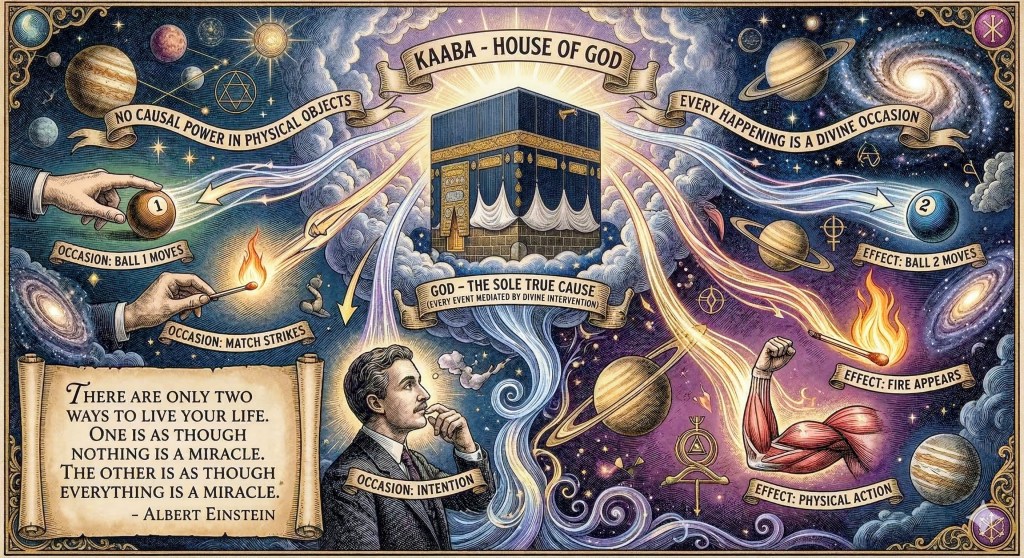
Under this framework, the universe is not a self-running machine operating on autopilot; it is a “story unfolding in real time” or a “constantly rendered scene”. Consequently, natural forces such as gravity are revealed to be convenient illusions. An apple falls to the ground not because of an innate, self-subsisting gravitational attraction inherent in the earth, but because God chooses to recreate the apple at a slightly lower spatial coordinate at each successive, discrete moment of time.
This continuous regeneration applies equally to the transfer of momentum. When a billiard ball rolls across a table and strikes a second ball, classical mechanics suggests that the first ball directly transfers its kinetic energy to the second. In al-Ghazali’s occasionalist paradigm, however, the first ball has no autonomous power to act. Instead, God terminates the motion of the first ball and directly creates the motion of the second ball at the exact moment of impact. What humans perceive as physical momentum is simply the continuous frame-by-frame rendering of spatial coordinates by the Divine Will.
The Fire and the Cotton: Constant Conjunction versus Metaphysical Necessity
In his famous text Tahafut al-Falasifa (The Incoherence of the Philosophers), al-Ghazali challenges the prevailing philosophical view that physical objects possess inherent causal powers that necessitate specific effects. The philosophers argued that the connection between an efficient cause (such as fire) and its effect (such as the combustion of cotton) is necessary and inviolable.
Al-Ghazali dismantles this by drawing a sharp distinction between empirical regularity and metaphysical necessity. He argues that empirical observation only reveals that two events regularly occur together (constant conjunction); it does not and cannot prove that one event causes the other. One observes the cotton turning black and combusting with the contact of the flame, but one cannot observe the fire itself actively generating the combustion. The true efficient cause of the burning, the blackness, and the separation of the cotton’s fibers is God—either directly or through the mediation of angelic agents—not the inanimate fire, which lacks both consciousness and causal efficacy. The fire is merely the occasion upon which the divine action occurs, not the true cause.
Miracles as the Logical Bridge to Everyday Occasionalism
A major theological impetus for al-Ghazali’s occasionalism was the preservation of the logical possibility of miracles, as described in the Quranic narratives. If the laws of nature were metaphysically necessary and inherent in the essence of things, then events like the suspension of fire’s burning power or the transformation of Moses’s staff would be logical impossibilities.
By establishing that physical objects possess no fixed, autonomous nature, al-Ghazali provides a seamless explanation for these extraordinary events. The miracles of Moses—such as his wooden staff transforming into a living serpent, or the waters of the Nile turning to blood—serve as dramatic empirical proofs of absolute divine sovereignty over matter. A wooden staff has no intrinsic, self-subsisting “nature” that prevents it from becoming a snake; it remains a staff only because God customarily chooses to recreate its wood-like qualities at each successive moment.
If God chooses to alter His custom, the staff instantly manifests the qualities of a serpent. Therefore, miracles are not violations of “laws of nature” (since nature possesses no independent, prescriptive laws), but are simply instances where God chooses to act differently than His customary pattern (sunnat Allaˉh). This realization serves as a logical bridge: if God can transform a staff into a serpent in a special case, then every ordinary instance of fire burning, water flowing, or bread nourishing is revealed to be equally dependent on His direct, moment-by-moment creative command. Occasionalism is, as Zia H. Shah MD beautifully summarizes, the rigorous “metaphysics of Inshallah” (if God wills), demonstrating that the entire cosmos is utterly contingent on the divine choice at every single instant.
Human Agency and the Ash’arite Theory of Acquisition
Extending occasionalism to human actions raises profound questions regarding free will, moral responsibility, and divine justice. If God is the sole immediate cause of every event in the universe, including the movements of our limbs and the thoughts in our minds, how can human beings be held accountable for their actions?
To resolve this, the Ash’arite tradition developed the subtle theory of Kasb (acquisition). Under this doctrine, human beings do not possess the autonomous power to create or effectuate physical actions. When a person intends to perform an action—such as throwing a handful of sand—God directly creates the physical motion of the arm and the trajectory of the sand at the exact moment of that choice.
The human role is not the creation of the act, but the acquisition of it through their internal choice and moral intention. Thus, God remains the sole creator of the physical deed, while the human being remains morally accountable for the intention and choice behind it. This delicate balance is explicitly captured in the Quranic description of the Battle of Badr: “You did not throw when you threw, but God threw” (Quran 8:17), which serves as a striking scriptural affirmation that while humans carry out the physical gesture of choosing and acting, the ultimate effectuation of every physical event traces back directly to the divine power.
The Zia H. Shah MD Synthesis: Occasionalism in the Age of Quantum Physics
For centuries, al-Ghazali’s occasionalism was dismissed by secular critics as a medieval theological oddity that allegedly hindered scientific progress by denying stable secondary causes. However, in the modern era, Zia H. Shah MD has revitalized this occasionalist framework, demonstrating that cutting-edge discoveries in quantum mechanics, cosmology, and information theory provide a stunning physical resonance with Ghazalian metaphysics.
Quantum Indeterminacy and Wave Function Collapse as Divine Interface
In classical Newtonian physics, the universe was viewed as a rigidly deterministic system where every event was locked into place by prior physical causes, leaving no conceptual room for divine action without physically “breaking” the laws of nature. Quantum mechanics has completely upended this deterministic paradigm, revealing that the subatomic level of reality is fundamentally probabilistic.
According to the Copenhagen interpretation, physical systems do not exist in definite states until they are measured; rather, they exist as mathematical superpositions of multiple potential outcomes, represented by the wave function (ψ). At the moment of measurement, this wave function undergoes an instantaneous “collapse” into a single, localized reality. Standard physics labels this collapse as “purely random” because there is no local, deterministic physical cause that dictates why one specific state is realized over another.
Zia H. Shah MD proposes that this quantum indeterminacy serves as the modern scientific interface for occasionalism. What physics designates as “randomness” is, in reality, the immediate expression of the Divine Will. God, as the unceasing Sustainer of the cosmos, directly collapses the wave function at every micro-instant, choosing which quantum potentiality is actualized into physical reality.
Because these individual divine choices conform to the statistical probability distributions of quantum mechanics on a macroscopic scale, the overall predictability of the physical world is maintained. This allows God to exercise continuous, real-time providence and guidance over the universe—influencing everything from the mutations driving biological evolution to the neural processes in the human brain—without ever violating or “breaking” the observable macro-laws of physics. It goes far beyond the “quantum divine action” proposed by Western theologians like John Polkinghorne and Robert John Russell, who suggest God merely nudges quantum events; under occasionalism, God actively determines every single quantum collapse as an ongoing act of continuous creation.
Quantum Entanglement, Nonlocality, and Metaphors of Divine Closeness
The experimental verification of quantum entanglement has further dismantled classical local realism. When two particles are entangled, they behave as a single, unified system, where a measurement performed on one particle instantly determines the state of its distant partner, regardless of whether they are separated by a millimeter or a light-year. Einstein skeptically termed this phenomenon “spooky action at a distance” because it violates the principle of local causality, which dictates that physical influences cannot travel faster than the speed of light. The 2022 Nobel Prize in Physics honored experiments proving that Bell’s inequalities are violated, confirming that nature is fundamentally non-local and that physical coordinates in intervening space do not cause the matching values.
Zia H. Shah MD presents quantum nonlocality as a profound physical metaphor for the central Islamic tenets of Tawhid (divine unity) and Ma’iyyah (divine omnipresence). In the classical materialist paradigm, the universe is viewed as a fragmented collection of isolated objects interacting through localized forces. Quantum entanglement reveals that the cosmos is an deeply relational, interconnected whole where separate entities act in absolute, instantaneous coordination. This holistic coordination mirrors a universe operating under a single, immediate divine command. Furthermore, just as spatial distance presents no barrier or delay to the instantaneous coordination of entangled particles, physical space presents no barrier to God’s immediate connection, knowledge, and action, providing a scientific resonance to the declaration: “He is with you wherever you are” (Quran 57:4).
Scientific Laws as Divine Habits: The Frank-Marmura Debate and Metaphysical Humility
To fully integrate occasionalism with scientific inquiry, Shah addresses the historical critiques of the doctrine, reframing the “laws of nature” not as independent, prescriptive necessities, but as descriptive accounts of “God’s customary way of acting”. This perspective preserves the logical foundation of science while cultivating a deep metaphysical humility.
Shah highlights the famous academic debate between Islamic studies scholars Richard Frank and Michael Marmura. Frank argued that al-Ghazali did not adhere to a strict, literal occasionalism but allowed for natural, secondary causation, positing that God acts of necessity to maintain a teleological cosmic system. Marmura, in direct opposition, defended the view that al-Ghazali maintained traditional Ash’arite occasionalism, where God is the sole immediate cause of every event, and modified his philosophy of science to accommodate this framework.
To reconcile these conflicting textual interpretations, Shah highlights a synthesised model: al-Ghazali maintained an intermediate position where created things possess passive potentials to act or be acted upon, which remain completely inert until actualized by the divine volitional agent at each successive moment. As Lenn Goodman emphasizes, al-Ghazali’s stance does not reject empirical regularity, but merely denies its metaphysical inevitability.
Thus, the “laws of nature” are descriptive customs (sunnat Allaˉh) that are highly reliable and study-able, yet completely dependent on the Creator’s continuous volition. This reinterpretation finds modern parallels in process philosophy, such as Alfred North Whitehead’s view of the universe as a dynamic series of continually recreated events, and in the Copenhagen interpretation of quantum mechanics, where physical reality remains a set of contingent possibilities until actualized.
Cosmological Horizons: Expanding Space, Extra Dimensions, and Quantum Pairs
Zia H. Shah MD extends this synthesis to the macro-scale of modern cosmology. The Quran declares: “And We have built the heavens as a manifestation of several of Our attributes, and surely We go on expanding the universe” (Quran 51:47). Modern astrophysics has confirmed that the observable universe is indeed expanding, stretching across approximately 93 billion light-years. This continuous, dynamic expansion of space itself—which does not violate relativity because it is space itself expanding, not an object moving through space—serves as a physical manifestation of God’s active, ongoing governance.
Furthermore, modern physical theories, such as string theory, propose the existence of extra spatial dimensions to unify gravity with other fundamental forces. Shah proposes that the confirmation of these extra dimensions will provide a conceptual pathway to justify the highly intimate, non-local Quranic descriptions of divine knowledge, providence, and the afterlife.
This is structurally coupled with the quantum reality of particle pairing. Immediately preceding the Quranic verse on the expanding universe, the text notes: “And We created everything in pairs” (Quran 51:49). In modern physics, this is mirrored in the discovery of charge-conjugate pairs, such as the electron and its antimatter partner, the positron. This pairing is fundamental to the stability and quantum structure of vacuum energy, illustrating how reflecting on these dualities—from cosmology to subatomic physics—expands our metaphysical horizons and solidifies our understanding of divine providence.
The Psychological Anchor: Remembrance in a Contingent World
The realization that every cause-and-effect relationship is entirely contingent on the Divine Will has profound psychological implications for human life. In a deterministic or purely materialist universe, human beings are subject to the blind, indifferent forces of nature, leading to existential anxiety and alienation.
Occasionalism, by contrast, establishes that there is no intermediary between the human soul and the Creator; every physical effect, from the warming of the sun to the healing of a disease, is a direct, intimate act of God. Consequently, true psychological peace and existential stability cannot be found by clinging to secondary causes, which are fundamentally powerless.
As Shah notes, this theological reality illuminates the psychological weight of the Quranic verses: “Surely in the remembrance of Allah do hearts find comfort” (Quran 13:28) and “Those who believe and work righteousness, Joy is for them, and a beautiful place of return” (Quran 13:29). The practice of dhikr (remembrance) serves as a spiritual and psychological anchor. By consciously aligning one’s soul with the ultimate Source of all outcomes, the believer finds true comfort, navigating a contingent, unpredictable world with an unshakeable trust in the continuous care of the Sustainer.
Thematic Epilogue
The systematic integration of Quran 57:1-6, Ghazalian occasionalism, and modern physics culminates in a highly coherent, dynamic worldview. It dismantles the historical, artificial wall between the “Word of God” (scriptural revelation) and the “Work of God” (the physical cosmos), uniting them under a single metaphysical framework.
When the human mind contemplates the physical laws of nature, it is not looking at self-existent, cold, mechanical necessities that operate independently of the divine realm. It is looking at the beautifully consistent, mathematically elegant “customs” of a personal, living Creator who manages the cosmos frame-by-frame. Science, far from being an antagonist to faith, becomes the highly disciplined, empirical study of these divine habits.
This occasionalist paradigm demands a profound existential shift. It infuses the natural world with a vibrant, sacred sentience. The background hum of the subatomic wave function, the deterministic reliability of macroscopic forces, and the vast non-local corridors of quantum space are not dead, blind matter; they are the involuntary, continuous Tasbih of the cosmos, exalting the sovereign Will that keeps them in existence moment by moment.
For the conscious human agent, recognizing that every heartbeat, every falling leaf, and every collapsing quantum state is a direct, intimate gift of creation from Al-Hayy Al-Qayyum dissolves the illusion of human self-sufficiency. It fosters a deep state of metaphysical humility, psychological tranquility, and absolute reliance on the One who is the First and the Last, the Manifest and the Hidden, and who remains closer to us than our very selves.


 The Glorious Quran and Science
Leave a comment