
Presented by Zia H Shah MD with the help of Claude
Abstract
This commentary examines the Quranic phrase وَكُلٌّ فِي فَلَكٍ يَسْبَحُونَ (“and each, in an orbit, is swimming”), which closes Surah Al-Anbiyāʾ 21:33 and Surah Yā Sīn 36:40. Through integrated philological, scientific, philosophical, and theological analysis, the essay argues that these seven words compress a cosmological vision of striking precision: a dynamic, ordered, and relational cosmos in which celestial bodies themselves—not merely their enclosing spheres—move along determinate curved paths with a motion the Qurʾān likens to swimming. The linguistic analysis of the root س-ب-ح (s-b-ḥ) uncovers a semantic field linking physical gliding through a medium with metaphysical glorification (tasbīḥ), so that cosmic motion and cosmic worship share a single morphological root. The scientific commentary documents that every astronomical and subatomic scale confirms ubiquitous, non-colliding motion—from the Moon’s 1.022 km/s orbital velocity to the Sun’s ~220–240 km/s circuit of the Galactic Centre, to the Local Group’s ~600 km/s bulk flow, to the irreducible zero-point motion mandated by the Heisenberg Uncertainty Principle. Philosophically, the verse positions the Qurʾān in dialogue with Heraclitean flux and Aristotelian–Avicennian arguments for a First Unmoved Mover. Theologically, it reframes nature as āyāt (signs) performing tasbīh by the very fact of motion. The essay closes by distinguishing a legitimate reading of the verse’s semantic generosity from the overreach of reductive iʿjāz ʿilmī concordism, proposing that the verse’s true force lies neither in predicting Newtonian mechanics nor in anticipating Gaia-era astrometry, but in disclosing a cosmos whose motion is itself a liturgy.
The verses in context
Surah Al-Anbiyāʾ 21:31–33
٣١ وَجَعَلْنَا فِي ٱلْأَرْضِ رَوَاسِيَ أَن تَمِيدَ بِهِمْ وَجَعَلْنَا فِيهَا فِجَاجًا سُبُلًا لَّعَلَّهُمْ يَهْتَدُونَ Wa jaʿalnā fī’l-arḍi rawāsiya an tamīda bihim wa jaʿalnā fīhā fijājan subulan laʿallahum yahtadūn. “And We placed within the earth firmly set mountains, lest it should shift with them, and We made therein [mountain] passes as roads, that they might be guided.” Quranic Arabic Corpus +2
٣٢ وَجَعَلْنَا ٱلسَّمَآءَ سَقْفًا مَّحْفُوظًا ۖ وَهُمْ عَنْ ءَايَـٰتِهَا مُعْرِضُونَ Wa jaʿalnā as-samāʾa saqfan maḥfūẓan wa hum ʿan āyātihā muʿriḍūn. “And We made the sky a protected canopy, yet from its signs they turn away.” Quran.comAl-Islam
٣٣ وَهُوَ ٱلَّذِى خَلَقَ ٱلَّيْلَ وَٱلنَّهَارَ وَٱلشَّمْسَ وَٱلْقَمَرَ ۖ كُلٌّ فِى فَلَكٍ يَسْبَحُونَ Wa huwa alladhī khalaqa al-layla wa an-nahāra wa ash-shamsa wa al-qamara; kullun fī falakin yasbaḥūn. “And it is He who created the night and the day, the sun and the moon — each, in an orbit, is swimming.” My Islam +3
The passage sits within a polemical section addressing Meccan disbelief. Earth is presented as stabilized, the sky as a “protected canopy” (saqfan maḥfūẓan), and the luminaries as participants in an ordered motion. Al-Ṭabarī links verse 32 to a theology of cosmic preservation—the sky does not collapse, the planets do not collide—while verse 33 supplies the mechanism: each is held in its own falak, coursing continuously. The rhetorical contrast is sharp: creation’s order is transparent (āyāt), yet humans are “turning away” (muʿriḍūn). Quran.com Observation is offered, refusal is diagnosed.
Surah Yā Sīn 36:36–40
٣٦ سُبْحَـٰنَ ٱلَّذِى خَلَقَ ٱلْأَزْوَٰجَ كُلَّهَا مِمَّا تُنۢبِتُ ٱلْأَرْضُ وَمِنْ أَنفُسِهِمْ وَمِمَّا لَا يَعْلَمُونَ Subḥāna alladhī khalaqa al-azwāja kullahā… “Exalted is He who created all pairs — from what the earth grows, and from themselves, and from that which they do not know.” Quran.com +3
٣٧ وَءَايَةٌ لَّهُمُ ٱلَّيْلُ نَسْلَخُ مِنْهُ ٱلنَّهَارَ فَإِذَا هُم مُّظْلِمُونَ Wa āyatun lahumu al-laylu naslakhu minhu an-nahāra fa-idhā hum muẓlimūn. “And a sign for them is the night. We strip from it the day, and behold, they are in darkness.” QuranIslamic Studies
٣٨ وَٱلشَّمْسُ تَجْرِى لِمُسْتَقَرٍّ لَّهَا ۚ ذَٰلِكَ تَقْدِيرُ ٱلْعَزِيزِ ٱلْعَلِيمِ Wa ash-shamsu tajrī li-mustaqarrin lahā; dhālika taqdīru al-ʿazīzi al-ʿalīm. “And the sun runs toward a resting-place decreed for it. That is the determination of the Exalted in Might, the Knowing.” Quran.com +3
٣٩ وَٱلْقَمَرَ قَدَّرْنَـٰهُ مَنَازِلَ حَتَّىٰ عَادَ كَٱلْعُرْجُونِ ٱلْقَدِيمِ Wa al-qamara qaddarnāhu manāzila ḥattā ʿāda ka-l-ʿurjūni al-qadīm. “And the moon — We have ordained for it phases, until it returns like the old date-stalk.” QuranClear Quran
٤٠ لَا ٱلشَّمْسُ يَنۢبَغِى لَهَآ أَن تُدْرِكَ ٱلْقَمَرَ وَلَا ٱلَّيْلُ سَابِقُ ٱلنَّهَارِ ۚ وَكُلٌّ فِى فَلَكٍ يَسْبَحُونَ Lā ash-shamsu yanbaghī lahā an tudrika al-qamara wa lā al-laylu sābiqu an-nahāri; wa kullun fī falakin yasbaḥūn. “It is not for the sun to overtake the moon, nor does the night outrun the day — and each, in an orbit, is swimming.” My Islam +2
The Yā Sīn passage is denser and more technical. It opens with subḥān (36:36), already sounding the root that will return in verse 40’s yasbaḥūn. It then introduces three explicit mechanics: the sun “runs toward a resting-place” (tajrī li-mustaqarrin lahā), the moon passes through discrete stations (manāzil), and the two bodies do not overtake one another. The closing clause generalizes: this regularity is an instance of taqdīr—divine measuring, proportioning, decree. Al-Zamakhsharī reads the passage as a display of mīzān (balance); al-Rāzī as a direct argument from cosmic regulation to the existence of a Regulator; Ibn Kathīr as theological consolation that the natural order will not unravel.
Philology of motion and worship
The root س-ب-ح
The Quranic Arabic Corpus records ninety-two occurrences of s-b-ḥ across the Qurʾān, The Last Dialogue distributed over several derived forms. Quranic Arabic Corpus Al-Rāghib al-Iṣfahānī, in the Mufradāt, anchors the root in a single physical intuition: al-sabḥ is “swift, unimpeded passage through water and through air”—al-marr al-sarīʿ fī al-māʾ wa fī al-hawāʾ. Lane’s Lexicon, drawing on Lisān al-ʿArab and Tāj al-ʿArūs, gives natation, gliding, and “coursing along without immersion,” Lane’s LexiconQuranX then extends the sense to “going far” and “being swift in motion.” Form I sabaḥa/yasbaḥu is the imperfect of that concrete image.
The theological sense emerges in Form II, sabbaḥa/yusabbiḥu, whose verbal noun is tasbīḥ. Morphologically, the doubled middle radical carries the well-known causative-intensive force: “to cause or declare to go far.” Semantically, al-Rāghib reads this as tanzīh—the declaration that God is far removed (munazzah) from every imperfection, every partner, every resemblance. The believer who says subḥān Allāh performs, in speech, the movement that the swimmer performs in water: a setting-apart, a going-beyond, a clearing of the medium. The homology is exact and, in classical Arabic, conscious.
This produces the root’s most theologically arresting property: the same lexical family that names the unimpeded motion of celestial bodies also names the act of glorifying God. The Qurʾān exploits this directly. Yā Sīn opens its cosmological section with subḥāna alladhī khalaqa al-azwāja (36:36) WordPress and closes it four verses later with wa kullun fī falakin yasbaḥūn (36:40). The ring is not accidental. The sun’s running is, etymologically, a species of glorification; the worshipper’s glorification is, etymologically, a form of gliding.
A methodological caution is in order. Classical lexicographers (Lisān, Ṣiḥāḥ, and contemporary standards including Hans Wehr) agree that Form I yasbaḥu in classical usage carries only the physical meaning—swim, float, glide, course. The theological sense is proper to Form II. WordReference The verb yasbaḥūn in 21:33 and 36:40 is therefore not “they glorify,” but “they swim/course.” The glorification reading enters obliquely: through the root’s resonance, through the echo across verses, and through the explicit parallel texts (17:44; 59:24) that identify all things as musabbiḥ.
The word فَلَك
Lane’s Lexicon lists no fewer than eight distinct senses of falak, all organized around the primitive image of a round thing that turns. The Semitic cognates are instructive: Akkadian pilakku and Hebrew pelek denote the whorl of a spindle; Geʿez falaka means “to revolve.” Muslim Hope The classical Arabic falka is the whorl itself—the hemispherical disc through which the spindle-pin rotates—and the commentary tradition preserves this etymology. Al-Ṭabarī and Ibn Kathīr both record the gloss of Ibn ʿAbbās: fī falkatin ka-falkati al-mighzal—”in a whorl like the whorl of a spindle.” WikiIslam +2 The image is of smooth, disciplined rotary motion along a curved path.
From this root the extended senses radiate: the vault of heaven, the pole about which the sky turns, Al-Salam InstituteQuranX the orbit of a specific luminary, a circular wave on the sea, a rounded mound of sand, QuranX the cartilage of the knee, the roundness of a young woman’s breast. In post-Ptolemaic Arabic scholarship, falak became a technical term for each of the concentric celestial spheres, Quran.com and ʿilm al-falak (literally “the science of the sphere”) is the standard Arabic term for astronomy from the Marāgha observatory through today. English translators have accordingly oscillated: Arberry’s “sky,” Pickthall’s and Sahih International’s “orbit,” Shakir’s “celestial sphere.” quran The classical ambiguity is a genuine feature of the text, not a defect.
The universality of وَكُلٌّ
The indefinite kullun (“each, every [one]”) with tanwīn functions as a pronominal substitute whose reference extends to the antecedents under discussion—at minimum, sun and moon; contextually, also night and day; and by implication, every body of the kind mentioned. Classical commentators, including al-Zamakhsharī and al-Qurṭubī, understood the form to embrace the stars as well. Surah Quran The universality is not a rhetorical flourish: when the same phrase concludes two separate passages (21:33 and 36:40), the claim is systemic—whatever moves in the heavens moves in its own curved path, and nothing is exempted.
The grammatical anomaly of يَسْبَحُونَ
The most philologically striking feature of the phrase is its verb form. Yasbaḥūn carries the wāw al-jamāʿa, the plural-masculine-rational suffix reserved in classical Arabic for ʿuqalāʾ—humans, angels, jinn. The standard agreement for non-rational plurals (jamʿ ghayr al-ʿāqil) such as stars would be feminine-singular (yasbaḥu or tasbaḥu). Al-Zamakhsharī, followed by Tafsīr al-Jalālayn and Ibn Kathīr, classifies this as tanzīl ghayr al-ʿāqil manzilat al-ʿāqil—treating the non-rational as though rational. Quran Oquranx The rhetorical function is personification: the celestial bodies perform their motion the way rational agents perform their duties, Surah Quran with regularity, lawfulness, and purpose. Al-Rāzī extends the point into theology: the rational plural signals willed obedience, a motion that is not mere mechanical necessity but conscious submission to divine command. The same grammatical device appears in Yūsuf’s dream (12:4), where the stars “prostrate” using the rational-plural sājidīn.
What science has uncovered
The verse’s philological claim—that every celestial body moves along its own curved path with an unimpeded, swimming-like motion—finds an unexpected vindication in the modern astronomical record.
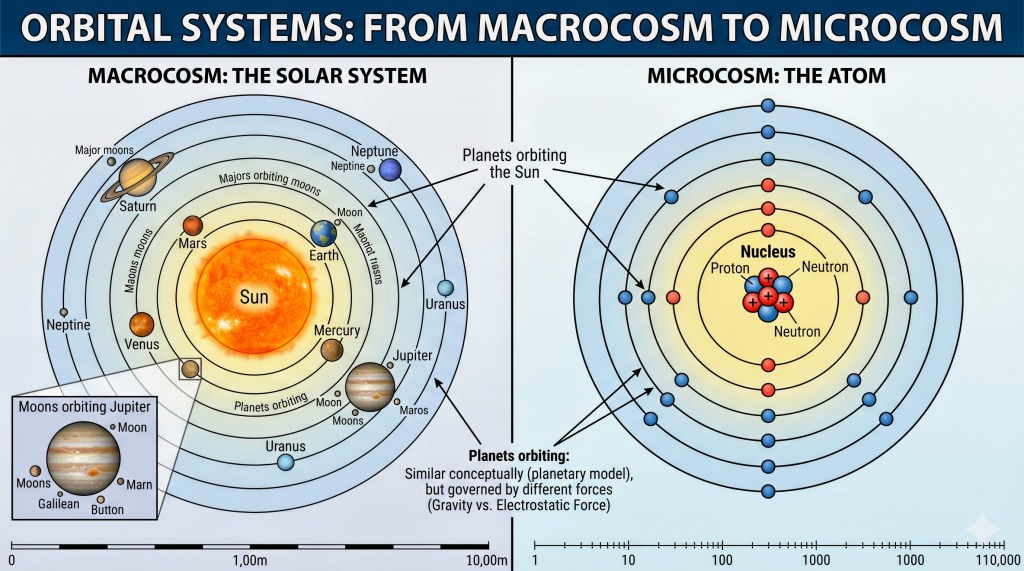
Orbits within orbits
The Moon circles the Earth at a mean velocity of 1.022 km/s Wikipedia with a sidereal period of 27.3217 days, Aerospaceastro receding from Earth at 3.8 cm per year due to tidal dissipation (Dickey et al., 1994). The Earth orbits the Sun at 29.78 km/s, completing a sidereal year of 365.256 days. NASA NSSDCA The Sun circles the Galactic Centre at approximately 220–240 km/s (Hunt et al., 2016), completing one “galactic year” every 225–250 million years. Embedded in this galactic motion is the Sun’s own proper drift with respect to nearby stars—the solar apex—directed toward a point in the constellation Hercules near Wikipedia Vega, AlchetronThe Oikofuge at roughly 13– Wikipedia20 km/s Hellenica World (Herschel, 1783; Dehnen & Binney, 1998). The Milky Way itself drifts through the Local Group and toward the Great Attractor and Shapley Supercluster, Wikipedia and relative to the Cosmic Microwave Background rest frame the Sun moves at 369.82 ± 0.11 km/s Wikipedia while the Local Group moves at Wikipedia ~631 km/s. Nowhere in the observable universe is anything at rest.
Stillness is forbidden at every scale
The principle generalizes below the astronomical. Classical electron orbits were already known to be impossible by 1913: an accelerating charge radiates energy, and a classical electron would spiral into the nucleus in ~10⁻¹¹ seconds. Quantum mechanics replaced the orbit with the orbital—a probability cloud |ψ|² of finding the electron in a region of space. Yet motion, in the sense of non-vanishing momentum expectation, remains: a ground-state hydrogen electron has a kinetic energy expectation of 13.6 eV. Electrons, protons, neutrons, and quarks all carry intrinsic angular momentum—spin ½ ℏ—not as a literal rotation but as a genuine, conserved, irreducible quantum feature. Inside every nucleon, quarks are bound by gluons Wikipedia through a confining potential, exchanging color charge with lattice-QCD-verified dynamism, and the ~99% of proton mass that is not bare quark rest-mass Nature is pure field energy.
Most decisively, the Heisenberg Uncertainty Principle (Δx·Δp ≥ ℏ/2) renders absolute stillness physically impossible. A perfectly localized particle would have infinite momentum uncertainty and thus infinite kinetic energy. Hence even at absolute zero, quantum systems retain zero-point motion: the hydrogen 1s electron cannot collapse onto the proton; helium-4 remains liquid at 0 K; nanomechanical oscillators exhibit irreducible “quantum jitter” (Safavi-Naeini et al., 2012). The classical notion of an inert, static substance has been displaced at every scale. Kullun fī falakin yasbaḥūn is, physically, not an exaggeration but an understatement.
The sun’s mustaqarr
Yā Sīn 36:38—wa ash-shamsu tajrī li-mustaqarrin lahā—is the single most discussed cosmological verse in the Qurʾān. The participle mustaqarr, from the root q-r-r (to settle), is morphologically indeterminate: it can be a place, a time, or an act of settling. Quran.com Classical commentators offered four readings. Al-Rāzī and Mujāhid favored the eschatological: the sun runs until its appointed term on the Day of Judgement. Quran.com Others, following the Abū Dharr ḥadīth (Bukhārī and Muslim), read it as daily: the sun reaches a nightly resting-place beneath the Throne. Quran.comQuran.com A third reading, attributed to Ibn Masʿūd’s variant qirāʾa lā mustaqarra lahā (“it has no resting-place”), Alim inverts the sense: the sun’s motion is ceaseless. QuranX A fourth, cross-referenced to 39:5 (kullun yajrī li-ajalin musammā), interprets mustaqarr as an appointed term.
Modern science has added a fifth interpretation. The Sun does in fact “run” toward a specific spatial destination: the solar apex in Hercules, Yolasite identified by William Herschel in 1783. Alchetron Maurice Bucaille’s 1976 reading, Worldofislam popularized in contemporary daʿwa literature, Cambridge CoreWikipedia identifies mustaqarr with this apex. This modern reading does not displace the classical ones; rather, the classical semantic generosity appears, in hindsight, to have accommodated a sense its original audience could not have constructed. The apologetic tradition has often overreached in such pairings, and a careful commentator should note Social Epistemology that no classical mufassir proposed a solar apex. But the semantic shape of the word is irreducibly dynamic, and the verse’s plain sense—the sun is running somewhere—is considerably closer to modern astrophysics than the Ptolemaic consensus that dominated learned cosmology for 1,400 years after its composition.
Why the sun does not overtake the moon
36:40 opens with a mechanical constraint: lā ash-shamsu yanbaghī lahā an tudrika al-qamar—”it is not for the sun to reach the moon.” My IslamQuran O In Newtonian and post-Newtonian terms, this is a statement about orbital non-interference: each body’s semi-major axis and orbital period are uniquely determined by Kepler’s Third Law (T² ∝ a³), and bodies on distinct orbits do not “catch” one another except through perturbation or resonance. The Moon’s Hill radius, Lagrange points, and the bounded-chaos character of solar-system dynamics identified by Jacques Laskar (1989, Nature) Nature all articulate a single underlying fact: the system is stable through relational proportion, not through stasis. Laskar’s Lyapunov time of ~5 Myr shows the system is strictly chaotic; Scholarpedia Laskar & Gastineau (2009) estimate a ~1% probability Oxford Academic that Mercury’s orbit destabilizes over the Sun’s remaining lifetime. Yet within these bounds, the structure is preserved over geological time. The phrase wa kullun fī falakin yasbaḥūn names precisely this: a bounded chaos whose boundedness is itself the signature of taqdīr.
Philosophical weight
A 7th-century text without a 7th-century cosmology
The cosmology of 7th-century Arabia was not Copernican. Ptolemaic geocentrism, with its system of crystalline spheres, deferents, and epicycles, was the learned consensus Muslim Hope across the Mediterranean and Near East, University of Rochester but its technical literature would begin to enter Arabic only with the translations of the 8th and 9th centuries. Wikiislam The Bedouin cosmology of the Hejaz and Najd, as reconstructed by Daniel Varisco and others, was a practical star-lore—the anwāʾ tradition—embedded in a tiered, tent-like conception of the heavens Wikipedia that the Qurʾān itself elsewhere describes in terms of samāwāt sabʿ (seven heavens). Encyclopedia MDPI
Against this backdrop, the phrase kullun fī falakin yasbaḥūn is culturally anomalous. It does not describe a flat earth under a domed sky; it describes determinate curved paths in which each body performs its own motion. Heliocentrism would not be proposed by Aristarchus in any systematic form until c. 270 BCE and would remain dormant until Copernicus’s De revolutionibus in 1543. Galactic rotation would be demonstrated by Oort only in 1927. EBSCO The solar apex was unknown until Herschel in 1783. Alchetron The Qurʾān’s 7th-century audience did not request, and could not have produced, such cosmological precision. It was culturally unnecessary information—a fact with considerable philosophical weight. A text that troubles to say more than its audience can use is either gratuitous or pointing past them.
Heraclitus, Parmenides, and the dynamic cosmos
The verse’s vision of universal motion invites comparison with Heraclitus of Ephesus, whose panta rhei—”everything flows”—stands as antiquity’s strongest affirmation of a cosmos of becoming rather than being. Parmenides’s counter-thesis, that true reality is the unchanging One and motion an illusion, Ijhssi framed the opposition that would haunt Greek metaphysics for a millennium. The Qurʾān takes neither side cleanly. It affirms creaturely motion as pervasive and real—kullun, “each and every”—while locating stasis, permanence, and unchangingness only in God (al-Ḥayy al-Qayyūm, 2:255). This is the classical Islamic position: change is ontologically real but metaphysically dependent; only the Necessary Existent is without motion because only He is without potency requiring actualization.
Aristotle, Ibn Sina, Ibn Rushd, Aquinas
If everything moves, what moves it? Aristotle’s Metaphysics Λ (Book XII) produced the classical answer: the chain of movers cannot regress infinitely, and so there must be a First Mover, itself unmoved, eternal, immaterial, and actual rather than potential. This is the ancestor of Aquinas’s First Way. The Islamic falsafa tradition transformed the argument. Al-Kindī, working from the ḥudūth (origination) premise, argued that a universe that began to exist requires a cause—the direct precursor of what is now called the kalām cosmological argument. Ibn Sīnā reframed the argument from motion into an argument from contingency: every existent whose essence is distinct from its existence is a mumkin al-wujūd (contingent being) requiring grounding in a wājib al-wujūd (necessary being) whose essence is its existence. Ibn Rushd, defending Aristotle against al-Ghazālī’s Tahāfut al-falāsifa, argued that the Prime Mover’s causality is eternal and that the cosmos’s perpetual motion is itself the mark of that causality.
The Quranic phrase, read through this tradition, does not prove the Unmoved Mover—but it supplies the premise the argument requires. Wa kullun fī falakin yasbaḥūn asserts, in one compressed line, that nothing in the observable cosmos is at metaphysical rest. If this is true universally, then the Unmoved Mover cannot be internal to the cosmos. Aquinas would recognize the argument instantly; so would Ibn Sīnā.
The metaphor of swimming
The choice of yasbaḥūn rather than yadūrūn (they rotate) or yajrūn (they run) is philosophically loaded. Swimming connotes effortless, medium-bearing, buoyant motion—not the grinding of gears, not the rolling of wheels, not the being-dragged of cargo. Al-Rāzī’s argument against the Ptolemaic hard-sphere model turns precisely on this verb: a body “swims” in a medium only if the medium yields to it and carries it. To say the planets are embedded in solid crystalline spheres, like nails in a door, makes yasbaḥūn unintelligible. Al-Rāzī’s 12th-century intuition—that the text requires the bodies themselves to move through a permeable medium—anticipates, without predicting, the Newtonian picture of bodies in empty space moving under central force.
This organic, fluid metaphor contrasts sharply with the clockwork universe of Newton and Laplace, in which cosmic motion is mechanical necessity. Yet the Quranic vision also contrasts with a merely chaotic flux, because the motion is fī falakin—along a defined curved path, within taqdīr. The text thereby avoids both the reductionism of pure mechanism and the indeterminacy of pure flow. Motion is disciplined, gracious, and purposeful—three adjectives that capture much of what distinguishes the Quranic cosmos.
Theological synthesis
Cosmos as text, motion as tasbīh
The Qurʾān’s most distinctive contribution to natural theology is its treatment of nature as āyāt—signs or verses—a word it uses both for its own scriptural units and for the phenomena of the created order. The two are semantically indistinguishable. This produces the “two books” doctrine of later Islamic thought: the kitāb mustūr (the written Book) and the kitāb manshūr (the spread-open Book of creation). Sūrah 21:32–33 performs this identification explicitly—the sky has āyāt from which the disbelievers turn away, and the first āyāt specified is the orbital motion of sun and moon.
Against this backdrop, the root s-b-ḥ does unified work. The cosmos’s motion is not merely evidence of a Creator—it is, at the level of the root, already His glorification. Two parallel verses make this programmatic:
17:44 — tusabbiḥu lahu as-samāwātu as-sabʿu wa al-arḍu wa man fīhinn; wa in min shayʾin illā yusabbiḥu bi-ḥamdihī wa lākin lā tafqahūna tasbīḥahum. “The seven heavens and the earth, and whatever is in them, exalt Him. There is not a thing that does not exalt Him with praise, but you do not understand their exaltation.”
59:24 — yusabbiḥu lahu mā fī as-samāwāti wa al-arḍ. “Whatever is in the heavens and the earth exalts Him.”
When 21:33 and 36:40 then say that the sun, moon, and their company are yasbaḥūn, the surface meaning is “they swim,” but the harmonic overtone is unmistakable: they glorify by swimming. The motion is the liturgy. Orbit and worship are, in the Quranic lexicon, nearly the same word. A galaxy turning is a galaxy praying.
Mīzān, qadar, taqdīr
The theological vocabulary surrounding 36:40 is explicit. Verse 38 identifies the sun’s running as taqdīr al-ʿAzīz al-ʿAlīm—”the measuring of the Mighty, the Knowing.” Verse 39 describes the moon’s phases as qaddarnāhu manāzil—”We have measured for it stations.” Elsewhere the cosmos is described as resting on al-mīzān (the balance, 55:7) and on qadar (the measure, 54:49). Orbital mechanics is, in Quranic vocabulary, a branch of divine proportioning. The stability of the solar system that Laplace and Laskar have studied mathematically is, in this register, the material face of taqdīr—not because the physics is a cipher for the theology, but because the physics is what proportioning looks like when written in the grammar of matter.
Classical reception
The classical mufassirūn read the verse within the Ptolemaic framework available to them, but their reading was not uniformly Ptolemaic. Al-Ṭabarī glossed yasbaḥūn as yajrūn—”they run”—and took the motion to belong to the bodies themselves. Al-Zamakhsharī stressed that sabḥ is the word for smooth, unimpeded motion through a yielding medium, and that the choice of verb implies a fluid rather than a rigid cosmology. Al-Rāzī, in the Mafātīḥ al-Ghayb, pressed the point most explicitly: if the planets were fixed in impermeable spheres, “swimming” would be a misuse of the verb; therefore the falak is the madār—the circular path—rather than the solid Ptolemaic orb. Ibn Kathīr and al-Qurṭubī preserved the same understanding through their transmissional method. It is striking that the classical tradition, without telescopes and without heliocentric models, read the text in a direction more compatible with modern physics than with the medieval astronomy that dominated the surrounding culture.
The iʿjāz ʿilmī question
A serious commentary must take a position on the scientific-miracle tradition, which from Ṭanṭāwī Jawharī’s early twentieth-century al-Jawāhir through Maurice Bucaille’s The Bible, the Qurʾān and Science (1976), to the work of Zaghlūl al-Najjār, has read verses like 21:33 and 36:40 as coded predictions of modern science. The reading has generated enormous popular apologetics and equally robust scholarly critique. Nidhal Guessoum’s Islam’s Quantum Question (2011) is the most sustained internal critique, charging the tradition with concordism, eisegesis, selective citation, and a methodological failure to engage the philosophy of science. Ziauddin Sardar, Taner Edis, and Stefano Bigliardi have developed parallel criticisms, arguing that the enterprise treats the Qurʾān as a scientific textbook, ignores verses whose plain sense conflicts with modern cosmology, and conflates semantic capacity with predictive power.
The measured position defended in this essay is that 21:33 and 36:40 do not predict Newtonian mechanics, nor do they anticipate the solar apex or the Great Attractor in any strong sense. They are not physics. They are, however, also not captive to the Ptolemaic or Bedouin cosmologies of their environment. They describe universal, curved-path, unimpeded motion of celestial bodies, they integrate this into a theological grammar of proportioning and glorification, and they do so in a linguistic register whose semantic range is broad enough to have remained intelligible across fourteen centuries of expanding cosmological knowledge. The verse’s achievement is neither scientific prophecy nor cultural mimicry but cosmological openness—a formulation compact enough to be read faithfully by al-Ṭabarī in the 10th century, al-Rāzī in the 13th, and an astrophysicist today.
Epilogue: a cosmos in liturgy
To read wa kullun fī falakin yasbaḥūn in full is to read a sentence that refuses the modern split between physics and metaphysics. It asserts, in one breath, that the sun, the moon, and their kind move of their own motion (against the crystalline spheres of Ptolemy); that they move along determinate curved paths (anticipating, in semantic rather than quantitative form, the geometry of orbits); that their motion is smooth, swift, and unimpeded (against friction-based ancient mechanics); that they do not collide (against the dread of cosmic disorder that haunted antique religion); and that their motion is a kind of glorification, because the root that names their gliding is the root that names the worshipper’s declaration of divine transcendence.
Modern astronomy has ratified the first four of these claims literally. The fifth it cannot test. But the fifth, theologically, is the point of the other four. A cosmos in which nothing is still is a cosmos in which nothing is neutral. Every orbit is a posture; every orbit is a verb; every orbit conjugates, in its own medium, the same root that the human tongue conjugates when it says subḥān Allāh. The sun pulling its course toward Hercules and the believer bowing at dawn are, in this grammar, doing the same thing with different bodies. Heraclitus was right that everything flows, and the philosophical tradition from Aristotle through Ibn Sīnā was right that universal motion requires a still ground. The Qurʾān’s contribution, uttered in Mecca and Medina to an audience that did not know heliocentrism or galactic rotation, is that the motion is not merely physical and the ground is not merely metaphysical: the cosmos moves because it is alive, and it is alive because it is, at its root, in an attitude of praise.
The verse’s few words therefore operate on three simultaneous registers. Scientifically, they name a fact now documented from lunar laser-ranging to the CMB dipole: there is no stillness anywhere. Philosophically, they locate creaturely existence on the side of becoming, and divine existence on the side of pure actuality, in a way that opens space for the arguments of kalām and the Five Ways. Theologically, they transform what physics describes into what liturgy performs. The universe, in the Qurʾānic vision, is not a machine that happens also to obey God. It is a motion that is, in its very kinematics, a saying of His name. Each—in an orbit—is swimming; and the swimming is the prayer.


Leave a Reply