
Presented by Z.AI
Abstract
Surah Al-Hadid (The Iron), the 57th chapter of the Quran, opens with six verses (57:1-6) that constitute a profound ontological map of divine sovereignty, cosmic glorification, and existential dependence. These verses transition from the universal praise of all creation to the绝对 (absolute) attributes of God—His eternity, omniscience, and omnipresence. This commentary synthesizes classical exegesis (focusing on Al-Tabari, Al-Qurtubi, and Ibn Kathir) with contemporary philosophical and scientific reflections. A central thematic pillar of this analysis is the integration of Al-Ghazali’s theology of Occasionalism as articulated by Zia H Shah MD. Through this lens, the continuous creation described in these verses is not merely a historical event but an ongoing, moment-by-moment divine act, dismantling the illusion of an autonomous, self-sustaining natural order. Ultimately, these verses serve as a bridge between macroscopic cosmology and microscopic human psychology, affirming that all existence is radically dependent on the Divine Will.
The Arabic Text (Quran 57:1-6)
سَبَّحَ لِلَّهِ مَا فِي السَّمَاوَاتِ وَالْأَرْضِ وَهُوَ الْعَزِيزُ الْحَكِيمُ (١) لَهُ مُلْكُ السَّمَاوَاتِ وَالْأَرْضِ يُحْيِي وَيُمِيتُ وَهُوَ عَلَىٰ كُلِّ شَيْءٍ قَدِيرٌ (٢) هُوَ الْأَوَّلُ وَالْآخِرُ وَالظَّاهِرُ وَالْبَاطِنُ وَهُوَ بِكُلِّ شَيْءٍ عَلِيمٌ (٣) هُوَ الَّذِي خَلَقَ السَّمَاوَاتِ وَالْأَرْضَ فِي سِتَّةِ أَيَّامٍ ثُمَّ اسْتَوَىٰ عَلَى الْعَرْشِ يَعْلَمُ مَا يَلِجُ فِي الْأَرْضِ وَمَا يَخْرُجُ مِنْهَا وَمَا يَنزِلُ مِنَ السَّمَاءِ وَمَا يَعْرُجُ فِيهَا وَهُوَ مَعَكُمْ أَيْنَ مَا كُنتُمْ وَاللَّهُ بِمَا تَعْمَلُونَ بَصِيرٌ (٤) لَهُ مُلْكُ السَّمَاوَاتِ وَالْأَرْضِ وَإِلَى اللَّهِ تُرْجَعُ الْأُمُورُ (٥) يُولِجُ اللَّيْلَ فِي النَّهَارِ وَيُولِجُ النَّهَارَ فِي اللَّيْلِ وَهُوَ عَلِيمٌ بِذَاتِ الصُّدُورِ (٦)
Six Translations
1. Sahih International: Whatever is in the heavens and earth exalts Allah, and He is the Exalted in Might, the Wise. His is the dominion of the heavens and earth. He gives life and causes death, and He is over all things competent. He is the First and the Last, the Ascendant and the Intimate, and He is, of all things, Knowing. It is He who created the heavens and earth in six days and then established Himself above the Throne. He knows what penetrates into the earth and what emerges from it and what descends from the heaven and what ascends therein; and He is with you wherever you are. And Allah is Seeing of what you do. His is the dominion of the heavens and earth. And to Allah are returned [all] matters. He causes the night to enter the day and causes the day to enter the night, and He is Knowing of that within the breasts.
2. Yusuf Ali: Whatever is in the heavens and on earth,- let it declare the Praises and Glory of Allah: for He is the Exalted in Might, the Wise. To Him belongs the dominion of the heavens and the earth: It is He Who gives Life and Death; and He has Power over all things. He is the First and the Last, the Evident and the Immanent: and He has full knowledge of all things. He it is Who created the heavens and the earth in Six Days, and is moreover firmly established on the Throne (of Authority). He knows what enters within the earth and what comes forth out of it, what comes down from heaven and what mounts up to it. And He is with you wheresoever ye may be. And Allah sees well all that ye do. To Him belongs the dominion of the heavens and the earth: and all affairs are referred back to Allah. He merges Night into Day, and He merges Day into Night; and He has full knowledge of the secrets of (all) hearts.
3. Muhammad Marmaduke Pickthall: All that is in the heavens and the earth glorifieth Allah; and He is the Mighty, the Wise. His is the Sovereignty of the heavens and the earth; He quickeneth and He giveth death; and He is Able to do all things. He is the First and the Last, and the Outward and the Inward; and He is Knower of all things. He it is Who created the heavens and the earth in six Days; then He mounted the Throne. He knoweth all that entereth the earth and all that emergeth therefrom and all that cometh down from the sky and all that ascendeth therein; and He is with you wheresoever ye may be. And Allah is Seer of what ye do. His is the Sovereignty of the heavens and the earth; and unto Allah all things are brought back. He causeth the night to pass into the day, and He causeth the day to pass into the night; and He is Knower of all that is in the breasts.
4. Muhammad Asad: ALL THAT IS in the heavens and on earth extols the limitless glory of God, the Sovereign, the Holy, the Almighty, the Wise! His is the dominion over the heavens and the earth; He gives life and deals death; and He has the power to will anything. He is the First and the Last, and the Outward and the Inward; and He has full knowledge of everything. He it is who has created the heavens and the earth in six aeons, and is established on the throne of His almightiness. He knows all that enters the earth, and all that comes out of it, as well as all that descends from the skies, and all that ascends to them. And He is with you wherever you may be; and God sees all that you do. His is the dominion over the heavens and the earth; and all things are brought back to God. He causes the night to flow into the day, and causes the day to flow into the night; and He has full knowledge of what is in the hearts [of men].
5. A.J. Arberry: All that is in the heavens and the earth magnifies God; He is the All-mighty, the All-wise. To Him belongs the Kingdom of the heavens and the earth; He gives life, and He makes to die, and He is powerful over everything. He is the First and the Last, the Outward and the Inward; He has knowledge of everything. It is He who created the heavens and the earth in six days, then seated Himself upon the Throne. He knows what penetrates into the earth, and what comes forth from it, what comes down from heaven, and what goes up to it; He is with you wherever you are; and God sees the things you do. To Him belongs the Kingdom of the heavens and the earth; and unto Him all things are returned. He inserts the night into the day, and He inserts the day into the night; and He knows the thoughts within the breasts.
6. M.A.S. Abdel Haleem: Everything in the heavens and earth glorifies God. He is the Almighty, the All Wise. Control of the heavens and earth belongs to Him; He gives life and death; He has power over all things. He is the First and the Last, the Visible and the Invisible; He has knowledge of all things. It is He who created the heavens and earth in six days and then established Himself on the throne. He knows what goes into the earth and what comes out of it; what comes down from heaven and what goes up to it. He is with you wherever you are; He sees all that you do. Control of the heavens and earth belongs to Him; all things are brought back to God. He makes the night overlap the day and the day overlap the night; He knows what is in the human heart.
Comprehensive Commentary: Classical and Contemporary Perspectives
Verse 1: Universal Tasbih (Glorification) “Whatever is in the heavens and earth exalts Allah…” Classical scholars like Ibn Kathir and Al-Tabari note that Tasbih here encompasses both verbal praise (for beings with intellect, like angels and humans) and an ontological state of submission (for inanimate objects). Al-Qurtubi emphasizes that the Hamd (praise) of creation is an expression of their inherent designed purpose (fitrah). Contemporary scholars expand this, viewing the “glorification” as the fundamental physics of the universe: particles obeying the laws of gravity and thermodynamics are, in an Islamic epistemological framework, executing a divine command, thereby “glorifying” God through their very existence and operation.
Verse 2: Absolute Sovereignty and the Duality of Life and Death “To Him belongs the dominion… He gives life and causes death…” The classical focus here is on Mulk (sovereignty/ownership) versus Mulk (temporary possession). Human beings only possess temporary stewardship; ultimate ownership belongs to God. Al-Tabari highlights that the pairing of life (hayat) and death (mawt) is mentioned before power (qadir) to remind humans of their absolute vulnerability, which necessitates submitting to the All-Powerful. Contemporary tafsir draws attention to the biological continuum—life and death are not isolated events but processes managed by complex divine systems, shifting the focus from mere biological cessation to spiritual transition.
Verse 3: The Four Divine Names (Al-Asma’ al-Husna) “He is the First and the Last, the Ascendant and the Intimate…” This verse contains the most profound ontological declarations. Classical exegetes, citing the famous Hadith where the Prophet supplicates using these names, explain:
- Al-Awwal (The First): There is nothing before Him.
- Al-Akhir (The Last): There is nothing after Him.
- Az-Zahir (The Manifest/Outward): His existence is proven by His evident creation.
- Al-Batin (The Hidden/Inward): His essence cannot be comprehended by physical sight or human intellect. Ibn Arabi and the Sufis view this as the ultimate paradox of divine unity: God is simultaneously the external reality we observe and the internal reality we cannot see. Contemporary philosophy of religion often compares this to the panentheistic view: the universe is in God, but God is also beyond the universe.
Verses 4-6: Cosmology, Omnipresence, and Psychology “He created the heavens and earth in six days… He knows what penetrates the earth… He is with you wherever you are… He merges night into day… and He is knowing of that within the breasts.” Classically, “six days” (ayyam) is understood not as 24-hour solar days, but as undefined cosmic epochs (Al-Qurtubi). The phrase “He is with you” is heavily guarded against anthropomorphism; it is universally interpreted by the early scholars (like Ibn Taymiyyah and Al-Tabari) as divine knowledge and awareness (‘ilm and muraqabah), not physical incarnation or pantheism. Finally, the transition from macroscopic cosmology (heavens and earth) to microscopic psychology (that within the breasts) demonstrates that God’s authority spans the infinitely large and the infinitely small.
Al-Ghazali’s Occasionalism through the Lens of Zia H Shah MD
To truly appreciate the depth of Surah Al-Hadid 57:1-6, one must engage with the theological framework of Occasionalism, championed masterfully by the 11th-century Islamic theologian Abu Hamid al-Ghazali, and beautifully elucidated in contemporary times by Dr. Zia H Shah MD (as detailed in his collection at thequran.love/category/occasionalism/).
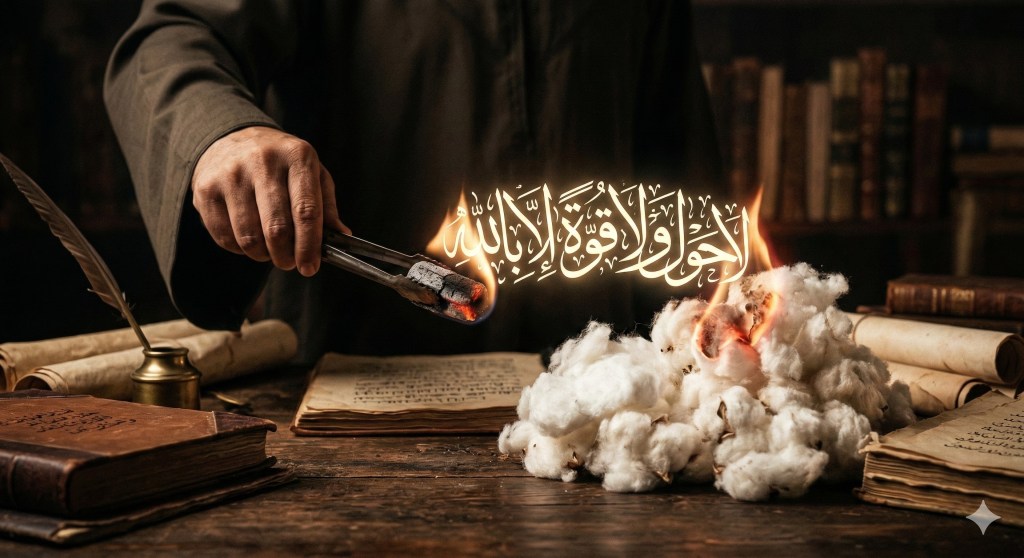
Occasionalism is the Islamic theological rebuttal to the Aristotelian concept of an autonomous, self-sustaining nature. In his magnum opus, Tahafut al-Falasifa (The Incoherence of the Philosophers), Al-Ghazali argued that what humans perceive as “cause and effect” (e.g., fire burning cotton, a seed growing into a tree) is merely a habit of observation, not a necessary metaphysical connection. The true, only cause of any effect is God. Fire does not burn; God creates the burning at the occasion of the fire touching the cotton.
Dr. Zia H Shah MD brings this profound classical theology into a modern context, demonstrating how it aligns perfectly with contemporary quantum mechanics and the epistemological limits of modern science. Science describes how patterns occur, but it cannot explain why the universe continues to hold these patterns at every successive millisecond.
When we apply Al-Ghazali’s Occasionalism (via Dr. Shah’s exposition) to Surah Al-Hadid, the verses transform from historical statements into a radical, living reality:
- Continuous Creation in Verse 1 & 4: When the verse states that God “created the heavens and the earth in six days,” Occasionalism dictates that this creation is not a finished event in the distant past. As Dr. Shah often highlights, the universe requires continuous divine sustenance. If God were to withdraw His will for a single instant, the universe would collapse into non-existence. The Tasbih (glorification) of the heavens and earth is their continuous state of being freshly created by God at every moment.
- Life and Death as Divine Immanence in Verse 2: “He gives life and causes death.” Under the Occasionalist lens, a beating heart is not driven merely by biological electricity; it is God constantly willing the “occasion” of life. Death is not the failure of biology, but the divine will choosing to cease the continuous creation of those biological functions.
- The Illusion of Time in Verse 6: “He causes the night to enter the day and the day to enter the night.” To a materialist, this is simply the rotation of the Earth, a mechanical process set in motion billions of years ago. But through Dr. Shah’s presentation of Ghazali’s thought, the rotation of the Earth is merely the occasion. The actual transition of time—the unfolding of the future into the present and the past into memory—is a direct, unmediated act of God.
Dr. Shah’s work reminds us that Al-Ghazali’s Occasionalism is not an anti-science stance; rather, it is the ultimate Tawhid (Divine Unity). It strips the universe of secondary deities—whether those deities are ancient idols or the modern, implicit idol of “Nature” acting independently of God. When we read verse 4—“He knows what penetrates the earth and what emerges from it”—through an Occasionalist lens, we realize that a seed sprouting is not an independent botanical miracle, but a direct, intimate whisper from the Al-Batin (The Hidden) into the physical realm. God’s omnipresence (Ma’akum ayna ma kuntum) is not just a watchful eye; it is the active, sustaining engine of every atom in existence.
Thematic Epilogue
Surah Al-Hadid (57:1-6) is a masterpiece of theological compression. In six brief verses, the Quran dismantles human arrogance by projecting the mind into the vastness of cosmic history, the abstraction of infinite time (The First and the Last), and the intimacy of human consciousness (the secrets of the breasts).
Classical exegesis protects these verses from anthropomorphism and linguistic misinterpretation, anchoring them in the solid bedrock of early Islamic orthodoxy. Contemporary reflections bridge the gap between ancient text and modern science, showing that the Quran’s cosmological descriptions remain remarkably resonant.
However, it is through the lens of Al-Ghazali’s Occasionalism, as revived by contemporary thinkers like Zia H Shah MD, that these verses achieve their most startling potency. We are left with a profound realization: the universe is not a machine left to run on its own. It is a symphony where every note is being played directly by the Divine Conductor at this very second. The transition of night into day, the beating of our hearts, and the thoughts within our chests are all continuous, fresh acts of divine creation. To read Surah Al-Hadid is to be stripped of the illusion of autonomy and invited into a state of perpetual Tasbih—recognizing that in every breath, we are entirely, utterly, and beautifully dependent on the Almighty.



Leave a comment