
Presented by Claude
- Surah al-Ḥadīd is a Medinan chapter of 29 verses whose spine is the unbreakable bond between faith (īmān) and sacrificial spending (infāq); its theology of total divine sovereignty — the four names of v.3, the omnipresence of v.4, and the predestined “Book” of vv.22–23 — maps with unusual precision onto al-Ghazālī’s occasionalism as revived by Dr. Zia H. Shah, while its namesake verse on iron (v.25) anchors a striking, scientifically defensible science-and-scripture reflection.
- The decisive thread for the thematic epilogue is Dr. Shah’s “Inshallah universe”: natural laws as God’s faithful habit (sunnat Allāh), quantum indeterminacy as “looseness at the joints,” and the 2022 Nobel Prize in Physics (Aspect, Clauser, Zeilinger) on Bell-inequality violation as a modern echo of al-Ghazālī’s denial of inherent causal powers — with Shah candidly conceding these are interpretive analogies, empirically indistinguishable from determinism, not proofs.
Key Findings
- Genre and occasion. Al-Ḥadīd is the 57th chapter, 29 verses, unanimously Medinan, and one of the five Musabbiḥāt (chapters opening with God’s glorification). Its central theme (miḥwar) is the inseparable link between genuine faith and tangible spending in God’s cause; it diagnoses the “hardening of hearts” (v.16) of believers grown spiritually complacent and prescribes renewed sacrifice. The Last Dialogue places it in the late-Medinan period (post-conquest of Makkah, c. 8–9 AH / 630–631 CE), connected to the financial demands of campaigns such as Tabūk; al-Wāḥidī (citing al-Kalbī and Muqātil) places v.16 about a year after the Hijra. Because Medinan surahs are composite, verses were likely revealed incrementally. Wikipedia
- The “thousand-verse” verse. Ibn Kathīr records (on al-ʿIrbāḍ ibn Sāriya, via Abū Dāwūd, al-Tirmidhī [graded ḥasan gharīb], al-Nasāʾī) that the Prophet recited the Musabbiḥāt before sleep, saying “in them is a verse better than a thousand verses” — identified as 57:3, the four names al-Awwal, al-Akhir, al-Ẓāhir, al-Bāṭin. The supplication in Ṣaḥīḥ Muslim (no. 2713): “O Allah, You are the First, so there is nothing before You; the Last, so there is nothing after You; the Manifest (al-Ẓāhir), so there is nothing above You; the Hidden (al-Bāṭin), so there is nothing nearer than You.” WikipediaSurah Quran
- Iron’s cosmic origin is established science. Iron sits near the peak of the nuclear binding-energy curve. Per the AME2016 atomic-mass evaluation, the three most tightly bound nuclides per nucleon are ⁶²Ni (8794.533 ± 0.007 keV/A), ⁵⁸Fe (8792.250 ± 0.006 keV/A), and ⁵⁶Fe (8790.354 ± 0.005 keV/A); ⁶²Ni has the highest binding energy per nucleon, while ⁵⁶Fe has the lowest mass per nucleon of all nuclides (converting 28 atoms of ⁶²Ni into 31 atoms of ⁵⁶Fe still releases 5.7 keV per nucleon). The practical upshot is that iron-group nuclei mark the end point of energy-releasing stellar fusion. Iron forms in the silicon-burning cores of massive stars and, as ⁵⁶Ni, in supernovae (Type Ia light curves are powered by ⁵⁶Ni → ⁵⁶Co → ⁵⁶Fe). The radioactive isotope iron-60 (half-life 2.6 million years, per Koll et al., Physical Review Letters 123, 072701, 2019) is produced by neutron capture in massive stars and “only expelled into space when the massive star explodes”; its detection in Pacific deep-sea crusts, Apollo 12/15/16 lunar samples, and Antarctic snow (the TUM-led team “amassed just 73,000 iron-60 atoms” from half a ton of snow) demonstrates that supernova-forged iron has literally “rained down” on Earth — a genuinely arresting resonance with anzalnā al-ḥadīd (“We sent down iron,” v.25). The popular abjad numerology (al-ḥadīd = 57, ḥadīd = 26) should be treated with caution, as it depends on contestable counting conventions.
- Two interpretive camps to distinguish explicitly. Mainstream Sunni tafsīr (Ibn Kathīr, Maududi) reads “We sent down iron” as God’s creation of iron in the earth (cf. “He sent down cattle,” 39:6), with primary emphasis on iron as political and military power (“mighty power,” weapons) plus civilizational benefits. The Lahore Ahmadiyya reading of Maulana Muhammad Ali agrees iron signifies power/defence but stresses the linguistic point that “sending down” means “causing to grow / bringing into existence,” and is distinctively rationalist elsewhere (six “periods” not literal “days”; the “Throne of Power” as a metaphor for authority; the “Book” of v.22 as divine knowledge/foreknowledge rather than rigid foreordainment; Hell as purgative; heaven and hell as conditions not places). The modern science-of-iron reading and the occasionalist epilogue constitute a third, contemporary layer championed by Dr. Shah.
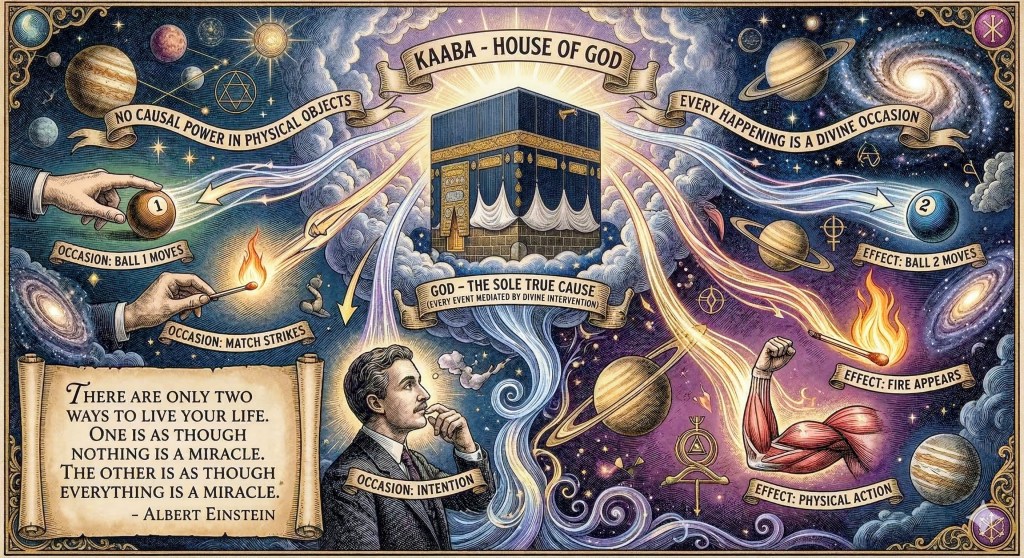
- Occasionalism is the unifying epilogue thread. Dr. Zia H. Shah’s corpus reframes al-Ghazālī’s doctrine — God alone is the true efficient cause (lā muʾaththira fī’l-wujūd illā Allāh); natural laws are God’s customary habit (sunnat Allāh / ʿāda) — as “the metaphysics of Inshallah,” and connects it tightly to 57:1–6 (continuous sustaining, the four names, omnipresence, the night/day cycle) and 57:22–23 (the predestined “Book”). He grounds it in quantum indeterminacy and the 2022 Nobel Prize, while candidly conceding the divine reading is an interpretation empirically indistinguishable from determinism. thequran
Details
A note on the deliverable
The final .docx for thequran.love should present each of the 29 verses in this order: (1) Arabic, (2) transliteration, (3) the six translations, (4) classical tafsīr where relevant, (5) science/philosophy/theology commentary, with the occasionalist synthesis reserved for the closing epilogue. Below is the gathered material organized for that build, with mainstream-Sunni vs. Lahore-Ahmadiyya distinctions flagged throughout.
I. Structure and themes of the surah
- vv.1–6: Cosmic tasbīḥ, divine sovereignty (mulk), life and death, the four names (v.3), creation in six periods and istiwāʾ, omniscience over all fluxes, omnipresence (“with you wherever you are”), the night/day cycle.
- vv.7–11: Command to believe and spend (infāq); wealth as a trust of which humans are made stewards (mustakhlafīn); those who spent before the Conquest rank higher; the “goodly loan” to God (v.11), occasion: Abū al-Daḥdāḥ donating his date-garden.
- vv.12–15: Eschatological light of believers running before them and on their right; hypocrites left in darkness begging to borrow light; a wall with a gate (mercy within, torment without).
- vv.16–19: “Has the time not come for hearts to be humbled…” — the central admonition against spiritual coldness; God revives dead hearts as He revives dead earth with rain; the truthful (ṣiddīqūn) and martyrs.
- vv.20–24: Worldly life as play, amusement, adornment, and mutual boasting (the rain-and-withering parable); the race toward forgiveness and a Paradise “as vast as heaven and earth”; the Book of decree (vv.22–23) so that believers neither grieve nor exult.
- vv.25–29: Messengers with the Book and Balance for justice; “We sent down iron”; Noah, Abraham, Jesus; the invented monasticism (rahbāniyya); call to the faithful and a “double portion” of mercy.
II. Verse-by-verse anchor material (Arabic, transliteration, translations, tafsīr)
Transliteration of vv.4–6, 25 (from hadid.surah.info, for the build):
- 57:4: Huwa lladhī khalaqa s-samāwāti wa-l-arḍa fī sittati ayyām; thumma ‘stawā ʿalā l-ʿarsh; yaʿlamu mā yaliju fī l-arḍi wa mā yakhruju minhā wa mā yanzilu mina s-samāʾi wa mā yaʿruju fīhā; wa huwa maʿakum aynamā kuntum; wallāhu bimā taʿmalūna baṣīr. Surah Hadid
- 57:25: Laqad arsalnā rusulanā bi-l-bayyināti wa anzalnā maʿahumu l-kitāba wa-l-mīzāna li-yaqūma n-nāsu bi-l-qisṭ; wa anzalnā l-ḥadīda fīhi baʾsun shadīdun wa manāfiʿu li-n-nās; wa li-yaʿlama llāhu man yanṣuruhū wa rusulahū bi-l-ghayb; inna llāha qawiyyun ʿazīz. Surah Hadid
- 57:25 Arabic: لَقَدۡ أَرۡسَلۡنَا رُسُلَنَا بِٱلۡبَيِّنَٰتِ وَأَنزَلۡنَا مَعَهُمُ ٱلۡكِتَٰبَ وَٱلۡمِيزَانَ لِيَقُومَ ٱلنَّاسُ بِٱلۡقِسۡطِۖ وَأَنزَلۡنَا ٱلۡحَدِيدَ فِيهِ بَأۡسٞ شَدِيدٞ وَمَنَٰفِعُ لِلنَّاسِ وَلِيَعۡلَمَ ٱللَّهُ مَن يَنصُرُهُۥ وَرُسُلَهُۥ بِٱلۡغَيۡبِۚ إِنَّ ٱللَّهَ قَوِيٌّ عَزِيزٞ myislam
Verse 3 — the four names. Six translations:
- Sahih International: “He is the First and the Last, the Ascendant and the Intimate, and He is, of all things, Knowing.” My Islam
- Yusuf Ali: “He is the First and the Last, the Evident and the Immanent: and He has full knowledge of all things.” My Islam
- Pickthall: “He is the First and the Last, and the Outward and the Inward; and He is Knower of all things.” IslamAwakened
- Asad: “He is the first and the last, the transcendent and the immanent; and He has knowledge of everything.” (Asad’s note: His Being is eternal, “time itself … is but God’s creation”; “He is the transcendental Cause of all that exists and, at the same time, immanent in every phenomenon of His creation,” citing Ṭabarī: “He is closer to everything than anything else could be”; and a supplementary Zamakhsharī rendering, “His existence is evident (ẓāhir) in the effects of His activity whereas He Himself is not perceptible (ghayr mudrak) to our senses.”) Alim
- Maududi: “He is the First and the Last, and the Manifest and the Hidden, and He has knowledge of everything.” My Islam
- Maulana Muhammad Ali (Lahore Ahmadiyya, 2010 edition): “He is the First and the Last and the Manifest and the Hidden, and He is Knower of all things.” (His note quotes Ṣaḥīḥ Muslim: “He is the First, so that there was nothing before Him … the Manifest, or the Ascendant over all, so that there is nothing above Him, and He is the Hidden, the Knower of hidden things, so that there is nothing hidden from Him.”) alahmadiyya
Tafsīr on v.3. Ibn Kathīr: this is the verse “better than a thousand”; al-Bukhārī relays Yaḥyā (al-Farrāʾ): “al-Ẓāhir: knowing all things; al-Bāṭin: knowing all things”; Ibn ʿAbbās advised reciting it to dispel doubt (Abū Dāwūd). Maududi: “When there was nothing, He was, and when there will be nothing, He will be. He is the most Manifest of all the manifest … and the Most Hidden of all the hidden, for not only do the senses fail to perceive Him but the intellect and thought and imagination also cannot attain to His essence.” Al-Rāzī (Mafātīḥ al-Ghayb): the names form two axes (time: First/Last; presence/knowability: Manifest/Hidden); God is “First in the descent of existence from Him to the contingent things (al-mumkināt), and Last in the ascent from the contingents back to Him”; He is Manifest “with respect to existence, for you do not see any contingent thing except that it is a proof of His existence,” and Hidden in that “the true reality (kunh) of His essence is unknown to creation”; strikingly, “the perfection of His being Manifest is itself the cause of His being Hidden.” Al-Rāzī insists “priority and posteriority are not established only by time” — God’s firstness is ontological, not chronological. Sayyid Quṭb (Fī Ẓilāl): “The first two attributes encompass the nature of time, and the other two the nature of place … nothing has any entity except God.” Elmalılı Hamdi Yazır: “He is al-Ẓāhir, who is felt through everything, and He is al-Bāṭin, who is not known through anything.” Surah Quran + 4
Verse 4 — six periods, istiwāʾ, omnipresence. Translations:
- Sahih International: “It is He who created the heavens and earth in six days and then established Himself above the Throne… and He is with you wherever you are. And Allah, of what you do, is Seeing.” My IslamMy Islam
- Pickthall: “…then He mounted the Throne. He knoweth all that entereth the earth… and He is with you wheresoever ye may be.” My Islam
- Maududi: “…then established Himself on the Throne… He is with you wherever you are.” My Islam
- Maulana Muhammad Ali: “He it is Who created the heavens and the earth in six periods, and He is established on the Throne of Power… And He is with you wherever you are. And Allah is Seer of what you do.” (Distinctive: “six periods,” and “Throne of Power” as metaphor for authority.) alahmadiyya
Tafsīr on v.4. Ṭabarī (quoted by Asad and in classical glosses) reads the “withness” as a withness of knowledge and power, glossing al-Bāṭin via 50:16 (“nearer than the jugular vein”): “He is the bāṭin of everything, nothing being nearer to anything than Him.” Ibn Kathīr: “He is watching over you and witnessing your deeds wherever you may be, on land or at sea, during the night or the day.” The Ashʿarī/Māturīdī tradition reads istiwāʾ as sovereign dominion (istīlāʾ), not spatial location; the Atharī tradition affirms it “without asking how” (bilā kayf); Ibn Taymiyya insisted both withness and aboveness are “real.” Maududi connects “with you” to providence: “If your heart is beating, if your lungs are breathing … it is only because all parts of your body are working under Allah’s rule.” thequran + 2
Verse 6 — night/day. Maulana Muhammad Ali: “He makes the night to pass into the day, and makes the day to pass into the night. And He is Knower of what is in the hearts.” Tafsīr/Science: the verb yūliju (“inserting through a bend”) and the cognate yukawwiru (39:5, root k-w-r, “to coil/wrap around a ball”) are read by some moderns as implying a rotating spherical earth; Ibn Kathīr reads the “merging” more modestly as seasonal lengthening/shortening of daylight (modern gloss: ~23.5° axial tilt). alahmadiyya
Verse 11 — the goodly loan. Sahih International: “Who is it that would loan Allah a goodly loan so He will multiply it for him and he will have a noble reward?” Occasion (Ibn Abī Ḥātim, on Ibn Masʿūd): Abū al-Daḥdāḥ, on hearing the verse, donated his garden of 600 date-palms; the Prophet said, “How plentiful are the sweet date clusters that Abū al-Daḥdāḥ has in Paradise!” Ibn Kathīr glosses wealth (v.7) as a trust transferred to humans from earlier generations. My Islam + 2
Verses 12–15 — light of believers. Sahih International v.12: “…their light proceeding before them and on their right…” v.13: hypocrites say “Wait for us that we may acquire some of your light,” answered “Go back behind you and seek light,” then “a wall will be placed between them with a door, its interior containing mercy, but on the outside of it is torment.” Ibn Kathīr (on Ibn Masʿūd): believers cross the Ṣirāṭ with light proportionate to their deeds — “some as large as a mountain … the least … as big as his index finger, lit at times and extinguished at other times.” Maulana Muhammad Ali distinctively reads the Fire of v.15 as a purgative maulā (friend/patron) that purifies “as fire purifies gold of dross,” and (note on v.21) holds “heaven and hell are not the names of two places, but are really two conditions.” Quran.com + 3
Verse 16 — hearts humbled. Sahih International: “Has the time not come for those who have believed that their hearts should become humbly submissive at the remembrance of Allah and what has come down of the truth? And let them not be like those who were given the Scripture before, and a long period passed over them, so their hearts hardened; and many of them are defiantly disobedient.” Asad: “IS IT NOT time that the hearts of all who have attained to faith should feel humble at the remembrance of God…?” Maulana Muhammad Ali: “Has not the time yet come for the believers that their hearts should be humble for the remembrance of Allah and the Truth that is revealed…” Tafsīr: Muslim records Ibn Masʿūd: “Only four years separated our acceptance of Islam and the revelation of this Ayah, in which Allah subtly admonished us.” Al-Wāḥidī (al-Kalbī, Muqātil): revealed concerning the hypocrites about a year after the Hijra; al-Jalālayn: concerning Companions who had over-indulged in jest. Ibn Kathīr: God “brings subtleness to hearts after they have become hard … just as He brings life back to the dead and dry earth by abundant rain.” Maududi: the People of the Book degenerated centuries after their prophets, but the Muslims were drifting while the Prophet was still among them. Maulana Muhammad Ali reads it prophetically: later Muslims “will fall off from the high standard of the earlier generations.” Quran.com + 6
Verse 20 — worldly life as play. Sahih International: “Know that the life of this world is but amusement and diversion and adornment and boasting to one another and competition in increase of wealth and children — like the example of a rain whose [resulting] plant growth pleases the tillers; then it dries and you see it turned yellow; then it becomes [scattered] debris. And in the Hereafter is severe punishment and forgiveness from Allah and approval. And what is the worldly life except the enjoyment of delusion.” Maulana Muhammad Ali: “Know that this world’s life is only an idle sport and play and an attraction and boasting among yourselves and a race in the multiplication of wealth and children… And this world’s life is nothing but a source of vanity.” Ibn Kathīr: life “starts young, then matures and then turns old and feeble,” paralleling human aging (cf. 30:54); the parable signals “the near demise of this life and the imminent end of it.” Quran.com
Verses 22–23 — the Book of decree. Sahih International v.22: “No disaster strikes upon the earth or among yourselves except that it is in a register before We bring it into being — indeed that, for Allah, is easy —” v.23: “In order that you not despair over what has eluded you and not exult [in pride] over what He has given you. And Allah does not like everyone self-deluded and boastful.” Maulana Muhammad Ali: “No disaster befalls in the earth, or in yourselves, but it is in a book before We bring it into existence — surely that is easy to Allah — so that you may not grieve for what has escaped you, nor exult in what He has given you.” Tafsīr: Ibn Kathīr cites the ḥadīth (Muslim): “Allah ordained the measures of everything fifty thousand years before He created the heavens and the earth,” and calls the verse “clear evidence to the misguidance of the … Qadariyyah” who deny preordainment; Qatāda glosses “calamity on the earth” as famine and “in yourselves” as illness. Distinctive Lahore Ahmadiyya note (Maulana Muhammad Ali, note on v.22): “The book here means Divine knowledge … the disasters which are predicted as befalling the Muslims in the latter days are due to their own falling off from the high standard of life … and hence the remedy suggested is again the making of sacrifices.” This reads the “Book” as foreknowledge (not rigid foreordainment), emphasizing human responsibility — a notable contrast with Ibn Kathīr’s predestinarian framing. Quran + 3
Verse 25 — iron. Six translations:
- Sahih International: “We have already sent Our messengers with clear evidences and sent down with them the Scripture and the balance that the people may maintain [their affairs] in justice. And We sent down iron, wherein is great military might and benefits for the people, and so that Allah may make evident those who support Him and His messengers unseen. Indeed, Allah is Powerful and Exalted in Might.” Quranic Arabic Corpusmyislam
- Yusuf Ali: “…and We sent down Iron, in which is (material for) mighty war, as well as many benefits for mankind, that Allah may test who it is that will help, Unseen, Him and His messengers…”
- Pickthall: “…and He revealed iron, wherein is mighty power and (many) uses for mankind, and that Allah may know him who helpeth Him and His messengers, though unseen…”
- Asad: renders anzalnā al-ḥadīd as God’s bestowal “from on high,” reading divine endowment with both martial and beneficial uses.
- Maududi: “And We sent down iron, wherein there is awesome power and many benefits for people, so that Allah may know who, without even having seen Him, helps Him and His Messengers. Surely Allah is Most Strong, Most Mighty.”
- Maulana Muhammad Ali: “And We sent down iron, in which is great violence and advantages for people, and that Allah may know who helps Him and His messengers, unseen.” (Note: “the sending down of a thing also means causing it to grow or bringing the means of it into existence,” citing 7:26 [clothing] and 39:6 [cattle]; iron “undoubtedly refers to the resistance against the enemy … effected with the sword … in defence of the faith.” On mīzān he distinctively reads it as the Prophet’s example/Sunnah.) alahmadiyya + 2
Tafsīr on v.25. Ibn Kathīr: iron’s “mighty power” = weapons (swords, spears, arrows, shields), citing the ḥadīth “I was sent with the sword just before the Hour”; its “benefits” = tools for livelihood (coins, hammers, axes, saws, plough-implements); “Allah does not need mankind’s help, but He ordered Jihad to test people.” Maududi: “Sending down iron means creating iron in the earth just as in (39:6) … He sent down for you eight heads of cattle”; placed immediately after the Prophets’ mission, “by iron here is meant political and military power,” for the Prophets came “to enforce [justice] practically, to collect necessary power … and to break the power of those who might resist it.” This is the principal mainstream Sunni reading: iron is the power to enforce the justice that the Book and Balance prescribe. My Islam
Verse 27 — monasticism. Sahih International: “…And We placed in the hearts of those who followed him compassion and mercy and monasticism, which they innovated; We did not prescribe it for them except [that they did so] seeking the approval of Allah. But they did not observe it with due observance…” Maududi: “As for monasticism, it is they who invented it; We did not prescribe it for them. They themselves invented it in pursuit of Allah’s good pleasure, and then they did not observe it as it ought to have been observed.” Tafsīr: Ibn Kathīr cites Anas: “Every Prophet has Rahbāniyyah (monasticism); Jihād in the cause of Allah is the Rahbāniyyah of this Ummah.” Maududi: “monasticism is an un-Islamic creed … ‘There is no monasticism in Islam’”; rahbāniyya derives from rahb (fear). Al-Qurṭubī held monasticism absolutely prohibited and had to argue grammatically that “and monasticism…” begins a separate sentence rather than being conjoined to “compassion and mercy.” Maarif-ul-Quran notes the two grammatical readings and that, per Ibn Masʿūd’s narration (Ibn Jarīr, Ibn Abī Ḥātim), the monastic groups who upheld justice “attained salvation,” so the innovation was not blameworthy in its origin but in its later non-observance. Lahore Ahmadiyya view (ahmadiyya.org, applying Maulana Muhammad Ali): Islam “does not believe in renunciation and suppression of what one can sublimate into something high and noble … For this very reason monastic life was prohibited in Islam.” (The exact verbatim wording of Maulana Muhammad Ali’s vv.26–29 and his monasticism footnote should be confirmed against the official alahmadiyya.org “Section 4 (verses 26–29)” page before publication, as that page could not be retrieved during research.) Tafsirq + 8
Verses 28–29 — double reward. Sahih International v.28: “O you who have believed, fear Allah and believe in His Messenger; He will [then] give you a double portion of His mercy and make for you a light by which you will walk and forgive you…” v.29: “…so that the People of the Scripture may know that they are not able [to obtain] anything from the bounty of Allah and that all bounty is in the hand of Allah…” Tafsīr: Ibn Kathīr (on Ibn ʿAbbās, via al-Nasāʾī) reads the “double portion” as the reward of People of the Book who believed in their own prophet and then in Muhammad (cf. the ḥadīth of “three who get a double reward”); ʿUmar’s exchange with a Jewish rabbi over the kifl (portion) is cited. Maududi notes the alternative that the addressees are the Muslims, urged to believe sincerely and not merely verbally.
III. The science of iron (for the v.25 commentary)
- Binding-energy peak (precise values). Per the AME2016 atomic-mass evaluation: ⁶²Ni = 8794.533 ± 0.007 keV per nucleon (highest), ⁵⁸Fe = 8792.250 ± 0.006 keV/A (second), ⁵⁶Fe = 8790.354 ± 0.005 keV/A (third). ⁵⁶Fe has the lowest mass per nucleon of any nuclide (930.412 MeV/c²); converting 28 atoms of ⁶²Ni into 31 atoms of ⁵⁶Fe still releases 5.7 keV per nucleon. Iron-group nuclei are therefore the “end point” of energy-releasing fusion; fusing heavier elements consumes energy, which is why silicon-burning in massive stars (T ≈ 3–4 billion K) lasts only ~one day before core collapse.
- Stellar and supernova synthesis. Iron forms via fusion of magnesium/silicon/sulfur in massive-star cores and via the decay chain ⁵⁶Ni → ⁵⁶Co → ⁵⁶Fe after explosive nucleosynthesis. The ESA states plainly: “Iron is formed via nuclear fusion in the cores of stars that are eight times more massive than our Sun … blown out into interstellar space” in supernova explosions; “Our Solar System formed from the collapse of a cloud of dust and gas enriched by material from supernova explosions … Iron, a vital ingredient of our blood, was minted in massive stars.” Wikipedia + 2
- “Sent down” literalism — the strongest evidence. Iron-60 (half-life 2.6 million years, per Koll et al., Physical Review Letters 123, 072701, 2019) is produced by neutron capture in massive stars and “only expelled into space when the massive star explodes.” Its detection in Pacific deep-sea ferromanganese crusts (TUM, since 1999), in Apollo 12/15/16 lunar samples, and in Antarctic snow (the TUM-led team “amassed just 73,000 iron-60 atoms” from half a ton of material) confirms that supernova-forged iron is still falling to Earth. Estimated source distance ≈ 300 light-years; the most recent influx 1.7–3.4 million years ago. This is the literal, defensible core of the “We sent down iron” reflection — though, as critics (WikiIslam) note, the Quran also uses “sent down” for cattle, garments, and other earthly things, so the verse’s primary register is theological provision rather than an astronomy lesson. The honest framing (per the Shahid Beheshti IQS study and Dr. Shah’s own caution) is resonance, not proof. ScienceDailyScienceDaily
- Iron in biology and civilization. Iron is the fourth most abundant element in Earth’s crust (~5% by weight); it dominates the planetary core and drives the geodynamo and magnetic field; in hemoglobin it transports oxygen (as Carl Sagan’s “star-stuff” framing and the ESA both put it, “the iron in your blood was forged in a dying star”). Civilizationally, iron defines the Iron Age, industry, and weaponry — exactly Ibn Kathīr’s and Maududi’s “mighty power” and “benefits for mankind.” Grokipedia
IV. Cosmology of vv.1–6 (for the science commentary)
- Six “periods.” “Six days” recurs seven times in the Quran (7:54, 10:3, 11:7, 25:59, 32:4, 50:38, 57:4); modern commentators gloss yawm as epoch. The scientific resonance is structural, not chronometric: the universe unfolded in ordered stages (inflation, particle formation, CMB decoupling, the “dark ages,” the first stars, galaxy assembly) over ~13.8 billion years. Flag for honesty: classical reports and a ḥadīth graded ṣaḥīḥ by al-Albānī envisioned literal short periods; the “epoch” reading is a modern harmonization, not the unanimous classical view.
- al-Awwal / al-Akhir. The First evokes the Big Bang’s absolute temporal beginning (overturning the eternal-universe model al-Ghazālī contested); the Last evokes the thermodynamic “heat death”/”Big Freeze.” Shah notes that “modern cosmology removed a major philosophical objection to occasionalism — the idea of an eternal, self-sustaining universe.” The 2011 Nobel Prize (Perlmutter, Schmidt, Riess, for the accelerating expansion) underwrites the heat-death scenario.
- al-Ẓāhir / al-Bāṭin and the dark sector. Per ESA’s Planck mission: normal matter ~4.9%, dark matter ~26.8%, dark energy ~68.3% — roughly 95% of the universe is “hidden,” detectable only gravitationally. A suggestive (not predictive) analogue to a reality whose manifest face rests upon a vast hidden substrate, read alongside v.4’s inventory of fluxes “entering the earth … descending from heaven.”
V. Philosophy
- Four names as a complete ontology (Rāzī): the Necessary Existent (wājib al-wujūd) versus the contingent (mumkin al-wujūd); since an infinite regress of causes is impossible, existence terminates in a being necessary-in-itself; “He is First in existence and Last in inference, because the goal of all rational demonstrations is knowledge of the Maker.” Transcendence-within-immanence: God is al-Bāṭin (beyond sense and imagination) precisely because He is al-Ẓāhir (overwhelmingly evident in every contingent thing).
- Omnipresence and istiwāʾ (v.4): the puzzle of God “above the Throne” yet “with you.” Ashʿarī resolution (Ṭabarī): a withness of knowledge and power, istiwāʾ as dominion. Ibn al-Jawzī’s hermeneutical symmetry: whoever reads “with you” figuratively must, in fairness, allow istiwāʾ figuratively too.
- Transience (v.20) and divine determinism (vv.22–23): the philosophical heart of the predestination question — the “Book” of decree (Ibn Kathīr: literal preordainment 50,000 years prior; Maulana Muhammad Ali: divine foreknowledge consistent with human responsibility), framed pastorally so believers “neither grieve nor exult.”
- Free will, divine action, and natural causation: the doorway to occasionalism — a God of moment-to-moment governance, not deism’s absentee clockmaker.
VI. Al-Ghazālī’s occasionalism and Dr. Zia H. Shah’s synthesis (the epilogue)
- The doctrine. Occasionalism (Tahāfut al-Falāsifa, 17th Discussion): “the connection between what is habitually believed to be a cause and what is habitually believed to be an effect is not necessary.” The fire-and-cotton paradigm: “The agent of the burning is God … what is customarily believed to be a cause is merely the occasion” (Marmura translation). Ashʿarī atomism: substances (jawāhir) and accidents (aʿrāḍ); since “no accident can last for two successive instances of time,” the world is perpetually re-created — continuous creation (tajdīd al-khalq). thequran
- Shah’s framing. Al-Ghazālī’s doctrine is “the metaphysics of ‘Inshallah’”; nature is “a theater of divine will, a system of signs (āyāt) pointing beyond themselves to God.” His three Quranic themes: no independent causality (31:22), continuous divine action (55:29, “Every day He is engaged in an affair”), and absolute sovereignty (8:17, “You did not throw when you threw, but God threw”). Occasionalism is “not a rejection of order, but a re-location of order: from intrinsic powers in created things to the immediate and continuous agency of God.” His memorable image: “The world is like a grand theater where God is the only actor, and what we call ‘characters’ (creatures) are merely costumes or instruments.” On continuous creation: reality is “like a ball of light that must be re-lit at every moment”; “were God to cease willing the world, it would instantly cease to exist.” thequranthequran
- Direct resonance with 57:1–6. Continuous sustaining (2:255 Āyat al-Kursī; 35:41, God “holds the heavens and the earth, lest they cease”); the four names as First Cause and final return, with reality ultimately ghaib; “He is with you wherever you are” as “the metaphysical precondition of God’s direct causal activity everywhere” (with 8:24, God “stands between a person and their heart,” answering v.6’s “He knows what is in the breasts”); the night/day cycle as the very image of sunnat Allāh (33:62, 35:43: “you will find no change in Allah’s way”).
- Laws as divine habit. Laws are “descriptive, not prescriptive”; fire “usually burns cotton because God chooses consistency — yet He could do otherwise” (21:69, Abraham’s fire made “cool and safe”). Shah engages the Humean/Mill–Ramsey–Lewis “best-system” account: occasionalism accepts the descriptive success of laws while denying the “law” is itself an efficient cause — “a theological completion of an empiricist insight.” thequran
- Modern physics. The “deterministic pivot”: “the same empirical data that motivates causal determinism can be reinterpreted as support for occasionalism.” Quantum indeterminacy is “looseness at the joints”; the photon at a water/air boundary (≈4% reflected, 96% transmitted, per Feynman’s QED) leaves “which fate befalls any individual photon … radically open.” The Royal Swedish Academy of Sciences awarded the 2022 Nobel Prize in Physics to Alain Aspect (Université Paris-Saclay/École Polytechnique), John F. Clauser (J.F. Clauser & Assoc.), and Anton Zeilinger (University of Vienna) “for experiments with entangled photons, establishing the violation of Bell inequalities and pioneering quantum information science” — the prize being “10 million Swedish kronor, to be shared equally between the laureates.” Daniel Garisto’s Scientific American gloss — “the universe is not locally real” — is the line Shah reads as a modern echo of al-Ghazālī’s denial of inherent causal powers. He draws on Karen Harding’s 1993 paper (American Journal of Islamic Social Sciences 10:2, pp. 165–177) that both the Copenhagen interpretation and al-Ghazālī’s occasionalism see objects as having “no inherent properties and no independent existence.” thequran + 2
- The “Inshallah universe” / divine simulation. Mapped onto Bostrom’s simulation hypothesis (The Philosophical Quarterly 53:211, 2003) as analogy, not literal claim: the Simulator corresponds to God, the code to the divine will/sunnah, the hardware to the creative command “Be!” (kun fayakūn); “miracles are mundane” because a programmer can suspend any rule with a keystroke. Frame-by-frame sustenance maps to the divine name al-Qayyūm (Self-Subsisting Sustainer; 2:255, 35:41): “just as a programmer must refresh every pixel … God recreates every atom at each discrete moment.” For 57:22–23, Shah leans on the verses’ own pastoral logic: misfortune is “set down in writing before We brought it into being” precisely “so you need not grieve for what you miss or gloat over what you gain.” thequran
- Honest hedging. Shah states that determinism and occasionalism “describe the same universe … competing metaphysical interpretations of the same physical reality,” that “no experiment can distinguish them,” and that “the only difference between them is God.” Scholarly caveat (per the Stanford Encyclopedia of Philosophy): there is genuine debate over how globally occasionalist al-Ghazālī really was (Marmura/Abrahamov reading him as a thoroughgoing occasionalist; Griffel/Frank seeing him as primarily defending the possibility of miracles, leaving room for non-necessitating secondary causes).
- Authorship note. Dr. Zia H. Shah, MD, is a physician (Internal Medicine, Pulmonary, Sleep Medicine) practicing in Upstate New York, Chief Editor of The Muslim Times, Chair of Religion and Science for The Muslim Sunrise, affiliated with the Ahmadiyya Muslim Community; his occasionalism corpus (~three dozen articles, February 2025–June 2026) is at thequran.love, several explicitly co-produced with AI systems (“Presented by Claude/Gemini”). His dedicated essay, “The First and the Last, the Manifest and the Hidden: A Scientific, Philosophical, and Theological Commentary on Qurʾān 57:1–6” (May 31, 2026), is the closest existing structural template; “Dr. Zia H. Shah’s Occasionalism: A Comprehensive Synthesis” (June 10, 2026) is the master overview to mine for the epilogue.


Leave a Reply